
Feed aggregator
Hubble Snaps Stellar Baby Pictures
- Hubble Home
- Overview
- Impact & Benefits
- Science
- Observatory
- Team
- Multimedia
- News
- More
3 min read
Hubble Snaps Stellar Baby Pictures The Cepheus A region is home to a number of infant stars, including a protostar that is responsible for much of the region’s illumination. NASA, ESA, and R. Fedriani (Instituto de Astrofisica de Andalucia); Processing: Gladys Kober (NASA/Catholic University of America) Star-forming region G033.91+0.11 is home to a protostar hidden within a reflection nebula. NASA, ESA, and R. Fedriani (Instituto de Astrofisica de Andalucia); Processing: Gladys Kober (NASA/Catholic University of America) A protostar is swathed in the gas of an emission nebula within star-forming region GAL-305.20+00.21. NASA, ESA, and R. Fedriani (Instituto de Astrofisica de Andalucia); Processing: Gladys Kober (NASA/Catholic University of America) A protostar’s jets of high-speed particles are responsible for the bright region of excited, glowing hydrogen in this Hubble image. NASA, ESA, and R. Fedriani (Instituto de Astrofisica de Andalucia); Processing: Gladys Kober (NASA/Catholic University of America)
Newly developing stars shrouded in thick dust get their first baby pictures in these images from NASA’s Hubble Space Telescope. Hubble took these infant star snapshots in an effort to learn how massive stars form.
Protostars are shrouded in thick dust that blocks light, but Hubble can detect the near-infrared emission that shines through holes formed by the protostar’s jets of gas and dust. The radiating energy can provide information about these “outflow cavities,” like their structure, radiation fields, and dust content. Researchers look for connections between the properties of these young stars – like outflows, environment, mass, brightness – and their evolutionary stage to test massive star formation theories.
These images were taken as part of the SOFIA Massive (SOMA) Star Formation Survey, which investigates how stars form, especially massive stars with more than eight times the mass of our Sun.
The Cepheus A region is home to a number of infant stars, including a protostar that is responsible for much of the region’s illumination. NASA, ESA, and R. Fedriani (Instituto de Astrofisica de Andalucia); Processing: Gladys Kober (NASA/Catholic University of America)Download this image (5.7 MB)
The high-mass star-forming region Cepheus A hosts a collection of baby stars, including one large and luminous protostar, which accounts for about half of the region’s brightness. While much of the region is shrouded in opaque dust, light from hidden stars breaks through outflow cavities to illuminate and energize areas of gas and dust, creating pink and white nebulae. The pink area is an HII region, where the intense ultraviolet radiation of the nearby stars has converted the surrounding clouds of gas into glowing, ionized hydrogen.
Cepheus A lies about 2,400 light-years away in the constellation Cepheus.
Download this image (5.8 MB)
Glittering much closer to home, this Hubble image depicts the star-forming region G033.91+0.11 in our Milky Way galaxy. The light patch in the center of the image is a reflection nebula, in which light from a hidden protostar bounces off gas and dust.
A protostar is swathed in the gas of an emission nebula within star-forming region GAL-305.20+00.21. NASA, ESA, and R. Fedriani (Instituto de Astrofisica de Andalucia); Processing: Gladys Kober (NASA/Catholic University of America)Download this image (5.8 MB)
This Hubble image showcases the star-forming region GAL-305.20+00.21. The bright spot in the center-right of the image is an emission nebula, glowing gas that is ionized by a protostar buried within the larger complex of gas and dust clouds.
A protostar’s jets of high-speed particles are responsible for the bright region of excited, glowing hydrogen in this Hubble image. NASA, ESA, and R. Fedriani (Instituto de Astrofisica de Andalucia); Processing: Gladys Kober (NASA/Catholic University of America)Download this image (5.7 MB)
Shrouded in gas and dust, the massive protostar IRAS 20126+4104 lies within a high-mass star-forming region about 5,300 light-years away in the constellation Cygnus. This actively forming star is a B-type protostar, characterized by its high luminosity, bluish-white color, and very high temperature. The bright region of ionized hydrogen at the center of the image is energized by jets emerging from the poles of the protostar, which ground-based observatories previously observed.
New images added every day between January 12-17, 2026! Follow @NASAHubble on social media for the latest Hubble images and news and see Hubble’s Stellar Construction Zones for more images of young stellar objects.
Facebook logo @NASAHubble @NASAHubble Instagram logo @NASAHubble Explore MoreExploring the Birth of Stars
Hubble’s Nebulae
Media Contact:
Claire Andreoli
NASA’s Goddard Space Flight Center, Greenbelt, MD
claire.andreoli@nasa.gov
Since its 1990 launch, the Hubble Space Telescope has changed our fundamental understanding of the universe.
Hubble’s Stellar Construction Zones
Hubble’s Night Sky Challenge
Hubble’s 35th Anniversary
NASA’s Artemis II mission to the moon is inching toward the launch pad
NASA rolled out the fully stacked Artemis II rocket and Orion capsule on Saturday, embarking on a four-mile journey to the launch pad
This gene may determine if dogs have long, floppy ears or short, study ones
Scientists are just beginning to understand the signals that determine the length of dogs’ ears
World models could unlock the next revolution in artificial intelligence
Why today’s AI systems struggle with consistency, and how emerging world models aim to give machines a steady grasp of space and time
First treaty to protect the high seas comes into force
First treaty to protect the high seas comes into force
Analysis of Chang'e-6 Samples Addresses Mysteries About the Far Side of the Moon.
Our nearest neighbor, the Moon, is still something of a mystery to us. For decades, scientists have wondered why it appears so lopsided, with dark volcanic plains on the near side (the side we see) and rugged, cratered mountains and a thicker crust on the far side. Now we might be closer to knowing why.
NASA’s SpaceX Crew-11 to Discuss Space Station Science Mission
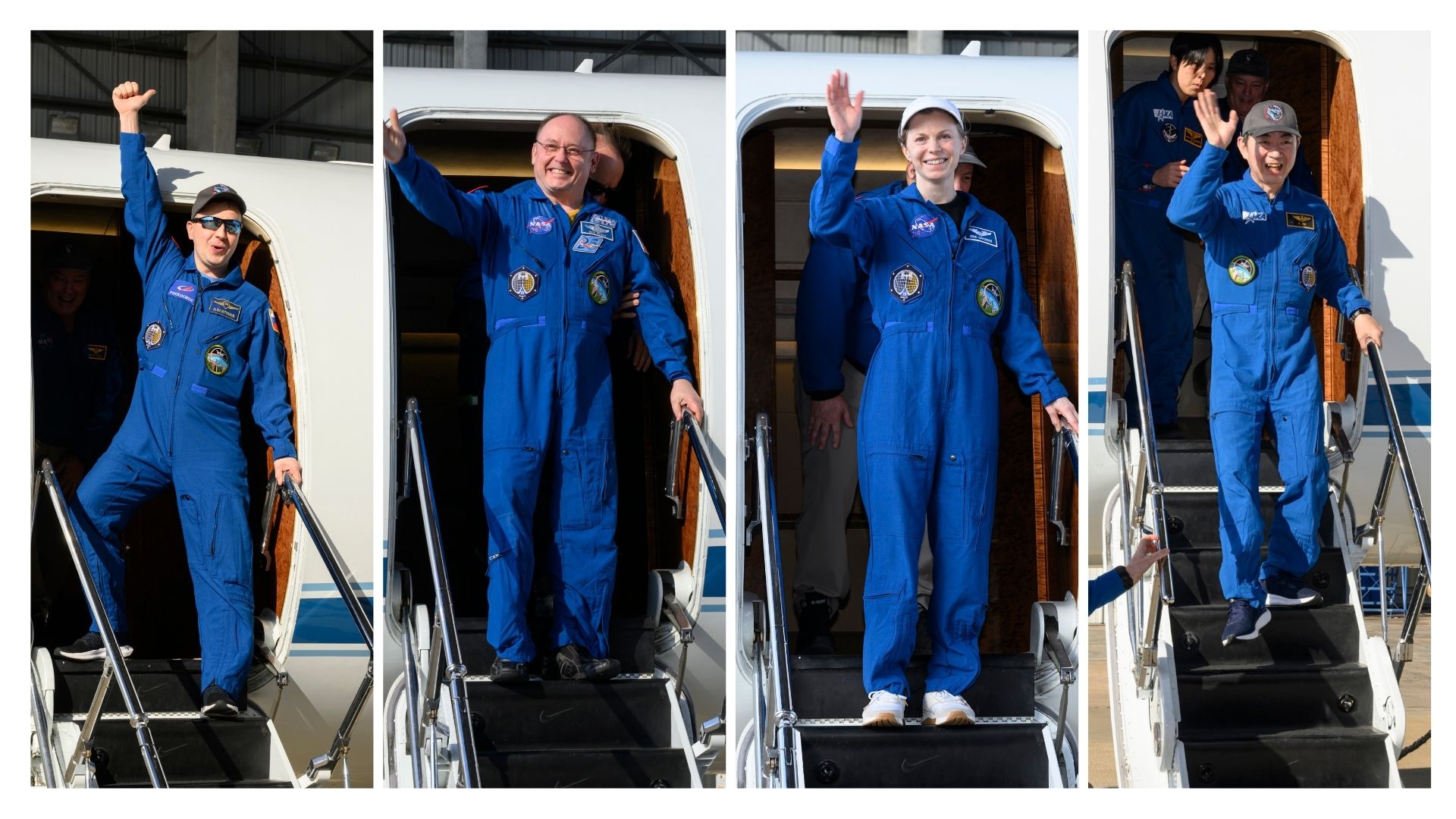
After 167 days in space, the crew members of NASA’s SpaceX Crew-11 mission will hold a news conference at 2:15 p.m. EST, Wednesday, Jan. 21, at the agency’s Johnson Space Center in Houston to discuss their science expedition aboard the International Space Station.
NASA astronauts Zena Cardman and Mike Fincke, JAXA (Japan Aerospace Exploration Agency) astronaut Kimiya Yui, and Roscosmos cosmonaut Oleg Platonov will answer questions about their mission. The crew members returned to Earth on Jan. 15, splashing down off the coast of San Diego, and arrived in Houston on Friday, where they will undergo standard postflight reconditioning and evaluations.
NASA will provide live coverage on the agency’s YouTube channel. Learn how to watch NASA content through a variety of additional online platforms, including social media.
Media are invited to attend in person or virtually. For in-person attendance, contact the NASA Johnson newsroom no later than 5 p.m. CST, Tuesday, Jan. 20, at jsccommu@mail.nasa.gov or 281-483-5111. Media participating by phone must dial into the news conference no later than 10 minutes prior to the start of the event to ask questions. Questions also may be submitted on social media using #AskNASA. A copy of NASA’s media accreditation policy is available on the agency’s website.
The crew spent more than five months in space, including 165 days aboard the orbiting laboratory, traveling nearly 71 million miles, and completing more than 2,670 orbits around Earth. While living and working aboard the station, the crew completed hundreds of science experiments and technology demonstrations.
Get the latest NASA space station news, images, and features on Instagram, Facebook, and X.
NASA’s Commercial Crew Program has delivered on its goal of safe, reliable, and cost-effective transportation to and from the International Space Station from the United States through a partnership with American private industry. This partnership is opening access to low Earth orbit and the space station to more people, more science, and more commercial opportunities. For more than 25 years, people have continuously lived and worked aboard the space station, advancing scientific knowledge and demonstrating new technologies that enable us to prepare for human exploration of the Moon as we prepare for Mars.
Learn more about NASA’s Commercial Crew Program at:
https://www.nasa.gov/commercialcrew
-end-
Joshua Finch / Jimi Russell
Headquarters, Washington
202-358-1100
joshua.a.finch@nasa.gov / james.j.russell@nasa.gov
Anna Schneider / Shaneequa Vereen
Johnson Space Center, Houston
281-483-5111
anna.c.schneider@nasa.gov / shaneequa.y.vereen@nasa.gov
NASA’s SpaceX Crew-11 to Discuss Space Station Science Mission
After 167 days in space, the crew members of NASA’s SpaceX Crew-11 mission will hold a news conference at 2:15 p.m. EST, Wednesday, Jan. 21, at the agency’s Johnson Space Center in Houston to discuss their science expedition aboard the International Space Station.
NASA astronauts Zena Cardman and Mike Fincke, JAXA (Japan Aerospace Exploration Agency) astronaut Kimiya Yui, and Roscosmos cosmonaut Oleg Platonov will answer questions about their mission. The crew members returned to Earth on Jan. 15, splashing down off the coast of San Diego, and arrived in Houston on Friday, where they will undergo standard postflight reconditioning and evaluations.
NASA will provide live coverage on the agency’s YouTube channel. Learn how to watch NASA content through a variety of additional online platforms, including social media.
Media are invited to attend in person or virtually. For in-person attendance, contact the NASA Johnson newsroom no later than 5 p.m. CST, Tuesday, Jan. 20, at jsccommu@mail.nasa.gov or 281-483-5111. Media participating by phone must dial into the news conference no later than 10 minutes prior to the start of the event to ask questions. Questions also may be submitted on social media using #AskNASA. A copy of NASA’s media accreditation policy is available on the agency’s website.
The crew spent more than five months in space, including 165 days aboard the orbiting laboratory, traveling nearly 71 million miles, and completing more than 2,670 orbits around Earth. While living and working aboard the station, the crew completed hundreds of science experiments and technology demonstrations.
Get the latest NASA space station news, images, and features on Instagram, Facebook, and X.
NASA’s Commercial Crew Program has delivered on its goal of safe, reliable, and cost-effective transportation to and from the International Space Station from the United States through a partnership with American private industry. This partnership is opening access to low Earth orbit and the space station to more people, more science, and more commercial opportunities. For more than 25 years, people have continuously lived and worked aboard the space station, advancing scientific knowledge and demonstrating new technologies that enable us to prepare for human exploration of the Moon as we prepare for Mars.
Learn more about NASA’s Commercial Crew Program at:
https://www.nasa.gov/commercialcrew
-end-
Joshua Finch / Jimi Russell
Headquarters, Washington
202-358-1100
joshua.a.finch@nasa.gov / james.j.russell@nasa.gov
Anna Schneider / Shaneequa Vereen
Johnson Space Center, Houston
281-483-5111
anna.c.schneider@nasa.gov / shaneequa.y.vereen@nasa.gov
A Simulated Asteroid Impact Reveals the Strength of Iron-Rich Rocks
Physicists at the University of Oxford have contributed to a new study which has found that iron-rich asteroids can tolerate far more energy than previously thought without breaking apart - a breakthrough with direct implications for planetary defence strategies.
NASA Receives 15th Consecutive ‘Clean’ Financial Audit Opinion
For the 15th consecutive year, NASA received an unmodified, or “clean,” opinion from an external auditor on its fiscal year 2025 financial statements.
The rating is the best possible audit opinion, certifying that NASA’s financial statements conform with Generally Accepted Accounting Principles for federal agencies and accurately present the agency’s financial position.
“NASA has delivered a complete and reliable report of our fiscal operations, critical to our success for the Golden Age of exploration and innovation,” said NASA Administrator Jared Isaacman. “NASA’s mission drives innovation in space exploration, scientific discovery, and aeronautics, pushing the boundaries of what’s possible. Our fiscal year 2025 budget fuels economic growth, drives the growing space economy, and keeps America first amidst increasing global competition.”
The 2025 Agency Financial Report provides key financial and performance information and demonstrates the agency’s commitment to transparency in the use of American taxpayers’ dollars. In addition, the 2025 report presents progress during the past year, and spotlights the array of NASA missions, objectives, and workforce advanced with these financial resources.
“This achievement reflects our team’s diligent stewardship of NASA’s resources, including our commitment to responsibly managing taxpayers’ dollars entrusted to the agency,” said Sidney Schmidt, NASA’s acting chief financial officer. “Their unwavering dedication to sound financial management and robust internal controls ensures we uphold public trust. Congratulations and thank you to everyone involved for your commendable efforts and hard work.”
In fiscal year 2025, NASA marked significant progress toward the Artemis II test flight. Targeted to launch no earlier than Friday, Feb. 6, the Artemis II mission will send four astronauts around the Moon and back to test the systems and hardware which will return humanity to the lunar surface. NASA and its partners landed two robotic science missions on the Moon, welcomed seven new signatory countries to the Artemis Accords, and advanced medical and technological experiments for long-duration space missions like hand-held X-ray equipment and navigation capabilities.
NASA also led a variety of science discoveries, including launching a joint satellite mission with India to regularly monitor Earth’s land and ice-covered surfaces, as well as identifying and tracking the third interstellar object in our solar system; achieved 25 continuous years of human presence aboard the International Space Station; and, for the first time, flew a test flight of the agency’s X-59 supersonic plane that will help revolutionize air travel.
For more information on NASA’s budget, visit:
https://www.nasa.gov/budgets-plans-and-reports
-end-
Bethany Stevens / Elizabeth Shaw
Headquarters, Washington
202-358-1600
bethany.c.stevens@nasa.gov / elizabeth.a.shaw@nasa.gov
NASA Receives 15th Consecutive ‘Clean’ Financial Audit Opinion
For the 15th consecutive year, NASA received an unmodified, or “clean,” opinion from an external auditor on its fiscal year 2025 financial statements.
The rating is the best possible audit opinion, certifying that NASA’s financial statements conform with Generally Accepted Accounting Principles for federal agencies and accurately present the agency’s financial position.
“NASA has delivered a complete and reliable report of our fiscal operations, critical to our success for the Golden Age of exploration and innovation,” said NASA Administrator Jared Isaacman. “NASA’s mission drives innovation in space exploration, scientific discovery, and aeronautics, pushing the boundaries of what’s possible. Our fiscal year 2025 budget fuels economic growth, drives the growing space economy, and keeps America first amidst increasing global competition.”
The 2025 Agency Financial Report provides key financial and performance information and demonstrates the agency’s commitment to transparency in the use of American taxpayers’ dollars. In addition, the 2025 report presents progress during the past year, and spotlights the array of NASA missions, objectives, and workforce advanced with these financial resources.
“This achievement reflects our team’s diligent stewardship of NASA’s resources, including our commitment to responsibly managing taxpayers’ dollars entrusted to the agency,” said Sidney Schmidt, NASA’s acting chief financial officer. “Their unwavering dedication to sound financial management and robust internal controls ensures we uphold public trust. Congratulations and thank you to everyone involved for your commendable efforts and hard work.”
In fiscal year 2025, NASA marked significant progress toward the Artemis II test flight. Targeted to launch no earlier than Friday, Feb. 6, the Artemis II mission will send four astronauts around the Moon and back to test the systems and hardware which will return humanity to the lunar surface. NASA and its partners landed two robotic science missions on the Moon, welcomed seven new signatory countries to the Artemis Accords, and advanced medical and technological experiments for long-duration space missions like hand-held X-ray equipment and navigation capabilities.
NASA also led a variety of science discoveries, including launching a joint satellite mission with India to regularly monitor Earth’s land and ice-covered surfaces, as well as identifying and tracking the third interstellar object in our solar system; achieved 25 continuous years of human presence aboard the International Space Station; and, for the first time, flew a test flight of the agency’s X-59 supersonic plane that will help revolutionize air travel.
For more information on NASA’s budget, visit:
https://www.nasa.gov/budgets-plans-and-reports
-end-
Bethany Stevens / Elizabeth Shaw
Headquarters, Washington
202-358-1600
bethany.c.stevens@nasa.gov / elizabeth.a.shaw@nasa.gov
Exploring Where Planets Form With The Hubble Space Telescope
This collection of new images taken by NASA’s Hubble Space Telescope showcases protoplanetary disks, the swirling masses of gas and dust that surround forming stars, in both visible and infrared wavelengths. Through observations of young stellar objects like these, Hubble helps scientists better understand how stars form. These visible-light images depict dark, planet-forming dust disks […]
What You Need to Know About NASA’s Artemis II Moon Mission
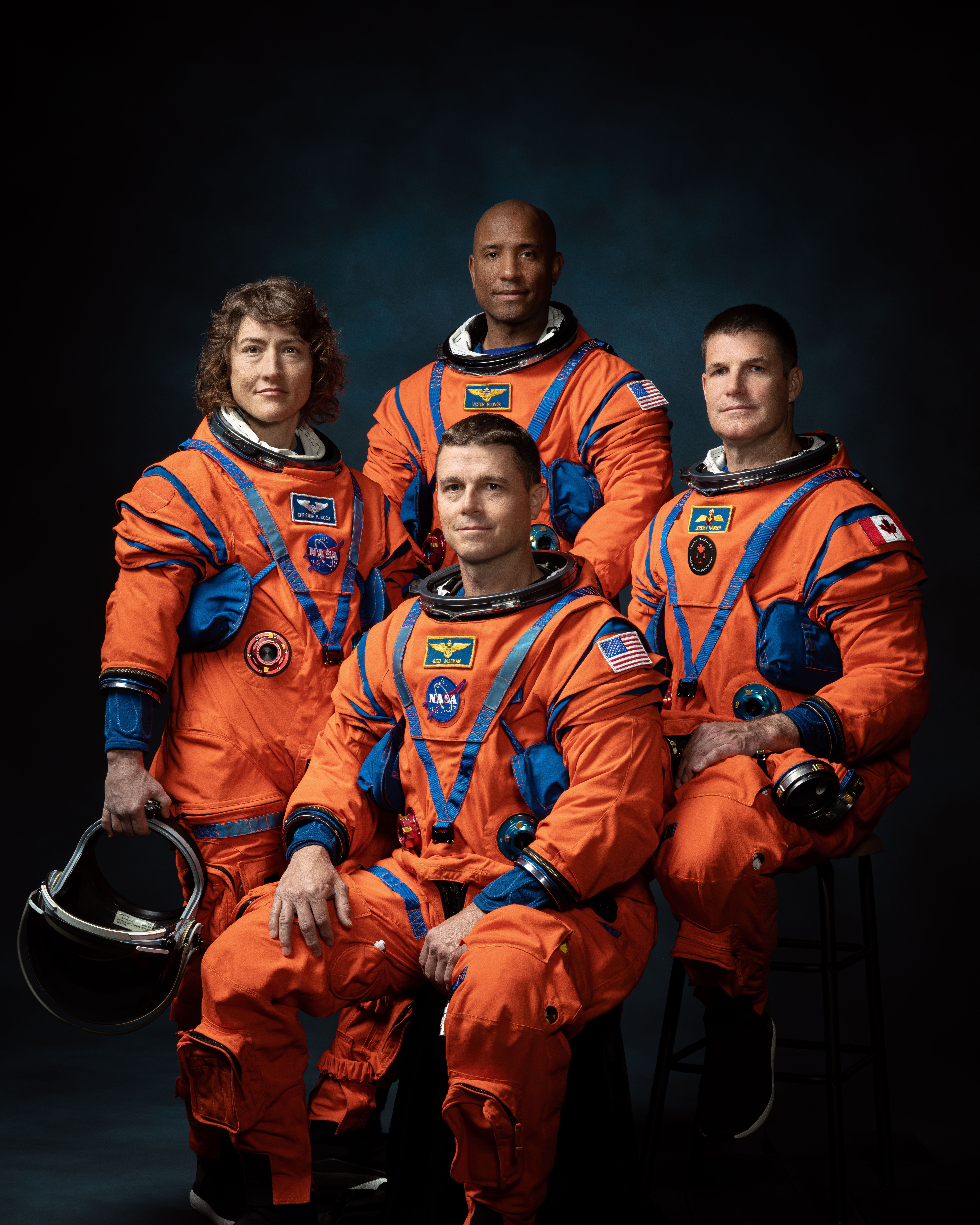
NASA is weeks away from sending astronauts farther than any crew has traveled before, with the agency’s second mission in its Artemis campaign. The Artemis II Press Kit now is available with information on the mission, astronauts, and other resources for media.
“Artemis II will be a momentous step forward for human spaceflight. This historic mission will send humans farther from Earth than ever before and deliver the insights needed for us to return to the Moon — all with America at the helm,” said NASA Administrator Jared Isaacman. “Artemis II represents progress toward establishing a lasting lunar presence and sending Americans to Mars. I could not be more impressed by our NASA team and the Artemis II crew, and wish them well. Boldly forward.”
Under the Artemis campaign, NASA is returning humans to the Moon for economic benefits, scientific discovery, and to prepare for crewed missions to Mars.
To learn more about Artemis, visit:
-end-
Lauren Low / Rachel Kraft
Headquarters, Washington
202-358-1600
lauren.e.low@nasa.gov / rachel.h.kraft@nasa.gov
What You Need to Know About NASA’s Artemis II Moon Mission
NASA is weeks away from sending astronauts farther than any crew has traveled before, with the agency’s second mission in its Artemis campaign. The Artemis II Press Kit now is available with information on the mission, astronauts, and other resources for media.
“Artemis II will be a momentous step forward for human spaceflight. This historic mission will send humans farther from Earth than ever before and deliver the insights needed for us to return to the Moon — all with America at the helm,” said NASA Administrator Jared Isaacman. “Artemis II represents progress toward establishing a lasting lunar presence and sending Americans to Mars. I could not be more impressed by our NASA team and the Artemis II crew, and wish them well. Boldly forward.”
Under the Artemis campaign, NASA is returning humans to the Moon for economic benefits, scientific discovery, and to prepare for crewed missions to Mars.
To learn more about Artemis, visit:
-end-
Lauren Low / Rachel Kraft
Headquarters, Washington
202-358-1600
lauren.e.low@nasa.gov / rachel.h.kraft@nasa.gov
RFK, Jr., shifts focus to questioning whether cell phones are safe. Here’s what the science says
The possible health effects of radiofrequency waves emitted by cell phones has been a subject of debate for decades
NASA Develops Blockchain Technology to Enhance Air Travel Safety and Security
3 min read
Preparations for Next Moonwalk Simulations Underway (and Underwater)By Supreet Kaur
In an era where data security is critical to aviation safety, NASA is exploring bold new solutions.
An Alta-X drone carries a custom built simulated Unmanned Aircraft Systems environment payload for the new blockchain system tests. Credit: NASA/Brandon Torres Navarette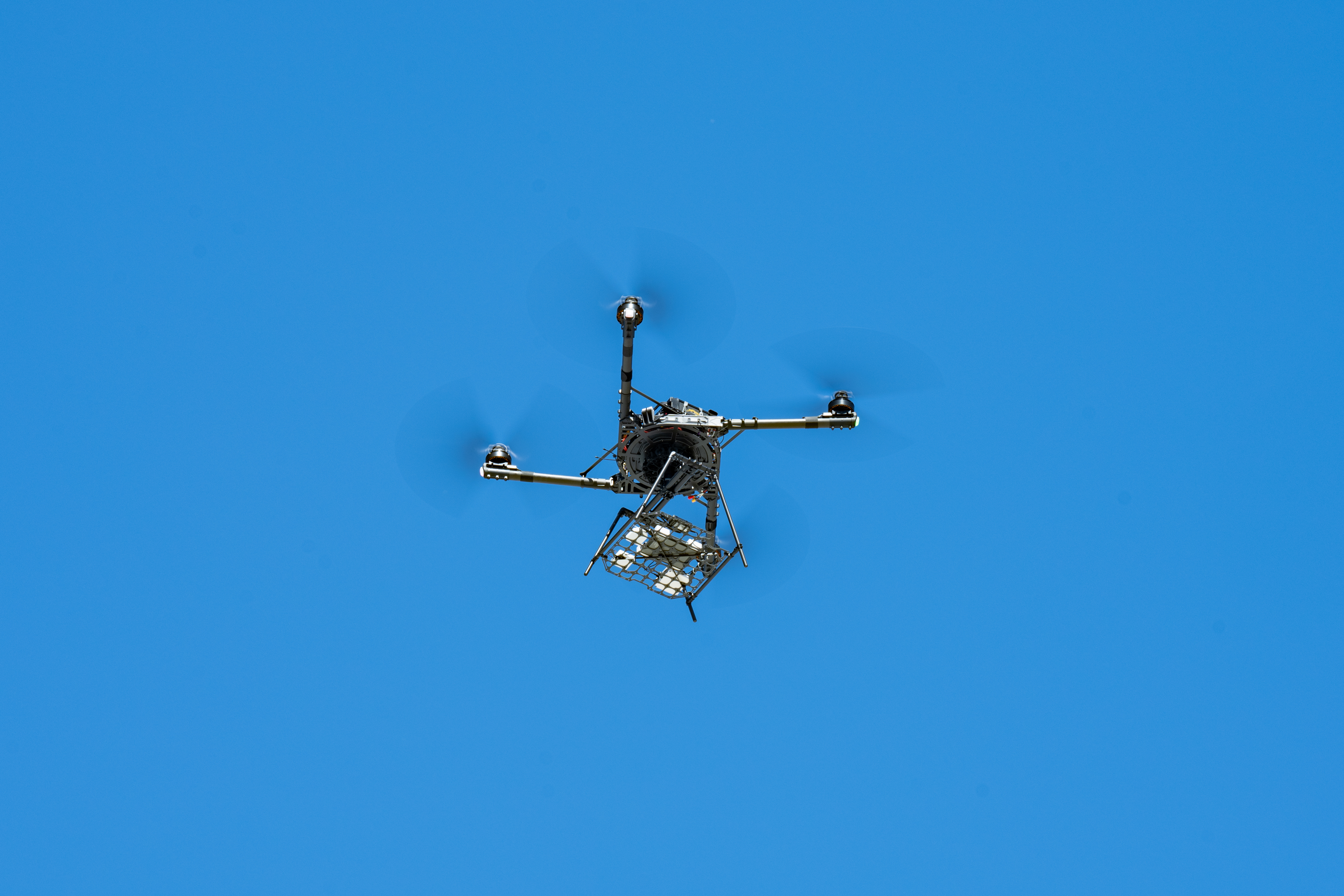
Through a drone flight test at NASA’s Ames Research Center in California’s Silicon Valley, researchers tested a blockchain-based system for protecting flight data. The system aims to keep air traffic management safe from disruption and protect data transferred between aircraft and ground stations from being intercepted or manipulated.
For aviation and airspace operations to remain safe, users need to be able to trust that data is reliable and transparent. While current systems have been able to protect flight data systems, cyberthreats continue to evolve, requiring new approaches. NASA researchers found the blockchain-based system can safely transmit and store information in real time.
Blockchain operates like a decentralized database — it does not rely on a single computer or centralized system. Instead, it shares information across a vast network, recording and verifying every change to a dataset. The system ensures the data stays safe, accurate, and trustworthy.
Previous cybersecurity research focused on implementing a layered security architecture — using multiple physical and digital security measures to control system access. For this test, researchers took a different approach using blockchain to address potential threats.
Using drones allowed the team to show that the blockchain framework could yield benefits across several priority areas in aviation development, including autonomous air traffic management, urban air mobility, and high-altitude aircraft.
Terrence D. Lewis (left), Kale Dunlap (center), and Aidan Jones monitor the flow of telemetry from both actual and simulated flights, ensuring the simulation and blockchain systems are processing and recording data accurately. Credit: NASA/Brandon Torres Navarette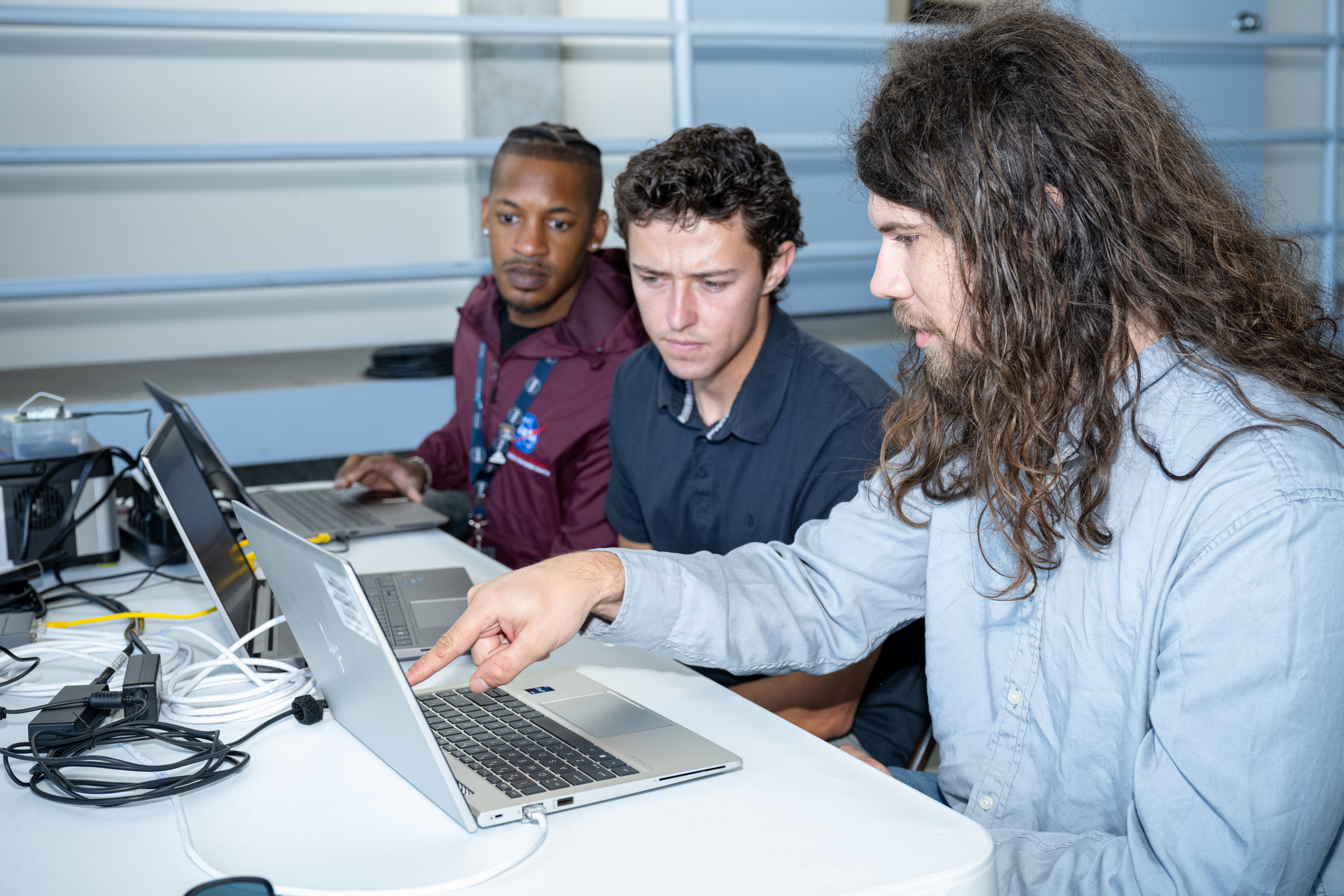
This NASA research explored how blockchain can secure digital transactions between multiple systems and operators. The team used an open-source blockchain framework that allows trusted users real-time sharing and storage of critical data like aircraft operator registration information, flight plans, and telemetry. This framework restricts access to this data to trusted parties and approved users only.
To further examine system resilience, the team introduced a set of cybersecurity tests designed to assess, improve, and reinforce security during operations in airspace environments. During an August flight at Ames, the team demonstrated these capabilities using an Alta-X drone with a custom-built software and hardware package that included a computer, radio, GPS system, and battery.
The test simulated an environment with a drone flying in real-world conditions, complete with a separate ground control station and the blockchain and security infrastructure. The underlying blockchain framework and cybersecurity protocols can be extended to support high-altitude operations at 60,000 feet and higher and Urban Air Mobility operations, paving the way for a more secure, scalable, and trusted ecosystem.
NASA researchers will continue to look at the data gathered during the test and apply what they’ve learned to future work. The testing will ultimately benefit U.S. aviation stakeholders looking for new tools to improve operations.
Through its Air Traffic Management and Safety project, NASA performed research to transform air traffic management systems to safely accommodate the growing demand of new air vehicles. The project falls under NASA’s Airspace Operations and Safety Program, a part the agency’s Aeronautics Research Mission Directorate that works to enable safe, efficient aviation transportation operations that benefit the flying public and industry.
NASA Develops Blockchain Technology to Enhance Air Travel Safety and Security
3 min read
Preparations for Next Moonwalk Simulations Underway (and Underwater)By Supreet Kaur
In an era where data security is critical to aviation safety, NASA is exploring bold new solutions.
An Alta-X drone carries a custom built simulated Unmanned Aircraft Systems environment payload for the new blockchain system tests. Credit: NASA/Brandon Torres NavaretteThrough a drone flight test at NASA’s Ames Research Center in California’s Silicon Valley, researchers tested a blockchain-based system for protecting flight data. The system aims to keep air traffic management safe from disruption and protect data transferred between aircraft and ground stations from being intercepted or manipulated.
For aviation and airspace operations to remain safe, users need to be able to trust that data is reliable and transparent. While current systems have been able to protect flight data systems, cyberthreats continue to evolve, requiring new approaches. NASA researchers found the blockchain-based system can safely transmit and store information in real time.
Blockchain operates like a decentralized database — it does not rely on a single computer or centralized system. Instead, it shares information across a vast network, recording and verifying every change to a dataset. The system ensures the data stays safe, accurate, and trustworthy.
Previous cybersecurity research focused on implementing a layered security architecture — using multiple physical and digital security measures to control system access. For this test, researchers took a different approach using blockchain to address potential threats.
Using drones allowed the team to show that the blockchain framework could yield benefits across several priority areas in aviation development, including autonomous air traffic management, urban air mobility, and high-altitude aircraft.
Terrence D. Lewis (left), Kale Dunlap (center), and Aidan Jones monitor the flow of telemetry from both actual and simulated flights, ensuring the simulation and blockchain systems are processing and recording data accurately. Credit: NASA/Brandon Torres NavaretteThis NASA research explored how blockchain can secure digital transactions between multiple systems and operators. The team used an open-source blockchain framework that allows trusted users real-time sharing and storage of critical data like aircraft operator registration information, flight plans, and telemetry. This framework restricts access to this data to trusted parties and approved users only.
To further examine system resilience, the team introduced a set of cybersecurity tests designed to assess, improve, and reinforce security during operations in airspace environments. During an August flight at Ames, the team demonstrated these capabilities using an Alta-X drone with a custom-built software and hardware package that included a computer, radio, GPS system, and battery.
The test simulated an environment with a drone flying in real-world conditions, complete with a separate ground control station and the blockchain and security infrastructure. The underlying blockchain framework and cybersecurity protocols can be extended to support high-altitude operations at 60,000 feet and higher and Urban Air Mobility operations, paving the way for a more secure, scalable, and trusted ecosystem.
NASA researchers will continue to look at the data gathered during the test and apply what they’ve learned to future work. The testing will ultimately benefit U.S. aviation stakeholders looking for new tools to improve operations.
Through its Air Traffic Management and Safety project, NASA performed research to transform air traffic management systems to safely accommodate the growing demand of new air vehicles. The project falls under NASA’s Airspace Operations and Safety Program, a part the agency’s Aeronautics Research Mission Directorate that works to enable safe, efficient aviation transportation operations that benefit the flying public and industry.
It’s so cold in Florida that iguanas might rain from the skies
Florida’s iguanas are an introduced species, and they aren’t used to the chilly temperatures the state is currently experiencing
NASA’s historic Artemis II moon mission is almost ready to launch
On Friday NASA laid out the time line for Artemis II, humanity’s first crewed mission to the moon in more than 50 years