
Feed aggregator
Improved ‘Terminator’ Sun Model Could Change Space Weather Forecasting
An idea about the sun’s magnetic field called the terminator model could help predict dangerous space weather more accurately
What the evolution of tickling tells us about being human
What the evolution of tickling tells us about being human
Australia's social media ban faces challenges and criticism on day one
Australia's social media ban faces challenges and criticism on day one
The Primordial Black Hole Saga: Part 3 - Primordial Ooze
The early universe was a pretty intense place to be. And not just “early” as in a few billion years ago. I mean early early, just a few seconds after the Big Bang. The universe is small, less than a meter across. It’s hot, with temperatures so high it doesn’t even make sense to say them – they’re just stupidly high numbers with no connection to our everyday existence.
The British Robots Bringing Heavy Industry to Orbit
The UK is actively trying to support the infrastructure to make it a significant player in the coming age of the space economy. It recently received 560 proposals to it’s National Space Innovation Program, and handed out £17M in grants to 17 different organizations following five main themes. One of those is an effort by the University of Leicester and The Welding Institute (TWI) to develop a robotic welder for use in repairing and manufacturing in space, as described by a new press release from the university.
How Animals Form Unlikely Alliances to Keep Predators Away
Cross-species “defense pacts” help animals keep tabs on parasites and predators
A 50 Million Light Year Structure Caught Spinning
Astronomers have discovered a filament 50 million light years long containing hundreds of galaxies, all spinning together. This immense structure, located 140 million light years away, challenges current models of galaxy formation by showing that large scale rotation can persist far longer and more coherently than theories predicted. The discovery offers a rare glimpse into how galaxies acquire their spin and reveals the Cosmic Web as a more dynamically active place than previously imagined.
Can NASA Bring Mars Rocks Back to Earth?
NASA’s Perseverance rover has gathered groundbreaking Mars samples, but the mission to bring them home is facing serious challenges.
Why we only recently discovered space is dark not bright
Why we only recently discovered space is dark not bright
Did ancient humans start farming so they could drink more beer?
Did ancient humans start farming so they could drink more beer?
How Mars Controls Earth's Climate
A new study reveals that Mars plays a surprisingly crucial role in Earth's climate cycles, with new simulations showing that the mass of our planetary neighbours directly controls the timing and intensity of Milankovitch cycles that drive ice ages. By varying Mars's mass from zero to ten times its current value in computer models, researchers discovered that a more massive Mars strengthens the ~100,000 year climate cycles and creates the 2.4 million year "grand cycle" that influences Earth's long term climate. This finding demonstrates that Earth's climate rhythms are connected to the gravitational structure of the inner Solar System, not just the Sun and Moon.
Euclid Reveals What Wakes Sleeping Black Holes
The European Space Agency's Euclid telescope has delivered an unprecedented set of observations of one million galaxies that shows that galaxy collisions play a dominant role in awakening supermassive black holes from their sleep. Using revolutionary AI-powered analysis methods, astronomers discovered that merging galaxies contain up to six times more active black holes than isolated galaxies, with the most luminous black holes found almost exclusively in collision zones.
Dinosaurs like Diplodocus may have been as colourful as birds
Dinosaurs like Diplodocus may have been as colourful as birds
The Nancy Grace Roman Telescope Is Complete!
Construction is complete on the Nancy Grace Roman Space Telescope, and its ahead of schedule. After extensive testing, the new flagship telescope should be ready to launch in Fall, 2026.
NASA Demonstrates Safer Skies for Future Urban Air Travel
2 min read
Preparations for Next Moonwalk Simulations Underway (and Underwater) NASA engineer Hanbong Lee demonstrates capabilities to manage busy urban airspace traffic during a recent simulation at NASA’s Ames Research Center in California’s Silicon Valley.NASA/Brandon Torres-Navarrete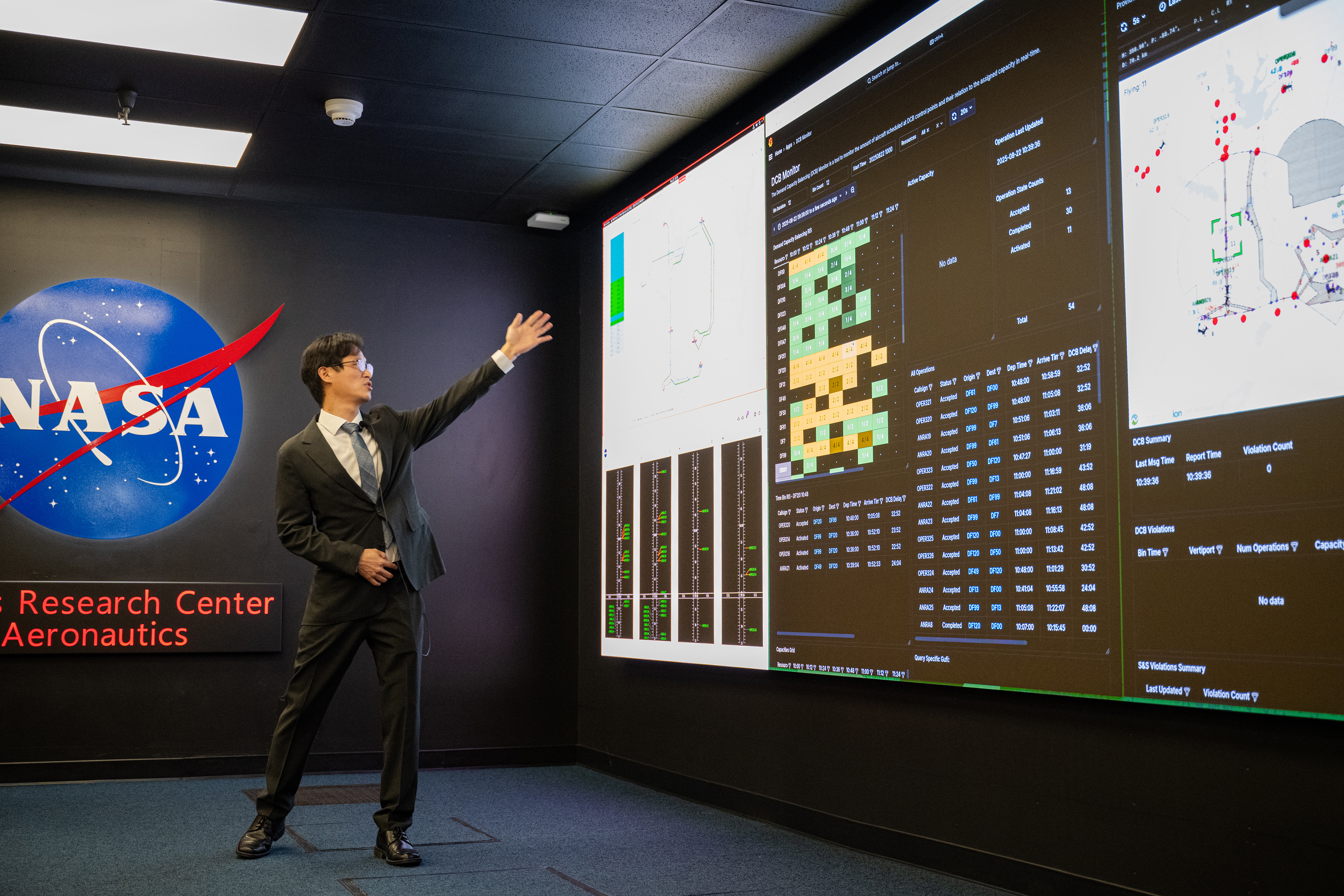
NASA is helping shape the future of urban air travel with a new simulation that will manage how electric air taxis and drones can successfully operate within busy areas.
The demonstration, held at NASA’s Ames Research Center in California’s Silicon Valley earlier this year, focused on a system called the Strategic Deconfliction Simulation, which helps coordinate flight plans before takeoff, reducing the risk of conflicts in busy urban environments
At the event, researchers demonstrated NASA’s Situational Viewer and Demand-Capacity Balancing Monitor, which visualizes air traffic and adjusts flight plans in real time. The simulation demonstrated traffic scenarios involving drone operations throughout the Dallas-Fort Worth area, testing how preplanned flights could improve congestion and manage the demand and capacity of the airspace – ensuring that all aircraft can operate smoothly even in crowded conditions.
Working with industry partners is critical to NASA’s efforts to develop and refine technologies needed for future air mobility. During the simulation, the company, ANRA Technologies, demonstrated its fleet and vertiport management systems, which are designed to support the coordination of multiple aircraft and ground operations.
“Simulating these complex environments supports broader efforts to ensure safe integration of drones and other advanced vehicles into the US airspace,” said Hanbong Lee, engineer at NASA Ames. “By showcasing these capabilities, we’re delivering critical data and lessons learned to support efforts at NASA and industry.”
This demonstration is another step toward the NASA team’s plan to hold a technical capability level simulation in 2026. This upcoming simulation would help shape the development of services aimed at managing aircraft flying in urban areas.
The simulation was created through a NASA team from its Air Mobility Pathfinders project, part of the agency’s continuing work to find solutions for safely integrating innovative new aircraft such as air taxis into U.S. cities and the national airspace. By developing advanced evaluations and simulations, the project supports safe, scalable, and publicly trusted air travel in urban areas, paving the way for a future where air taxis and drones are a safe and reliable part of everyday life.
The project falls under NASA’s Airspace Operations and Safety Program, which works to enable safe and efficient aviation transportation.
Share Details Last Updated Dec 09, 2025 Related Terms Explore More 6 min read Retirement Article 9 hours ago 5 min read NASA Begins Moon Mission Plume-Surface Interaction Tests Article 1 day ago 5 min read Painting Galaxy Clusters by Numbers (and Physics) Article 1 day ago Keep Exploring Discover More Topics From NASAMissions
Humans in Space
Climate Change
Solar System