
Feed aggregator
May Podcast: The Delightful Dippers
This month’s episode showcases the Big and Little Dippers, now placed high in the northern evening sky. We'll also track down all five bright planets and watch for meteors from Halley's Comet. So grab your curiosity, and come along on this month’s Sky Tour.
The post May Podcast: The Delightful Dippers appeared first on Sky & Telescope.
Winter’s End Is Written in the Clouds
- Earth
- Earth Observatory
- Image of the Day
- EO Explorer
- Topics
- More Content
- About
Winter’s End Is Written in the Clouds
- Earth
- Earth Observatory
- Image of the Day
- EO Explorer
- Topics
- More Content
- About
Flexible 3D-Printable Shielding for Extreme Environments
You’re based at Artemis Station on the lunar south pole, and you’re monitoring your 12 autonomous rovers that are exploring the surrounding terrain for signs of water ice or other essentials minerals. They’re about 3 kilometers out when you suddenly get a NASA Alert for an incoming solar storm. You know the rovers won’t return to base before the storm hits, but you’re calm knowing the rovers all recently got retrofitted with the latest hair-thin nanotube shielding to protect them from the harsh electromagnetic waves and radiation.
I Am Artemis: Ryan Schulte
Listen to this audio excerpt from Ryan Schulte, Orion flywheel project manager:
0:00 / 0:00
Your browser does not support the audio element.As the four Artemis II astronauts traveled on a 694,481-mile journey around the Moon and back, the Orion spacecraft provided them with all the essentials for deep space life, including daily exercise. The crew used an exercise device called the flywheel throughout their mission to maintain their physical and mental health, and Ryan Schulte, Orion flywheel project manager, led the team responsible for developing the flywheel for the historic flight.
At NASA’s Johnson Space Center in Houston, Schulte oversees the team that designed, built, tested, and flew the flywheel used on Artemis II, and currently develops a fleet of more reusable exercise devices for future Artemis missions.
What we’re doing with this exercise device has a direct impact on the crew’s safety, health, and their mission success. I feel lucky to work on hardware that the crew is physically using, interacting with, and benefiting from on a daily basis.Ryan Schulte
Orion Flywheel Project Manager
The flywheel is a compact, multi-functional device about the size of a large shoebox that provides the crew with a range of aerobic and resistive workouts without requiring any electrical power from the spacecraft.
“It works kind of like an inertial yo-yo,” said Schulte.
The user can select different gear ratios for different resistance modes, and the flywheel can provide ultimately up to 500 pounds of resistance.
“It’s really all dependent upon how much effort you put in. The crew can do squats, deadlifts, bent rows, high-pulls, curls, heel raises, and aerobic rowing all in one device.”
Developing the flywheel for Orion posed unique challenges for Schulte’s team, ranging from limited space and crew mobility to reducing noise generation for easy crew communication during workouts.
“One of the biggest challenges was trying to fit everything into this compact box, and also to be able to have enough space inside the rest of the capsule for someone to fully stand up and fully extend at high rates of speed and repetitions,” said Schulte.
The team’s successful response to these challenges was displayed during the approximately 10-day Artemis II mission, where the crew members exercised for roughly 30 minutes per day with the flywheel. The sessions helped to counteract both the physical and mental effects induced by a microgravity environment, which on future, longer-duration Artemis missions, will become an increasingly important component for astronauts.
Ryan Schulte, Orion flywheel project manager, demonstrates a rowing exercise on the Orion flywheel in the Exercise Countermeasures Lab at NASA’s Johnson Space Center in Houston.NASA/Rad Sinyak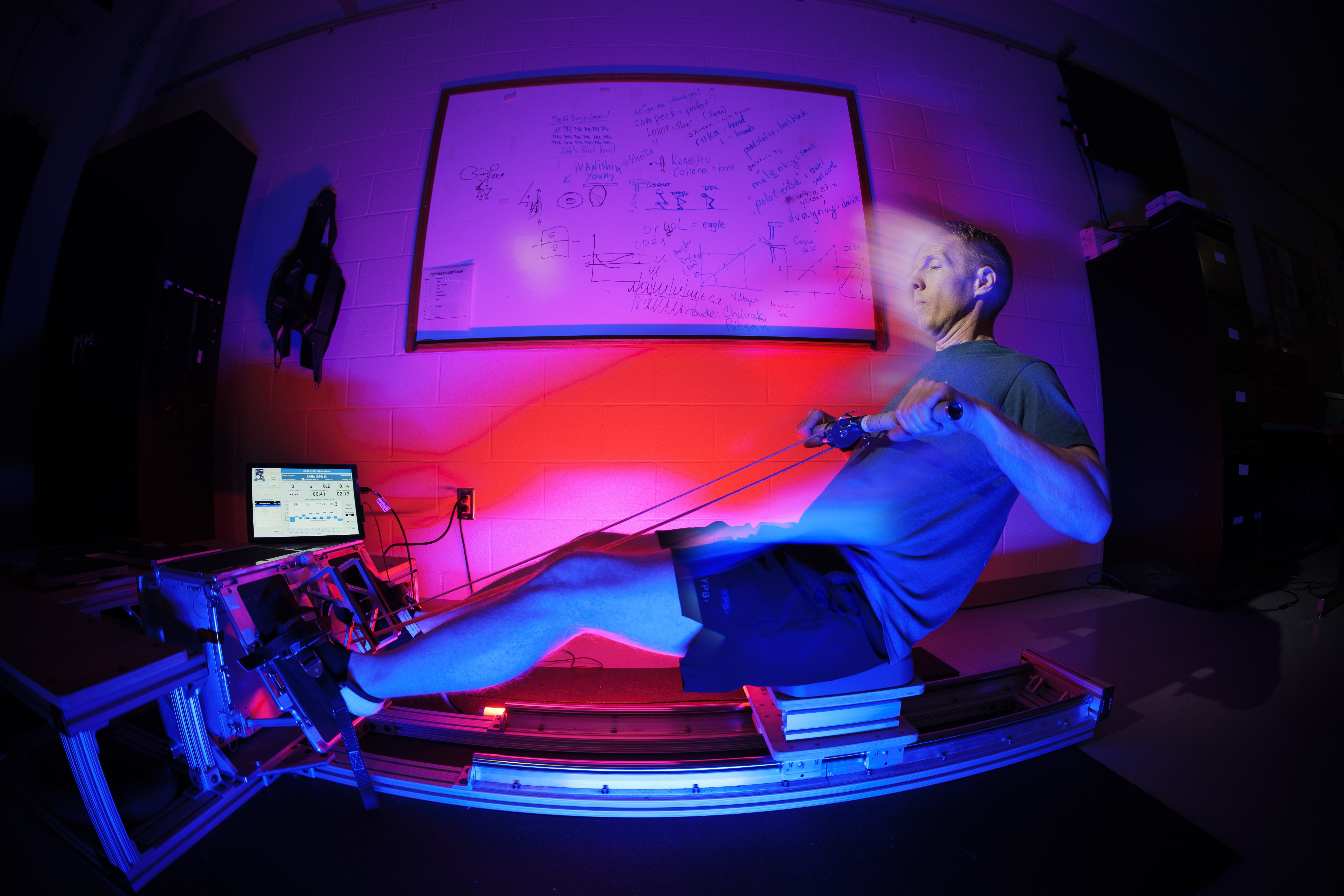
“Without Earth’s gravity, the crew’s muscles, bones, and stamina all begin to atrophy, or weaken,” Schulte said. “Exercise will help prevent injury as crews need to perform long lunar spacewalks on the surface or for emergency egress out of the capsule.”
Exercise with the flywheel also supports the crew’s mental health, providing psychological benefits while living in a compact space inside Orion.
“It’s a great form of stress relief,” Schulte said. “It improves their mental clarity by getting their fluids and their blood flowing, which can stagnate in your head in zero gravity. We’ve talked to some of the crew about how much clearer their minds feel after exercise in flight.”
Schulte began his career as a co-op at Johnson in 2007, then joined NASA full-time as a test engineer for pyrotechnics, propulsion, and power systems. He later transitioned to NASA’s Human Health and Performance Directorate and began working in the Human Research Program, where his interest in human interfaces with engineering grew, eventually leading him to his current role as the flywheel project manager.
With the success of Artemis II and the promise of future missions ahead, Schulte’s work on the flywheel and next generation exercise devices will play a vital role in keeping astronauts safe, healthy, and mission ready on the lunar surface and beyond.
I feel incredibly lucky to be doing what I get to do. There’s not a lot of people out there that get to do this type of work. It is really just an honor and a privilege to be able to serve my country in this way.Ryan Schulte
Orion Flywheel Project Manager
About the AuthorPenelope Lauren Garcia-Galan Share Details Last Updated Apr 29, 2026 Related Terms Explore More 4 min read NASA Laser Terminal Enhances Views During Artemis II Mission Article 2 days ago 3 min read I Am Artemis: Peter Rossoni Article 6 days ago 4 min read Johnson Leaders Honored by National Space Club & Foundation Article 7 days ago Keep Exploring Discover More Topics From NASAMissions
Humans in Space
Climate Change
Solar System
I Am Artemis: Ryan Schulte
Listen to this audio excerpt from Ryan Schulte, Orion flywheel project manager:
0:00 / 0:00
Your browser does not support the audio element.As the four Artemis II astronauts traveled on a 694,481-mile journey around the Moon and back, the Orion spacecraft provided them with all the essentials for deep space life, including daily exercise. The crew used an exercise device called the flywheel throughout their mission to maintain their physical and mental health, and Ryan Schulte, Orion flywheel project manager, led the team responsible for developing the flywheel for the historic flight.
At NASA’s Johnson Space Center in Houston, Schulte oversees the team that designed, built, tested, and flew the flywheel used on Artemis II, and currently develops a fleet of more reusable exercise devices for future Artemis missions.
What we’re doing with this exercise device has a direct impact on the crew’s safety, health, and their mission success. I feel lucky to work on hardware that the crew is physically using, interacting with, and benefiting from on a daily basis.Ryan Schulte
Orion Flywheel Project Manager
The flywheel is a compact, multi-functional device about the size of a large shoebox that provides the crew with a range of aerobic and resistive workouts without requiring any electrical power from the spacecraft.
“It works kind of like an inertial yo-yo,” said Schulte.
The user can select different gear ratios for different resistance modes, and the flywheel can provide ultimately up to 500 pounds of resistance.
“It’s really all dependent upon how much effort you put in. The crew can do squats, deadlifts, bent rows, high-pulls, curls, heel raises, and aerobic rowing all in one device.”
Developing the flywheel for Orion posed unique challenges for Schulte’s team, ranging from limited space and crew mobility to reducing noise generation for easy crew communication during workouts.
“One of the biggest challenges was trying to fit everything into this compact box, and also to be able to have enough space inside the rest of the capsule for someone to fully stand up and fully extend at high rates of speed and repetitions,” said Schulte.
The team’s successful response to these challenges was displayed during the approximately 10-day Artemis II mission, where the crew members exercised for roughly 30 minutes per day with the flywheel. The sessions helped to counteract both the physical and mental effects induced by a microgravity environment, which on future, longer-duration Artemis missions, will become an increasingly important component for astronauts.
Ryan Schulte, Orion flywheel project manager, demonstrates a rowing exercise on the Orion flywheel in the Exercise Countermeasures Lab at NASA’s Johnson Space Center in Houston.NASA/Rad Sinyak“Without Earth’s gravity, the crew’s muscles, bones, and stamina all begin to atrophy, or weaken,” Schulte said. “Exercise will help prevent injury as crews need to perform long lunar spacewalks on the surface or for emergency egress out of the capsule.”
Exercise with the flywheel also supports the crew’s mental health, providing psychological benefits while living in a compact space inside Orion.
“It’s a great form of stress relief,” Schulte said. “It improves their mental clarity by getting their fluids and their blood flowing, which can stagnate in your head in zero gravity. We’ve talked to some of the crew about how much clearer their minds feel after exercise in flight.”
Schulte began his career as a co-op at Johnson in 2007, then joined NASA full-time as a test engineer for pyrotechnics, propulsion, and power systems. He later transitioned to NASA’s Human Health and Performance Directorate and began working in the Human Research Program, where his interest in human interfaces with engineering grew, eventually leading him to his current role as the flywheel project manager.
With the success of Artemis II and the promise of future missions ahead, Schulte’s work on the flywheel and next generation exercise devices will play a vital role in keeping astronauts safe, healthy, and mission ready on the lunar surface and beyond.
I feel incredibly lucky to be doing what I get to do. There’s not a lot of people out there that get to do this type of work. It is really just an honor and a privilege to be able to serve my country in this way.Ryan Schulte
Orion Flywheel Project Manager
About the AuthorPenelope Lauren Garcia-Galan Share Details Last Updated Apr 29, 2026 Related Terms Explore More 2 min read NASA Welcomes Morocco as 64th Artemis Accords Signatory Article 6 hours ago 4 min read NASA Laser Terminal Enhances Views During Artemis II Mission Article 2 days ago 3 min read I Am Artemis: Peter Rossoni Article 6 days ago Keep Exploring Discover More Topics From NASAMissions
Humans in Space
Climate Change
Solar System
How a Meteorite Helps Explain Mercury's Chemical Makeup
Mercury is one of the four rocky worlds of the Solar System, yet its chemistry is very different from Earth, Venus, and Mars. Missions to the planet show that it has an iron-poor, but sulfur- and magnesium-rich crust. Furthermore, it's known to planetary scientists as the most reduced planet in the Solar system. It means that the chemical makeup is dominated by sulfides, carbides, and silicides -- as opposed to oxides like we see here on Earth.
US-Indian Spacecraft Captures Mexico City Subsidence
NASA/JPL-Caltech/David Bekaert Photojournal Navigation Downloads US-Indian Spacecraft Captures Mexico City Subsidence
JPEG (32.05 MB)
PIA26709 Figure A
PNG (4.38 MB)
Description
A scientist produced this map of land subsidence (sinking) in Mexico City using data from the NISAR (NASA-ISRO Synthetic Aperture Radar) mission captured between Oct. 25, 2025, and Jan. 17, 2026. The region has been a well-known hot spot of subsidence for decades, and images like this help confirm that NISAR is performing as expected in its first year of operation.
The dark blue color indicates areas found to be subsiding by more than half an inch (more than 2 centimeters) per month, due in large part to groundwater pumping, which has led to compaction of the dry, ancient lakebed on which the city was built. The yellow and red areas are likely residual noise signals that are expected to decrease as NISAR collects more data and refines its measurements.
Two marshy ecosystems with ties to the country’s past can be seen in the image. The dark green oblong to the northeast of the airport is Nabor Carrillo, an artificial lake constructed over the now-extinct Lake Texcoco. Chalco Lake, a wetland located in a historically fertile region to the south, shares its name with a major body of water that was drained over a period of centuries to reduce flooding in the city. The ancient lake was a primary natural habitat of the Mexican Axolotl, an endangered species of salamander with the ability to regrow limbs.
Another landmark pinpointed in the image — the Angel of Independence along the Paseo de la Reforma — was built in 1910 to commemorate 100 years of Mexico’s independence. Standing over 100 feet (30 meters) tall, the monument has had 14 steps added to its base over the years as the land around it has gradually sunk.
Figure A
Figure A is a version of the image extending further south and with no labels, scale, or compass.
The images were created with data from NISAR’s L-band radar instrument, which uses a 9-inch (24-centimeter) wavelength that enables its signal to penetrate dense vegetation such as forest canopies.
The satellite’s S-band radar, provided by the Indian Space Research Organisation’s Space Applications Centre, uses a 4-inch (10-centimeter) microwave signal that’s more sensitive to small vegetation, which makes it effective at monitoring certain types of agriculture and grassland ecosystems. Launched in 2025, NISAR is the first satellite to carry two SAR instruments at different wavelengths.
Data from NISAR will benefit humanity by helping researchers around the world better understand changes across our planet’s surface, from cities to forests and glaciers. The global and rapid coverage from NISAR will also provide unprecedented support for disaster response, producing data to assist in mitigating and assessing damage, with observations before and after catastrophic events available in short time frames.
Find more information about NISAR here: https://science.nasa.gov/mission/nisar/
Keep Exploring Discover More Topics From Photojournal
Photojournal
Search Photojournal
Photojournal’s Latest Content
Feedback
US-Indian Spacecraft Captures Mexico City Subsidence
JPEG (32.05 MB)
PIA26709 Figure APNG (4.38 MB)
DescriptionA scientist produced this map of land subsidence (sinking) in Mexico City using data from the NISAR (NASA-ISRO Synthetic Aperture Radar) mission captured between Oct. 25, 2025, and Jan. 17, 2026. The region has been a well-known hot spot of subsidence for decades, and images like this help confirm that NISAR is performing as expected in its first year of operation.
The dark blue color indicates areas found to be subsiding by more than half an inch (more than 2 centimeters) per month, due in large part to groundwater pumping, which has led to compaction of the dry, ancient lakebed on which the city was built. The yellow and red areas are likely residual noise signals that are expected to decrease as NISAR collects more data and refines its measurements.
Two marshy ecosystems with ties to the country’s past can be seen in the image. The dark green oblong to the northeast of the airport is Nabor Carrillo, an artificial lake constructed over the now-extinct Lake Texcoco. Chalco Lake, a wetland located in a historically fertile region to the south, shares its name with a major body of water that was drained over a period of centuries to reduce flooding in the city. The ancient lake was a primary natural habitat of the Mexican Axolotl, an endangered species of salamander with the ability to regrow limbs.
Another landmark pinpointed in the image — the Angel of Independence along the Paseo de la Reforma — was built in 1910 to commemorate 100 years of Mexico’s independence. Standing over 100 feet (30 meters) tall, the monument has had 14 steps added to its base over the years as the land around it has gradually sunk.
Figure AFigure A is a version of the image extending further south and with no labels, scale, or compass.
The images were created with data from NISAR’s L-band radar instrument, which uses a 9-inch (24-centimeter) wavelength that enables its signal to penetrate dense vegetation such as forest canopies.
The satellite’s S-band radar, provided by the Indian Space Research Organisation’s Space Applications Centre, uses a 4-inch (10-centimeter) microwave signal that’s more sensitive to small vegetation, which makes it effective at monitoring certain types of agriculture and grassland ecosystems. Launched in 2025, NISAR is the first satellite to carry two SAR instruments at different wavelengths.
Data from NISAR will benefit humanity by helping researchers around the world better understand changes across our planet’s surface, from cities to forests and glaciers. The global and rapid coverage from NISAR will also provide unprecedented support for disaster response, producing data to assist in mitigating and assessing damage, with observations before and after catastrophic events available in short time frames.
Find more information about NISAR here: https://science.nasa.gov/mission/nisar/
Keep Exploring Discover More Topics From PhotojournalPhotojournal
Search Photojournal
Photojournal’s Latest Content
Feedback
Curiosity Blog, Sols 4873-4878: Welcome to the Atacama Drill Target
- Curiosity Home
- Science
- News and Features
- Multimedia
- Mars Missions
- Mars Home
2 min read
Curiosity Blog, Sols 4873-4878: Welcome to the Atacama Drill Target NASA’s Mars rover Curiosity acquired this image using its Front Hazard Avoidance Camera (Front Hazcam) on April 23, 2026 — Sol 4874, or Martian day 4,874 of the Mars Science Laboratory mission — at 01:12:31 UTC. NASA/JPL-Caltech
Written by Sharon Wilson Purdy, Planetary Geologist at the Smithsonian National Air and Space Museum
Earth planning date: Friday, April 24, 2026
There was excitement in the air as the Curiosity Science Team kicked off a drill campaign at the Atacama site to characterize the first Mount Sharp layered-sulfate bedrock since leaving the boxwork terrain.
Monday was a three-sol plan (4873-4875) where we focused on “drill sol 1” activities that included a pre-load test on our drill target as well as triage contact science. APXS assembled a set of repeated observations on the Atacama drill target, and the coordinated MAHLI images taken with different lighting will provide an opportunity to detect possible changes between the datasets. Mastcam assembled stereo mosaics to document the Atacama drill site, investigate variations in the bedrock at “Kimsa Chata,” and characterize the layering within Paniri butte.
Planning resumed Friday with another three-sol plan (4876-4878) that included the full drill and portion characterization related to “drill sols 2 and 3” activities. Mastcam planned stereo mosaics of rocks in the workspace including a laminated rock with an exposed edge named “Queen of the Andes,” a rock with polygonal fractures that was broken when the rover drove over it named “Curaco,” and more coverage of the “El Almendrillo” target.
Rounding out the plans this week, the Environmental theme group continues to monitor dust in the atmosphere, study cloud movements, and document the presence of dust devils. The rover will also autonomously select two targets to be analyzed by the ChemCam instrument.
Next week we look forward to continuing our drill campaign, where the next step will be delivering a portion of the Atacama target to the ChemMin instrument for analysis. The science team is looking forward to seeing how the mineralogy of the layered sulfate unit here compares to our last drill of the same unit at the Mineral King site, which is nearly 160 meters (525 feet) below our current location!
-
Want to read more posts from the Curiosity team?
-
Want to learn more about Curiosity’s science instruments?
Article
1 week ago
3 min read Curiosity Blog, Sols 4859-4866: One Small Crater and Thousands of Polygons
Article
2 weeks ago
4 min read Curiosity Blog, Sols 4852–4858: When Data Take Their Time…
Article
2 weeks ago
Keep Exploring Discover More Topics From NASA Mars
Mars is the fourth planet from the Sun, and the seventh largest. It’s the only planet we know of inhabited…
All Mars Resources
Explore this collection of Mars images, videos, resources, PDFs, and toolkits. Discover valuable content designed to inform, educate, and inspire,…
Rover Basics
Each robotic explorer sent to the Red Planet has its own unique capabilities driven by science. Many attributes of a…
Mars Exploration: Science Goals
The key to understanding the past, present or future potential for life on Mars can be found in NASA’s four…
Curiosity Blog, Sols 4873-4878: Welcome to the Atacama Drill Target
- Curiosity Home
- Science
- News and Features
- Multimedia
- Mars Missions
- Mars Home
2 min read
Curiosity Blog, Sols 4873-4878: Welcome to the Atacama Drill Target NASA’s Mars rover Curiosity acquired this image using its Front Hazard Avoidance Camera (Front Hazcam) on April 23, 2026 — Sol 4874, or Martian day 4,874 of the Mars Science Laboratory mission — at 01:12:31 UTC. NASA/JPL-CaltechWritten by Sharon Wilson Purdy, Planetary Geologist at the Smithsonian National Air and Space Museum
Earth planning date: Friday, April 24, 2026
There was excitement in the air as the Curiosity Science Team kicked off a drill campaign at the Atacama site to characterize the first Mount Sharp layered-sulfate bedrock since leaving the boxwork terrain.
Monday was a three-sol plan (4873-4875) where we focused on “drill sol 1” activities that included a pre-load test on our drill target as well as triage contact science. APXS assembled a set of repeated observations on the Atacama drill target, and the coordinated MAHLI images taken with different lighting will provide an opportunity to detect possible changes between the datasets. Mastcam assembled stereo mosaics to document the Atacama drill site, investigate variations in the bedrock at “Kimsa Chata,” and characterize the layering within Paniri butte.
Planning resumed Friday with another three-sol plan (4876-4878) that included the full drill and portion characterization related to “drill sols 2 and 3” activities. Mastcam planned stereo mosaics of rocks in the workspace including a laminated rock with an exposed edge named “Queen of the Andes,” a rock with polygonal fractures that was broken when the rover drove over it named “Curaco,” and more coverage of the “El Almendrillo” target.
Rounding out the plans this week, the Environmental theme group continues to monitor dust in the atmosphere, study cloud movements, and document the presence of dust devils. The rover will also autonomously select two targets to be analyzed by the ChemCam instrument.
Next week we look forward to continuing our drill campaign, where the next step will be delivering a portion of the Atacama target to the ChemMin instrument for analysis. The science team is looking forward to seeing how the mineralogy of the layered sulfate unit here compares to our last drill of the same unit at the Mineral King site, which is nearly 160 meters (525 feet) below our current location!
-
Want to read more posts from the Curiosity team?
-
Want to learn more about Curiosity’s science instruments?
Article
1 week ago
3 min read Curiosity Blog, Sols 4859-4866: One Small Crater and Thousands of Polygons
Article
2 weeks ago
4 min read Curiosity Blog, Sols 4852–4858: When Data Take Their Time…
Article
2 weeks ago
Keep Exploring Discover More Topics From NASA Mars
Mars is the fourth planet from the Sun, and the seventh largest. It’s the only planet we know of inhabited…
All Mars Resources
Explore this collection of Mars images, videos, resources, PDFs, and toolkits. Discover valuable content designed to inform, educate, and inspire,…
Rover Basics
Each robotic explorer sent to the Red Planet has its own unique capabilities driven by science. Many attributes of a…
Mars Exploration: Science Goals
The key to understanding the past, present or future potential for life on Mars can be found in NASA’s four…
Binary Stars Form Lots Of Exoplanets, But Many Of Them Are Ejected As Rogue Planets
Binary stars are common, but for a long time astronomers have thought that exoplanets would have trouble forming around them. In recent years, powerful telescopes have detected about 50 of these planets. Now, new simulations show that their formation isn't actually rare, it's just that they tend to be on wide orbits, with few opportunities to observe transits. Also, many of them are ejected and become rogue planets.
US-Indian Space Mission Maps Extreme Subsidence in Mexico City

One of the most powerful radar systems ever launched into space has mapped the ground moving beneath one of fastest subsiding capitals in the world: Mexico City. The findings show how quickly and reliably the NISAR (NASA-ISRO Synthetic Aperture Radar) satellite can track real-time changes across Earth’s surface from orbit, unhindered by clouds or vegetation that impede optical sensors and higher-frequency radars.
Home to some 20 million people, the Mexico City area is built atop an aquifer. Extensive groundwater pumping, combined with the weight of urban development, has resulted in the compaction of the ancient lakebed beneath the city for more than a century. An engineer first documented the issue in 1925, and by the 1990s and 2000s, parts of the metropolitan area were sinking by around 14 inches (35 centimeters) per year, damaging infrastructure including the Metro, one of the largest rapid transit systems in the Americas.
Several generations of space-based radar have tracked Mexico City on the move. The NISAR mission, launched in July 2025, is now advancing these efforts, analyzing fast-changing areas that are challenging to survey from space. Capable of working day and night, rain or shine, NISAR’s L-band synthetic aperture radar is designed to track subtle motions such as land sinking and rising, glaciers sliding, and croplands growing, as it passes overhead multiple times a month.
“Images like this confirm that NISAR’s measurements align with expectations,” said Craig Ferguson, deputy project manager at NASA Headquarters in Washington. “NISAR’s long wavelength L-band radar will make it possible to detect and track land subsidence in more challenging and densely vegetated regions such as coastal communities where they may have the compounding effects of both land subsidence and sea level rise.”
The new analysis is based on preliminary measurements taken by NISAR between October 2025 and January 2026, during Mexico City’s dry season. Parts of the region found to be subsiding by more than half an inch (more than 2 centimeters) per month are shown in dark blue. The yellow and red areas are likely residual noise signals that are expected to decrease as NISAR collects more data. The structure near the center of the image is Benito Juarez International Airport, with Lake Nabor Carrillo visible as a dark green oblong to the northeast.
One area landmark — the Angel of Independence along the Paseo de la Reforma — is a visible indicator of subsidence. Built in 1910 to commemorate 100 years of Mexico’s independence, the towering monument stands 114 feet (36 meters) high and has had 14 steps added to its base as the land around it gradually sinks.
“Mexico City is a well-known hot spot when it comes to subsidence, and images like this are just the beginning for NISAR,” said David Bekaert, a project manager at the Flemish Institute for Technological Research and a member of the NISAR science team. “We’re going to see an influx of new discoveries from all over the world, given the unique sensing capabilities of NISAR and its consistent global coverage.”
A joint mission developed by NASA and the Indian Space Research Organisation (ISRO), NISAR launched from Satish Dhawan Space Centre on India’s southeastern coast. Managed by Caltech, NASA’s Jet Propulsion Laboratory in Southern California leads the United States component of the project and provided the satellite’s L-band SAR and antenna reflector. The spacecraft bus and its S-band SAR were provided by ISRO.
The NISAR satellite is the first to carry two SAR instruments at different wavelengths and is monitoring Earth’s land and ice surfaces twice every 12 days, collecting data using the spacecraft’s giant drum-shaped reflector, which measures 39 feet (12 meters) wide — the largest radar antenna reflector NASA has ever sent into space.
To learn more about NISAR, visit:
https://science.nasa.gov/mission/nisar/
Media Contacts
Andrew Wang / Andrew Good
Jet Propulsion Laboratory, Pasadena, Calif.
626-379-6874 / 818-393-2433
andrew.wang@jpl.nasa.gov / andrew.c.good@jpl.nasa.gov
Written by Sally Younger
2026-027
Explore More 3 min read Winter’s End Is Written in the CloudsAs winter turned to spring, the skies over the Gulf of Alaska displayed textbook examples…
Article 12 hours ago 3 min read US-Indian Spacecraft Captures Mexico City SubsidenceDescription A scientist produced this map of land subsidence (sinking) in Mexico City using data…
Article 19 hours ago 3 min read Fires Rage in GeorgiaFirefighters are battling two destructive blazes in the southern part of the state as drought…
Article 1 day ago Keep Exploring Discover More Topics From NASA Mission: NISARWhen did NISAR launch? July 30, 2025 Where is NISAR? 464 miles (747 km) from Earth What does NISAR do?…
Water | Earth — A Photo-EssayWe shall not cease from exploration, and the end of all our exploring will be to arrive where we started…
Jet Propulsion Laboratory
EarthYour home. Our Mission. And the one planet that NASA studies more than any other.
US-Indian Space Mission Maps Extreme Subsidence in Mexico City
One of the most powerful radar systems ever launched into space has mapped the ground moving beneath one of fastest subsiding capitals in the world: Mexico City. The findings show how quickly and reliably the NISAR (NASA-ISRO Synthetic Aperture Radar) satellite can track real-time changes across Earth’s surface from orbit, unhindered by clouds or vegetation that impede optical sensors and higher-frequency radars.
Home to some 20 million people, the Mexico City area is built atop an aquifer. Extensive groundwater pumping, combined with the weight of urban development, has resulted in the compaction of the ancient lakebed beneath the city for more than a century. An engineer first documented the issue in 1925, and by the 1990s and 2000s, parts of the metropolitan area were sinking by around 14 inches (35 centimeters) per year, damaging infrastructure including the Metro, one of the largest rapid transit systems in the Americas.
Several generations of space-based radar have tracked Mexico City on the move. The NISAR mission, launched in July 2025, is now advancing these efforts, analyzing fast-changing areas that are challenging to survey from space. Capable of working day and night, rain or shine, NISAR’s L-band synthetic aperture radar is designed to track subtle motions such as land sinking and rising, glaciers sliding, and croplands growing, as it passes overhead multiple times a month.
“Images like this confirm that NISAR’s measurements align with expectations,” said Craig Ferguson, deputy project manager at NASA Headquarters in Washington. “NISAR’s long wavelength L-band radar will make it possible to detect and track land subsidence in more challenging and densely vegetated regions such as coastal communities where they may have the compounding effects of both land subsidence and sea level rise.”
The new analysis is based on preliminary measurements taken by NISAR between October 2025 and January 2026, during Mexico City’s dry season. Parts of the region found to be subsiding by more than half an inch (more than 2 centimeters) per month are shown in dark blue. The yellow and red areas are likely residual noise signals that are expected to decrease as NISAR collects more data. The structure near the center of the image is Benito Juarez International Airport, with Lake Nabor Carrillo visible as a dark green oblong to the northeast.
One area landmark — the Angel of Independence along the Paseo de la Reforma — is a visible indicator of subsidence. Built in 1910 to commemorate 100 years of Mexico’s independence, the towering monument stands 114 feet (36 meters) high and has had 14 steps added to its base as the land around it gradually sinks.
“Mexico City is a well-known hot spot when it comes to subsidence, and images like this are just the beginning for NISAR,” said David Bekaert, a project manager at the Flemish Institute for Technological Research and a member of the NISAR science team. “We’re going to see an influx of new discoveries from all over the world, given the unique sensing capabilities of NISAR and its consistent global coverage.”
A joint mission developed by NASA and the Indian Space Research Organisation (ISRO), NISAR launched from Satish Dhawan Space Centre on India’s southeastern coast. Managed by Caltech, NASA’s Jet Propulsion Laboratory in Southern California leads the United States component of the project and provided the satellite’s L-band SAR and antenna reflector. The spacecraft bus and its S-band SAR were provided by ISRO.
The NISAR satellite is the first to carry two SAR instruments at different wavelengths and is monitoring Earth’s land and ice surfaces twice every 12 days, collecting data using the spacecraft’s giant drum-shaped reflector, which measures 39 feet (12 meters) wide — the largest radar antenna reflector NASA has ever sent into space.
To learn more about NISAR, visit:
https://science.nasa.gov/mission/nisar/
Media Contacts
Andrew Wang / Andrew Good
Jet Propulsion Laboratory, Pasadena, Calif.
626-379-6874 / 818-393-2433
andrew.wang@jpl.nasa.gov / andrew.c.good@jpl.nasa.gov
Written by Sally Younger
2026-027
Explore More 3 min read US-Indian Spacecraft Captures Mexico City SubsidenceDescription A scientist produced this map of land subsidence (sinking) in Mexico City using data…
Article 4 hours ago 3 min read Fires Rage in GeorgiaFirefighters are battling two destructive blazes in the southern part of the state as drought…
Article 21 hours ago 7 min read Nighttime Imaging Grows Landsat’s Science ValueBy Earth Resources Observation and Science (EROS) Center For more than 50 years, Landsat has imaged Earth’s…
Article 1 day ago Keep Exploring Discover More Topics From NASA Mission: NISARWhen did NISAR launch? July 30, 2025 Where is NISAR? 464 miles (747 km) from Earth What does NISAR do?…
Water | Earth — A Photo-EssayWe shall not cease from exploration, and the end of all our exploring will be to arrive where we started…
Jet Propulsion Laboratory
EarthYour home. Our Mission. And the one planet that NASA studies more than any other.
Measles outbreaks can end, but the danger of the disease doesn’t
The recent measles outbreak in South Carolina sickened nearly 1,000 people before public health officials got it under control. Vaccination can effectively prevent further spread
A giant hailstorm just killed an emu at a Missouri zoo
A hailstorm of these proportions is “unusual” but not unheard of in Missouri at this time of year, one expert says
Is the Earliest Supermassive Black Hole Mystery Solved?
One of the most intriguing puzzles in cosmology is the existence of supermassive black holes that seem to appear very early in the history of the Universe. Astronomers keep finding them at times when, by all that they understand about the infant Universe, they shouldn't be there. The standard theory of black hole formation suggests that they shouldn't have had enough time to grow as massive as they appear to be. Yet, there they are, monster black holes with the mass of at least a billion suns. The James Webb Space Telescope (JWST) has found a large population of them in early epochs, and they've been observed in very early quasars as well.