
Feed aggregator
Our brains play a surprising role in recovering from a heart attack
Nobel prizewinner Omar Yaghi says his invention will change the world
Nobel prizewinner Omar Yaghi says his invention will change the world
A foraging teenager was mauled by a bear 27,000 years ago, skeleton shows
The remains of a teenage boy who lived around 27,000 years ago suggest he was attacked by a cave bear—some of the first direct evidence of a predator attacking an ancient human
NASA to push ahead with ‘wet’ dress rehearsal for Artemis II moon mission
A crucial test of NASA’s upcoming crewed flight to the moon is set to take place as soon as Saturday, the agency said
NASA, Partners Advance LISA Prototype Hardware
3 min read
NASA, Partners Advance LISA Prototype HardwareEngineers and scientists at NASA’s Goddard Space Flight Center in Greenbelt, Maryland, completed tests this month on a second early version of a key element of the upcoming LISA (Laser Interferometer Space Antenna) mission.
The LISA mission, a collaboration between ESA (the European Space Agency) and NASA, will use infrared lasers to detect gravitational waves, or ripples in the fabric of space-time. The tests involved the frequency reference system, delivered by BAE Systems, that will help control the lasers connecting LISA’s three spacecraft. The lasers must be finely tuned to make precise measurements — to within a trillionth of a meter, called a picometer.
A prototype laser optical module for LISA (Laser Interferometer Space Antenna) rests on a table after testing at NASA’s Goddard Space Flight Center in Greenbelt, Maryland, in May 2025. Xiaozhen Xu, an engineer with Miller Engineering and Research Corp., works in the background. The smaller box to the right is the laser electronics module. Each of the three LISA spacecraft will have a laser system with a frequency reference component and six laser heads.NASA/Sophia Roberts Download high-resolution images from NASA’s Scientific Visualization Studio
The team tested the first version of the system in May 2025.
“The extensive round of checkouts on the frequency reference system last year were very successful,” said Ira Thorpe, the project scientist for LISA at NASA Goddard. “This second unit is identical, so our assessments this time around were less intense and preface a future cross-check of the two, which is the gold-standard for checking the stability of the system overall.”
In addition to the laser system, NASA is contributing the telescopes, devices to manage the buildup of onboard electrical charge, and the framework scientists will need to process the data the mission will generate.
A prototype charge management device for LISA sits on a lab bench at NASA Goddard in May 2025. Each of the three LISA spacecraft will have a charge management device to reduce the buildup of electric charge on the gold-platinum proof masses that fly freely inside the spacecraft. The University of Florida in Gainesville and Fibertek Inc. in McNair, Va., are developing the devices.NASA/Dennis Henry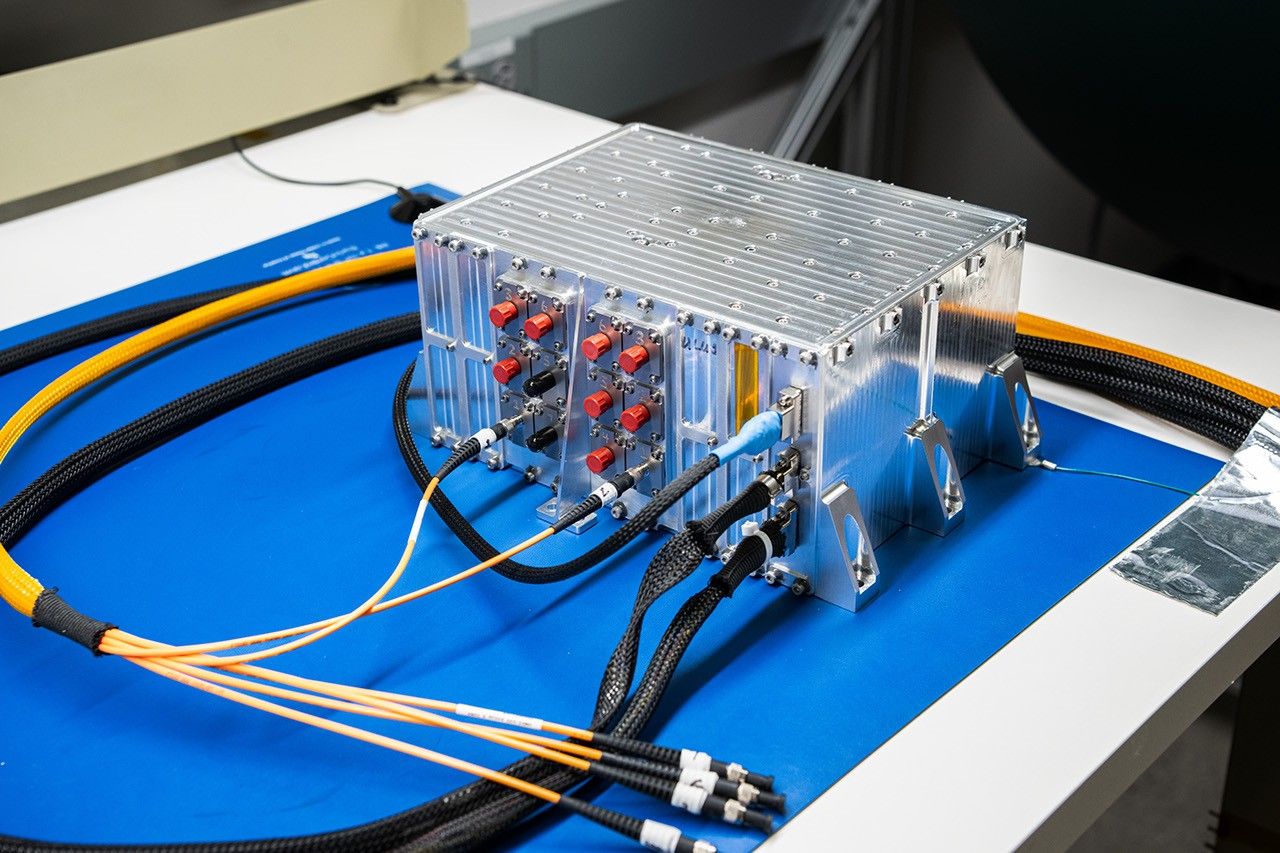
NASA’s contributions are part of the agency’s efforts to innovate on ambitious science missions that will help us better understand how the universe works. LISA will also offer a major advancement in multimessenger astronomy, which is how scientists explore cosmic signals other than light.
The three LISA spacecraft will fly in a vast triangular formation that follows Earth as it orbits the Sun. Each arm of the triangle will stretch 1.6 million miles (2.5 million kilometers).
Each spacecraft will contain two free-floating cubes inside called proof masses. Arriving gravitational waves from throughout the universe will minutely change the lengths of the triangle’s arms. The lasers connecting the cubes will measure changes in their separation to within a distance smaller than a helium atom.
In May 2024, technicians inspected the prototype LISA telescope in a darkened clean room at NASA Goddard. Illuminated by a flashlight, the telescope’s structure glows. The prototype is made from a translucent, amber-colored, glass-ceramic material called Zerodur, which is often used in high-precision applications because it resists changes in shape over a wide temperature range. The mirror, near center and coated in gold, reflects a magnified image of part of the telescope.NASA/Dennis Henry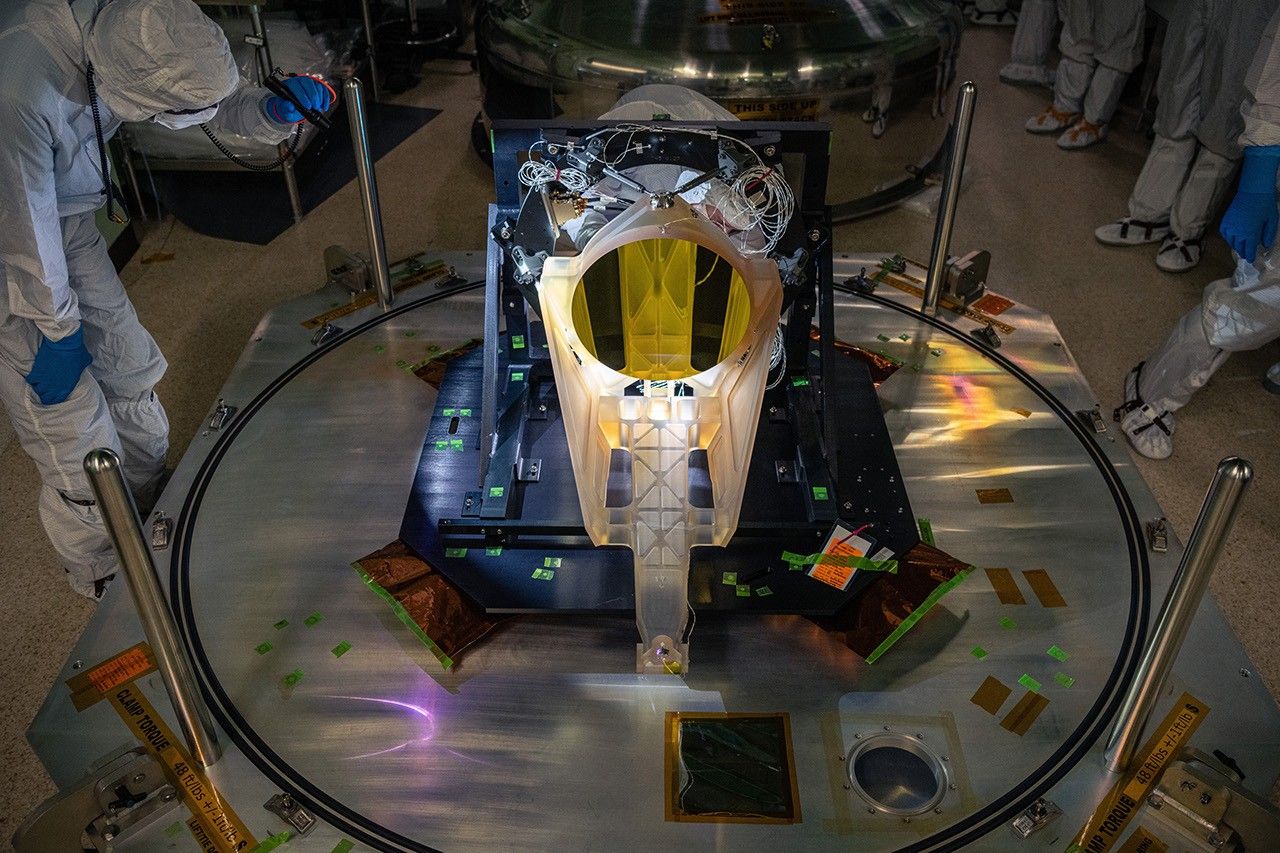
The enormous scale of the triangle will enable LISA to detect gravitational waves that cannot be found with ground-based facilities, such as those generated when massive black holes in the centers of galaxies merge. Scientists can use the data to learn about a source’s distance and physical properties.
The LISA mission is slated to launch in the mid-2030s.
By Jeanette Kazmierczak
NASA’s Goddard Space Flight Center, Greenbelt, Md.
Media Contact:
Claire Andreoli
301-286-1940
NASA’s Goddard Space Flight Center, Greenbelt, Md.
NASA, Partners Advance LISA Prototype Hardware
3 min read
NASA, Partners Advance LISA Prototype HardwareEngineers and scientists at NASA’s Goddard Space Flight Center in Greenbelt, Maryland, completed tests this month on a second early version of a key element of the upcoming LISA (Laser Interferometer Space Antenna) mission.
The LISA mission, a collaboration between ESA (the European Space Agency) and NASA, will use infrared lasers to detect gravitational waves, or ripples in the fabric of space-time. The tests involved the frequency reference system, delivered by BAE Systems, that will help control the lasers connecting LISA’s three spacecraft. The lasers must be finely tuned to make precise measurements — to within a trillionth of a meter, called a picometer.
A prototype laser optical module for LISA (Laser Interferometer Space Antenna) rests on a table after testing at NASA’s Goddard Space Flight Center in Greenbelt, Maryland, in May 2025. Xiaozhen Xu, an engineer with Miller Engineering and Research Corp., works in the background. The smaller box to the right is the laser electronics module. Each of the three LISA spacecraft will have a laser system with a frequency reference component and six laser heads.NASA/Sophia Roberts Download high-resolution images from NASA’s Scientific Visualization StudioThe team tested the first version of the system in May 2025.
“The extensive round of checkouts on the frequency reference system last year were very successful,” said Ira Thorpe, the project scientist for LISA at NASA Goddard. “This second unit is identical, so our assessments this time around were less intense and preface a future cross-check of the two, which is the gold-standard for checking the stability of the system overall.”
In addition to the laser system, NASA is contributing the telescopes, devices to manage the buildup of onboard electrical charge, and the framework scientists will need to process the data the mission will generate.
A prototype charge management device for LISA sits on a lab bench at NASA Goddard in May 2025. Each of the three LISA spacecraft will have a charge management device to reduce the buildup of electric charge on the gold-platinum proof masses that fly freely inside the spacecraft. The University of Florida in Gainesville and Fibertek Inc. in McNair, Va., are developing the devices.NASA/Dennis HenryNASA’s contributions are part of the agency’s efforts to innovate on ambitious science missions that will help us better understand how the universe works. LISA will also offer a major advancement in multimessenger astronomy, which is how scientists explore cosmic signals other than light.
The three LISA spacecraft will fly in a vast triangular formation that follows Earth as it orbits the Sun. Each arm of the triangle will stretch 1.6 million miles (2.5 million kilometers).
Each spacecraft will contain two free-floating cubes inside called proof masses. Arriving gravitational waves from throughout the universe will minutely change the lengths of the triangle’s arms. The lasers connecting the cubes will measure changes in their separation to within a distance smaller than a helium atom.
In May 2024, technicians inspected the prototype LISA telescope in a darkened clean room at NASA Goddard. Illuminated by a flashlight, the telescope’s structure glows. The prototype is made from a translucent, amber-colored, glass-ceramic material called Zerodur, which is often used in high-precision applications because it resists changes in shape over a wide temperature range. The mirror, near center and coated in gold, reflects a magnified image of part of the telescope.NASA/Dennis HenryThe enormous scale of the triangle will enable LISA to detect gravitational waves that cannot be found with ground-based facilities, such as those generated when massive black holes in the centers of galaxies merge. Scientists can use the data to learn about a source’s distance and physical properties.
The LISA mission is slated to launch in the mid-2030s.
By Jeanette Kazmierczak
NASA’s Goddard Space Flight Center, Greenbelt, Md.
Media Contact:
Claire Andreoli
301-286-1940
NASA’s Goddard Space Flight Center, Greenbelt, Md.
European Space Conference in Bruxelles: ESA DG keynote address
Watch the keynote address by ESA Director General Josef Aschbacher at the 18th European Space Conference in Brussels.
The European Space Conference is a key strategic event bringing together representatives from ESA, the European Commission, industry, national space agencies and other European institutions to discuss the future of Europe in space.
1400 quirky objects found in Hubble's archive
A team of astronomers have used a new AI-assisted method to search for rare astronomical objects in the Hubble Legacy Archive. The team sifted through nearly 100 million image cutouts in just two and a half days, uncovering nearly 1400 anomalous objects, more than 800 of which had never been documented before.
The HWO Must Be Picometer Perfect To Observe Earth 2.0
Lately we’ve been reporting about a series of studies on the Habitable Worlds Observatory (HWO), NASA’s flagship telescope mission for the 2040s. These studies have looked at the type of data they need to collect, and what the types of worlds they would expect to find would look like. Another one has been released in pre-print form on arXiv from the newly formed HWO Technology Maturation Project Office, which details the technology maturation needed for this powerful observatory and the “trade space” it will need to explore to be able to complete its stated mission.
ESA at the European Space Conference - Day 1
The European Space Agency discussed plans for its record budget as the 18th European Space Conference began in Brussels, Belgium on 27 January.
Asteroid 2024 YR4 Has a 4% Chance of Hitting the Moon. Here’s Why That’s a Scientific Goldmine.
There’s a bright side to every situation. In 2032, the Moon itself might have a particularly bright side if it is blasted by a 60-meter-wide asteroid. The chances of such an event are still relatively small (only around 4%), but non-negligible. And scientists are starting to prepare both for the bad (massive risks to satellites and huge meteors raining down on a large portion of the planet) and the good (a once in a lifetime chance to study the geology, seismology, and chemical makeup of our nearest neighbor). A new paper from Yifan He of Tsinghua University and co-authors, released in pre-print form on arXiv, looks at the bright side of all of the potential interesting science we can do if a collision does, indeed, happen.
Menopause linked to changes in brain’s gray matter, new study shows
Brain changes during menopause could help explain why some people experience neurological symptoms such as anxiety, depression and memory problems
Europe’s next-generation weather satellite sends back first images
The first images from the Meteosat Third Generation-Sounder satellite have been shared at the European Space Conference in Brussels, showing how the mission will provide data on temperature and humidity, for more accurate weather forecasting over Europe and northern Africa.
We have a new way to explain why we agree on the nature of reality
We have a new way to explain why we agree on the nature of reality
Floods Inundate Southern Mozambique
- Earth
- Earth Observatory
- Image of the Day
- EO Explorer
- Topics
- More Content
- About
Floods Inundate Southern Mozambique
- Earth
- Earth Observatory
- Image of the Day
- EO Explorer
- Topics
- More Content
- About
Galilean Moons’ Water Differences Set During Formation
How long did it take to establish the water content within Jupiter’s Galilean moons, Io and Europa? This is what a recent study published in The Astrophysical Journal hopes to address as a team of scientists from the United States and France investigated the intricate processes responsible for the formation and evolution of Io and Europa. This study has the potential to help scientists better understand the formation and evolution of two of the most unique moons in the solar system, as Io and Europa are known as the most volcanically active body in the solar system and an ocean world estimated to contain twice the volume of Earth’s oceans, respectively.