
Feed aggregator
Is the flu shot linked to dysphonia? Here’s what the science says
The U.S. secretary of health and human services told USA Today that he believed the flu jab was a “potential culprit” for his spasmodic dysphonia that he could not “rule out”
Ancient bacterium discovery rewrites the origins of syphilis
Ancient bacterium discovery rewrites the origins of syphilis
Sonic booms can protect Earth from dangerous space junk
Scientists are using technology developed to study earthquakes to address an out-of-this-world risk
Ancient bacterium’s genome could rewrite the history of syphilis
Treponema pallidum, a microorganism that can cause a deadly sexually transmitted disease in humans, may have a far more ancient lineage than scientists once thought
Parents might age faster or slower based on how many kids they have
A new study found that women in Finland who had a lot of kids—or none—aged faster than those with one or a few kids. But the findings don’t necessarily translate to today’s parents
Probing the Mysteries of the Solar Corona with ESA’s Proba-3
Some really unique science can be done during a total solar eclipse. Totality is the one time we can see the elusive corona of the Sun, the pearly white segment of our host star’s lower atmosphere where space weather activity originates. The trouble is, totality is fleeting. What researchers really need are eclipses on demand. ESA’s innovative Proba-3 mission does just that, by making use of a free-flying occulting disk. Launched in late 2024, we’re now seeing some unique science and images from the space observatory.
Our oral microbiome could hold the key to preventing obesity
Our oral microbiome could hold the key to preventing obesity
Ancient giant kangaroos could have hopped despite their huge size
Ancient giant kangaroos could have hopped despite their huge size
NASA AI Model That Found 370 Exoplanets Now Digs Into TESS Data
4 min read
NASA AI Model That Found 370 Exoplanets Now Digs Into TESS Data This artist’s impression shows the star TRAPPIST-1 with two planets transiting across it. ExoMiner++, a recently updated open-source software package developed by NASA, uses artificial intelligence to help find new transiting exoplanets in data collected by NASA’s missions. NASA, ESA, and G. Bacon (STScI)
Scientists have discovered over 6,000 planets that orbit stars other than our Sun, known as exoplanets. More than half of these planets were discovered thanks to data from NASA’s retired Kepler mission and NASA’s current TESS (Transiting Exoplanet Survey Satellite) mission. However, the enormous treasure trove of data from these missions still contains many yet-to-be-discovered planets. All of the data from both missions is publicly available in NASA archives, and many teams around the world have used that data to find new planets using a number of techniques.
In 2021, a team from NASA’s Ames Research Center in California’s Silicon Valley created ExoMiner, a piece of open-source software that used artificial intelligence (AI) to validate 370 new exoplanets from Kepler data. Now, the team has created a new version of the model trained on both Kepler and TESS data, called ExoMiner++.
Artist’s impression of NASA’s Transiting Exoplanet Survey Satellite (TESS), which launched in 2018 and has discovered nearly 700 exoplanets so far. NASA’s ExoMiner++ software is working toward identifying more planets in TESS data using artificial intelligence. NASA’s Goddard Space Flight Center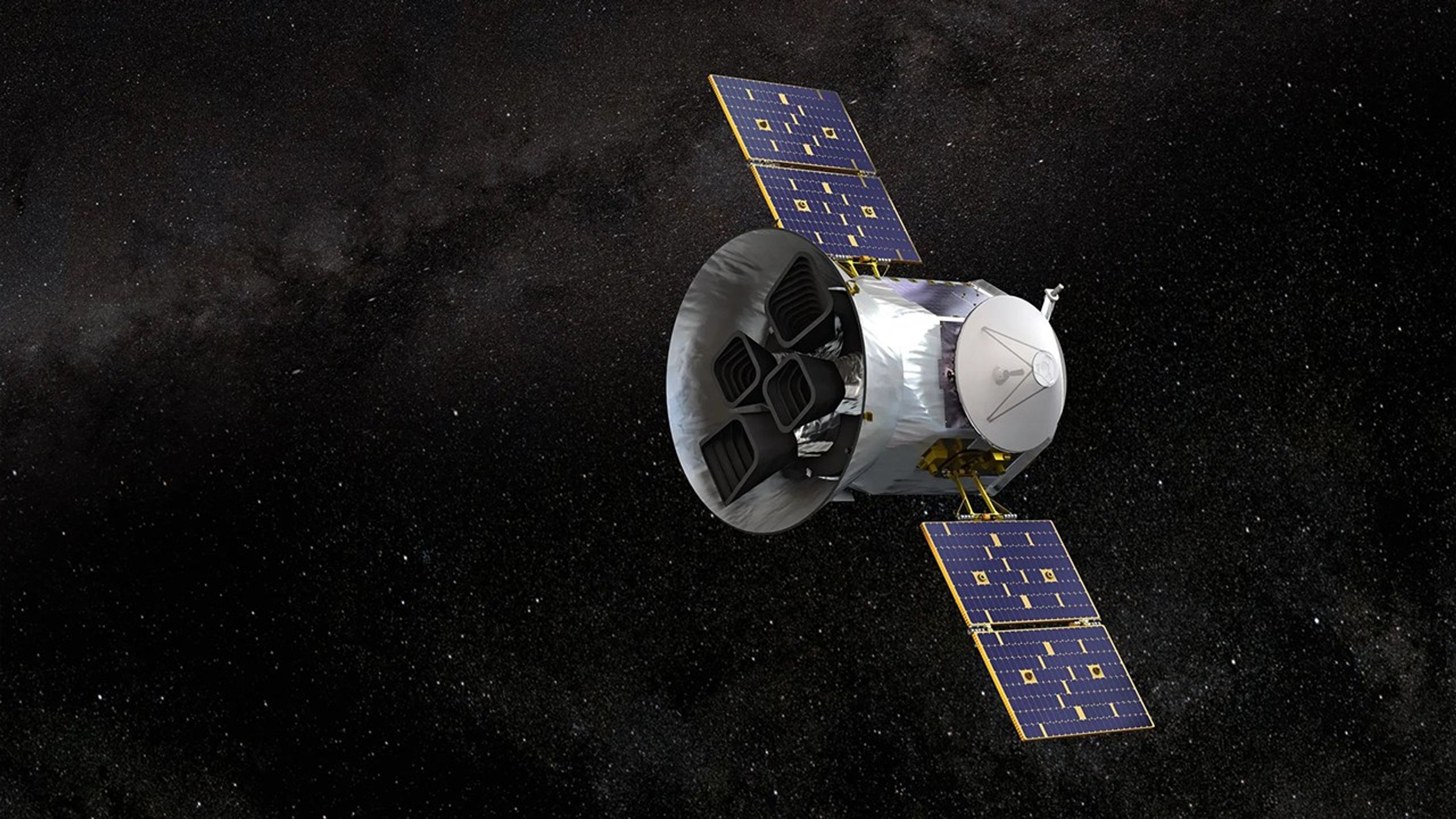
The new algorithm, which is discussed in a recent paper published in the Astronomical Journal, identified 7,000 targets as exoplanet candidates from TESS on an initial run. An exoplanet candidate is a signal that is likely to be a planet but requires follow-up observations from additional telescopes to confirm.
ExoMiner++ can be freely downloaded from GitHub, allowing any researcher to use the tool to hunt for planets in TESS’s growing public data archive.
“Open-source software like ExoMiner accelerates scientific discovery,” said Kevin Murphy, NASA’s chief science data officer at NASA Headquarters in Washington. “When researchers freely share the tools they’ve developed, it lets others replicate the results and dig deeper into the data, which is why open data and code are important pillars of gold-standard science.”
ExoMiner++ sifts through observations of possible transits to predict which ones are caused by exoplanets and which ones are caused by other astronomical events, such as eclipsing binary stars. “When you have hundreds of thousands of signals, like in this case, it’s the ideal place to deploy these deep learning technologies,” said Miguel Martinho, a KBR employee at NASA Ames who serves as the co-investigator for ExoMiner++.
To view this video please enable JavaScript, and consider upgrading to a web browser that
supports HTML5 video
Kepler and TESS operate differently — TESS is surveying nearly the whole sky, mainly looking for planets transiting nearby stars, while Kepler looked at a small patch of sky more deeply than TESS. Despite these different observing strategies, the two missions produce compatible datasets, allowing ExoMiner++ to train on data from both telescopes and deliver strong results. “With not many resources, we can make a lot of returns,” said Hamed Valizadegan, the project lead for ExoMiner and a KBR employee at NASA Ames.
The next version of ExoMiner++ will improve the usefulness of the model and inform future exoplanet detection efforts. While ExoMiner++ can currently flag planet candidates when given a list of possible transit signals, the team is also working on giving the model the ability to identify the signals themselves from the raw data.
Open-source science and open-source software are why the exoplanet field is advancing as quickly as it is.Jon Jenkins
Exoplanet Scientist, NASA Ames Research Center
In addition to the ongoing stream of data from TESS, future exoplanet-hunting missions will give ExoMiner users plenty more data to work with. NASA’s upcoming Nancy Grace Roman Space Telescope will capture tens of thousands of exoplanet transits — and, like TESS data, Roman data will be freely available in line with NASA’s commitment to Gold Standard Science and sharing data with the public. The advances made with the ExoMiner models could help hunt for exoplanets in Roman data, too.
“The open science initiative out of NASA is going to lead to not just better science, but also better software,” said Jon Jenkins, an exoplanet scientist at NASA Ames. “Open-source science and open-source software are why the exoplanet field is advancing as quickly as it is.”
NASA’s Office of the Chief Science Data Officer leads the open science efforts for the agency. Public sharing of scientific data, tools, research, and software maximizes the impact of NASA’s science missions. To learn more about NASA’s commitment to transparency and reproducibility of scientific research, visit science.nasa.gov/open-science. To get more stories about the impact of NASA’s science data delivered directly to your inbox, sign up for the NASA Open Science newsletter.
By Lauren Leese
Web Content Strategist for the Office of the Chief Science Data Officer
Article
2 weeks ago
5 min read NASA’s Hubble Sees Asteroids Colliding at Nearby Star for First Time
Article
1 month ago
6 min read NASA’s Webb Observes Exoplanet Whose Composition Defies Explanation
Article
1 month ago
Keep Exploring Discover Related Topics
Missions
Humans in Space
Climate Change
Solar System
NASA AI Model That Found 370 Exoplanets Now Digs Into TESS Data
4 min read
NASA AI Model That Found 370 Exoplanets Now Digs Into TESS Data This artist’s impression shows the star TRAPPIST-1 with two planets transiting across it. ExoMiner++, a recently updated open-source software package developed by NASA, uses artificial intelligence to help find new transiting exoplanets in data collected by NASA’s missions. NASA, ESA, and G. Bacon (STScI)Scientists have discovered over 6,000 planets that orbit stars other than our Sun, known as exoplanets. More than half of these planets were discovered thanks to data from NASA’s retired Kepler mission and NASA’s current TESS (Transiting Exoplanet Survey Satellite) mission. However, the enormous treasure trove of data from these missions still contains many yet-to-be-discovered planets. All of the data from both missions is publicly available in NASA archives, and many teams around the world have used that data to find new planets using a number of techniques.
In 2021, a team from NASA’s Ames Research Center in California’s Silicon Valley created ExoMiner, a piece of open-source software that used artificial intelligence (AI) to validate 370 new exoplanets from Kepler data. Now, the team has created a new version of the model trained on both Kepler and TESS data, called ExoMiner++.
Artist’s impression of NASA’s Transiting Exoplanet Survey Satellite (TESS), which launched in 2018 and has discovered nearly 700 exoplanets so far. NASA’s ExoMiner++ software is working toward identifying more planets in TESS data using artificial intelligence. NASA’s Goddard Space Flight CenterThe new algorithm, which is discussed in a recent paper published in the Astronomical Journal, identified 7,000 targets as exoplanet candidates from TESS on an initial run. An exoplanet candidate is a signal that is likely to be a planet but requires follow-up observations from additional telescopes to confirm.
ExoMiner++ can be freely downloaded from GitHub, allowing any researcher to use the tool to hunt for planets in TESS’s growing public data archive.
“Open-source software like ExoMiner accelerates scientific discovery,” said Kevin Murphy, NASA’s chief science data officer at NASA Headquarters in Washington. “When researchers freely share the tools they’ve developed, it lets others replicate the results and dig deeper into the data, which is why open data and code are important pillars of gold-standard science.”
ExoMiner++ sifts through observations of possible transits to predict which ones are caused by exoplanets and which ones are caused by other astronomical events, such as eclipsing binary stars. “When you have hundreds of thousands of signals, like in this case, it’s the ideal place to deploy these deep learning technologies,” said Miguel Martinho, a KBR employee at NASA Ames who serves as the co-investigator for ExoMiner++.
To view this video please enable JavaScript, and consider upgrading to a web browser that
supports HTML5 video
Kepler and TESS operate differently — TESS is surveying nearly the whole sky, mainly looking for planets transiting nearby stars, while Kepler looked at a small patch of sky more deeply than TESS. Despite these different observing strategies, the two missions produce compatible datasets, allowing ExoMiner++ to train on data from both telescopes and deliver strong results. “With not many resources, we can make a lot of returns,” said Hamed Valizadegan, the project lead for ExoMiner and a KBR employee at NASA Ames.
The next version of ExoMiner++ will improve the usefulness of the model and inform future exoplanet detection efforts. While ExoMiner++ can currently flag planet candidates when given a list of possible transit signals, the team is also working on giving the model the ability to identify the signals themselves from the raw data.
Open-source science and open-source software are why the exoplanet field is advancing as quickly as it is.Jon Jenkins
Exoplanet Scientist, NASA Ames Research Center
In addition to the ongoing stream of data from TESS, future exoplanet-hunting missions will give ExoMiner users plenty more data to work with. NASA’s upcoming Nancy Grace Roman Space Telescope will capture tens of thousands of exoplanet transits — and, like TESS data, Roman data will be freely available in line with NASA’s commitment to Gold Standard Science and sharing data with the public. The advances made with the ExoMiner models could help hunt for exoplanets in Roman data, too.
“The open science initiative out of NASA is going to lead to not just better science, but also better software,” said Jon Jenkins, an exoplanet scientist at NASA Ames. “Open-source science and open-source software are why the exoplanet field is advancing as quickly as it is.”
NASA’s Office of the Chief Science Data Officer leads the open science efforts for the agency. Public sharing of scientific data, tools, research, and software maximizes the impact of NASA’s science missions. To learn more about NASA’s commitment to transparency and reproducibility of scientific research, visit science.nasa.gov/open-science. To get more stories about the impact of NASA’s science data delivered directly to your inbox, sign up for the NASA Open Science newsletter.
By Lauren Leese
Web Content Strategist for the Office of the Chief Science Data Officer
Article
2 weeks ago
5 min read NASA’s Hubble Sees Asteroids Colliding at Nearby Star for First Time
Article
1 month ago
6 min read NASA’s Webb Observes Exoplanet Whose Composition Defies Explanation
Article
1 month ago
Keep Exploring Discover Related Topics
Missions
Humans in Space
Climate Change
Solar System
Watch Stellar Explosions Near and Far (Videos)
New videos from the Solar Orbiter and the Chandra X-ray Observatory capture magnetic avalanches on the Sun and the exploding remnants of a star 17,000 light-years away.
The post Watch Stellar Explosions Near and Far (Videos) appeared first on Sky & Telescope.
Does limiting social media help teens? We'll finally get some evidence
Does limiting social media help teens? We'll finally get some evidence
Mutations from Space Might Solve an Antibiotic Crisis
If humans are ever going to expand into space itself, it will have to be for a reason. Optimists think that reason is simply due to our love of exploration itself. But in history, it is more often a profit motive that has led humans to seek out new lands. So, it stands to reason that, in order for us to truly begin space colonization, we will have to have a business-related reason to do so. A new paper from the lab of Srivatsan Raman at the University of Wisconsin-Madison and recently published in PLOS Biology, describes one potential such business case - genetically modifying bacteriophages to attack antibiotic resistant bacteria.
Scientists just calculated how many microplastics are in our atmosphere. The number is absolutely shocking
A new estimate suggests land sources eject 600 quadrillion pieces of microplastic into the atmosphere every year
Arctic Weather Satellite paves way for constellation
Already recognised for its excellence and even adopted for operational weather forecasting, the European Space Agency’s Arctic Weather Satellite has now fulfilled its most important role. This small prototype mission has succeeded in paving the way for a new constellation of similar satellites, known as EPS-Sterna.