
Feed aggregator
Exercise may relieve depression as effectively as antidepressants
Does Free Will Exist? Part 3: A Superdeterministic Universe
So let’s say you set up an experiment to measure a quantum property of subatomic particles. Like, I don’t know, spin.
Does Free Will Exist? Part 2: The Chaotic Universe
All of physics rests on causal determinism. It’s like…how we do physics. It IS physics.
Europa May Be Lifeless and Unihabitable After All
New research shows that Jupiter's moon Europa, one of the prime targets in the search for life, may not have the conditions required after all. The research shows that the moon lacks the type of active seafloor faulting needed to create habitability. Deep sea vents created by the faulting introduce nutrients into the water that organisms use to harness energy, and without those nutrients, the moon's subsurface ocean is likely dead.
Weight regain seems to occur within 2 years of stopping obesity drugs
Weight regain seems to occur within 2 years of stopping obesity drugs
NASA Mulls Ending Space Station Crew-11 Mission Early after Astronaut Suffers Medical Issue
NASA may bring some of the ISS’s crew home earlier than planned after one member experienced a medical issue just hours before two astronauts were due to complete a space walk outside the station on Wednesday
NASA Celebrates Artemis II During Houston Texans Space City Day
NASA’s Johnson Space Center was front and center Jan. 4, 2026, as the Houston Texans faced the Indianapolis Colts during Space City Day at NRG Stadium. Fans watched the Texans win while getting a close look at NASA’s Artemis II mission, the first crewed flight of the Artemis campaign.
The Artemis II mission will send four astronauts—NASA astronauts Reid Wiseman, Victor Glover, and Christina Koch, along with CSA (Canadian Space Agency) astronaut Jeremy Hansen—around the Moon and back to Earth to test Orion spacecraft systems in deep space and help lay the groundwork for future lunar missions.
NASA connected fans with the agency’s next giant leap, reinforcing Space City’s role in shaping the future of human exploration.
NASA’s Johnson Space Center employees hold the American flag on the field during the national anthem at NRG Stadium in Houston.Image courtesy of the Houston Texans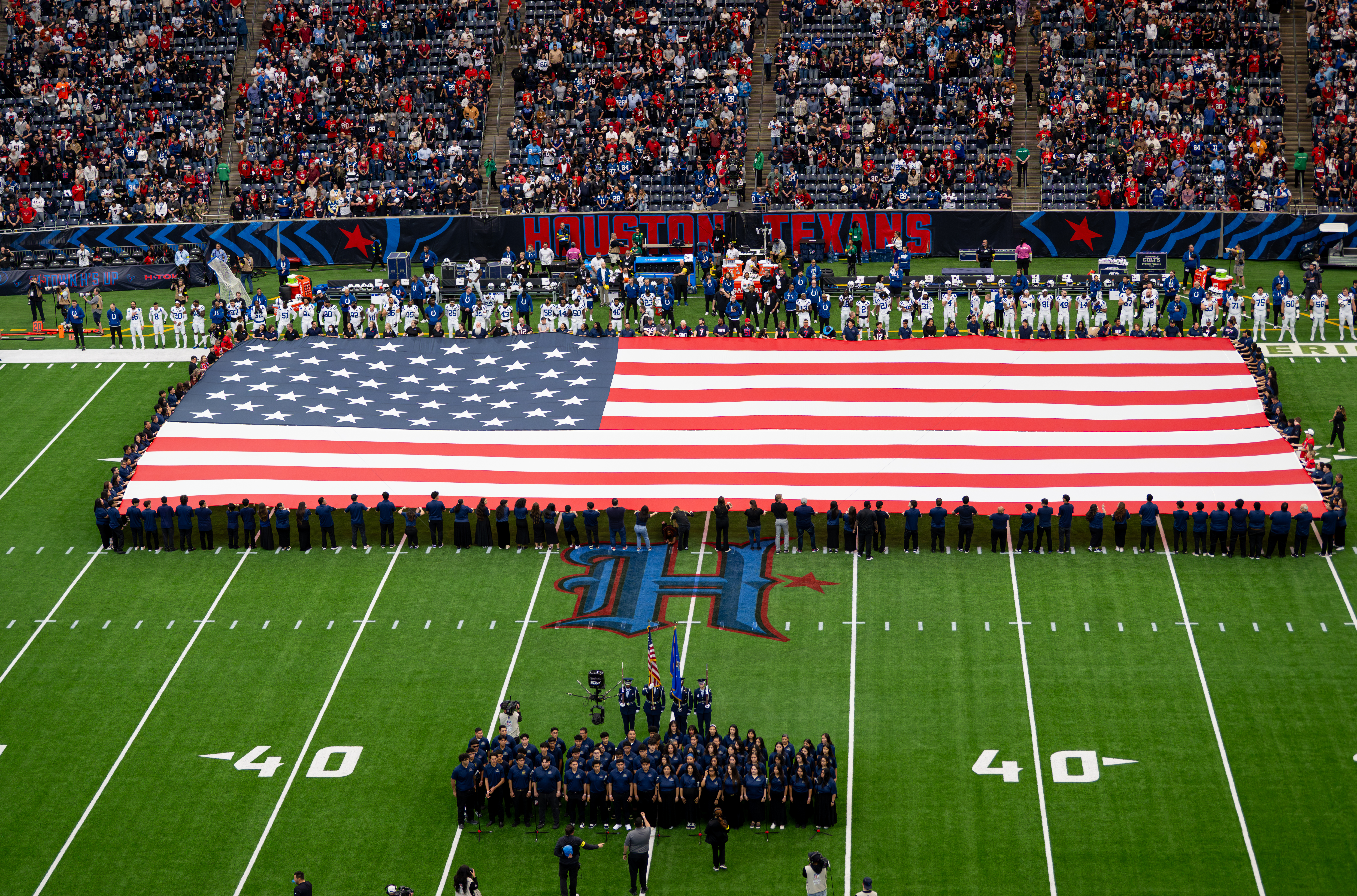
Before kickoff, 27 Johnson employees helped unfurl the U.S. flag for the national anthem, marking the start of an evening that blended football, exploration, and Houston pride.
Johnson employees gather on the BULLevard to share the excitement of space exploration with football fans.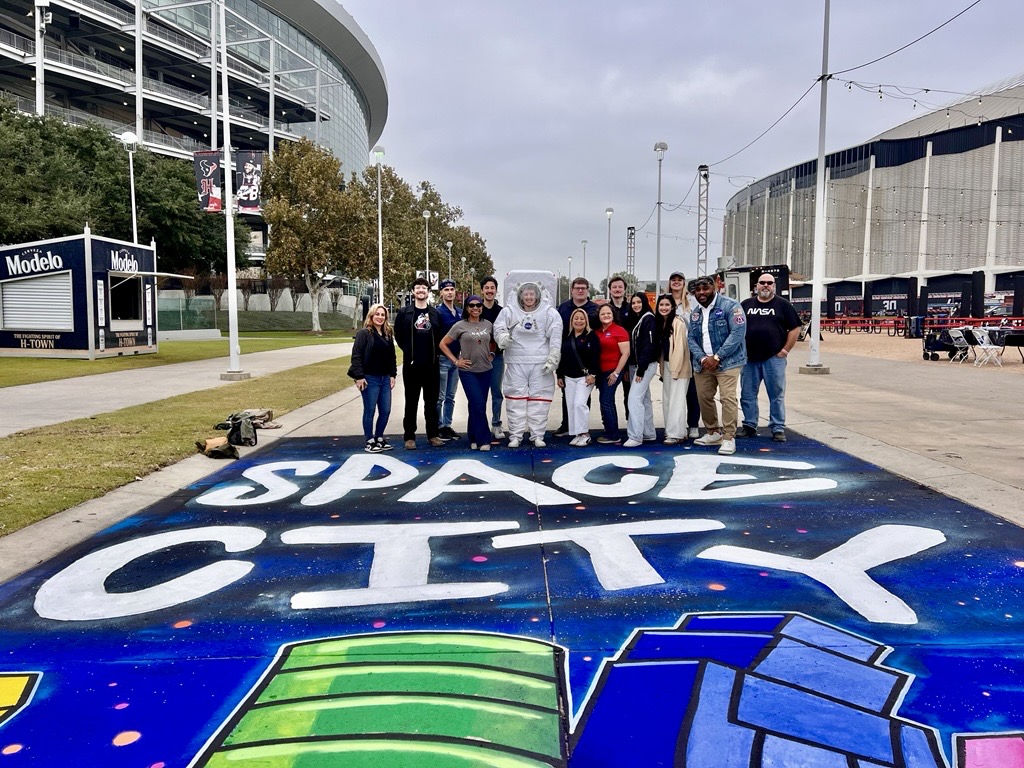
On the BULLevard, Johnson employees engaged with fans at a NASA activation area, where visitors explored the agency’s Mobile Exhibit Trailer and learned more about Artemis II. Team members answered questions and shared how NASA is preparing to send humans back to the Moon.
From left, Johnson Community Engagement Lead Jessica Cordero, NASA astronaut Jessica Watkins, Johnson Space Center Director Vanessa Wyche, NASA Flight Controller Jonathan Guthmiller wearing the Extravehicular Mobility Unit (EMU), Multimedia Developer Jessica Krenzel, and NASA Flight Controller Sarah Hill stand together during the outdoor engagement on the BULLevard outside NRG Stadium.
Johnson Director Vanessa Wyche and NASA astronaut Jessica Watkins visited the exhibit and the Extravehicular Activity and Human Surface Mobility Program booth, where they greeted team members and thanked volunteers supporting the event.
The International Space Station Program joined the celebration with a prerecorded message from the Expedition 74 crew, marking over 25 years of continuous human presence in low Earth orbit.
The Expedition 74 crew aboard the International Space Station deliver a prerecorded message to fans on the stadium jumbotron during the Houston Texans’ Space City Day game.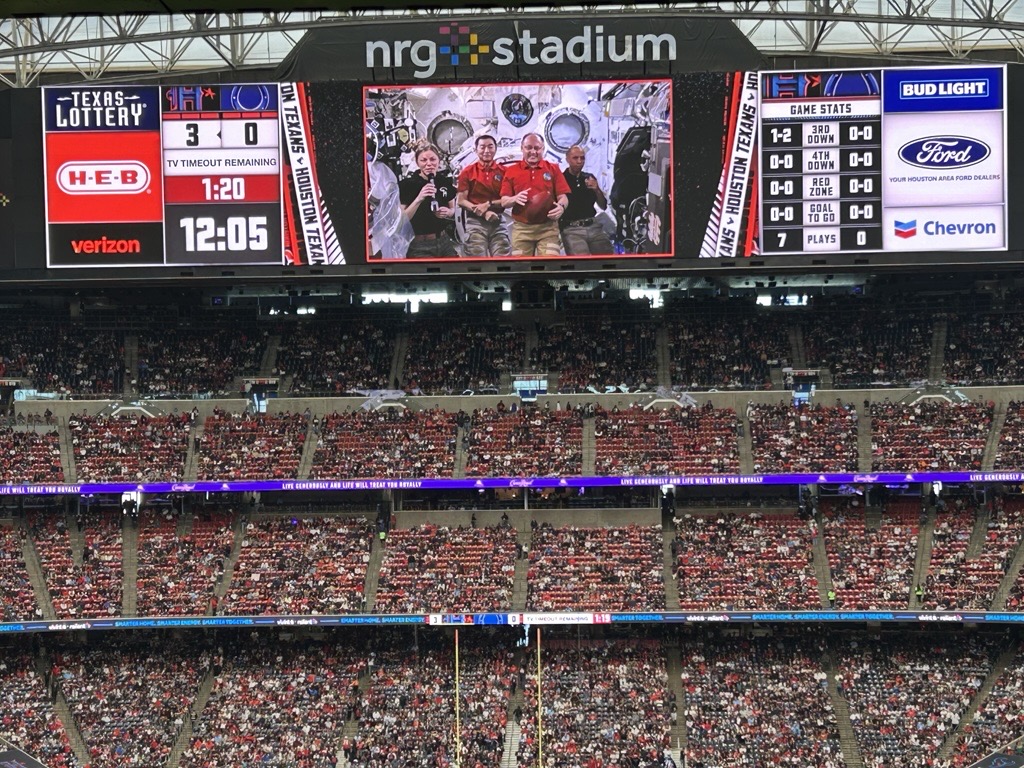
“Even from 250 miles above the Earth, we’re proud to represent Houston and celebrate the mission of this incredible city on and off the field,” said NASA astronaut Mike Fincke.
“Today’s game reminds us how connected Houston, NASA, and the Texans truly are,” said NASA astronaut Zena Cardman.
Cardman highlighted how research aboard the International Space Station has led to innovations that benefit life on Earth, including applications now used in sports and athletic safety. Advances in materials developed for spacesuits and astronaut protection have influenced the design of modern helmets and padding, while cooling technologies originally created for extreme environments are used in training gear and protective equipment.
“Space innovation doesn’t remain in orbit, sometimes it ends up on the 50-yard line.”
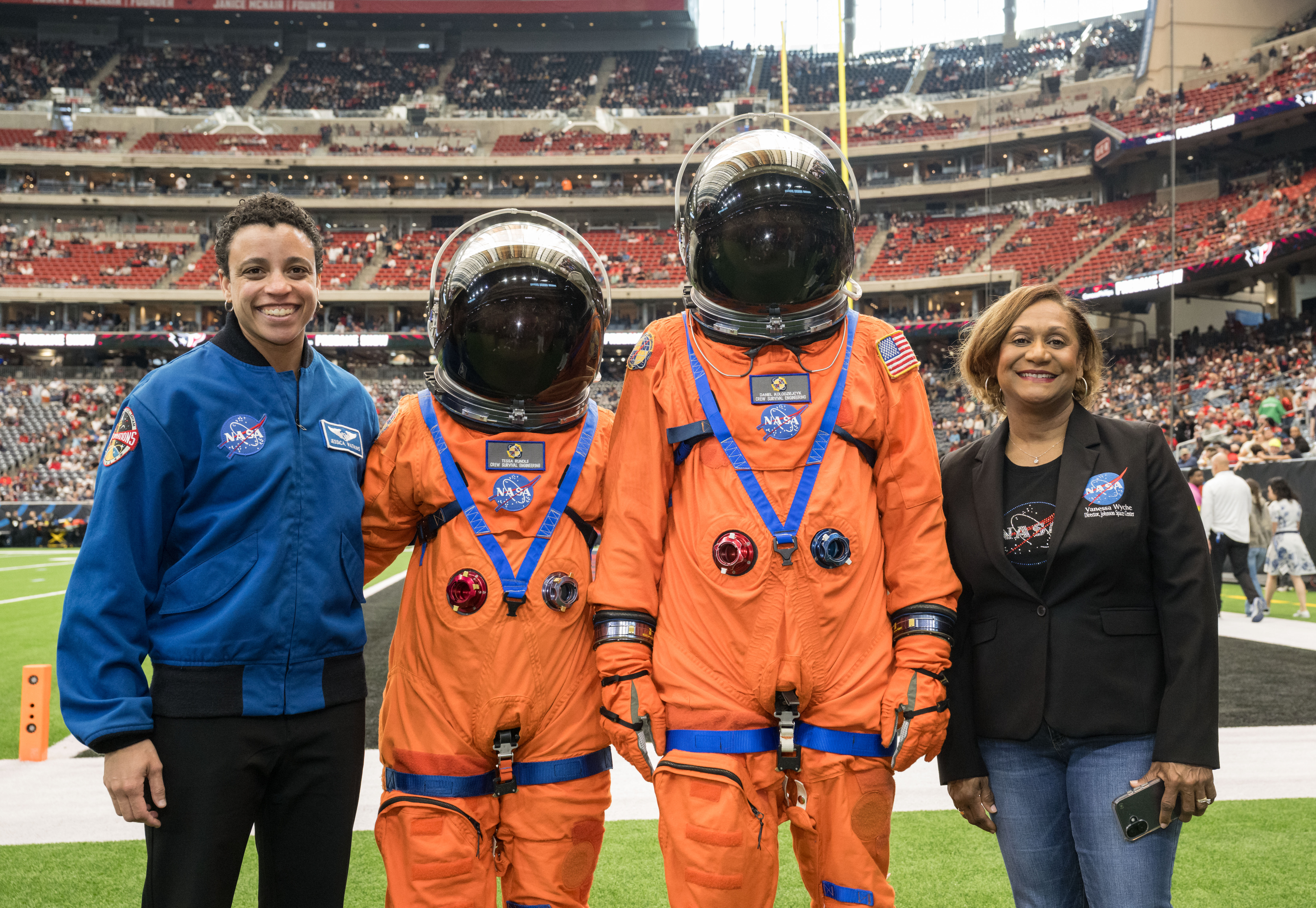
NASA astronaut Jessica Watkins, center, and Johnson employees Tessa Rundle and Daniel Kolodziejcyk, wearing Orion Crew Survival System spacesuits, take the field during the Texans’ “Reppin’ H-Town” appearance. Image courtesy of the Houston Texans Johnson Director Vanessa Wyche waves to fans after participating in the ceremonial coin toss.Image courtesy of the Houston Texans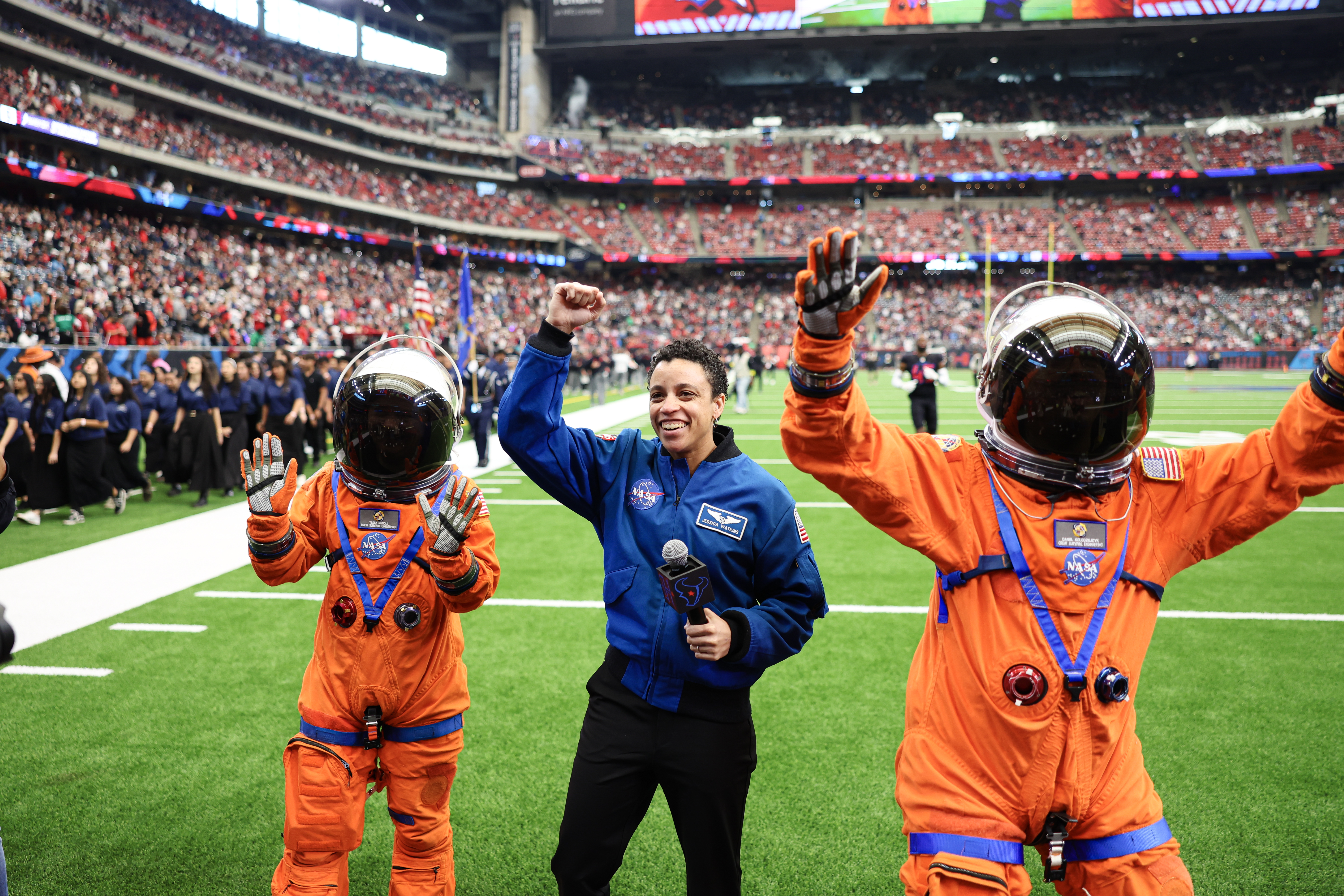

Jessica Watkins took the field for the Texans’ “Reppin’ H-Town” appearance, joined by Johnson employees Tessa Rundle and Daniel Kolodziejcyk wearing NASA’s Orion Crew Survival System spacesuits. The bright orange pressure suits are designed to protect astronauts during launch, flight, and reentry aboard NASA’s Orion spacecraft.
The pregame continued with Center Director Vanessa Wyche joining the festivities on the field and participating in the ceremonial coin toss, where she called heads.
About 30 seconds into halftime, the Artemis Fueling the Fire video played on the stadium jumbotron, sharing NASA’s plans to return humans to the Moon and marking a major step in the agency’s Moon to Mars campaign.
Center Director Vanessa Wyche and NASA astronaut Jessica Watkins are interviewed on the field during halftime.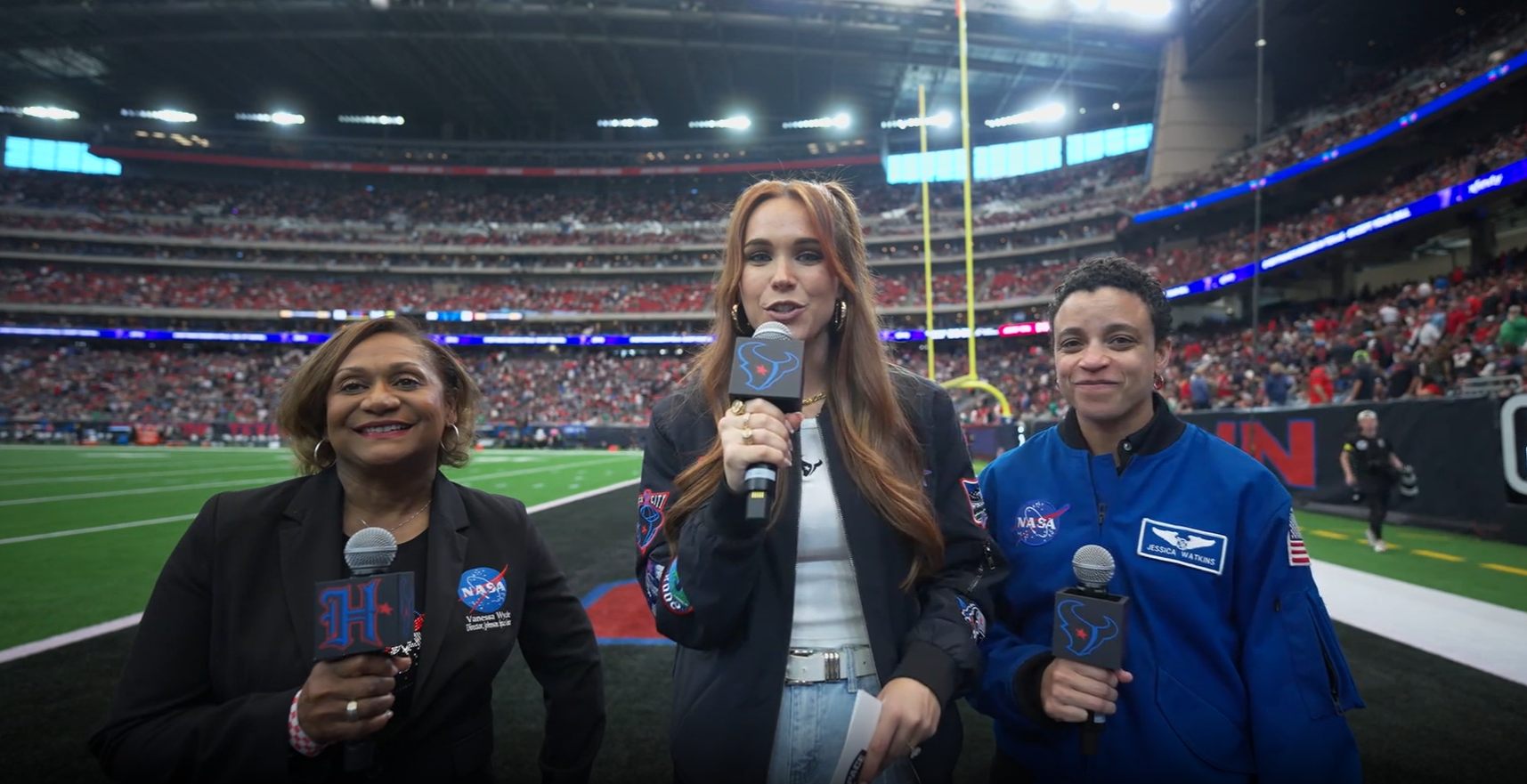
The video led into a live interview with Vanessa Wyche and Jessica Watkins, where Wyche discussed the Artemis II mission and Watkins highlighted similarities between astronaut training and football training. At the conclusion of the interview, the host invited fans to take part in NASA’s “Send Your Name with Artemis II” initiative, which allows the public to have their names stored on a small chip aboard the Orion spacecraft during the mission. Participants receive a digital boarding pass and virtual guest access to select NASA launches. While the names remain stored electronically inside the spacecraft, the effort symbolically gives participants a place on Orion’s journey around the Moon.
Image courtesy of the Houston Texans Image courtesy of the Houston Texans NASA/James Blair Image courtesy of the Houston Texans NASA/James Blair Explore More 1 min read NASA Starts Up Gateway’s Power System for First Time Article 4 hours ago 4 min read 25 Years in Orbit: Science, Innovation, and the Future of Exploration Article 24 hours ago 4 min read Diving Into Human Spaceflight Safety with NASA Johnson’s Craig Shannon Article 2 days agoNASA Celebrates Artemis II During Houston Texans Space City Day
NASA’s Johnson Space Center was front and center Jan. 4, 2026, as the Houston Texans faced the Indianapolis Colts during Space City Day at NRG Stadium. Fans watched the Texans win while getting a close look at NASA’s Artemis II mission, the first crewed flight of the Artemis campaign.
The Artemis II mission will send four astronauts—NASA astronauts Reid Wiseman, Victor Glover, and Christina Koch, along with CSA (Canadian Space Agency) astronaut Jeremy Hansen—around the Moon and back to Earth to test Orion spacecraft systems in deep space and help lay the groundwork for future lunar missions.
NASA connected fans with the agency’s next giant leap, reinforcing Space City’s role in shaping the future of human exploration.
NASA’s Johnson Space Center employees hold the American flag on the field during the national anthem at NRG Stadium in Houston.Image courtesy of the Houston TexansBefore kickoff, 27 Johnson employees helped unfurl the U.S. flag for the national anthem, marking the start of an evening that blended football, exploration, and Houston pride.
Johnson employees gather on the BULLevard to share the excitement of space exploration with football fans.On the BULLevard, Johnson employees engaged with fans at a NASA activation area, where visitors explored the agency’s Mobile Exhibit Trailer and learned more about Artemis II. Team members answered questions and shared how NASA is preparing to send humans back to the Moon.
From left, Johnson Community Engagement Lead Jessica Cordero, NASA astronaut Jessica Watkins, Johnson Space Center Director Vanessa Wyche, NASA Flight Controller Jonathan Guthmiller wearing the Extravehicular Mobility Unit (EMU), Multimedia Developer Jessica Krenzel, and NASA Flight Controller Sarah Hill stand together during the outdoor engagement on the BULLevard outside NRG Stadium.Johnson Director Vanessa Wyche and NASA astronaut Jessica Watkins visited the exhibit and the Extravehicular Activity and Human Surface Mobility Program booth, where they greeted team members and thanked volunteers supporting the event.
The International Space Station Program joined the celebration with a prerecorded message from the Expedition 74 crew, marking over 25 years of continuous human presence in low Earth orbit.
The Expedition 74 crew aboard the International Space Station deliver a prerecorded message to fans on the stadium jumbotron during the Houston Texans’ Space City Day game.“Even from 250 miles above the Earth, we’re proud to represent Houston and celebrate the mission of this incredible city on and off the field,” said NASA astronaut Mike Fincke.
“Today’s game reminds us how connected Houston, NASA, and the Texans truly are,” said NASA astronaut Zena Cardman.
Cardman highlighted how research aboard the International Space Station has led to innovations that benefit life on Earth, including applications now used in sports and athletic safety. Advances in materials developed for spacesuits and astronaut protection have influenced the design of modern helmets and padding, while cooling technologies originally created for extreme environments are used in training gear and protective equipment.
“Space innovation doesn’t remain in orbit, sometimes it ends up on the 50-yard line.”
NASA astronaut Jessica Watkins, center, and Johnson employees Tessa Rundle and Daniel Kolodziejcyk, wearing Orion Crew Survival System spacesuits, take the field during the Texans’ “Reppin’ H-Town” appearance. Image courtesy of the Houston Texans Johnson Director Vanessa Wyche waves to fans after participating in the ceremonial coin toss.Image courtesy of the Houston TexansJessica Watkins took the field for the Texans’ “Reppin’ H-Town” appearance, joined by Johnson employees Tessa Rundle and Daniel Kolodziejcyk wearing NASA’s Orion Crew Survival System spacesuits. The bright orange pressure suits are designed to protect astronauts during launch, flight, and reentry aboard NASA’s Orion spacecraft.
The pregame continued with Center Director Vanessa Wyche joining the festivities on the field and participating in the ceremonial coin toss, where she called heads.
About 30 seconds into halftime, the Artemis Fueling the Fire video played on the stadium jumbotron, sharing NASA’s plans to return humans to the Moon and marking a major step in the agency’s Moon to Mars campaign.
Center Director Vanessa Wyche and NASA astronaut Jessica Watkins are interviewed on the field during halftime.The video led into a live interview with Vanessa Wyche and Jessica Watkins, where Wyche discussed the Artemis II mission and Watkins highlighted similarities between astronaut training and football training. At the conclusion of the interview, the host invited fans to take part in NASA’s “Send Your Name with Artemis II” initiative, which allows the public to have their names stored on a small chip aboard the Orion spacecraft during the mission. Participants receive a digital boarding pass and virtual guest access to select NASA launches. While the names remain stored electronically inside the spacecraft, the effort symbolically gives participants a place on Orion’s journey around the Moon.
Image courtesy of the Houston Texans Image courtesy of the Houston Texans NASA/James Blair NASA NASA/James Blair Image courtesy of the Houston Texans NASA/James Blair Explore More 1 min read NASA Starts Up Gateway’s Power System for First Time Article 12 hours ago 4 min read 25 Years in Orbit: Science, Innovation, and the Future of Exploration Article 1 day ago 4 min read Diving Into Human Spaceflight Safety with NASA Johnson’s Craig Shannon Article 3 days agoOpenAI Would Like You to Share Your Health Data with Its ChatGPT
Users will be able to upload their health data to ChatGPT in order to get what OpenAI has described as a more personalized experience
X-Ray Spectra Could Help Reveal Dark Matter in Galaxy Clusters
A study published in the Astrophysical Journal Letters demonstrates that decaying dark matter (DDM) can potentially be detected in unidentified X-ray emission lines in the spectra of galaxy clusters.
Schmidt Sciences Announces Plan for Lazuli, a Private Space Telescope
Bigger than Hubble and launching as soon as 2029, the Lazuli Space Observatory would be the first-ever full-scale private space telescope
25 Years in Orbit: Science, Innovation, and the Future of Exploration
NASA and its partners have supported humans continuously living and working in space since November 2000. A truly global endeavor, the International Space Station has been visited by more than 290 people from 26 countries and a variety of international and commercial spacecraft. The unique microgravity laboratory has hosted more than 4,000 experiments from over 5,000 researchers from 110 countries. The space station also is facilitating the growth of a commercial market in low Earth orbit for research, technology development, and crew and cargo transportation.
After a quarter of century of human presence in orbit, the station remains a symbol of international cooperation and a proving ground for humanity’s next giant leaps to the Moon and, eventually, Mars.
September’s full Moon, the Harvest Moon, is photographed from the space station, placed in between exterior station hardware.NASAThe microgravity environments aboard the space station unlocks discoveries that benefit life on Earth and prepare humans for deep space missions. NASA’s Human Research Program (HRP) works to understand the changes astronauts face aboard the orbital outpost and to develop interventions to keep crews healthy before, during, and after flight.
Astronauts aboard the station exercise for roughly two hours a day to protect bone density, muscle strength, and the cardiovascular system, but the longer they are in microgravity, the harder it can be for the brain and body to readapt to gravity’s pull. After months in orbit, returning astronauts often describe Earth as heavy, loud, and strangely still. Some reacclimate within days, while other astronauts take longer to fully recover.
Through HRP-led studies, scientists track these changes and test solutions—from improved exercise regimens to medical monitoring and nutritional strategies. The results inspire new medical technologies, while teaching scientists how the human body adapts to long-duration spaceflights—knowledge that helps keep astronauts healthy on future missions.
In the Tranquility node of the orbiting laboratory, NASA astronaut Jessica Meir exercises on the Combined Operational Load Bearing External Resistance Treadmill (COLBERT), technically named the Treadmill 2 and abbreviated as T2. NASA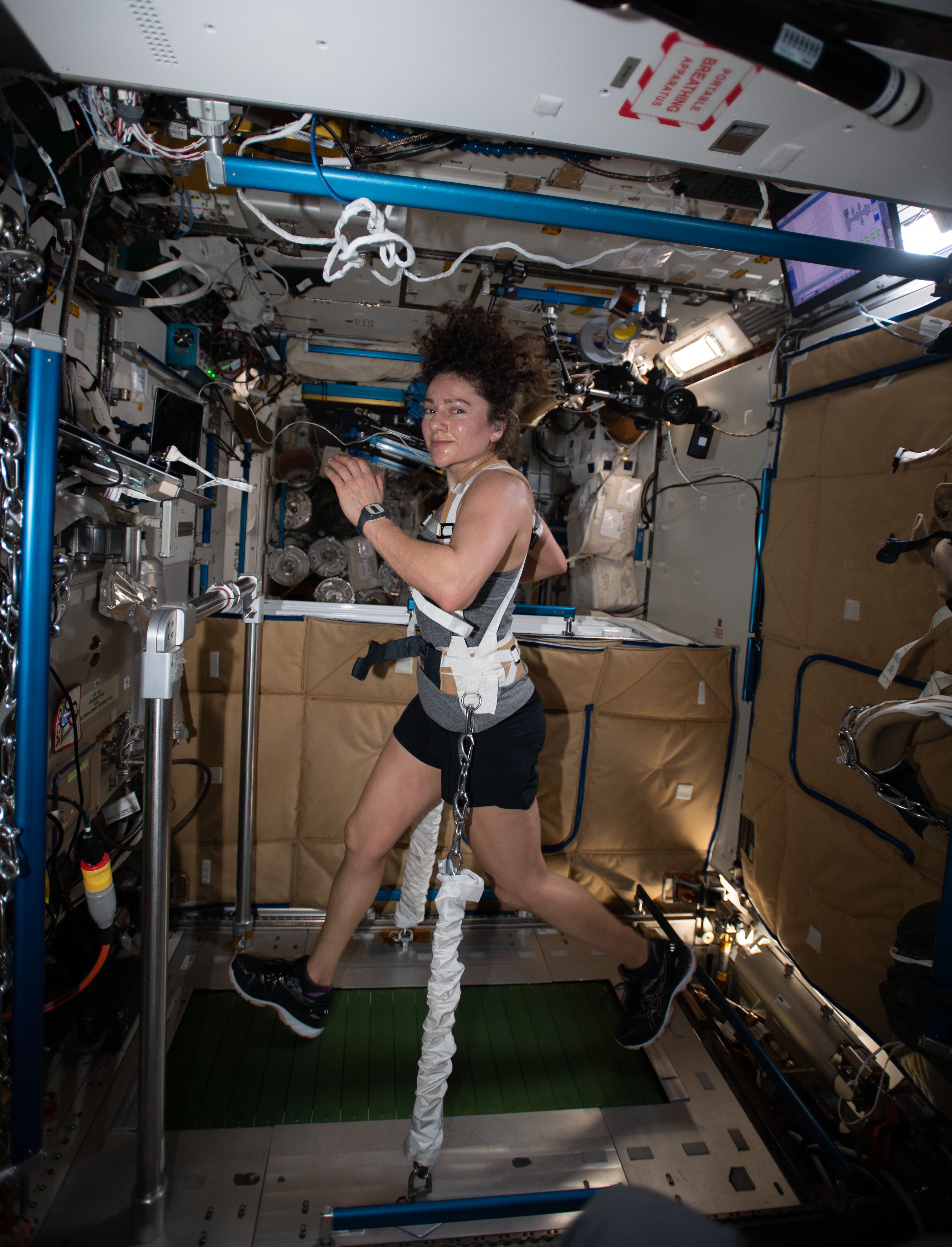
The space station continues to be a critical platform for sharpening skills, technology, and understanding that will prepare humanity to return to the Moon with NASA’s Artemis campaign and journey on to Mars and beyond.
Since space presents an entirely new physical environment with a distinct set of challenges, the orbiting laboratory is uniquely positioned to support research and preparations not possible on Earth. That includes:
- Mastering techniques for basic tasks like drinking water, sleeping, exercising, and handling various materials.
- Developing solutions to microgravity-induced changes to and challenges for the human body.
- Testing reliable technologies and self-sustaining ecosystems necessary for deep space travel, from life support systems to in-orbit agriculture and 3D printing of materials.
- Refining techniques and procedures for data and imagery collection and analysis.
Read more about how the space station has enabled significant strides in our journey farther into the final frontier.
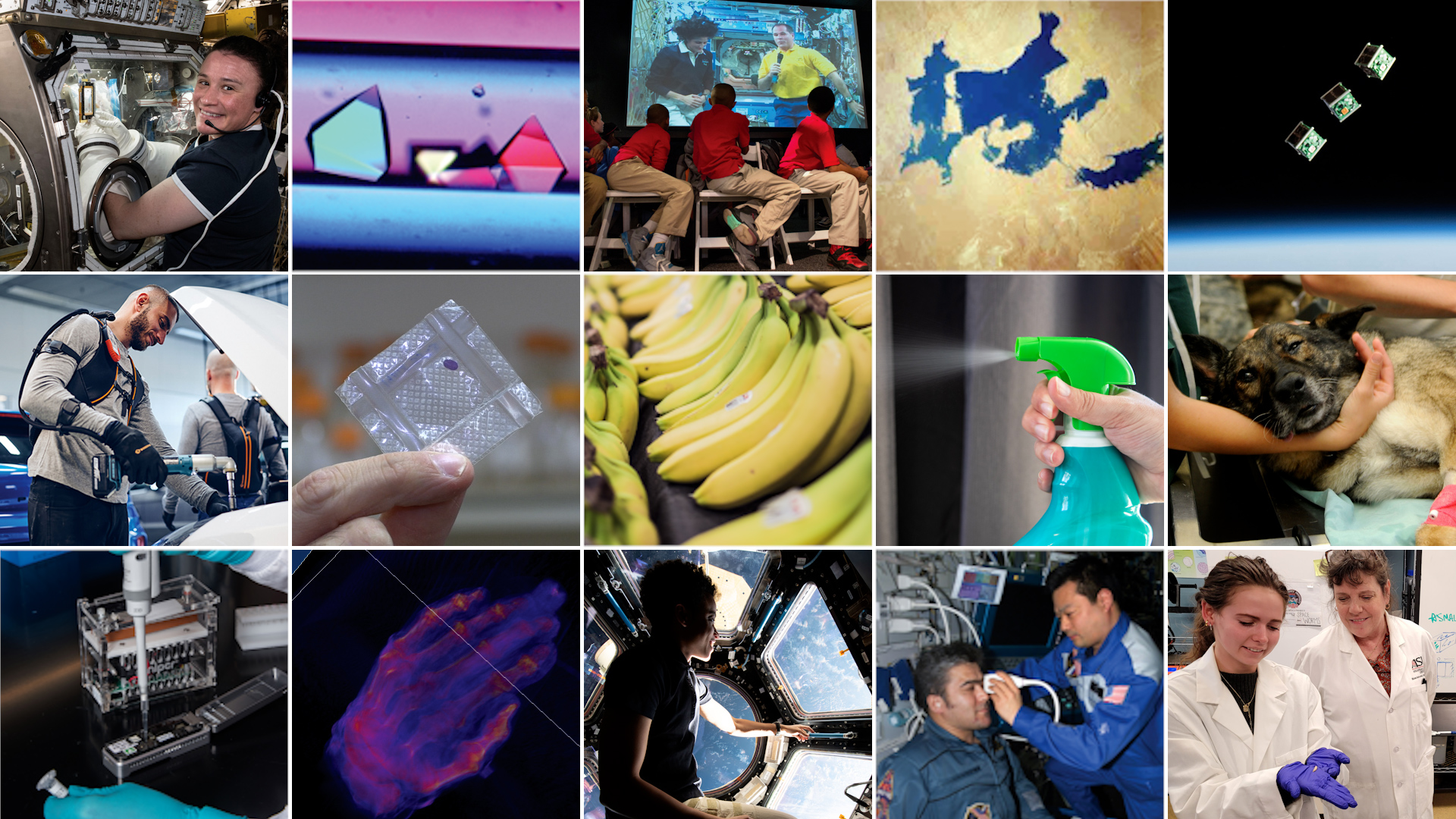
The first decade of the space station was the decade of construction. The second decade moved from initial studies to fully using the orbiting laboratory. Now we are in the decade of results.
With nearly 25 years of experiments conducted aboard the station, more breakthroughs are materializing than ever before. These scientific discoveries and technological advancements are benefiting humanity on the ground, contributing to the growing low Earth orbit economy, and helping to prepare for future exploration of the Moon and Mars.
Innovations include:
- Advances in X-ray technologies, developed to create a space station telescope, are helping unravel the mysteries of our universe while improving medical devices on Earth.
- Temperature-change data that has been employed in efforts to reduce heat absorbed by city surfaces, reduce fire risk, and help farmers efficiently water their fields.
- Demonstrations of robotic technologies with the potential to relieve repetitive movement and other workplace-related stressors.
- Development of a small ultrasound unit for crew health monitoring that has since been adapted to provide diagnostic care in remote areas on Earth.
Find more information about the space station’s benefits for humanity here.
Explore More 1 min read NASA Starts Up Gateway’s Power System for First Time Article 4 hours ago 4 min read NASA Celebrates Artemis II During Houston Texans Space City Day Article 22 hours ago 4 min read Supernova Remnant Video From NASA’s Chandra Is Decades in Making Article 2 days ago25 Years in Orbit: Science, Innovation, and the Future of Exploration
NASA and its partners have supported humans continuously living and working in space since November 2000. A truly global endeavor, the International Space Station has been visited by more than 290 people from 26 countries and a variety of international and commercial spacecraft. The unique microgravity laboratory has hosted more than 4,000 experiments from over 5,000 researchers from 110 countries. The space station also is facilitating the growth of a commercial market in low Earth orbit for research, technology development, and crew and cargo transportation.
After a quarter of century of human presence in orbit, the station remains a symbol of international cooperation and a proving ground for humanity’s next giant leaps to the Moon and, eventually, Mars.
September’s full Moon, the Harvest Moon, is photographed from the space station, placed in between exterior station hardware.NASAThe microgravity environments aboard the space station unlocks discoveries that benefit life on Earth and prepare humans for deep space missions. NASA’s Human Research Program (HRP) works to understand the changes astronauts face aboard the orbital outpost and to develop interventions to keep crews healthy before, during, and after flight.
Astronauts aboard the station exercise for roughly two hours a day to protect bone density, muscle strength, and the cardiovascular system, but the longer they are in microgravity, the harder it can be for the brain and body to readapt to gravity’s pull. After months in orbit, returning astronauts often describe Earth as heavy, loud, and strangely still. Some reacclimate within days, while other astronauts take longer to fully recover.
Through HRP-led studies, scientists track these changes and test solutions—from improved exercise regimens to medical monitoring and nutritional strategies. The results inspire new medical technologies, while teaching scientists how the human body adapts to long-duration spaceflights—knowledge that helps keep astronauts healthy on future missions.
In the Tranquility node of the orbiting laboratory, NASA astronaut Jessica Meir exercises on the Combined Operational Load Bearing External Resistance Treadmill (COLBERT), technically named the Treadmill 2 and abbreviated as T2. NASAThe space station continues to be a critical platform for sharpening skills, technology, and understanding that will prepare humanity to return to the Moon with NASA’s Artemis campaign and journey on to Mars and beyond.
Since space presents an entirely new physical environment with a distinct set of challenges, the orbiting laboratory is uniquely positioned to support research and preparations not possible on Earth. That includes:
- Mastering techniques for basic tasks like drinking water, sleeping, exercising, and handling various materials.
- Developing solutions to microgravity-induced changes to and challenges for the human body.
- Testing reliable technologies and self-sustaining ecosystems necessary for deep space travel, from life support systems to in-orbit agriculture and 3D printing of materials.
- Refining techniques and procedures for data and imagery collection and analysis.
Read more about how the space station has enabled significant strides in our journey farther into the final frontier.
The first decade of the space station was the decade of construction. The second decade moved from initial studies to fully using the orbiting laboratory. Now we are in the decade of results.
With nearly 25 years of experiments conducted aboard the station, more breakthroughs are materializing than ever before. These scientific discoveries and technological advancements are benefiting humanity on the ground, contributing to the growing low Earth orbit economy, and helping to prepare for future exploration of the Moon and Mars.
Innovations include:
- Advances in X-ray technologies, developed to create a space station telescope, are helping unravel the mysteries of our universe while improving medical devices on Earth.
- Temperature-change data that has been employed in efforts to reduce heat absorbed by city surfaces, reduce fire risk, and help farmers efficiently water their fields.
- Demonstrations of robotic technologies with the potential to relieve repetitive movement and other workplace-related stressors.
- Development of a small ultrasound unit for crew health monitoring that has since been adapted to provide diagnostic care in remote areas on Earth.
Find more information about the space station’s benefits for humanity here.
Explore More 1 min read NASA Starts Up Gateway’s Power System for First Time Article 12 hours ago 4 min read NASA Celebrates Artemis II During Houston Texans Space City Day Article 1 day ago 4 min read Supernova Remnant Video From NASA’s Chandra Is Decades in Making Article 2 days agoStellar Habitability In Our Neighbourhood
A new survey of K-type stars in the Sun's neighbourhood reveals important information about their ability to sustain their habitable zones. These stars are less massive, cooler, and dimmer than the Sun, but stay on the main sequence for many tens of billions of years. Their long lives can create the stable conditions necessary for life to develop on exoplanets.
Hunting with poison arrows may have begun 60,000 years ago in Africa
Hunting with poison arrows may have begun 60,000 years ago in Africa
Humans Made Poisoned Arrowheads Thousands of Years Earlier Than Previously Thought
The use of poison on arrows marked a revolution in human hunting technology—new evidence suggests it happened tens of thousands of years earlier than previously known