
Feed aggregator
Scientists Denounce Trump’s Plan to Kill Crucial Atmospheric Science Center
The U.S. government is dismantling the National Center for Atmospheric Research, jettisoning key climate science projects in the process
NASA Langley Research Center: 2025 Year in Review
The future of flight, space exploration, and science starts at NASA’s Langley Research Center in Hampton, Virginia, where we have been advancing innovation for more than 100 years. Join us as we look back at NASA Langley’s achievements in 2025 that continued our storied legacy of pushing the boundaries of what is possible.
Langley Researchers Explore MARVL-ous Technology for Future Trips to Mars Modular Assembled Radiators for Nuclear Electric Propulsion Vehicles, or MARVL, aims to take a critical element of nuclear electric propulsion, its heat dissipation system, and divide it into smaller components that can be assembled robotically and autonomously in space. This is an artist’s rendering of what the fully assembled system might look like.NASA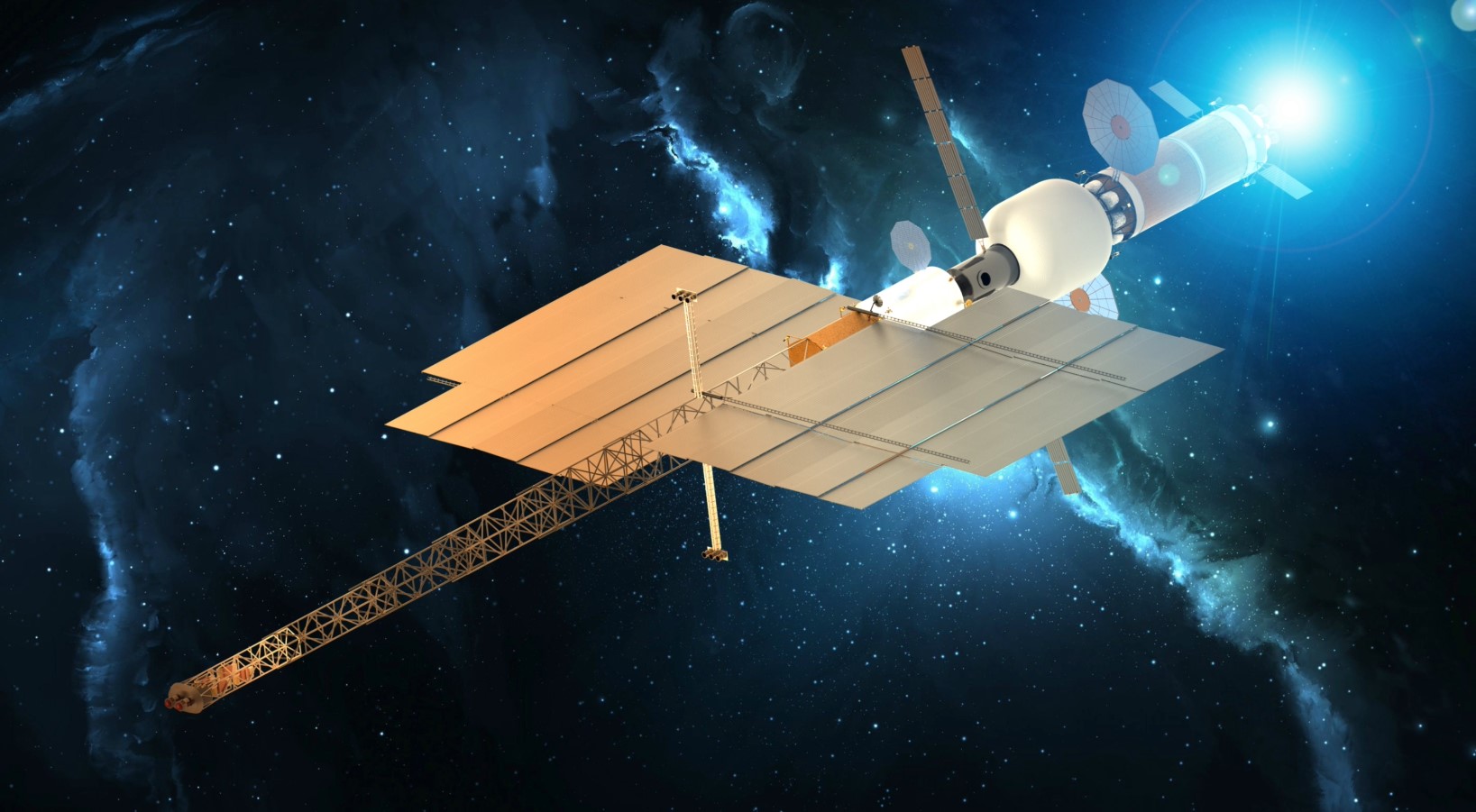
As NASA returns astronauts to the Moon through the agency’s Artemis campaign in advance of human exploration of Mars, researchers at Langley are exploring technology that could significantly reduce travel time to the Red Planet. Modular Assembled Radiators for Nuclear Electric Propulsion Vehicles, or MARVL, would use robots for in-space assembly of elements needed to enable nuclear electric propulsion of future spacecraft, which could transform travel to deep space.
NASA Cameras Catch First-of-its-Kind Moon Close-upThe Moon was ready for its close-up in March, when cameras developed by a Langley team captured first-of-its-kind imagery of a lunar lander’s engine plumes interacting with the Moon’s surface during Firefly Aerospace’s Blue Ghost Mission 1. Information gathered from images like this is critical in helping NASA prepare for future crewed and uncrewed lunar landings.
Stellar Event Offers NASA Rare Look at Uranus This rendering demonstrates what is happening during a stellar occultation and illustrates an example of the light curve data graph recorded by scientists that enables them to gather atmospheric measurements, like temperature and pressure, from Uranus as the amount of starlight changes when the planet eclipses the star.NASA/Langley Research Center Advanced Concepts LaboratoryIn April, planetary scientists at Langley led an international team of astronomers during a cosmic alignment three decades in the making: a rare opportunity to study Uranus. The one-hour event gave them a glimpse into the planet’s atmosphere, information that could enable future Uranus exploration efforts.
NASA Instrument Measures Wind for Improved Weather Forecasts This visualization shows AWP 3D measurements gathered on Oct. 15, 2024, as NASA’s G-III aircraft flew along the East Coast of the U.S. and across the Great Lakes region. Laser light that returns to AWP as backscatter from aerosol particles and clouds allows for measurement of wind direction, speed, and aerosol concentration as seen in the separation of data layers. NASA Scientific Visualization StudioSevere or extreme weather can strike in a moment’s notice, and having the tools to accurately predict weather events can help save lives and property. Scientists at Langley have developed and are testing an instrument that uses laser technology to gather precise wind measurements, data that is a crucial element for accurate weather forecasting.
Langley Researchers Develop New Technique to Test Long, Flexible Booms Researchers look at a bend that occurred in the 94-foot triangular, rollable and collapsible boom during an off-axis compression test.NASA/David C. Bowman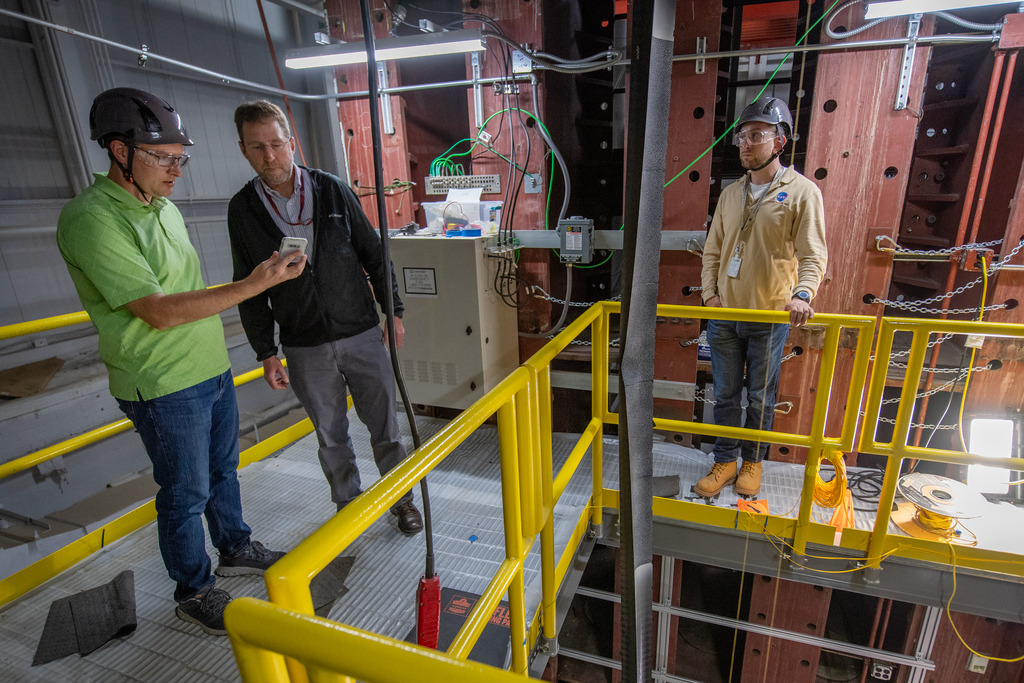
Gravity can create issues when testing materials for space, but Langley researchers have found a way to successfully use gravity and height when testing long composite booms. Testing these composite booms is important because they could support space exploration in a variety of ways, including being used to build structures that could support humans living and working on the Moon.
NASA Imaging Team Supports Missions to Advance Space Exploration, Science A rendering of a space capsule from The Exploration Company re-entering Earth’s atmosphere.Image courtesy of The Exploration Company
A Langley team that specializes in capturing imagery-based engineering datasets from spacecraft during launch and reentry continued its work in 2025, including support of a European aerospace company’s test flight in June. Not only does the team support a variety of missions to advance the agency’s work, but they also collaborate with the private sector as NASA works to open space to more science, people, and opportunities.
NASA Instrument Uses Moonlight for Improved Space Measurements An artist’s rendering of NASA’s Arcstone instrument on-orbit gathering measurements of lunar reflectance.Blue Canyon Technologies
One of the most challenging tasks in remote sensing from space is achieving required instrument calibration on-orbit. Langley scientists are addressing the challenge head on through the Arcstone mission, an instrument that launched in June and aims to establish the Moon as a cost-efficient, high-accuracy calibration reference. Once established, the new standard can be applied to past, present, and future spaceborne sensors and satellite constellations. Arcstone uses a spectrometer, a scientific instrument that measures and analyzes light, to measure lunar spectral reflectance.
NASA Mission Continues Monitoring Air We Breathe By measuring nitrogen dioxide (NO2) and formaldehyde (HCHO), TEMPO can derive the presence of near-surface ozone. On Aug. 2, 2024 over Houston, TEMPO observed exceptionally high ozone levels in the area. On the left, NO2 builds up in the atmosphere over the city and over the Houston Ship Channel. On the right, formaldehyde levels are seen reaching a peak in the early afternoon. Formaldehyde is largely formed through the oxidation of hydrocarbons, an ingredient of ozone production, such as those that can be emitted by petrochemical facilities found in the Houston Ship Channel. NASA’s Scientific Visualization StudioThe success of NASA’s Tropospheric Emissions: Monitoring of Pollution mission, or TEMPO, earned the mission an extension, meaning the work to monitor Earth’s air quality from 22,000 miles above the ground will continue through at least September 2026. The Langley-led mission launched in 2023 and is NASA’s first to use a spectrometer, a scientific instrument that measures and analyzes light, to gather hourly air quality data continuously over North America during daytime hours. The data gathered is distributed freely to the public, giving air quality forecasters, scientists, researchers, and your next-door neighbor access to quality information about the air we breathe down to the neighborhood level.
NASA Tests New, Innovative Tech to Enable Faster Launches at Lower Costs The fully assembled and tested Athena EPIC satellite which incorporates eight HISats mounted on a mock-up of a SpaceX provided launch pedestal which will hold Athena during launch.NovaWurks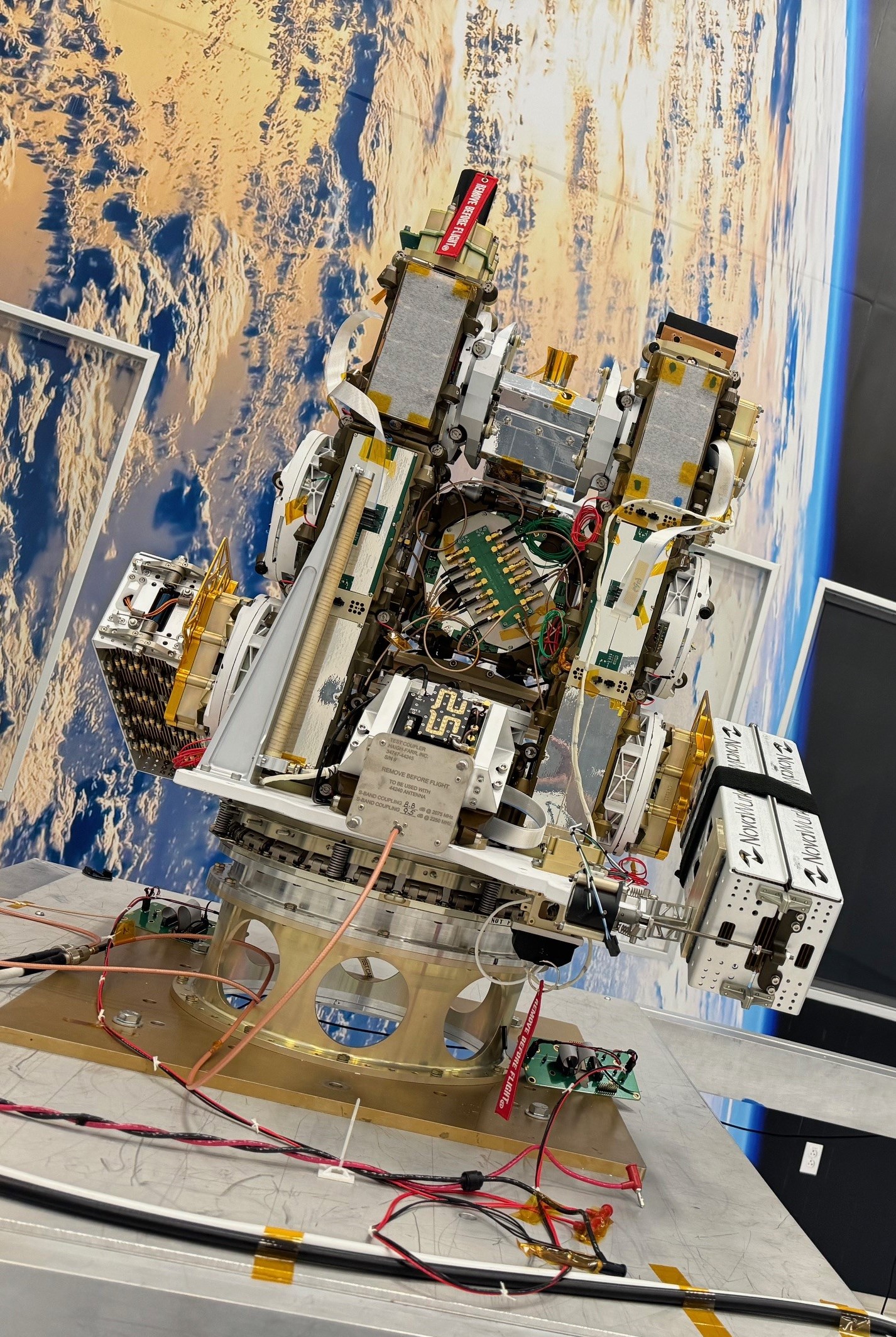
NASA’s Athena Economical Payload Integration Cost mission, or Athena EPIC, launched in July with the goal to shape a future path to launch that saves taxpayers money and expedites access to space. Athena EPIC was the first NASA-led mission led to utilize HISat technology, small satellites engineered to aggregate, share resources, and conform to different sizes and shapes. Langley’s scientists designed and built the Athena sensor with spare parts from NASA’s CERES (Clouds and the Earth’s Radiant Energy System) mission to gather top of atmosphere measurements. Athena EPIC demonstrates a novel way to launch Earth-observing instruments into orbit quicker and more economically.
Drop Test at Langley Offers Research, Data for Potential Air Taxi DesignsThe future of air travel includes the safe integration of drones and air taxis into our airspace for passenger transport, cargo delivery, and public service capabilities. That is why NASA is investigating and testing potential air taxi materials and designs to help the aviation industry better understand how those materials behave under impact. Data collected from a drop test at Langley’s Landing and Impact Research Facility in June will help in the development of safety regulations for advanced air mobility aircraft, leading to safer designs.
Langley Wind Tunnel Tests Help Support Advanced Air Mobility Aircraft Development NASA researcher Norman W. Schaeffler adjusts a propellor, which is part of a 7-foot wing model that was recently tested at NASA’s Langley Research Center in Hampton, Virginia. In May and June, NASA researchers tested the wing in the 14-by-22-Foot Subsonic Wind Tunnel to collect data on critical propeller-wing interactions. The lessons learned will be shared with the public to support advanced air mobility aircraft development.NASA/Mark Knopp
NASA advanced the future of air taxis and autonomous cargo drones by testing a 7-foot wing model in Langley’s 14-by-22-Foot Subsonic Wind Tunnel. This effort produced data on critical propeller-wing interactions, as well as data relevant to cruise, hover, and transition conditions for advanced air mobility aircraft. The results will help validate next-generation design tools and accelerate safe, reliable development across the advanced air mobility industry.
NASA Tests Air Taxi Tech for Future Aircraft Development The Research Aircraft for electric Vertical takeoff and landing Enabling techNologies Subscale Wind Tunnel and Flight Test undergoes a free flight test on the City Environment Range Testing for Autonomous Integrated Navigation range at NASA’s Langley Research Center in Hampton, Virginia on April 22, 2025.NASA/Rob Lorkiewicz

The lack of publicly available engineering and flight data to help address technical barriers in the design and development of new electric vertical takeoff and landing (eVTOL) aircraft is a challenge for researchers and engineers. That is why Langley researchers are using a research aircraft that provides real-world data, obtained through wind tunnel and flight tests, to help fill the information gap and check the accuracy of computer models for flight dynamics and controls. Making this data available to all is a key step in transforming the way we fly and safely integrating new aircraft into our nation’s airspace.
NASA Material Flies High for Study of Long-Term Effects of Space Robert Mosher, HIAD materials and processing lead at NASA Langley, holds up a piece of f webbing material, known as Zylon, which comprise the straps of the HIAD.NASA/Joe Atkinson
A material from NASA Langley is riding high as it orbits the Earth aboard a United States Space Force test vehicle, giving researchers a better understanding of how the material responds to long-duration exposure to the harsh vacuum of space. The strap material is a part of a Langley-developed aeroshell to protect spacecraft re-entering Earth’s atmosphere or to ensure their safe landing on other celestial bodies, such as Mars. Understanding how extended exposure to space affects the material is important as NASA prepares to send humans beyond the Moon.
NASA Flights Study Impacts of Space Weather on Travelers Frozen and rocky terrain in the Polar region observed from above Nuuk, Greenland during NASA’s SWXRAD science flights.NASA/Guillaume Gronoff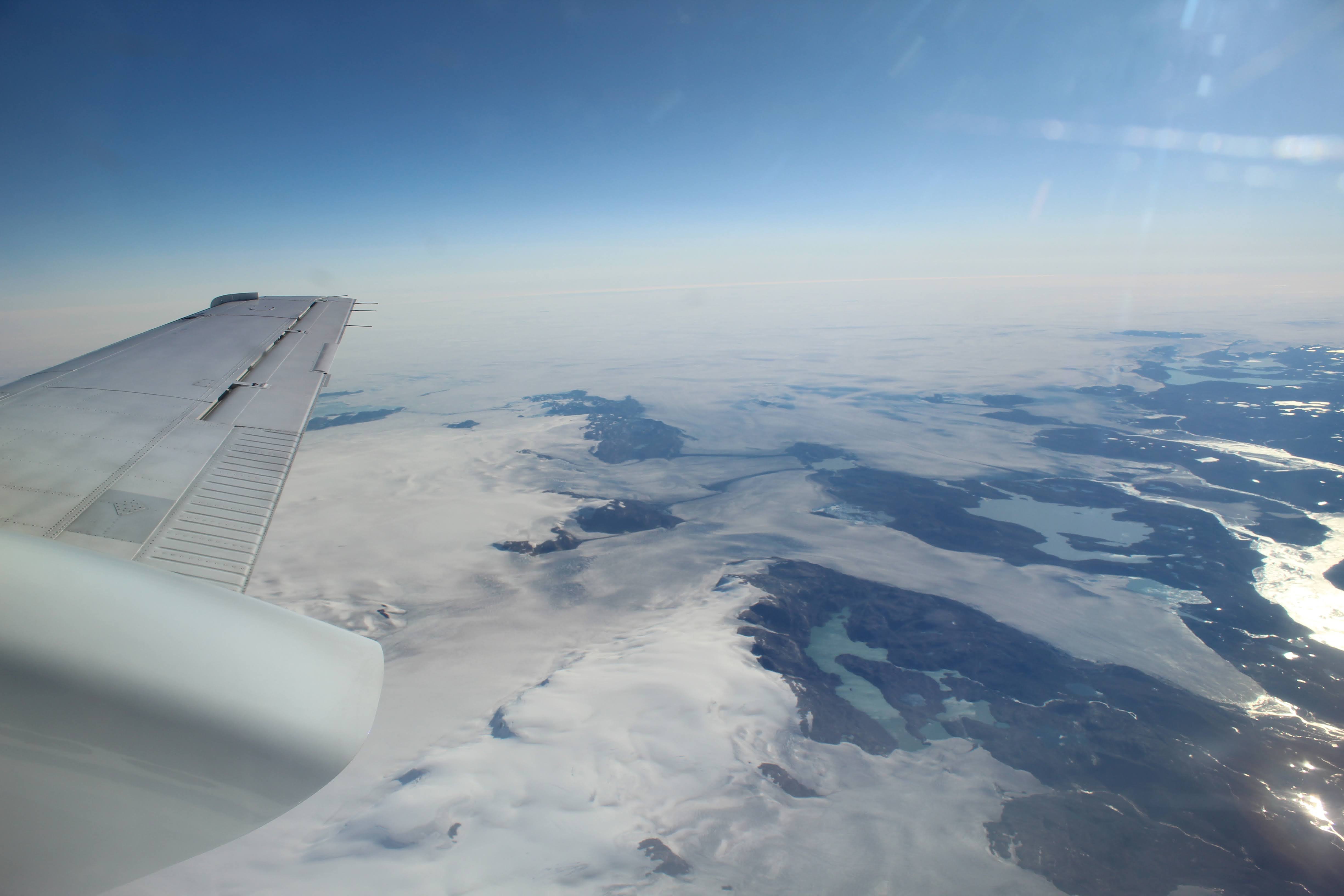
Data gathered during a Langley-led airborne science campaign late this summer could help protect air travelers on Earth and future space travelers to the Moon, Mars, and beyond from the health risks associated with radiation exposure. NASA’s Space Weather Aviation Radiation (SWXRAD) aircraft flight campaign took place in Greenland and measured the radiation dose level to air travelers from cosmic radiation. Researchers are using the information to enhance a modeling system that offers real-time global maps of the hazardous radiation in the atmosphere and creates exposure predictions for aircraft and spacecraft.
NASA’s Dragonfly Completes Wind Tunnel Tests at Langley Set up and testing of Dragonfly model in the Transonic Dynamics TunnelNASA/David C. Bowman
As NASA returns astronauts to the Moon through the Artemis campaign in preparation for human exploration of Mars, the agency also has its sights set on Saturn, specifically Saturn’s moon Titan. NASA’s Dragonfly, a car-sized rotorcraft set to launch no earlier than 2028, will explore Titan and try to discover how life began. This fall, engineers placed a full-scale test model representing half of the Dragonfly lander in Langley’s Transonic Dynamics Tunnel to evaluate how its rotor system performed in Titan-like conditions. The data will be integral in developing the rotorcraft’s flight plans and navigation software as it investigates multiple landing sites on Titan.
NASA Offers Science, Technology, and Expertise During Disaster Response True color imagery of Hurricane Milton on Oct. 7, 2024, from the NOAA-21 satellite. NASA / NOAA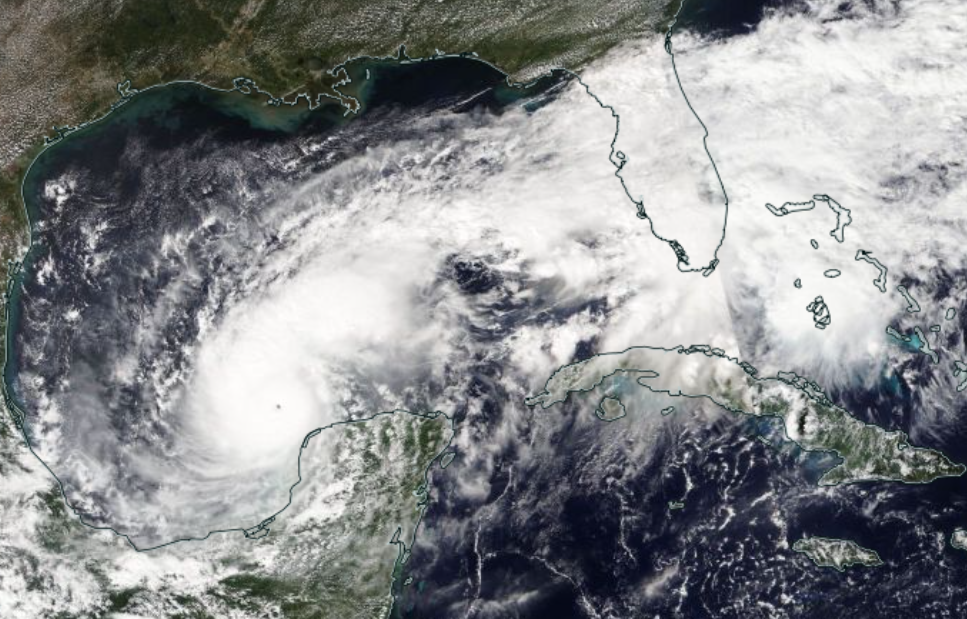
In response to severe weather that impacted more than 10 states in November, the NASA Disasters Response Coordination System (DRCS) activated to support national partners. The DRCS is headquartered at Langley. NASA worked closely with the National Weather Service and the Federal Emergency Management Agency serving the central and southeastern U.S. to provide satellite data and expertise that help communities better prepare, respond, and recover.
NASA’s X-59 Takes FlightIn October, NASA’s Quesst mission celebrated a major milestone – the X-59 quiet supersonic one-of-a-kind research aircraft flew for the first time, a historic moment for aviation. The hard work, talent, and innovation of NASA engineers and project team members, including many based at NASA Langley, made this achievement possible. One of the notable traits of the X-59 is the eXternal Vision System (XVS) which allows the test pilots to safely maneuver the skies without a forward-facing window. This unique supersonic design feature was developed and tested at NASA Langley.
The X-59’s first flight was a major step toward quiet supersonic flight over land, which could revolutionize air travel.
What a Blast! Langley Begins Plume-Surface Interaction Tests Views of the 60-foot vacuum sphere in the which the plume-surface interaction testing is happening.NASA/Joe Atkinson
A team at NASA Langley is firing engine plumes into simulated lunar soil because as the United States returns to the Moon, both through NASA’s Artemis campaign and the commercialization of space, researchers need to understand the hazards that may occur when a lander’s engines blast away at the lunar dust, soil, and rocks.
Langley Inspires Through Community Engagement, Educational Opportunities NASA Langley highlights its Cirrus Design SR22 during Air Power Over Hampton Roads STEM Day. NASA/Angelique Herring
Langley connected with communities across Virginia and beyond to share the center’s work and impact, and inspire the next generation of explorers, scientists, and researchers. Thousands of spectators enjoyed hands-on activities and exhibits during the Air Power over Hampton Roads air show at Joint Base Langley-Eustis in Hampton, Virginia, where NASA Langley’s aviation past, present, and future were on full display. More than 2,300 students from across the nation eagerly participated in Langley’s 2025 Student Art Contest, and shared their artistic spin on the theme, “Our Wonder Changes the World.” Langley and Embry-Riddle Aeronautical University announced an agreement in September that will leverage Langley’s aerospace expertise and Embry-Riddle’s specialized educational programs and research to drive innovation in aerospace, research, education, and technology, while simultaneously developing a highly skilled workforce for the future of space exploration and advanced air mobility.
Langley looks forward to another year of successes and advancements in 2026, as we continue to make the seemingly impossible, possible.
Share Details Last Updated Dec 17, 2025 Related Terms Explore More 2 min read NextSTEP-3 B: Moon to Mars Architecture Studies Article 2 days ago 6 min read Retirement Article 1 week ago 2 min read NASA Demonstrates Safer Skies for Future Urban Air Travel Article 1 week agoNASA Langley Research Center: 2025 Year in Review
The future of flight, space exploration, and science starts at NASA’s Langley Research Center in Hampton, Virginia, where we have been advancing innovation for more than 100 years. Join us as we look back at NASA Langley’s achievements in 2025 that continued our storied legacy of pushing the boundaries of what is possible.
Langley Researchers Explore MARVL-ous Technology for Future Trips to Mars Modular Assembled Radiators for Nuclear Electric Propulsion Vehicles, or MARVL, aims to take a critical element of nuclear electric propulsion, its heat dissipation system, and divide it into smaller components that can be assembled robotically and autonomously in space. This is an artist’s rendering of what the fully assembled system might look like.NASAAs NASA returns astronauts to the Moon through the agency’s Artemis campaign in advance of human exploration of Mars, researchers at Langley are exploring technology that could significantly reduce travel time to the Red Planet. Modular Assembled Radiators for Nuclear Electric Propulsion Vehicles, or MARVL, would use robots for in-space assembly of elements needed to enable nuclear electric propulsion of future spacecraft, which could transform travel to deep space.
NASA Cameras Catch First-of-its-Kind Moon Close-upThe Moon was ready for its close-up in March, when cameras developed by a Langley team captured first-of-its-kind imagery of a lunar lander’s engine plumes interacting with the Moon’s surface during Firefly Aerospace’s Blue Ghost Mission 1. Information gathered from images like this is critical in helping NASA prepare for future crewed and uncrewed lunar landings.
Stellar Event Offers NASA Rare Look at Uranus This rendering demonstrates what is happening during a stellar occultation and illustrates an example of the light curve data graph recorded by scientists that enables them to gather atmospheric measurements, like temperature and pressure, from Uranus as the amount of starlight changes when the planet eclipses the star.NASA/Langley Research Center Advanced Concepts LaboratoryIn April, planetary scientists at Langley led an international team of astronomers during a cosmic alignment three decades in the making: a rare opportunity to study Uranus. The one-hour event gave them a glimpse into the planet’s atmosphere, information that could enable future Uranus exploration efforts.
NASA Instrument Measures Wind for Improved Weather Forecasts This visualization shows AWP 3D measurements gathered on Oct. 15, 2024, as NASA’s G-III aircraft flew along the East Coast of the U.S. and across the Great Lakes region. Laser light that returns to AWP as backscatter from aerosol particles and clouds allows for measurement of wind direction, speed, and aerosol concentration as seen in the separation of data layers. NASA Scientific Visualization StudioSevere or extreme weather can strike in a moment’s notice, and having the tools to accurately predict weather events can help save lives and property. Scientists at Langley have developed and are testing an instrument that uses laser technology to gather precise wind measurements, data that is a crucial element for accurate weather forecasting.
Langley Researchers Develop New Technique to Test Long, Flexible Booms Researchers look at a bend that occurred in the 94-foot triangular, rollable and collapsible boom during an off-axis compression test.NASA/David C. BowmanGravity can create issues when testing materials for space, but Langley researchers have found a way to successfully use gravity and height when testing long composite booms. Testing these composite booms is important because they could support space exploration in a variety of ways, including being used to build structures that could support humans living and working on the Moon.
NASA Imaging Team Supports Missions to Advance Space Exploration, Science A rendering of a space capsule from The Exploration Company re-entering Earth’s atmosphere.Image courtesy of The Exploration CompanyA Langley team that specializes in capturing imagery-based engineering datasets from spacecraft during launch and reentry continued its work in 2025, including support of a European aerospace company’s test flight in June. Not only does the team support a variety of missions to advance the agency’s work, but they also collaborate with the private sector as NASA works to open space to more science, people, and opportunities.
NASA Instrument Uses Moonlight for Improved Space Measurements An artist’s rendering of NASA’s Arcstone instrument on-orbit gathering measurements of lunar reflectance.Blue Canyon TechnologiesOne of the most challenging tasks in remote sensing from space is achieving required instrument calibration on-orbit. Langley scientists are addressing the challenge head on through the Arcstone mission, an instrument that launched in June and aims to establish the Moon as a cost-efficient, high-accuracy calibration reference. Once established, the new standard can be applied to past, present, and future spaceborne sensors and satellite constellations. Arcstone uses a spectrometer, a scientific instrument that measures and analyzes light, to measure lunar spectral reflectance.
NASA Mission Continues Monitoring Air We Breathe By measuring nitrogen dioxide (NO2) and formaldehyde (HCHO), TEMPO can derive the presence of near-surface ozone. On Aug. 2, 2024 over Houston, TEMPO observed exceptionally high ozone levels in the area. On the left, NO2 builds up in the atmosphere over the city and over the Houston Ship Channel. On the right, formaldehyde levels are seen reaching a peak in the early afternoon. Formaldehyde is largely formed through the oxidation of hydrocarbons, an ingredient of ozone production, such as those that can be emitted by petrochemical facilities found in the Houston Ship Channel. NASA’s Scientific Visualization StudioThe success of NASA’s Tropospheric Emissions: Monitoring of Pollution mission, or TEMPO, earned the mission an extension, meaning the work to monitor Earth’s air quality from 22,000 miles above the ground will continue through at least September 2026. The Langley-led mission launched in 2023 and is NASA’s first to use a spectrometer, a scientific instrument that measures and analyzes light, to gather hourly air quality data continuously over North America during daytime hours. The data gathered is distributed freely to the public, giving air quality forecasters, scientists, researchers, and your next-door neighbor access to quality information about the air we breathe down to the neighborhood level.
NASA Tests New, Innovative Tech to Enable Faster Launches at Lower Costs The fully assembled and tested Athena EPIC satellite which incorporates eight HISats mounted on a mock-up of a SpaceX provided launch pedestal which will hold Athena during launch.NovaWurksNASA’s Athena Economical Payload Integration Cost mission, or Athena EPIC, launched in July with the goal to shape a future path to launch that saves taxpayers money and expedites access to space. Athena EPIC was the first NASA-led mission led to utilize HISat technology, small satellites engineered to aggregate, share resources, and conform to different sizes and shapes. Langley’s scientists designed and built the Athena sensor with spare parts from NASA’s CERES (Clouds and the Earth’s Radiant Energy System) mission to gather top of atmosphere measurements. Athena EPIC demonstrates a novel way to launch Earth-observing instruments into orbit quicker and more economically.
Drop Test at Langley Offers Research, Data for Potential Air Taxi DesignsThe future of air travel includes the safe integration of drones and air taxis into our airspace for passenger transport, cargo delivery, and public service capabilities. That is why NASA is investigating and testing potential air taxi materials and designs to help the aviation industry better understand how those materials behave under impact. Data collected from a drop test at Langley’s Landing and Impact Research Facility in June will help in the development of safety regulations for advanced air mobility aircraft, leading to safer designs.
Langley Wind Tunnel Tests Help Support Advanced Air Mobility Aircraft Development NASA researcher Norman W. Schaeffler adjusts a propellor, which is part of a 7-foot wing model that was recently tested at NASA’s Langley Research Center in Hampton, Virginia. In May and June, NASA researchers tested the wing in the 14-by-22-Foot Subsonic Wind Tunnel to collect data on critical propeller-wing interactions. The lessons learned will be shared with the public to support advanced air mobility aircraft development.NASA/Mark KnoppNASA advanced the future of air taxis and autonomous cargo drones by testing a 7-foot wing model in Langley’s 14-by-22-Foot Subsonic Wind Tunnel. This effort produced data on critical propeller-wing interactions, as well as data relevant to cruise, hover, and transition conditions for advanced air mobility aircraft. The results will help validate next-generation design tools and accelerate safe, reliable development across the advanced air mobility industry.
NASA Tests Air Taxi Tech for Future Aircraft Development The Research Aircraft for electric Vertical takeoff and landing Enabling techNologies Subscale Wind Tunnel and Flight Test undergoes a free flight test on the City Environment Range Testing for Autonomous Integrated Navigation range at NASA’s Langley Research Center in Hampton, Virginia on April 22, 2025.NASA/Rob Lorkiewicz
The lack of publicly available engineering and flight data to help address technical barriers in the design and development of new electric vertical takeoff and landing (eVTOL) aircraft is a challenge for researchers and engineers. That is why Langley researchers are using a research aircraft that provides real-world data, obtained through wind tunnel and flight tests, to help fill the information gap and check the accuracy of computer models for flight dynamics and controls. Making this data available to all is a key step in transforming the way we fly and safely integrating new aircraft into our nation’s airspace.
NASA Material Flies High for Study of Long-Term Effects of Space Robert Mosher, HIAD materials and processing lead at NASA Langley, holds up a piece of f webbing material, known as Zylon, which comprise the straps of the HIAD.NASA/Joe AtkinsonA material from NASA Langley is riding high as it orbits the Earth aboard a United States Space Force test vehicle, giving researchers a better understanding of how the material responds to long-duration exposure to the harsh vacuum of space. The strap material is a part of a Langley-developed aeroshell to protect spacecraft re-entering Earth’s atmosphere or to ensure their safe landing on other celestial bodies, such as Mars. Understanding how extended exposure to space affects the material is important as NASA prepares to send humans beyond the Moon.
NASA Flights Study Impacts of Space Weather on Travelers Frozen and rocky terrain in the Polar region observed from above Nuuk, Greenland during NASA’s SWXRAD science flights.NASA/Guillaume GronoffData gathered during a Langley-led airborne science campaign late this summer could help protect air travelers on Earth and future space travelers to the Moon, Mars, and beyond from the health risks associated with radiation exposure. NASA’s Space Weather Aviation Radiation (SWXRAD) aircraft flight campaign took place in Greenland and measured the radiation dose level to air travelers from cosmic radiation. Researchers are using the information to enhance a modeling system that offers real-time global maps of the hazardous radiation in the atmosphere and creates exposure predictions for aircraft and spacecraft.
NASA’s Dragonfly Completes Wind Tunnel Tests at Langley Set up and testing of Dragonfly model in the Transonic Dynamics TunnelNASA/David C. BowmanAs NASA returns astronauts to the Moon through the Artemis campaign in preparation for human exploration of Mars, the agency also has its sights set on Saturn, specifically Saturn’s moon Titan. NASA’s Dragonfly, a car-sized rotorcraft set to launch no earlier than 2028, will explore Titan and try to discover how life began. This fall, engineers placed a full-scale test model representing half of the Dragonfly lander in Langley’s Transonic Dynamics Tunnel to evaluate how its rotor system performed in Titan-like conditions. The data will be integral in developing the rotorcraft’s flight plans and navigation software as it investigates multiple landing sites on Titan.
NASA Offers Science, Technology, and Expertise During Disaster Response True color imagery of Hurricane Milton on Oct. 7, 2024, from the NOAA-21 satellite. NASA / NOAAIn response to severe weather that impacted more than 10 states in November, the NASA Disasters Response Coordination System (DRCS) activated to support national partners. The DRCS is headquartered at Langley. NASA worked closely with the National Weather Service and the Federal Emergency Management Agency serving the central and southeastern U.S. to provide satellite data and expertise that help communities better prepare, respond, and recover.
NASA’s X-59 Takes FlightIn October, NASA’s Quesst mission celebrated a major milestone – the X-59 quiet supersonic one-of-a-kind research aircraft flew for the first time, a historic moment for aviation. The hard work, talent, and innovation of NASA engineers and project team members, including many based at NASA Langley, made this achievement possible. One of the notable traits of the X-59 is the eXternal Vision System (XVS) which allows the test pilots to safely maneuver the skies without a forward-facing window. This unique supersonic design feature was developed and tested at NASA Langley.
The X-59’s first flight was a major step toward quiet supersonic flight over land, which could revolutionize air travel.
What a Blast! Langley Begins Plume-Surface Interaction Tests Views of the 60-foot vacuum sphere in the which the plume-surface interaction testing is happening.NASA/Joe AtkinsonA team at NASA Langley is firing engine plumes into simulated lunar soil because as the United States returns to the Moon, both through NASA’s Artemis campaign and the commercialization of space, researchers need to understand the hazards that may occur when a lander’s engines blast away at the lunar dust, soil, and rocks.
Langley Inspires Through Community Engagement, Educational Opportunities NASA Langley highlights its Cirrus Design SR22 during Air Power Over Hampton Roads STEM Day. NASA/Angelique HerringLangley connected with communities across Virginia and beyond to share the center’s work and impact, and inspire the next generation of explorers, scientists, and researchers. Thousands of spectators enjoyed hands-on activities and exhibits during the Air Power over Hampton Roads air show at Joint Base Langley-Eustis in Hampton, Virginia, where NASA Langley’s aviation past, present, and future were on full display. More than 2,300 students from across the nation eagerly participated in Langley’s 2025 Student Art Contest, and shared their artistic spin on the theme, “Our Wonder Changes the World.” Langley and Embry-Riddle Aeronautical University announced an agreement in September that will leverage Langley’s aerospace expertise and Embry-Riddle’s specialized educational programs and research to drive innovation in aerospace, research, education, and technology, while simultaneously developing a highly skilled workforce for the future of space exploration and advanced air mobility.
Langley looks forward to another year of successes and advancements in 2026, as we continue to make the seemingly impossible, possible.
Share Details Last Updated Dec 17, 2025 Related Terms Explore More 2 min read NextSTEP-3 B: Moon to Mars Architecture Studies Article 2 days ago 6 min read Retirement Article 1 week ago 2 min read NASA Demonstrates Safer Skies for Future Urban Air Travel Article 1 week agoProba-3 fills the solar observation gap
It has been a busy year for the European Space Agency’s Proba-3 mission. The satellite duo has already created more than 50 artificial solar eclipses in orbit since the mission operations began less than a year ago. The resulting data confirm Proba-3's ability to provide the missing puzzle piece in our observations of the Sun's enigmatic atmosphere – the corona.
Why Most Exoplanets Are Magma Worlds
In astronomy, there is a concept called “degeneracy”. It has nothing to do with delinquent people, but instead is used to describe data that could be interpreted multiple ways. In some cases, that interpretation is translated into exciting new possibilities. But many times, when that happens, other, more mundane explanations are ignored for the publicity that the more interesting possibilities provide. That seems to have been the case for many “sub-Neptune” exoplanets discovered recently. Some theories have described them as Hycean worlds - worlds that are filled with water oceans or ice. But a new paper from Robb Calder of the University of Cambridge and his co-authors shows that, most likely, these planets are almost all made of molten lava instead.
Cosmology’s Great Debate began a century ago – and is still going
Cosmology’s Great Debate began a century ago – and is still going
Strange Cosmic Blast May Be First-Ever Superkilonova Observed
The combination of a supernova and a kilonova may have produced a rare space explosion that astronomers have never seen before
Why a Critical Orca Community Is Slipping toward Extinction
A scientist, a journalist and a remarkable scent‑detecting dog race to learn what’s endangering the last southern resident orcas
Galileo’s first Ariane 6 launch strengthens European resilience
On 17 December, two Galileo satellites lifted off from Europe’s Spaceport in French Guiana aboard an Ariane 6 rocket. This marked the 14th launch for Europe’s Galileo constellation, reinforcing Europe’s satellite navigation capabilities, resilience and autonomy.
Galileo L14 liftoff on Ariane 6
On 17 December, two new Galileo satellites lifted off from Europe’s Spaceport in French Guiana aboard an Ariane 6 rocket. This marked the 14th launch for Europe’s satellite navigation operational satellite programme, reinforcing Europe’s resilience and autonomy.
The European Space Agency (ESA) is responsible for carrying out the Galileo launch with Arianespace on behalf of the European Commission. The Galileo satellites were manufactured by OHB, under contract with ESA. Once in orbit, the EU Agency for the Space Programme (EUSPA) will bring the satellites into service and oversee their operation.
The flight, designated VA266, was the first launch of Galileo satellites on Europe’s newest heavy-lift launcher Ariane 6.
A Siberian Snowman in Billings
- Earth
- Earth Observatory
- Image of the Day
- EO Explorer
- Topics
- More Content
- About

Icons of winter are sometimes found in unexpected places. In one striking example, a series of oval lagoons in a remote part of Siberia forms the shape of a towering snowman when viewed from above.
This image, centered on the remote village of Billings and nearby Cape Billings on Russia’s Chukchi Peninsula, was captured by the OLI (Operational Land Imager) aboard Landsat 8 on June 16, 2025. Established in the 1930s as a port and supply point for the Soviet Union, the village sits on a narrow sandspit that separates the Arctic Ocean from a series of connected coastal inshore lagoons.
The elongated, oval lagoons are frozen over and flanked by sea ice. Though June is one of the warmest months in Billings, ice cover is routine even then. Mean daily minimum temperatures are just minus 0.6 degrees Celsius (30.9 degrees Fahrenheit) in June, according to meteorological data.
Though the shape may seem engineered, it is natural and the product of geological processes common in the far north. The ground in this part of Siberia is frozen most of the year and pockmarked with spear-shaped ice wedges buried under the surface. Summer melting causes overlying soil to slump, leaving shallow depressions that fill with meltwater and form thermokarst lakes. Once created, consistency in the direction of the winds and waves likely aligned and elongated the lakes into the shapes seen in the image. The thin ridges separating the lakes may represent the edges of different ice wedges below the surface.
The first reference to humans building snowmen dates back to the Middle Ages, according to the book The History of the Snowman. While three spherical segments are the most common form, other variants dominate in certain areas. In Japan, snowmen typically have just two segments and are rarely given arms. This five-segmented snowman-shaped series of lakes spans about 22 kilometers (14 miles) from top to bottom, making it roughly 600 times longer than the actual snowwoman that held the Guinness record for being the world’s tallest snowperson in 2025.
Snowmen are not the only winter icons tied to this remote landscape. For early expeditions to the Russian Arctic, reindeer offered one of the most reliable modes of transportation. That includes expeditions by the town’s namesake, Commodore Joseph Billings, a British-born naval officer who enlisted in the Russian navy and led a surveying expedition to find a Northeast Passage between 1790 and 1794.
Although the hundred-plus members of the expedition did not reach Cape Billings, they explored much of the Chukchi Peninsula, producing some of the first accurate maps and further confirming that Asia and North America were separated by a strait. In the winter months, when their ships were beset by ice, the explorers moved to temporary camps on land and instead surveyed the region with reindeer-drawn wooden sleds, according to historical accounts. Winters, in fact, offered the best conditions for exploration because the peninsula’s many rivers and lakes turned into solid surfaces that were easy to traverse in comparison to the muddy bogs that open up in the summer.
Indigenous Chukchi people living on the peninsula at the time routinely used reindeer to haul both people and cargo. A pair of reindeer can comfortably haul hundreds of pounds for several hours a day. In addition to their impressive endurance in cold temperatures, reindeer largely feed themselves by digging through snow and grazing on lichens, something that neither sled dogs nor horses can do.
Historical documents indicate that the Billings expedition enlisted Chukchi people to manage and care for the reindeer they used, with some accounts suggesting that the explorers used dozens of reindeer at times. While reindeer were mainly used to haul sleds, Chukchi people likely rode them as well.
Non-Chukchi members of the expedition reportedly experimented with riding reindeer, though their experiments did not always go smoothly. Billings’ secretary and translator Martin Sauer reported using a saddle without stirrups or a bridle and falling “nearly 20 times” after about three hours of travel in his account of the expedition. Not only that, he added, but the saddle “at first, causes astonishing pain to the thighs.”
NASA Earth Observatory image by Michala Garrison, using Landsat data from the U.S. Geological Survey. Story by Adam Voiland.
References & Resources- Alekseev, A.I. (1966) Joseph Billings. The Geographical Journal, 132(2), 233-238.
- Arctic Portal Chukchi. Accessed December 16, 2025.
- Astronomy (2019, January 2) Ultima Thule emerges as contact binary, “cosmic snowman,” in new spacecraft images. Accessed December 16, 2025.
- Chlenov, M. (2006) The “Uelenski Language” and its Position Among Native Languages of the Chukchi Peninsula. Alaska Journal of Anthropology, 4(1-2), 74-91.
- Dokuchaev, A., et al. (2022) The First Scientific Expeditions to the Bering Strait and to the Russian Colonies in America. Arctic and North, 48, 179-208.
- Eckstein, B., via Internet Archive (2007) The history of the snowman. Simon & Schuster: New York. Accessed December 16, 2025.
- Hobden, H. Yakutia in the 18th century – The Great Scientific Expeditions – Part Two. Accessed December 16, 2025.
- Klokov, K.B. (2023) Geographical variability and cultural diversity of reindeer pastoralism in northern Russia: delimitation of areas with different types of reindeer husbandry. Pastoralism, 13, 15.
- Krylenko, V. (2017) Estuaries and Lagoons of the Russian Arctic Seas. Estuaries of the World, Springer: Cham, 13-15.
- NASA (2012) Views of the Snowman. Accessed December 16, 2025.
- Obscure Histories (2022, December 20) The Snowman: A brief history of a winter entertainment. Accessed December 16, 2025.
- Radio Free Europe (2015, March 10) The Village At The End Of The Earth. Accessed December 16, 2025.
- Sauer, M., via Internet Archive (1802) An account of a geographical and astronomical expedition to the northern parts of Russia. Strahan: London. Accessed December 16, 2025.
- Zonn, I., et al. (2016) Shores of the Chukchi Sea. The Eastern Arctic Seas Encyclopedia, 298-301.
JPEG (9.74 MB)
You may also be interested in:
Stay up-to-date with the latest content from NASA as we explore the universe and discover more about our home planet.
Arctic Sea Ice Ties for 10th-Lowest on Record
3 min read
Satellite data show that Arctic sea ice likely reached its annual minimum extent on September 10, 2025.
ArticleAntarctic Sea Ice Saw Its Third-Lowest Maximum
2 min read
Sea ice around the southernmost continent hit one of its lowest seasonal highs since the start of the satellite record.
ArticleGreenland Ice Sheet Gets a Refresh
3 min read
A moderately intense season of surface melting left part of the ice sheet dirty gray in summer 2025, but snowfall…
Article1
2
3
4
Next
Keep Exploring Discover More from NASA Earth Science Subscribe to Earth Observatory Newsletters
Subscribe to the Earth Observatory and get the Earth in your inbox.
Earth Observatory Image of the Day
NASA’s Earth Observatory brings you the Earth, every day, with in-depth stories and stunning imagery.
Explore Earth Science
Earth Science Data
A Siberian Snowman in Billings
- Earth
- Earth Observatory
- Image of the Day
- EO Explorer
- Topics
- More Content
- About
Icons of winter are sometimes found in unexpected places. In one striking example, a series of oval lagoons in a remote part of Siberia forms the shape of a towering snowman when viewed from above.
This image, centered on the remote village of Billings and nearby Cape Billings on Russia’s Chukchi Peninsula, was captured by the OLI (Operational Land Imager) aboard Landsat 8 on June 16, 2025. Established in the 1930s as a port and supply point for the Soviet Union, the village sits on a narrow sandspit that separates the Arctic Ocean from a series of connected coastal inshore lagoons.
The elongated, oval lagoons are frozen over and flanked by sea ice. Though June is one of the warmest months in Billings, ice cover is routine even then. Mean daily minimum temperatures are just minus 0.6 degrees Celsius (30.9 degrees Fahrenheit) in June, according to meteorological data.
Though the shape may seem engineered, it is natural and the product of geological processes common in the far north. The ground in this part of Siberia is frozen most of the year and pockmarked with spear-shaped ice wedges buried under the surface. Summer melting causes overlying soil to slump, leaving shallow depressions that fill with meltwater and form thermokarst lakes. Once created, consistency in the direction of the winds and waves likely aligned and elongated the lakes into the shapes seen in the image. The thin ridges separating the lakes may represent the edges of different ice wedges below the surface.
The first reference to humans building snowmen dates back to the Middle Ages, according to the book The History of the Snowman. While three spherical segments are the most common form, other variants dominate in certain areas. In Japan, snowmen typically have just two segments and are rarely given arms. This five-segmented snowman-shaped series of lakes spans about 22 kilometers (14 miles) from top to bottom, making it roughly 600 times longer than the actual snowwoman that held the Guinness record for being the world’s tallest snowperson in 2025.
Snowmen are not the only winter icons tied to this remote landscape. For early expeditions to the Russian Arctic, reindeer offered one of the most reliable modes of transportation. That includes expeditions by the town’s namesake, Commodore Joseph Billings, a British-born naval officer who enlisted in the Russian navy and led a surveying expedition to find a Northeast Passage between 1790 and 1794.
Although the hundred-plus members of the expedition did not reach Cape Billings, they explored much of the Chukchi Peninsula, producing some of the first accurate maps and further confirming that Asia and North America were separated by a strait. In the winter months, when their ships were beset by ice, the explorers moved to temporary camps on land and instead surveyed the region with reindeer-drawn wooden sleds, according to historical accounts. Winters, in fact, offered the best conditions for exploration because the peninsula’s many rivers and lakes turned into solid surfaces that were easy to traverse in comparison to the muddy bogs that open up in the summer.
Indigenous Chukchi people living on the peninsula at the time routinely used reindeer to haul both people and cargo. A pair of reindeer can comfortably haul hundreds of pounds for several hours a day. In addition to their impressive endurance in cold temperatures, reindeer largely feed themselves by digging through snow and grazing on lichens, something that neither sled dogs nor horses can do.
Historical documents indicate that the Billings expedition enlisted Chukchi people to manage and care for the reindeer they used, with some accounts suggesting that the explorers used dozens of reindeer at times. While reindeer were mainly used to haul sleds, Chukchi people likely rode them as well.
Non-Chukchi members of the expedition reportedly experimented with riding reindeer, though their experiments did not always go smoothly. Billings’ secretary and translator Martin Sauer reported using a saddle without stirrups or a bridle and falling “nearly 20 times” after about three hours of travel in his account of the expedition. Not only that, he added, but the saddle “at first, causes astonishing pain to the thighs.”
NASA Earth Observatory image by Michala Garrison, using Landsat data from the U.S. Geological Survey. Story by Adam Voiland.
References & Resources- Alekseev, A.I. (1966) Joseph Billings. The Geographical Journal, 132(2), 233-238.
- Arctic Portal Chukchi. Accessed December 16, 2025.
- Astronomy (2019, January 2) Ultima Thule emerges as contact binary, “cosmic snowman,” in new spacecraft images. Accessed December 16, 2025.
- Chlenov, M. (2006) The “Uelenski Language” and its Position Among Native Languages of the Chukchi Peninsula. Alaska Journal of Anthropology, 4(1-2), 74-91.
- Dokuchaev, A., et al. (2022) The First Scientific Expeditions to the Bering Strait and to the Russian Colonies in America. Arctic and North, 48, 179-208.
- Eckstein, B., via Internet Archive (2007) The history of the snowman. Simon & Schuster: New York. Accessed December 16, 2025.
- Hobden, H. Yakutia in the 18th century – The Great Scientific Expeditions – Part Two. Accessed December 16, 2025.
- Klokov, K.B. (2023) Geographical variability and cultural diversity of reindeer pastoralism in northern Russia: delimitation of areas with different types of reindeer husbandry. Pastoralism, 13, 15.
- Krylenko, V. (2017) Estuaries and Lagoons of the Russian Arctic Seas. Estuaries of the World, Springer: Cham, 13-15.
- NASA (2012) Views of the Snowman. Accessed December 16, 2025.
- Obscure Histories (2022, December 20) The Snowman: A brief history of a winter entertainment. Accessed December 16, 2025.
- Radio Free Europe (2015, March 10) The Village At The End Of The Earth. Accessed December 16, 2025.
- Sauer, M., via Internet Archive (1802) An account of a geographical and astronomical expedition to the northern parts of Russia. Strahan: London. Accessed December 16, 2025.
- Zonn, I., et al. (2016) Shores of the Chukchi Sea. The Eastern Arctic Seas Encyclopedia, 298-301.
JPEG (9.74 MB)
You may also be interested in:
Stay up-to-date with the latest content from NASA as we explore the universe and discover more about our home planet.
Arctic Sea Ice Ties for 10th-Lowest on Record
3 min read
Satellite data show that Arctic sea ice likely reached its annual minimum extent on September 10, 2025.
ArticleAntarctic Sea Ice Saw Its Third-Lowest Maximum
2 min read
Sea ice around the southernmost continent hit one of its lowest seasonal highs since the start of the satellite record.
ArticleGreenland Ice Sheet Gets a Refresh
3 min read
A moderately intense season of surface melting left part of the ice sheet dirty gray in summer 2025, but snowfall…
Article1
2
3
4
Next
Keep Exploring Discover More from NASA Earth Science Subscribe to Earth Observatory Newsletters
Subscribe to the Earth Observatory and get the Earth in your inbox.
Earth Observatory Image of the Day
NASA’s Earth Observatory brings you the Earth, every day, with in-depth stories and stunning imagery.
Explore Earth Science
Earth Science Data
Ancient Bees Burrowed Inside Bones, Fossils Reveal
Bones of now extinct species became a haven for bee babies thousands of years ago, scientists report in a first-of-its-kind discovery
NASA IXPE’s Longest Observation Solves Black Hole Jets Mystery
4 min read
Preparations for Next Moonwalk Simulations Underway (and Underwater) Two composite images show side-by-side observations of the Perseus Cluster from NASA’s IXPE (Imaging X-Ray Polarimetry Explorer) and Chandra X-ray Observatory. Scientists used data from both observatories, along with data from Nuclear Spectroscopic Telescope Array (NuSTAR), and Neil Gehrels Swift Observatory, to confirm measurements of the galaxy cluster.X-ray: (Chandra) NASA/CXC/SAO, (IXPE) NASA/MSFC; Image Processing: NASA/CXC/SAO/N. Wolk and K. Arcand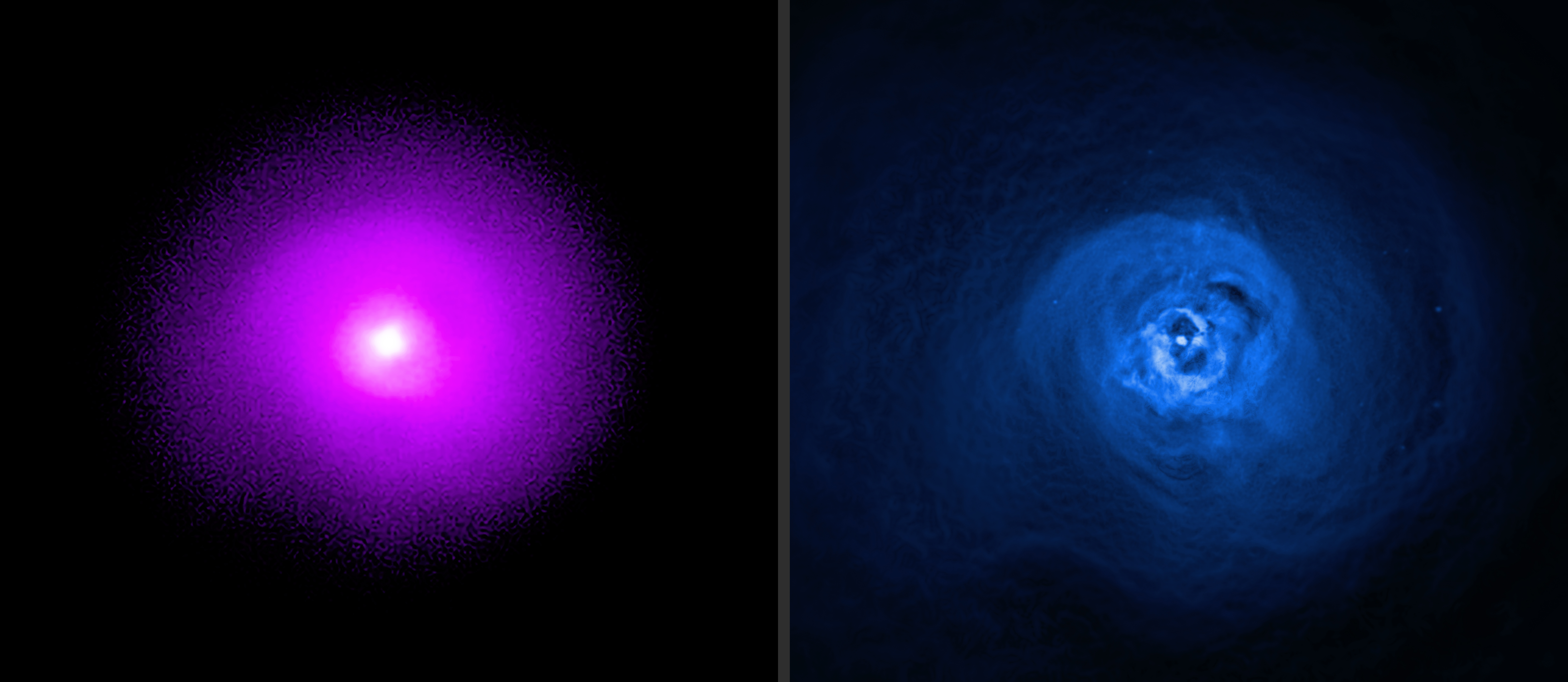
Written by Michael Allen
An international team of astronomers using NASA’s IXPE (Imaging X-ray Polarimetry Explorer) has identified the origin of X-rays in a supermassive black hole’s jet, answering a question that has been unresolved since the earliest days of X-ray astronomy. Their findings are described in a paper published in The Astrophysical Journal Letters, by the American Astronomical Society, Nov. 11.
The IXPE mission observed the Perseus Cluster, the brightest galaxy cluster observable in X-rays, for more than 600 hours over a 60-day period between January and March. Not only is this IXPE’s longest observation of a single target to date, it also marks IXPE’s first time observing a galaxy cluster.
Specifically, the team of scientists studied the polarization properties of 3C 84, the massive active galaxy located at the very center of the Perseus Cluster. This active galaxy is a well-known X-ray source and a common target for X-ray astronomers because of its proximity and brightness.
Because the Perseus Cluster is so massive, it hosts an enormous reservoir of X-ray emitting gas as hot as the core of the Sun. The use of multiple X-ray telescopes, particularly the high-resolution imaging power of NASA’s Chandra X-ray Observatory was essential to disentangle the signals in the IXPE data. Scientists combined these X-ray measurements with data from the agency’s Nuclear Spectroscopic Telescope Array (NuSTAR) mission and Neil Gehrels Swift Observatory.
Fast facts- Polarization measurements from IXPE carry information about the orientation and alignment of emitted X-ray light waves. The more X-ray waves traveling in sync, the higher the degree of polarization.
- X-rays from an active galaxy like 3C 84 are thought to originate from a process known as inverse Compton scattering, where light bounces off particles and gains energy. The polarization measurements from IXPE allow us to identify the presence of either inverse Compton scattering or other scenarios.
- “Seed photons” is the term for the lower-energy radiation undergoing the energizing process of inverse Compton scattering.
- You may remember the Perseus Cluster from this sonification replicating what a Black Hole sounds like from May 2022.
“While measuring the polarization of 3C 84 was one of the key science goals, we are still searching for additional polarization signals in this galaxy cluster that could be signatures of more exotic physics,” said Steven Ehlert, project scientist for IXPE and astronomer at NASA’s Marshall Space Flight Center in Huntsville.
Chandra & IXPE composite image of the Perseus Cluster.X-ray: (Chandra) NASA/CXC/SAO, (IXPE) NASA/MSFC; Image Processing: NASA/CXC/SAO/N. Wolk and K. Arcand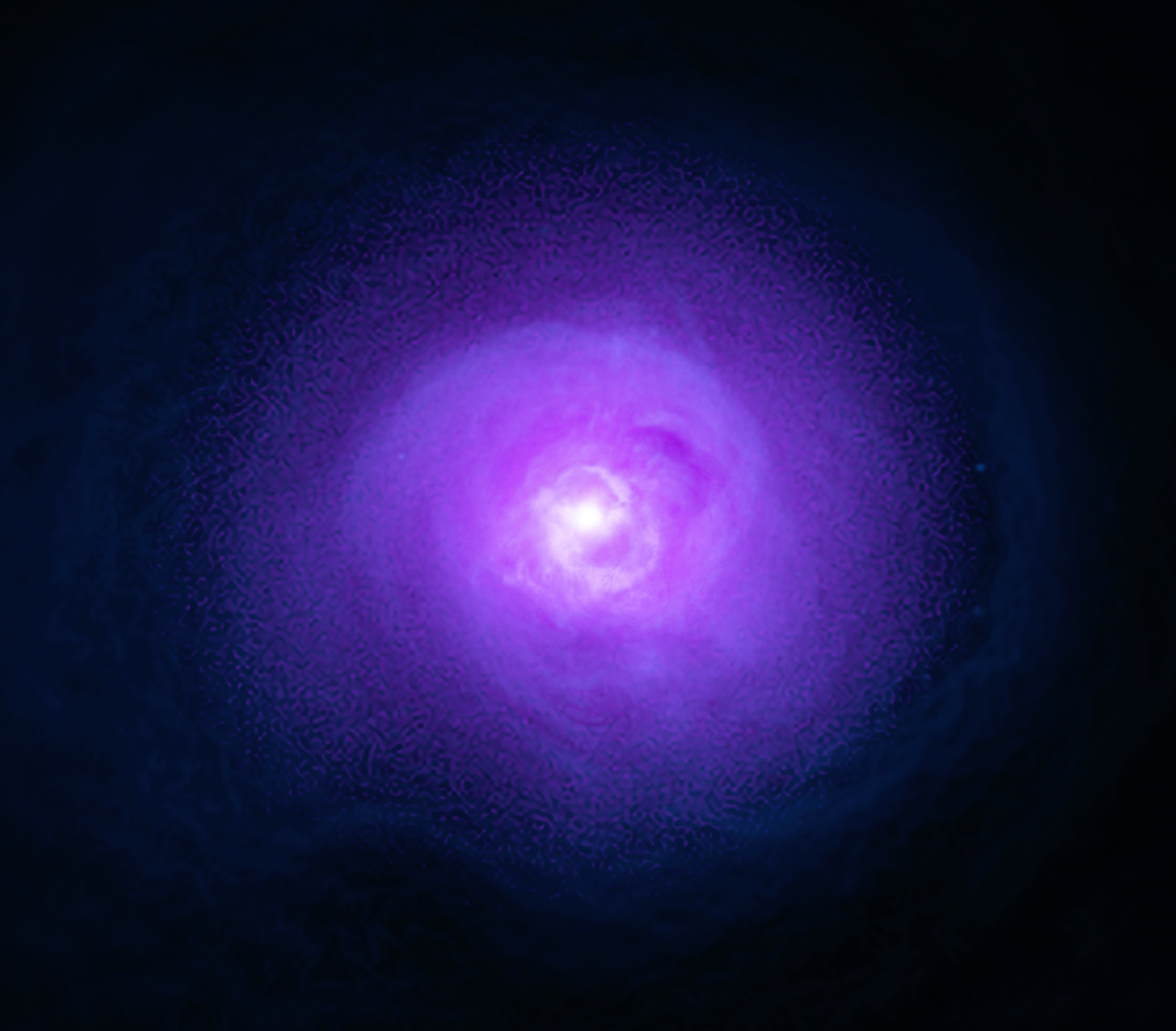
“We’ve already determined that for sources like 3C 84, the X-rays originated from inverse Compton scattering,” said Ioannis Liodakis, a researcher at the Institute of Astrophysics – FORTH in Heraklion, Greece, and lead author on the paper. “With IXPE observations of 3C 84 we had a unique chance to determine the properties of the seed photons.”
The first possible origin scenario for the seed photons is known as synchrotron self-Compton, where lower-energy radiation originates from the same jet that produces the highly energetic particles.
In the alternative scenario known as external Compton, seed photons originate from background radiation sources unrelated to the jet.
“The synchrotron self-Compton and external Compton scenarios have very different predictions for their X-ray polarization,” said Frederic Marin, an astrophysicist at the Strasbourg Astronomical Observatory in France and co-author of the study. “Any detection of X-ray polarization from 3C 84 almost decisively rules out the possibility of external Compton as the emission mechanism.”
Throughout the 60-day observation campaign, optical and radio telescopes around the world turned their attention to 3C 84 to further test between the two scenarios.
NASA’s IXPE measured a net polarization of 4% in the X-rays spectrum, with comparable values measured in the optical and radio data. These results strongly favor the synchrotron self-Compton model for the seed photons, where they come from the same jet as the higher-energy particles.
“Separating these two components was essential to this measurement and could not be done by any single X-ray telescope, but by combining the IXPE polarization data with Chandra, NuSTAR, and Swift, we were able to confirm this polarization measurement was associated specifically with 3C 84,” said Sudip Chakraborty, a researcher at the Science and Technology Institute of the Universities Space Research Association in Huntsville, Alabama, and co-author on the paper.
Scientists will continue to analyze IXPE’s data from different locations in the Perseus Cluster for different signals.
More about IXPENASA’s IXPE, which continues to provide unprecedented data enabling groundbreaking discoveries about celestial objects across the universe, is a joint NASA and Italian Space Agency mission with partners and science collaborators in 12 countries. The IXPE mission is led by NASA’s Marshall Space Flight Center in Huntsville, Alabama. BAE Systems, Inc., headquartered in Falls Church, Virginia, manages spacecraft operations together with the University of Colorado’s Laboratory for Atmospheric and Space Physics in Boulder.
Learn more about IXPE’s ongoing mission here:
Share Details Last Updated Dec 17, 2025 EditorLee MohonContactCorinne M. Beckingercorinne.m.beckinger@nasa.govLocationMarshall Space Flight Center Related Terms Explore More 3 min read Galaxy With Black Hole Shines In Image From NASA’s Chandra, IXPEIn the center of this galaxy is a supermassive black hole feeding off the gas…
Article 3 years ago 5 min read Historic Nebula Seen Like Never Before With NASA’s IXPE Article 3 years ago 4 min read IXPE Untangles Theories Surrounding Historic Supernova Remnant Article 2 years ago Keep Exploring Discover Related Topics Imaging X-ray Polarimetry Explorer (IXPE)The Imaging X-ray Polarimetry Explorer (IXPE) is a space observatory built to discover the secrets of some of the most…
ChandraSpace Telescope
James Webb Space Telescope (B)The James Webb Space Telescope (sometimes called JWST or Webb) will be a large infrared telescope with a 6.5-meter primary…
Hubble Space TelescopeHubble, the observatory, is the first major optical telescope to be placed in space, the ultimate mountaintop. Above the distortion…
NASA IXPE’s Longest Observation Solves Black Hole Jets Mystery
4 min read
Preparations for Next Moonwalk Simulations Underway (and Underwater) Two composite images show side-by-side observations of the Perseus Cluster from NASA’s IXPE (Imaging X-Ray Polarimetry Explorer) and Chandra X-ray Observatory. Scientists used data from both observatories, along with data from Nuclear Spectroscopic Telescope Array (NuSTAR), and Neil Gehrels Swift Observatory, to confirm measurements of the galaxy cluster.X-ray: (Chandra) NASA/CXC/SAO, (IXPE) NASA/MSFC; Image Processing: NASA/CXC/SAO/N. Wolk and K. ArcandWritten by Michael Allen
An international team of astronomers using NASA’s IXPE (Imaging X-ray Polarimetry Explorer) has identified the origin of X-rays in a supermassive black hole’s jet, answering a question that has been unresolved since the earliest days of X-ray astronomy. Their findings are described in a paper published in The Astrophysical Journal Letters, by the American Astronomical Society, Nov. 11.
The IXPE mission observed the Perseus Cluster, the brightest galaxy cluster observable in X-rays, for more than 600 hours over a 60-day period between January and March. Not only is this IXPE’s longest observation of a single target to date, it also marks IXPE’s first time observing a galaxy cluster.
Specifically, the team of scientists studied the polarization properties of 3C 84, the massive active galaxy located at the very center of the Perseus Cluster. This active galaxy is a well-known X-ray source and a common target for X-ray astronomers because of its proximity and brightness.
Because the Perseus Cluster is so massive, it hosts an enormous reservoir of X-ray emitting gas as hot as the core of the Sun. The use of multiple X-ray telescopes, particularly the high-resolution imaging power of NASA’s Chandra X-ray Observatory was essential to disentangle the signals in the IXPE data. Scientists combined these X-ray measurements with data from the agency’s Nuclear Spectroscopic Telescope Array (NuSTAR) mission and Neil Gehrels Swift Observatory.
Fast facts- Polarization measurements from IXPE carry information about the orientation and alignment of emitted X-ray light waves. The more X-ray waves traveling in sync, the higher the degree of polarization.
- X-rays from an active galaxy like 3C 84 are thought to originate from a process known as inverse Compton scattering, where light bounces off particles and gains energy. The polarization measurements from IXPE allow us to identify the presence of either inverse Compton scattering or other scenarios.
- “Seed photons” is the term for the lower-energy radiation undergoing the energizing process of inverse Compton scattering.
- You may remember the Perseus Cluster from this sonification replicating what a Black Hole sounds like from May 2022.
“While measuring the polarization of 3C 84 was one of the key science goals, we are still searching for additional polarization signals in this galaxy cluster that could be signatures of more exotic physics,” said Steven Ehlert, project scientist for IXPE and astronomer at NASA’s Marshall Space Flight Center in Huntsville.
Chandra & IXPE composite image of the Perseus Cluster.X-ray: (Chandra) NASA/CXC/SAO, (IXPE) NASA/MSFC; Image Processing: NASA/CXC/SAO/N. Wolk and K. Arcand“We’ve already determined that for sources like 3C 84, the X-rays originated from inverse Compton scattering,” said Ioannis Liodakis, a researcher at the Institute of Astrophysics – FORTH in Heraklion, Greece, and lead author on the paper. “With IXPE observations of 3C 84 we had a unique chance to determine the properties of the seed photons.”
The first possible origin scenario for the seed photons is known as synchrotron self-Compton, where lower-energy radiation originates from the same jet that produces the highly energetic particles.
In the alternative scenario known as external Compton, seed photons originate from background radiation sources unrelated to the jet.
“The synchrotron self-Compton and external Compton scenarios have very different predictions for their X-ray polarization,” said Frederic Marin, an astrophysicist at the Strasbourg Astronomical Observatory in France and co-author of the study. “Any detection of X-ray polarization from 3C 84 almost decisively rules out the possibility of external Compton as the emission mechanism.”
Throughout the 60-day observation campaign, optical and radio telescopes around the world turned their attention to 3C 84 to further test between the two scenarios.
NASA’s IXPE measured a net polarization of 4% in the X-rays spectrum, with comparable values measured in the optical and radio data. These results strongly favor the synchrotron self-Compton model for the seed photons, where they come from the same jet as the higher-energy particles.
“Separating these two components was essential to this measurement and could not be done by any single X-ray telescope, but by combining the IXPE polarization data with Chandra, NuSTAR, and Swift, we were able to confirm this polarization measurement was associated specifically with 3C 84,” said Sudip Chakraborty, a researcher at the Science and Technology Institute of the Universities Space Research Association in Huntsville, Alabama, and co-author on the paper.
Scientists will continue to analyze IXPE’s data from different locations in the Perseus Cluster for different signals.
More about IXPENASA’s IXPE, which continues to provide unprecedented data enabling groundbreaking discoveries about celestial objects across the universe, is a joint NASA and Italian Space Agency mission with partners and science collaborators in 12 countries. The IXPE mission is led by NASA’s Marshall Space Flight Center in Huntsville, Alabama. BAE Systems, Inc., headquartered in Falls Church, Virginia, manages spacecraft operations together with the University of Colorado’s Laboratory for Atmospheric and Space Physics in Boulder.
Learn more about IXPE’s ongoing mission here:
Share Details Last Updated Dec 17, 2025 EditorLee MohonContactCorinne M. Beckingercorinne.m.beckinger@nasa.govLocationMarshall Space Flight Center Related Terms Explore More 3 min read Galaxy With Black Hole Shines In Image From NASA’s Chandra, IXPEIn the center of this galaxy is a supermassive black hole feeding off the gas…
Article 3 years ago 5 min read Historic Nebula Seen Like Never Before With NASA’s IXPE Article 3 years ago 4 min read IXPE Untangles Theories Surrounding Historic Supernova Remnant Article 2 years ago Keep Exploring Discover Related Topics Imaging X-ray Polarimetry Explorer (IXPE)The Imaging X-ray Polarimetry Explorer (IXPE) is a space observatory built to discover the secrets of some of the most…
ChandraSpace Telescope
James Webb Space Telescope (B)The James Webb Space Telescope (sometimes called JWST or Webb) will be a large infrared telescope with a 6.5-meter primary…
Hubble Space TelescopeHubble, the observatory, is the first major optical telescope to be placed in space, the ultimate mountaintop. Above the distortion…
NASA Launches Research Program for Students to Explore Big Ideas
NASA is now accepting concepts for a new research challenge. The Opportunities in Research, Business, Innovation, and Technology (ORBIT) challenge is a multi-phase innovation competition designed to empower university and college students to develop next-generation solutions that benefit life on Earth and deep-space exploration.
With up to $380,000 in total prize funding, NASA’s ORBIT challenges student teams to bring their most forward-thinking concepts to the table, either utilizing NASA intellectual property or conceptualizing their own. Teams are tasked with conducting targeted research, designing early mockups or models, and performing feasibility analyses to refine their ideas. Finalists then advance to a live showcase where they present their work to a panel of expert judges, who evaluate the proposals and select winners based on the teams’ final pitches and responses to questions.
The ORBIT has two challenge tracks for teams to choose from. The ORBIT Earth track requires teams to select a NASA-owned patent and develop novel commercial or nonprofit applications addressing real-world problems. From adapting aerospace materials for disaster response and preparedness, to repurposing space-based sensors for healthcare, students must demonstrate clear pathways to public benefit.
The ORBIT Space track asks teams to design new system concepts aligned with NASA’s current and future missions, particularly supporting the Artemis program’s goal of establishing a sustainable human presence on the Moon and preparing for eventual missions to Mars and beyond. Students will create technically feasible designs for everything from lunar habitats that could house future Artemis astronauts to deep space robotics that open more pathways to in-situ resource utilization. Teams that successfully integrate objectives from both tracks may qualify for an optional integration bonus.
This challenge accelerates innovation in areas critical to NASA’s future goals while cultivating a pipeline of interdisciplinary talent. By engaging the next generation in NASA’s dual mission to explore space and improve life on Earth, ORBIT inspires students to join the agency’s talent network while delivering tangible benefits to American communities and industries.
Beyond monetary awards, participants stand to gain mentorship from NASA experts, access to agency facilities, and hands-on experience in systems design, entrepreneurship, and commercialization.
For complete competition details, eligibility requirements, and official rules, visit: https://go.nasa.gov/4q2TS9u
Registration is open until Feb. 9, 2026, through the NASA STEM Gateway.
Keep Exploring Discover More Topics From NASAMUREP Student Engagement
Learning Resources
NASA STEM Opportunities and Activities For Students
For Colleges and Universities
NASA Launches Research Program for Students to Explore Big Ideas
NASA is now accepting concepts for a new research challenge. The Opportunities in Research, Business, Innovation, and Technology (ORBIT) challenge is a multi-phase innovation competition designed to empower university and college students to develop next-generation solutions that benefit life on Earth and deep-space exploration.
With up to $380,000 in total prize funding, NASA’s ORBIT challenges student teams to bring their most forward-thinking concepts to the table, either utilizing NASA intellectual property or conceptualizing their own. Teams are tasked with conducting targeted research, designing early mockups or models, and performing feasibility analyses to refine their ideas. Finalists then advance to a live showcase where they present their work to a panel of expert judges, who evaluate the proposals and select winners based on the teams’ final pitches and responses to questions.
The ORBIT has two challenge tracks for teams to choose from. The ORBIT Earth track requires teams to select a NASA-owned patent and develop novel commercial or nonprofit applications addressing real-world problems. From adapting aerospace materials for disaster response and preparedness, to repurposing space-based sensors for healthcare, students must demonstrate clear pathways to public benefit.
The ORBIT Space track asks teams to design new system concepts aligned with NASA’s current and future missions, particularly supporting the Artemis program’s goal of establishing a sustainable human presence on the Moon and preparing for eventual missions to Mars and beyond. Students will create technically feasible designs for everything from lunar habitats that could house future Artemis astronauts to deep space robotics that open more pathways to in-situ resource utilization. Teams that successfully integrate objectives from both tracks may qualify for an optional integration bonus.
This challenge accelerates innovation in areas critical to NASA’s future goals while cultivating a pipeline of interdisciplinary talent. By engaging the next generation in NASA’s dual mission to explore space and improve life on Earth, ORBIT inspires students to join the agency’s talent network while delivering tangible benefits to American communities and industries.
Beyond monetary awards, participants stand to gain mentorship from NASA experts, access to agency facilities, and hands-on experience in systems design, entrepreneurship, and commercialization.
For complete competition details, eligibility requirements, and official rules, visit: https://go.nasa.gov/4q2TS9u
Registration is open until Feb. 9, 2026, through the NASA STEM Gateway.
Keep Exploring Discover More Topics From NASAMUREP Student Engagement
Learning Resources
NASA STEM Opportunities and Activities For Students
For Colleges and Universities
Through Astronaut Eyes: 25 Years of Life in Orbit
After 25 years of continuous human presence in space, the International Space Station remains a training and proving ground for deep space missions, enabling NASA to focus on Artemis missions to the Moon and Mars. The orbiting laboratory is also a living archive of human experience, culture, and connection.
Creating community Expedition 34 crew members pictured in the Unity node of the International Space Station in December 2012. NASA
With 290 visitors from 26 countries and five international partners, the space station has celebrated many different cultures during its 25 years of continuous human presence. Crew members share their holiday traditions, cuisine, music, and games with each other – creating their own community, similar to the ones they have back home, while maintaining a connection to Earth.
Crews living and working aboard the space station during the holiday season have found creative ways to mark the occasions from low Earth orbit. Festive socks, Halloween costumes, mini artificial Christmas trees, champagne, and candle-less menorahs are just a few of the items space station visitors have brought with them to spread holiday cheer.
Mealtimes are also the perfect opportunity to share a taste of home. The space station’s standard menu is inclusive of varied cuisines, but crew members also contribute their own special food items. French astronaut Thomas G. Pesquet once brought macarons to help celebrate his birthday, and several JAXA (Japan Aerospace Exploration Agency) astronauts have hosted sushi parties.
Sharing a piece of themselves and their cultures not only fosters crew camaraderie but also supports the international collaboration necessary to sustain the space station’s success.
Taking music to new heights Expedition 55 crew members aboard the space station (from left) are NASA astronaut Drew Feustel, Roscosmos cosmonaut Oleg Artemyev, and NASA astronauts Ricky Arnold and Scott Tingle. JAXA (Japan Aerospace Exploration Agency)/Norishige Kanai
The first musical instrument, an acoustic guitar, arrived at the orbiting laboratory in August 2001. Since then, playing music aboard the orbiting laboratory has supported astronaut well-being, fostered relationships among international crew members, and helped them connect with home.
The space station’s instrument collection started with an acoustic guitar and an electric keyboard, and also includes an alto saxophone. Some NASA astronauts bring their own instruments to suit their playing habits – bagpipes for Kjell Lindgren, flutes for Catherine Coleman, a piccolo for Jessica Meir. International partners have, too. In April 2010, JAXA astronauts Soichi Noguchi and Naoko Yamazaki performed a duet using a bamboo flute and a miniature version of a traditional Japanese stringed instrument.
Several crew members have played in concerts on Earth while still orbiting the planet. Coleman played a duet with the frontman of Jethro Tull, for example, and ESA (European Space Agency) Luca Parmitano used the station’s electric keyboard to participate in a concert at Moscow’s Luzhniki Stadium. He later became the first person to perform a DJ set from space.
The space station has even hosted at least one epic jam session, featuring the crew members of Expedition 55 on guitar, flutes, and a drum made from a repurposed waste container.
Read more musical memories here.
NASA astronaut and Expedition 69 Flight Engineer Woody Hoburg plays guitar inside the space station’s Kibo laboratory module. NASA astronaut Jessica Meir plays a saxophone in front of the station’s Cupola windows. Roscosmos cosmonaut Aleksandr Gorbunov plays an electronic keyboard aboard the space station’s Harmony module. NASA astronaut Cady Coleman plays a flute in the JAXA (Japan Aerospace Exploration Agency) Kibo laboratory aboard the space station. Former NASA astronaut Dan Burbank plays a guitar while Russian cosmonaut Anton Shkaplerov plays a musical keyboard in the station’s Unity node. An astronaut’s perspective The sun shines above Earth’s horizon as the space station orbited 264 miles above the Canadian province of Quebec.NASAAcross the decades and missions of U.S. human spaceflight, NASA astronauts have shared a unique and transcendent experience: looking down at Earth from the space station’s cupola windows. That experience has had a profound impact on many, creating a powerful shift in the way astronauts think about life and our home planet – a phenomenon known as the overview effect.
Crew members aboard the orbital outpost describe the beauty of our planet and how it stands in stark contrast to the darkness of space from the cupola module. Many comment on Earth’s fragility and the need to protect it after observing how thin the planet’s atmosphere appears to be from orbit. Others note the lack of borders or lines we see on a map, emphasizing that all of humanity is connected.
Regardless of how long they stay in orbit, astronauts return with a different worldview they are eager to share with others.
Read more about astronaut perspectives on the overview effect or watch “Down to Earth” on NASA+.
Capturing the beauty and science in orbitThe space station provides a vantage point like no other. The cupola observation module, with its seven windows, offers unparalleled panoramic views of Earth and space which are crucial for monitoring mission activities, conducting scientific observations, and supporting crew morale and habitability. Astronauts aboard the orbiting laboratory have captured millions of photographs of Earth, creating a visual archive that spans 25 years of continuous human presence in orbit.
These images serve as scientific data used to track hurricanes, monitor wildfires, measure glacial retreat, and study urban growth through NASA’s Crew Earth Observations. Astronaut photography also supports NASA Disaster Response, a program that works with various NASA centers to collect data before, during, and following a disaster to aid recovery efforts.
The cupola has become a favorite spot for astronauts to work and reflect. Their photos help connect people worldwide to the orbital outpost, reinforcing the importance of protecting our planet.
Earth views NASA astronaut Don Pettit photographs “cosmic colors at sunrise.” From 250 miles above, the space station’s orbital path covers most of Earth’s population, offering valuable data and a great opportunity for shooting photography. The Full Moon is pictured setting below Earth’s horizon from the space station. Earth observation taken by the Expedition 40 crew aboard the orbital outpost. The southern coast of Africa is pictured from the space station’s “window to the world,” or cupola, as it soared 265 miles above. Earth observation taken during a day pass by an Expedition 36 crew member aboard the space station. The Canadarm2 robotic arm, with Dextre—its fine-tuned robotic hand—attached, extends from the space station’s Harmony module as the orbital outpost soars 263 miles above Kazakhstan. Earth observation taken during a night pass by the Expedition 40 crew aboard the orbiting laboratory. Clouds gather on Nepal’s sub-tropical side of the Himalayas with Mount Everest at the center of this photograph taken by an external high definition camera on the space station as it orbited 263 miles above the Indian subcontinent. The Milky Way appears above Earth’s bright atmospheric glow from the orbital outpost as it soared 261 miles above southern Iran. The soft hues of an orbital sunrise reveals the cloud tops above the Pacific Ocean northeast of New Zealand as the space station orbited 260 miles above. NASA astronaut Don Pettit captures a photo of a fire in La Porte, Texas in 2024. NASA astronaut John Phillips photographs a wildfire raging through northeast Phoenix in 2005. The blue-green lights of fishing boats, designed to lure squid, sardines, or mackerel, dot the East China Sea and the Taiwan Strait contrasting with the coastal city lights of Taiwan and China. The space station was orbiting 259 miles above the South China Sea just south of Taiwan. The Moon’s shadow, or umbra, is pictured covering portions of the Canadian provinces of Quebec and New Brunswick and the American state of Maine. Lightning illuminates the cloud tops of Category 1 Hurricane Erick as it stormed across the Pacific Ocean south of the Mexican state of Chiapas. Eruption of Cleveland Volcano, Aleutian Islands, Alaska in 2006. Hurricane Gabrielle is seen in the Atlantic Ocean as a Category 4 storm with sustained winds of 140 miles per hour. Hurricane Milton, a Category 5 storm at the time, in the Gulf of America off the coast of Yucatan Peninsula in 2024. Wildfires burn throughout Canada’s central provinces sending smoke drifting into the United States’ Great Lakes and Northeast regions. Lightning illuminates the cloud tops as the International Space Station orbits 259 miles above the Atlantic Ocean east of the Bahamas. Station memories from the ground Flight controllers at NASA’s Mission Control Center in Houston marked 25 years of continuous human presence in space with the Expedition 73 crew aboard the orbital outpost on Nov. 2, 2025.NASA/Pooja J. Jesrani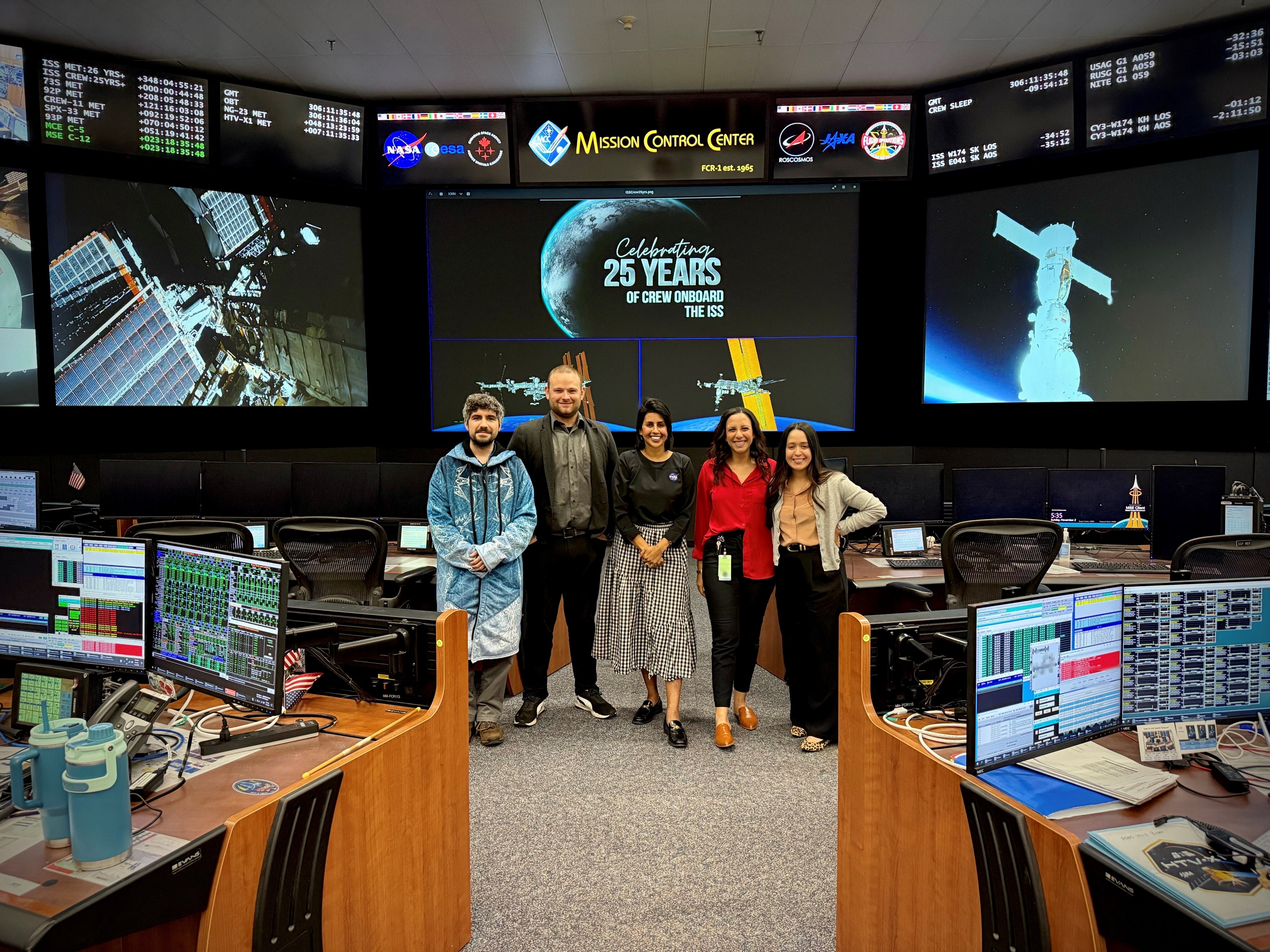
Behind every moment aboard the orbiting laboratory is a dedicated team on the ground – engineers, scientists, flight directors, and communicators – who work around the clock to keep crews safe and missions running smoothly.
They mark milestones together, from spacecraft dockings and crew returns to mission anniversaries and plaque-hanging ceremonies. Teams on console in the mission control have even organized chess matches with astronauts in orbit to foster connection between Earth and space.
The flight control team celebrated the 25th anniversary of continuous human habitation in space with the Expedition 73 crew aboard the station on Nov. 2, 2025. The team congratulated the crew to mark the incredible milestone. They emphasized that humanity has held a heartbeat in orbit for a quarter century, a testament to human curiosity, cooperation, and courage that keeps the light of exploration shining above Earth and represents the very best of what humankind can achieve together. Every orbit, every experiment, and every challenge has taught teams how to adapt, grow, and build the skills needed for the next great leaps to the Moon, Mars, and beyond.
Holidays are often spent in the control rooms, where teams decorate consoles, share potluck meals, and hold the occasional cookie-cutting contest. Engineers in the station’s Mission Evaluation Room (MER) host an annual “MERloween,” a tradition that began in 2006 to celebrate the year’s milestones and reflect on lessons learned.
These traditions highlight the spirit and teamwork that make every mission possible. The dedication honed through decades of mission support now guides the teamwork and expertise that will send Artemis astronauts to the Moon and beyond.
Flight controllers in mission control celebrate the holidays while supporting crews aboard the space station. NASA/Josh Valcarcel Painting hope beyond Earth NASA astronaut Nicole Stott, the first person to watercolor in space, paints aboard the space station. NASA

Former NASA astronaut Nicole Stott became the first person to watercolor in space during her time aboard the orbiting laboratory. Inspired by the beauty of Earth from orbit, she used her art to connect the science of human spaceflight with the creativity that defines it.
After returning to Earth, Stott helped launch the Space for Art Foundation, which unites children around the world through the healing power of art and space. One of its most meaningful initiatives, the Spacesuit Art Project, invites young patients undergoing cancer treatment to create colorful artwork that is transformed into custom-made spacesuits. Each suit – Hope, Courage, Unity, Victory, Dreamer, Exploration, Beyond, and Infinity – celebrates the imagination and resilience of its creators.
Four of these suits have journeyed to and from the orbiting laboratory, where astronauts wore them during special downlinks to speak with the patients and raise awareness for childhood cancer research. The project shows that space exploration is not only about discovery, but about compassion, creativity, and the human spirit that connects us all.
Explore More 4 min read Unexpected Trajectory: Erin Sholl’s Path to Human Spaceflight Safety Article 2 days ago 6 min read 25 Years of Space Station Technology Driving Exploration Article 6 days ago 3 min read City Lights Glow Along Moonlit WatersAn astronaut photographed moonglint shimmering across the sea surface and the bright clusters of Florida’s…
Article 7 days agoThrough Astronaut Eyes: 25 Years of Life in Orbit
After 25 years of continuous human presence in space, the International Space Station remains a training and proving ground for deep space missions, enabling NASA to focus on Artemis missions to the Moon and Mars. The orbiting laboratory is also a living archive of human experience, culture, and connection.
Creating community Expedition 34 crew members pictured in the Unity node of the International Space Station in December 2012. NASAWith 290 visitors from 26 countries and five international partners, the space station has celebrated many different cultures during its 25 years of continuous human presence. Crew members share their holiday traditions, cuisine, music, and games with each other – creating their own community, similar to the ones they have back home, while maintaining a connection to Earth.
Crews living and working aboard the space station during the holiday season have found creative ways to mark the occasions from low Earth orbit. Festive socks, Halloween costumes, mini artificial Christmas trees, champagne, and candle-less menorahs are just a few of the items space station visitors have brought with them to spread holiday cheer.
Mealtimes are also the perfect opportunity to share a taste of home. The space station’s standard menu is inclusive of varied cuisines, but crew members also contribute their own special food items. French astronaut Thomas G. Pesquet once brought macarons to help celebrate his birthday, and several JAXA (Japan Aerospace Exploration Agency) astronauts have hosted sushi parties.
Sharing a piece of themselves and their cultures not only fosters crew camaraderie but also supports the international collaboration necessary to sustain the space station’s success.
Taking music to new heights Expedition 55 crew members aboard the space station (from left) are NASA astronaut Drew Feustel, Roscosmos cosmonaut Oleg Artemyev, and NASA astronauts Ricky Arnold and Scott Tingle. JAXA (Japan Aerospace Exploration Agency)/Norishige KanaiThe first musical instrument, an acoustic guitar, arrived at the orbiting laboratory in August 2001. Since then, playing music aboard the orbiting laboratory has supported astronaut well-being, fostered relationships among international crew members, and helped them connect with home.
The space station’s instrument collection started with an acoustic guitar and an electric keyboard, and also includes an alto saxophone. Some NASA astronauts bring their own instruments to suit their playing habits – bagpipes for Kjell Lindgren, flutes for Catherine Coleman, a piccolo for Jessica Meir. International partners have, too. In April 2010, JAXA astronauts Soichi Noguchi and Naoko Yamazaki performed a duet using a bamboo flute and a miniature version of a traditional Japanese stringed instrument.
Several crew members have played in concerts on Earth while still orbiting the planet. Coleman played a duet with the frontman of Jethro Tull, for example, and ESA (European Space Agency) Luca Parmitano used the station’s electric keyboard to participate in a concert at Moscow’s Luzhniki Stadium. He later became the first person to perform a DJ set from space.
The space station has even hosted at least one epic jam session, featuring the crew members of Expedition 55 on guitar, flutes, and a drum made from a repurposed waste container.
Read more musical memories here.
NASA astronaut and Expedition 69 Flight Engineer Woody Hoburg plays guitar inside the space station’s Kibo laboratory module. NASA astronaut Jessica Meir plays a saxophone in front of the station’s Cupola windows. Roscosmos cosmonaut Aleksandr Gorbunov plays an electronic keyboard aboard the space station’s Harmony module. NASA astronaut Cady Coleman plays a flute in the JAXA (Japan Aerospace Exploration Agency) Kibo laboratory aboard the space station. Former NASA astronaut Dan Burbank plays a guitar while Russian cosmonaut Anton Shkaplerov plays a musical keyboard in the station’s Unity node. An astronaut’s perspective The sun shines above Earth’s horizon as the space station orbited 264 miles above the Canadian province of Quebec.NASAAcross the decades and missions of U.S. human spaceflight, NASA astronauts have shared a unique and transcendent experience: looking down at Earth from the space station’s cupola windows. That experience has had a profound impact on many, creating a powerful shift in the way astronauts think about life and our home planet – a phenomenon known as the overview effect.
Crew members aboard the orbital outpost describe the beauty of our planet and how it stands in stark contrast to the darkness of space from the cupola module. Many comment on Earth’s fragility and the need to protect it after observing how thin the planet’s atmosphere appears to be from orbit. Others note the lack of borders or lines we see on a map, emphasizing that all of humanity is connected.
Regardless of how long they stay in orbit, astronauts return with a different worldview they are eager to share with others.
Read more about astronaut perspectives on the overview effect or watch “Down to Earth” on NASA+.
Capturing the beauty and science in orbitThe space station provides a vantage point like no other. The cupola observation module, with its seven windows, offers unparalleled panoramic views of Earth and space which are crucial for monitoring mission activities, conducting scientific observations, and supporting crew morale and habitability. Astronauts aboard the orbiting laboratory have captured millions of photographs of Earth, creating a visual archive that spans 25 years of continuous human presence in orbit.
These images serve as scientific data used to track hurricanes, monitor wildfires, measure glacial retreat, and study urban growth through NASA’s Crew Earth Observations. Astronaut photography also supports NASA Disaster Response, a program that works with various NASA centers to collect data before, during, and following a disaster to aid recovery efforts.
The cupola has become a favorite spot for astronauts to work and reflect. Their photos help connect people worldwide to the orbital outpost, reinforcing the importance of protecting our planet.
Earth views NASA astronaut Don Pettit photographs “cosmic colors at sunrise.” From 250 miles above, the space station’s orbital path covers most of Earth’s population, offering valuable data and a great opportunity for shooting photography. The Full Moon is pictured setting below Earth’s horizon from the space station. Earth observation taken by the Expedition 40 crew aboard the orbital outpost. The southern coast of Africa is pictured from the space station’s “window to the world,” or cupola, as it soared 265 miles above. Earth observation taken during a day pass by an Expedition 36 crew member aboard the space station. The Canadarm2 robotic arm, with Dextre—its fine-tuned robotic hand—attached, extends from the space station’s Harmony module as the orbital outpost soars 263 miles above Kazakhstan. Earth observation taken during a night pass by the Expedition 40 crew aboard the orbiting laboratory. Clouds gather on Nepal’s sub-tropical side of the Himalayas with Mount Everest at the center of this photograph taken by an external high definition camera on the space station as it orbited 263 miles above the Indian subcontinent. The Milky Way appears above Earth’s bright atmospheric glow from the orbital outpost as it soared 261 miles above southern Iran. The soft hues of an orbital sunrise reveals the cloud tops above the Pacific Ocean northeast of New Zealand as the space station orbited 260 miles above. NASA astronaut Don Pettit captures a photo of a fire in La Porte, Texas in 2024. NASA astronaut John Phillips photographs a wildfire raging through northeast Phoenix in 2005. The blue-green lights of fishing boats, designed to lure squid, sardines, or mackerel, dot the East China Sea and the Taiwan Strait contrasting with the coastal city lights of Taiwan and China. The space station was orbiting 259 miles above the South China Sea just south of Taiwan. The Moon’s shadow, or umbra, is pictured covering portions of the Canadian provinces of Quebec and New Brunswick and the American state of Maine. Lightning illuminates the cloud tops of Category 1 Hurricane Erick as it stormed across the Pacific Ocean south of the Mexican state of Chiapas. Eruption of Cleveland Volcano, Aleutian Islands, Alaska in 2006. Hurricane Gabrielle is seen in the Atlantic Ocean as a Category 4 storm with sustained winds of 140 miles per hour. Hurricane Milton, a Category 5 storm at the time, in the Gulf of America off the coast of Yucatan Peninsula in 2024. Wildfires burn throughout Canada’s central provinces sending smoke drifting into the United States’ Great Lakes and Northeast regions. Lightning illuminates the cloud tops as the International Space Station orbits 259 miles above the Atlantic Ocean east of the Bahamas. Station memories from the ground Flight controllers at NASA’s Mission Control Center in Houston marked 25 years of continuous human presence in space with the Expedition 73 crew aboard the orbital outpost on Nov. 2, 2025.NASA/Pooja J. JesraniBehind every moment aboard the orbiting laboratory is a dedicated team on the ground – engineers, scientists, flight directors, and communicators – who work around the clock to keep crews safe and missions running smoothly.
They mark milestones together, from spacecraft dockings and crew returns to mission anniversaries and plaque-hanging ceremonies. Teams on console in the mission control have even organized chess matches with astronauts in orbit to foster connection between Earth and space.
The flight control team celebrated the 25th anniversary of continuous human habitation in space with the Expedition 73 crew aboard the station on Nov. 2, 2025. The team congratulated the crew to mark the incredible milestone. They emphasized that humanity has held a heartbeat in orbit for a quarter century, a testament to human curiosity, cooperation, and courage that keeps the light of exploration shining above Earth and represents the very best of what humankind can achieve together. Every orbit, every experiment, and every challenge has taught teams how to adapt, grow, and build the skills needed for the next great leaps to the Moon, Mars, and beyond.
Holidays are often spent in the control rooms, where teams decorate consoles, share potluck meals, and hold the occasional cookie-cutting contest. Engineers in the station’s Mission Evaluation Room (MER) host an annual “MERloween,” a tradition that began in 2006 to celebrate the year’s milestones and reflect on lessons learned.
These traditions highlight the spirit and teamwork that make every mission possible. The dedication honed through decades of mission support now guides the teamwork and expertise that will send Artemis astronauts to the Moon and beyond.
Flight controllers in mission control celebrate the holidays while supporting crews aboard the space station. NASA/Josh Valcarcel Painting hope beyond Earth NASA astronaut Nicole Stott, the first person to watercolor in space, paints aboard the space station. NASAFormer NASA astronaut Nicole Stott became the first person to watercolor in space during her time aboard the orbiting laboratory. Inspired by the beauty of Earth from orbit, she used her art to connect the science of human spaceflight with the creativity that defines it.
After returning to Earth, Stott helped launch the Space for Art Foundation, which unites children around the world through the healing power of art and space. One of its most meaningful initiatives, the Spacesuit Art Project, invites young patients undergoing cancer treatment to create colorful artwork that is transformed into custom-made spacesuits. Each suit – Hope, Courage, Unity, Victory, Dreamer, Exploration, Beyond, and Infinity – celebrates the imagination and resilience of its creators.
Four of these suits have journeyed to and from the orbiting laboratory, where astronauts wore them during special downlinks to speak with the patients and raise awareness for childhood cancer research. The project shows that space exploration is not only about discovery, but about compassion, creativity, and the human spirit that connects us all.
Explore More 4 min read Unexpected Trajectory: Erin Sholl’s Path to Human Spaceflight Safety Article 2 days ago 6 min read 25 Years of Space Station Technology Driving Exploration Article 7 days ago 3 min read City Lights Glow Along Moonlit WatersAn astronaut photographed moonglint shimmering across the sea surface and the bright clusters of Florida’s…
Article 1 week ago