
Feed aggregator
Daniel H. Wilson on Finding a Native Take on Traditional Alien Invasion Stories
Hole in the Sky, by Daniel H. Wilson, is one of Scientific American’s best fiction picks of 2025. In the novel, aliens talk through an AI headset and land in the Cherokee Nation, while the military scrambles to contain and control the unknown
Extremophile ‘Fire Amoeba’ Pushes the Boundaries of Complex Life
It was thought that complex cells couldn’t survive above a certain temperature, but a tiny amoeba has proven that assumption wrong
Hunter-gatherer groups are much less egalitarian than they seem
Hunter-gatherer groups are much less egalitarian than they seem
Hunter-gather groups are much less egalitarian than they seem
Hunter-gather groups are much less egalitarian than they seem
China’s Explosive Zhuque-3 Test Previews the Global Race for Reusable Rockets
A partially successful test of China’s Zhuque-3 rocket shows that other countries are rapidly catching up with the U.S in the race for reusable rocketry
Week in images: 01-05 December 2025
Week in images: 01-05 December 2025
Discover our week through the lens
Quantum experiment settles a century-old row between Einstein and Bohr
Quantum experiment settles a century-old row between Einstein and Bohr
Aluminum Is Crucial to Vaccines—And Safe. Why Are CDC Advisers Debating It?
RFK Jr.’s vaccine advisory panel will be discussing the inclusion of adjuvants in childhood vaccinations today. Here’s what’s at stake
The Sun's Poles Are Different Than We Expected
A new analysis of the Solar Orbiter's unique views of the Sun's poles shows how a "conveyor belt" moves within our nearest star.
The post The Sun's Poles Are Different Than We Expected appeared first on Sky & Telescope.
How Australian teens are planning to get around their social media ban
How Australian teens are planning to get around their social media ban
Hubble Spots a Storm of New Stars
- Hubble Home
- Overview
- Impact & Benefits
- Science
- Observatory
- Team
- Multimedia
- News
- More
2 min read
Hubble Spots a Storm of New Stars This NASA/ESA Hubble Space Telescope image features the spiral galaxy named NGC 1792.ESA/Hubble & NASA, D. Thilker, F. Belfiore, J. Lee and the PHANGS-HST Team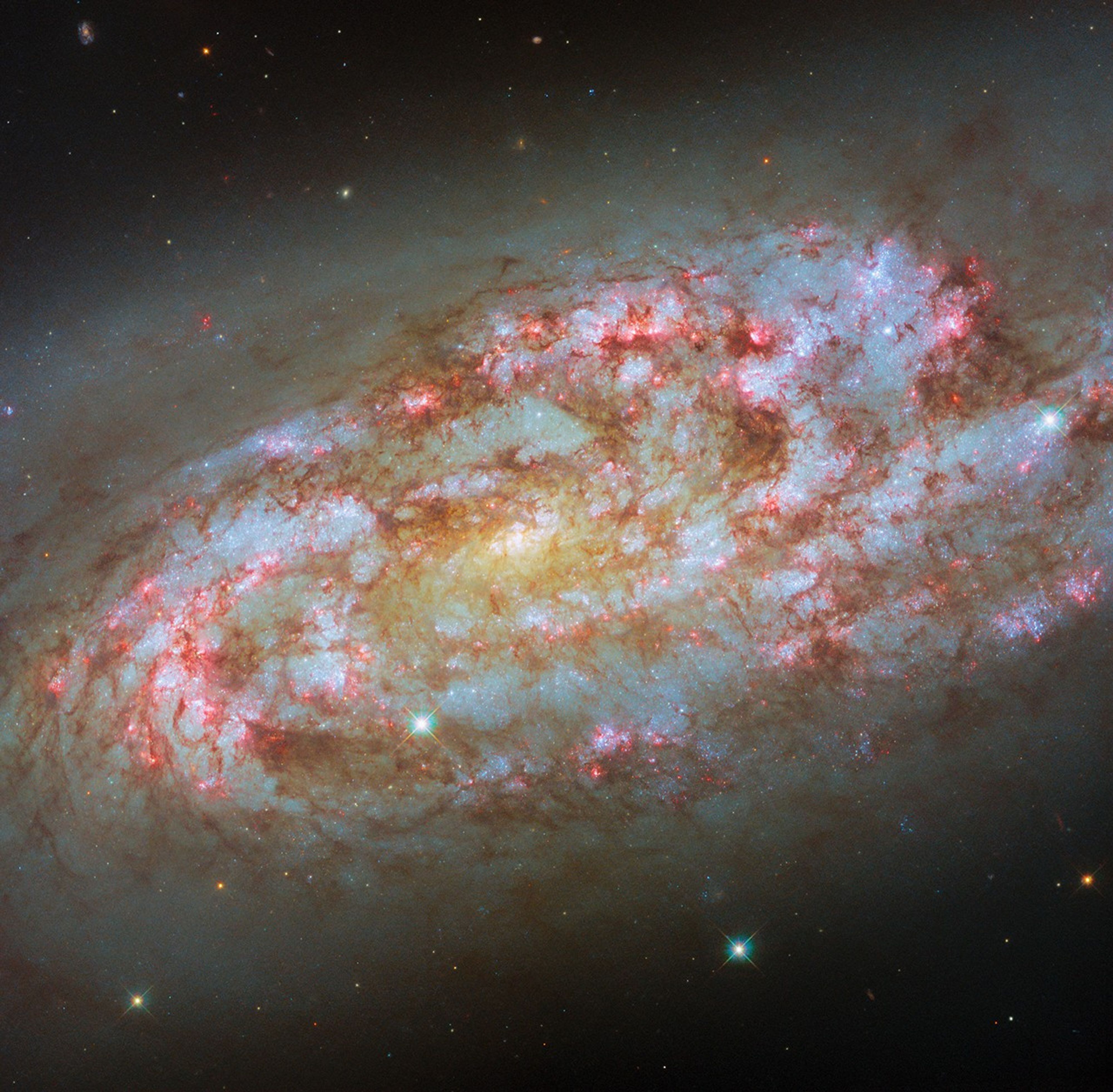
This NASA/ESA Hubble Space Telescope image features a stormy and highly active spiral galaxy named NGC 1792. Located over 50 million light-years from Earth in the constellation Columba (the Dove), the bright glow of the galaxy’s center is offset by the flocculent and sparkling spiral arms swirling around it.
NGC 1792 is just as fascinating to astronomers as its chaotic look might imply. Classified as a starburst galaxy, it is a powerhouse of star formation, with spiral arms rich in star-forming regions. In fact, it is surprisingly luminous for its mass. The galaxy is close to a larger neighbor, NGC 1808, and astronomers think the strong gravitational interaction between the two stirred up the reserves of gas in this galaxy. The result is a torrent of star formation, concentrated on the side closest to its neighbor, where gravity has a stronger effect. NGC 1792 is a perfect target for astronomers seeking to understand the complex interactions between gas, star clusters, and supernovae in galaxies.
Hubble studied this galaxy before. This new image includes additional data collected throughout 2025, providing a deeper view of the tumultuous activity taking place in the galaxy. Blossoming red lights in the galaxy’s arms mark Hydrogen-alpha (H-alpha) emission from dense clouds of hydrogen molecules. The newly forming stars within these clouds shine powerfully with ultraviolet radiation. This intense radiation ionizes the hydrogen gas, stripping away electrons which causes the gas to emit H-alpha light. H-alpha is a very particular red wavelength of light and a tell-tale sign of new stars.
@NASAHubble Instagram logo @NASAHubble Linkedin logo @NASAHubbleMedia Contact:
Claire Andreoli (claire.andreoli@nasa.gov)
NASA’s Goddard Space Flight Center, Greenbelt, MD
Hubble Spots a Storm of New Stars
- Hubble Home
- Overview
- Impact & Benefits
- Science
- Observatory
- Team
- Multimedia
- News
- More
2 min read
Hubble Spots a Storm of New Stars This NASA/ESA Hubble Space Telescope image features the spiral galaxy named NGC 1792.ESA/Hubble & NASA, D. Thilker, F. Belfiore, J. Lee and the PHANGS-HST TeamThis NASA/ESA Hubble Space Telescope image features a stormy and highly active spiral galaxy named NGC 1792. Located over 50 million light-years from Earth in the constellation Columba (the Dove), the bright glow of the galaxy’s center is offset by the flocculent and sparkling spiral arms swirling around it.
NGC 1792 is just as fascinating to astronomers as its chaotic look might imply. Classified as a starburst galaxy, it is a powerhouse of star formation, with spiral arms rich in star-forming regions. In fact, it is surprisingly luminous for its mass. The galaxy is close to a larger neighbor, NGC 1808, and astronomers think the strong gravitational interaction between the two stirred up the reserves of gas in this galaxy. The result is a torrent of star formation, concentrated on the side closest to its neighbor, where gravity has a stronger effect. NGC 1792 is a perfect target for astronomers seeking to understand the complex interactions between gas, star clusters, and supernovae in galaxies.
Hubble studied this galaxy before. This new image includes additional data collected throughout 2025, providing a deeper view of the tumultuous activity taking place in the galaxy. Blossoming red lights in the galaxy’s arms mark Hydrogen-alpha (H-alpha) emission from dense clouds of hydrogen molecules. The newly forming stars within these clouds shine powerfully with ultraviolet radiation. This intense radiation ionizes the hydrogen gas, stripping away electrons which causes the gas to emit H-alpha light. H-alpha is a very particular red wavelength of light and a tell-tale sign of new stars.
@NASAHubble Instagram logo @NASAHubble Linkedin logo @NASAHubbleMedia Contact:
Claire Andreoli (claire.andreoli@nasa.gov)
NASA’s Goddard Space Flight Center, Greenbelt, MD
Scientists and Senators are Excited About the Sugars Found in the OSIRIS-REx Samples
It’s been over two years since the samples from Bennu gathered by OSIRIS-REx were returned to Earth. But there’s still plenty of novel science coming out of that 121.6 g of material. Three new papers were released recently that describe different aspects of that sample. One in particular, from Yoshihiro Furukawa of Tohoku University in Japan and their co-authors, has already attracted plenty of attention, including from US Senator (and former astronaut) Mark Kelly. It shows that all of the building blocks for early life were available on the asteroid - raising the chances that planets throughout the galaxy could be seeded with the abiotic precursors for life.
Telecom Fiber-Optic Cables Measured an Earthquake in Incredible Detail
Fiber optics that connect the world can detect its earthquakes, too
Cosmic Magnification Is One of the Universe’s Weirdest Optical Illusions
In our topsy-turvy universe, sometimes the farther away an object is, the bigger it seems to be
How Zuranolone, a Fast-Acting Drug, Might Help Those Suffering with Postpartum Depression
Journalist Marla Broadfoot discusses zuranolone, a drug that may help people whose postpartum depression hasn’t responded to traditional antidepressants.