

Feed aggregator
Scientists race to develop Ebola drugs as outbreak surges
Clinical trials for treatments against Ebola Bundibugyo virus are ‘in a strong position’ to be launched quickly in the Democratic Republic of the Congo and Uganda
NASA’s New Shock Detectives Project Invites Volunteers to Help Study Solar Wind
The Sun sprays an extremely fast stream of charged particles called the solar wind. At approximately 56,000 miles (90,000 kilometers) in front of the Earth toward the Sun, the solar wind collides with the Earth’s protective magnetic field, generating a long-lasting shock wave that stretches for hundreds of thousands of miles. Now, you can help scientists examine data about this “bow shock” to better understand how the solar wind affects the Earth by joining a new research project: Shock Detectives.
At this enormous shock wave boundary, the ever-changing magnetic field can either make the solar wind messy and dynamic (“chaotic”) or leave it smooth and stable (“peaceful”).
When “chaotic” plasma dominates, more energy can reach Earth’s magnetosphere, possibly leading to disruptions in GPS signals, communications, and power grids. Scientists don’t yet fully understand when the plasma changes between “peaceful” and “chaotic” states or how those changes affect energy transfer to Earth.
You can help solve this mystery. NASA’s Magnetospheric Multiscale (MMS) mission has collected more than ten years of data from this zone – more than scientists can analyze alone. As Shock Detectives, you’ll help sort the chaotic from peaceful regions of the data, giving researchers a crucial set of clues.
The value of this new knowledge doesn’t end at Earth – what scientists learn about the Earth-Sun bow shock will help them understand how the solar wind of other stars impacts their orbiting planets. Your contributions may help take Shock Detectives ‘out of this world’!
This project is closely connected to another NASA-supported project, Space Umbrella, which also relies on MMS data and imagery. While Space Umbrella focuses on the broad boundary between Earth’s magnetic shield and the surrounding solar wind, Shock Detectives zooms in just outside that boundary on the transition region, which can be upwards of 10 miles (17 kilometers) in thickness, to better understand how plasma behaves near the shock. Together, these efforts build a more complete picture of Earth’s space environment.
Join Shock Detectives and help crack the case here: https://go.nasa.gov/4wILD6Y
Want a quick overview? Check out the introduction video.
The Earth’s magnetosphere (blue) interacts with the solar wind,, creating a shock wave (red), like a sonic boom in space. Join the Shock Detectives project and help scientists study this region and better understand how the solar wind affects our livesMark Garlick/Science Photo Library via Getty Images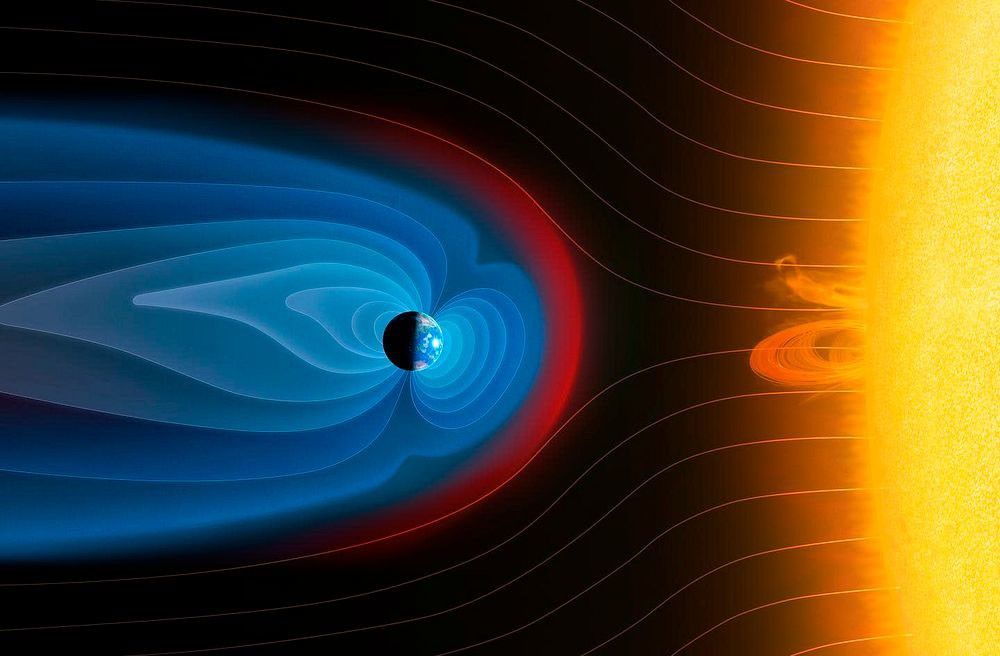
NASA’s New Shock Detectives Project Invites Volunteers to Help Study Solar Wind
The Sun sprays an extremely fast stream of charged particles called the solar wind. At approximately 56,000 miles (90,000 kilometers) in front of the Earth toward the Sun, the solar wind collides with the Earth’s protective magnetic field, generating a long-lasting shock wave that stretches for hundreds of thousands of miles. Now, you can help scientists examine data about this “bow shock” to better understand how the solar wind affects the Earth by joining a new research project: Shock Detectives.
At this enormous shock wave boundary, the ever-changing magnetic field can either make the solar wind messy and dynamic (“chaotic”) or leave it smooth and stable (“peaceful”).
When “chaotic” plasma dominates, more energy can reach Earth’s magnetosphere, possibly leading to disruptions in GPS signals, communications, and power grids. Scientists don’t yet fully understand when the plasma changes between “peaceful” and “chaotic” states or how those changes affect energy transfer to Earth.
You can help solve this mystery. NASA’s Magnetospheric Multiscale (MMS) mission has collected more than ten years of data from this zone – more than scientists can analyze alone. As Shock Detectives, you’ll help sort the chaotic from peaceful regions of the data, giving researchers a crucial set of clues.
The value of this new knowledge doesn’t end at Earth – what scientists learn about the Earth-Sun bow shock will help them understand how the solar wind of other stars impacts their orbiting planets. Your contributions may help take Shock Detectives ‘out of this world’!
This project is closely connected to another NASA-supported project, Space Umbrella, which also relies on MMS data and imagery. While Space Umbrella focuses on the broad boundary between Earth’s magnetic shield and the surrounding solar wind, Shock Detectives zooms in just outside that boundary on the transition region, which can be upwards of 10 miles (17 kilometers) in thickness, to better understand how plasma behaves near the shock. Together, these efforts build a more complete picture of Earth’s space environment.
Join Shock Detectives and help crack the case here: https://go.nasa.gov/4wILD6Y
Want a quick overview? Check out the introduction video.
The Earth’s magnetosphere (blue) interacts with the solar wind,, creating a shock wave (red), like a sonic boom in space. Join the Shock Detectives project and help scientists study this region and better understand how the solar wind affects our livesMark Garlick/Science Photo Library via Getty ImagesWind-assisted cargo ships could more than halve shipping emissions
Wind-assisted cargo ships could more than halve shipping emissions
Colossal claims an artificial eggshell will help it bring back the moa
Colossal claims an artificial eggshell will help it bring back the moa
Math puzzle: Fix the matchstick equation
Fix the matchstick equation in this math puzzle
Female beast hunters battled leopards in ancient Rome
Mosaic depictions of a weapon-wielding female gladiator are the first physical evidence showing women in ancient Rome could be skilled beast hunters
Odd “butterfly” molecule could lead to new parts of the quantum realm
Odd “butterfly” molecule could lead to new parts of the quantum realm
NASA dreams of a nuclear power plant on the moon. Here’s why
To build its moon base, NASA needs a lot of power
Which problems will quantum computers solve—and when?
Quantum computing could lead to revolutions in cryptography, materials design and telecommunications. But fulfilling those promises could be many years away
A field guide to quantum computer qubits
Here are six ways to build a quantum computer
New high‑resolution map transforms what we know about Roman roads and the Roman Empire
A massive digitization project has nearly doubled the known extent of the first continent-scale road network
Quantum computing is reaching its make-or-break moment
Will computers based on quantum physics really change the world?
How commercial satellites are changing modern warfare
Commercial satellites can now watch much of Earth in near-real time. Militaries are learning new ways to fool them
Readers respond to the February 2026 issue
Letters to the editors for the February 2026 issue of Scientific American
New ways to keep from losing muscle on Ozempic
Ozempic and just getting older take off muscle. New therapies could retain it