

Feed aggregator
SpaceX Booster Will Hit the Moon This August
The imminent lunar impact of a SpaceX Falcon 9 rocket booster highlights the growing amount of space debris near the Moon.
The post SpaceX Booster Will Hit the Moon This August appeared first on Sky & Telescope.
Tracy Arm’s Post-Tsunami Landscape
- Earth
- Earth Observatory
- Image of the Day
- EO Explorer
- Topics
- More Content
- About
Tracy Arm’s Post-Tsunami Landscape
- Earth
- Earth Observatory
- Image of the Day
- EO Explorer
- Topics
- More Content
- About
“Simplified Proteins” Reveal the Biochemical Dawn of Early Earth
When researchers look up at the sky and wonder if we’re not alone, they also realize the origins of life here on Earth might hold the key to finding out. The chaotic chemical soup of our early world eventually led to the staggering complexity of modern life, but how exactly did it start? Proteins were one of the key ingredients in the early years, but we’re still only just discovering how these marvels of modern biology first managed to fold, function, and survive. A new review paper, The borderlands of foldability: lessons from simplified proteins, published recently in Trends in Chemistry, showcases how scientists are attempting to answer this question - by researching “simplified proteins”.
Meet the Fleet: NASA Armstrong Continues Legacy of Flight Research
3 min read
Preparations for Next Moonwalk Simulations Underway (and Underwater) NASA’s X-59 quiet supersonic research aircraft flies above Palmdale and Edwards, California, during its first flight Tuesday, Oct. 28, 2025, accompanied by a NASA F/A-18 research aircraft serving as chase.NASA/Jim Ross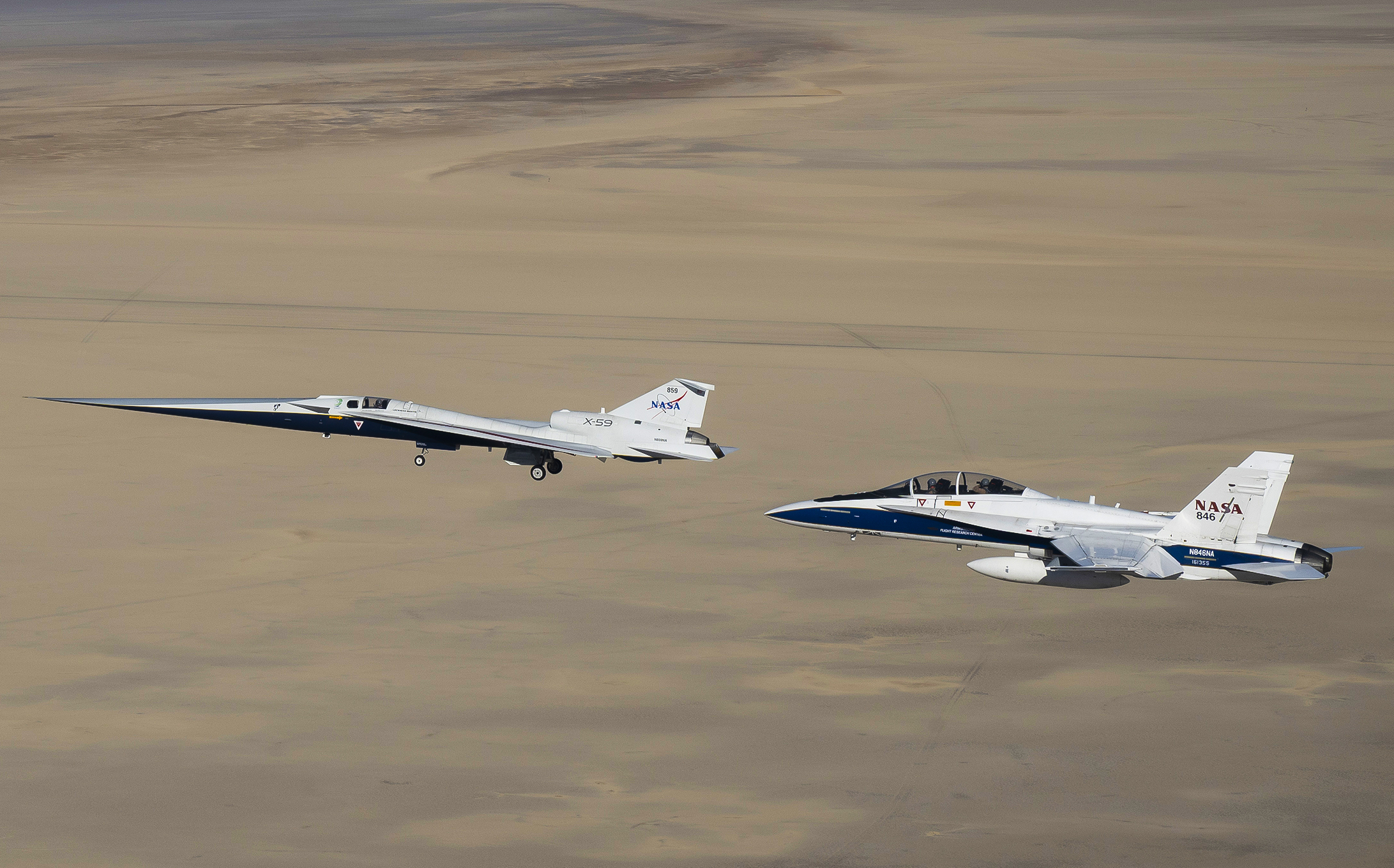
NASA’s home for experimental flight is welcoming more flyers to its already high-performing fleet as it continues to support science and aeronautics test missions – continuing the legacy of pioneers like Neil Armstrong.
NASA’s Armstrong Flight Research Center in Edwards, California, added multiple aircraft this year: two F-15s supersonic jets, a Pilatus PC-12 utility plane, and a T-34 turboprop trainer, which the center will use to support the agency’s advancement of aerospace research.
Throughout the center’s history, pilots have flown everything from large aircraft like the 747 Shuttle Carrier Aircraft and rocket-powered airplanes like the X-15 to high-speed repurposed fighter jets like the F-18. And after almost 80 years, flight research is still going strong in the desert today.
“Armstrong has a rich history of flight research, but it’s the multidimensional skills of the people we have here, and the knowledge they’ve built to handle very unique aircraft maintenance and modifications, that stands out,” said Darren Cole, capabilities manager for the Flight Demonstrations and Capabilities project at NASA Armstrong.
Armstrong has a rich history of flight research, but it’s the multidimensional skills of the people we have here … that stands out.Darren Cole
Capabilities Manager at NASA Armstrong
The center plays a pivotal role in worldwide airborne science missions, flying scientists and equipment from NASA, other government agencies, industry, and academia to collect measurements such as air pollution levels, glacier melt trends, and wildland fire mapping.
Scientists can manage experiments in real time aboard flying laboratories like the NASA ER-2, to collect important data with the help of Armstrong’s pilots and airborne science team.
“We all come together to make the science happen,” said Matt Berry, airborne research platforms branch chief at NASA Armstrong. “It is the agility of the Armstrong team that allows us to collaborate with scientists, get their equipment onboard, and to fly them to areas where they need to collect data.”
The center sits on Rogers Dry Lake, a 44-square-mile slat flat area used for aviation research and test operations. Rogers and the adjacent Rosamond Dry Lake have seen everything from space shuttle landings to emergency test flight recoveries. The Rogers lakebed continues to serve as an important piece of Armstrong’s test missions.
For NASA Armstrong, it all started with the first attempt by a human to fly faster than the speed of sound in the Bell X-1. In 1946, 13 employees from NASA’s predecessor agency, the National Advisory Committee for Aeronautics (NACA), arrived at what was then known as Muroc Army Airfield to prepare for the X-1 tests. A year later, NACA’s Muroc Flight Test Unit was established as a permanent facility at the airfield.
The center has gone by several names over the years, most recently changing from NASA’s Dryden Flight Research Center to NASA Armstrong in 2014. But its legacy has never shifted: The Bell X-1E, the last of the X-1 series of aircraft, now sits in front of NASA Armstrong, welcoming the newest test pilots, engineers, scientists, explorers, and dreamers. And they’re using the aircraft of today to break new barriers.
“I don’t think there is another place in the world with a more diverse fleet of aircraft. We have everything from a low-altitude powered glider to ER-2s, which are flying at high altitudes, and a multitude of aircraft in between,” Cole said.
From sourcing rare components to machining custom parts in-house, NASA Armstrong’s teams transform these aircraft into research workhorses. The center continues its crucial role in leading aeronautics testing, Earth science research, and supporting government and industry partners.
Learn more about aircraft flown at NASA Armstrong Share Details Last Updated May 07, 2026 EditorDede DiniusContactTeresa Whitingteresa.whiting@nasa.govLocationArmstrong Flight Research Center Related Terms Explore More 6 min read Cornell Students Aid NASA with Drone Safety in Sky Article 2 days ago 3 min read NASA’s Dryden Aeronautical Test Range Supports Flight, Space Missions Article 3 days ago 4 min read NASA Fosters Development of Lunar Resource-Seeking Technologies Article 5 days ago Keep Exploring Discover More Topics From NASANASA Armstrong Flight Research Center
Aeronautics
X-Planes at Armstrong
NASA Aircraft
Meet the Fleet: NASA Armstrong Continues Legacy of Flight Research
3 min read
Preparations for Next Moonwalk Simulations Underway (and Underwater) NASA’s X-59 quiet supersonic research aircraft flies above Palmdale and Edwards, California, during its first flight Tuesday, Oct. 28, 2025, accompanied by a NASA F/A-18 research aircraft serving as chase.NASA/Jim RossNASA’s home for experimental flight is welcoming more flyers to its already high-performing fleet as it continues to support science and aeronautics test missions – continuing the legacy of pioneers like Neil Armstrong.
NASA’s Armstrong Flight Research Center in Edwards, California, added multiple aircraft this year: two F-15s supersonic jets, a Pilatus PC-12 utility plane, and a T-34 turboprop trainer, which the center will use to support the agency’s advancement of aerospace research.
Throughout the center’s history, pilots have flown everything from large aircraft like the 747 Shuttle Carrier Aircraft and rocket-powered airplanes like the X-15 to high-speed repurposed fighter jets like the F-18. And after almost 80 years, flight research is still going strong in the desert today.
“Armstrong has a rich history of flight research, but it’s the multidimensional skills of the people we have here, and the knowledge they’ve built to handle very unique aircraft maintenance and modifications, that stands out,” said Darren Cole, capabilities manager for the Flight Demonstrations and Capabilities project at NASA Armstrong.
Armstrong has a rich history of flight research, but it’s the multidimensional skills of the people we have here … that stands out.Darren Cole
Capabilities Manager at NASA Armstrong
The center plays a pivotal role in worldwide airborne science missions, flying scientists and equipment from NASA, other government agencies, industry, and academia to collect measurements such as air pollution levels, glacier melt trends, and wildland fire mapping.
Scientists can manage experiments in real time aboard flying laboratories like the NASA ER-2, to collect important data with the help of Armstrong’s pilots and airborne science team.
“We all come together to make the science happen,” said Matt Berry, airborne research platforms branch chief at NASA Armstrong. “It is the agility of the Armstrong team that allows us to collaborate with scientists, get their equipment onboard, and to fly them to areas where they need to collect data.”
The center sits on Rogers Dry Lake, a 44-square-mile slat flat area used for aviation research and test operations. Rogers and the adjacent Rosamond Dry Lake have seen everything from space shuttle landings to emergency test flight recoveries. The Rogers lakebed continues to serve as an important piece of Armstrong’s test missions.
For NASA Armstrong, it all started with the first attempt by a human to fly faster than the speed of sound in the Bell X-1. In 1946, 13 employees from NASA’s predecessor agency, the National Advisory Committee for Aeronautics (NACA), arrived at what was then known as Muroc Army Airfield to prepare for the X-1 tests. A year later, NACA’s Muroc Flight Test Unit was established as a permanent facility at the airfield.
The center has gone by several names over the years, most recently changing from NASA’s Dryden Flight Research Center to NASA Armstrong in 2014. But its legacy has never shifted: The Bell X-1E, the last of the X-1 series of aircraft, now sits in front of NASA Armstrong, welcoming the newest test pilots, engineers, scientists, explorers, and dreamers. And they’re using the aircraft of today to break new barriers.
“I don’t think there is another place in the world with a more diverse fleet of aircraft. We have everything from a low-altitude powered glider to ER-2s, which are flying at high altitudes, and a multitude of aircraft in between,” Cole said.
From sourcing rare components to machining custom parts in-house, NASA Armstrong’s teams transform these aircraft into research workhorses. The center continues its crucial role in leading aeronautics testing, Earth science research, and supporting government and industry partners.
Learn more about aircraft flown at NASA Armstrong Share Details Last Updated May 07, 2026 EditorDede DiniusContactTeresa Whitingteresa.whiting@nasa.govLocationArmstrong Flight Research Center Related Terms Explore More 6 min read Cornell Students Aid NASA with Drone Safety in Sky Article 2 days ago 3 min read NASA’s Dryden Aeronautical Test Range Supports Flight, Space Missions Article 3 days ago 4 min read NASA Fosters Development of Lunar Resource-Seeking Technologies Article 5 days ago Keep Exploring Discover More Topics From NASANASA Armstrong Flight Research Center
Aeronautics
X-Planes at Armstrong
NASA Aircraft
A Brief-ish History of SETI. Part I: "Where is Everybody?"
The history of SETI is long and varied, with countless contributions made by some of the most brilliant minds humanity has ever produced. In this series, we will look into the milestones and principles that have led the field to where it is today.
The Asteroid Hunter
Somewhere out there, hurtling through space in the darkness, is an asteroid with our name on it. We just don't know which one yet. NASA's answer to that uncomfortable truth is NEO Surveyor, a purpose built infrared space telescope currently taking shape in laboratories across America, and scheduled for launch in 2027. The stakes, quite literally, could not be higher.
NASA Welcomes Paraguay as 67th Artemis Accords Signatory

The Republic of Paraguay signed the Artemis Accords on Thursday during a ceremony in Asunción, becoming the latest nation to commit to the shared principles guiding civil space exploration.
“Today, I am proud to welcome Paraguay as the 67th signatory to the Artemis Accords,” said NASA Administrator Jared Isaacman. “They join an ever-growing coalition of like-minded nations committed to the peaceful, transparent, and responsible exploration of space. Established by President Trump in his first term, the Artemis Accords provided the principles for how we explore the Moon, Mars, and beyond. Now, with his national space policy, we are putting the Artemis Accords into practice with our Moon Base. We are creating opportunities for all Artemis Accords signatories, including Paraguay, to join us on the lunar surface and advance our shared objectives in this next era of exploration.”
U.S. Embassy Asunción Chargé d’Affaires ad interim Aaron Pratt shared Isaacman’s remarks during the ceremony. Minister President of the Paraguayan Space Agency Osvaldo Almirón Riveros signed on behalf of Paraguay.
“The signing of the Artemis Accords represents a historic milestone for Paraguay and reflects our commitment to international cooperation, the peaceful use of outer space, scientific development, and the advancement of national space capabilities,” said Almirón Riveros. “This step strengthens Paraguay’s position within the global space community and opens new opportunities for research, innovation, and sustainable development.”
The Paraguayan Space Agency was established in 2014 and has worked to develop capabilities in satellite technology and Earth observation, including with international partners. Its first satellite, GuaraníSat‑1, launched from the International Space Station in 2021. The agency now is preparing to launch its second satellite, GuaraníSat‑2, in October aboard a Falcon 9 from Vandenberg Space Force Base in California. The mission was developed with collaborators from NASA’s Jet Propulsion Laboratory and other partners.
In 2020, the United States, led by NASA and the U.S. State Department, joined with seven other founding nations to establish the Artemis Accords, responding to the growing interest in lunar activities by both governments and private companies. The Artemis Accords introduced the first set of practical principles aimed at enhancing the safety and coordination between like-minded nations as they explore the Moon, Mars, and beyond.
Signing the Artemis Accords means committing to explore peaceably and transparently, to render aid to those in need, to enable access to scientific data that all of humanity can learn from, to ensure activities do not interfere with those of others, and to preserve historically significant sites and artifacts by developing best practices for space exploration for the benefit of all.
More countries are expected to sign the Artemis Accords in the months and years ahead, as NASA continues its work to establish a safe, peaceful, and prosperous future in space.
For more information about the Artemis Accords, visit:
https://www.nasa.gov/artemis-accords
Share Details Last Updated May 07, 2026 LocationNASA Headquarters Related TermsNASA Welcomes Paraguay as 67th Artemis Accords Signatory
The Republic of Paraguay signed the Artemis Accords on Thursday during a ceremony in Asunción, becoming the latest nation to commit to the shared principles guiding civil space exploration.
“Today, I am proud to welcome Paraguay as the 67th signatory to the Artemis Accords,” said NASA Administrator Jared Isaacman. “They join an ever-growing coalition of like-minded nations committed to the peaceful, transparent, and responsible exploration of space. Established by President Trump in his first term, the Artemis Accords provided the principles for how we explore the Moon, Mars, and beyond. Now, with his national space policy, we are putting the Artemis Accords into practice with our Moon Base. We are creating opportunities for all Artemis Accords signatories, including Paraguay, to join us on the lunar surface and advance our shared objectives in this next era of exploration.”
U.S. Embassy Asunción Chargé d’Affaires ad interim Aaron Pratt shared Isaacman’s remarks during the ceremony. Minister President of the Paraguayan Space Agency Osvaldo Almirón Riveros signed on behalf of Paraguay.
“The signing of the Artemis Accords represents a historic milestone for Paraguay and reflects our commitment to international cooperation, the peaceful use of outer space, scientific development, and the advancement of national space capabilities,” said Almirón Riveros. “This step strengthens Paraguay’s position within the global space community and opens new opportunities for research, innovation, and sustainable development.”
The Paraguayan Space Agency was established in 2014 and has worked to develop capabilities in satellite technology and Earth observation, including with international partners. Its first satellite, GuaraníSat‑1, launched from the International Space Station in 2021. The agency now is preparing to launch its second satellite, GuaraníSat‑2, in October aboard a Falcon 9 from Vandenberg Space Force Base in California. The mission was developed with collaborators from NASA’s Jet Propulsion Laboratory and other partners.
In 2020, the United States, led by NASA and the U.S. State Department, joined with seven other founding nations to establish the Artemis Accords, responding to the growing interest in lunar activities by both governments and private companies. The Artemis Accords introduced the first set of practical principles aimed at enhancing the safety and coordination between like-minded nations as they explore the Moon, Mars, and beyond.
Signing the Artemis Accords means committing to explore peaceably and transparently, to render aid to those in need, to enable access to scientific data that all of humanity can learn from, to ensure activities do not interfere with those of others, and to preserve historically significant sites and artifacts by developing best practices for space exploration for the benefit of all.
More countries are expected to sign the Artemis Accords in the months and years ahead, as NASA continues its work to establish a safe, peaceful, and prosperous future in space.
For more information about the Artemis Accords, visit:
https://www.nasa.gov/artemis-accords
Share Details Last Updated May 07, 2026 LocationNASA Headquarters Related TermsAstronomers Spot Possible Missing Link to Webb’s Little Red Dots
Astronomers may have found the missing link required to understand one of the James Webb Space Telescope’s most puzzling discoveries.
The post Astronomers Spot Possible Missing Link to Webb’s Little Red Dots appeared first on Sky & Telescope.
Trump administration cut funding to study hantavirus, the virus behind deadly cruise ship outbreak
The Centers for Research in Emerging Infectious Diseases were designed to study viruses that could jump from animals to people, including hantavirus, but in 2025 the National Institutes of Health said the work wouldn’t continue
NASA Sends Mars Helicopter Blades Beyond Mach 1
NASA/JPL-Caltech Photojournal Navigation Downloads NASA Sends Mars Helicopter Blades Beyond Mach 1
JPEG (1.38 MB)
Description
Engineer Fernando Mier-Hicks inspects a test stand used to investigate the performance of next-generation Mars helicopter rotor blades at high speeds inside the 25-Foot Space Simulator at NASA’s Jet Propulsion Laboratory in Southern California in November 2025. Data from the tests indicate that the rotors could surpass the sound barrier without breaking apart.
The test campaign was funded by the agency’s Mars Exploration Program in pursuit of maximizing the capability of future aircraft flying at the Red Planet. A division of Caltech in Pasadena, JPL manages the Mars Exploration Program for NASA’s Science Mission Directorate in Washington.
Keep Exploring Discover More Topics From Photojournal
Photojournal
Search Photojournal
Photojournal’s Latest Content
Feedback
NASA Sends Mars Helicopter Blades Beyond Mach 1
NASA/JPL-Caltech Photojournal Navigation Downloads NASA Sends Mars Helicopter Blades Beyond Mach 1
JPEG (1.38 MB)
Description
Engineer Fernando Mier-Hicks inspects a test stand used to investigate the performance of next-generation Mars helicopter rotor blades at high speeds inside the 25-Foot Space Simulator at NASA’s Jet Propulsion Laboratory in Southern California in November 2025. Data from the tests indicate that the rotors could surpass the sound barrier without breaking apart.
The test campaign was funded by the agency’s Mars Exploration Program in pursuit of maximizing the capability of future aircraft flying at the Red Planet. A division of Caltech in Pasadena, JPL manages the Mars Exploration Program for NASA’s Science Mission Directorate in Washington.
Keep Exploring Discover More Topics From Photojournal
Photojournal
Search Photojournal
Photojournal’s Latest Content
Feedback
NASA’s Next-Gen Mars Helicopter Rotors Are Moving Fast
NASA/JPL-Caltech Photojournal Navigation Downloads NASA’s Next-Gen Mars Helicopter Rotors Are Moving Fast
JPEG (1.34 MB)
Description
Engineer Jaakko Karras inspects a next-generation Mars helicopter rotor blade prior to supersonic speed testing in the 25-Foot Space Simulator at NASA’s Jet Propulsion Laboratory in Southern California in November 2025. The three-bladed rotor hanging horizontally in the foreground is the next-gen rotor being tested. The vertically aligned two-bladed rotor provided a “headwind,” enabling the tips of the three-bladed rotor to go beyond Mach 1. Data from the tests indicate that the next-gen rotor could surpass the sound barrier without breaking apart.
The agency’s Mars Exploration Program funded the test campaign in pursuit of maximizing the capability of future aircraft flying at the Red Planet. A division of Caltech in Pasadena, JPL manages the Mars Exploration Program for NASA’s Science Mission Directorate in Washington.
Keep Exploring Discover More Topics From Photojournal
Photojournal
Search Photojournal
Photojournal’s Latest Content
Feedback
NASA’s Next-Gen Mars Helicopter Rotors Are Moving Fast
NASA/JPL-Caltech Photojournal Navigation Downloads NASA’s Next-Gen Mars Helicopter Rotors Are Moving Fast
JPEG (1.34 MB)
Description
Engineer Jaakko Karras inspects a next-generation Mars helicopter rotor blade prior to supersonic speed testing in the 25-Foot Space Simulator at NASA’s Jet Propulsion Laboratory in Southern California in November 2025. The three-bladed rotor hanging horizontally in the foreground is the next-gen rotor being tested. The vertically aligned two-bladed rotor provided a “headwind,” enabling the tips of the three-bladed rotor to go beyond Mach 1. Data from the tests indicate that the next-gen rotor could surpass the sound barrier without breaking apart.
The agency’s Mars Exploration Program funded the test campaign in pursuit of maximizing the capability of future aircraft flying at the Red Planet. A division of Caltech in Pasadena, JPL manages the Mars Exploration Program for NASA’s Science Mission Directorate in Washington.
Keep Exploring Discover More Topics From Photojournal
Photojournal
Search Photojournal
Photojournal’s Latest Content
Feedback
NASA Pushes Next-Gen Mars Helicopter Rotor Blades Past Mach 1
The rotor blades that will carry NASA’s next-generation helicopters to new Martian heights broke the sound barrier during March tests at NASA’s Jet Propulsion Laboratory in Southern California. Data from the tests, which took place in a special chamber that can simulate environmental conditions on the Red Planet, indicate that the fastest traveling part of the rotor blade, the tips, can be accelerated beyond Mach 1 without breaking apart. Data gathered from 137 test runs will enable engineers to design aircraft capable of carrying heavier payloads, including science instruments.
“NASA had a great run with the Ingenuity Mars Helicopter, but we are asking these next-generation aircraft to do even more at the Red Planet,” said Al Chen, Mars Exploration Program manager at JPL. “That’s not an easy ask. While everything about Mars is hard, flying there is just about the hardest thing you can do. That’s because its atmosphere is so incredibly thin that it is hard to generate lift, and yet Mars has significant gravity.”
By pushing rotors beyond the speed of sound during recent testing at NASA’s Jet Propulsion Laboratory, engineers are unlocking new possibilities for low-altitude aerial exploration of Mars. Credit: NASA/JPL-CaltechIngenuity, which performed the first powered, controlled flight on another world just over five years ago on April 19, 2021, was a trailblazing technology demonstration that did not carry science instruments. The agency’s recently announced SkyFall project and other potential future Mars aircraft will be capable of carrying payloads — including science instruments and sensors — to collect data in support of future human and robotic missions, leveraging the advantages that come with low-altitude aerial exploration.
Need for speedIn the fast-moving world of rotors, more thrust comes from a quicker spin or a larger diameter. Although this axiom holds true on Earth, engineers designing aircraft for the Red Planet must be much more aggressive. Because the Mars atmosphere is only 1% as dense as Earth’s, maximizing thrust requires pushing blade tips toward the speed of sound to achieve significant lift. While small-diameter rotors on Earth can also rotate at thousands of revolutions per minute, they have more air molecules to push and don’t need to approach the sonic edge.
To view this video please enable JavaScript, and consider upgrading to a web browser that supports HTML5 video
NASA’s Ingenuity Mars Helicopter does a slow spin test of its blades on April 8, 2021, the 48th Martian day, or sol, of the mission. The rotorcraft, captured here by the Mastcam-Z instrument aboard NASA’s Perseverance rover, completed its historic first flight less than two Earth weeks later.NASA/JPL-Caltech/ASU/MSSSThe Ingenuity flight team never allowed the rotational speed of their composite-skinned foam rotors to exceed 2,700 rpm during the helicopter’s 72 flights at Mars for two reasons: to avoid the unpredictable physics of the sound barrier and to make sure that an unexpected gust of wind (from a dust devil, for instance) wouldn’t send the rotor tips over the sonic edge.
“If Chuck Yeager were here, he’d tell you things can get squirrely around Mach 1,” said JPL’s Jaakko Karras, the rotor test lead. “With that in mind, we planned Ingenuity’s flights to keep the rotor blade tips at Mach 0.7 with no wind so that if we encountered a Martian headwind while in flight, the rotor tips wouldn’t go supersonic. But we want more performance from our next-gen Mars aircraft. We needed to know that our rotors could go faster safely.”
While Mach 1 on Earth at sea level is approximately 760 mph (1,223 kph), the speed of sound on Mars is significantly slower — roughly 540 mph (869 kph) — due to the planet’s thin, cold, carbon-dioxide-rich atmosphere.
Blade-proof chamberTo begin evaluating the rotors, which were developed and manufactured by AeroVironment in Simi Valley, California, Karras and his team mounted a three-bladed rotor that could be used in future Mars helicopter designs inside the historic 25-Foot Space Simulator at JPL. They evacuated the air and replaced it with just enough carbon dioxide to match the Martian atmosphere, then blasted the rotor with wind as it spun at increasing speeds.
The test engineers had taken the precaution of lining part of the chamber with sheet metal in case the blades broke apart during the supersonic experiment. From a control room a few yards away from the chamber, the team watched displays showing data and a view inside the chamber as the rpm climbed as high as 3,750. At that rate, the tips were traveling at Mach 0.98. Then the engineers activated a fan inside the chamber that pelted the rotors with headwinds. After each run, they increased in wind velocity for the next run.
The team pushed rotor tip speeds to Mach 1.08, boosting the Mars vehicle’s lift capability by 30%. This breakthrough allows future missions to support heavier scientific payloads, including advanced sensors and larger batteries for extended flight.
Next the team tried their luck with the two-bladed SkyFall rotor. Because it is slightly longer than the three-bladed version, only 3,570 rpm was needed to achieve the same near-supersonic speed at the rotor tips prior to introducing the headwinds.
“The successful testing of these rotors was a major step toward proving the feasibility of flight in more demanding environments, which is key for next-gen vehicles,” said Shannah Withrow-Maser, an aerodynamicist from NASA’s Ames Research Center in Silicon Valley and member of the test team. “We thought we’d be lucky to hit Mach 1.05, and we reached Mach 1.08 on our last runs. We’re still digging into the data, and there may be even more thrust on the table. These next-gen helicopters are going to be amazing.”
The SkyFall mission design team has incorporated the test team’s findings into the performance specifications. Inspired by Ingenuity, the only rotorcraft to fly on another planet to date, SkyFall is designed to carry three next-gen Mars helicopters to the Red Planet in December 2028.
More about NASA’s Mars Exploration ProgramThe faster-than-sound spin test campaign was funded by the agency’s Mars Exploration Program in pursuit of maximizing the capability of future aircraft flying at the Red Planet. A division of Caltech in Pasadena, JPL manages the Mars Exploration Program for NASA’s Science Mission Directorate in Washington.
For more information about NASA’s Mars Exploration Program, visit:
Media Contacts
DC Agle
Jet Propulsion Laboratory, Pasadena, Calif.
818-393-9011
agle@jpl.nasa.gov
Karen Fox / Alana Johnson
NASA Headquarters, Washington
240-285-5155 / 202-672-4780
karen.c.fox@nasa.gov / alana.r.johnson@nasa.gov
2026-029
Explore More 2 min read NASA’s Perseverance Mars Rover Surveys ‘Crocodile Bridge’Description NASA’s Perseverance Mars rover used its Mastcam-Z camera system to capture this 360-degree panorama…
Article 3 days ago 5 min read NASA’s Perseverance, Curiosity Panoramas Capture Two Sides of Mars Article 2 weeks ago 5 min read NASA’s Curiosity Finds Organic Molecules Never Seen Before on Mars Article 2 weeks ago Keep Exploring Discover More Topics From NASA Mars: FactsMars is one of the most explored bodies in our solar system, and it’s the only planet where we’ve sent…
Ingenuity Mars Helicopter
Jet Propulsion Laboratory
Mars ExplorationMars is the only planet we know of inhabited entirely by robots. Learn more about the Mars Missions.
NASA Pushes Next-Gen Mars Helicopter Rotor Blades Past Mach 1
The rotor blades that will carry NASA’s next-generation helicopters to new Martian heights broke the sound barrier during March tests at NASA’s Jet Propulsion Laboratory in Southern California. Data from the tests, which took place in a special chamber that can simulate environmental conditions on the Red Planet, indicate that the fastest traveling part of the rotor blade, the tips, can be accelerated beyond Mach 1 without breaking apart. Data gathered from 137 test runs will enable engineers to design aircraft capable of carrying heavier payloads, including science instruments.
“NASA had a great run with the Ingenuity Mars Helicopter, but we are asking these next-generation aircraft to do even more at the Red Planet,” said Al Chen, Mars Exploration Program manager at JPL. “That’s not an easy ask. While everything about Mars is hard, flying there is just about the hardest thing you can do. That’s because its atmosphere is so incredibly thin that it is hard to generate lift, and yet Mars has significant gravity.”
By pushing rotors beyond the speed of sound during recent testing at NASA’s Jet Propulsion Laboratory, engineers are unlocking new possibilities for low-altitude aerial exploration of Mars. Credit: NASA/JPL-CaltechIngenuity, which performed the first powered, controlled flight on another world just over five years ago on April 19, 2021, was a trailblazing technology demonstration that did not carry science instruments. The agency’s recently announced SkyFall project and other potential future Mars aircraft will be capable of carrying payloads — including science instruments and sensors — to collect data in support of future human and robotic missions, leveraging the advantages that come with low-altitude aerial exploration.
Need for speedIn the fast-moving world of rotors, more thrust comes from a quicker spin or a larger diameter. Although this axiom holds true on Earth, engineers designing aircraft for the Red Planet must be much more aggressive. Because the Mars atmosphere is only 1% as dense as Earth’s, maximizing thrust requires pushing blade tips toward the speed of sound to achieve significant lift. While small-diameter rotors on Earth can also rotate at thousands of revolutions per minute, they have more air molecules to push and don’t need to approach the sonic edge.
To view this video please enable JavaScript, and consider upgrading to a web browser that supports HTML5 video
NASA’s Ingenuity Mars Helicopter does a slow spin test of its blades on April 8, 2021, the 48th Martian day, or sol, of the mission. The rotorcraft, captured here by the Mastcam-Z instrument aboard NASA’s Perseverance rover, completed its historic first flight less than two Earth weeks later.NASA/JPL-Caltech/ASU/MSSSThe Ingenuity flight team never allowed the rotational speed of their composite-skinned foam rotors to exceed 2,700 rpm during the helicopter’s 72 flights at Mars for two reasons: to avoid the unpredictable physics of the sound barrier and to make sure that an unexpected gust of wind (from a dust devil, for instance) wouldn’t send the rotor tips over the sonic edge.
“If Chuck Yeager were here, he’d tell you things can get squirrely around Mach 1,” said JPL’s Jaakko Karras, the rotor test lead. “With that in mind, we planned Ingenuity’s flights to keep the rotor blade tips at Mach 0.7 with no wind so that if we encountered a Martian headwind while in flight, the rotor tips wouldn’t go supersonic. But we want more performance from our next-gen Mars aircraft. We needed to know that our rotors could go faster safely.”
While Mach 1 on Earth at sea level is approximately 760 mph (1,223 kph), the speed of sound on Mars is significantly slower — roughly 540 mph (869 kph) — due to the planet’s thin, cold, carbon-dioxide-rich atmosphere.
Blade-proof chamberTo begin evaluating the rotors, which were developed and manufactured by AeroVironment in Simi Valley, California, Karras and his team mounted a three-bladed rotor that could be used in future Mars helicopter designs inside the historic 25-Foot Space Simulator at JPL. They evacuated the air and replaced it with just enough carbon dioxide to match the Martian atmosphere, then blasted the rotor with wind as it spun at increasing speeds.
The test engineers had taken the precaution of lining part of the chamber with sheet metal in case the blades broke apart during the supersonic experiment. From a control room a few yards away from the chamber, the team watched displays showing data and a view inside the chamber as the rpm climbed as high as 3,750. At that rate, the tips were traveling at Mach 0.98. Then the engineers activated a fan inside the chamber that pelted the rotors with headwinds. After each run, they increased in wind velocity for the next run.
The team pushed rotor tip speeds to Mach 1.08, boosting the Mars vehicle’s lift capability by 30%. This breakthrough allows future missions to support heavier scientific payloads, including advanced sensors and larger batteries for extended flight.
Next the team tried their luck with the two-bladed SkyFall rotor. Because it is slightly longer than the three-bladed version, only 3,570 rpm was needed to achieve the same near-supersonic speed at the rotor tips prior to introducing the headwinds.
“The successful testing of these rotors was a major step toward proving the feasibility of flight in more demanding environments, which is key for next-gen vehicles,” said Shannah Withrow-Maser, an aerodynamicist from NASA’s Ames Research Center in Silicon Valley and member of the test team. “We thought we’d be lucky to hit Mach 1.05, and we reached Mach 1.08 on our last runs. We’re still digging into the data, and there may be even more thrust on the table. These next-gen helicopters are going to be amazing.”
The SkyFall mission design team has incorporated the test team’s findings into the performance specifications. Inspired by Ingenuity, the only rotorcraft to fly on another planet to date, SkyFall is designed to carry three next-gen Mars helicopters to the Red Planet in December 2028.
More about NASA’s Mars Exploration ProgramThe faster-than-sound spin test campaign was funded by the agency’s Mars Exploration Program in pursuit of maximizing the capability of future aircraft flying at the Red Planet. A division of Caltech in Pasadena, JPL manages the Mars Exploration Program for NASA’s Science Mission Directorate in Washington.
For more information about NASA’s Mars Exploration Program, visit:
Media Contacts
DC Agle
Jet Propulsion Laboratory, Pasadena, Calif.
818-393-9011
agle@jpl.nasa.gov
Karen Fox / Alana Johnson
NASA Headquarters, Washington
240-285-5155 / 202-672-4780
karen.c.fox@nasa.gov / alana.r.johnson@nasa.gov
2026-029
Explore More 2 min read NASA’s Perseverance Mars Rover Surveys ‘Crocodile Bridge’Description NASA’s Perseverance Mars rover used its Mastcam-Z camera system to capture this 360-degree panorama…
Article 3 days ago 5 min read NASA’s Perseverance, Curiosity Panoramas Capture Two Sides of Mars Article 2 weeks ago 5 min read NASA’s Curiosity Finds Organic Molecules Never Seen Before on Mars Article 2 weeks ago Keep Exploring Discover More Topics From NASA Mars: FactsMars is one of the most explored bodies in our solar system, and it’s the only planet where we’ve sent…
Ingenuity Mars Helicopter
Jet Propulsion Laboratory
Mars ExplorationMars is the only planet we know of inhabited entirely by robots. Learn more about the Mars Missions.
Industry Moon Lander Training Cabin Lands at NASA for Artemis
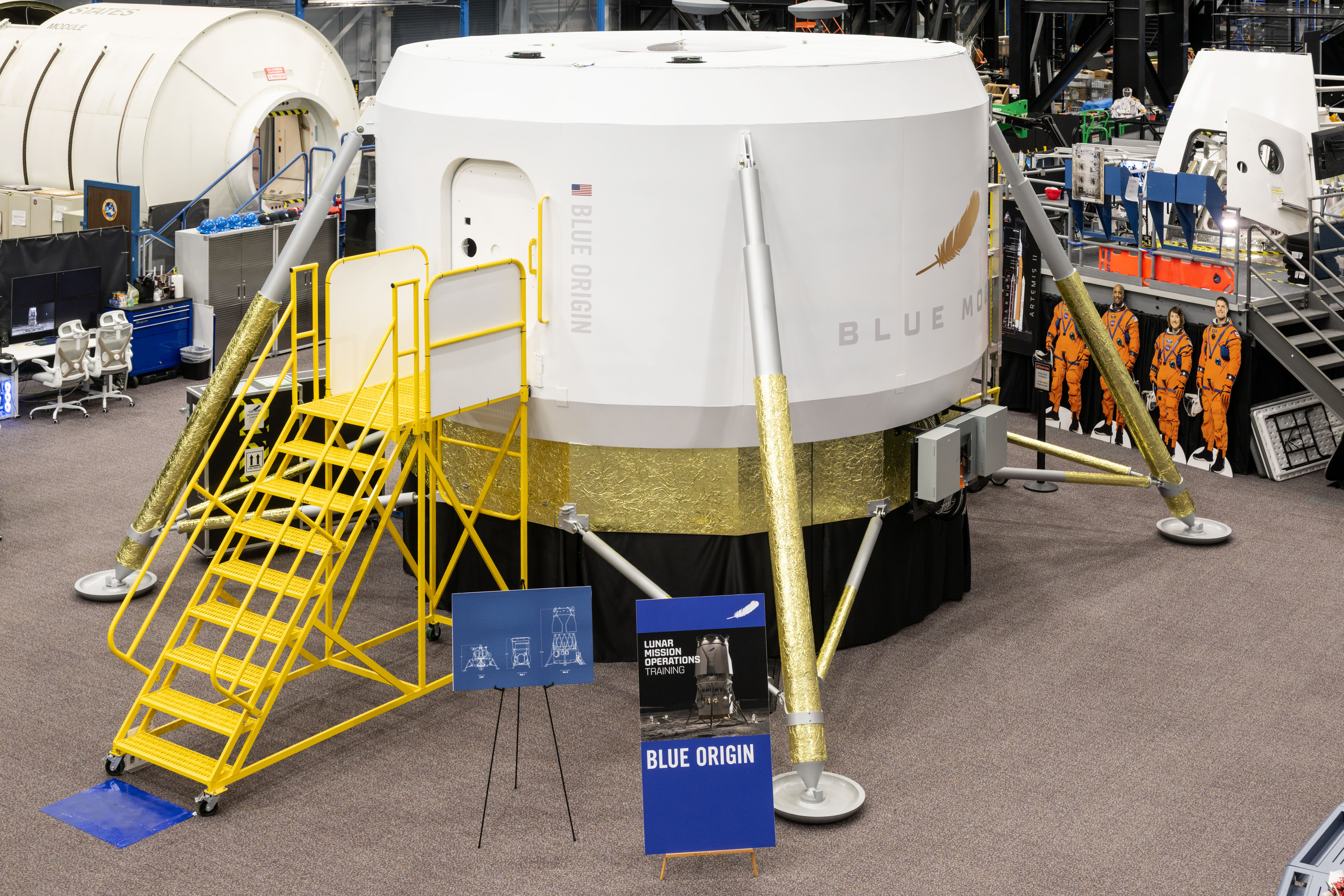
A full-scale mock-up of a crew cabin for a future industry lunar lander for NASA’s Artemis program now is operational for training and testing. The agency and its industry partners will use Blue Origin’s Blue Moon Mark 2 crew cabin for mission simulations as the agency prepares to dock with landers in Earth orbit in 2027 and send astronauts to the Moon by 2028.
NASA is working with two American companies to develop the human landing systems that will safely transport astronauts from lunar orbit to the Moon’s surface and back for Artemis. Blue Origin’s lander, launching uncrewed on top of the company’s New Glenn rocket, will meet astronauts aboard NASA’s Orion spacecraft in lunar orbit. Two astronauts will board the Blue Moon crew lander, which will ferry them to the surface and back to other crew members aboard Orion in lunar orbit following the conclusion of their surface stay.
The Blue Moon crew lander that will fly to the Moon will stand about 52 feet tall. Its crew cabin, located at the base of the lander, will be the living and working space where two astronauts will eat, sleep, conduct science, and observe the lunar environment during their stay.
The prototype at NASA’s Johnson Space Center in Houston is a full-size model, featuring the exterior ladder astronauts will use during their time on the Moon. As NASA and industry teams prepare for future crewed missions to the lunar surface, this model will evolve to support more advanced mission and training needs. Over time, it will become an integrated simulator with interactive systems that help astronauts practice for their flight with ground flight control teams.
NASA and Blue Origin can access the exterior and interior of the crew cabin trainer to conduct a series of human-in-the-loop tests, or tests with human interaction, including mission scenarios, mission control communications, spacesuit checkouts, and preparations for simulated moonwalks. The training cabin will also be used to provide design feedback to the Blue Origin team as the lander continues to be developed and mission planning evolves.
Following the successful Artemis II test flight that took four astronauts around the Moon, NASA will launch the Artemis III mission next year to test critical systems in Earth orbit, including rendezvous and docking with one or both commercial landers from Blue Origin and SpaceX. The agency and its partners will conduct integrated checkouts of life support, communications, propulsion, and potentially new spacesuits. These operations will pave the way for Artemis IV and V in 2028, which will return NASA astronauts to the Moon using these commercial provide landers.
Under Artemis, NASA will send astronauts on increasingly difficult missions to explore more of the Moon for scientific discovery and economic benefits, building the foundation for the first crewed missions to Mars.
Learn more about the Artemis program:
Share Details Last Updated May 07, 2026 EditorLee MohonContactCorinne M. Beckingercorinne.m.beckinger@nasa.govLocationMarshall Space Flight Center Related TermsIndustry Moon Lander Training Cabin Lands at NASA for Artemis
A full-scale mock-up of a crew cabin for a future industry lunar lander for NASA’s Artemis program now is operational for training and testing. The agency and its industry partners will use Blue Origin’s Blue Moon Mark 2 crew cabin for mission simulations as the agency prepares to dock with landers in Earth orbit in 2027 and send astronauts to the Moon by 2028.
NASA is working with two American companies to develop the human landing systems that will safely transport astronauts from lunar orbit to the Moon’s surface and back for Artemis. Blue Origin’s lander, launching uncrewed on top of the company’s New Glenn rocket, will meet astronauts aboard NASA’s Orion spacecraft in lunar orbit. Two astronauts will board the Blue Moon crew lander, which will ferry them to the surface and back to other crew members aboard Orion in lunar orbit following the conclusion of their surface stay.
The Blue Moon crew lander that will fly to the Moon will stand about 52 feet tall. Its crew cabin, located at the base of the lander, will be the living and working space where two astronauts will eat, sleep, conduct science, and observe the lunar environment during their stay.
The prototype at NASA’s Johnson Space Center in Houston is a full-size model, featuring the exterior ladder astronauts will use during their time on the Moon. As NASA and industry teams prepare for future crewed missions to the lunar surface, this model will evolve to support more advanced mission and training needs. Over time, it will become an integrated simulator with interactive systems that help astronauts practice for their flight with ground flight control teams.
NASA and Blue Origin can access the exterior and interior of the crew cabin trainer to conduct a series of human-in-the-loop tests, or tests with human interaction, including mission scenarios, mission control communications, spacesuit checkouts, and preparations for simulated moonwalks. The training cabin will also be used to provide design feedback to the Blue Origin team as the lander continues to be developed and mission planning evolves.
Following the successful Artemis II test flight that took four astronauts around the Moon, NASA will launch the Artemis III mission next year to test critical systems in Earth orbit, including rendezvous and docking with one or both commercial landers from Blue Origin and SpaceX. The agency and its partners will conduct integrated checkouts of life support, communications, propulsion, and potentially new spacesuits. These operations will pave the way for Artemis IV and V in 2028, which will return NASA astronauts to the Moon using these commercial provide landers.
Under Artemis, NASA will send astronauts on increasingly difficult missions to explore more of the Moon for scientific discovery and economic benefits, building the foundation for the first crewed missions to Mars.
Learn more about the Artemis program:
Share Details Last Updated May 07, 2026 EditorLee MohonContactCorinne M. Beckingercorinne.m.beckinger@nasa.govLocationMarshall Space Flight Center Related Terms