
Feed aggregator
Ebola outbreak triggers U.S. ban on travelers from three African nations
At least six Americans are believed to have been exposed to the Ebola virus, and one person who appears to have contracted the virus has been evacuated to Germany
How scientists developed a hantavirus PCR test in a weekend
Researchers at the Nebraska Public Health Laboratory worked round the clock to develop a test for the Andes virus at the center of the deadly cruise ship outbreak
Hidden copy of the oldest known poem in the English language leaves researchers ‘speechless’
Researchers discovered the copy of the 1,300-year-old poem lurking inside a historical text in an Italian library
NASA’s MAVEN Makes 1st Discovery of Atmospheric Effect at Mars
In December 2023, scientists looking at Mars data stumbled across something completely unexpected — observations of an atmospheric effect never before seen in the Red Planet’s atmosphere. Using instruments aboard NASA’s MAVEN (Mars Atmosphere and Volatile Evolution) mission, scientists identified a phenomenon known to occur in Earth’s magnetosphere, where charged particles are squeezed like toothpaste coming out of a tube along magnetic structures called flux tubes. This so-called Zwan-Wolf effect aids in the deflection of solar wind around Earth and has been observed and studied there for decades. Now, a new study published in Nature Communications provides the first comprehensive observations of the same effect in Mars’ atmosphere.
An artistic representation of the Zwan-Wolf effect at Mars, as observed by NASA’s MAVEN (Mars Atmosphere and Volatile Evolution) mission. While this effect typically helps to deflect the solar wind at Earth, at Mars it is shown to “squeeze” the atmosphere and have implications on how space weather interacts with the planet. The yellow arrows represent the movement of the effect in the Martian atmosphere. LASP/CU Boulder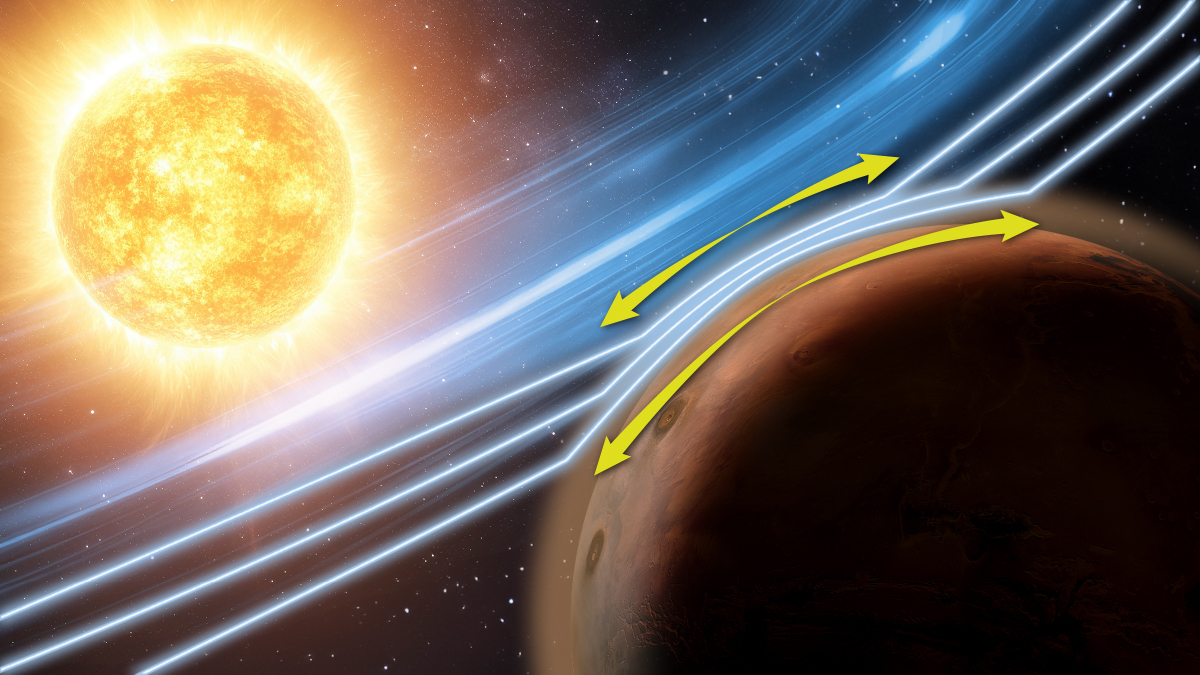
“When investigating the data, I all of a sudden noticed some very interesting wiggles,” said Christopher Fowler, a research assistant professor at West Virginia University in Morgantown and lead author of the study. “I would never have guessed it would be this effect, since it’s never been seen in a planetary atmosphere before.”
The Zwan-Wolf effect was first discovered in 1976, and until now has only been observed in planetary magnetospheres, not their atmospheres. Unlike Earth, Mars is not protected by a global magnetic field, affecting how it interacts with the solar wind and space weather. In this new study, the Zwan-Wolf effect was observed in the ionosphere — deep within the Martian atmosphere below 200 km — which contains significant numbers of electrically charged particles. The data showed that these charged particles were being squeezed and distributed around Mars’ atmosphere.
Although Mars has an induced magnetosphere, a magnetic field generated by the solar wind interacting with the Martian ionosphere, it can greatly change in size and shape with large solar wind and space weather events. That is what Fowler and his team saw in the MAVEN data when a large solar storm hit Mars. Based on their findings, the Zwan-Wolf effect may be occurring constantly in the Martian ionosphere but at levels undetectable by MAVEN’s instrumentation. The impact of the space weather event appears to have amplified the effect, allowing the scientists to observe it in the data.
In the beginning, Fowler and his team came across some interesting-looking fluctuations in measurements of the magnetic field as the spacecraft flew through the atmosphere. To explain this, they dug into observations made by several instruments on MAVEN, including measurements of the charged particle environment in the ionosphere. Their sleuthing uncovered even more weird and interesting features in the data. After ruling out several other possibilities, the team was able to identify the culprit as the Zwan-Wolf effect, which explained all the features they were seeing.
“No one expected that this effect could even occur in the atmosphere,” said Fowler. “That’s what makes this even more exciting. It introduces interesting physics that we haven’t yet explored and a new way the Sun and space weather can change the dynamics in the Martian atmosphere.”
Understanding the Zwan-Wolf effect at Mars will further our understanding of how space weather affects the planet and provides new insight into how this effect might occur at similar unmagnetized bodies, such as Venus and Saturn’s moon Titan. Observations like this also highlight the importance of knowing how large space weather events can lead to changes in the environment at and around the Red Planet and potentially affect assets on or near Mars.
“Knowing how space weather interacts with Mars is essential,” said Shannon Curry, the principal investigator of MAVEN and research scientist at the Laboratory for Atmospheric Space Physics at the University of Colorado Boulder. “The MAVEN team continues making new discoveries with our datasets and finding these links between our host star and the Red Planet.”
The MAVEN spacecraft launched in November 2013 and entered Mars’ orbit in September 2014. The mission’s goal is to explore the planet’s upper atmosphere, ionosphere, and interactions with the Sun and solar wind to explore the loss of the Martian atmosphere to space. Understanding atmospheric loss gives scientists insight into the history of the Red Planet’s atmosphere and climate, liquid water, and planetary habitability. The MAVEN spacecraft, in orbit around Mars, experienced a loss of signal with ground stations on Earth on Dec. 6, 2025. In Feb. 2026, NASA launched an anomaly review board to assess the probable current state of the spacecraft and the likelihood of its recovery.
The MAVEN mission is part of NASA’s Mars Exploration Program portfolio. The mission’s principal investigator is based at the Laboratory for Atmospheric and Space Physics at the University of Colorado Boulder, which is also responsible for managing science operations and public outreach and communications. NASA’s Goddard Space Flight Center in Greenbelt, Maryland, manages the MAVEN mission. Lockheed Martin Space built the spacecraft and is responsible for mission operations. NASA’s Jet Propulsion Laboratory in Southern California provides navigation and Deep Space Network support.
By Willow Reed
Laboratory for Atmospheric and Space Physics, University of Colorado Boulder
Media contacts:
Karen Fox / Alana Johnson
Headquarters, Washington
240-285-5155 / 202-672-4780
karen.c.fox@nasa.gov / alana.r.johnson@nasa.gov
Sarah Frazier
Goddard Space Flight Center, Greenbelt, Md.
sarah.frazier@nasa.gov
NASA Selects Next Class of Space Health Postdoctoral Fellows
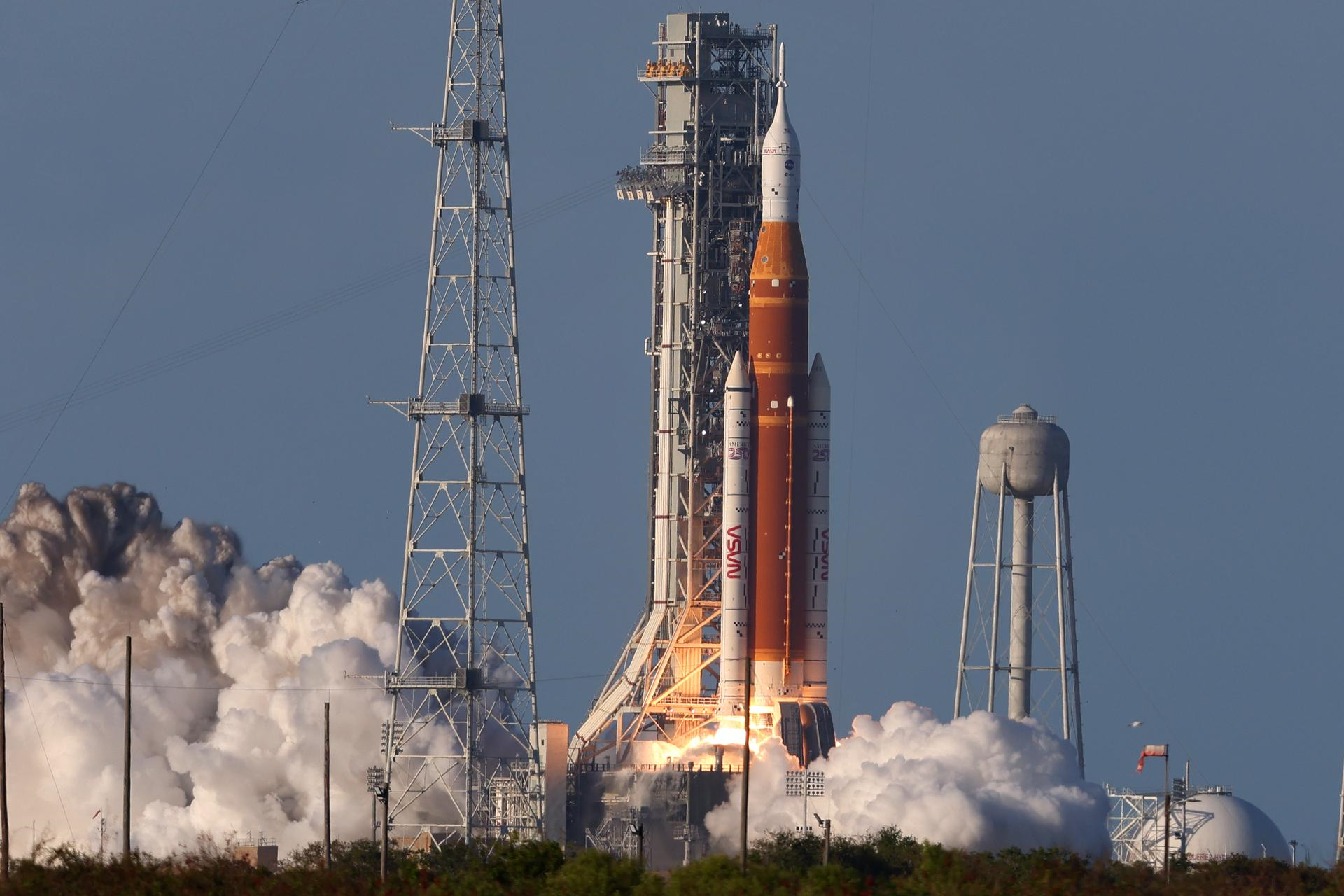
The NASA-funded Translational Research Institute for Space Health (TRISH) has selected two early‑career scientists for its next class of postdoctoral fellows. The new fellows will begin their projects in May, focusing on space food systems and astronaut eye health.
The TRISH Postdoctoral Fellowship Program supports independent research that advances biomedical, behavioral, and technological approaches relevant to human space exploration. The selected projects should aim to reduce spaceflight-related health risks and improve human health on Earth.
The selected fellows are:
Dr. Baiyang Liu
Institution: Columbia University in New York City
Project: Developing a Diazotrophic and Nutritionally Optimized Spirulina Strain for Extended Space Missions
Mentor: Dr. Harris Wang
Dr. Dylan Pham
Institution: Texas A&M University in College Station
Project: Impact of Simulated Microgravity and Aging on Ocular Artery and Neural Retina Function
Mentor: Dr. Travis Hein
“Our postdoctoral fellows bring new ideas, technical expertise, and energy to some of the most complex challenges in human spaceflight,” said Dr. Dorit Donoviel, executive director of TRISH and associate professor at Baylor College of Medicine in Houston. “By investing in the next generation, we are building the capability required to achieve a sustained presence on the Moon and extend human exploration deeper into space.”
A virtual institute, TRISH is empowered by NASA’s Human Research Program to help solve challenges of human deep space exploration. It pursues and funds research to deliver scientific and technological solutions that advance space health and help humans thrive wherever they explore, in space or on Earth.
____
NASA’s Human Research Program
NASA’s Human Research Program pursues methods and technologies to support safe, productive human space travel. Through science conducted in laboratories, ground-based analogs, commercial missions, the International Space Station and Artemis missions, the program scrutinizes how spaceflight affects human bodies and behaviors. Such research drives the program’s quest to innovate ways that keep astronauts healthy and mission ready as human space exploration expands to the Moon, Mars, and beyond.
Explore More 3 min read NASA’s Simulated Mars Mission Marks 200 Days Inside Habitat Article 2 weeks ago 4 min read NASA’s SpaceX Crew-12 to Study Adaptation to Altered Gravity Article 3 months ago 5 min read Out of This World Discoveries: Space Station Research in 2025 Article 4 months ago Keep Exploring Discover More Topics From NASALiving in Space
Artemis
Human Research Program
Space Station Research and Technology
Floatation tanks deployed to combat PTSD after devastating wildfires
What is love? Even a meeting on the subject can't find the answer
How I used psychology to come back from the worst year of my life
The world is less prepared for a pandemic than before COVID. Here’s why
As world health leaders face deadly outbreaks of hantavirus and Ebola, a major pandemic preparedness report finds we are less safe from viral outbreaks than before COVID
Beacon of Light
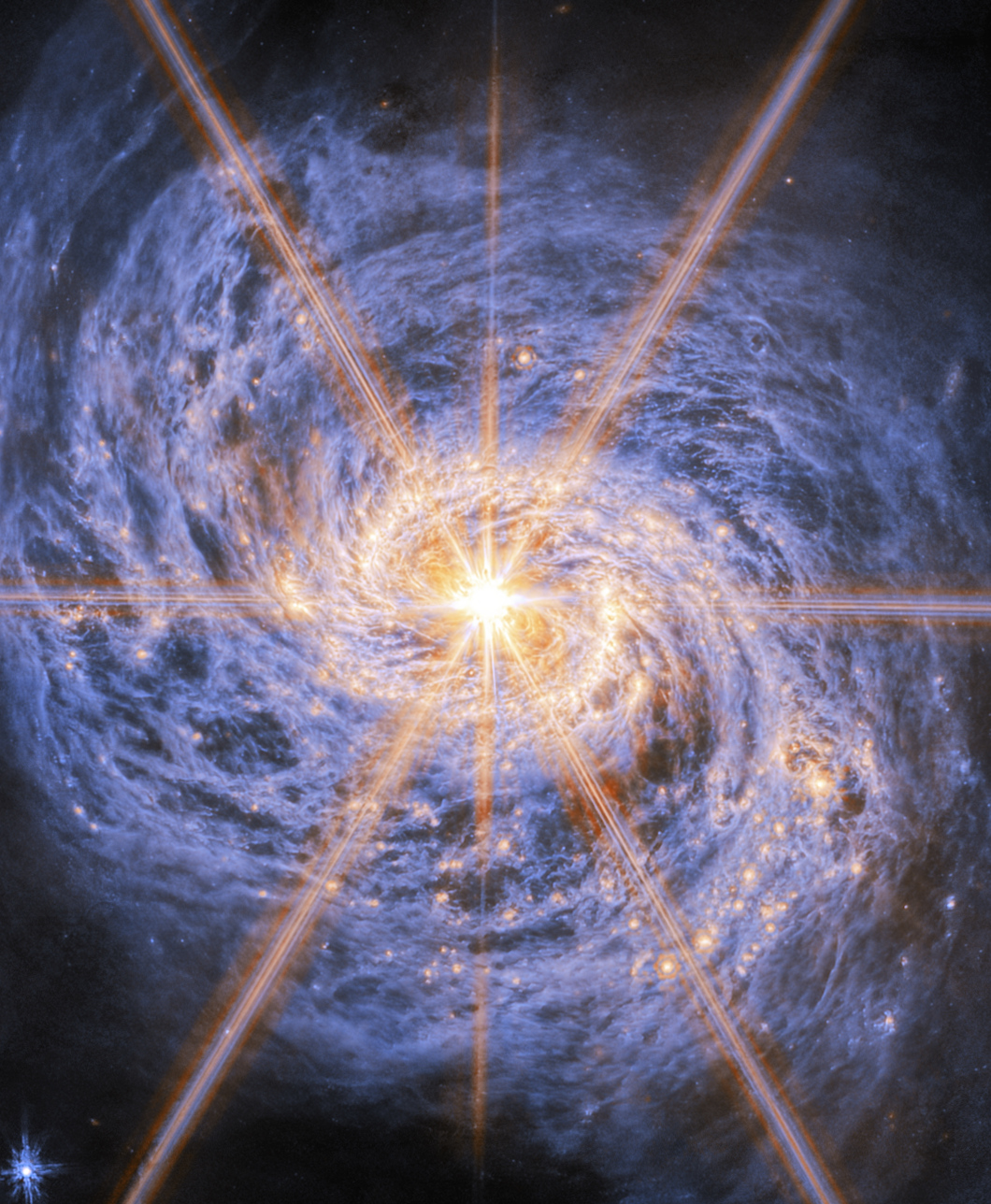
The heart of galaxy M77 shines brightly in this May 7, 2026, image from NASA’s James Webb Space Telescope. The intense glow is due to gas being pulled by the strong gravity of the central black hole into a tight and rapid orbit around it. The motion of the gas causes it to heat up, releasing tremendous amounts of radiation.
The bright lines radiating out of the center are diffraction spikes. The spikes are not a physical feature of the galaxy, but an optical effect caused by the telescope itself.
Image credit: ESA/Webb, NASA & CSA, A. Leroy
See a Lincoln Memorial-sized asteroid pass within just 56,000 miles of Earth today
The asteroid will swing by Earth on Monday and be close enough to be visible using an amateur telescope
What If the Universe Had No Beginning? Part 3: A Universe From Nothing
Run Hawking's machinery and out pops something startling: the most likely universe looks an awful lot like ours, complete with inflation, a low-entropy beginning, and an arrow of time. All of cosmology, falling out for free. Almost.
The Milky Way's Turbulence Distorts Light from Distant Quasars
We may be getting better images of the Milky Way's supermassive black hole in the future. Astronomers used 10 years of observations of a distant blazar to detect turbulence in the Milky Way's interstellar medium. This turbulence makes images of Sagittarius A-star blurry.