

Feed aggregator
How Louisiana Native Turned Childhood Wonder into NASA Stennis Career
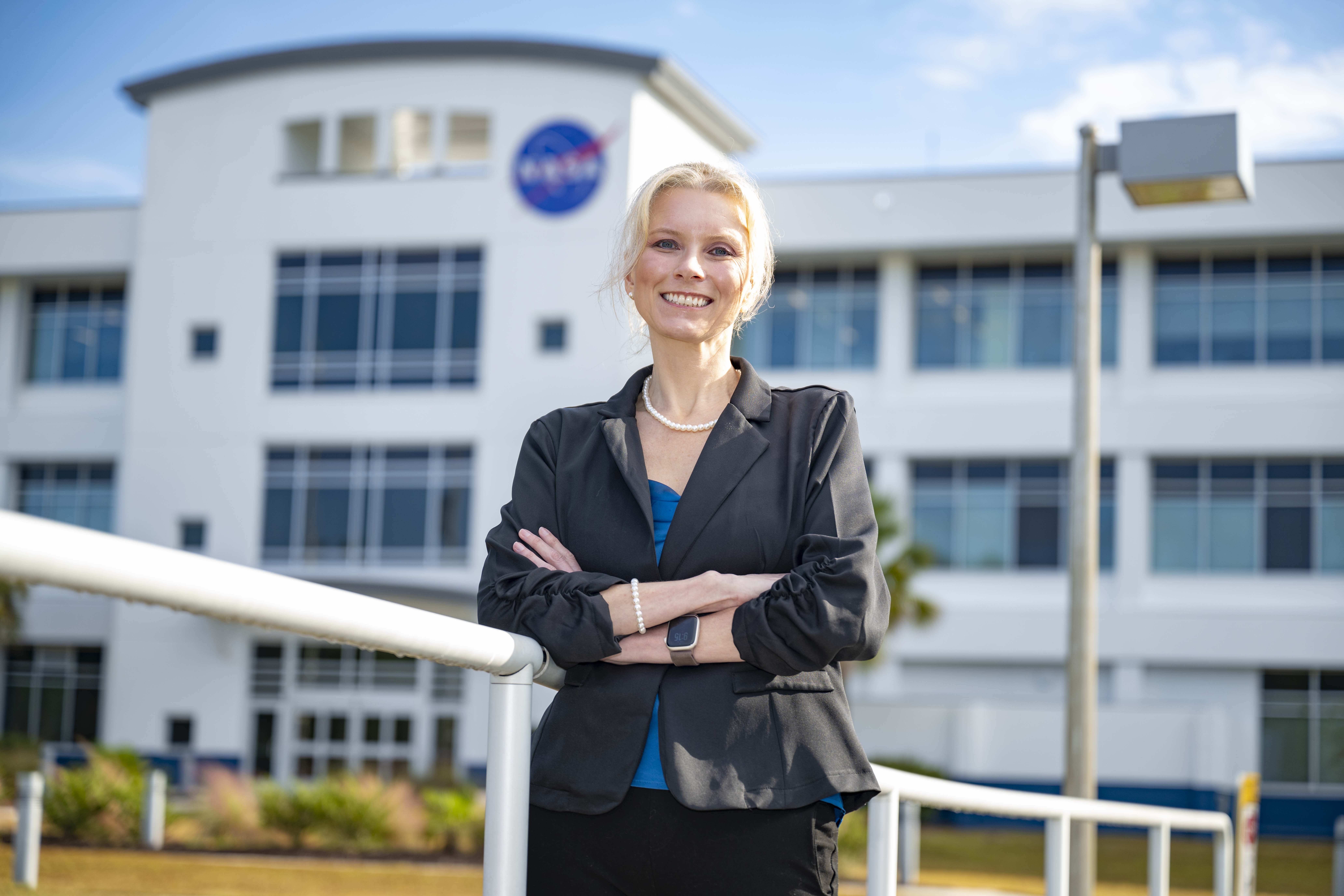
Michelle Hoehn vividly remembers the day a seed was planted for her future at NASA’s Stennis Space Center near Bay St. Louis, Mississippi.
As a seventh grader, the Bogalusa, Louisiana, native joined her dad for Father/Daughter Day at NASA Stennis. Hoehn knew she wanted to be part of something bigger, something that sparked wonder and purpose, in the moment she visited her dad’s office. She recalled feeling a sense of awe and possibility that day.
It was not until her second year at Southeastern Louisiana University – after the birth of her first child – that she focused on building a career, though. Finance and accounting have always been a part of her life. She filed paperwork at her grandfather’s store and helped her mom during tax season.
“It was clear that this field was the right fit for me,” she said.
Today, Hoehn works as a cost accountant in the Office of the Chief Financial Officer at NASA Stennis. She ensures all costs are accurately recorded and reported. Her work supports financial integrity, enabling informed decisions and efficient use of resources.
“It is incredibly rewarding to know that my work helps keep NASA’s operations transparent and efficient because every accurate number supports the bigger mission of space exploration and discovery,” said Hoehn.
Hoehn’s financial management work supports NASA’s Artemis program that will send astronauts to the Moon to establish a sustainable presence and prepare for future human exploration of Mars.
“I’m honored to be a part of NASA’s Artemis effort,” she said. “Knowing that my work helps enable the next chapter of lunar exploration, and ultimately the journey to Mars, is both humbling and deeply motivating.”
One of the most fascinating parts of Hoehn’s work at NASA Stennis is seeing how even the smallest financial details can have a ripple effect on major NASA missions.
Although her work is often behind the scenes, the data she manages helps guide decisions that impact propulsion testing, technology development, and even future space exploration.
“It is incredible to realize that a spreadsheet I work on today could be tied to a rocket engine test of the future,” she said. “That connection between everyday tasks and extraordinary outcomes is something I never take for granted, and it is what makes working at NASA Stennis so rewarding.”
Working as an accountant on large, complex projects – some worth millions of dollars – also comes with challenges.
The projects demand precision, attention to detail, and a deep understanding of evolving financial regulations and systems. To stay ahead, Hoehn keeps an open mind and embraces continuous learning. She is always looking for ways to grow, adapt, and strengthen her role in supporting NASA’s financial integrity and broader mission.
This year marks 15 years as a NASA employee for Hoehn and 21 years of service overall at NASA Stennis, where she began as a contractor in 2004.
“The workforce at NASA Stennis is highly collaborative and mission-driven,” Hoehn said. “Whether you are working in engineering, finance, or support services, there is a collective sense of purpose and pride in contributing to space exploration and scientific discovery. It is an environment where ideas are welcomed, excellence is encouraged, and every individual plays a vital role in the success of NASA’s mission.”
From the time Hoehn walked in her dad’s office as a seventh-grade student, she has experienced firsthand the opportunities NASA Stennis offers.
“NASA Stennis is a place of unlimited potential, not only in its contributions to NASA’s missions, but in the opportunities it offers to current and future employees, customers, and stakeholders,” Hoehn said. “It is where I have been empowered to exceed the goals I once set for myself and continue to grow, both personally and professionally. NASA Stennis is a place where you are encouraged to be part of something greater than yourself.”
Learn More About Careers at NASA Stennis Explore More 2 min read NASA Makes Webby 30s List of Most Iconic, Influential on Internet Article 3 months ago 5 min read Crossroads to the Future – NASA Stennis Grows into a Model Federal City Article 3 months ago 4 min read NASA Stennis Provides Ideal Location for Range of Site Tenants Article 3 months agoThe 33 best books, films, games and TV to entertain you this Christmas
The 33 best books, films, games and TV to entertain you this Christmas
Black Hole Caught Blasting Matter into Space at 130 Million MPH
X-ray space telescopes caught a supermassive black hole flinging matter into space at a fifth of the speed of light
Timing cancer drug delivery around our body clock may boost survival
Timing cancer drug delivery around our body clock may boost survival
The audacious quest to light up the sky with artificial auroras
The audacious quest to light up the sky with artificial auroras
This Weekend’s Geminids Meteor Shower Should Be Spectacular
As far as annual meteor showers are concerned, 2025 has saved the best for last. This year’s Geminids are not to be missed
Space-Based Data Centers Could Power AI with Solar Energy—At a Cost
Space-based computing offers easy access to solar power but presents its own environmental challenges
The Primordial Black Hole Saga: Part 2 - Not Your Normal Black Holes
At the same time that Vera Rubin was turning cosmology upside down with conclusive evidence for the existence of dark matter, Stephen Hawking was doing…Stephen Hawking things.
Mathematicians Crack a Fractal Conjecture on Chaos
A type of chaos found in everything from prime numbers to turbulence can unify a pair of unrelated ideas, revealing a mysterious, deep connection that disappears without randomness
Breakthrough in Digital Screens Takes Color Resolution to Incredibly Small Scale
These miniature displays can be the size of your pupil, with as many pixels as you have photoreceptors—opening the way to improved virtual reality
NASA Researchers Test Mars Tech In Deserts Throughtout the Country
Engineers can be split into two camps - those who just release whatever they’re building and try to fix whatever might be wrong with it as they get feedback on it, and those who test their product in every possible way before releasing it to the public. Luckily, NASA engineers are in the latter camp - it wouldn’t look great if all of the probes we send throughout the solar system failed because of something we could have easily tested for here at home. However, finding analogues for the places we want to send those probes remains a challenge for some NASA projects, so they make due with the best Earth has to offer. For Mars, that means testing technology in the desert’s rolling sand dune and rocky outcrops, and this year several different NASA technologies were tested in deserts throughout the country, as reported in a press release from the agency.
Galileo pre-launch media briefing
Watch the replay of the media briefing held ahead of the 14th operational launch of the Galileo programme. The briefing covers the mission details for the launch of two Galileo satellites, which are set to lift off on 17 December aboard Ariane 6 from Europe’s Spaceport in French Guiana.
We’ve finally cracked how to make truly random numbers
We’ve finally cracked how to make truly random numbers
Flaring black hole whips up ultra-fast winds
Leading X-ray space telescopes XMM-Newton and XRISM have spotted an extraordinary blast from a supermassive black hole. In a matter of hours, the gravitational monster whipped up powerful winds, flinging material out into space at eye-watering speeds of 60 000 km per second.
NASA Astronaut Jonny Kim, Crewmates Return from Space Station
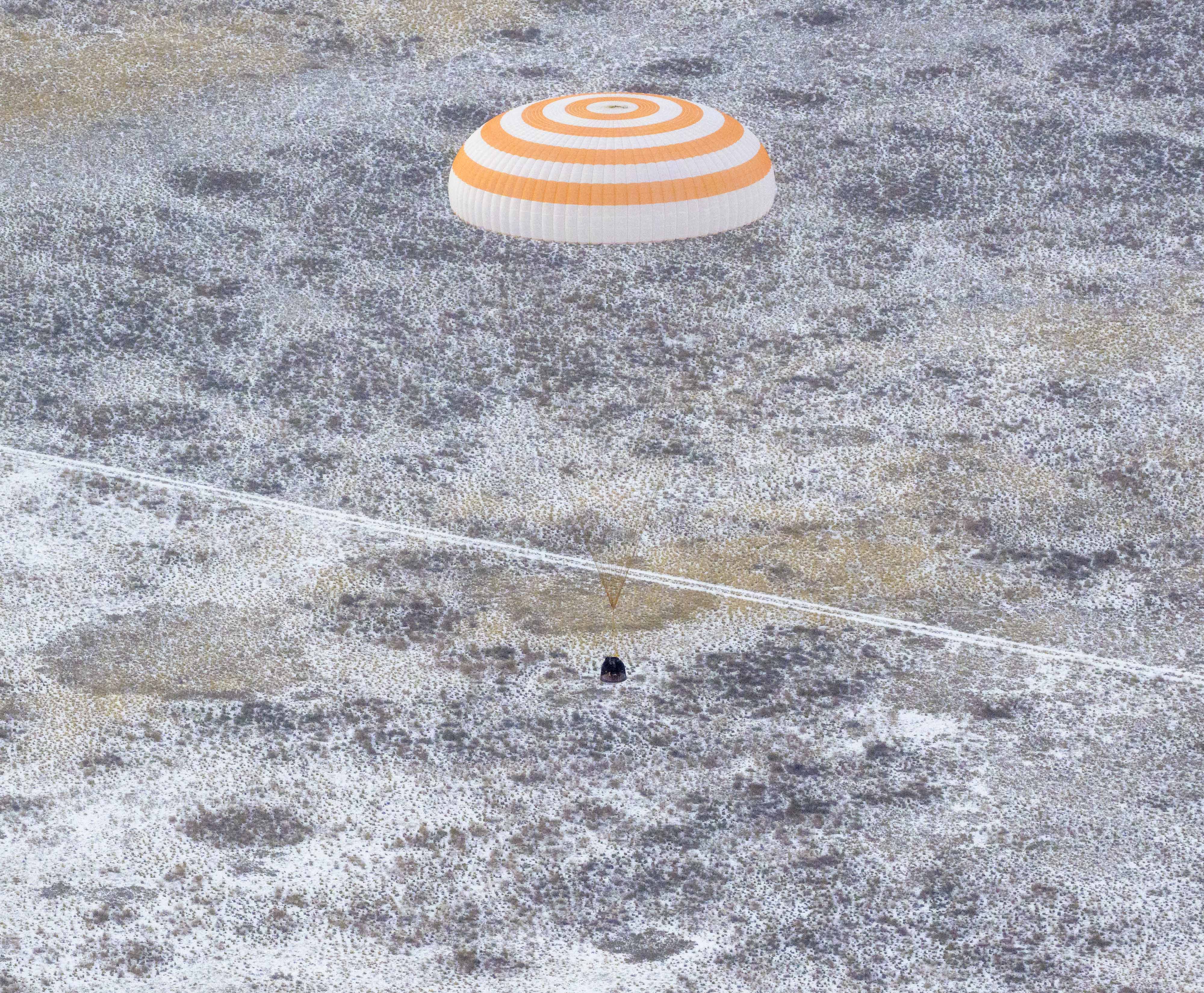
NASA astronaut Jonny Kim returned to Earth on Tuesday alongside Roscosmos cosmonauts Sergey Ryzhikov and Alexey Zubritsky, wrapping up an eight-month science mission aboard the International Space Station to benefit life on Earth and future space exploration.
They made a safe, parachute-assisted landing at 12:03 a.m. EST (10:03 a.m. local time), southeast of Dzhezkazgan, Kazakhstan, after departing the space station at 8:41 p.m. on Dec. 8, aboard the Soyuz MS-27 spacecraft.
Over the course of 245 days in space, the crew orbited Earth 3,920 times, traveling nearly 104 million miles. They launched to the space station on April 8. This mission marked the first spaceflight for both Kim and Zubritsky, while Ryzhikov completed his third journey to space, logging a total of 603 days in space.
NASA astronaut Jonny Kim shows off the Matroyshka (stacking) doll he received upon his return to Earth, Dec. 9, 2025. Kim and his crewmates landed safely aboard their Soyuz MS-27 spacecraft in a remote area near the town of Zhezkazgan, Kazakhstan.NASA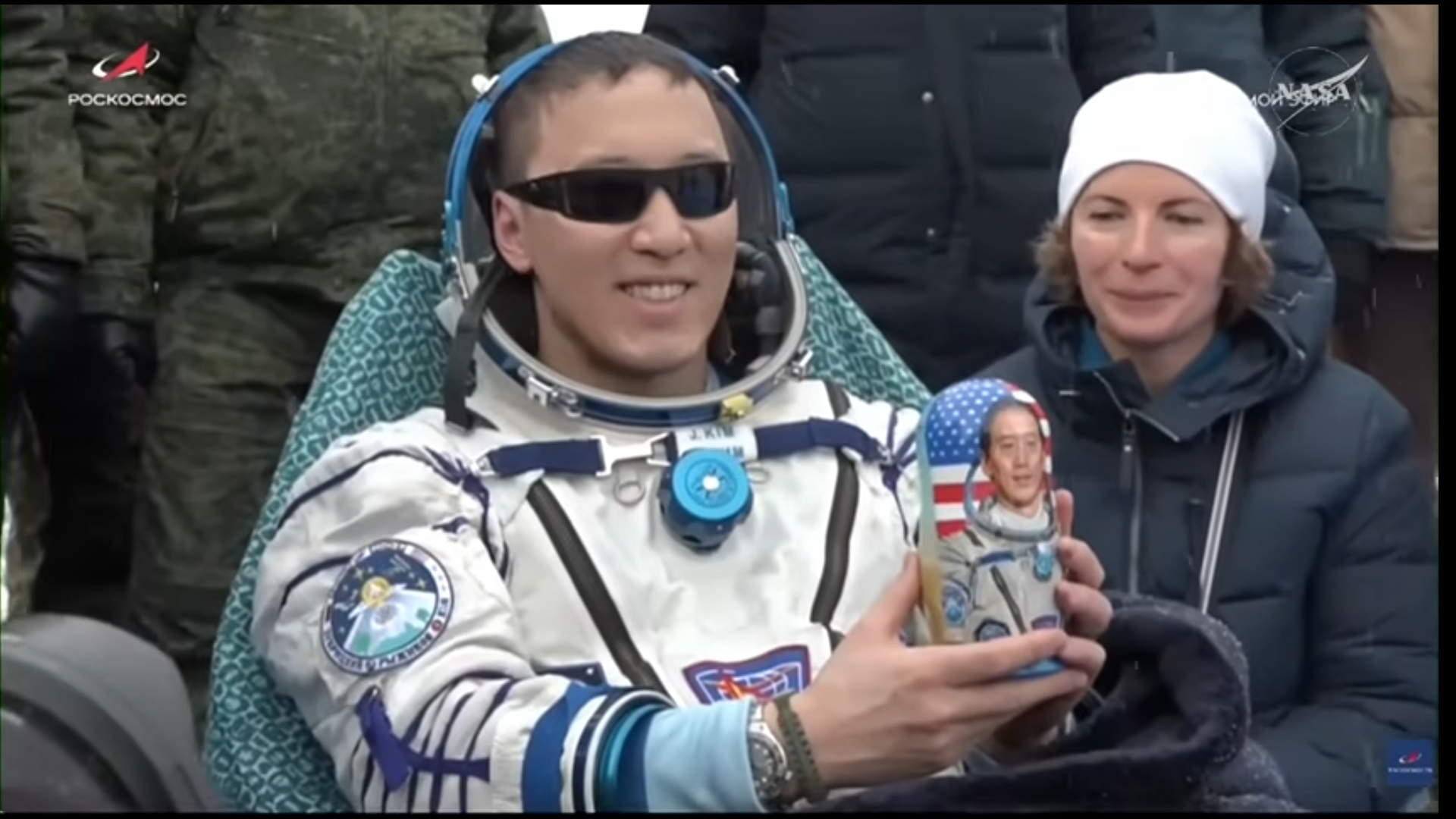
While aboard the orbiting laboratory, Kim contributed to a wide range of scientific investigations and technology demonstrations. He studied the behavior of bioprinted tissues containing blood vessels in microgravity for an experiment helping advance space-based tissue production to treat patients on Earth. He also evaluated the remote command of multiple robots in space for the Surface Avatar study, which could support the development of robotic assistants for future exploration missions. Additionally, Kim worked on developing in-space manufacturing of DNA-mimicking nanomaterials, which could improve drug delivery technologies and support emerging therapeutics and regenerative medicine.
Following post-landing medical checks, the crew will return to the recovery staging area in Karaganda, Kazakhstan. Kim will then board a NASA aircraft bound for the agency’s Johnson Space Center in Houston.
For more than 25 years, people have lived and worked continuously aboard the International Space Station, advancing scientific knowledge and making research breakthroughs that are not possible on Earth. The station is a critical testbed for NASA to understand and overcome the challenges of long-duration spaceflight and to expand commercial opportunities in low Earth orbit. As commercial companies concentrate on providing human space transportation services and destinations as part of a robust low Earth orbit economy, NASA is focusing its resources on deep space missions to the Moon as part of the Artemis campaign in preparation for future human missions to Mars.
Learn more about International Space Station research and operations at:
-end-
Josh Finch
Headquarters, Washington
202-358-1100
joshua.a.finch@nasa.gov
Sandra Jones / Joseph Zakrzewski
Johnson Space Center, Houston
281-483-5111
sandra.p.jones@nasa.gov / joseph.a.zakrzewski@nasa.gov
NASA Astronaut Jonny Kim, Crewmates Return from Space Station
NASA astronaut Jonny Kim returned to Earth on Tuesday alongside Roscosmos cosmonauts Sergey Ryzhikov and Alexey Zubritsky, wrapping up an eight-month science mission aboard the International Space Station to benefit life on Earth and future space exploration.
They made a safe, parachute-assisted landing at 12:03 a.m. EST (10:03 a.m. local time), southeast of Dzhezkazgan, Kazakhstan, after departing the space station at 8:41 p.m. on Dec. 8, aboard the Soyuz MS-27 spacecraft.
Over the course of 245 days in space, the crew orbited Earth 3,920 times, traveling nearly 104 million miles. They launched to the space station on April 8. This mission marked the first spaceflight for both Kim and Zubritsky, while Ryzhikov completed his third journey to space, logging a total of 603 days in space.
NASA astronaut Jonny Kim shows off the Matroyshka (stacking) doll he received upon his return to Earth, Dec. 9, 2025. Kim and his crewmates landed safely aboard their Soyuz MS-27 spacecraft in a remote area near the town of Zhezkazgan, Kazakhstan.NASAWhile aboard the orbiting laboratory, Kim contributed to a wide range of scientific investigations and technology demonstrations. He studied the behavior of bioprinted tissues containing blood vessels in microgravity for an experiment helping advance space-based tissue production to treat patients on Earth. He also evaluated the remote command of multiple robots in space for the Surface Avatar study, which could support the development of robotic assistants for future exploration missions. Additionally, Kim worked on developing in-space manufacturing of DNA-mimicking nanomaterials, which could improve drug delivery technologies and support emerging therapeutics and regenerative medicine.
Following post-landing medical checks, the crew will return to the recovery staging area in Karaganda, Kazakhstan. Kim will then board a NASA aircraft bound for the agency’s Johnson Space Center in Houston.
For more than 25 years, people have lived and worked continuously aboard the International Space Station, advancing scientific knowledge and making research breakthroughs that are not possible on Earth. The station is a critical testbed for NASA to understand and overcome the challenges of long-duration spaceflight and to expand commercial opportunities in low Earth orbit. As commercial companies concentrate on providing human space transportation services and destinations as part of a robust low Earth orbit economy, NASA is focusing its resources on deep space missions to the Moon as part of the Artemis campaign in preparation for future human missions to Mars.
Learn more about International Space Station research and operations at:
-end-
Josh Finch
Headquarters, Washington
202-358-1100
joshua.a.finch@nasa.gov
Sandra Jones / Joseph Zakrzewski
Johnson Space Center, Houston
281-483-5111
sandra.p.jones@nasa.gov / joseph.a.zakrzewski@nasa.gov