NASA - Breaking News

Girl Scouts Event Brings Space Science to the Next Generation
In early May 2026, NASA employees, contractors, and volunteers helped to bring Heliophysics to girls of all ages in a fun-filled weekend of hands-on science activities and experiments. The event took place from May 1-3 at Camp Conowingo, a Girl Scouts of Central Maryland camping property on the Susquehanna River north of Baltimore, and brought together participants from across the region.
With support from the Heliophysics Education Activation Team (HEAT) and the outreach program from NASA’s PUNCH (Polarimeter to Unify the Corona and Heliosphere) mission, NASA heliophysicist Nicholeen Viall led a camping trip on which 165 Girl Scouts earned their Space Science badge and Ancient and Modern Sun-Watching patch.
The badge and patch were earned over the course of the weekend through a series of activity stations that included hands-on examples of how scientists study the Sun, Heliosphere, Moon, planets, and stars. In particular, these creative experiments allowed attendees to learn about space weather and see firsthand how the Sun impacts our lives, which is a cornerstone of HEAT education goals.
The activities were set up in seven stations. Girl Scout troops were split into 7 groups, plus an 8th group of high school seniors who ran the stations. Each group was named after a constellation (Ursa Major, Leo, Orion, Cassiopeia, Pegasus, Cygnus, Lyra, and Canis Major).
On the morning and afternoon of Saturday May 2, each group spent about 45 minutes per station doing activities to earn a space science badge.
- Station 1 helped Girl Scouts learn about the different career possibilities available in Space Sciences and at NASA
- Station 2 gave Girl Scouts the opportunity to play with polarized sun glasses and try out the ultraviolet beads activity
- Station 3 involved learning more about the Sun and the PUNCH mission through key vocabulary terms and role-playing activities
- Station 4, the Solar System Walk, was a path with planet markers spaced out to scale to help campers identify all the planets in our solar system
- Station 5 demonstrated the phases of the Moon and why different constellations appear in the night sky during the year
- Station 6 taught the Girl Scouts about NASA missions; and
- Station 7 gave Girl Scouts the opportunity to practice shooting a bow and arrow, which is a tradition at Camp Conowingo.
On Friday and Saturday evenings, the groups participated in a star and Moon gazing nighttime astronomy activity and were able to find Jupiter.
These activities were made possible in part thanks to time contributed by members of NASA Solar System Ambassadors and the National Capitol Astronomers. Station 3 from the daytime events also had Sunspotter telescopes for the Girl Scouts to try out, which were provided by HEAT with help from team member Carolyn Ng.
Fellow HEAT team member Laura-Ashley Alegbeleye was also onsite leading activities, where her expertise in classroom education really shined. Laura-Ashley attended as a representative of HEAT, which allowed her to share HEAT resources and educational content with the Girl Scout attendees at several stations, including Station 1.
Viall describes the Space Science Career station by pointing out that the event coordinators leveraged HEAT educational materials, as well as activities designed for the Ancient and Modern Sun Watching patch by the PUNCH team, to show that even a NASA mission requires many different skill sets. “It’s not just scientists and the engineers,” says Viall. “It is financial analysts, it’s communications people, it’s good writers, it’s good artists. All of these different people have to be a part of the team.”
One of the standout moments of the weekend was the campfire at the end of Saturday, which is a tradition for Girl Scout camping events, according to Viall. “One of the traditions of the campfire is that we all sing songs and the Girl Scouts put on skits,” explains Viall. “I want to say about half of the skits that the Girl Scouts made were about space, the Sun, astronauts, or about exploring Mars.”
Viall also pointed out that the event offered a chance for older girl scouts to gain mentoring experience by leading five of the seven activity stations. “I went to those troops over a month ahead of the event,” says Viall. “I met with them and taught them the activities, sent them all the materials, and brainstormed with them about the best way to teach the younger Girl Scouts.” The event taught these older Girl Scouts how to be great leaders themselves by sharing the knowledge with the younger Girl Scouts which Viall helped to impart on them. “That part was really cool, to see the older girls teaching the younger girls the [science] concepts.”
As a final note, Viall points out that after the 165 Girl Scouts signed up, which was the maximum capacity of the campground, there were still three more troops who had wanted to participate. “We had so much interest that I visited an additional 30 girls at their troop meetings to do a quick Space Science/PUNCH lesson event,” says Viall.
Girl Scouts of the USA have offered the Space Science badge series for kindergarten through twelfth grade students since 2019. The Ancient and Modern Sun-Watching patch leverages the PUNCH Public Outreach products, curated for the Girl Scout experience.Girl Scouts of Southwest Texas convened a prototype patch-earning event in 2024. Now, two years later, the Girl Scouts who participated in the Camp Conowingo event officially earned the Ancient and Modern Sun-Watching patch. Viall is the PUNCH Mission Scientist, which helped establish the connection that made the whole event possible. Together with collaborators from NASA HEAT, this event certainly helped to activate a love for science in a new generation of learners.
Share Details Last Updated May 27, 2026 Related TermsLa NASA anunciará la tripulación de Artemis III e informará sobre el progreso de la misión
La NASA informará sobre los avances de la misión Artemis III de la agencia y anunciará los astronautas asignados a este vuelo de prueba durante un evento en vivo a las 11 a.m. EDT (hora del este) del martes 9 de junio en el Centro Espacial Johnson de la agencia en Houston.
Siga la rueda de prensa en vivo a través de la aplicación NASA+ y el canal de YouTube de la agencia. Descubra cómo ver el contenido de la NASA en diversas plataformas en línea, incluidas las redes sociales (información ofrecida en inglés).
Tras el evento, la tripulación de Artemis III estará disponible para un número limitado de entrevistas presenciales y virtuales.
Las solicitudes de entrevista deben enviarse a la sala de prensa del centro Johnson antes de las 5 p.m. del 4 de junio. Los periodistas que no son ciudadanos estadounidenses interesados en asistir deben comunicarse, en inglés, con la sala de prensa de Johnson mediante correo electrónico (jsccommu@mail.nasa.gov) antes de las 5 p.m. del jueves 28 de mayo. Los periodistas estadounidenses deben comunicarse con la sala de prensa antes de las 5 p.m. del jueves 4 de junio. Los medios registrados recibirán la confirmación y detalles adicionales del evento por correo electrónico. La política de acreditación de medios de la NASA está disponible en línea.
Artemis III lanzará a cuatro astronautas desde el Centro Espacial Kennedy de la NASA en Florida en la nave espacial Orion, la cual viajará a bordo del cohete SLS (Sistema de Lanzamiento Espacial, por sus siglas en inglés). La misión pondrá a prueba las capacidades críticas de encuentro y acoplamiento entre Orion y los sistemas comerciales de aterrizaje humano necesarios para llevar a los astronautas a la superficie lunar. Basándose en el exitoso vuelo de prueba tripulado de Artemis II en abril, Artemis III allanará el camino para futuras misiones a la Luna.
Como parte de una edad de oro de innovación y exploración, la NASA enviará astronautas en misiones cada vez más complejas para explorar más de la Luna con fines de descubrimiento científico y beneficios económicos, y para continuar sentando las bases para las primeras misiones tripuladas a Marte.
Para más información sobre el programa Artemis, visite:
https://www.nasa.gov/artemis (inglés)
https://ciencia.nasa.gov/artemis (español)
-fin-
Rachel Kraft / María José Viñas
Sede central, Washington
+1 202-358-1600
rachel.h.kraft@nasa.gov / maria-jose.vinasgarcia@nasa.gov
Anna Schneider
Centro Espacial Johnson
+1 281-483-5111
anna.c.schneider@nasa.gov
Students Build Moon Robots for NASA’s 2026 Lunabotics Challenge
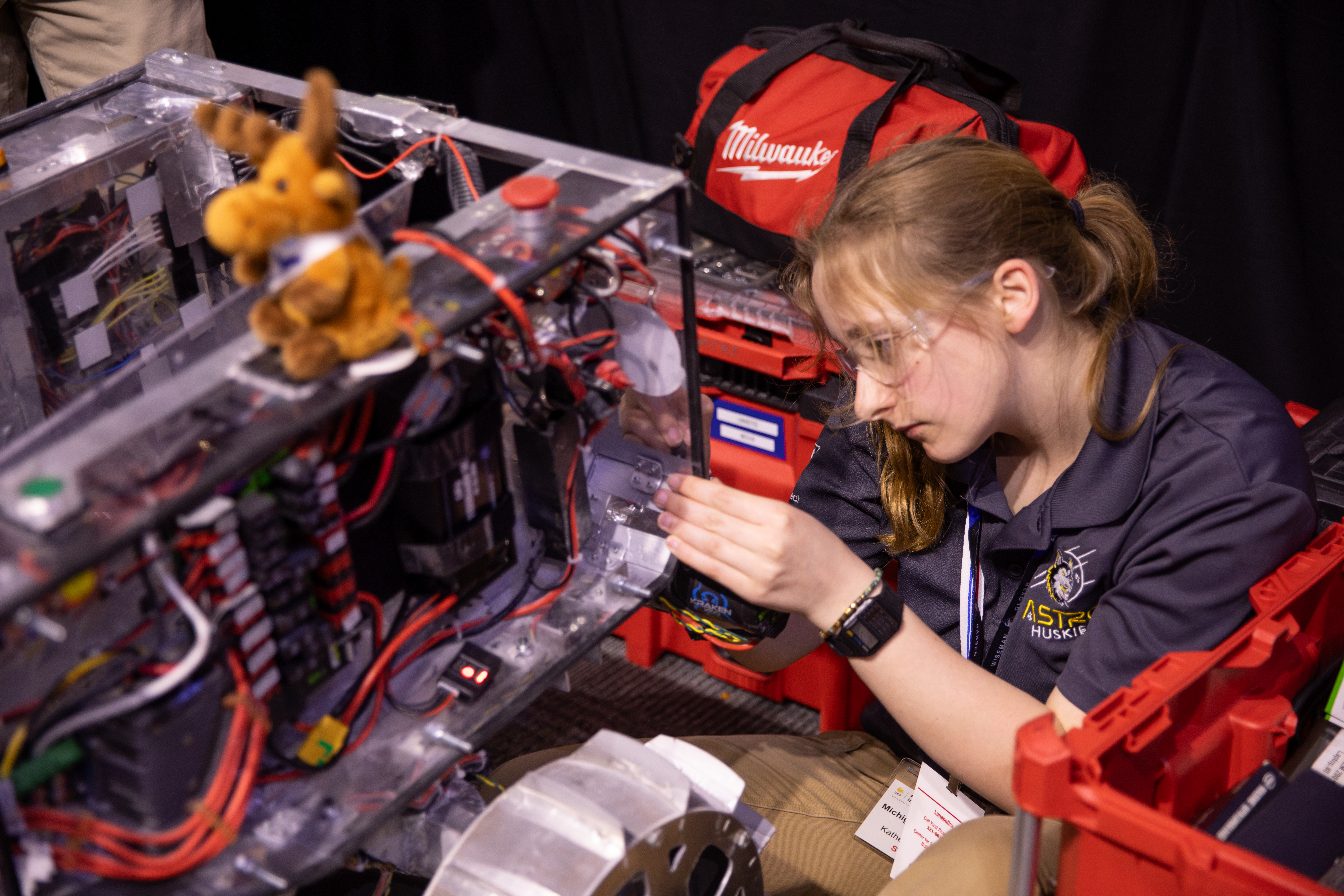
Katherine Rauscher of Michigan Technological University prepares her team’s prototype lunar robot for its turn during the finals for NASA’s 2026 Lunabotics Challenge competition on Tuesday, May 19, 2026, at the Kennedy Space Center Visitor Complex in Florida.
Forty-seven teams from around the U.S. designed and built remote-controlled robots capable of traversing challenging lunar terrain while constructing regolith-based berm under conditions similar to those the agency will face as it returns to the lunar surface through Artemis.
The Lunabotics Challenge invites students from higher education institutions to apply NASA’s Systems Engineering principles to design and build a prototype off-world construction robot. Participants will develop a robot capable of performing construction operations that support future space exploration objectives.
Image credit: NASA/Ben Smegelsky
NASA-European Sea Level Mission Homes in on El Niño
To view this video please enable JavaScript, and consider upgrading to a web browser that supports HTML5 video
The international Sentinel-6 Michael Freilich sea level satellite observed a swell of warm water, called a Kelvin wave, moving eastward in the equatorial Pacific Ocean, arriving off the South American coast in May. Warm Kelvin waves often precede El Niño events.NASA/JPL-CaltechSea level data from a satellite launched by NASA and European partners shows that a swell of warm water hundreds of miles wide has arrived in the Pacific Ocean off the coast of South America, a sign that El Niño will likely emerge later in the year. Because water expands as it warms, a rise in elevation of an area of the ocean indicates increasing ocean temperatures.
El Niños can cause heavy precipitation in some regions and deficits in others, influencing daily life and commerce around the world.
Launched in 2020 by NASA and led by ESA (European Space Agency) for the E.U. Copernicus Programme, the Sentinel-6 Michael Freilich satellite measures and maps water height for the entire ocean every 10 days, down to fractions of an inch. In the case of El Niño, the satellite tracks what are called warm Kelvin waves.
These waves typically form after brief periods when winds over the far western equatorial Pacific Ocean shift from prevailing easterlies — moving from east to west — to westerlies. That effect, combined with a general weakening of easterly winds along the equator, causes water in the tropics of the western Pacific to get warmer and sea levels to rise. The wave that forms then propagates east for several weeks, eventually reaching South America and causing water off the coast to heat up and rise. An El Niño develops as multiple Kelvin waves appear over the course of several months, and the warm water accumulates off the shores of Colombia, Ecuador, and Peru.
“While this year’s event started a bit later than the big El Niños of 2015 and 1997, it’s beginning to catch up,” said Josh Willis, a sea level researcher at NASA’s Jet Propulsion Laboratory in Southern California and project scientist for Sentinel-6 Michael Freilich. “We’ll see how big it gets.”
Measurements from Sentinel-6 Michael Freilich show a small Kelvin wave forming around Micronesia in late January and dissipating by mid-February. A new wave emerged in early March, then moved east over time. By mid-May, the seas around Peru were more than 5.9 inches (15 centimeters) higherthan long-term averages.
“NASA’s observation of El Niño uses sea level satellites like Sentinel-6 Michael Freilich to track massive Kelvin waves as they cross the Pacific, capture changes in Earth’s ocean thermodynamics, improve forecasts of weather extremes, and help communities prepare for potential coastal hazards,” said Nadya Vinogradova Shiffer, lead program scientist at NASA Headquarters in Washington. “Stay tuned as more ocean stories continue to unfold.”
Tracking El NiñoFishermen in the 1600s coined the name El Niño — Spanish for “the boy,” a reference to the birth of baby Jesus — because it tended to intensify around Christmastime. Warmer waters meant they would catch fewer fish.
Warmer sea surface temperatures in the central and eastern Pacific affect atmospheric circulation patterns worldwide by shifting the jet stream, which impacts storm tracks. This can lead to heavy rain and snow in some areas and unusual heat and dryness in others. How far away those impacts appear depends on the strength of the El Niño.
In more modest events, like the ones that began in 2018 and 2023, impacts such as drought and flooding were mostly seeb in and around the tropical Pacific. Large El Niños, like the one in 2015-2016, reach much farther, causing drought in Africa and flooding in California.
El Niños usually peak between November and January, so it will be several months before the largest impacts become clear.
“Every El Niño is different,” said JPL sea level researcher Severine Fournier, deputy project scientist for Sentinel-6 Michael Freilich. “But they almost always make for a hot year and big changes in rainfall in parts of the globe.”
Sentinel-6 Michael Freilich is the current official reference satellite for global sea level measurements. Launched in 2020, it is continuing a legacy started in 1992 by the TOPEX/Poseidon satellite. A series of successors have carried the baton since then, and the latest, Sentinel-6B, which launched November 2025, will take over for its predecessor by the end of 2026.
More about Sentinel-6 Michael FreilichSentinel-6 Michael Freilich, named after former NASA Earth Science Division Director Michael Freilich, is one of two satellites that compose the Copernicus Sentinel-6/Jason-CS (Continuity of Service) mission.
Sentinel-6/Jason-CS, a part of the European Union’s Earth observation programme called Copernicus, was jointly developed by ESA, the European Organisation for the Exploitation of Meteorological Satellites (EUMETSAT), NASA, and the National Oceanic and Atmospheric Administration (NOAA), with funding support from the European Commission and technical support on performance from the French space agency CNES (Centre National d’Études Spatiales). Spacecraft monitoring and control, as well as the processing of all the altimeter science data, is carried out by EUMETSAT on behalf of the European Union’s Copernicus Programme, with the support of all partner agencies.
A division of Caltech in Pasadena, JPL contributed three science instruments for each Sentinel-6 satellite: the Advanced Microwave Radiometer, the Global Navigation Satellite System – Radio Occultation, and the Laser Retroreflector Array. NASA also contributed launch services, ground systems supporting operation of the NASA science instruments, the science data processors for two of these instruments, and support for the U.S. members of the international Ocean Surface Topography Science Team.
To learn more about Sentinel-6 Michael Freilich, visit:
https://www.nasa.gov/sentinel-6
Media ContactsAndrew Wang / Andrew Good
Jet Propulsion Laboratory, Pasadena, Calif.
626-379-6874 / 818-393-2433
andrew.wang@jpl.nasa.gov / andrew.c.good@jpl.nasa.gov
2026-035
Explore More 5 min read A Shift in What’s Shaping U.S. LandscapesWild disturbances are on the rise, while land disturbed by human activity has been decreasing.
Article 19 minutes ago 5 min read NASA Develops Sensor to Improve Firefighter Safety Article 7 hours ago 2 min read Released: NASA Goddard Issues Draft Request for Proposal for the Landsat 10 SpacecraftThe Landsat 10 Spacecraft Draft Request for Proposal (DRFP) is available for review via SAM.gov.
Article 8 hours ago Keep Exploring Discover More Topics From NASA Mission: Sentinel-6 Michael FreilichWhen did Sentinel-6 Michael Freilich launch? November 21, 2020 Where is Sentinel-6 Michael Freilich? 830 miles (1,336 km) above Earth…
Water | Earth Observatory Topic
Climate ChangeNASA is a global leader in studying Earth’s changing climate.
Jet Propulsion Laboratory
Webinar 6/17: Discover, Access, and Task Commercial Data with NASA’s Satellite Data Explorer
- CSDA
- Commercial Data
- CSDA Vendors
- Program Activities
- Learning Resources
- FAQs
- News
1 min read
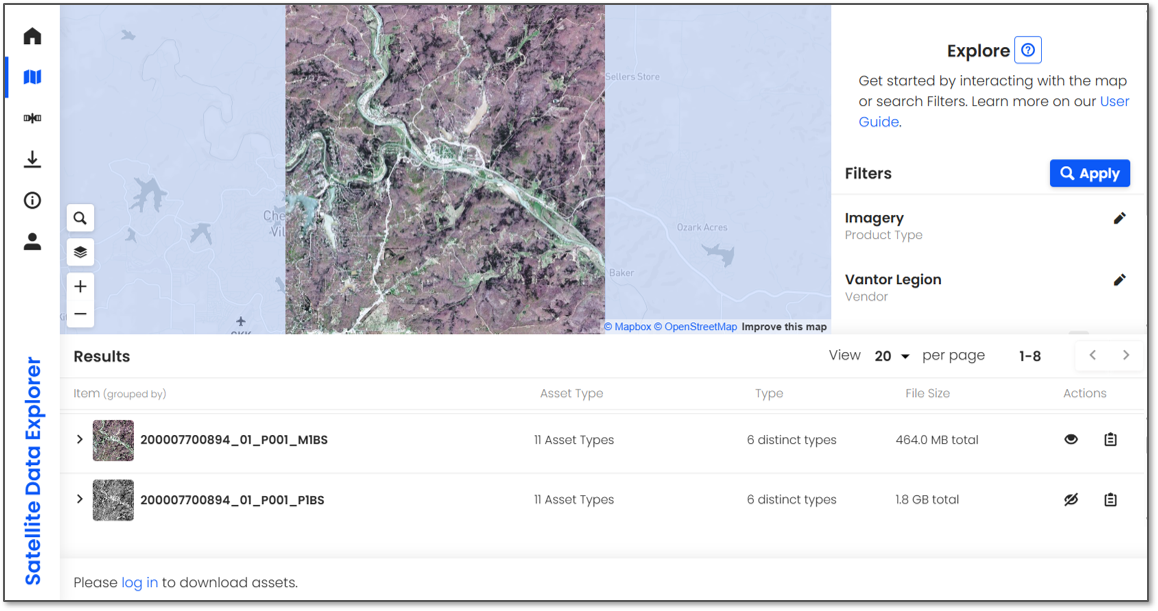
Webinar 6/17: Discover, Access, and Task Commercial Data with NASA’s Satellite Data Explorer This screen capture shows a multispectral image from Vantor in the CSDA program’s Satellite Data Explorer user interface. Credit: (C) VantorJoin us for an NASA Commercial Satellite Data Acquisition (CSDA) program webinar on Wednesday, June 17, 2026, at 2:00 p.m. EDT (-04:00 UTC) to learn how to use the Satellite Data Explorer(SDX) to search, access, and task commercial Earth Observation data available through NASA’s CSDA program.
The SDX is a web-based data discovery, access, and data tasking platform developed under the CSDA program that enables approved users to discover, access, task, and download commercial Earth observation data available through the program.
During this webinar event, data users will learn how to use the SDX to streamline their data workflow. A live demonstration will focus on the key features and functionalities of the tool from searching and filtering capabilities (e.g., by area-of-interest, product type, vendor) to visualizing query results through interactive maps and quick-look browse imagery. Webinar participants will also learn how to use the new Data Acquisition Request System to submit and track commercial data tasking requests for future acquisitions.
Register for WebinarNASA’s Webb Reveals Black Hole That Formed Before Its Galaxy
- Webb
- News
- Overview
- Science
- Observatory
- Multimedia
- Team
- More
Image: NASA, ESA, CSA, Lukas Furtak (Ben-Gurion University); Image Processing: Alyssa Pagan (STScI)
Which comes first, the galaxy or the black hole? We don’t know, but scientists have long thought it could be the galaxy: Large stars within an existing galaxy consume their fuel and collapse to form black holes, which can gobble up surrounding material and merge over time to form more massive entities.
But it’s hard to figure out how black holes millions to billions of times the mass of the Sun, thousands of which have now been detected in the early universe, could have grown so quickly from such small seeds.
Now, researchers using NASA’s James Webb Space Telescope have detected clear evidence that some supermassive black holes were enormous from the beginning, forming without a stellar collapse phase, and without a significantly more massive host galaxy to feed them.
“This is a remarkable finding,” said Roberto Maiolino of University of Cambridge in the United Kingdom, co-author of studies published in Nature and the Monthly Notices of the Royal Astronomical Society. “It’s a paradigm shift, a total revisiting of the classical scenarios of how black holes form and grow.”
Little Red Dot QSO1The team’s conclusion is based on detailed observations of Abell2744-QSO1 (QSO1), a prototypical Little Red Dot that existed just 700 million years after the big bang.
Although QSO1 is only 1,300 light-years across, and its light has been traveling for more than 13 billion years, it is easier to study than most other Little Red Dots because it is gravitationally lensed by galaxy cluster Abell 2744 (Pandora’s Cluster). QSO1 is both magnified and triply imaged, appearing in three different locations in the sky.
Initial studies of QSO1 revealed compelling evidence that it may be little more than a cloud of glowing hydrogen and helium gas circling a supermassive black hole estimated at 40 million times the mass of the Sun. But as with other early black holes discovered by Webb, there was uncertainty about whether it really was that massive.
“Before now, all of the mass measurements of black holes in the early universe have been indirect, based on assumptions from what we know about them in the local universe. We didn’t know if those assumptions really apply to the distant universe,” said co-author Francesco D’Eugenio, also of the University of Cambridge.
Image: Little Red Dot Abell2744-QSO1 (NIRCam Image) An image from NIRCam on NASA’s James Webb Space Telescope shows Little Red Dot Abell2744-QSO1, magnified and triply imaged by galaxy cluster Abell 2744 (Pandora’s Cluster). Image: NASA, ESA, CSA, Lukas Furtak (Ben-Gurion University); Image Processing: Alyssa Pagan (STScI) Mapping gas composition, velocityThe team recognized that if QSO1’s black hole is as massive as it looks, they should be able to use the integral field unit (IFU) on Webb’s NIRSpec (Near Infrared Spectrograph) to trace the effects of its gravity on the gas swirling around it, while also mapping the distribution of various elements in the gas.
Cambridge graduate student Ignas Juodžbalis and Cosimo Marconcini of the University of Florence, lead authors on one of the studies, used the IFU observations to map motions of hydrogen gas surrounding the black hole. When they plotted the rotation velocity as a function of distance from the center, they found that the gas has Keplerian motion: It orbits a central point in the same way that planets in our solar system orbit the Sun.
“This is important because it tells us that most of the mass of QSO1 is concentrated in the black hole at the center,” said Juodžbalis. “If the mass were more distributed, as it would be if there were a lot of stars, the gas would not have this perfect Keplerian rotation.”
Since Keplerian motion is governed by simple laws of gravity, the team was able to use the gas velocity measurements to calculate the black hole mass directly, a feat that had not previously been possible.
They found that not only is the black hole immense — roughly 50 million solar masses — it makes up, at minimum, an astonishing two-thirds of QSO1’s total mass. This proportion is thousands of times greater than in nearby galaxies, where supermassive black holes make up only a tiny fraction of the host galaxy’s total mass.
The IFU composition maps supported these results, showing that the gas throughout QSO1 is almost entirely hydrogen and helium, with very little of the heavier elements like oxygen that would be expected in a galaxy rich with stars and stellar debris. With a metallicity less than 0.5% of the Sun, QSO1 is one of the most pristine galactic environments ever measured.
“This is a phenomenal result,” said Maiolino. “It is the first direct measurement of a black hole mass within the first billion years after the big bang, and it is consistent with the previous measurements.” The team thinks this is a good sign that the assumptions used for indirect mass measurements are valid and the masses of other black holes in the early universe have not been overestimated.
Supermassive black hole originsThe outsized mass of QSO1 relative to its host galaxy suggests that it can’t have formed gradually from much smaller, stellar-mass black holes merging and feeding. “It seems that we have found a black hole that does not have a substantial host galaxy and that has predated stellar processes,” said Juodžbalis. “This is very exciting because it is evidence for primordial black holes or direct collapse black holes, which have been theorized but not confirmed.”
Whether QSO1’s black hole evolved from a “heavy seed” that formed within the first second of the big bang or somewhat later from the collapse of a giant cloud of gas, it was almost certainly born big, and may be in the early stages of building a galaxy around it.
The team thinks that Little Red Dots like QSO1 cannot have been rare in the early universe, and is in the process of analyzing similar objects to find out whether supermassive black holes actually do predate the galaxies where they currently reside.
The James Webb Space Telescope is the world’s premier space science observatory. Webb is solving mysteries in our solar system, looking beyond to distant worlds around other stars, and probing the mysterious structures and origins of our universe and our place in it. Webb is an international program led by NASA with its partners, ESA (European Space Agency) and CSA (Canadian Space Agency).
To learn more about Webb, visit:
Downloads & Related InformationThe following sections contain links to download this article’s images and videos in all available resolutions followed by related information links, media contacts, and if available, research paper and Spanish translation links.
Related Images & Videos Little Red Dot Abell2744-QSO1 (NIRCam Image)
An image from NIRCam on NASA’s James Webb Space Telescope shows Little Red Dot Abell2744-QSO1, magnified and triply imaged by galaxy cluster Abell 2744 (Pandora’s Cluster).
Little Red Dot Abell2744-QSO1a (NIRCam Image with NIRSpec IFU Velocity Map)
An image detail from NIRCam (left) on NASA’s James Webb Space Telescope shows Little Red Dot Abell2744-QSO1. A map of gas velocity in QSO1 (right), made using the IFU on NIRSpec, shows evidence for a 50-million-solar-mass black hole at the center.
Little Red Dot Abell2744-QSO1 (NIRCam Compass Image)
Image of Abell 2744 and Little Red Dot Abell2744-QSO1, captured by Webb’s NIRCam, with compass arrows, scale bar, and color key for reference.
Little Red Dot Abell2744-QSO1: Sonification of Gas Velocity Around a Supermassive Black Hole (NIRCam and NIRSpec IFU)
A sonification is a translation of data into sound. In this sonification, the velocity of hydrogen gas moving around a black hole in the center of a Little Red Dot known as Abell2744-QSO1 (QSO1) is translated into sounds of varying pitch (or frequency). The faster the gas is movi…
Related Links
Watch: NASA Black Hole Visualization Takes Viewers Beyond the Brink
Explore more: ViewSpace | Black Holes: Searching for the unseen
Read more: Dissecting Supermassive Black Holes
Watch: What Webb Learns from Light
Explore more: NASA’s Universe of Learning: Black Hole Resources
Contact Media
Laura Betz
NASA’s Goddard Space Flight Center
Greenbelt, Maryland
laura.e.betz@nasa.gov
Margaret Carruthers
Space Telescope Science Institute
Baltimore, Maryland
Hannah Braun
Space Telescope Science Institute
Baltimore, Maryland
Related Terms Keep Exploring Related Topics James Webb Space Telescope
Webb is the premier observatory of the next decade, serving thousands of astronomers worldwide. It studies every phase in the…
Galaxies
Black Holes
Universe
National Institutes of Health Nutrition Education Challenge
NASA’s Center of Excellence for Collaborative Innovation (CoECI) assists in the use of crowdsourcing across the federal government. CoECI’s NASA Tournament Lab offers the contract capability to run external crowdsourced challenges on behalf of NASA and other agencies.
The National Institutes of Health (NIH) Office of Nutrition Research (ONR) invites U.S.-based, accredited, non-profit academic institutions to participate in the “Integration of Nutrition Training into Health Care Education” Challenge.
ONR’s mission is to stimulate innovative research to address the complexities of nutrition, its ecology, and its critical role in health across the lifespan for all. The goal of this challenge is to identify, evaluate, and promote effective, scalable, and evidence-based approaches to integrating nutrition training into medical and nursing education, including both established programs and emerging models with strong potential for dissemination.
The NIH Nutrition Education Challenge offers a total prize purse of up to $2,100,000 to recognize and reward exemplary nutrition curricula across three program types and two challenge tracks. Awards of up to $75,000 each will be distributed to winning institutions across the Exemplar Track and Developing Track in three program categories: Medical Schools, Residency Programs, and Nursing Programs.
Award: $2,100,000 in total prizes
Open date: May 26, 2026
Submission deadline: September 15, 2026
For more information, visit: https://nutritioneducationchallenge.org/
NASA’s 2026 Lunabotics: Winning Student Teams Engineering Lunar Future
Resilient. Efficient. Autonomous. These are qualities NASA demands of its hardware, especially as the agency accelerates plans for a permanent Moon Base. NASA’s 2026 Lunabotics Challenge put those traits on full display, as college student engineers from across the country gathered at the Astronauts Memorial Foundation’s Center for Space Education at the Kennedy Space Center Visitor Complex in Florida to demonstrate robotic technologies and systems engineering expertise that could build and sustain long‑term lunar infrastructure.
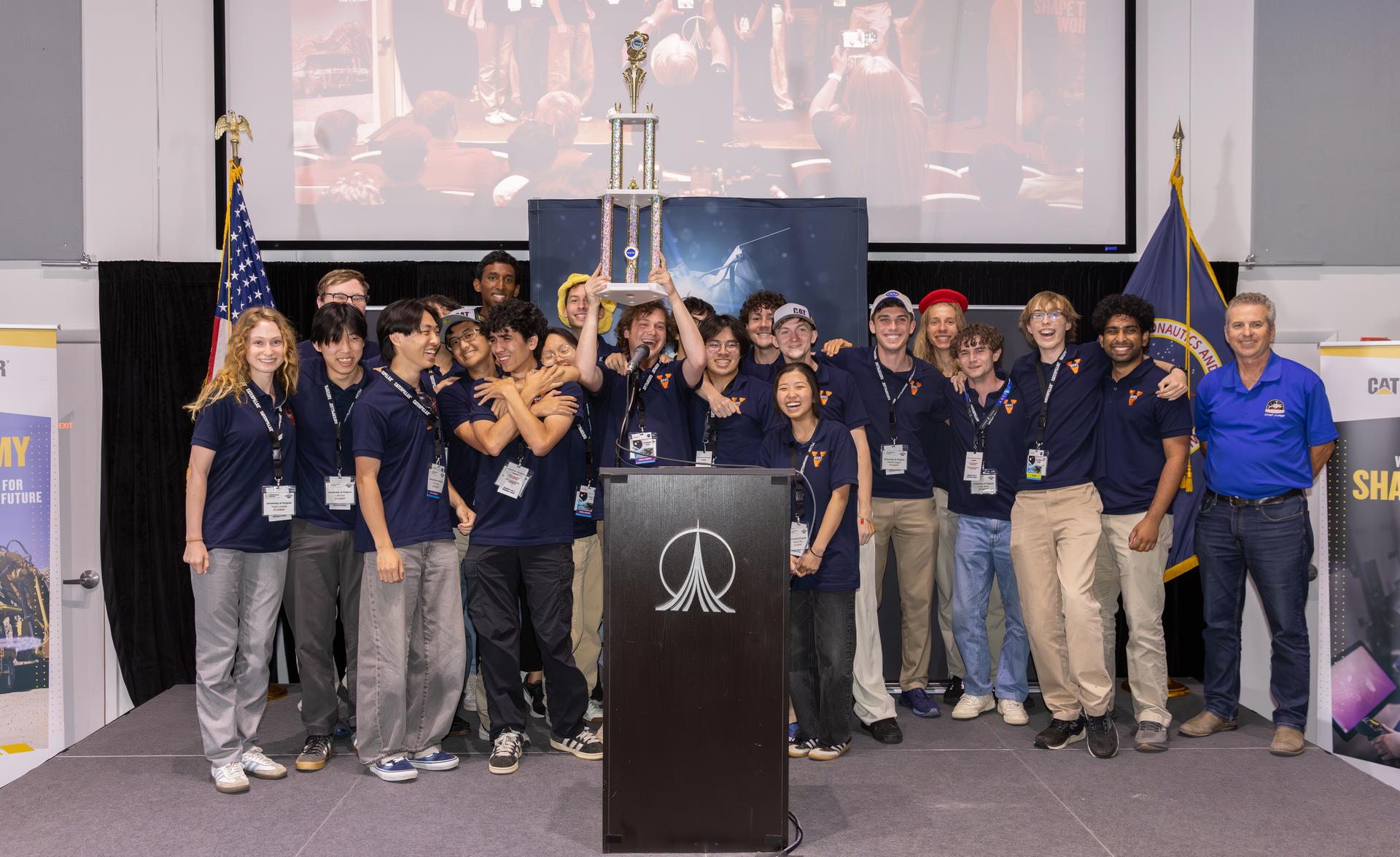
When the simulated lunar dust settled, the University of Virginia earned the Off World Grand Prize for completing all events and achieving the highest overall score.
“The Off World Grand Prize is really about everything,” said Robert Mueller, senior technologist at NASA Kennedy’s Swamp Works, lead judge, and co‑founder of the original Lunabotics robotic mining challenge. “It’s a difficult prize to win, and it’s not obvious, because the team that built the biggest berm didn’t win. But on an actual lunar mission, it’s not just one thing that matters — it’s everything in the system.”
Student test bed for lunar construction challengesThe agency’s annual Lunabotics Challenge is a two‑semester competition in which higher‑education students design, build, and test prototype lunar construction robots using NASA systems engineering principles. The 2026 competition opened last September, with teams submitting industry plans, engineering reports, and robot specifications. Judges selected 47 teams to advance to a qualifying round at the University of Central Florida’s Exolith Lab in Orlando, where the robots faced their first tests.
The goal during the qualifying round was straightforward: excavate and collect simulated lunar soil, transport it across challenging terrain, and construct a berm, or a raised mound of soil used to provide structure, support, or protection. Performance was evaluated across several criteria, and the top 10 teams moved on to the three‑day final round held May 19 to 21 at NASA Kennedy.
Judges assessed far more than berm size. Robot weight, communications performance, energy use, and level of autonomy all contributed to scores across four main criteria: a science, technology, engineering, and math (STEM) industry plan; a systems engineering paper; presentations and demonstrations; and robotic construction.
The University of Virginia team excelled not only in measurable metrics but also in preparation and resilience. When a wheel detached during their first finals run, the team reconfigured the robot to operate on three wheels and kept digging.
“When we saw the wheel break in the arena, we thought that was it,” said Craig Kalkwarf, a fourth‑year aerospace engineering and astronomy major and mechanical lead of the 22‑member team. “But we came so prepared. We had metal wheels ready to swap out. We had a plan. We ultimately got the win, and part of that was planning for anything — and it worked out.”
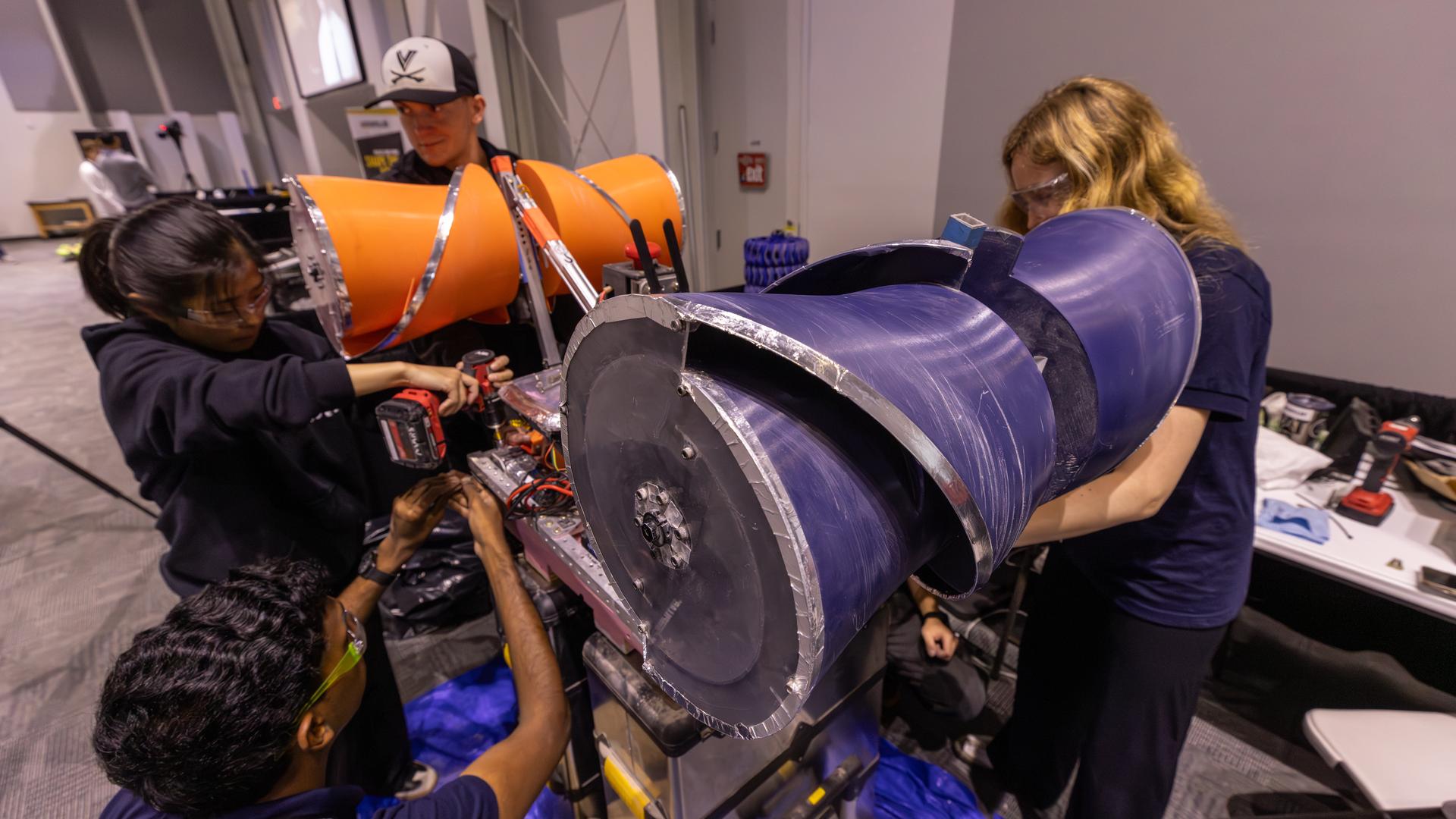
Students from the University of Virginia prepare their prototype lunar robot for its turn during the finals for NASA’s 2026 Lunabotics Challenge competition on Wednesday, May 20, 2026, inside the Astronauts Memorial Foundation’s Center for Space Education at the Kennedy Space Center Visitor Complex in Florida. NASA/Cory S Huston Engineering NASA’s lunar futureA key part of the Lunabotics Challenge is students employing NASA’s Systems Engineering Process, a multidisciplinary, mission‑driven approach that integrates hardware, software, people, and procedures to create complex, high‑reliability systems.
Competition judges noted that the systems engineering prowess on display this year was among the strongest in the challenge’s 17‑year history. Teams and their robots demonstrated remarkable adaptability in the face of obstacles. Multiple teams overcame wheel issues, robots stuck in rough terrain managed to break free, and one team pressed on after its digger blades damaged their robot, but only after it successfully deposited enough material to create an impressive berm.
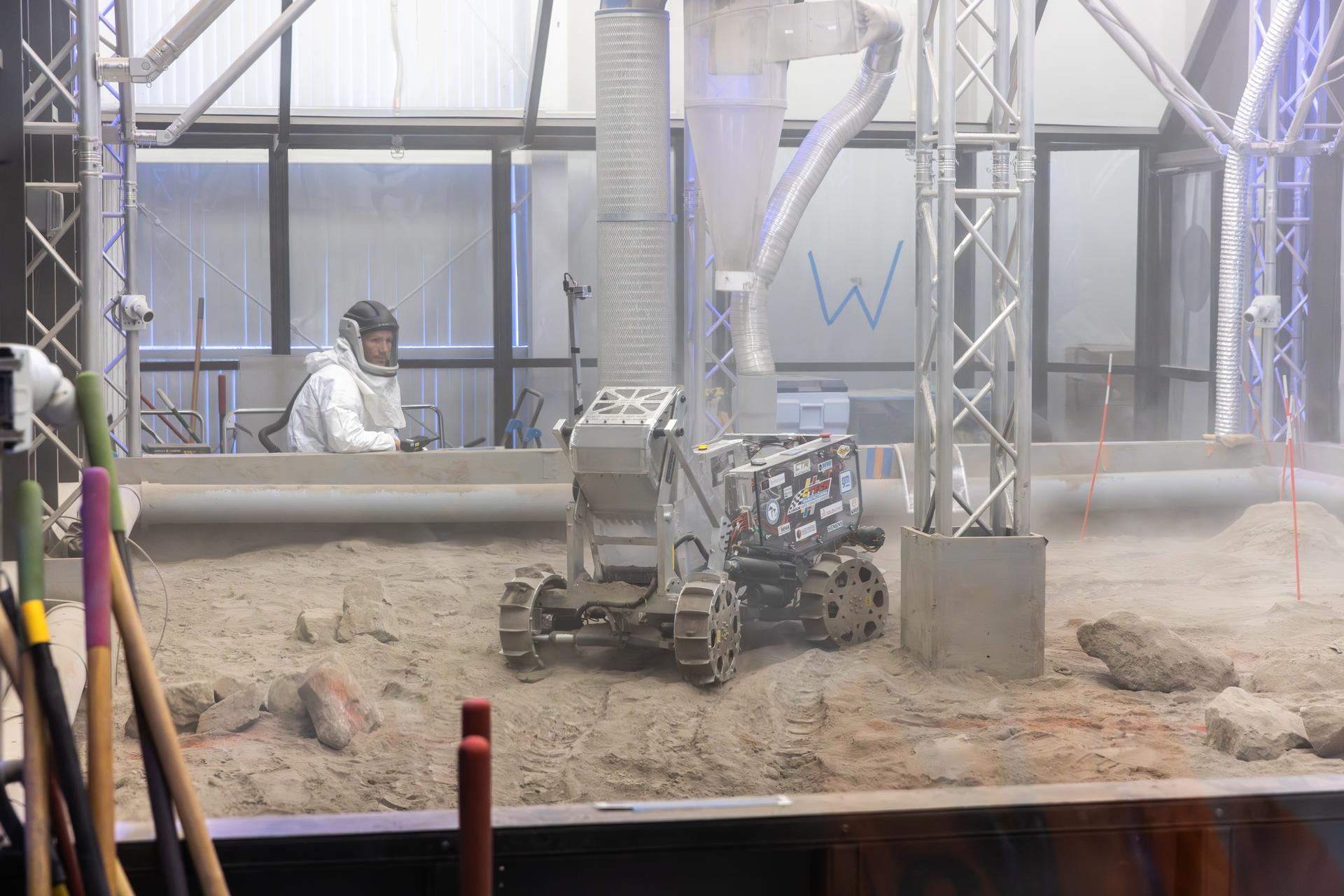
By the competition’s close, event organizers praised how teams built upon previous robotic designs, as several teams were veterans of the competition, and marveled at the number of fully autonomous robots that competed in the qualifying and final rounds. Last year, there were 12 fully autonomous robots, while this year the number grew to 27. This led to tighter competition, as well as more efficiency during the runs inside the Center for Space Education’s Artemis Arena – the large, engineered test bed filled with lunar soil simulant, designed to mimic the loose, uneven terrain robots will encounter on the Moon.
“Teams excavated much more material than we anticipated,” said Rich Johanboeke, project manager for the competition and longtime Lunabotics organizer. “This speaks to how teams have evolved previous design iterations and how much innovation we’re seeing from these students. It’s an exciting time!”
The University of Utah team’s prototype lunar robot performs during the finals for NASA’s 2026 Lunabotics Challenge competition on Thursday, May 21, 2026, inside the Astronauts Memorial Foundation’s Center for Space Education at the Kennedy Space Center Visitor Complex in Florida.NASA/Kim Shiflett Challenge designed for the Artemis eraComing just weeks after the success of NASA’s Artemis II mission, Lunabotics highlights some of the next steps toward establishing a sustainable human presence on the Moon. Autonomous robots capable of shaping lunar soil into berms will play a vital role in protecting landing sites, supporting power systems, and forming the building blocks of future lunar outposts.
“This might be the first thing NASA does on the Moon Base — robotically building a berm using a local resource, the lunar soil,” Mueller said. “We are watching and learning from these teams in preparation for a real mission launching in a few years, which is IPEx.”
Developed at Kennedy’s Swamp Works, IPEx, or Infrastructure Pilot Excavator, is poised to launch to the lunar surface through NASA’s CLPS (Commercial Lunar Payload Services) initiative. Acting as both excavator and hauler, IPEx is designed to dig and transport lunar regolith efficiently, which are critical capabilities for supporting human exploration and making the most of lunar resources.
Building engineering pipeline to NASAThis year’s Lunabotics Challenge didn’t just celebrate student ingenuity — it helped advance the technologies and engineering approaches that will define the next era of lunar exploration.
For students, Lunabotics provides an immersive engineering experience that mirrors industry‑level problem‑solving. For NASA, the competition, like the agency’s other Student Design Challenges, is helping to find novel solutions to technical challenges currently faced by the agency, while also helping recruit the next generation of engineers, technologists, and innovators to NASA.
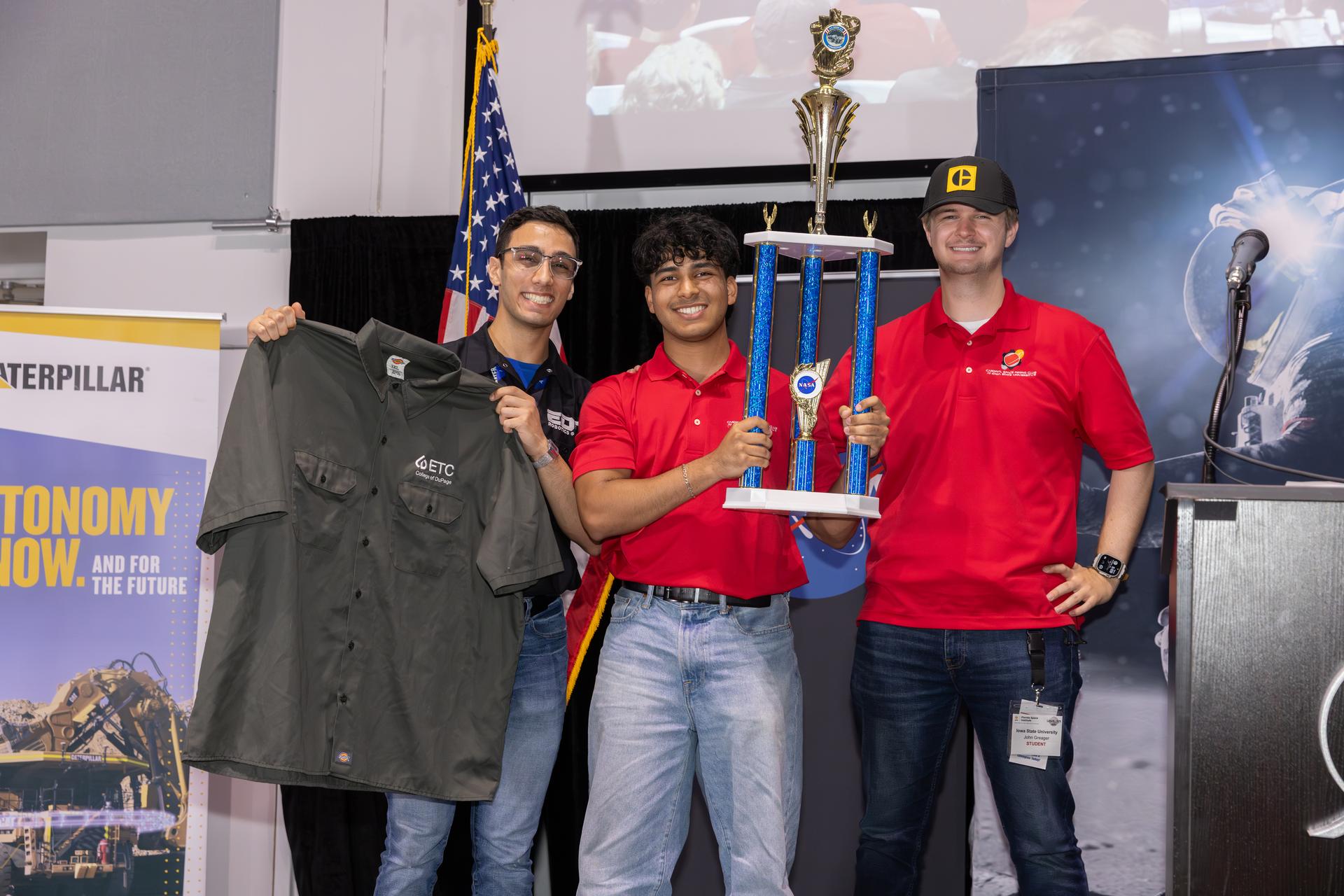
Alumni from the College of DuPage in Glen Ellyn, Illinois, accept the Lunabotics Construction Award on behalf of the team for building the largest berm during NASA’s 2026 Lunabotics Challenge competition on Thursday, May 21, 2026, inside the Astronauts Memorial Foundation’s Center for Space Education at the Kennedy Space Center Visitor Complex in Florida.NASA/Kim Shiflett“I think it’s everyone’s dream to come work at NASA,” said Andrew Ebert, a mechanical engineering student at the College of DuPage in Glen Ellyn, Illinois, whose team took home the prize for building the biggest berm. “It’s always pushing the boundaries of what has ever been done by humans. In my opinion, it’s the coolest thing you can do in engineering.”
The creativity, resilience, and technical mastery demonstrated by these teams are directly shaping NASA’s path toward a sustainable Moon Base. When Americans begin lunar construction in a few years, the experience and expertise gained by the young engineers through Lunabotics becomes even more meaningful and potentially impactful for NASA.
“These students might be working for NASA by the time we start building on the Moon,” said Mueller.
To learn more about NASA’s Lunabotics Challenge visit:
https://www.nasa.gov/learning-resources/lunabotics-challenge
2026 Lunabotics Challenge WinnersOff World Grand Prize – Overall Excellence
University of Virginia in Charlottesville
Lunabotics Construction Award
1st place: College of DuPage in Glen Elyn, Illinois
2nd place: University of Virginia
3rd place: Michigan Technological University in Houghton, Michigan
Caterpillar Autonomy Award
1st place: The University of Alabama in Huntsville
2nd place: University of Virginia
3rd place: University of Utah in Salt Lake City
4th place: Purdue University in West Lafayette, Indiana
5th place: Iowa State University in Ames
6th place: College of DuPage
Lunabotics Efficient Use of Communications Power Award
Iowa State University
Systems Engineering Paper
1st place: The University of Alabama
2nd place: University of Virginia
3rd place: University of Illinois in Chicago
Nova Award for Stellar Systems Engineering by a First Year School
Laredo College in Laredo, Texas
Northwestern University in Evanston, Illinois
Systems Engineering Leaps & Bounds Award
University of Virginia
Rocket Award for Accelerating Systems Engineering Mastery
University of Illinois in Urbana-Champaign
Presentations and Demonstrations
1st place: New Mexico Institute of Mining and Technology in Socorro, New Mexico
2nd place: The University of Alabama
3rd place: Colorado School of Mines in Golden, Colorado
Honorable Mention: Michigan Technological University
Presentations and Demonstrations First Steps Awards
Carnegie Mellon University in Pittsburg, Pennsylvania
Hubble Spies Faint Irregular Galaxy
- Hubble Home
- Overview
- Impact & Benefits
- Science
- Observatory
- Team
- Multimedia
- News
- More
1 min read
Hubble Spies Faint Irregular Galaxy This NASA Hubble Space Telescope image captures the faint glow of the dwarf irregular galaxy ESO 490-017. NASA, ESA, R. Tully (University of Hawaii); Image Processing: G. Kober (NASA/Catholic University of America)This NASA Hubble Space Telescope image features the dwarf irregular galaxy ESO 490-017, roughly 12,000 light-years in diameter and some 23 million light-years away in the constellation Canis Major. The galaxy’s low surface brightness makes it appear as a faint, starry swarm behind brighter foreground stars that are easily recognized by their diffraction spikes. Numerous red, orange, and beige dots are distant galaxies peppering the black background, many exhibiting distinct spiral structure.
The data in this image of ESO 490-017 was part of a Hubble observing program that looked at the movement of galaxies and galaxy clusters through space. Matter in the universe is distributed unevenly, and the gravitational influence of that matter drives the “cosmic flow” or movement of large-scale structures in the universe.
Hubble is uniquely capable of providing distances to nearby galaxies like ESO 490-017 by measuring the luminosities of low-mass red giant stars as “standard candles”. The observing program also provided a legacy archive of the types of stars in local galaxies.
Facebook logo @NASAHubble @NASAHubble Instagram logo @NASAHubbleMedia Contact:
Claire Andreoli
NASA’s Goddard Space Flight Center, Greenbelt, MD
claire.andreoli@nasa.gov
Since its 1990 launch, the Hubble Space Telescope has changed our fundamental understanding of the universe.
Hubble’s Galaxies
Hubble Science Highlights
Hubble Images
Ever Restless Mount Dukono Erupts
- Earth
- Earth Observatory
- Image of the Day
- EO Explorer
- Topics
- More Content
- About
NASA to Announce Artemis III Crew, Provide Mission Progress Update
NASA will provide an update on the agency’s Artemis III mission and announce the astronauts assigned to the test flight during a live event at 11 a.m. EDT on Tuesday, June 9, at the agency’s Johnson Space Center in Houston.
The event will stream on NASA+ and on the agency’s YouTube channel. Learn how to watch NASA content through a variety of online platforms, including social media.
Following the event, the Artemis III crew will be available for limited in-person and virtual interviews.
Interview requests must be submitted to the NASA Johnson newsroom by 5 p.m. on Thursday, June 4. International media interested in attending must contact the NASA Johnson newsroom at jsccommu@mail.nasa.gov by 5 p.m., Thursday, May 28. U.S. media must contact the newsroom by 5 p.m., June 4. Registered media will receive confirmation and additional event details by email. NASA’s media accreditation policy is available online.
Artemis III will launch four astronauts from NASA’s Kennedy Space Center in Florida aboard the Orion spacecraft on the SLS (Space Launch System) rocket. The mission will test critical rendezvous and docking capabilities between Orion and commercial human landing systems needed to deliver astronauts to the lunar surface. Building on the successful Artemis II crewed test flight in April, Artemis III will pave the way for future surface missions.
As part of the Golden Age of innovation and exploration, NASA will send Artemis astronauts on increasingly complex missions to explore more of the Moon for scientific discovery, economic benefits, establish an enduring human presence on the lunar surface, and to build on our foundation for the first crewed missions to Mars.
Learn more about NASA’s Artemis program:
-end-
Rachel Kraft
Headquarters, Washington
202-358-1600
rachel.h.kraft@nasa.gov
Anna Schneider
Johnson Space Center, Houston
281-483-5111
anna.c.schneider@nasa.gov
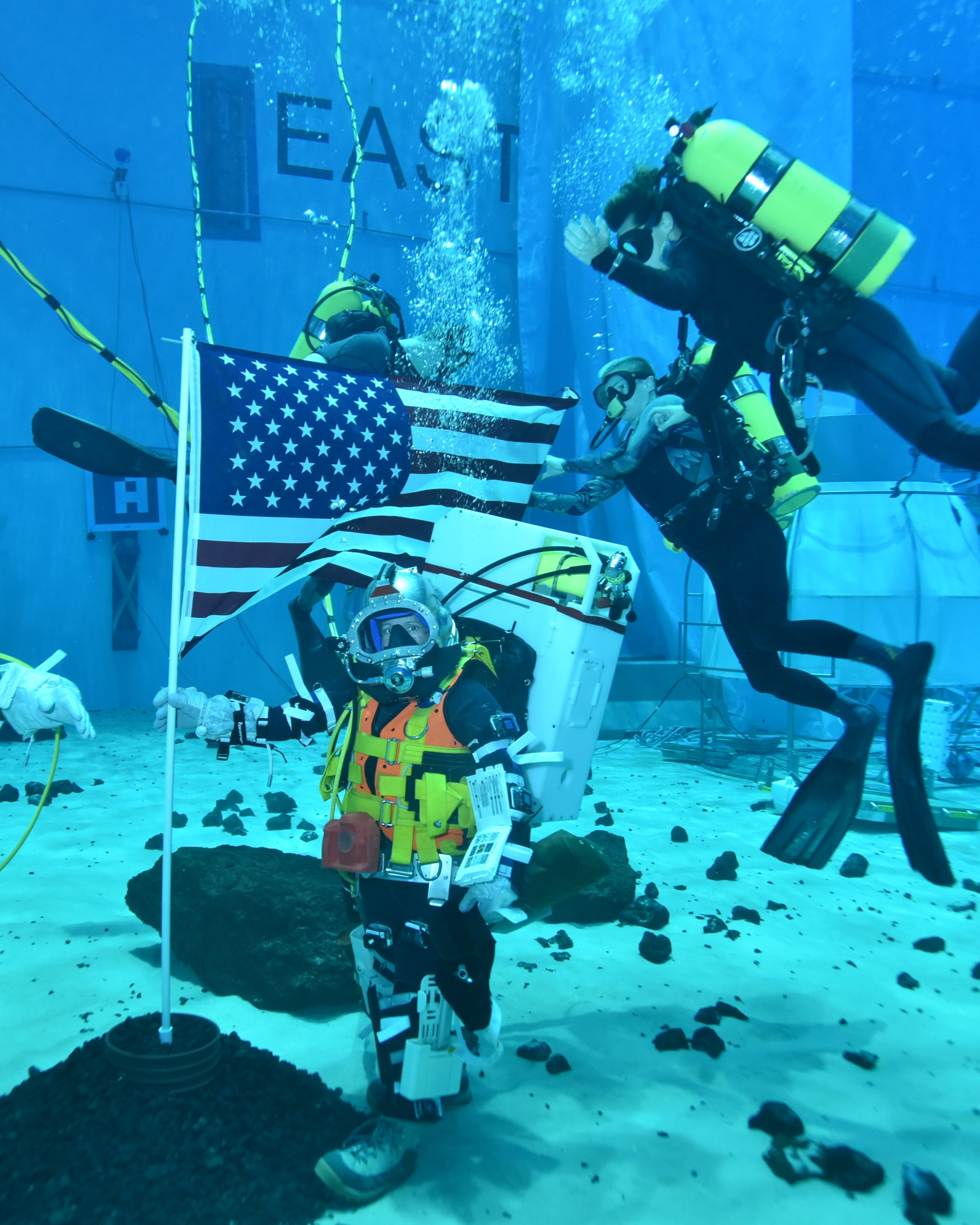
NASA Astronauts to Answer Questions from Students in New York
2 min read
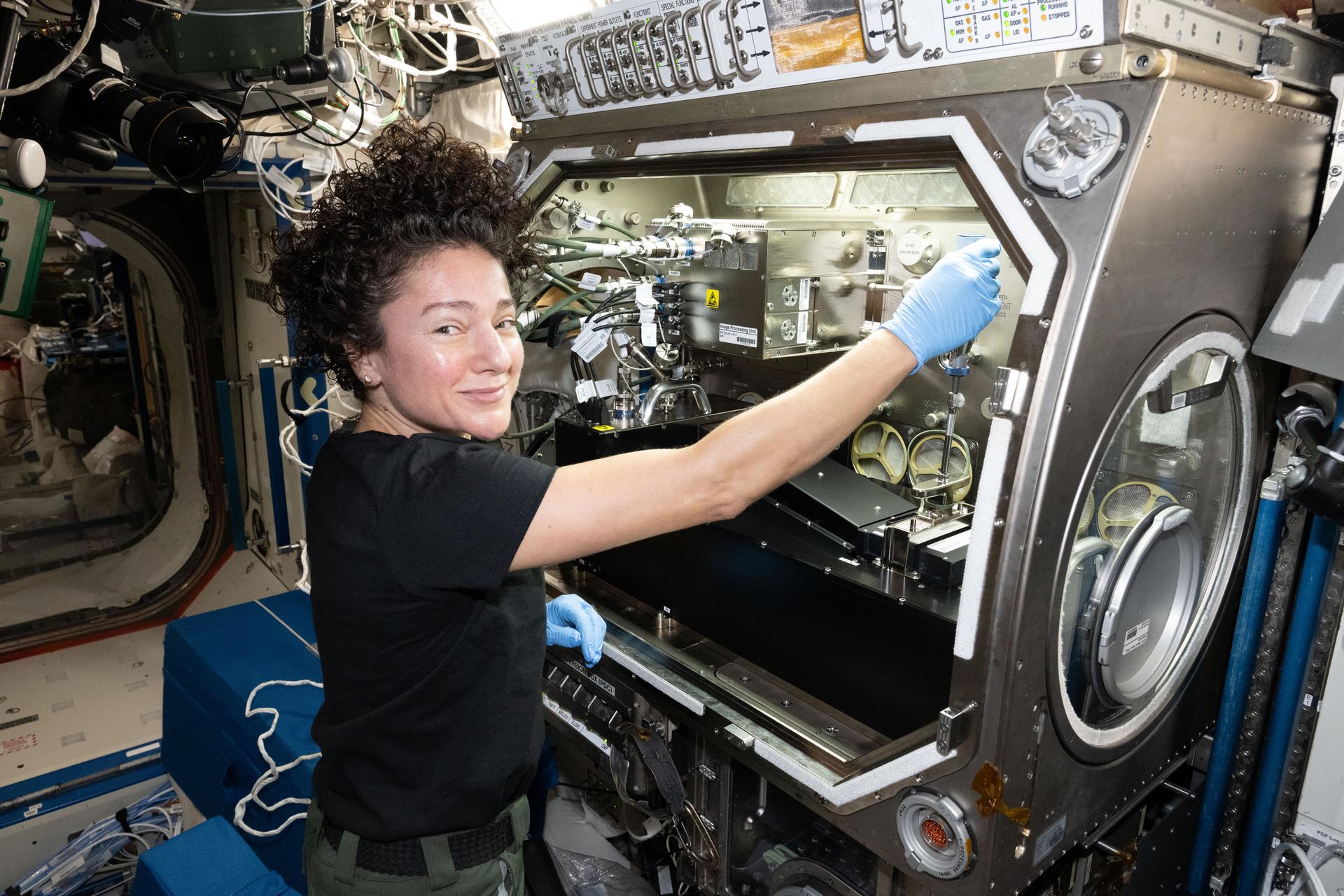
Preparations for Next Moonwalk Simulations Underway (and Underwater) NASA astronaut and Expedition 74 flight engineer Jessica Meir configures research gear inside the Destiny laboratory module’s Microgravity Science Glovebox aboard the International Space Station.Credit: NASA/Jessica MeirStudents in New York will hear from NASA astronaut Jessica Meir as she answers their prerecorded science, technology, engineering, and mathematics (STEM) questions while aboard the International Space Station.
The Earth-to-space call will begin at 11:05 p.m. EDT Thursday, May 28, and will stream live on the agency’s Learn With NASA YouTube channel.
This event is hosted by the Cradle of Aviation Museum in Garden City, New York, for students in grades K-12 and members of the community. This unique opportunity aims to deepen understanding of space exploration and enhance awareness of STEM careers.
Media interested in covering the event must RSVP no later than 5 p.m. EDT, Wednesday, May 27, to Jerelyn Zontini at: 516-567-0537 or jzontini@cradleofaviation.org.
For more than 25 years, astronauts have continuously lived and worked aboard the space station, testing technologies, performing science, and developing skills needed to explore farther from Earth. Astronauts communicate with NASA’s Mission Control Center in Houston 24 hours a day through SCaN’s (Space Communications and Navigation) Near Space Network.
Research and technology investigations taking place aboard the space station benefit people on Earth and lay the groundwork for other agency deep space missions. As part of NASA’s Artemis program, the agency will send astronauts to the Moon to prepare for future human exploration of Mars, inspiring the world through discovery in a new Golden Age of innovation and exploration.
For more information on NASA in-flight calls, visit:
https://www.nasa.gov/stemonstation
Share Details Last Updated May 26, 2026 Related Terms Explore More 7 min read NASA’s 2026 Lunabotics: Winning Student Teams Engineering Lunar Future Article 3 hours ago 4 min read NASA’s AWE Completes Mission to Study Earth’s Effect on Space WeatherOn May 21, ground controllers powered down NASA’s AWE (Atmospheric Waves Experiment) instrument, bringing the…
Article 6 days ago 5 min read NASA Highlights 2025 International Space Station Science Results Article 6 days ago Keep Exploring Discover Related TopicsMissions
Humans in Space
Learning Resources
In-Flight STEM Downlinks
NASA Provides Update on Moon Base Rovers, Landers, Missions
Editor’s note: Release was updated May 27, 2026, to provide additional details on the crewed lunar terrain vehicles.
During a Moon Base event Tuesday at NASA’s Headquarters in Washington, the agency announced new contracts for lunar rovers for crew to drive and uncrewed cargo landers bound for the Moon. NASA leaders also shared target launch timeframes and upcoming milestones for the first Moon Base infrastructure and exploration missions to the lunar South Pole region ahead of Artemis astronaut landings.
“The Moon Base will be America’s and humanity’s first outpost on another celestial world,” said NASA Administrator Jared Isaacman. “Every mission, crewed and uncrewed, will be a learning opportunity as we return to the lunar surface, build the infrastructure to stay, and master the skills required to live and operate in one of the most demanding and dangerous environments imaginable. We will go for the science, for all we stand to gain from an economic and technological perspective, for the innovations that will make life better here on Earth, and to prepare for where we will inevitably go next. We are grateful for President Trump’s leadership, the bipartisan commitment from Congress, our industry and international partners, and the dedicated NASA workforce whose expertise enables us to achieve the near-impossible.”
NASA announced the first three Moon Base missions to begin building sustained operations:
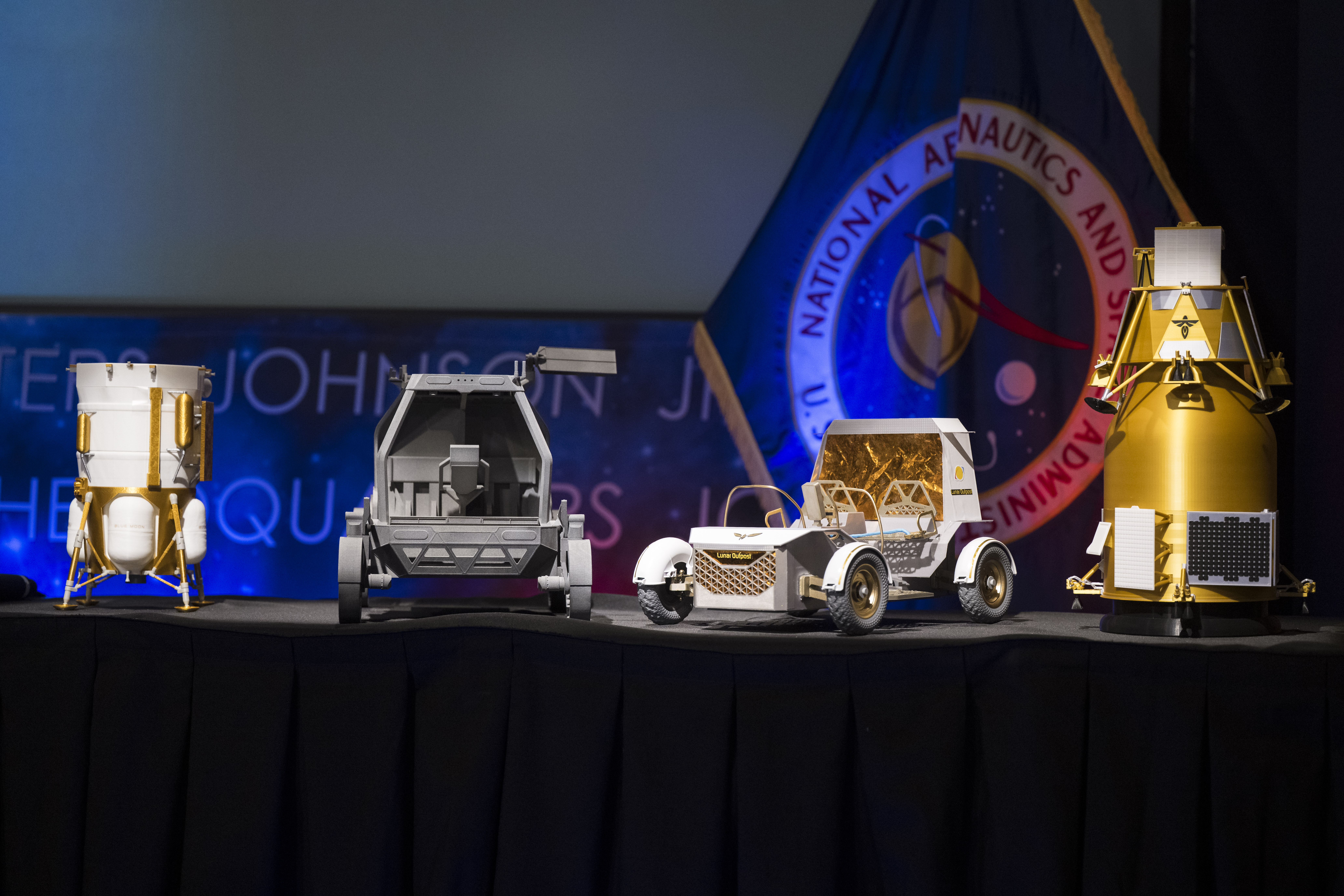
- Moon Base I: Targeted for launch no earlier than fall 2026, this mission will use Blue Origin’s Blue Moon Mark 1 Endurance lander to deliver NASA payloads. Equipment will include the Stereo Cameras for Lunar Plume-Surface Studies instrument to study how thrusters interact with the Moon’s surface, and the Laser Retroreflective Array, which helps orbiting spacecraft determine a more precise location using reflected laser light. The mission will land on the Shackleton Connecting Ridge to demonstrate capabilities that reduce risk for future crewed Artemis landing missions in 2028.
- Moon Base II: Planned for launch later this year, this mission will deliver more than 1,100 pounds of cargo on Astrobotic’s Griffin lander, including Astrolab’s FLIP rover, to mature mobility systems that inform future lunar terrain vehicle, or LTV, operations.
- Moon Base III: Also targeted for this year, this mission will fly the first payload selected through NASA’s Payloads and Research Investigations on the Surface of the Moon initiative. Its anchor investigation, Lunar Vertex, will fly on Intuitive Machines’ Nova-C Trinity lunar lander and study lunar swirls, or light spots on the surface of the Moon, to improve understanding of surface evolution and material behavior under extreme conditions. The mission will include payloads from ESA (European Space Agency) and the Korea Astronomy and Space Science Institute, reflecting commercial and international participation in Moon Base activities.
These missions are the first of more than a dozen missions that will be announced this year, each designed to generate operational data and reduce risk ahead of crewed Artemis surface activities.
NASA has awarded Astrolab $219 million and Lunar Outpost $220 million to build and deliver the first phase of LTVs. Awarded under the Phase 1 High Achievability Mission task orders of the Lunar Terrain Vehicle Services contract, these firm-fixed-price, performance-based milestones will enable NASA to deploy crewed and uncrewed mobility systems to the lunar surface by 2028 through the agency’s CLPS (Commercial Lunar Payload Services) initiative. Early surface mobility is a foundational component of the national space policy priority to create an enduring lunar presence.
Astrolab’s Crewed Lunar Vehicle, or CLV‑1, adapted from the company’s FLEX architecture, is a crewed rover designed to transport astronauts, carry supplies, and support remote operations, with a compact stowed configuration, a mass of about 2,000 pounds, and the ability to reach more than 6 mph on level terrain.
Complementing this capability, Lunar Outpost’s Pegasus is a lighter, mission‑ready evolution of its Eagle rover designed explicitly to meet NASA’s updated crewed LTV requirements. Operational for up to a year and capable of manual, autonomous, or teleoperated driving at speeds more than 9 mph, Pegasus incorporates Apollo‑heritage technologies and builds on prototype and flight experience to deliver human‑centered mobility essential for establishing a sustained Moon Base.
Deploying multiple LTVs early in Moon Base development will accelerate technology demonstrations, inform site planning, and reduce operational risk ahead of crewed Artemis missions, enabling NASA to characterize terrain hazards, move materials, pre-stage resources, and mature systems needed for long-duration lunar exploration.
Over the next 18 months, the selected providers will finalize rover designs, conduct crewed evaluations, and qualify flight units for operational readiness, with the resulting LTVs supporting autonomous traverses, terrain preparation, scientific investigations, technology demonstrations, and astronaut transport.
As Moon Base efforts advance, NASA will expand opportunities for additional vendors through on‑ramp competitions, fostering a robust, sustainable approach to lunar mobility and strengthening national priorities in space capability.
To deliver these rovers to the Moon’s South Pole region, NASA awarded Blue Origin $188 million with an option period worth $280.4 million for two task orders, which includes an option period based on initial phase performance. NASA can choose to extend the task order for payload delivery.
This competitive procurement, executed under the CLPS 1.0 indefinite-delivery/indefinite-quantity framework, the CX-2 task order represents a strategic investment in lunar exploration and will play a critical role in enabling mobility and infrastructure development for sustained lunar operations, marking a significant step toward establishing a permanent human presence on the Moon.
Building on the successes and lessons learned from CLPS 1.0, the agency also outlined how the next generation of cargo landers under CLPS 2.0 will continue to deliver payloads to the lunar surface and lunar orbit, supporting NASA’s ambitious goals for sustained lunar operations. This next phase introduces enhanced flexibility, allowing NASA to order turn-key delivery services or start accepting delivery of CLPS hardware for integration into its own missions. The final CLPS 2.0 request for proposal was released on May 15, with responses due on Tuesday, June 30.
Moonfall update
The agency also shared new updates on MoonFall, a mission that will send four drones to fly short hops on the lunar surface as they survey potential landing sites for Artemis astronauts. NASA‘s Jet Propulsion Laboratory in Southern California has been developing the design and testing prototype hardware and has selected Firefly Aerospace to build the spacecraft that will transport the drones from Earth orbit to the Moon. Launch is targeted for 2028.
The drones will independently land on the lunar surface and then gather high-resolution imagery of hard-to-reach terrain over the course of a single lunar day. After each drone’s final flight, its survive-the-night payload will continue to operate for several months, marking a sustained U.S. presence at the lunar South Pole.
More robotic missions to come
Finally, NASA stated in the coming weeks that a selection of additional CLPS 1.0 task awards, issued during the agency’s Ignition event, for Moon Base payloads and technology demonstrations, is forthcoming. In the coming months, there also will be additional opportunities to compete for CLPS 1.0 and 2.0 task orders as Phase 1 technology demonstrations are defined and planned for Moon Base missions.
During the update, NASA leadership reiterated that establishing a sustained lunar presence is aligned with the agency’s broader exploration strategy, supported by increased launch cadence, expanded industry partnerships, and agencywide coordination.
As part of the Golden Age of innovation and exploration, NASA will send astronauts on increasingly difficult missions to explore more of the Moon for scientific discovery, economic benefits, and to build on our foundation for the first crewed missions to Mars.
For more on Moon Base, visit:
-end-
George Alderman / James Gannon
Headquarters, Washington
202-358-1600
george.a.alderman@nasa.gov / james.h.gannon@nasa.gov
Chennai City Lights
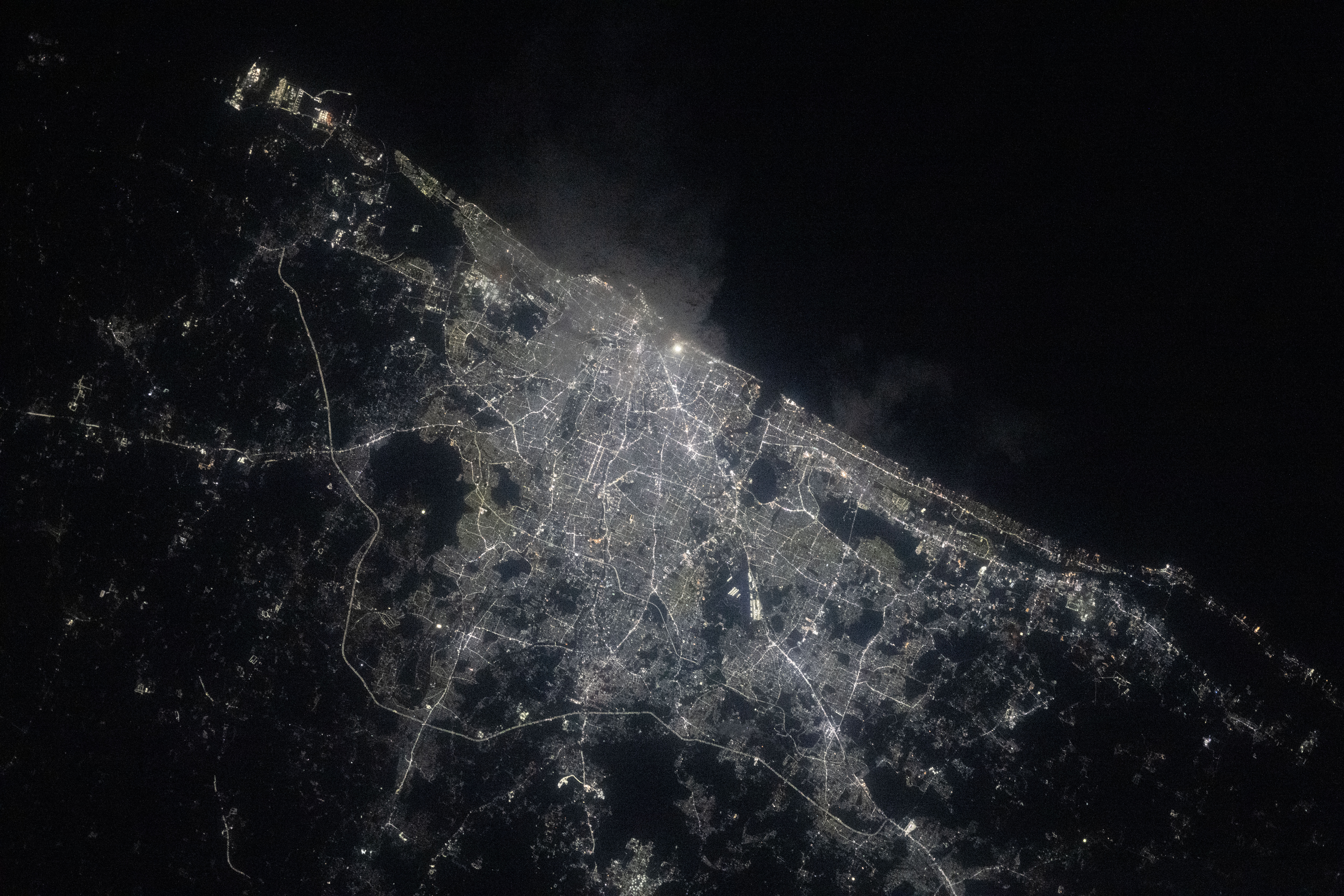
Chennai, on India’s southern coast along the Bay of Bengal and with a metropolitan population of about 8.7 million, shines with white LED streetlights in this photograph taken at approximately 9:13 p.m. local time on May 2, 2026, from the International Space Station.
Earth observations from the space station let us see how our planet changes over time. In combination with NASA-developed technologies, these observations provide the foundation needed to explore and sustain human life on the Moon, Mars, and beyond.
Image credit: NASA/Chris Williams
New Instrument Used Antarctic Ice Sheet to Probe Extreme Universe
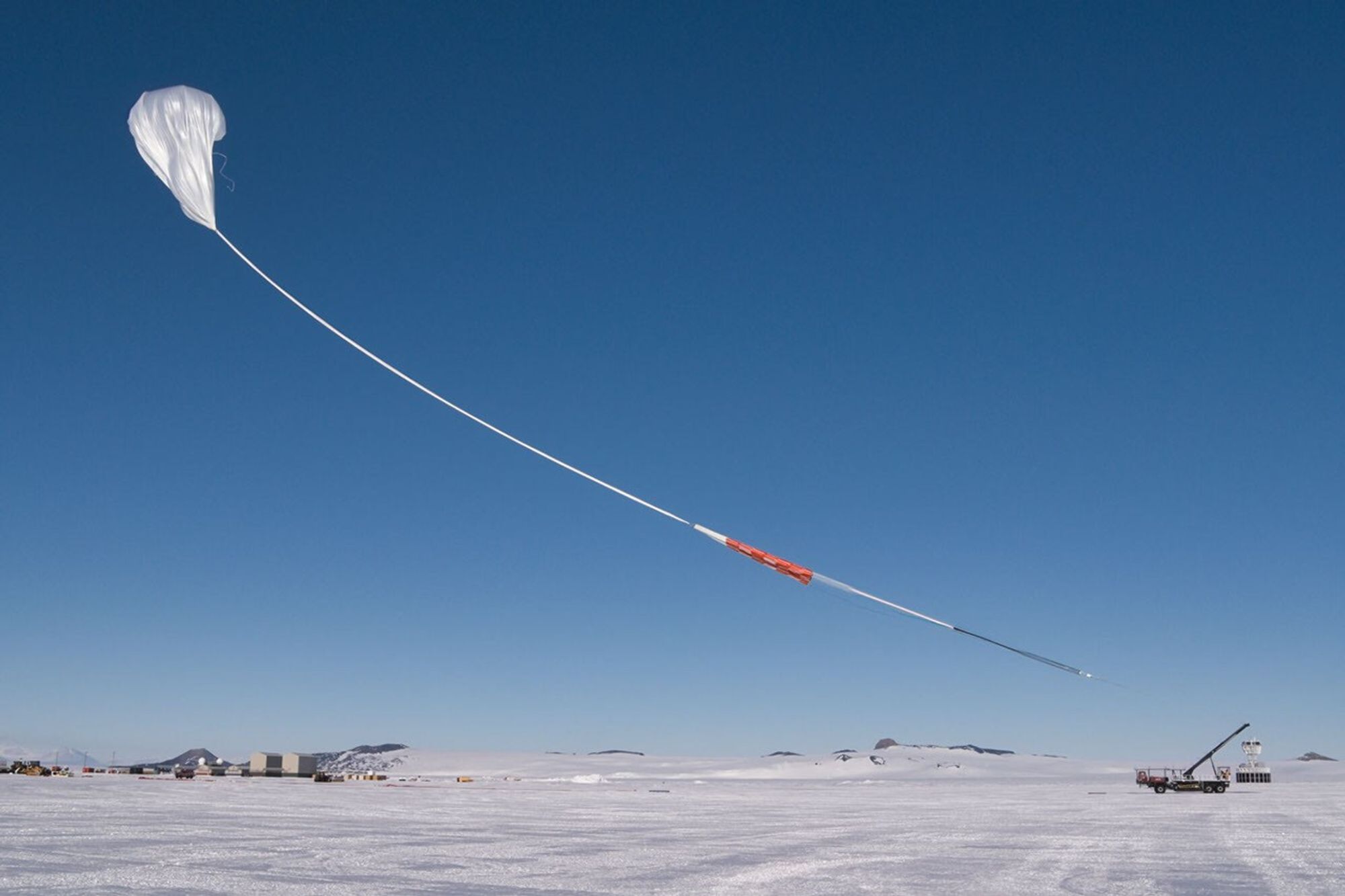
The Payload for Ultrahigh Energy Observations (PUEO) is a NASA Astrophysics Pioneers Program mission designed to detect the most energetic particles in the universe. The PUEO mission flew high above Antarctica on a Long Duration Balloon (LDB) and used the Antarctic ice sheet as an enormous detection volume to look for radio signals generated by the interactions of extremely energetic astrophysical neutrinos as they passed through the ice. In addition to searching for the highest energy neutrinos, PUEO could also detect radio signals from high energy cosmic rays showering in Earth’s atmosphere (a.k.a. air showers), either as the signals entered directly into the instrument or reflected off the ice below. The sensitivity achieved with the PUEO instrument was a result of technology advancements and careful optimization of the experimental design to enable accommodation within the balloon platform’s launch volume.
The ultra-high energy neutrinos that PUEO was searching for carry information from the most extreme places in the universe, including supermassive black holes that accrete matter at the centers of galaxies, neutron star mergers, and other powerful cosmic accelerators. Because these particles travel large distances along straight lines without being absorbed, they provide a unique view of the distant, most energetic universe. Not only will data collected by PUEO reveal the origin and composition of the highest-energy cosmic rays, it will also test fundamental physics at energies far beyond those achievable in human-made particle accelerators on Earth.
The PUEO mission built on heritage from the NASA-sponsored Antarctic Impulsive Transient Antenna (ANITA) mission, which had four successful flights from 2006-2016. Like ANITA, PUEO consisted of an array of radio-frequency antennas, an onboard data acquisition system that is triggered by neutrino-like signals and processes and saves the data, and a navigation and command and control system. From its 120,000-foot altitude, PUEO monitored an extremely large volume of Antarctic ice, looking for signals from very rare, high-energy neutrino interactions.
The first of NASA’s Astrophysics Pioneers missions to launch, PUEO took off Dec. 20, 2025, from NASA’s Long Duration Balloon Facility near McMurdo Station, Antarctica, and flew for 23 days before landing approximately 120 miles (200 km) from the South Pole. The full payload has been recovered, including the data drives. The PUEO team is currently analyzing the data collected—an undertaking that may take up to a year due to the complex nature of the task.
The PUEO mission’s on-ice integration team is seen here in front of the fully constructed instrument. Credit: Cosmin DeaconuThe significant improvement in sensitivity achieved with the PUEO instrument compared to that of ANITA was due to a variety of technology advancements and careful optimization of the experimental design to enable accommodation within the balloon platform’s constrained launch volume.
Lowering detection threshold with interferometric triggeringAt the heart of PUEO’s technology advancement was a new type of trigger called an interferometric phased array trigger. The PUEO trigger coherently summed signals from multiple antennas in real time, enabling the instrument to detect weaker signals than previously possible. By lowering the trigger threshold, PUEO could dig further into the noise, and find weaker neutrino and cosmic-ray signals than previous experiments.
More channels in a physically constrained spaceThe PUEO antenna collecting area for frequencies above 300 MHz was doubled compared to ANITA, improving the sensitivity to radio emission from particle interactions. To ensure the PUEO payload remained within the allowable launch volume, the team increased the low-frequency cutoff of the PUEO antennas, which enabled them to be even smaller than those used on ANITA.
Low-frequency instrument for air shower characterizationTo improve sensitivity to extensive air showers produced by cosmic rays and potentially neutrinos, PUEO incorporated a new low-frequency instrument that deployed once the payload reached float altitude (it would have been much too large to fit in the allowable launch volume in its flight configuration). This new low-frequency instrument incorporated antennas that are sensitive down to 50 MHz, and extended PUEOs sensitivity to air showers.
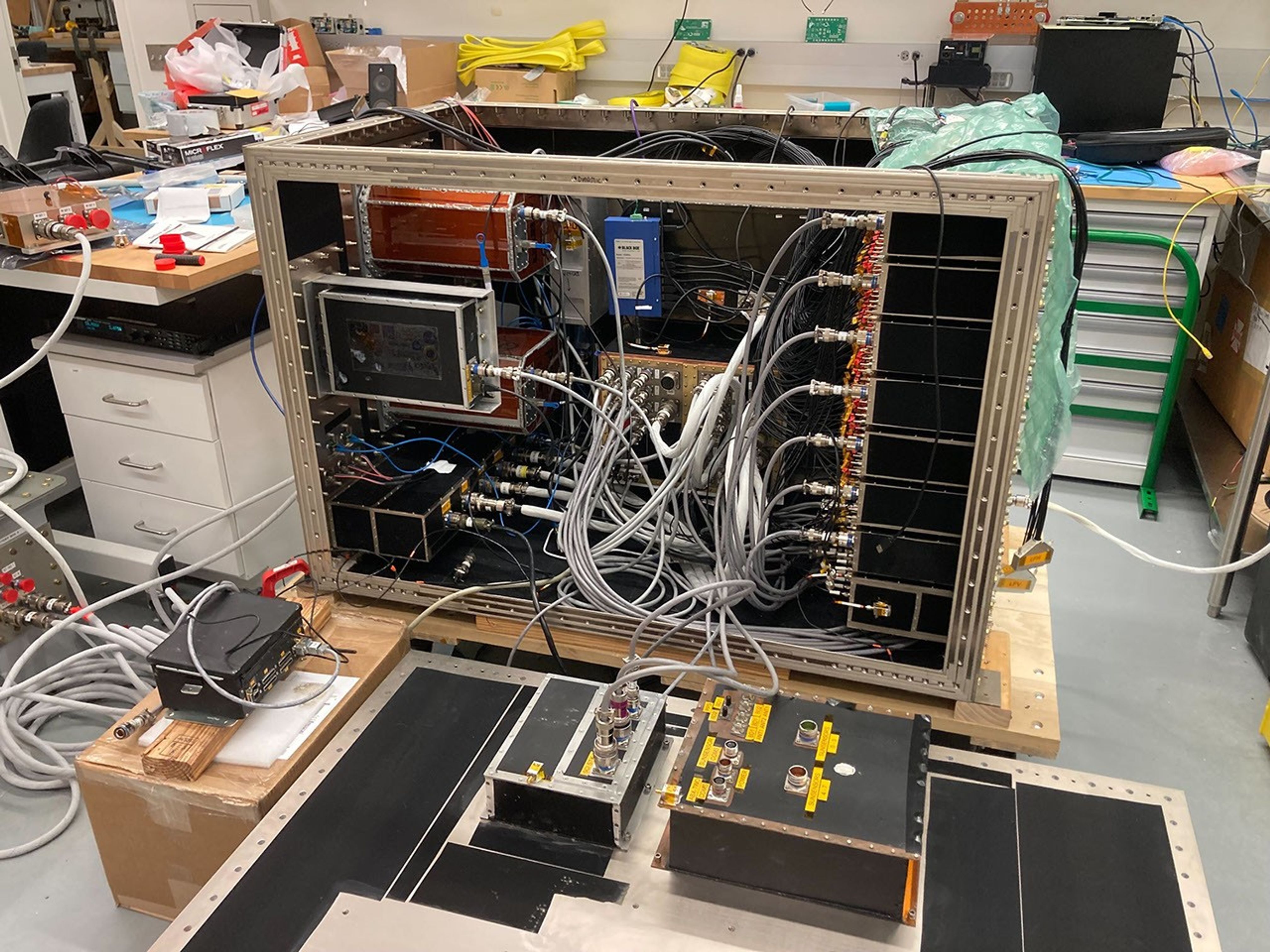
This photo shows the inside of PUEO’s Main Instrument Enclosure, where many of PUEO’s electronics are housed. Credit: Eric OberlaMany of the technology advancements that were developed for PUEO may also be applicable for mission concepts under development that would use the lunar regolith as a detector for ultra-high energy cosmic rays, and other potential future radio missions on the moon.
Project Lead: Dr. Abigail Vieregg, David N. Schramm Director of the Kavli Institute for Cosmological Physics and professor of Physics, Astronomy & Astrophysics, and the Enrico Fermi Institute, University of Chicago, assisted by graduate student, Rachel Scrandis
Sponsoring Organization(s): NASA Astrophysics Division Pioneers Program
A Full Moon Checkup
- Earth
- Earth Observatory
- Image of the Day
- EO Explorer
- Topics
- More Content
- About
Jaclyn Kagey Shapes Humanity’s Return to the Moon
For Jaclyn Kagey, preparing astronauts to put boots on the Moon is part of her daily work.
As the Artemis extravehicular activity lead in NASA’s Flight Operations Directorate, Kagey plays a central role in preparing astronauts to safely explore the lunar surface.
Official portrait of Jaclyn Kagey. NASA/Robert Markowitz My mission is to shape the historic endeavor by working closely with scientists and industry partners to define lunar surface activities. We are setting the standard for humanity’s return to the Moon.Jaclyn Kagey
Artemis Extravehicular Activity Lead
During Artemis missions, astronauts will explore the Moon’s South Pole, a region never visited by humans, paving the way for future deep space exploration.
Kagey helps define how astronauts will work on the Moon, from planning detailed spacewalk timelines to guiding real-time operations. Crews will conduct these activities after stepping outside NASA’s human landing system, a commercial lander designed to safely transport astronauts from lunar orbit to the surface and back.
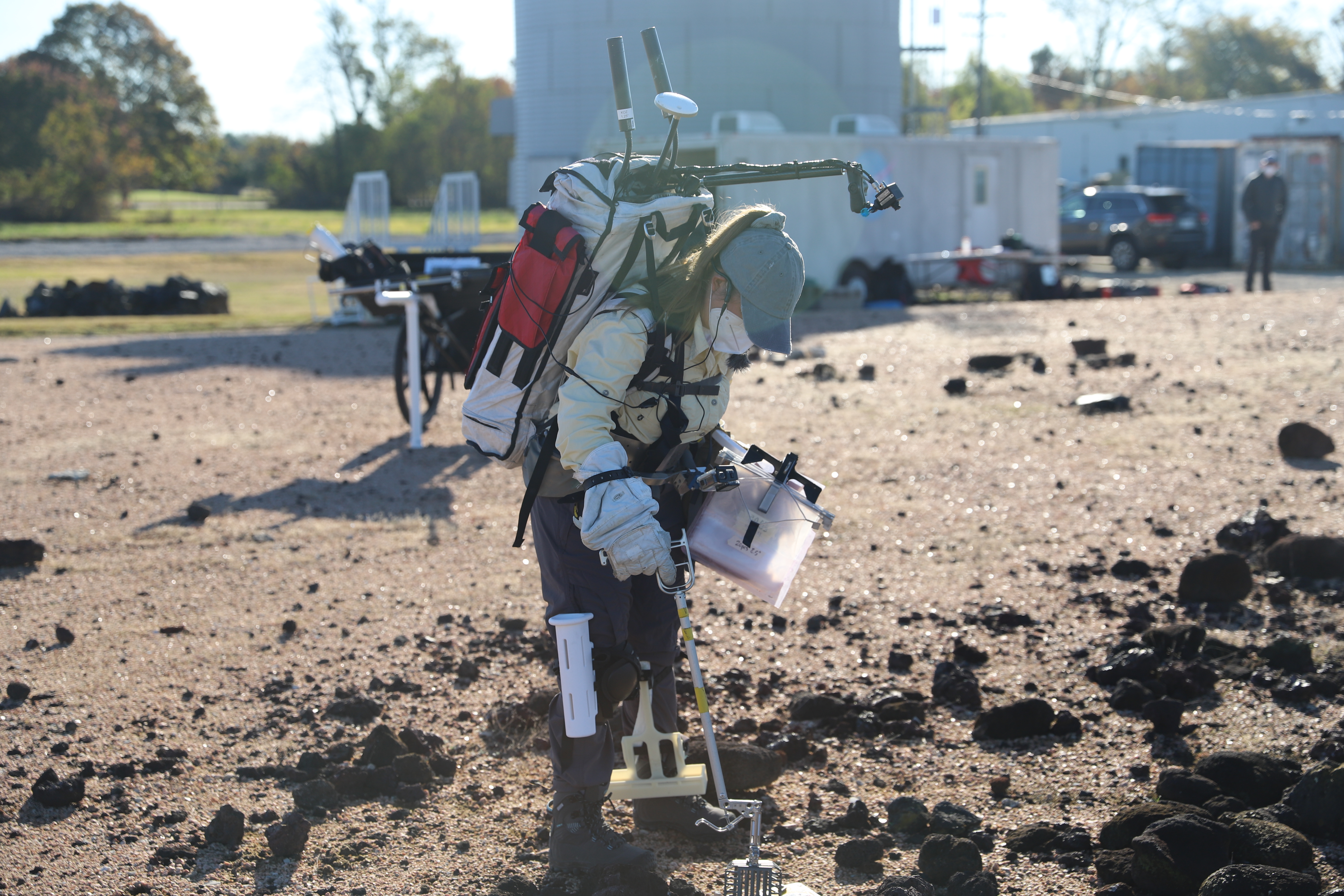
Jaclyn Kagey conducts lunar surface operations training in the Rock Yard at Johnson Space Center, where teams test tools and procedures for future Artemis missions. NASAKagey’s NASA career spans more than 25 years and includes work across some of the agency’s most complex programs.
While studying at Embry-Riddle Aeronautical University, she watched space shuttle launches that solidified her goal of working at NASA. “From a young age, my aspirations were singularly focused on contributing to the nation’s aircraft and spaceflight endeavors,” she said.
That goal became reality through United Space Alliance, where she and her husband began their careers as contractors.
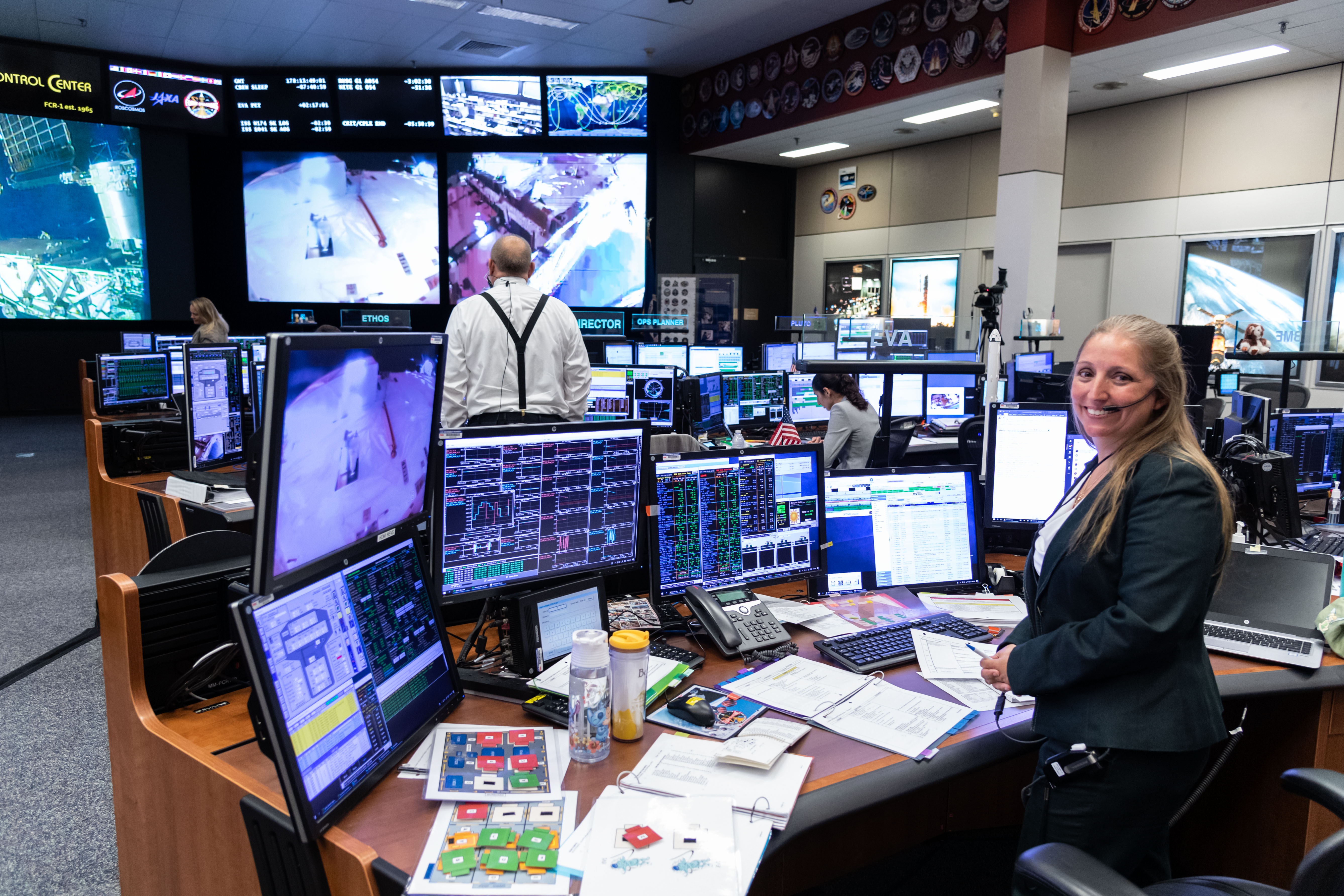
Jaclyn Kagey works in the Mission Control Center during a spacewalk simulation at NASA’s Johnson Space Center in Houston.NASA/Robert MarkowitzOne of her career-defining moments came during a high-pressure operation aboard the International Space Station.
“I’ve planned and executed seven spacewalks, but one that stands out was U.S. EVA 21,” she said. “We had a critical ammonia leak on the station, and from the time the issue was identified, we had just 36 hours to plan, prepare the spacesuits, and execute the repair.”
The team successfully completed the spacewalk and restored the system. “The agility, dedication, and teamwork shown during that operation were remarkable,” Kagey said. “It demonstrated what this team can accomplish under pressure.”
Jaclyn Kagey trains in NASA’s Neutral Buoyancy Laboratory, where astronauts and flight controllers rehearse spacewalk procedures in a simulated microgravity environment.NASA There are times when the mission requires everything you have. There are also times when you have to step back. Learning when to do each is critical.Jaclyn Kagey
Artemis Extravehicular Activity Lead
Throughout her career, Kagey has learned that adaptability is an essential skill.
“Things rarely go exactly as planned, and my job is to respond in a way that keeps the crew safe and the mission moving forward,” she said.
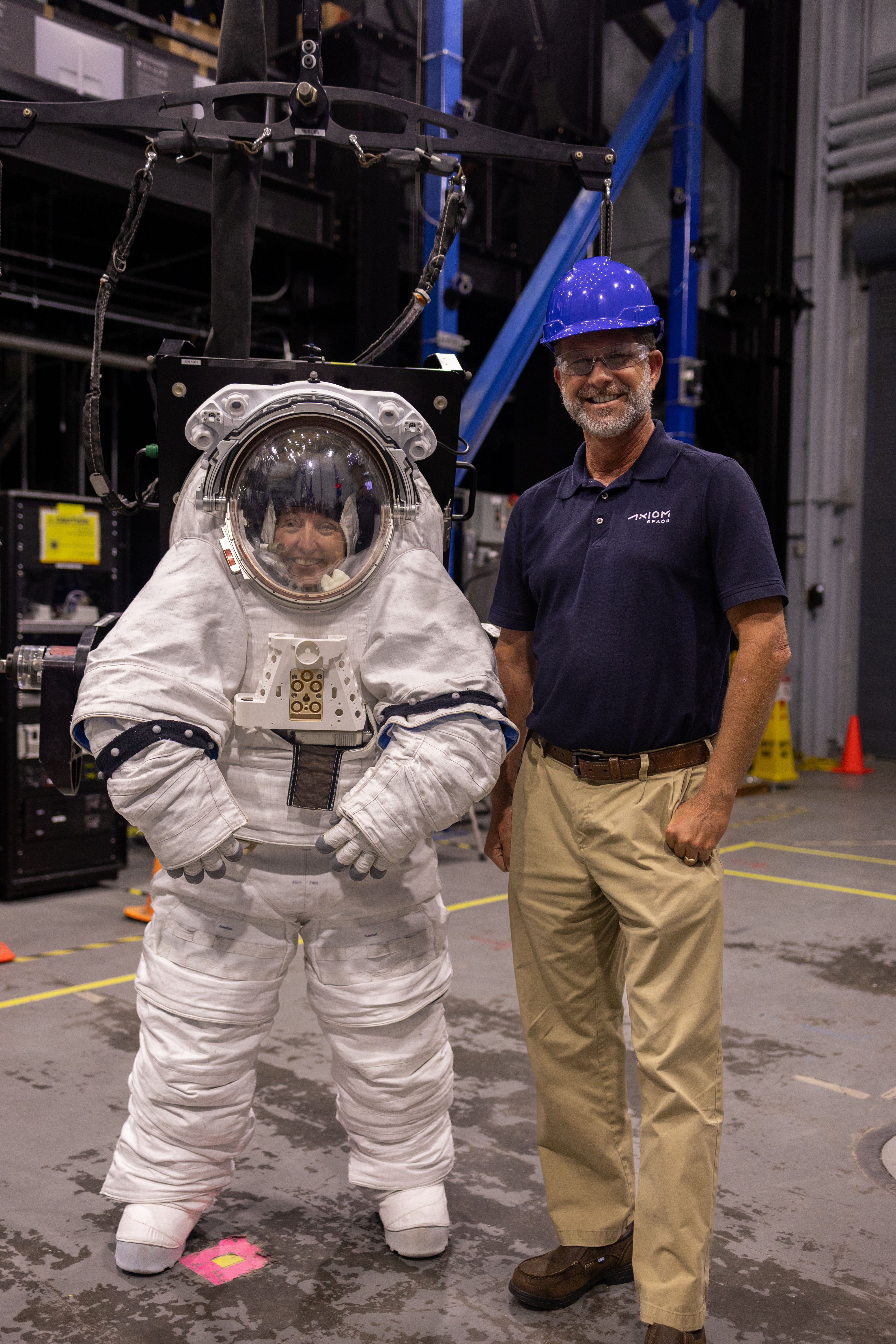
Jaclyn Kagey suited up in Axiom Space’s Extravehicular Mobility Unit (AxEMU) spacesuit during a test on the Active Response Gravity Offload System (ARGOS) at Johnson’s Space Vehicle Mockup Facility. Axiom SpaceKagey’s influence also extends to the future of spacesuit development. Standing on the shorter end of the height spectrum, she once could not complete a full test in the legacy Extravehicular Mobility Unit despite passing the fit check. Although Kagey could don the suit, its proportions were too large for her and made it difficult to move as needed for the test. That experience drove her to advocate for designs that better support a wider range of body types.
That effort came full circle when she recently completed her first test in Axiom Space’s lunar spacesuit, called the Axiom Extravehicular Mobility Unit (AxEMU), on the Active Response Gravity Offload System (ARGOS) at Johnson Space Center in Houston.
“It’s exciting to literally fit into the future of spacewalks!” Kagey said.
About the AuthorSumer Loggins Share Details Last Updated May 25, 2026 Related Terms Explore More 2 min read NASA Seeks Interest for Artemis Mission CubeSats Article 5 days ago 3 min read Lunar Robots: NASA Spotlights Moon Base at 2026 FIRST Robotics Competition Article 5 days ago 4 min read I Am Artemis: Tim Goddard Article 6 days ago Keep Exploring Discover More Topics From NASAMissions
Humans in Space
Climate Change
Solar System
An Early “Decoration Day” Celebration
- Earth
- Earth Observatory
- Image of the Day
- EO Explorer
- Topics
- More Content
- About
Call for Creatives: NASA Seeks Help Illuminating Mission Storytelling
As NASA pushes the boundaries of exploration and innovation for the benefit of humanity, the agency is looking for partners to share mission stories covering Artemis Moon missions, nuclear propulsion, aeronautics, and more.
NASA published an Announcement for Proposals on May 21 asking filmmakers, documentarians, songwriters, storytellers, poets, and others to submit proposals to partner with the agency by Tuesday, June 30.
In this initial round, NASA is seeking up to 10 partners for unfunded Space Act Agreements to share the stories behind, and insights into, multiple NASA missions, including, but not limited to, the following:
- Artemis program, including the recently added Artemis III mission in 2027, and Artemis IV lunar landing in 2028, as well as plans for the agency to develop a Moon Base. Learn more about Artemis on the agency’s website.
- NASA’s advancement of nuclear propulsion, including the Space Reactor-1 Freedom mission to Mars in 2028 carrying the Skyfall payload.
- NASA’s cutting-edge aviation work through flight tests and other efforts.
While this opportunity is focused on U.S. creators, the agency will consider proposals with a minority of international participants. Proposals should detail which area of focus is desired, funding and distribution arrangements, and any specifics needs from NASA to move forward (access to facilities, personnel, etc.).
Full requirements and other details are available online:
https://go.nasa.gov/CreatorProposals
-end-
Camille Gallo / Cheryl Warner
Headquarters, Washington
202-358-1600
camille.m.gallo@nasa.gov / cheryl.m.warner@nasa.gov
NASA Sets Coverage for Roscosmos Spacewalk Outside Space Station
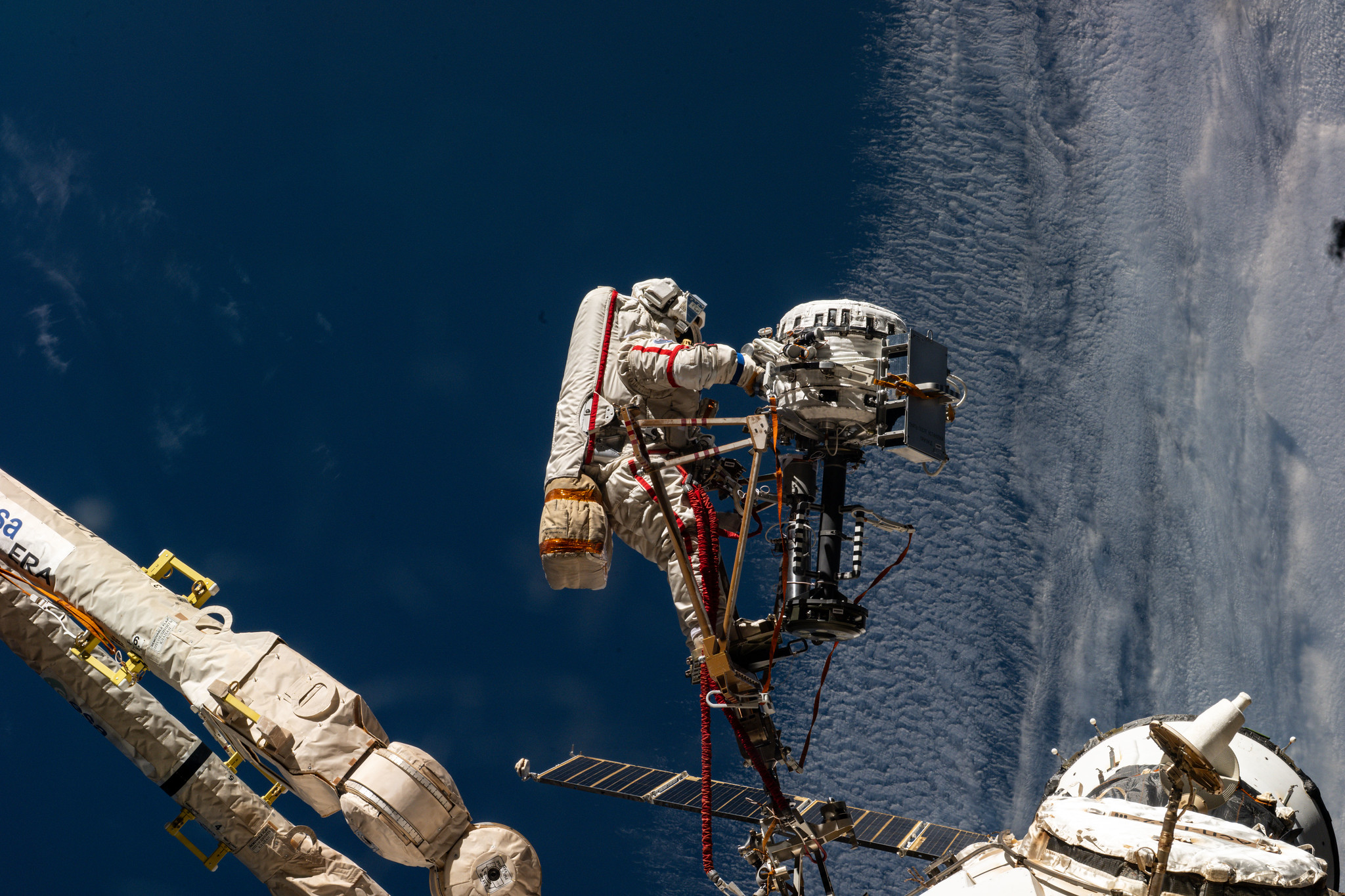
NASA will provide live coverage on Wednesday, May 27, as two Roscosmos cosmonauts conduct a spacewalk outside the International Space Station. The spacewalk is scheduled to begin at approximately 10:15 a.m. EDT and last roughly five hours.
Watch NASA’s live coverage beginning at 9:45 a.m. on NASA+, Amazon Prime, and the agency’s YouTube channel. Learn how to watch NASA content through a variety of online platforms, including social media.
International Space Station Expedition 74 commander Sergey Kud-Sverchkov and flight engineer Sergei Mikaev will install a solar radiation experiment on the Zvezda service module and remove other science hardware from the Poisk and Nauka modules of the orbiting complex’s Roscosmos segment. If time allows, the duo also will photograph one of the Progress 94 cargo spacecraft’s Kurs rendezvous antennas, which failed to deploy in March following its launch to the space station.
This Roscosmos spacewalk will be the second for Kud-Sverchkov and the first for Mikaev. Kud-Sverchkov will wear a spacesuit with red stripes, and Mikaev will wear a spacesuit with blue stripes. It will be the 279th spacewalk in support of space station assembly, maintenance, and upgrades.
To learn more about International Space Station research, operations, and its crews, visit:
-end-
Josh Finch / Jimi Russell
Headquarters, Washington
202-358-1100
joshua.a.finch@nasa.gov / james.j.russell@nasa.gov
Sandra Jones
Johnson Space Center, Houston
281-483-5111
sandra.p.jones@nasa.gov