NASA - Breaking News

A Moonlit Earth as Seen From Artemis II
- Earth
- Earth Observatory
- Image of the Day
- EO Explorer
- Topics
- More Content
- About
Curiosity Blog, Sols 4908-4912: Goodbye Campo Marte, It’s Been Fun!
- Curiosity Home
- Science
- News and Features
- Multimedia
- Mars Missions
- Mars Home
5 min read
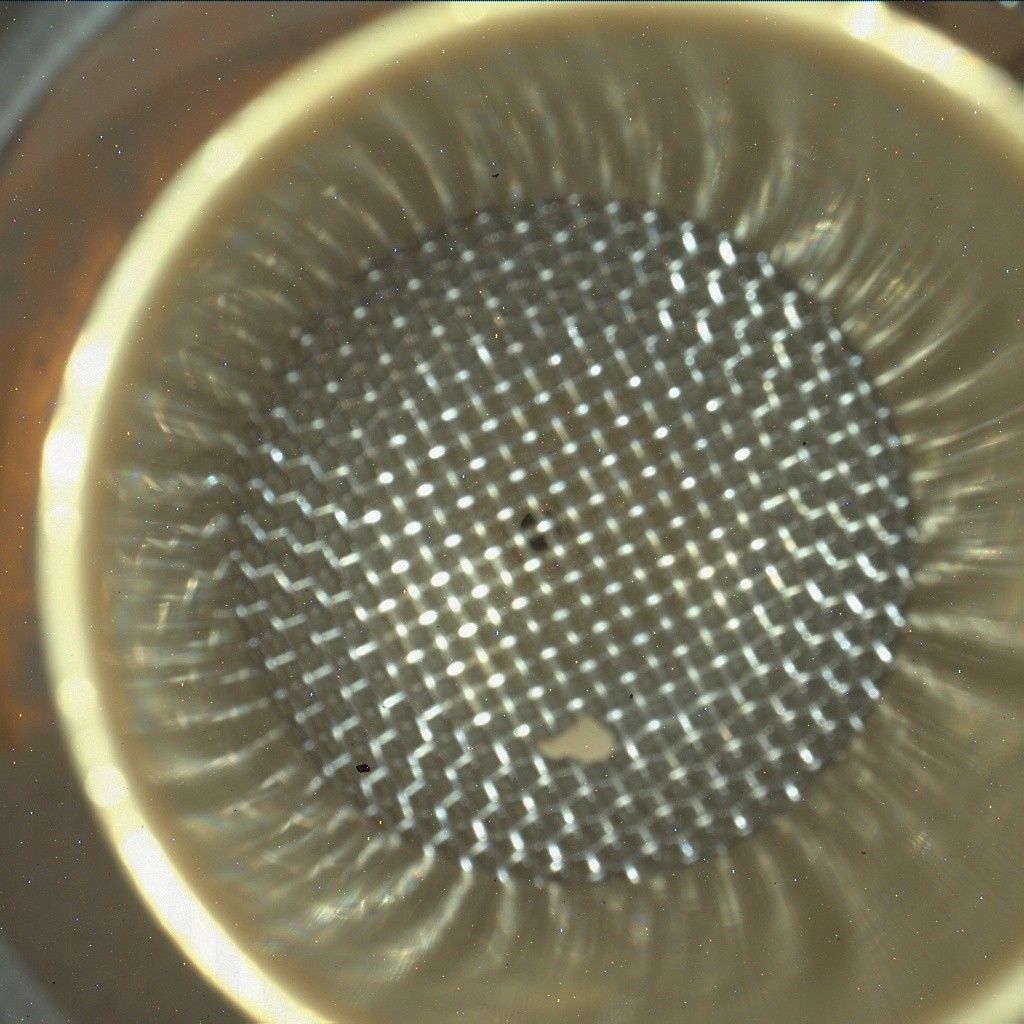
Curiosity Blog, Sols 4908-4912: Goodbye Campo Marte, It’s Been Fun! NASA’s Mars rover Curiosity acquired this image of the inlet on its Chemistry & Mineralogy X-Ray Diffraction instrument (CheMin), which is about the size of a laptop computer and sits inside rover’s body, where it analyzes the chemical composition of rocks and soil. Curiosity captured the image using its Mars Hand Lens Imager (MAHLI), a close-up camera located on the turret at the end of the rover’s robotic arm, on May 28, 2026 — Sol 4908, or Martian day 4,908 of the Mars Science Laboratory Mission — at 11:14:14 UTC. NASA/JPL-Caltech/MSSSBy Susanne P. Schwenzer, Professor of Planetary Mineralogy at The Open University, UK
Earth planning date: Friday, May 29, 2026
Drilling always keeps the rover in place for a little while, and our 47th successful drill, “Campo Marte,” was no exception. The team used the time wisely and on top of the drilling, we also have many observations. Thinking for a long time about a workspace always gets me attached to the area — some more than others; at the shorter stops, especially — when I am on shift several times during this time. I was Science Operations Working Group chair three times while we were here, so it’s a real “Goodbye” for me today as we are driving onward to reach the next area up the hill on Mount Sharp.
The Campo Marte drill was successful, as my colleague Abigail Fraeman reported last week. This week was spent investigating the aftermath of the drilling, which means running the CheMin instrument to get mineralogical data and the SAM instrument to inspect the volatile releases. ChemCam, APXS, MAHLI and Mastcam were also busy documenting the drill hole and the drill fines, as well as how much sample there was available overall.
Of course, Curiosity also had a very good look at the other interesting targets in the area! Besides all the work on the drill hole, ChemCam carried out an expert’s targeting exercise by setting two targets up to aim at two different layers on adjacent spots on the finely laminated sediments. That involves aiming at millimeter-sized targets, named “Corcovado” and “Junakas,” respectively, about 3 meters away (about 10 feet)! We are curious if the layers are chemically different, which would tell us about different formation conditions, or if they are similar and the conditions when those layers formed were more similar. ChemCam is also looking at the target “Palcaya” to get more data on the chemistry of the layered bedrock, and will investigate the target “Alcamachi,” which is a float rock that looks intriguingly dark. Maybe that tells us it’s got a different chemistry? We will find out when we get the data!
In addition to the chemistry measurements, ChemCam will also carry out a spectral investigation on the target “Magallanas,” which was a little too far away to also point the laser at it, but is intriguingly dark. This last week, ChemCam also planned three long-distance RMIs to document the sedimentary structures — younger and older ones — in the surrounding area. One of them drew the suspicion that it might break a record: it might be the longest strip of RMI images we have taken in one mosaic! The jury is out, it’s 24 frames and this way links up with an earlier, shorter set of images. The reason the mosaic is so long is because it images a small ridge with sedimentary textures that could tell us about the depositional conditions when the rock layers formed. But how cool is that — at 13+ years to still break our own records?
Since our arrival, Mastcam has been very busy getting the entire region around us imaged. In addition, some higher-resolution mosaics have been taken, most notably one of the locations where the remaining sample was dropped, and then of the workspace to see again how much sample might — or might not — have been left in the drill stem and fallen out when Curiosity did the motions that are designed to shake any remaining sample out of the drill, to leave it prepared for the next time. Another imaging task, but for MAHLI, is to always image the sample inlets, also, to see if they are clean and prepared for the next sample. I included the MAHLI image of the CheMin inlet — don’t worry about the little rock, it’s with us for a while, and the CheMin team now calls it “our pet rock.”
APXS joined the drill-hole investigations and has been focused on it even more than usual. The team decided that this is a very good opportunity to increase counting statistics beyond the usual and well-tested levels by significantly increasing the measurement time. To achieve that, it measured the Campo Marte drill fines in all plans of this week. And on the last night of that, MAHLI gets out its LED lights to finish the experiment with a sparkling nighttime MAHLI experiment to document it all.
Our environmental team has kept the rover busy by looking at atmospheric opacity, dust activity, dust-devil activity and, of course, also monitoring the environment in general. With all this finished, the rover will continue its way up the hill to the next interesting area. I heard something like “cross-bedding” during the discussions, but as a mineralogist, I just note that that decision was taken by people who know more about sediments than I do, while I am itching to see the CheMin mineralogy results!
-
Want to read more posts from the Curiosity team?
-
Want to learn more about Curiosity’s science instruments?
Article
6 days ago
3 min read Curiosity Blog, Sols 4893-4899: Drilling at Campo Marte and a Visit From the Psyche Spacecraft
Article
2 weeks ago
3 min read Curiosity Blog, Sols 4886-4892: Ingenuity and Perseverance, Curiosity Style
Article
3 weeks ago
Keep Exploring Discover More Topics From NASA Mars
Mars is the fourth planet from the Sun, and the seventh largest. It’s the only planet we know of inhabited…
All Mars Resources
Explore this collection of Mars images, videos, resources, PDFs, and toolkits. Discover valuable content designed to inform, educate, and inspire,…
Rover Basics
Each robotic explorer sent to the Red Planet has its own unique capabilities driven by science. Many attributes of a…
Mars Exploration: Science Goals
The key to understanding the past, present or future potential for life on Mars can be found in NASA’s four…
NASA Finds New Way Earth May Have Received Elements Needed for Life
Illustration: ESO
NASA-supported scientists have provided new information about how the early Earth may have acquired some elements necessary for the planet to become habitable. They also suggest a new role for Jupiter in the distribution of these elements throughout the young solar system. The study, published today in Science Advances, examines this history by looking at the ratio of phosphorus to nitrogen in iron meteorites and in younger objects known as chondrites.
The study suggests that Earth acquired its inventory of the life-essential elements phosphorous and nitrogen primarily from the inner solar system, without requiring a significant contribution from outer solar system chondritesDebjeet Pathak
Rice University
Planetary system formationOur solar system formed from gas and dust that swirled around the proto-Sun more than 4.5 billion years ago. This gas contained the raw materials needed to form planets, moons, and ultimately life as we know it. Two elements of particular importance for life are nitrogen and phosphorus.
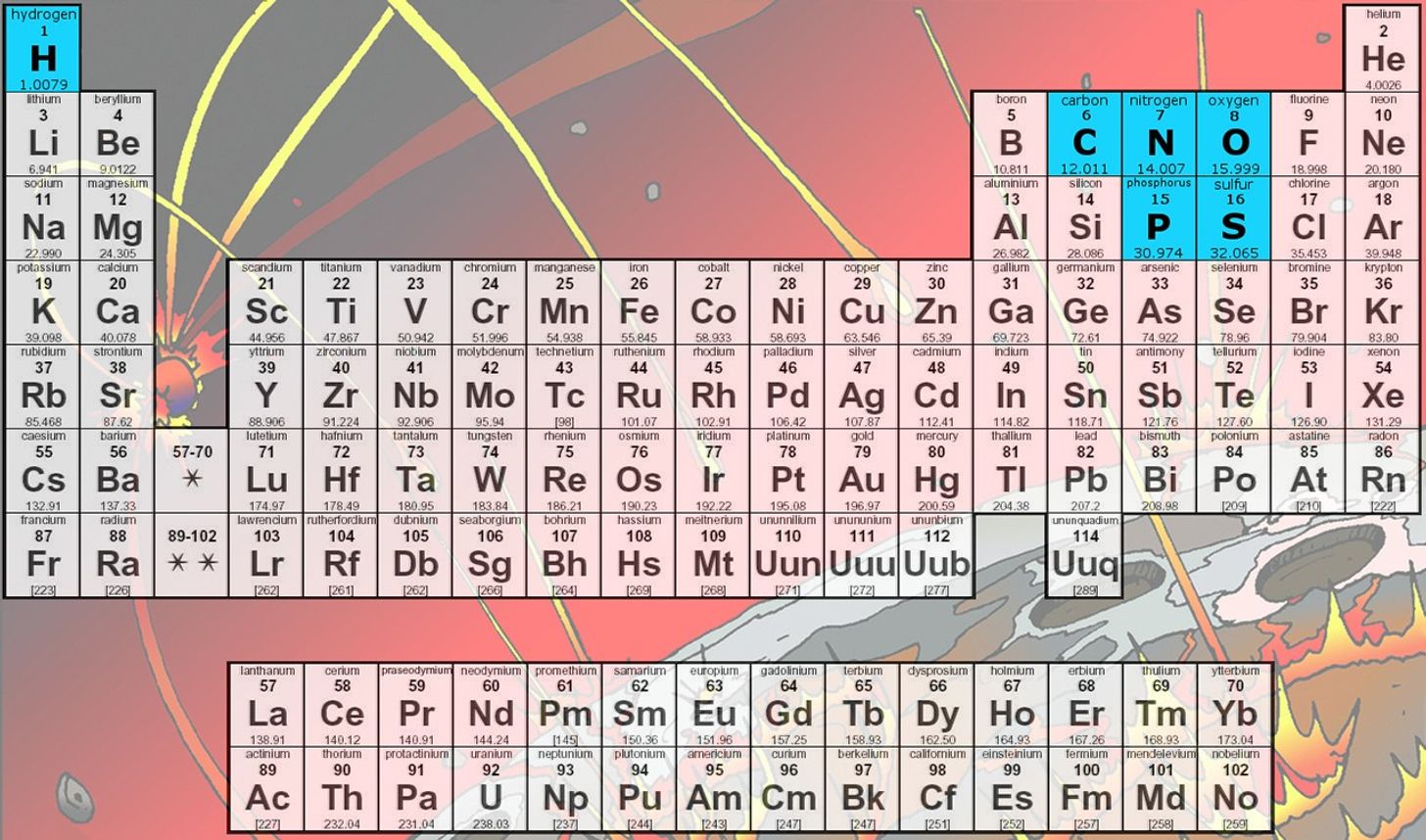
All life on Earth needs the same elements: carbon, hydrogen, nitrogen, oxygen, phosphorus, and sulfur (CHNOPS). These elements came from space, born inside stars and spread in clouds of gas and dust. Gravity then caused this material to gather together, forming new stars and smaller objects like planets. NASAIn the earliest stages of the solar system, gas and dust coalesced into bodies known as planetesimals. As these objects orbited the young Sun in this chaotic environment, planetesimals collided, leaving shattered remnants throughout the system. Eventually, many of these pieces were incorporated into planets and moons. Other pieces survive today as asteroids, still orbiting the Sun, and – if they have impacted the Earth and been recovered – as meteorites. These meteorites provide a window into the early solar system at a time before the Earth existed. Chondrites and iron meteorites are two different classes of these meteorites.
As their name suggests, iron meteorites are dense, metallic objects and are primarily made of iron-nickel alloy. Chondrites, on the other hand, are stony objects and they are responsible for most of the meteorites that have been found on Earth.
Each type of meteorite originates from planetesimals that formed at different times in our system. The oldest generation of planetesimals are the source of iron meteorites. Chondrites came from a second generation of planetesimals that formed 2-3 million years later.
Habitable planet buildingUnderstanding how the Earth was made and the timing of its formation is important for astrobiologists who study how and when our planet became habitable for life as we know it. The young Earth needed to have a supply of life’s ingredients, including nitrogen and phosphorus, for the first living cells to form.
There is debate between scientists over where Earth’s stock of life-essential elements came from. Some evidence points to chondrites in the outer solar system traveling inward to arrive at Earth late in our planet’s formation process. However, the new study tells a different story.
Using laboratory experiments and geochemical models, the team reconstructed a map of phosphorus-nitrogen (P/N) ratios across the early solar system and found differences between the first (iron meteorites) and second (chondrites) generations of planetesimals.
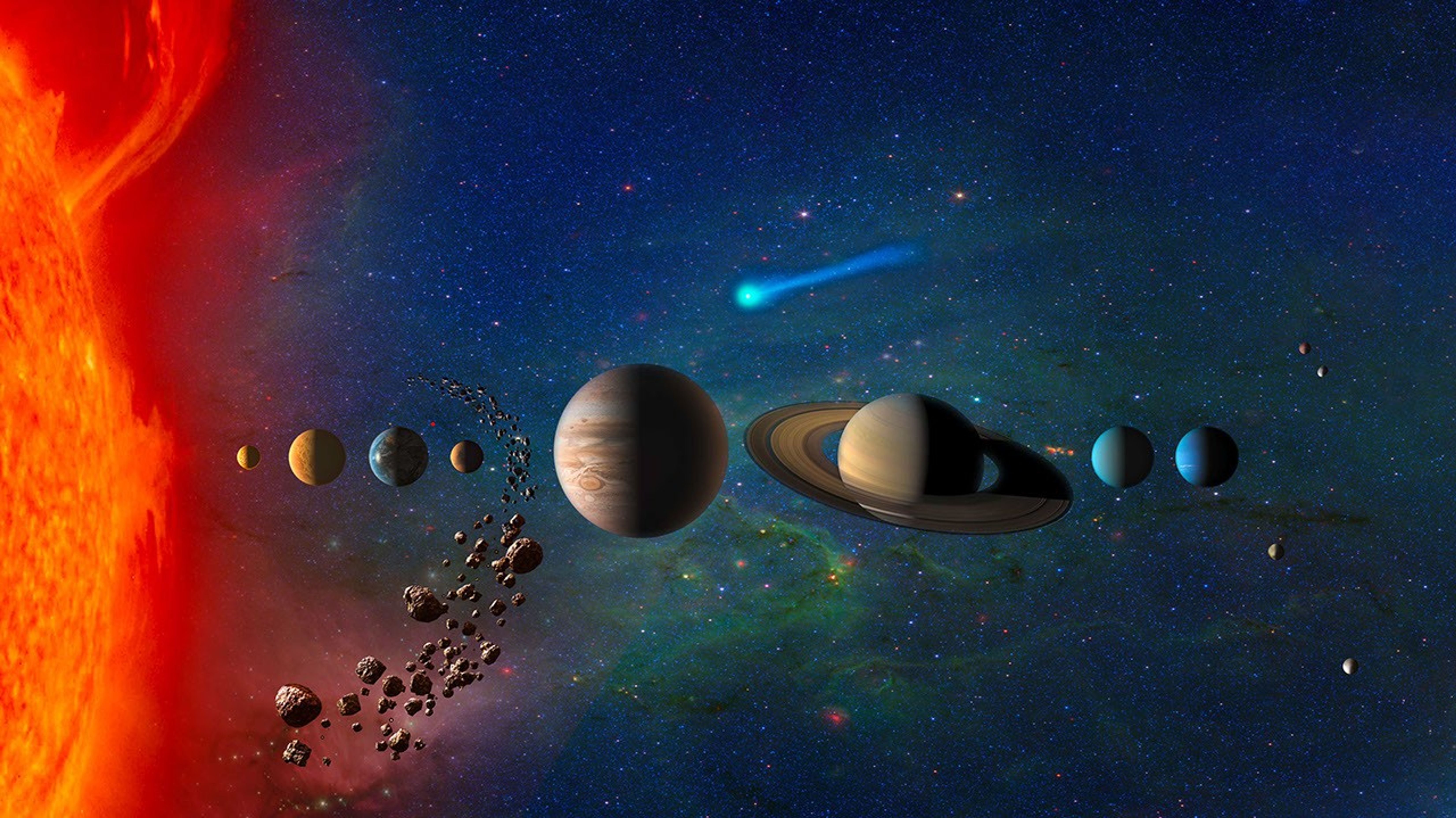
An illustration of our solar system. The asteroid belt is located between Mars and Jupiter, separating our system into what we refer to as the inner and outer regions. NASA/JPL-CaltechThe experiments and subsequent geochemical modeling showed that the first generation had a higher ratio of P/N in the outer solar system, with that ratio decreasing toward the inner solar system. This trend was reversed in the second generation of planetesimals, with higher P/N ratios in the inner solar system.
The thought is that during the formation of the first generation of planetesimals, there was an outward flow of material that raised the P/N ratio in the outer solar system. Then came Jupiter.
For our own solar system, Jupiter’s presence and growth history, indeed, seem to have played a critical role in determining the distribution of the basic chemical ingredients necessary for habitable worlds.Rajdeep Dasgupta
Rice University
As Jupiter formed and grew to a tremendous size (and gravitational influence), the planet restricted the movement of phosphorus and nitrogen from the inner to outer solar system. This meant that when the second generation of planetesimals appeared, those in the inner solar system were left with a higher P/N ratio than their cousins further out.
“For our own solar system, Jupiter’s presence and growth history, indeed, seem to have played a critical role in determining the distribution of the basic chemical ingredients necessary for habitable worlds,” said Rajdeep Dasgupta of Rice University in Houston and senior author on the study. “It remains an open question whether a life-essential element budget similar to Earth’s can be established without a Jupiter-like planet in the population.”
Geochemical accretion modeling further shows that Earth’s present-day P/N signature is best reproduced by the inner solar system planetesimals, either those related to iron meteorites or those related to chondrites.
“The study suggests that Earth acquired its inventory of the life-essential elements phosphorous and nitrogen primarily from the inner solar system, without requiring a significant contribution from outer solar system chondrites,” said study lead author Debjeet Pathak, graduate student at Rice University.
For more information on astrobiology at NASA, visit:
https://science.nasa.gov/astrobiology
Karen Fox / Molly Wasser
Headquarters, Washington
202-358-1600
karen.c.fox@nasa.gov / molly.l.wasser@nasa.gov
Share
Details Last Updated Jun 03, 2026 Related Terms Explore More 5 min read NASA Uses Mineralogical Marker to Understand Ancient Martian ClimateScientists analyzed 20 Martian samples collected by NASA’s Curiosity Rover and found that differences in…
Article
6 days ago
5 min read NASA Research Shows Early Life Relied on Rare Metal
Article
4 weeks ago
8 min read Optical Vortex Phase Masks for the Detection of Habitable Worlds
A team of NASA researchers is developing new types of optical masks that could help…
Article
2 months ago
Keep Exploring Discover More Astrobiology Topics From NASA
Astrobiology Program Overview
Astrobiology Multimedia
Astrobiology Publications
Funded Astrobiology Research at NASA
International Sea Level Satellite Observes El Niño Precursor
NASA/JPL-Caltech Photojournal Navigation Downloads International Sea Level Satellite Observes El Niño Precursor
MP4 (1.10 MB)
Description
Sea level height data from the international Sentinel-6 Michael Freilich satellite collected from March to May 2026 show higher, warmer water moving from the western Pacific Ocean to just off the coast of Colombia, Ecuador, and Peru. This phenomenon is known as a warm Kelvin wave, signified in this animation of the data by yellow, orange, red, and white. The emergence of Kelvin waves in the early part the year is a signal that an El Niño event is likely to follow.
In early 2026, measurements from Sentinel-6 Michael Freilich showed a small Kelvin wave forming around Micronesia in late January and dissipating by mid-February. The wave shown in the animation emerged in early March, then moved east over time. By mid-May, the seas around Peru were more than 5.9 inches (15 centimeters) higher than long-term averages. Because water expands as it warms, a rise in elevation of an area of the ocean indicates increasing temperature.
The additional heat at the sea surface can change the circulation patterns of energy, water, and air in the atmosphere, which can affect weather. El Niños can cause heavy precipitation in some regions and deficits in others, influencing daily life and commerce around the world.
Sentinel-6 Michael Freilich, named after former NASA Earth Science Division Director Michael Freilich, is one of two satellites that compose the Copernicus Sentinel-6/Jason-CS (Continuity of Service) mission.
Sentinel-6/Jason-CS was jointly developed by ESA, the European Organisation for the Exploitation of Meteorological Satellites (EUMETSAT), NASA, and NOAA, with funding support from the European Commission and technical support on performance from the French space agency CNES (Centre National d’Études Spatiales). Spacecraft monitoring and control, as well as the processing of all the altimeter science data, is carried out by EUMETSAT on behalf of the European Union’s Copernicus programme, with the support of all partner agencies.
A division of Caltech in Pasadena, NASA’s Jet Propulsion Laboratory contributed three science instruments for each Sentinel-6 satellite: the Advanced Microwave Radiometer, the Global Navigation Satellite System – Radio Occultation, and the Laser Retroreflector Array. NASA also contributed launch services, ground systems supporting operation of the NASA science instruments, the science data processors for two of these instruments, and support for the U.S. members of the international Ocean Surface Topography Science Team.
To learn more about Sentinel-6 Michael Freilich, visit:
https://www.nasa.gov/sentinel-6
Keep Exploring Discover More Topics From Photojournal
Photojournal
Search Photojournal
Photojournal’s Latest Content
Feedback
Journey to the Center of the Virgo Cluster
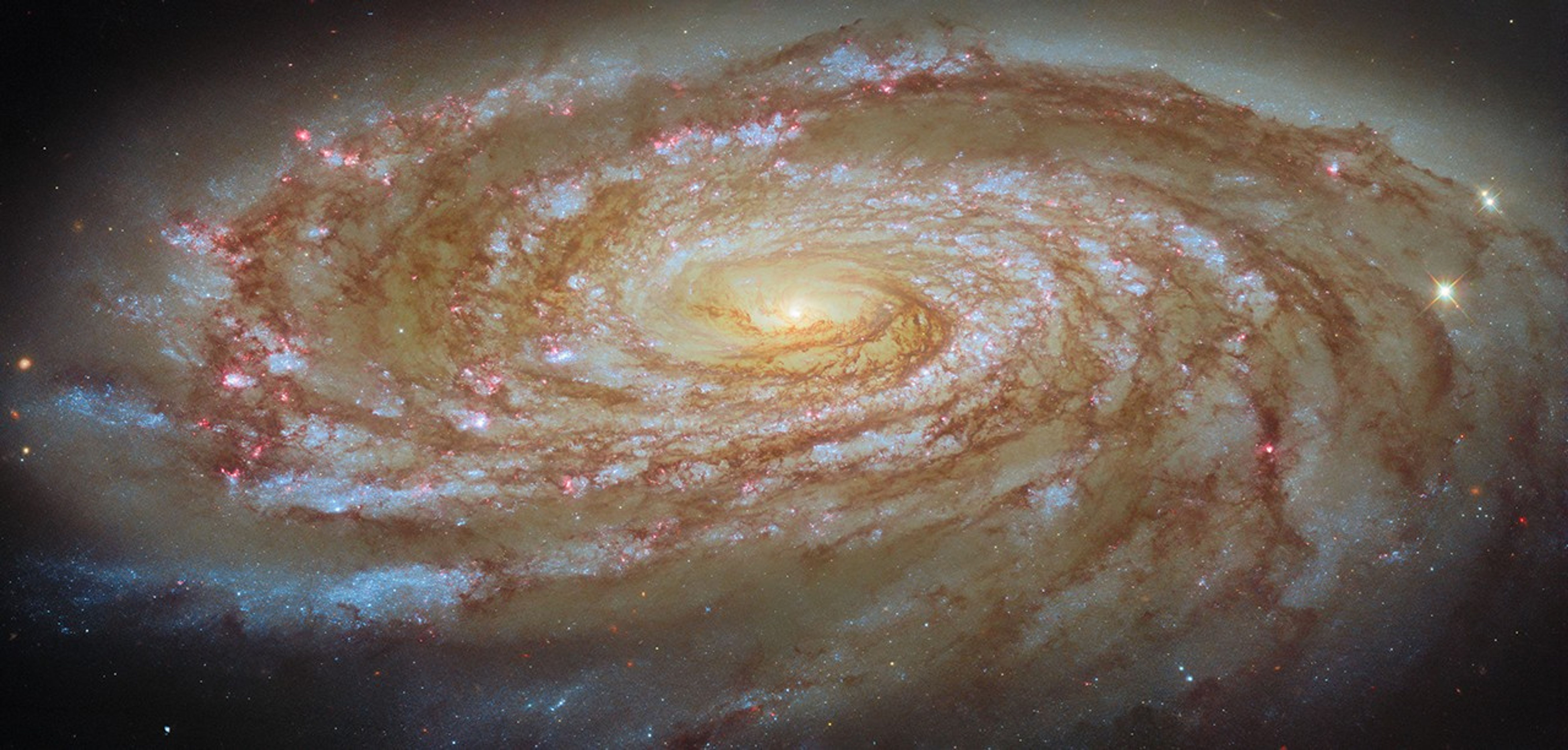
The focus of this NASA/ESA Hubble Space Telescope image released on May 29, 2026, is an active spiral galaxy on a journey lasting hundreds of millions of years. The galaxy Messier 88 (M88), also known as NGC 4501, is located about 63 million light-years away in the constellation Coma Berenices (Berenice’s Hair).
M88 is an active galaxy, which means that its center harbors a supermassive black hole that is snacking on gas and dust. Astronomers estimate the black hole is around 100 million times as massive as the Sun, and it appears to be powering outflows of gas from the galaxy’s center.
Image credit: ESA/Hubble & NASA, D. Thilker
NASA Drains 66-Million-Gallon Reservoir to Upgrade Critical Water System
A powerful but mostly unseen water system at work during rocket engine tests at NASA’s Stennis Space Center near Bay St. Louis, Mississippi, underwent an upgrade in May.
Crews brought the High Pressure Industrial Water Facility’s 66-million-gallon reservoir to its lowest level since construction in the 1960s by pumping out about 40 million gallons of water over three days.
This brought the reservoir, measuring 800 feet in diameter and about 25 feet deep, down to the level needed to replace a 3,000 gallon per minute pump that supplies water for fire suppression to the test complexes.
before after The High Pressure Industrial Water Facility’s 66-million-gallon reservoir is shown at NASA’s Stennis Space Center on May 7 as work gets underway to remove about 40 million gallons of water to complete upgrades.NASA/Danny Nowlin The reservoir is shown at NASA’s Stennis Space Center on May 11 at its lowest level since construction in the 1960s. Crews lowered the reservoir by pumping out about 40 million gallons over three days to complete upgrades. NASA/Danny Nowlin beforeafter The High Pressure Industrial Water Facility’s 66-million-gallon reservoir is shown at NASA’s Stennis Space Center on May 7 as work gets underway to remove about 40 million gallons of water to complete upgrades.NASA/Danny Nowlin The reservoir is shown at NASA’s Stennis Space Center on May 11 at its lowest level since construction in the 1960s. Crews lowered the reservoir by pumping out about 40 million gallons over three days to complete upgrades. NASA/Danny Nowlin before afterBefore and After
Lowering the ReservoirMay 7, 2026 – May 11, 2026
CurtainToggle2-Up Image Details BEFORE (SSC-20260507-s00393) The High Pressure Industrial Water Facility’s 66-million-gallon reservoir is shown at NASA’s Stennis Space Center on May 7 as work gets underway to remove about 40 million gallons of water to complete upgrades. AFTER (SSC-20260511-s00420) The reservoir is shown at NASA’s Stennis Space Center on May 11 at its lowest level since construction in the 1960s. Crews lowered the reservoir by pumping out about 40 million gallons over three days to complete upgrades.For a typical RS-25 engine test supporting NASA’s Artemis missions, about five million gallons of water flow from the reservoir to the Fred Haise Test Stand. The water cools the engine exhaust that reaches up to 6,000 degrees Fahrenheit, supplies water to the flame deflector and helps with sound suppression during a test.
A hot fire test produces critical data to ensure an engine is safe and reliable.
before after A view from the Thad Cochran Test Stand at NASA’s Stennis Space Center on May 7 shows the High Pressure Industrial Water Facility’s 66-milion-gallon reservoir as work gets underway to remove about 40 million gallons of water to complete upgrades.NASA/Danny Nowlin A view from the Thad Cochran Test Stand at NASA’s Stennis Space Center on May 11 shows the reservoir at its lowest level since construction in the 1960s. Crews lowered the reservoir by pumping out 40 million gallons over three days to complete upgrades.NASA/Danny Nowlin beforeafter A view from the Thad Cochran Test Stand at NASA’s Stennis Space Center on May 7 shows the High Pressure Industrial Water Facility’s 66-milion-gallon reservoir as work gets underway to remove about 40 million gallons of water to complete upgrades.NASA/Danny Nowlin A view from the Thad Cochran Test Stand at NASA’s Stennis Space Center on May 11 shows the reservoir at its lowest level since construction in the 1960s. Crews lowered the reservoir by pumping out 40 million gallons over three days to complete upgrades.NASA/Danny Nowlin before afterBefore and After
A View from the Thad Cochran Test StandMay 7, 2026 – May 11, 2026
CurtainToggle2-Up Image Details BEFORE (SSC-20260507-s00395) – A view from the Thad Cochran Test Stand at NASA’s Stennis Space Center on May 7 shows the High Pressure Industrial Water Facility’s 66-milion-gallon reservoir as work gets underway to remove about 40 million gallons of water to complete upgrades. AFTER (SSC-20260511-s00423) – A view from the Thad Cochran Test Stand at NASA’s Stennis Space Center on May 11 shows the reservoir at its lowest level since construction in the 1960s. Crews lowered the reservoir by pumping out 40 million gallons over three days to complete upgrades.The water used during a test is recycled for future use as it flows back into the on-site canal system, before returning to the reservoir.
“The old pump that supported fire suppression for testing reached its end of life, so this project promotes reliability with the upgrade,” said Justin Lucas, NASA project manager.
In addition to a new pump, the piping has improved to a 14-inch-to-12-inch configuration.
Picture trying to drink water from a big cup using a tiny coffee stirrer. This is similar to how the previous pump relied on piping that narrowed from 14 inches down to 10 inches before reaching the pump. The water moved but required more work from the system.
“With the upgraded configuration, less velocity inside the pipe with the same amount of flow equals a longer lasting pipe, pump, and hardware,” said Lucas.
A work crew lays suction piping on May 6 for the portable pumps that will help remove about 40 million gallons of water from the High Pressure Industrial Water Facility’s 66-million-gallon reservoir to complete upgrades at NASA’s Stennis Space Center. Floating buoys keep the suction piping suspended above the reservoir floor, preventing it from drawing in mud. This also protects the integrity of the reservoir bed by ensuring no underlying material is removed.NASA/Danny Nowlin A drone image shows water flowing to the Thad Cochran Test Stand at NASA’s Stennis Space Center on May 7. Crews lowered the High Pressure Industrial Water Facility’s 66 million gallon reservoir to its lowest level since the 1960s by pumping out about 40 million gallons over three days to complete upgrades.NASA/Jason Peterson A drone image shows the High Pressure Industrial Water Facility’s 66-million-gallon reservoir at NASA’s Stennis Space Center on May 7. Crews lowered the reservoir to its lowest level since the 1960s by pumping out about 40 million gallons over three days to complete upgrades.NASA/Jason Peterson A work crew uses a lift to remove the main isolation valve to complete upgrades at NASA’s Stennis Space Center’s High Pressure Industrial Water Facility on May 11. The isolation valve isolates the water supply during work to replace the 3,000 gallon per minute pump that supplies water for fire suppression to the test complexes.NASA/Danny Nowlin The High Pressure Industrial Water Facility’s 66-million-gallon reservoir is shown with about 40 million gallons of water removed at NASA’s Stennis Space Center on May 11. Crews lowered the reservoir to its lowest level since construction in the 1960s to complete upgrades.NASA/Danny Nowlin The High Pressure Industrial Water Facility’s 66-million-gallon reservoir is shown with about 40 million gallons of water removed at NASA’s Stennis Space Center on May 11. Crews lowered the reservoir to its lowest level since construction in the 1960s to complete upgrades.NASA/Danny NowlinThe water system upgrades have strengthened a vital system that supports NASA’s Artemis missions, along with commercial companies operating at NASA Stennis, home to America’s largest multiuser propulsion test site.
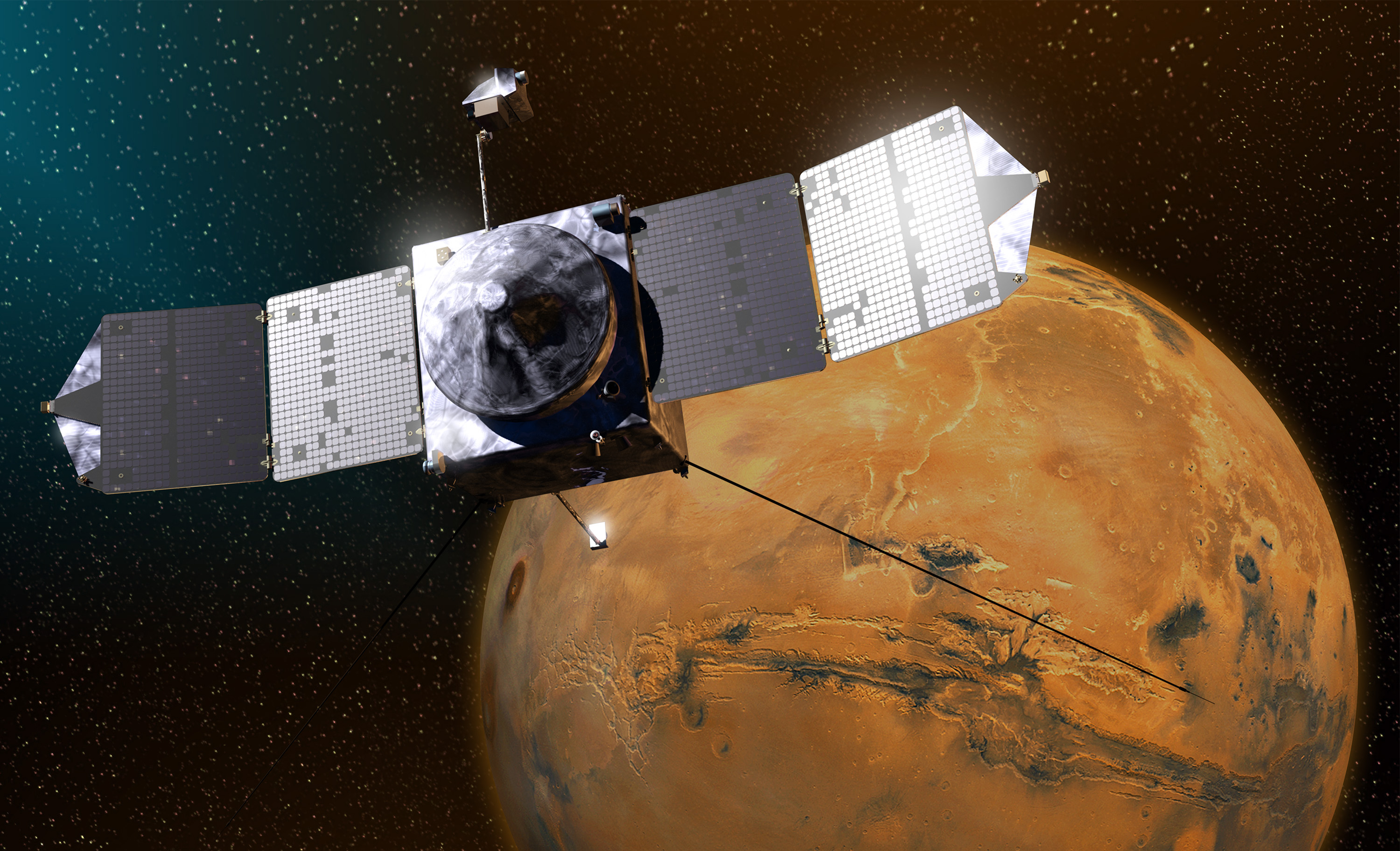
NASA Says Farewell to MAVEN Mars Mission, Hosts Media Call Today
The first mission devoted to observing the Martian atmosphere and its evolution, NASA’s MAVEN (Mars Atmosphere and Volatile Evolution), has ended after more than 11 years in orbit at Mars and a decade beyond its primary, one-year mission. The spacecraft was heard last on Dec. 6, when it experienced an unexpected loss of signal after it passed behind the Red Planet.
NASA will host a media teleconference at 2 p.m. EDT today, Wednesday, June 3, to discuss MAVEN’s achievements.
The agency convened an anomaly review board in February to evaluate recovery efforts and assess the spacecraft’s probable current state. The review board has determined that the MAVEN spacecraft is not recoverable, and it is no longer capable of performing its science and data relay mission, which is consistent with the mission team’s findings.
Telemetry from MAVEN prior to the spacecraft’s passage behind Mars in December showed all subsystems working normally. After the spacecraft emerged, NASA’s Deep Space Network (DSN) did not observe a signal. A brief fragment of telemetry data from analysis of radio signals recorded by the DSN’s open-loop receivers indicated the spacecraft was in safe mode and rotating at an unusually high rate when it emerged from behind Mars, indicating a disruption in MAVEN’s orbit trajectory. The review board concluded that due to this rotation, the batteries on the spacecraft had drained, causing the communications system to lose power and rendering MAVEN in an unrecoverable state.
These preliminary findings do not address a potential root cause for the anomaly, which still is being investigated. The review board is expected to provide its final report later this year. NASA has begun the official process of decommissioning the MAVEN mission, following standard procedures to archive the full mission dataset for the science and exploration communities.
“The science MAVEN has given us is key to informing what kind of radiation protection and safety measures we must take before sending humans to Mars,” said Louise Prockter, director of the Planetary Science Division at NASA Headquarters in Washington. “The data collected from MAVEN will continue to provide valuable insight into Mars for decades to come.”
Launched in November 2013, the MAVEN mission explored the Red Planet’s upper atmosphere, ionosphere, and interactions with the Sun to explore the loss of the Martian atmosphere to space. Understanding atmospheric loss gives scientists insight into the history of the planet’s atmosphere and climate, liquid water, and planetary habitability.
“The MAVEN mission has truly advanced our understanding of the Martian atmosphere and evolution. This dataset has had a tremendous impact on the field,” said Shannon Curry, MAVEN’s principal investigator and a researcher at the Laboratory for Atmospheric and Space Physics at the University of Colorado Boulder. “Our science team is exceptionally proud of all of these amazing discoveries.”
Sun’s impact on Mars
One of MAVEN’s first major results was that the erosion of Mars’ atmosphere increases significantly during solar storms. The team studied how the solar wind, which is a stream of charged particles continually streaming from the Sun, and solar storms continually strip away Mars’ atmosphere, as well as how this process played a key role in altering the Martian climate from a potentially habitable world to today’s cold, arid planet. The MAVEN mission made unprecedented strides in advancing our understanding of how the Sun and space weather affect Mars, as it was the only spacecraft that could simultaneously take measurements of both the Sun and the Martian atmospheric response.
Martian light shows
The MAVEN mission discovered several types of auroras that light up when energetic particles plunge into the atmosphere, bombarding gases and making them glow. The MAVEN team showed that protons create new kinds of auroras at Mars. On Earth, proton auroras only occur in very small regions near the poles, whereas at Mars they can occur everywhere.
Mars’ atmosphere sputters into space
To better understand how Mars lost most of its atmosphere, MAVEN measured atmospheric sputtering for the first time at any planet. The team did this by observing argon, which is a noble gas, meaning it rarely reacts with other constituents in the Martian atmosphere. The only significant way it can be removed is by atmospheric sputtering, a process where ions crash into the Martian atmosphere at high enough speeds that they splash gas molecules out of the atmosphere, much like doing a cannonball into a pool. The team used 11 years of data to reveal the presence of sputtered argon at high altitudes in the exact locations that the energetic particles crashed into the atmosphere, showing sputtering in real time.
Understanding Mars’ dusty secrets
In 2018, a series of dust storms created a dust cloud so large that it enveloped the Red Planet. The MAVEN team studied how this “global” dust storm affected Mars’ upper atmosphere to understand how these events affected the escape of water to space. It confirmed that heating from dust storms can loft water molecules far higher into the atmosphere than usual, leading to a sudden surge in water lost to space.
Chasing comets
In addition to Martian science, MAVEN contributed to NASA’s effort to observe comet 3I/ATLAS at Mars. Over the course of 10 days last year, the MAVEN team designed a new observing campaign to capture 3I/ATLAS by taking multiple images of the comet in several wavelengths, much like using various filters on a camera. Then it snapped high-resolution UV images to identify the hydrogen coming from the comet. By studying a combination of these images, scientists can identify a variety of molecules and better understand the comet’s composition and history.
During the mission’s lifetime, MAVEN’s science team produced more than 800 publications, and additional publications are planned.
In addition to science, the MAVEN spacecraft was an instrumental player in NASA’s Mars Relay Network, communicating data from Mars rovers to Earth. It also holds the solar system record for most data relayed from another planet in a single day.
Audio of today’s media teleconference will stream on the agency’s website at:
Participants in the teleconference include:
- Tiffany Morgan, director, Mars Exploration Program, Planetary Science Division, NASA Headquarters
- Mike Moreau, project manager, MAVEN, NASA’s Goddard Space Flight Center, Greenbelt, Maryland
- Greg Heckler, deputy program manager for Capability Development, SCaN (Space Communications and Navigation), NASA Headquarters
- Shannon Curry, MAVEN principal investigator, Laboratory for Atmospheric and Space Physics at the University of Colorado Boulder
To ask questions by phone, media must RSVP no later than 12 p.m. to: sarah.frazier@nasa.gov. NASA’s media accreditation policy is available online.
The MAVEN mission is part of NASA’s Mars Exploration Program portfolio. The mission’s principal investigator is based at the Laboratory for Atmospheric and Space Physics at the University of Colorado Boulder, which also is responsible for managing science operations and public outreach and communications. NASA’s Goddard Space Flight Center in Greenbelt, Maryland, manages the MAVEN mission. Lockheed Martin Space built the spacecraft and is responsible for mission operations. NASA’s Jet Propulsion Laboratory in Southern California provides navigation and Deep Space Network support.
For more information about NASA’s Mars Exploration Program, visit:
https://science.nasa.gov/planetary-science/programs/mars-exploration
-end-
Karen Fox / Alana Johnson
Headquarters, Washington
240-285-5155 / 202-672-4780
karen.c.fox@nasa.gov / alana.r.johnson@nasa.gov
Sarah Frazier
Goddard Space Flight Center, Greenbelt, Md.
202-853-7191
sarah.frazier@nasa.gov
Typhoon Jangmi
- Earth
- Earth Observatory
- Image of the Day
- EO Explorer
- Topics
- More Content
- About
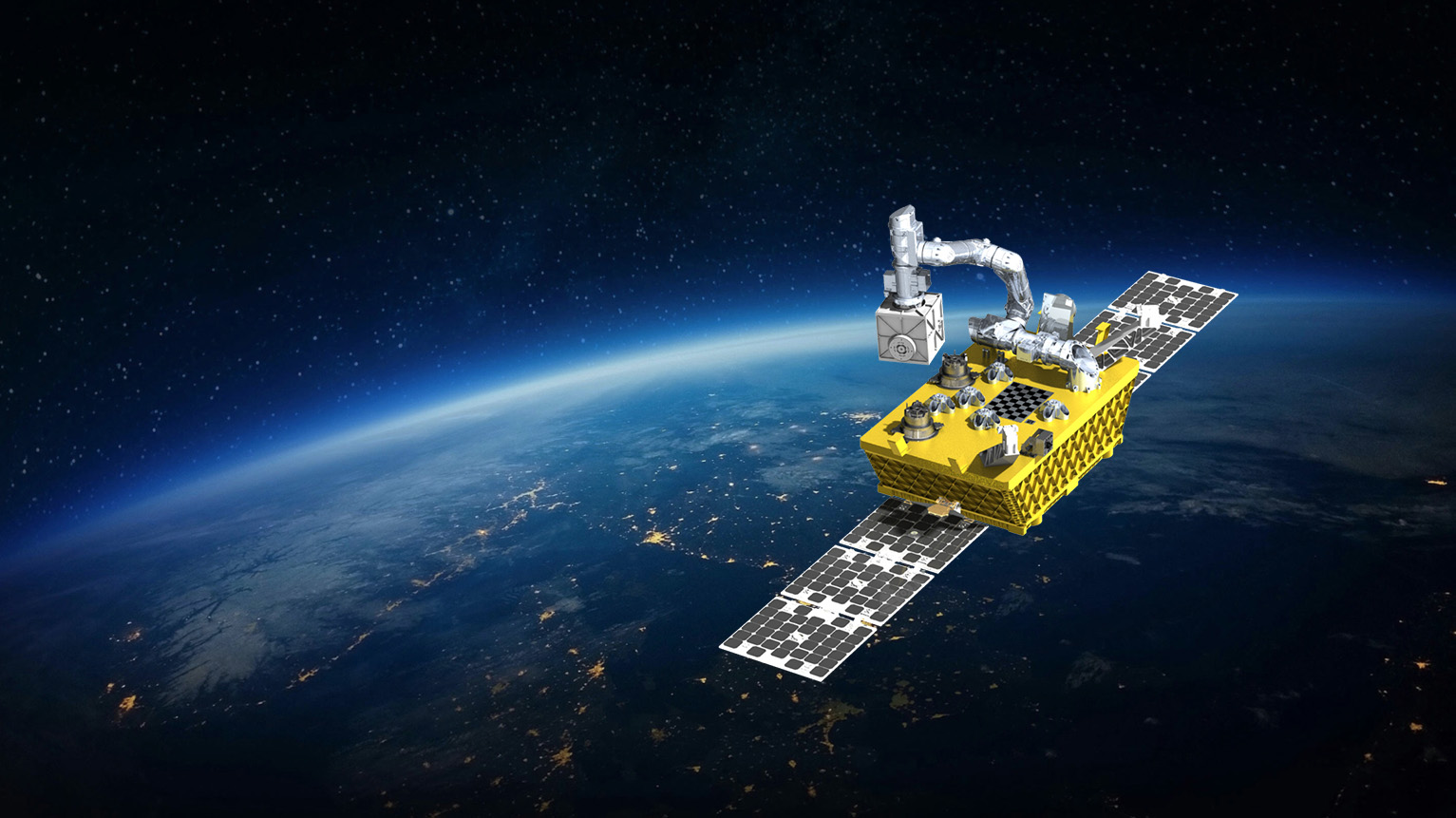
NASA Space Roboticist Challenge
The Fly Foundational Robots (FFR) mission will launch a robotic arm, with seven degrees of freedom, to low Earth orbit. NASA is opening access to the robotic arm to a select group of U.S. researchers — principal investigators, post-doctoral researchers, professors, and highly qualified graduate students — who have a compelling experiment and the capability to execute it.
All participants must submit eligibility documentation at registration. Once your eligibility is reviewed and confirmed, you will receive access to the Phase 1 submission portal.
- Phase 0 — Eligibility Registration
Begin by completing your eligibility registration. Submission documentation is required at this stage as part of federal competition requirements. Registration closes at 12:59 p.m. ET (11:59 p.m. CT) on Sept. 23.
- Phase 1 — White Paper Submission
Submit a white paper proposing a short, focused experiment using the FFR robotic arm. Up to 15 teams advance to Phase 2. Submission closes at 12:59 p.m. ET (11:59 p.m. CT) on Oct. 2. - Phase 2 — Simulation & Validation
Invited participants conduct simulation and validation testing, including visits to Goddard Space Flight Center in Greenbelt, Maryland.
Prize: Teams that pass validation will receive an offer of on-orbit experiment time on the FFR Mission
Challenge Registration Open Date: May 20, 2026
Challenge Registration Close Date: September 23, 2026
For more information, visit: https://spaceroboticistchallenge.com/
Look Up!
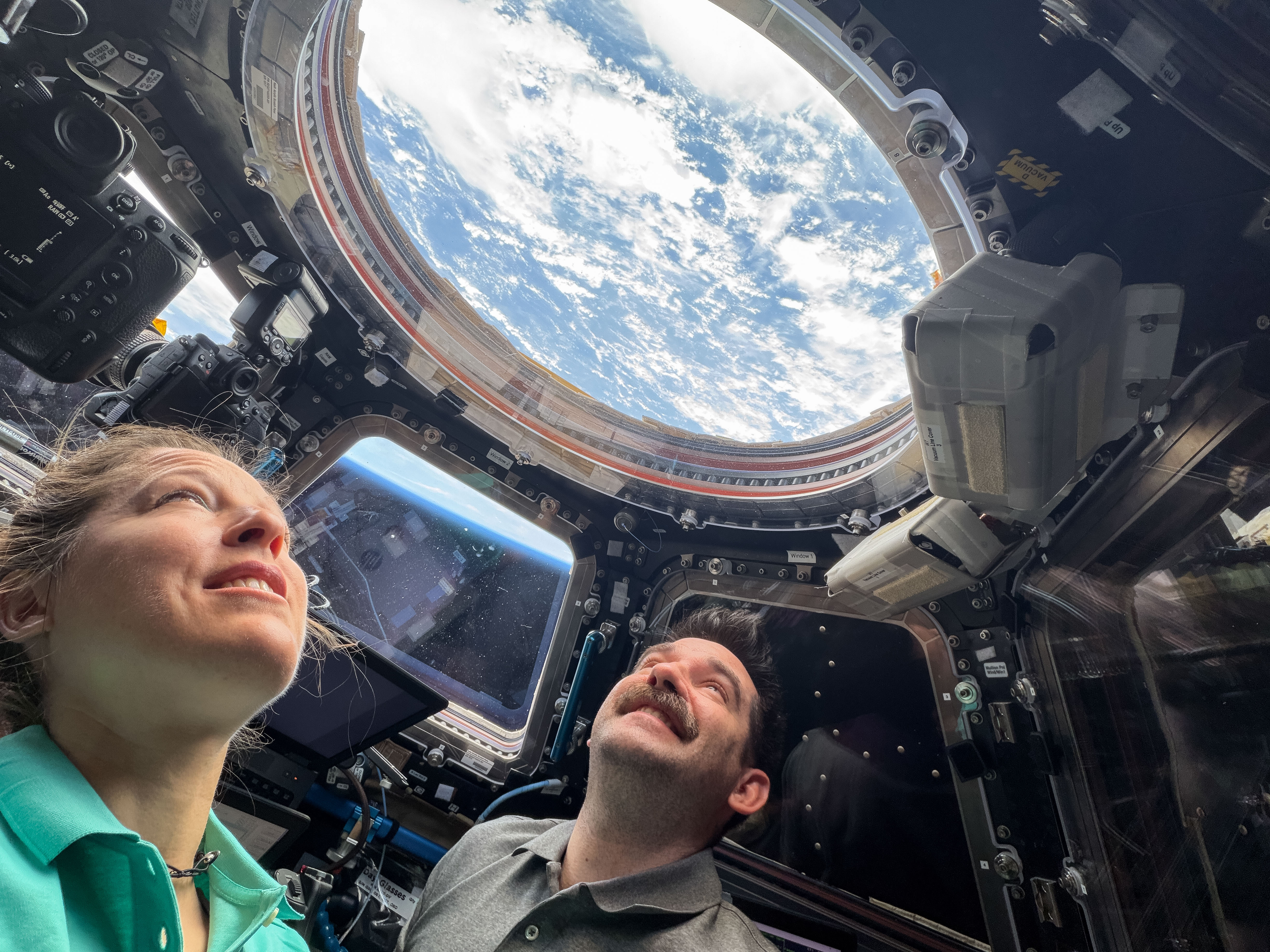
Astronauts Sophie Adenot of ESA (European Space Agency) and Jack Hathaway of NASA, both Expedition 74 flight engineers, look out a window in the cupola, monitoring the automated approach and docking of the SpaceX Dragon cargo spacecraft to the International Space Station on May 17, 2026. The orbital outpost was soaring 259 miles above the Indian Ocean just west of the Maldives at the time of this photograph.
See the cupola and other parts of the space station in our guided tour.
Image credit: ESA/Sophie Adenot
NASA Testing Wastewater Treatment Facility for Future Moon Base
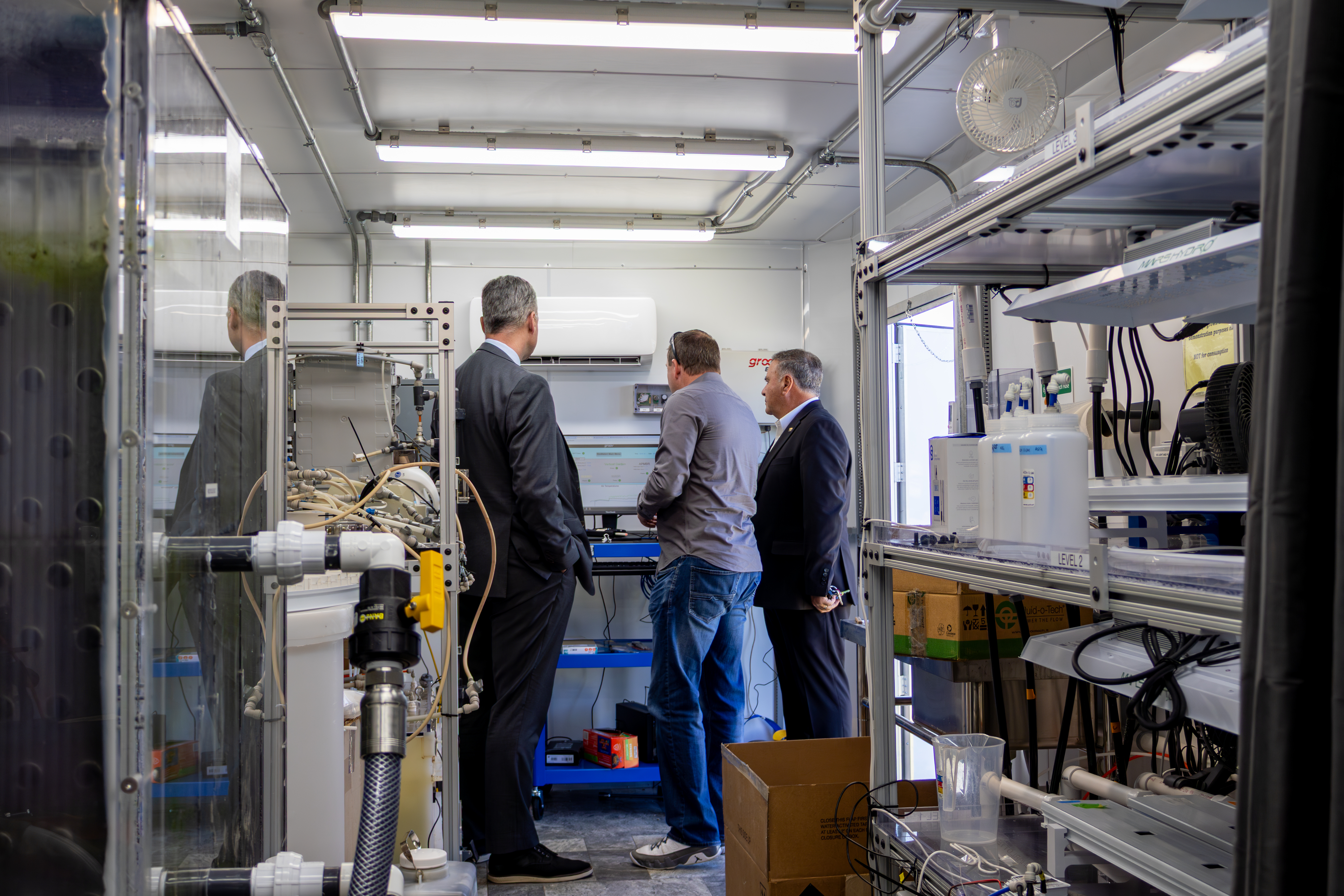
A mobile wastewater treatment system built at NASA’s Kennedy Space Center in Florida that can help prepare for long-duration missions on the Moon and Mars departed the spaceport and arrived at the University of North Dakota in Grand Forks. Graduate students at the university will test the technology under conditions designed to closely mimic the challenges of operating on another planetary surface.
The Divergent Deployable Wastewater Treatment Facility is designed to turn crew wastewater into useful resources, which future explorers will need every day. At the University of North Dakota, teams will integrate this new wastewater system with the university’s Integrated Lunar/Martian Analog Habitat. Student operators and NASA researchers will study how the facility performs when connected to a habitat-like environment and exposed to the kinds of operational limits crews could face on another planet.
“NASA’s Artemis program is laying the groundwork for a sustained human presence on the Moon, where habitats will need to operate far from the steady resupply chain that supports astronauts in partial gravity,” said Luke Roberson, surface water systems lead within the Mars Campaign Office at NASA Kennedy. “To solve that challenge, we are developing the future of sustainable lunar surface systems to process wastewater into nutrient feedstocks for plants and biomanufacturing.”
How Treatment System WorksHoused inside an 8.5-by-24-foot trailer, the facility brings together three biological reactor systems, a vertical garden, water-polishing hardware, environmental monitoring, autonomous control software, and safety systems. The trailer was outfitted at NASA Kennedy to function as a deployable laboratory and to travel between at least two simulation test sites as the technology matures.
Unlike wastewater systems on Earth, this facility keeps waste streams separate. That divergent approach is important for small crews, because wastewater from four to eight people can be highly concentrated. Urine, hygiene water, laundry water, fecal waste, and food waste each contain different levels of salts, solids, carbon, nitrogen, phosphorus, and other compounds. Treating them separately allows each stream to be processed by the reactor best suited for the job.
To do that, the system uses three different bioreactors to treat waste streams. The Anaerobic Phototrophic Membrane Bioreactor processes fecal and food waste and converts it into a nutrient-rich wastewater that can support plant growth. The Suspended Aerobic Membrane Bioreactor processes urine and flush water. The Membrane Aerated Biological Reactor treats graywater from hygiene and laundry activities. Collectively, the bioreactors process nutrients to feed the facility’s vertical garden and prepare the water for reuse. Inside that garden, crops will grow hydroponically, or without using soil, by using nutrient solutions derived from the bioreactors. Researchers will compare crop performance with plants grown using standard hydroponic nutrients.
NASA’s Dr. Roberson demonstrating the Divergent Wastewater Treatment Facility to UND Chair Dr. De Leon and Dr. Robert Kraus, Dean of UND’s School of Aerospace Sciences.University of North DakotaAt North Dakota, under a NASA EPSCoR (Established Program to Stimulate Competitive Research) grant, the facility was connected to the Integrated Lunar/Martian Analog Habitat through a bathroom interface that includes a urine-diverting toilet. The setup will allow different waste streams to be separated at the source and sent to the correct treatment systems. In parallel, Ali Alshami’s team is developing novel membrane-based separation technologies intended for future integration into the divergent wastewater facility to improve water recovery efficiency, contaminant rejection, and overall system resilience for long-duration habitation missions.
“The tests will help NASA evaluate real-world operation, crew training needs, system reliability, and how wastewater simulants compare with actual human metabolic waste in an analog mission environment,” said Alshami.
These efforts are focused on advancing compact, energy-efficient treatment approaches capable of handling complex wastewater streams generated in closed-loop extraterrestrial environments.
“The testing campaign at the University of North Dakota supports the facility’s technology maturation from laboratory-scale validation toward demonstration in a relevant Inflatable Lunar/Martian Analog Habitat environment,” said Pablo De Leon, professor and department chair of Space Studies at the University of North Dakota.
Lessons learned could inform future higher-fidelity tests, including potential integration with NASA’s next generation of yearlong simulated Mars missions via isolation analogs at the agency’s Johnson Space Center in Houston.
Technology for Making Moon Base SustainableThe work is part of NASA’s broader Bioregenerative Life Support Systems effort, which is developing biological approaches to reduce dependence on Earth-supplied consumables. In future lunar or Martian habitats, systems like the wastewater treatment facility could help close life support loops by recovering water, recycling nutrients, supporting crop production, and reducing the amount of waste that must be stored or discarded. Further NASA research completed trade studies demonstrating how bioregenerative life support becomes more effective for space travel over current life support technologies.
NASA researchers also are exploring how wastewater-recovered resources could support in-space manufacturing. One effort is studying how nutrient-rich water from bioregenerative wastewater systems could feed microbes that produce lactic acid, which can be turned into polylactic acid. The material could one day serve as a binder for 3D printing with lunar or Martian regolith, the loose, fragmental surface material, or could be used for replacement parts, extending the value of recovered waste beyond water and food systems.
“By sending the facility from NASA Kennedy to North Dakota, the agency is moving a key part of that circular economy out of the lab and into a real-world test,” said J.J. Edelmann, surface systems domain lead for the Mars Campaign Office at NASA Headquarters in Washington. “The work may begin with wastewater, but its goal is much larger. We want to help future crews live sustainably on the Moon, learn how to operate farther from Earth, and carry those lessons forward to Mars.”
To learn more about the agency’s lunar and Mars exploration, visit:
Be a Clump Scout and Help Reveal Secrets of Stellar Nurseries
In the mid-20th century, astronomers discovered strange “clumpy” galaxies filled with mysterious bright blobs – massive stellar nurseries where stars are born at an explosive rate. Curiously, these clumpy galaxies were much more common in the early universe than they are today. We still don’t know why they vanished.
The Euclid space telescope, an ESA (European Space Agency) mission with critical contributions from NASA, has begun to capture images of millions of galaxies. These images – far more than any team of professional scientists could ever catalog alone – include high-definition views of clumpy galaxies that promise to reveal structure within and among the clumps. Astronomers hope to use these images to obtain new information about which galaxies host clumps, where the clumps are, how and why they evolved, and more – but they need your help!
To tackle this mountain of data, scientists are creating a “digital assistant” in the form of machine learning, a kind of artificial intelligence. The machine algorithm has been partially trained with results from an earlier project called “Galaxy Zoo: Clump Scout.” Now, as a volunteer for the new Galaxy Zoo: Clump Scout II project, you’ll improve and train this tool further. You’ll examine images of galaxies that the machine has labelled with squares where it thinks it sees a real clump. The machine often gets confused by distant stars or camera glitches. So you’ll gently move those squares around, delete them, or add new ones, to help the algorithm learn.
As a part of Galaxy Zoo: Clump Scout II, you will help investigate how giant star-forming nurseries formed, solve the mystery of their disappearance over cosmic time, and reveal more about how star formation really works in galaxies. All you need is a laptop or smartphone. Click here to learn more!
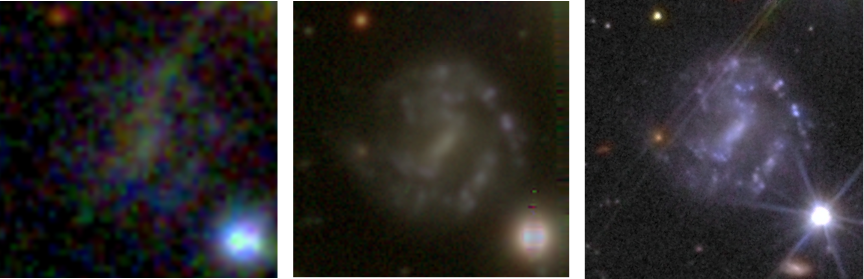
A clumpy galaxy seen by telescopes with the Sloan Digital Sky Survey (left), the Hyper Suprime-Cam (middle) and the Euclid mission (right). You can see how the better resolving power of each subsequent telescope helps us see more and more detail about the star-forming clumps. (The bright object at the bottom right is a foreground star.) Image data: SDSS (left; Sloan Digital Sky Survey – CC BY 4.0); HSC (center; NAOJ/HSC Project – CC BY 4.0); Euclid (right; ESA/Euclid/Euclid Consortium/NASA – CC BY 3.0 IGO). Image post-processing and compilation by Hugh Dickinson and Jürgen Popp. Learn More and Get Involved Galaxy Zoo: Clump Scout IIIdentify star-forming clumps in galaxy images, and help train machines to do the same.
Facebook logo @nasascience_ @nasascience_ Instagram logo @nasascience_ Linkedin logo @nasascience_
Spacewalking With Scott Wray, Artemis EVA Training Lead
Scott Wray’s experience with spacewalks started when he was about 6 years old. A tent resembling a lunar lander provided the perfect imaginary spacecraft. “I would lie on my back with my feet propped up on a pillow as I imagined going through a launch countdown sequence,” he said. “Then I would exit the tent into a darkened bedroom and hop around just like the footage I had seen of Apollo astronauts.”
Today, with more than 16 years at NASA’s Johnson Space Center under his belt, Wray is proud to have shaped spacewalk training across three eras of human spaceflight.
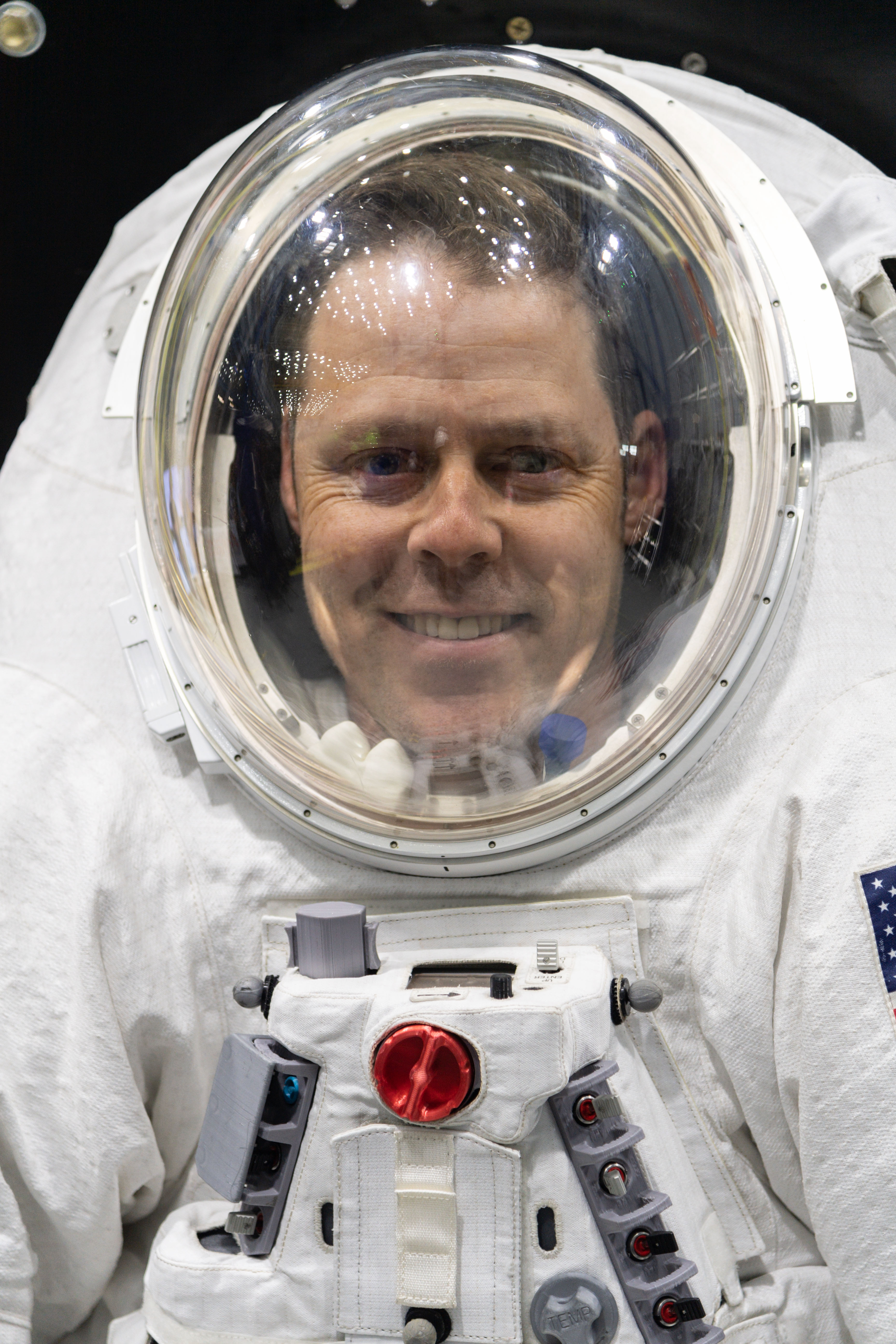
Scott Wray smiles before a suited test run with Johnson’s Active Response Gravity Offload System. NASA/Josh ValcarcelThe childhood fascination with spaceflight evolved into a passion for engineering, demonstrated through countless LEGO and airplane model builds and voracious readership of aircraft design books. His path to NASA was cemented by a week-long camp at Space Center Houston, which included several tours of Johnson’s signature facilities and a visit by former NASA Flight Director Gene Kranz. “I was so inspired by the facilities and the incredible history of this place, I knew that I had to work here someday,” he said.
Wray participated in NASA’s Contractor Co-op Program with United Space Alliance while studying aerospace engineering at Embry-Riddle Aeronautical University and completed several tours with different organizations at Johnson. At the time, astronauts were training to conduct spacewalks, also known as EVAs, for both the Space Shuttle and International Space Station programs. During one co-op experience with the shuttle’s In-Flight Maintenance Team (IFM), Wray observed the IFM and EVA teams collaborating with the STS-117 crew to fix the peeled-back thermal blanket on space shuttle Atlantis’s Orbital Maneuvering System pod. He helped the teams develop crew procedures for practicing the repair inside the shuttle, using surgical staples and pins to tack the blanket down. “This real-time troubleshooting is where I learned about the EVA group and set my sights on working there during my final co-op tour,” he said. “I love to be hands-on, to take things apart and come up with creative solutions – that’s what really attracted me to EVA.”
EVA work also reminded Wray of time spent as a dog mushing guide in Alaska. “That is where I got my first taste of expeditionary skills,” he said. “We lived in a remote glacier camp, taking care of 250 Alaskan Huskies. I learned how to make do with the tools you have and make repairs to a broken sled miles away from home.” At times, Johnson’s EVA team must create similar workarounds. “Some of our best moments as a team have come when our hardware or vehicle has malfunctioned, requiring us to devise a real-time solution,” he said. “It sounds scrappy, but I think it’s how we put the human into human spaceflight.”
Wray became a full-time EVA team member at Johnson after graduation, working under various contracts until he transitioned to a civil servant position in 2021. He started as an EVA instructor focused on tools and hardware and teaching astronauts how to perform their maintenance and repair duties. As NASA’s astronaut corps evolved to include a wider range of backgrounds and body types, Wray worked to develop new EVA techniques and tools that could accommodate any crew member. “That meant creating a curriculum that capitalized on individual strengths while building teamwork and resilience,” he said.
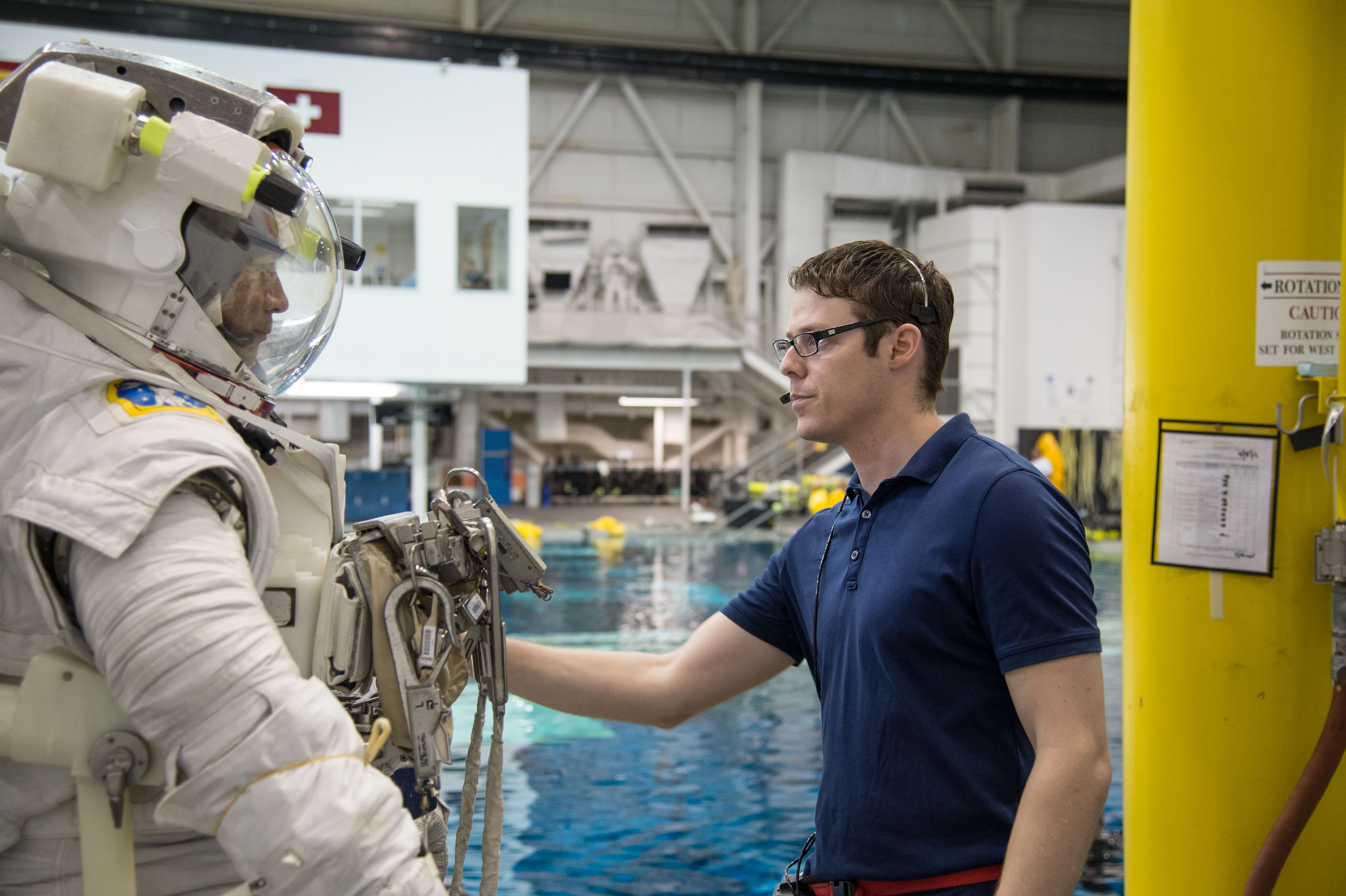
Scott Wray prepares JAXA (Japan Aerospace Exploration Agency) astronaut Kimiya Yui for an EVA training run in the Neutral Buoyancy Laboratory pool. NASA/Bill StaffordWray also served as a flight controller for shuttle and space station EVAs. He remembers being on console in Johnson’s Mission Control Center during a space station EVA in July 2013. That excursion was terminated early after water began filling the spacesuit helmet of ESA (European Space Agency) astronaut Luca Parmitano, and the team could neither determine its source nor stop its flow. “That incident taught me that even after decades of operating a spacesuit, there are still failure modes we haven’t imagined,” he said. “It reinforced the need for vigilance, adaptability, and continuous learning—because in human spaceflight, lives depend on it.”
In the last few years, Wray’s responsibilities shifted to preparing Artemis crew members for missions to the Moon. Now the Artemis EVA training lead, Wray oversees the development of training flows that will ready astronauts for lunar surface operations – a challenge NASA has not faced in over 50 years.
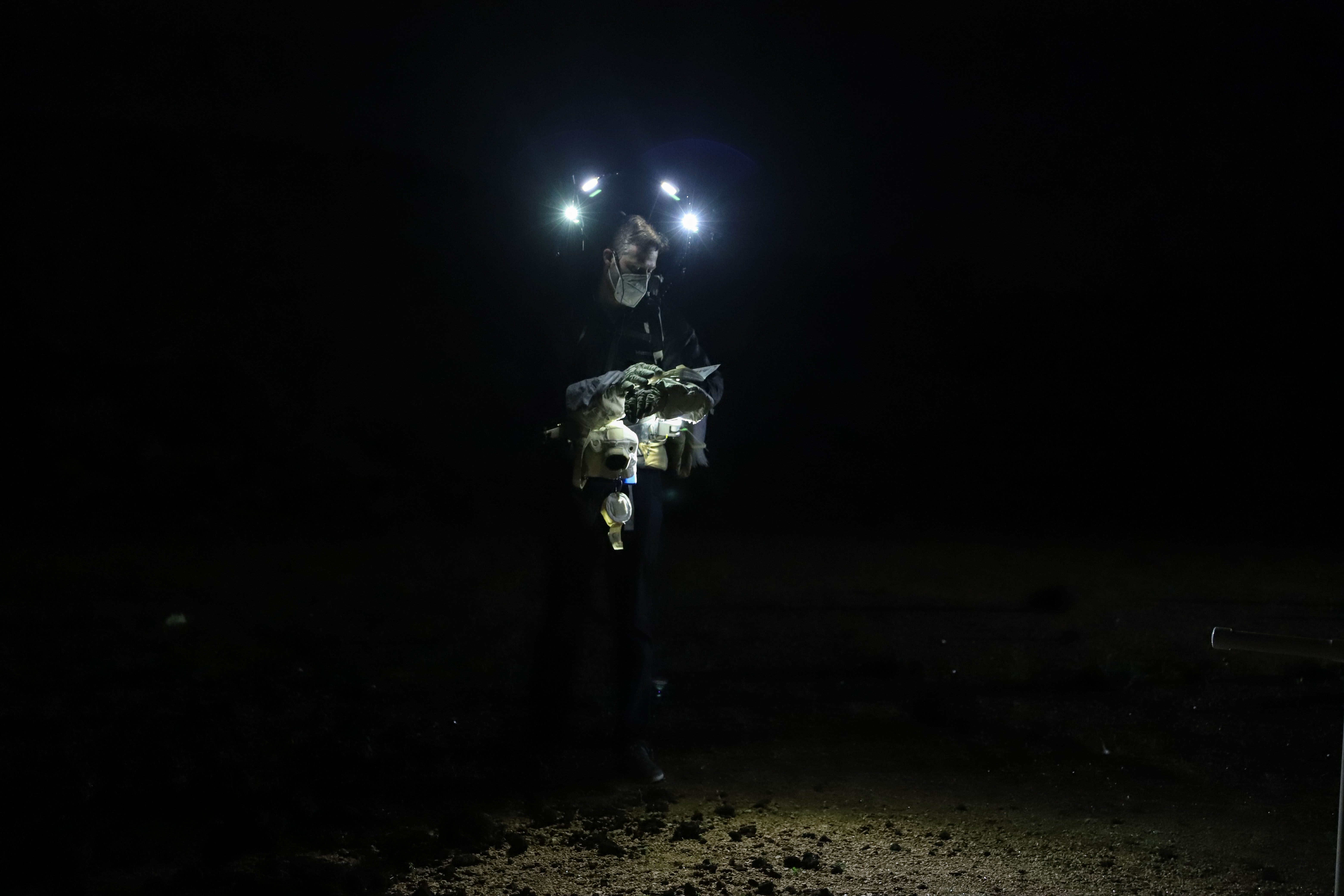
Scott Wray participates in a nighttime evaluation of EVA operations at the Johnson Space Center Rock Yard in March 2021. The evening test was designed to better understand the impact of lunar South Pole lighting conditions on EVA operations.While many astronauts have completed space station training or an EVA, the skills required for lunar exploration will be different. “It’s going to be a completely new spacesuit, new vehicles, new environment,” Wray said. “And now they’re going to be walking instead of translating with their hands like we do on station.” At the same time, trainings must go beyond these foundational spacewalk techniques. “Our curriculum integrates geology, covering topics like impact cratering, volcanology, sample collection, and traverse planning,” Wray explained. “It’s about enabling astronauts to become effective field scientists while mastering complex EVA operations.”
To build these skills, the team uses multiple training environments. The Neutral Buoyancy Laboratory has been NASA’s flagship EVA training facility since it opened in 1997, but the team also uses the Active Response Gravity Offload System for suited mobility practice. Additional training systems include virtual reality, lighting laboratories that simulate the Moon’s harsh South Pole lighting conditions, field sites for geology training and sample collection, and suit simulators that prepare astronauts to respond to caution-and-warning scenarios.
“Spearheading this effort as EVA training lead allows me to ensure every element—from science to operations—is integrated into a program that will prepare astronauts for success on the Moon and beyond,” Wray said. “This effort is more than preparation, it’s the foundation for future exploration and a steppingstone toward Mars. Knowing that our work will help shape the next era of human spaceflight is incredibly rewarding.”
Scott Wray serves as the test subject for Exploration EVA Pressure Garment Subsystem mobility data collection using the Active Response Gravity Offload System.Amid these complex preparations, Wray still finds time for new pursuits outside of the office. His daughter inspired him and his wife to try an acting class at a local fine arts studio, leading to Wray’s on-stage debut in a performance of “Rock of Ages.” He starred as William Shakespeare in this year’s production of “Something Rotten.” “I never would have thought I’d have so much fun acting, singing, and dancing on stage,” he said. “The community we are part of and the ability to join our daughter in activities she enjoys has been so rewarding.”
Wray said he is incredibly grateful to play another role off-stage – being part of missions that will conduct meaningful science on the lunar surface. “Returning to the Moon is something I’ve dreamed about since I was a kid,” he said. “Artemis isn’t just about going back—it’s about shaping the future. When we choose to push the boundaries of exploration, the advancements we make don’t just expand knowledge, they create lasting benefits for all of humanity.”
About the AuthorLinda E. Grimm Share Details Last Updated May 28, 2026 Related Terms Explore More 5 min read NASA Testing Wastewater Treatment Facility for Future Moon Base Article 14 hours ago 3 min read NASA to Conduct Low-Altitude Flights Near Houston Article 1 day ago 4 min read I Am Artemis: Daniel Stubbs Article 5 days ago Keep Exploring Discover More Topics From NASAMissions
Humans in Space
Climate Change
Solar System
Fire’s Footprint on Santa Rosa Island
- Earth
- Earth Observatory
- Image of the Day
- EO Explorer
- Topics
- More Content
- About
NASA Awards Modification Contract for Reduced Gravity Test Aircraft
1 min read
Preparations for Next Moonwalk Simulations Underway (and Underwater) NASANASA selected Denmar Technical Services of Nevada to provide aircraft modifications, maintenance, and testing services to the Human Spaceflight Mission Directorate at NASA’s Armstrong Flight Research Center in Edwards, California, and Johnson Space Center in Houston.
The award is a firm-fixed-price contract and will be time and material for any over and above and unforeseen work. This contract has a maximum potential value of $8.4 million, which runs through Feb. 1, 2027.
The contractor will modify a Boeing 737-700 aircraft to perform lunar-gravity parabolic flights to test NASA space equipment. Once modifications are complete, NASA Armstrong will own the aircraft and oversee aircraft operations out of NASA Johnson.
The aircraft will be used to validate astronaut lunar suits and associated crew systems required to support Artemis mission objectives. This can be done with the modified 737 aircraft in an operationally relevant, reduced-gravity environment prior to lunar mission execution.
For information about NASA and agency programs, visit:
-end-
Dede Dinius
Armstrong Flight Research Center, Edwards, Calif.
661-276-5701
darin.l.dinius@nasa.gov
NASA Invites Media to See Roman Space Telescope Arrive at Kennedy
Registration is open for media to cover the arrival of NASA’s Nancy Grace Roman Space Telescope at the agency’s Kennedy Space Center in Florida in the coming weeks.
The observatory will arrive aboard NASA’s Pegasus barge from NASA’s Goddard Space Flight Center in Greenbelt, Maryland, where teams completed its construction, assembly, and testing. Credentialed media will be able to witness the arrival and unloading of the space telescope in its transport container at NASA Kennedy’s turn basin. From there, technicians will move the telescope to the center’s Payload Hazardous Servicing Facility for launch processing.
NASA subject matter experts will be available on site to answer questions about the arrival.
Media interested in participating must apply for credentials at:
To receive credentials, media must apply by 11:59 p.m. EDT on Thursday, June 4. This opportunity is open to U.S. citizens only.
Once approved, credentialed media will receive a confirmation email. Additional information, including the specific date of arrival activities, will follow. NASA’s media accreditation policy is available online. For questions about accreditation, please email ksc-media-accreditat@mail.nasa.gov. For other questions, please contact Kennedy’s newsroom at: 321-867-2468.
Named after NASA’s first chief astronomer, the Nancy Grace Roman Space Telescope will have a deep, panoramic view of the cosmos, generating never-before-seen pictures that will revolutionize our understanding of the universe. The observatory will usher in a new era of cosmic surveys, unveiling troves of celestial objects, and shedding light on some of the universe’s most profound mysteries, including phenomena we can’t see. Roman also will showcase a test of the most advanced technology ever flown in space to directly image planets around nearby stars, a key step in NASA’s search for life on other worlds.
The Roman telescope is managed at NASA Goddard with participation by NASA’s Jet Propulsion Laboratory in Southern California; Caltech/IPAC in Pasadena, California; the Space Telescope Science Institute in Baltimore; and a science team of scientists from various research institutions. The primary industrial partners are BAE Systems Inc., L3Harris Technologies, and Teledyne Scientific & Imaging. Contributions to Roman also are made by ESA (European Space Agency), JAXA (Japan Aerospace Exploration Agency), the French space agency CNES (Centre National d’Études Spatiales), and the Max Planck Institute for Astronomy in Germany.
The agency’s Launch Services Program, based at NASA Kennedy, manages the launch service for the Roman Space Telescope, which will lift off as soon as early September on a SpaceX Falcon Heavy rocket from Launch Complex 39A.
For more information about NASA’s Roman telescope, visit:
-end-
Karen Fox / Alise Fisher
Headquarters, Washington
202-385-1287 / 202-358-2546
karen.c.fox@nasa.gov / alise.m.fisher@nasa.gov
Leejay Lockhart / Danielle Sempsrott
Kennedy Space Center, Fla.
321-747-8310 / 321-298-8990
leejay.lockhart@nasa.gov / danielle.c.sempsrott@nasa.gov
Claire Andreoli
Goddard Space Flight Center, Greenbelt, Md.
301-286-1940
claire.andreoli@nasa.gov
NASA to Conduct Low-Altitude Flights Near Houston
Five research aircraft will support a Student Airborne Research Program (SARP) mission out of Ellington Field in Houston. Flights are expected from Wednesday, June 3 to Saturday, June 13. During the mission, select maneuvers will be conducted at low altitudes over the Houston area.
Pilots will fly remote sensing payloads in raster patterns, or parallel back-and-forth lines. The instruments flown could help researchers map the movement of the gases and particles that make up Earth’s atmosphere, changes to the lowest part of the atmosphere near the coastline, and the natural processes affecting the land and water in that area. The flights will primarily take place in the Houston area, with some extending over the Gulf of America.
While many of the flights will operate at higher altitudes, a WP-3D Orion will conduct maneuvers as low as 1,000 feet above ground level. Owned and operated by the National Oceanic and Atmospheric Administration (NOAA), this aircraft is used as a hurricane hunter and has supported several airborne science missions for NASA. It is equipped with a multitude of scientific instrumentation, radars, and recording systems for both in-flight and remote sensing measurements of the atmosphere, the Earth, and its environment.
The NASA-operated aircraft participating in the mission also are equipped with a variety of remote sensing instruments, including two lidars, a synthetic-aperture radar, an imaging spectrometer, and two spectrometers.
The operations will involve the agency’s Gulfstream V (N95NA), Gulfstream C-20A (N802NA), and Gulfstream III (N520NA), as well as NOAA’s WP-3D Orion (N43RF) and a King Air B200 aircraft (N46L) owned by Dynamic Aviation and contracted by NASA. The flights can be tracked in real time at NASA Airborne Science Program Tracker.
The SARP effort is an eight-week summer internship program that provides undergraduate students with hands-on experience by engaging in field research and data analysis and with access to one or more NASA Airborne Science Program flying science laboratories.
For more information about the NASA Airborne Science program, visit:
https://airbornescience.nasa.gov
Explore More 6 min read Spacewalking With Scott Wray, Artemis EVA Training Lead Article 19 hours ago 4 min read Contractor to Civil Servant: NASA Welcomes Kenny Heckle Article 5 days ago 2 min read Growing Stem Cells in Space to Improve Cancer and Disease Treatments Article 6 days agoWhat’s Up: June 2026 Skywatching Tips from NASA
Venus and Jupiter meet after sunset, the Moon passes in front of Venus, summer begins, and deep-sky treasures rise into view.
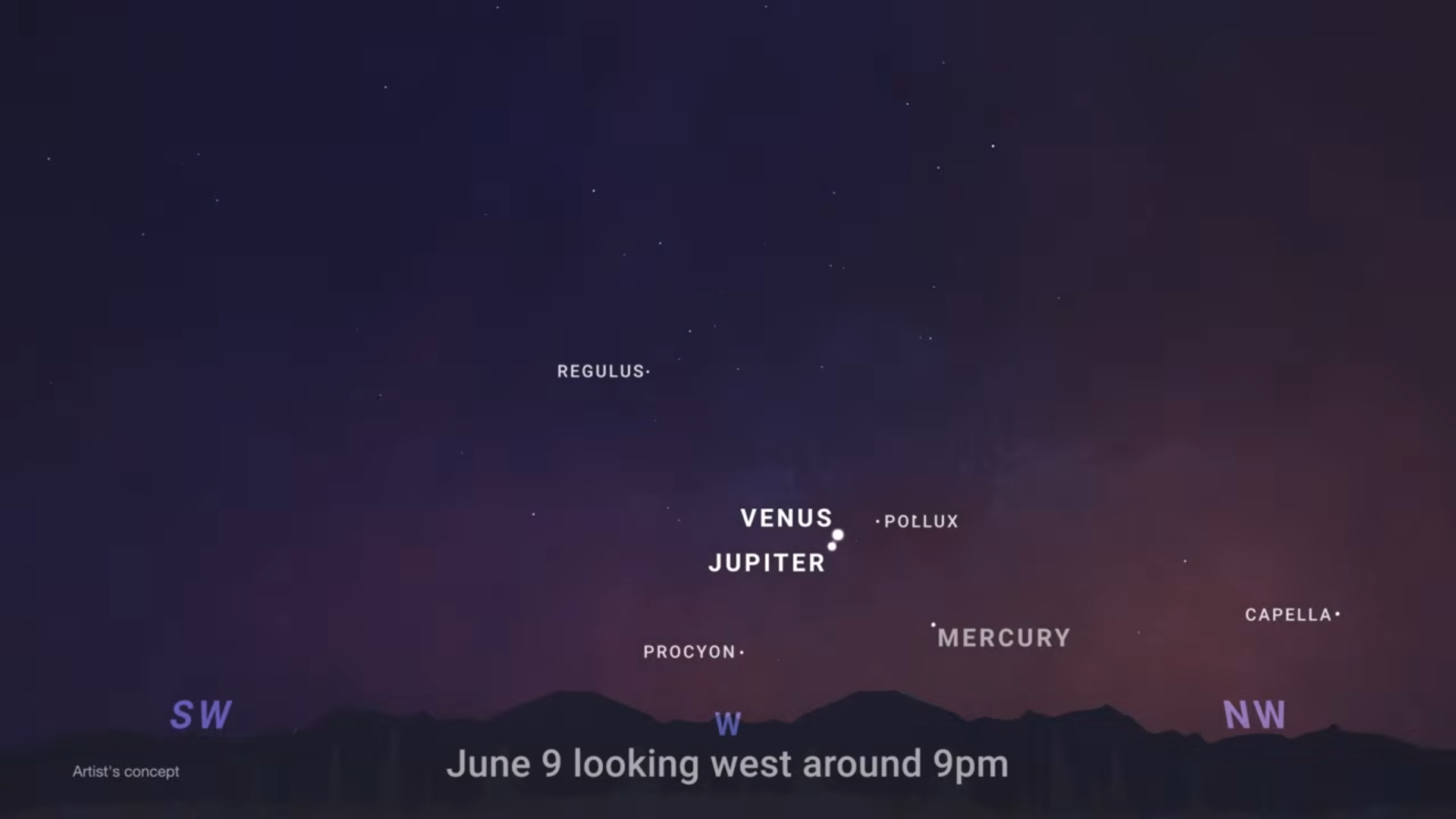
Skywatching Highlights- June 9: Venus and Jupiter conjunction
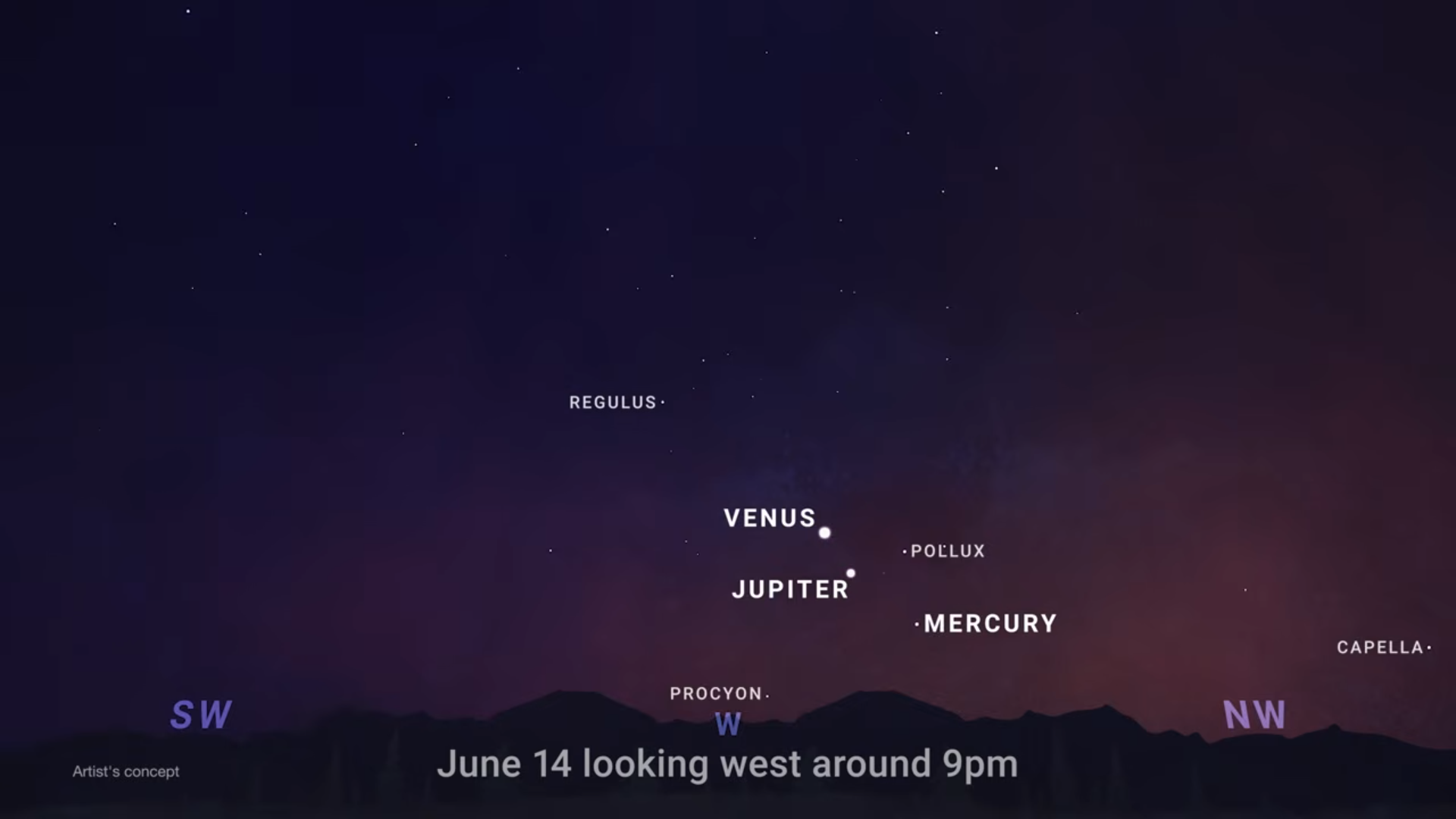
- June 11–15: Mercury joins Venus and Jupiter after sunset
- June 17: Moon passes in front of Venus & close Moon and Venus pairing
- June 21: June solstice & start of astronomical summer
- June: Summer Triangle and deep-sky observing targets rise into view
Planets gather after sunset, the Moon passes in front of Venus, summer officially begins and deep sky treasures rise into view. That’s What’s Up for June.
Early this month, look west shortly after sunset to see Venus and Jupiter. They are two of the brightest planets in our sky and around June 9th, they’ll appear close together after sunset. This is called a planetary conjunction—when two planets appear near each other from our point of view on Earth, even though they’re still millions of miles apart in space.
NASA/JPL-CaltechFrom June 11th through June 15th, Mercury joins the scene, creating a mini parade of planets low in the western sky. This happens because the planets orbit the sun along nearly the same path in our sky, called the ecliptic. So from our point of view on Earth, they sometimes appear to gather in the same part of the sky.
NASA/JPL-CaltechVenus will be the brightest and easiest to spot with Jupiter nearby. Mercury will sit lower toward the horizon, so you will need a clear view to the west to catch it in the glow of twilight.
On June 17th, from some locations the Moon will pass in front of Venus. This is called a lunar occultation. For viewers in the right viewing path, Venus will look like it disappears behind the Moon, then reappears later. The event will be visible from parts of the United States, Canada, Brazil and Venezuela. Outside of the exact viewing path, many skywatchers may still see a close pairing of the Moon and Venus, but this comes with an important safety note. For many viewers this will happen during the daytime.
If you’re trying to observe the occultation, do not point binoculars, a telescope, or a camera near the sun unless you’re using proper solar safety equipment. Looking at or near the sun through optics can cause serious eye injury.
June also brings the summer solstice. In the Northern Hemisphere, the June solstice marks the start of the astronomical summer. In Pacific time, it happens on Sunday, June 21st at 1:24 a.m.
Around the solstice, the Northern Hemisphere gets its longest days and shortest nights of the year.
But here’s a fun fact, the longest day does not usually line up exactly with the earliest sunrise or latest sunset. For example, in Los Angeles, the earliest sunrise comes before the solstice, while the latest sunset comes after it.
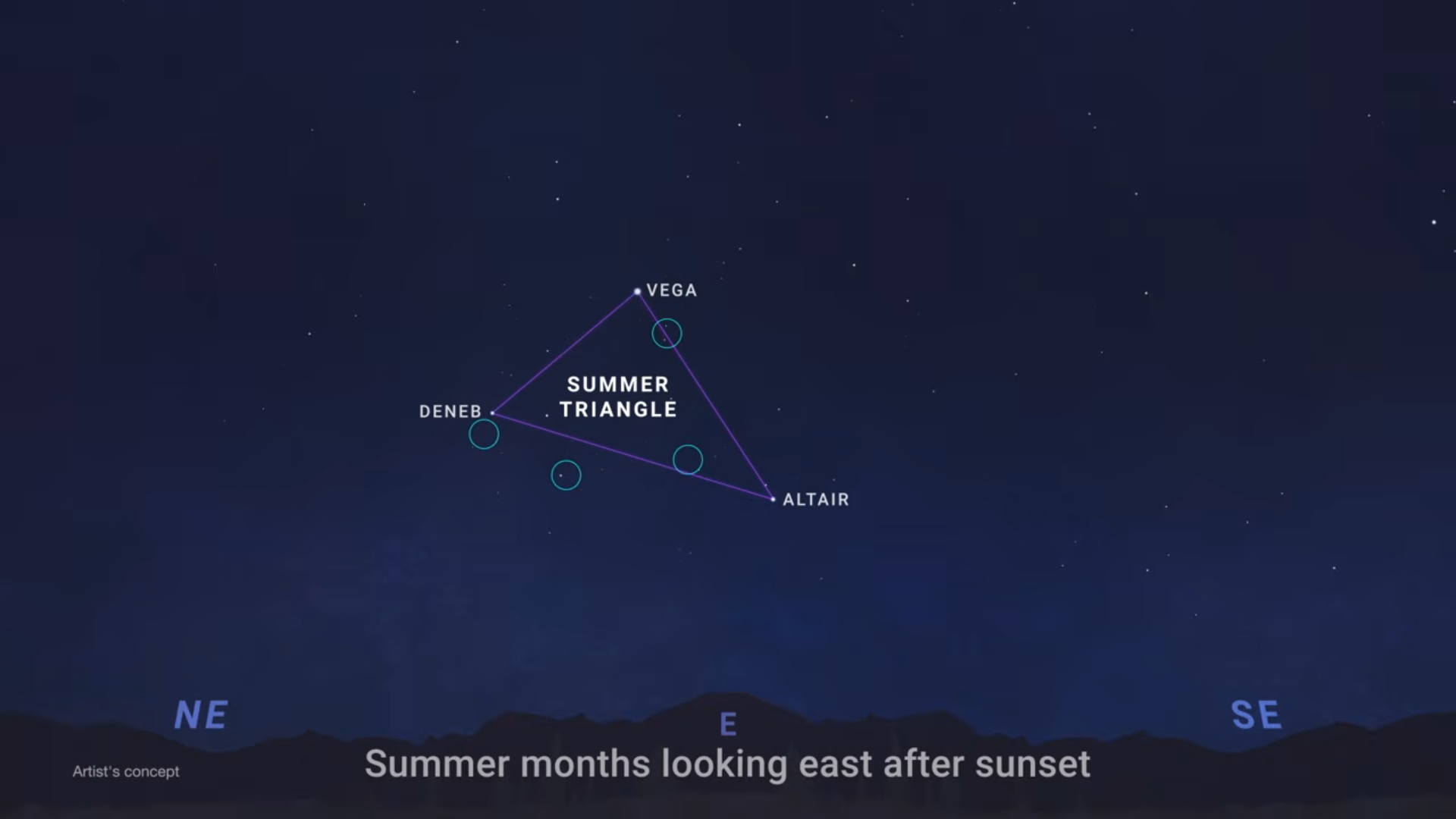
And once the sky gets dark, summer brings some favorite targets for telescope users and astrophotographers. First, look for the Summer Triangle, formed by the bright stars Vega, Altair, and Deneb. Inside and around this region are deep sky objects like the Dumbbell Nebula, the Ring Nebula, the North America Nebula, and the Veil Nebula. The Dumbbell Nebula, also known as Messier 27, was the first planetary nebula ever discovered.
These objects are not bright like planets, but with telescopes or long exposure photography, they reveal glowing gas, dying stars, and stellar nurseries in our galaxy.
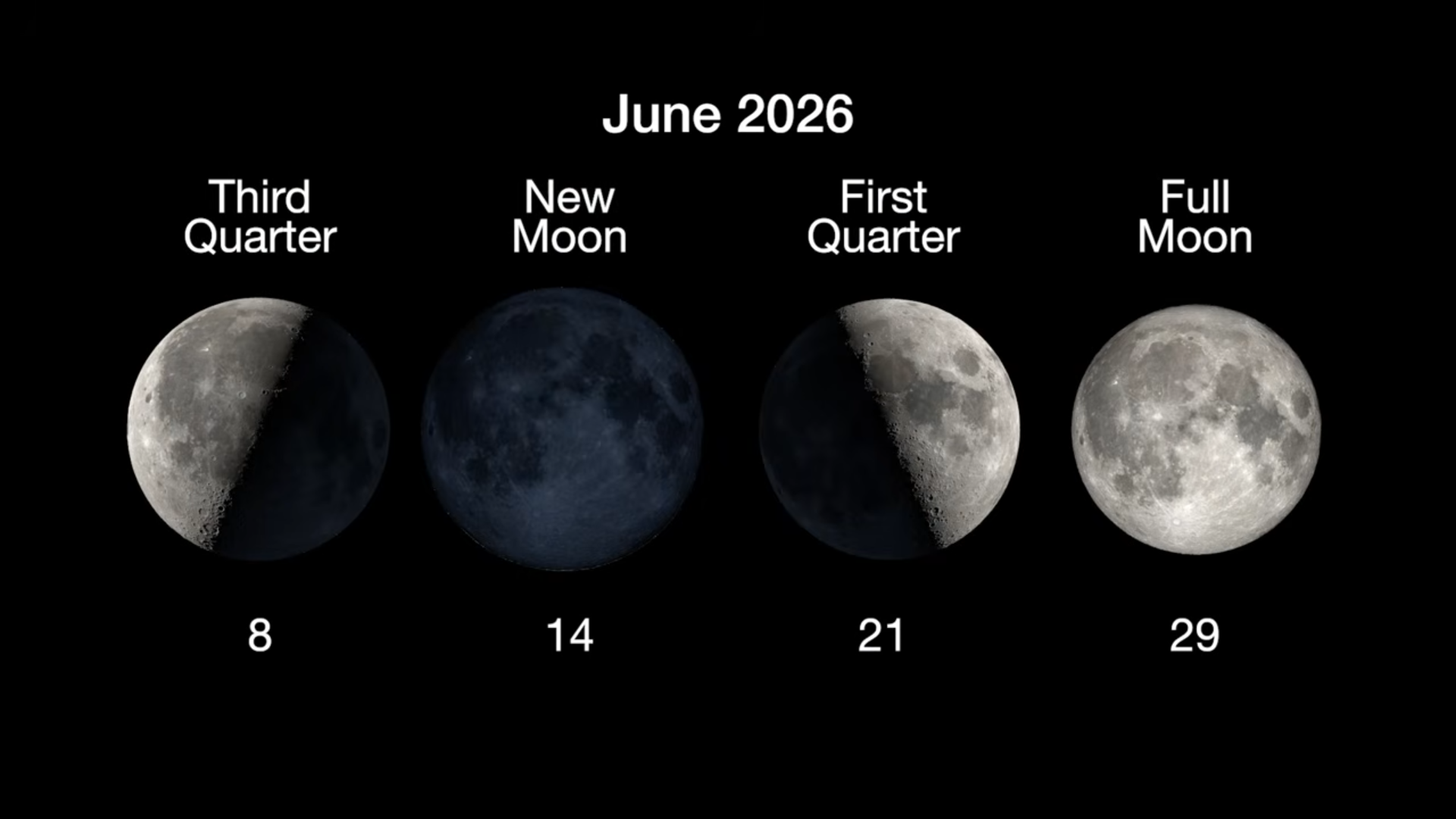
NASA/JPL-CaltechHere are the phases of the Moon for June. You can stay up to date on all of NASA’s missions exploring the solar system and beyond at science.nasa.gov. I’m Raquel Villanueva from NASA’s Jet Propulsion Laboratory, and that’s What’s Up this month.
NASA/JPL-Caltech Keep Exploring Discover More Topics From NASA
What’s Up
Skywatching
Galaxies
Stars
Pretty in Pink
This image of Westerlund 2 released on March 19, 2026, features Chandra X-ray Observatory data (pink) and infrared data from NASA’S James Webb Space Telescope (red, orange, green, cyan, and blue). Scores of gleaming stars ringed in neon pink stretch across the frame, highlighting a cluster where stars are between one and three million years old. Brick-orange dust clouds along the bottom edge illustrate the raw materials of this active stellar nursery.
Westerlund 2 resides in a raucous stellar breeding ground known as Gum 29, located 20,000 light-years away from Earth in the constellation Carina.
See a different view of Westerlund 2.
Image credit: X-ray: NASA/CXC/SAO/Sejong Univ./Hur et al; JWST: ESA/Webb, NASA & CSA, V. Almendros-Abad, M. Guarcello, K. Monsch, and the EWOCS team. Image Processing: NASA/CXC/SAO/L. Frattare and K. Arcand
Space Out This Summer with Variety of NASA STEM Activities
Summer is “Go” for launch, and NASA has a universe of ways to help you to jump in, explore, and create! Whether you prefer to spend this season fueling your creativity, going outdoors into nature, or daydreaming about your future, NASA offers ways to take your interests to the next level.
Here are some opportunities to level up your skills with NASA STEM this summer.
Rise to Stardance ChallengeFrom Monday, June 1, through Sept. 30, students ages 13 to 18 are invited to flex their creativity in the online Stardance Challenge, a partnership between NASA and the education non-profit Hack Club. Whether you’re into space, coding, hardware, or just love building cool things, this is your chance to work with real NASA mission data from programs like Artemis, the James Webb Space Telescope, and more.
Participants can create anything from code and apps to electronics, circuit boards, models, and simulations. Hack Club will offer peer and expert reviews, prizes, and plenty of opportunities to show off your work. Meanwhile, NASA will provide access to publicly available datasets, mission materials, multimedia, and virtual sessions with subject matter experts who can share insights on space science, engineering, and careers. Ready to start brainstorming? Visit the Hack Club: Stardance Challenge website to explore project options, check out prizes, and RSVP to get a reminder when the challenge opens
NASA Astronaut Megan McArthur is conducting a technology demonstration with Astrobee flying robots.Credit: NASA Go Behind Scenes of NASA CareersThink NASA is only for astronauts, scientists, and tech experts? Think again. It takes a wide range of professionals and specialists to bring the nation’s aerospace goals to life. Summer is the perfect time to discover how your skills and interests could make a difference at NASA.
Connect directly with NASA experts through online events designed to spark your curiosity and help you explore real STEM career paths. These virtual sessions provide a behind‑the‑scenes look at NASA’s workforce, plus the chance to ask questions.
- Tuesday, June 2: NASA’s Career Technical Education Day at Goddard Space Flight Center dives into robotics, AI, autonomous systems, and the skilled technical careers that keep NASA missions running. Register by May 26.
- Thursday, June 11: Virtual Career Connection: Aviation Technology and Maintenance introduces you to aircraft mechanics and technicians who support NASA’s flight programs and explores pathways into aviation technology careers. Register by June 2.
Looking for more? Check out the Next Gen STEM for Careers web page for videos, articles, and more ways to learn about the variety of jobs at NASA.
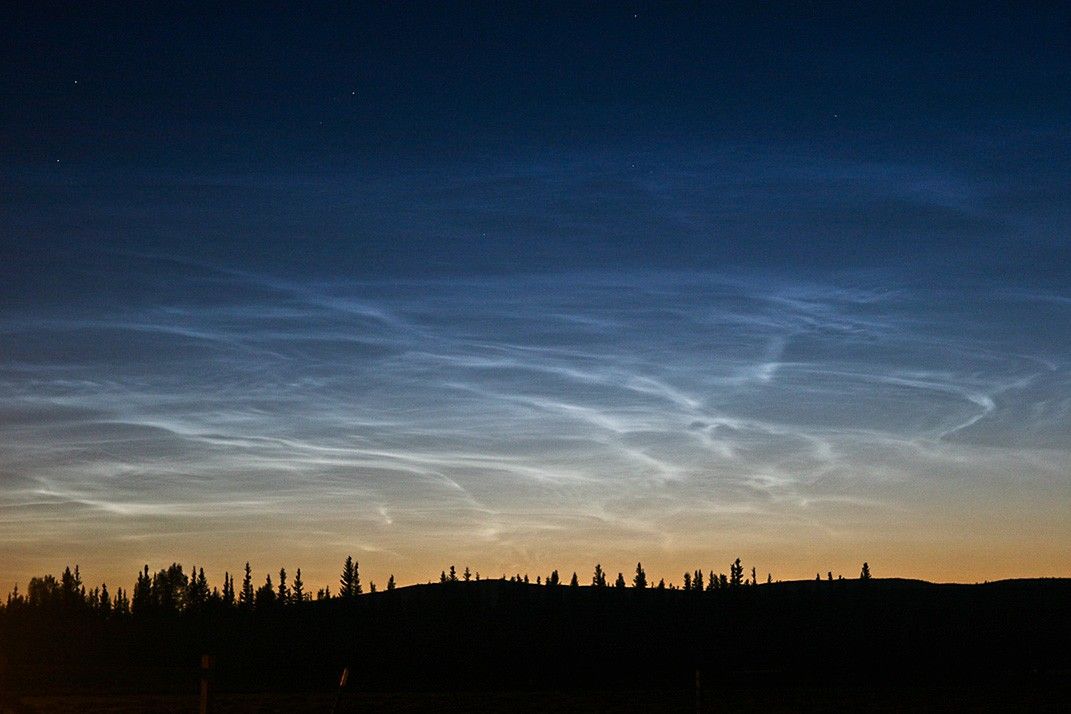
Noctilucent clouds seen from Fairbanks, Alaska.Credit: Patrick Cobb – Photovoltaic designer, photographer Dive into NASA Research Through Citizen ScienceNASA invites people of all ages and backgrounds to do NASA science as a part of real science projects that rely on volunteers. Citizen Science is a great way to make new friends, meet some scientists, and help NASA solve mysteries of the universe this summer – using just a phone or computer. You can join from anywhere, participate on your own schedule, and dive right into real research using actual mission data. Here are two examples:
- Through Space Cloud Watch, you can help NASA study noctilucent clouds. Noctilucent means “night-shining,” and that’s exactly what they do! During summer twilight at high latitudes, these clouds catch sunlight and appear to glow even in a darkened sky. Take a photo and submit a report to help scientists track how these rare clouds are changing.
- Take your cloud‑watching to another planet with Cloudspotting on Mars, where you review real NASA images to identify clouds above the Red Planet and help scientists understand Martian weather.
Curious about what other projects you might enjoy? See all current Citizen Science opportunities available through NASA’s Science Mission Directorate.
No matter how you spend your summer – building projects like the Hack Club’s Stardance Challenge, jumping into real NASA research through citizen science, or exploring possible NASA career paths – there’s a launch pad waiting for you. And remember, NASA’s STEM Resources website is available year-round to serve as your one-stop hub for hands-on activities, videos, articles, and more to spark curiosity and fuel big ideas.
Keep Exploring Discover More Topics From NASAFor Students Grades 9-12
Mobile and Desktop Apps
Games and Interactives
NASA STEM Opportunities and Activities For Students