NASA - Breaking News

Psyche Spacecraft Completes Mars Flyby
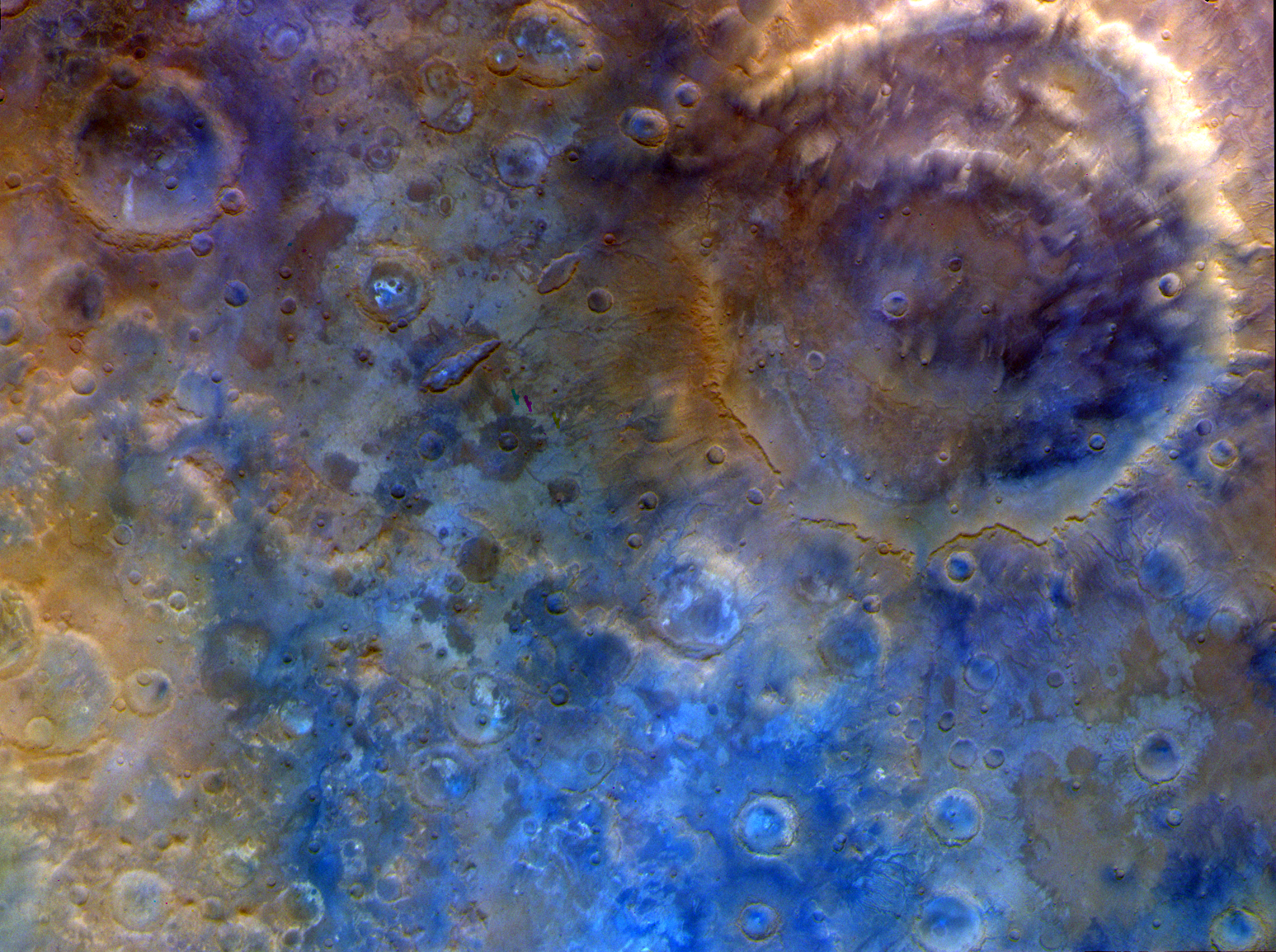
NASA’s Psyche spacecraft completed its close approach of Mars on May 15, coming within 2,864 miles (4,609 kilometers) of the planet’s surface. During the flyby, it took this image and others. This representative color image, captured by Psyche’s multispectral imager instrument, features the double-ring crater Huygens and the surrounding heavily cratered southern highlands.
This flyby used a gravity assist from Mars to provide a critical boost in speed and to adjust the spacecraft’s orbital plane without using any onboard propellant, sending it on its way toward the metal-rich asteroid Psyche. When it arrives in August 2029, it will insert itself into orbit, then map the asteroid and gather science data. If the asteroid proves to be the metallic core of an ancient planetesimal, it could offer a one-of-a-kind window into the interior of rocky planets like Earth.
Learn more about the flyby and see more photos from the event.
Image credit: NASA/JPL-Caltech/ASU
NASA-developed AI Could Help Track Harmful Algae
NASA scientists have developed an artificial intelligence tool to take on a longstanding challenge in ocean waters. In a study recently published in AGU Earth and Space Science, researchers reported the tool was able to fuse data from multiple satellites and detect harmful algal blooms that occurred in western Florida and Southern California.
Severe blooms can pose health risks and cost coastal economies in the United States tens of millions of dollars every year. Areas in Florida such as Tampa Bay and Sarasota have wrestled with the problem for decades. A species called Karenia brevis can thrive in Gulf of America waters, spawning harmful algal blooms that kill wildlife, foul beaches, and sicken swimmers. On the West Coast, blooms of Pseudo-nitzschia have poisoned hundreds of dolphins, California sea lions, and other marine animals in recent years. Toxins from algaecan even enter the air and cause respiratory illness in humans.
To manage the risk, health agencies regularly test waters and issue warnings or beach closures when necessary. The National Oceanic and Atmospheric Administration (NOAA) works with states and other local partners to issue harmful algal bloom forecasts, like weather forecasts, during bloom seasons.
On-site testing requires hours in a boat to manually collect water samples that must be sent to a lab for analysis, taking a day or more and requiring multiple tests. It’s even more challenging to know where to test before a bloom starts spreading.
NASA’s Earth-orbiting satellites already track harmful algal blooms with their unique global view. By bringing together diverse datasets, the new AI tool could serve as a force multiplier to help communities determine where to focus their efforts.
“At the very least, a tool like this can help us know where and when to collect water samples as an algal bloom is starting,” said one of the paper’s coauthors, Michelle Gierach, a scientist at NASA’s Jet Propulsion Laboratory in Southern California. “It can also drive collaboration between specialists, fostering new ways to conduct the science and deliver decision-support products.”
Today, satellites can detect a variety of clues that signal an algal bloom. A hyperspectral sensor aboard NASA’s Plankton, Aerosol, Cloud, ocean Ecosystem (PACE) satellite, for example, can identify algal communities by their size, shape, and pigment. Other instruments like TROPOMI (Tropospheric Monitoring Instrument) pick up on the faint red glow emitted by species such as K. brevis as they photosynthesize.
The study team, consisting of Gierach, Kelly Luis of NASA JPL, and research data scientist Nick LaHaye of Spatial Informatics Group, brought together findings from five space missions or instruments, including PACE and TROPOMI.
The challenge for them was the quantity of raw data involved. How would AI distinguish between deep water and a coastline? Could it recognize a bloom across different data streams? Would it ever be able to handle inputs from both satellites and sensors in the water?
The team developed a self-supervised machine learning system, designed to learn patterns from multiple kinds of satellite data and compare them with field observations. This approach enables AI to recognize relationships between different data sources without needing any labeling in advance.
The system was trained on satellite data collected in 2018 and 2019. Field and lab measurements were then used to add real-world context to the patterns that the system was recognizing. The scientists evaluated the tool’s performance across later time periods in the same geographic areas. Initial results indicate that it can correctly identify and map harmful blooms, including specific species like K. brevis, performing well even in complex coastal waters swirling with sediment, plants, and runoff.
“Applying self-supervised AI to massive streams of satellite data is rapidly becoming a powerful tool for generating actionable ocean intelligence,” said Nadya Vinogradova Shiffer, lead program scientist at NASA Headquarters in Washington.
The team is now improving the tool with more data from more coastlines and expanding tests to other kinds of water bodies, including lakes, with the goal of making it accessible to decision-makers in coming years.
“The aim of this work is to start to bridge technologies to better serve end users and their needs, from aquaculture to tourism,” Luis said. “To do that, we’re going to bring all our NASA assets to the table.”
Media Contacts
Andrew Wang / Andrew Good
Jet Propulsion Laboratory, Pasadena, Calif.
626-379-6874 / 818-393-2433
andrew.wang@jpl.nasa.gov / andrew.c.good@jpl.nasa.gov
2026-034
Explore More 2 min read Fire Chars Santa Rosa IslandThe blaze spread across the southern side of the second-largest island in California’s Channel Islands…
Article 19 hours ago 5 min read NASA’s Psyche Mission Aces Mars Flyby, Targets Metal-Rich Asteroid Article 1 day ago 3 min read Farming in Ancient Lake AgassizThe glacial lake left a layer of silt and clay in southeastern Manitoba, creating fertile…
Article 2 days ago Keep Exploring Discover More Topics From NASAEarth Observations
Earth Science Mission
Mission: PACEWhen did PACE launch? February 8, 2024 Where is PACE? 420 miles (676.5 km) from Earth What does PACE do?…
Jet Propulsion Laboratory
NASA to Provide Update on Moon Base Strategy, Missions
NASA will host a news conference at 2 p.m. EDT, Tuesday, May 26, to share Moon Base plans and highlight progress toward a sustained presence on the lunar surface. The media briefing will take place at the agency’s Headquarters in Washington.
Leadership will discuss program progress, including new industry partners and mission plans. Subject matter experts will be available for one-on-one interviews after the news conference ends.
Watch live on NASA+ and the agency’s YouTube channel. Learn how to watch NASA content through a variety of online platforms, including social media.
Participants include:
- NASA Administrator Jared Isaacman
- Lori Glaze, acting associate administrator, Exploration Systems Development Mission Directorate
- Carlos García-Galán, program executive, Moon Base
Media unable to attend in person may ask questions by telephone. To participate in person or by phone, media must RSVP to the headquarters newsroom no later than 11 a.m. on May 26, at: hq-media@mail.nasa.gov. NASA’s media accreditation policy is available online.
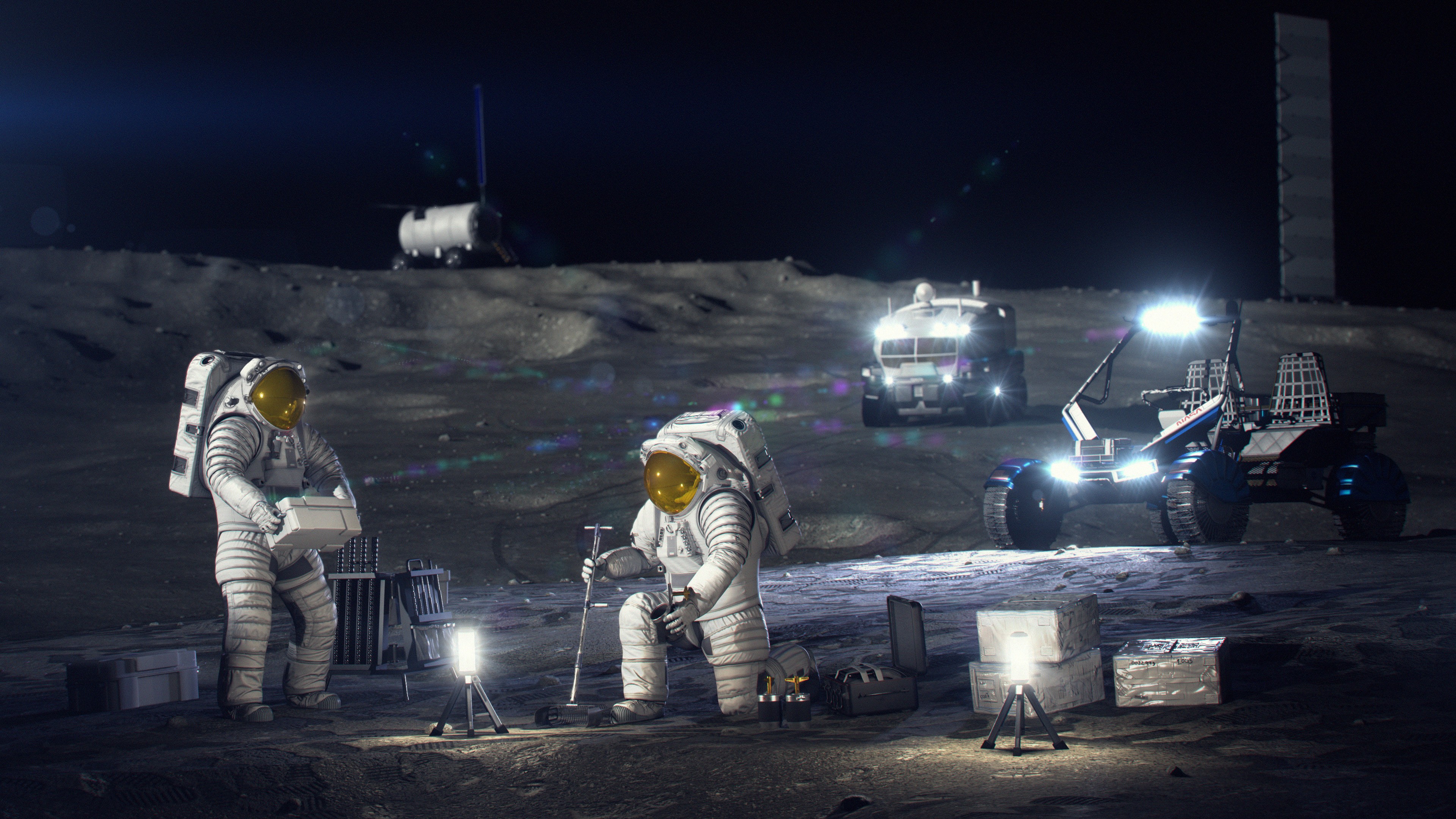
NASA is advancing development of Moon Base, a long-term lunar exploration and infrastructure initiative designed to enable sustained human presence and expanded scientific and commercial activity at the lunar South Pole.
As part of the Golden Age of innovation and exploration, NASA will send astronauts on increasingly difficult missions to explore more of the Moon for scientific discovery, economic benefits, and to build on our foundation for the first crewed missions to Mars.
For more information about NASA’s missions, visit:
-end-
Bethany Stevens / James Gannon
Headquarters, Washington
202-358-1600
bethany.c.stevens@nasa.gov / james.h.gannon@nasa.gov
NASA Releases Technology Priorities to Energize Space Industry
NASA released the 2026 Civil Space Shortfall Ranking list on Wednesday, which integrates more than 400 responses from stakeholders including industry organizations, government agencies, and academia. Shortfalls refer to technology areas requiring further development to meet future exploration, science, and other mission needs. The goal of this document is to rank the space community’s most pervasive shortfalls to help guide NASA’s space technology development and investments.
The greatest technological breakthroughs are built on shared vision. At the intersection of government and industry, we’re poised to use this feedback to accelerate high-risk, high-reward technologies, pushing NASA beyond the cutting edge to enable the near impossible.Greg Stover
Acting associate administrator for NASA’s Space Technology Mission Directorate at the agency’s headquarters in Washington
As NASA lays the foundation for long-term missions to the Moon and paves the way for human exploration on Mars, the top ranked shortfalls reflect the challenges industry is most eager to solve, such as developing infrastructure and capabilities for assets to operate for extended durations in the lunar environment, providing surface mobility and logistics for crew and assets on planetary surfaces, and developing on-board advanced computing capabilities for space operations.
From this year’s public call for feedback, NASA received 454 total external responses. Each response was considered the input of a single individual, not a consolidated response of the organization they represented. The cross-cutting nature of this feedback underscores the importance of public, private partnership to drive U.S. leadership in space technology and energize the space economy.
“This feedback provides an invaluable dataset,” said Angela Krenn, acting chief architect for NASA Technology. “As our process matures, each round of input helps target our resources, ensuring America’s space industry can tackle tomorrow’s greatest challenges. By tapping into the collective expertise of our stakeholders, we turn their insights into fuel for NASA’s next giant leap.”
The 2026 shortfalls process builds on NASA’s first shortfall ranking, which asked participants to rank 187 civil space shortfalls, resulting in an integrated list of technology priorities. Leveraging the feedback provided by stakeholders, this year’s exercise streamlined the process by consolidating the shortfalls into 32 broader, integrated categories. This restructuring maintains the original content’s depth while creating a more efficient and accessible feedback mechanism for participants.
Using the 2026 shortfalls results, NASA Technology selected 40 primary focus areas for its fiscal year 2026 investments. These focus areas combine the quantitative data of the shortfall rankings with considerations from NASA’s Ignition initiatives, science and technology, while establishing paths for collaboration with industry, ensuring relevance with academia, and leveraging overlaps in interests with other government agencies.
The 40 focus areas include several capabilities to enable NASA’s future lunar infrastructure including: landing at the lunar South Pole exploration sites in various illumination conditions with accuracy; excavating and transporting lunar regolith at a scale relevant for a demonstration mission; and providing low power, thermal management, and actuation for distributed surface assets to survive and operate in the lunar environment. The list of 40 focus areas is available on page 10 of the shortfalls document.
To learn more about the civil space shortfall feedback opportunity and results as well as monitor future feedback opportunities, visit:
www.nasa.gov/civilspaceshortfalls
Share Details Last Updated May 20, 2026 EditorLoura HallLocationNASA Headquarters Related Terms Explore More 3 min read NASA Bolsters Golden Age of Exploration with Technology Priorities Article 4 months ago 3 min read NASA Releases First Integrated Ranking of Civil Space Challenges Article 2 years agoI Am Artemis: Tim Goddard
Listen to this audio excerpt from Tim Goddard, NASA open water lead:
0:00 / 0:00
Your browser does not support the audio element.At the end of their mission around the Moon, NASA’s Artemis II astronauts were recovered from their Orion spacecraft by a team of U.S. Navy divers and NASA personnel. This included Tim Goddard, NASA open water lead, who helped guide the complex open water recovery of both Orion and the crew members, once they safely splashed down in the Pacific Ocean off the coast of San Diego.
As the open water lead, Goddard is responsible for the design, certification, procurement, and training, for both the NASA and Navy team. He also oversees the hardware and operations that are needed to recover the crew and spacecraft from the open ocean and bring them to safety aboard an amphibious Navy ship after splashdown.
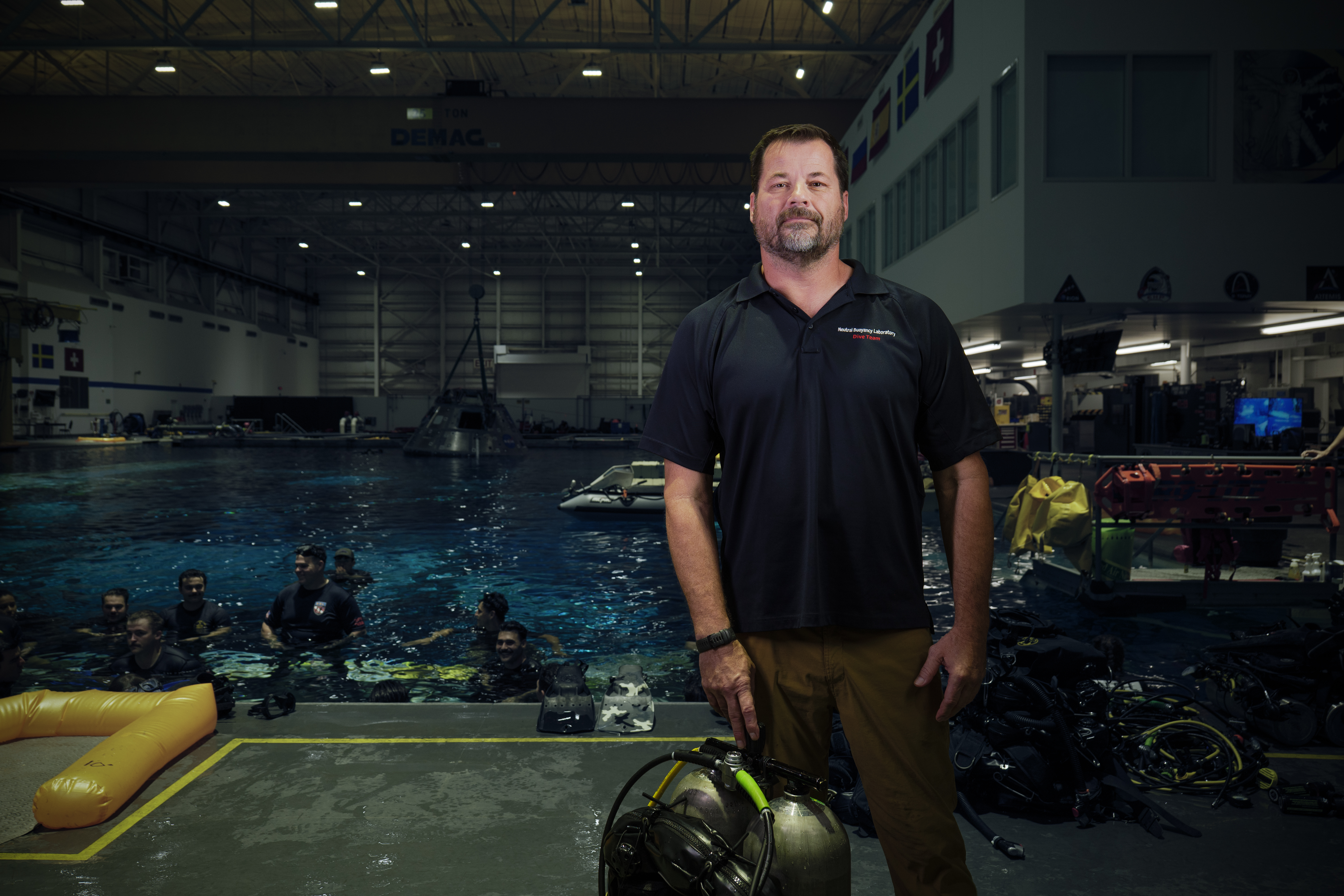
Tim Goddard, NASA open water lead, stands in the Neutral Buoyancy Laboratory (NBL) at NASA’s Johnson Space Center in Houston. Goddard conducts training in the NBL with NASA and U.S. Navy recovery teams to prepare for Orion spacecraft recovery operations. NASA/Rad Sinyak“This is a very complex set of operations,” said Goddard. “We have six small boats in the water. We’re relying on four separate helicopters and the host Navy ship at the same time. We have over 50 folks in the water and in different boats. I have team members underwater, on the surface, and small boats moving all around.”
And that’s just Goddard’s portion of the recovery — the larger operation entails coordination of activities that includes the Navy ship’s operations, communications, vessel traffic, medical needs, aviation operations, and more.
It’s a large orchestration of personnel and hardware to just enable recovery of the astronauts from the capsule — and then, we have to recover the spacecraft in the well deck of the Navy ship, which can be up to nine hours later.Tim Goddard
NASA Open Water Lead
Goddard and his team practice, practice, practice long before recovery day to ensure the complicated dance goes smoothly. They start by performing training runs with representative Orion hardware at the Neutral Buoyancy Laboratory at NASA’s Johnson Space Center in Houston, one of the world’s largest indoor pools that can support large-scale underwater and topside operations. The team then pushes out to San Diego, starting with bay operations and working their way up to open ocean conditions similar to what they’ll see on recovery day.
“By the time they do the real mission, they have hours and hours on each type of facet or each phase of that recovery,” said Goddard. “We bring them out and then we just go through repetition after repetition. When we do the real thing, it’s not their first time seeing it.”
NASA and U.S. Navy recovery teams, including NASA Open Water Lead Tim Goddard, prepare to transfer the crew to the USS John P. Murtha following the splashdown of the Orion spacecraft on April 10, 2026, marking the conclusion of the nearly 10‑day Artemis II mission around the Moon.NASA/Joel KowskyIt’s actually Goddard’s third time recovering Orion — the team recovered the capsule on Orion’s first flight, Exploration Flight Test-1 in 2014, and Artemis I, Orion’s first uncrewed test flight around the Moon in 2022.
“We were strictly focused on capsule recovery for both of those flights,” said Goddard. “Now we introduced humans to the loop with a flight crew being in the capsule. Our primary focus has shifted from recovering the capsule to recovering the crew first. Once we get the crew safe and sound on the ship, we transfer our focus and shift our operations to the recovery of the capsule.”
Goddard joined the initial Orion recovery team in 2007, and has served as the open water lead for over 10 years. He joined NASA in the 1990s after a 27-year career as a Navy diver, initially serving in dive operations in the Neutral Buoyancy Lab and then pursuing mechanical engineering.
Over half of my time at NASA has been supporting this operation. That's a long time, and to finally have the Moon mission go off and bring the folks back — it's an immense pleasure. I am very excited and proud to be able to support this mission.Tim Goddard
NASA Open Water Lead
With crew aboard, there was an immense responsibility along with the pleasure of getting them home safely for Goddard.
“There was a lot of weight and stress that the other folks and I carried,” he said. “I can tell you under the previous two missions, once we set the capsule down, that was the moment of elation and ‘I can sleep now.’ That was tenfold when we recovered the crew. Once they were recovered and the capsule was back in San Diego, I had an immense feeling of relief.”
About the AuthorErika Peters Share Details Last Updated May 20, 2026 Related Terms Explore More 4 min read NASA Outlines Preliminary Artemis III Mission Plans Article 1 week ago 3 min read I Am Artemis: Kathleen Harmon Article 1 week ago 2 min read Nicholas Houghton: Engineering Crew Safety for NASA’s Artemis Missions Article 1 week ago Keep Exploring Discover More Topics From NASAMissions
Humans in Space
Climate Change
Solar System
NASA’s Fermi Glimpses Power Source of Supercharged Supernovae
5 min read
NASA’s Fermi Glimpses Power Source of Supercharged SupernovaeAn international team studying data from NASA’s Fermi Gamma-ray Space Telescope concludes the mission detected a rare, unusually luminous supernova. The researchers say it likely received its power-up from a supermagnetized neutron star born in the stellar collapse that triggered the explosion.
Gamma rays detected by NASA’s Fermi Gamma-ray Space Telescope gave scientists a look under the hood of a rare supernova that produced much more light than normal.NASA’s Goddard Space Flight Center
Download high-resolution video and images from NASA’s Scientific Visualization Studio
The Fermi mission is part of NASA’s fleet of observatories monitoring the changing cosmos to help humanity better understand how the universe works.
“For nearly 20 years, astronomers have searched Fermi data for gamma-ray signals from thousands of supernovae, and while a few intriguing hints have been reported, none were definitive until now,” study lead Fabio Acero at the French National Centre for Scientific Research (CNRS) and the University of Paris-Saclay.
A paper describing the findings published Wednesday in the journal Astronomy & Astrophysics.
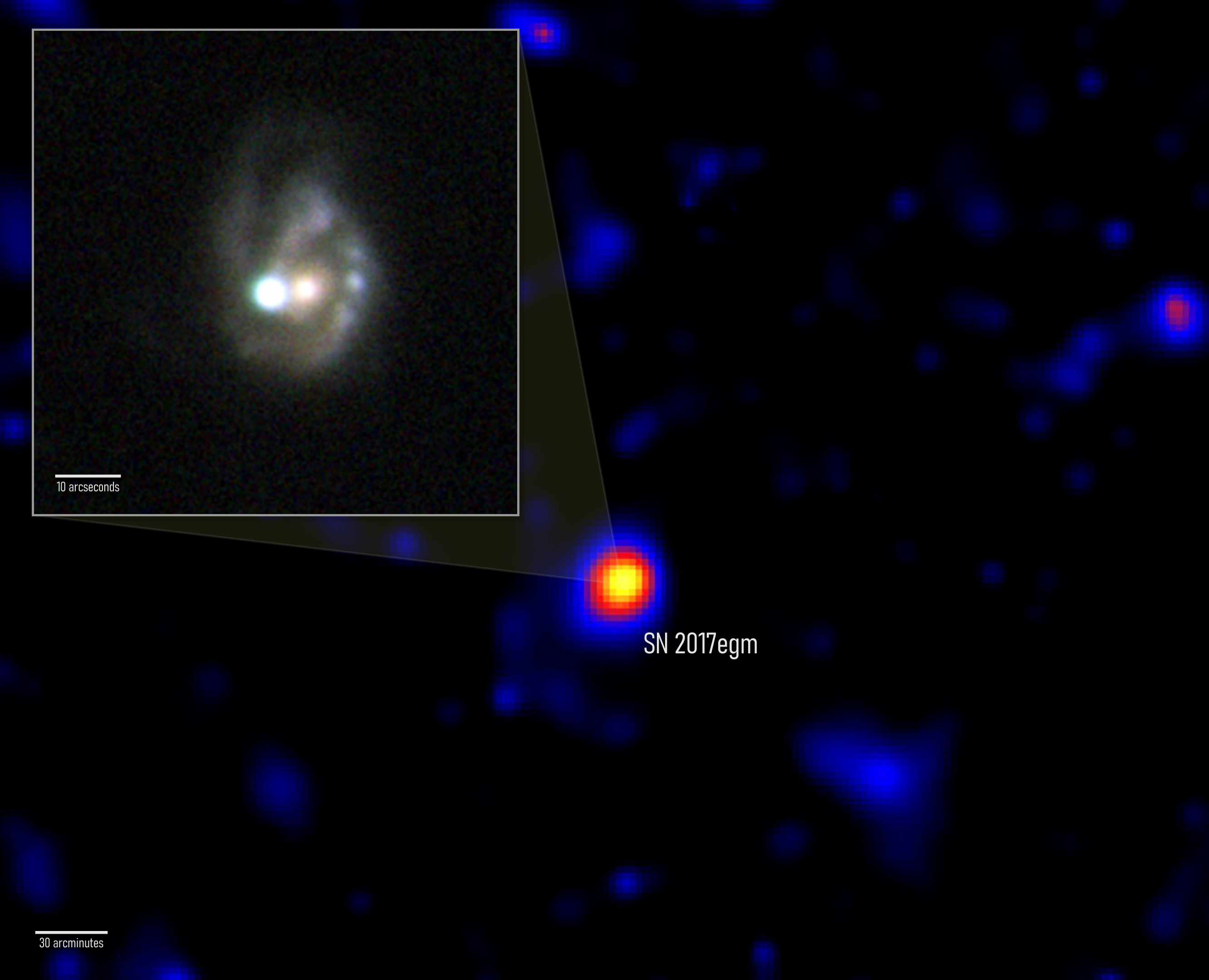
This composite image shows two views of SN 2017egm, in visible light (inset) and gamma rays (background). The optical image shows the supernova — the brightest object in the scene — and its host galaxy on July 1, 2017. The background map shows a wide area of the sky surrounding the supernova’s position. Brighter colors indicate greater statistical likelihood that gamma rays are associated with the explosion. The map includes gamma rays detected by Fermi’s Large Area Telescope from July 5, 2017, to Oct. 25, 2017, or from 43 to 155 days after the supernova was discovered. Background, NASA/DOE/Fermi LAT Collaboration and Acero et. al. 2026; inset, NOT+ALFSOC/Bose et al. 2020Core-collapse supernovae occur when the energy-producing center of a star many times our Sun’s mass runs out of fuel, collapses under its own weight, and explodes. During the collapse, a city-sized neutron star or an even smaller black hole may form. A blast wave blows away the rest of the star, which rapidly expands as a hot, dense cloud of ionized gas.
In the last couple of decades, nearly 400 exceptional core-collapse supernovae have been identified. Each of these events, dubbed superluminous supernovae, produced 10 or more times the amount of visible light normally seen.
In 2024, a study led by Li Shang at Anhui University in Hefei, China, noted that Fermi’s Large Area Telescope may have seen gamma rays — the most energetic form of light — from a superluminous supernova that occurred years earlier.
Dubbed SN 2017egm, this supercharged outburst occurred in galaxy NGC 3191, located about 440 million light-years away in the constellation Ursa Major. Even at this distance, the explosion remains one of the closest of its type to us on Earth.
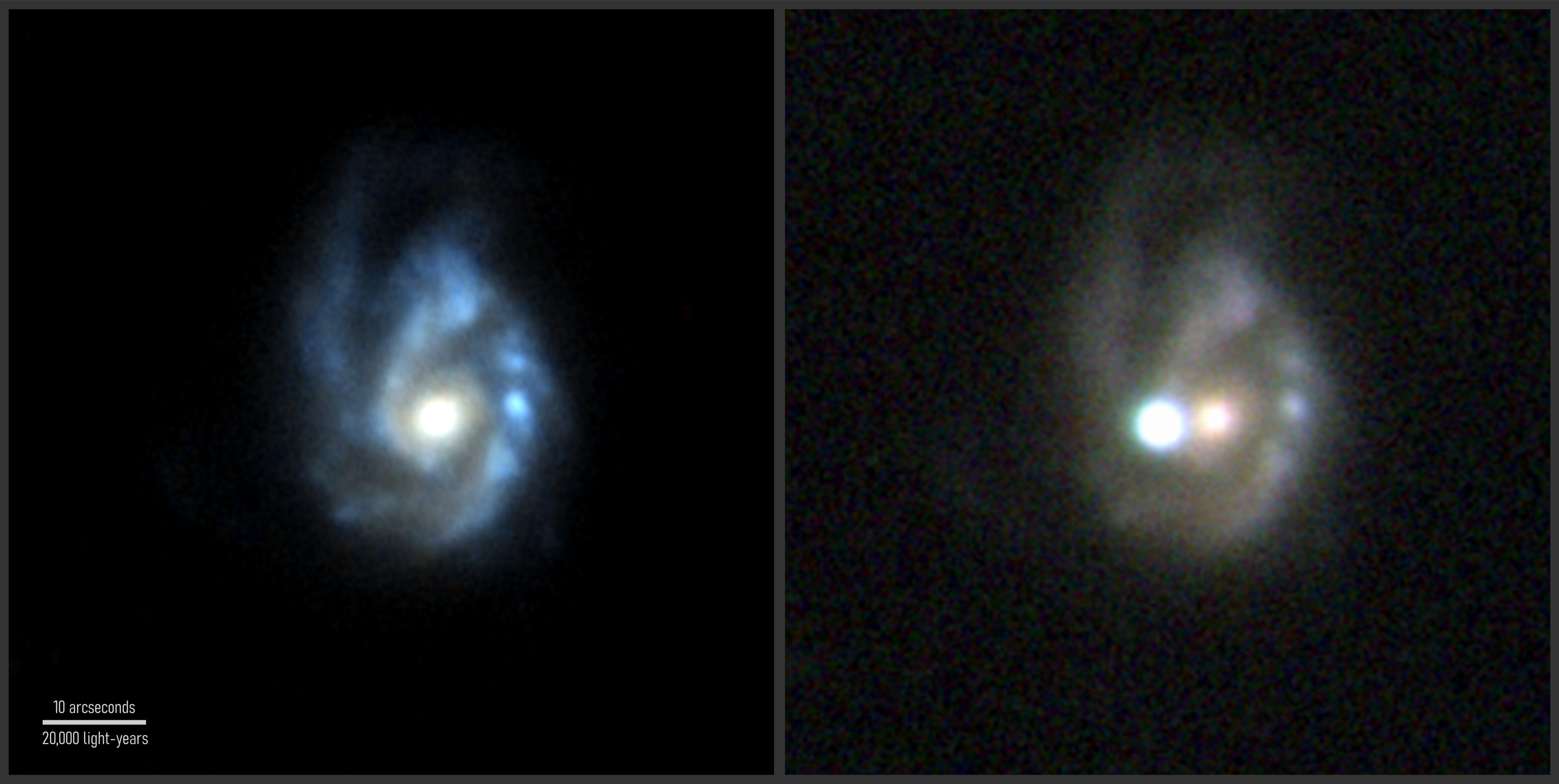
The superluminous supernova SN 2017egm was discovered by the European Space Agency’s Gaia mission on May 23, 2017. It exploded in a massive barred spiral galaxy known as NGC 3191, shown on the left before the eruption. The image at right, taken on July 1, 2017, shows the supernova outshining the entire galaxy. Left, SDSS and PS1; right, NOT+ALFSOC/Bose et al. 2020“We searched for gamma rays from the six nearest superluminous supernovae seen during the first 16 years of Fermi’s mission,” said Guillem Martí-Devesa, a researcher previously at the University of Trieste in Italy and now a fellow at the Institute of Space Sciences in Barcelona, Spain. “Only SN 2017egm shows evidence for gamma rays, confirming earlier hints that some supernovae can be as luminous in gamma rays as they are in visible light. This opens up a new window for studying these fascinating events.”
Theorists have debated the possible energy sources that give these explosions their extra punch. High on the list has been the formation of a magnetar, a type of neutron star with the strongest magnetic fields known — up to 1,000 times the intensity of typical neutron stars. That’s 10 trillion times stronger than a refrigerator magnet.
The team undertook a deeper analysis of the supernova’s observed optical and gamma-ray features to compare how well different theoretical models reproduced them. A model developed by co-authors Indrek Vurm at the University of Tartu in Estonia and Brian Metzger at Columbia University in New York City traced how light and particles produced by a newborn magnetar would move outward and interact with the supernova’s expanding debris.
Scientists expect a newly formed magnetar to spin a few hundred times a second. This rapid rotation produces a strong outflow of electrons and positrons, their antimatter counterparts, that forms a vast cloud of energetic particles.
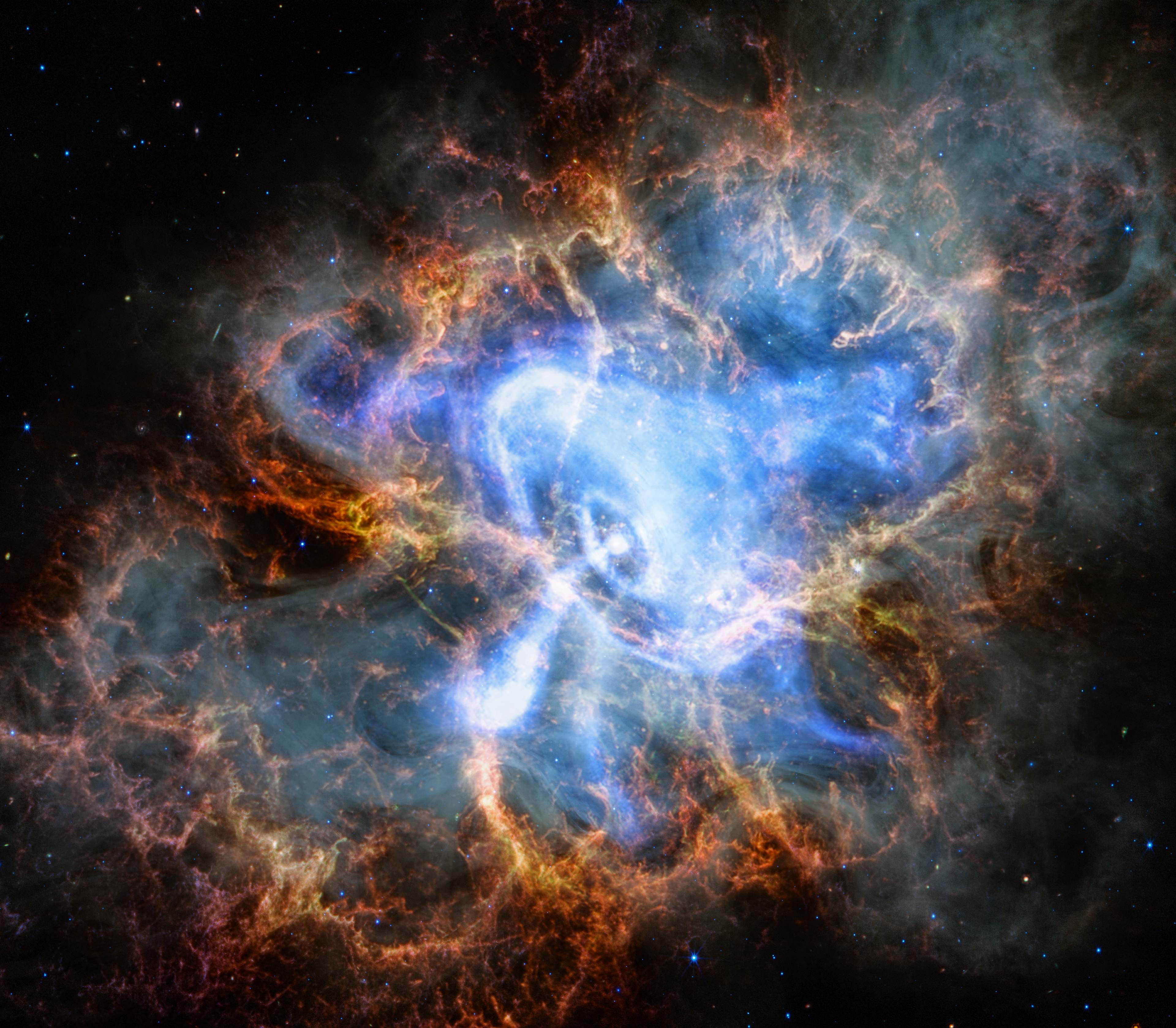
The Crab Nebula formed in a supernova explosion observed in 1054. At its heart lies an isolated neutron star, the crushed core of the original star. It spins about 30 times a second, sweeping a beam of radiation toward Earth with every rotation, lighthouse style, which classifies the neutron star as a pulsar. This rapid spin powers X-ray jets (elongated blue-white feature near center) and a high-speed outflow of electrons and other particles. The particles collect in a vast cloud-like structure called a pulsar wind nebula, which also forms around magnetars, the pulsar’s supermagnetized cousin. This emission gradually slows the neutron star’s spin. These images combine X-ray data from NASA’s Chandra X-ray Observatory (bluish white) and infrared data from NASA’s James Webb Space Telescope. X-ray, Chandra: NASA/CXC/SAO; Infrared, Webb: NASA/STScI; Image Processing: NASA/CXC/SAO/J. MajorWithin this cloud — called a magnetar wind nebula — various interactions fuel the production and absorption of gamma rays. For example, an electron and a positron can annihilate into a pair of gamma-ray photons, or two gamma rays can collide and produce the particles. In these and other ways, gamma rays interact with the supernova debris. Unable to escape directly, they become reprocessed, downshifted into lower-energy visible light that provides the supernova with its extra boost in luminosity.
“About three months after the collapse, as the supernova debris expands and cools, the gamma rays can begin to leak out,” Acero said. “This magnetar model best reproduces the supernova’s luminosity and the arrival time of its gamma rays during the first months, but we see room for improvement at later times, when the visible light fades quite irregularly.”
Acero and his colleagues suggest that additional processes likely played contributing roles during SN 2017egm’s long fade-out. These include debris falling back onto the magnetar and interactions between the blast wave and matter ejected by the star in the centuries prior to its demise.
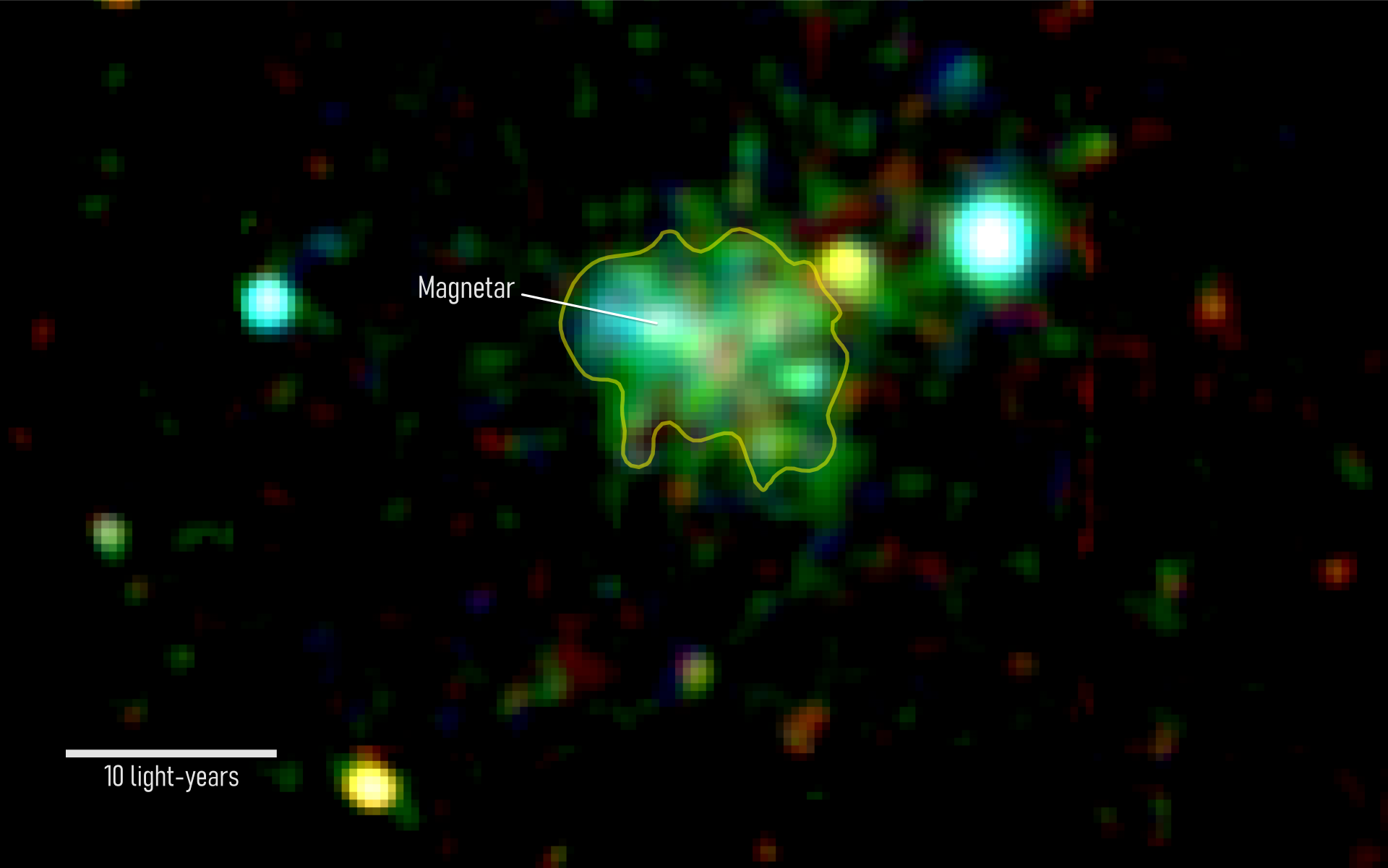
The X-ray glow associated with a source known as Swift J1834.9-0846, located near the center of the W41 supernova remnant, comes from the first magnetar wind nebula identified (outline). ESA/XMM-Newton and Younes et al. 2016The team also examined how well a new ground-based gamma-ray facility, the Cerenkov Telescope Array Observatory, might detect events like SN 2017egm. With about 50 hours of observing time, they say, a similar supernova could be detected out to about 500 million light-years. Our understanding of phenomena like SN 2017egm will improve thanks to cooperation between such facilities and NASA’s fleet of space-based observatories that watch for rapid changes in the universe.
“The magnetar central engine mechanism discussed in this paper builds upon a lot of observational and theoretical advances in magnetars over the last 20 years,” said Judy Racusin, a deputy project scientist for the Fermi mission at NASA’s Goddard Space Flight Center in Greenbelt, Maryland. “Observing gamma rays from supernovae will give us a new way to explore their inner workings.”
By Francis Reddy
NASA’s Goddard Space Flight Center, Greenbelt, Md.
Media Contact:
Claire Andreoli
301-286-1940
claire.andreoli@nasa.gov
NASA’s Goddard Space Flight Center, Greenbelt, Md.
Fire Chars Santa Rosa Island
- Earth
- Earth Observatory
- Image of the Day
- EO Explorer
- Topics
- More Content
- About
NASA’s Psyche Mission Images Mars’ Huygens Crater
NASA/JPL-Caltech/ASU Photojournal Navigation Downloads NASA’s Psyche Mission Images Mars’ Huygens Crater
PNG (3.47 MB)
Description
Captured by the multispectral imager instrument on NASA’s Psyche mission, this is an enhanced-color view of the large double-ring crater Huygens (upper right; about 290 miles, or 470 kilometers, in diameter) and the surrounding heavily cratered southern highlands near 15 degrees south latitude. The various colors in this dramatic scene are likely due to differences in the compositional properties of dust, sand, and bedrock in this ancient terrain. The image scale is around 2,200 feet (670 meters) per pixel.
The image was acquired with Imager A on May 15, 2026, at about 1:18 p.m. PDT, shortly after closest approach with the planet. The images have been processed into an enhanced-color view (to bring out color details beyond what the human eye can see) using red, green, and blue data from imager filters.
For more information about NASA’s Psyche mission, visit:
https://science.nasa.gov/mission/psyche/
Keep Exploring Discover More Topics From Photojournal
Photojournal
Search Photojournal
Photojournal’s Latest Content
Feedback
NASA’s Psyche Mission Spies Mars’ Wind-Blown Craters During Close Approach
NASA/JPL-Caltech/ASU Photojournal Navigation Downloads NASA’s Psyche Mission Spies Mars’ Wind-Blown Craters During Close Approach
PNG (1.78 MB)
Description
This view of the Martian surface, captured by NASA’s Psyche spacecraft on May 15, 2026, shows streaks that have formed due to wind blowing over impact craters in the Syrtis Major region. The image scale is nearly 1,200 feet (360 meters) per pixel. The wind streaks extend to about 30 miles (50 kilometers) long, and the large craters near center-bottom of the scene average around 30 miles in diameter.
The images have been processed into a natural-color view (approximating what the human eye would see) using red, green, and blue data from imager filters.
For more information about NASA’s Psyche mission, visit:
https://science.nasa.gov/mission/psyche/
Keep Exploring Discover More Topics From Photojournal
Photojournal
Search Photojournal
Photojournal’s Latest Content
Feedback
Psyche’s High-Resolution View of Mars’ South Pole
NASA/JPL-Caltech/ASU Photojournal Navigation Downloads Psyche’s High-Resolution View of Mars’ South Pole
PNG (1.09 MB)
Description
This is the highest-resolution view of the water ice-rich south polar cap of Mars captured by NASA’s Psyche mission after it made its close approach with the planet for a gravity assist. The image scale is around 0.7 miles per pixel (1.14 kilometers per pixel). The cap itself extends across more than 430 miles (700 kilometers). The image was acquired with Imager A on May 15, 2026, at about 1:53 p.m. PDT.
With Mars in the rearview mirror, the spacecraft will soon resume use of its solar-electric propulsion system to make a beeline to the main asteroid belt, between the orbits of Mars and Jupiter. When it arrives in August 2029, it will insert itself into orbit around the asteroid Psyche, which is thought to be the partial core of a planetesimal, a building block of an early planet.
For more information about NASA’s Psyche mission, visit:
https://science.nasa.gov/mission/psyche/
Keep Exploring Discover More Topics From Photojournal
Photojournal
Search Photojournal
Photojournal’s Latest Content
Feedback
NASA’s Psyche Mission Sees Mars’ South Pole After Flyby
NASA/JPL-Caltech/ASU Photojournal Navigation Downloads NASA’s Psyche Mission Sees Mars’ South Pole After Flyby
PNG (423.28 KB)
Description
This is Psyche’s first view of a nearly “full Mars” seen shortly after the spacecraft’s closest approach to the planet on May 15, 2026. The view extends from the south polar cap northwards to the Valles Marineris canyon system and beyond.
With Mars in the rearview mirror, the spacecraft will soon resume use of its solar-electric propulsion system to make a beeline to the main asteroid belt, between the orbits of Mars and Jupiter. When it arrives in August 2029, it will insert itself into orbit around the asteroid Psyche, which is thought to be the partial core of a planetesimal, a building block of an early planet.
For more information about NASA’s Psyche mission, visit:
https://science.nasa.gov/mission/psyche/
Keep Exploring Discover More Topics From Photojournal
Photojournal
Search Photojournal
Photojournal’s Latest Content
Feedback
NASA’s Psyche Mission Images the Crescent of Mars
NASA/JPL-Caltech/ASU Photojournal Navigation Downloads NASA’s Psyche Mission Images the Crescent of Mars
PNG (251.49 KB)
Description
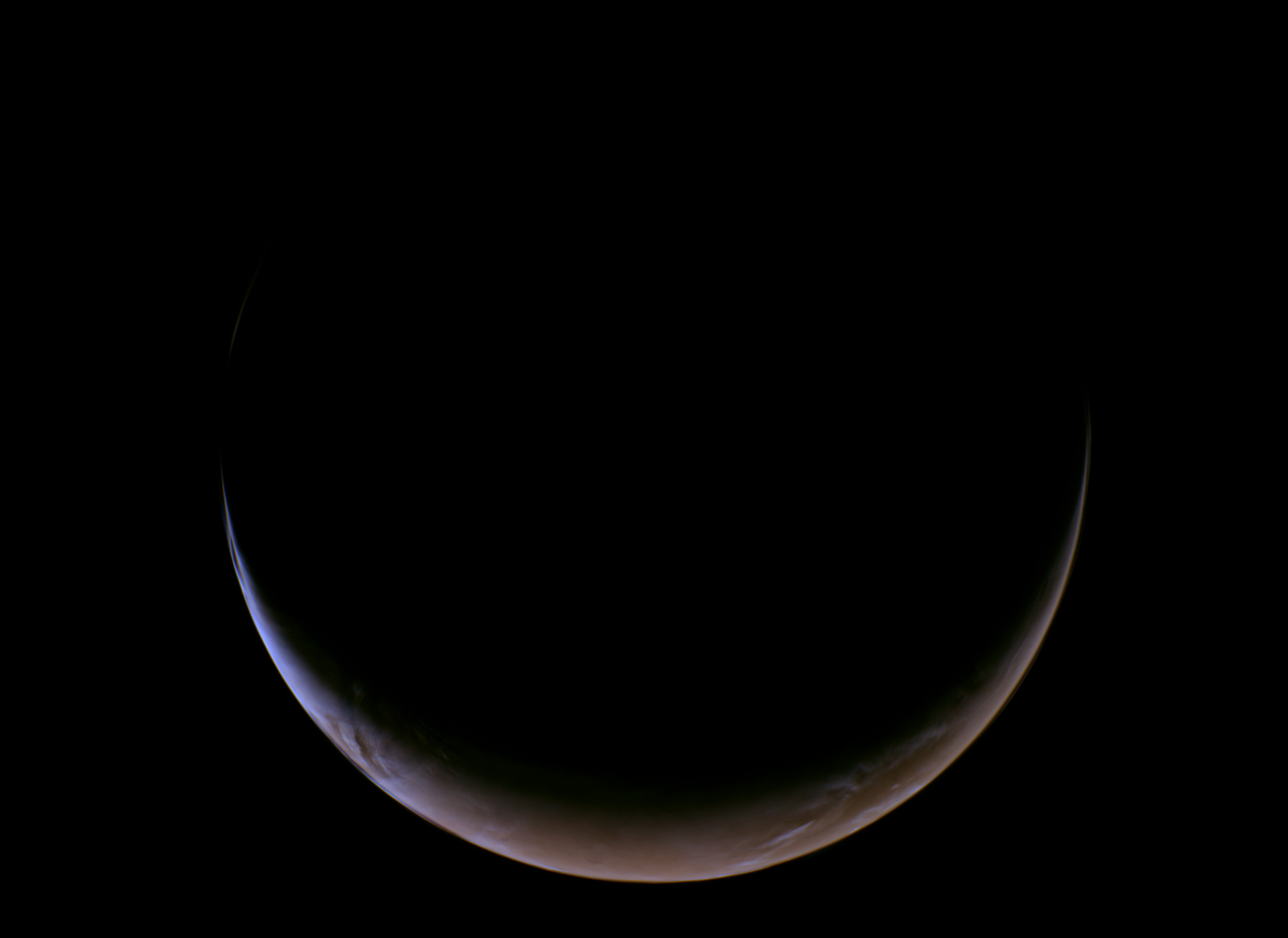
This view of a crescent Mars was captured on May 15, 2026, at about 5:03 a.m. PDT by NASA’s Psyche mission as it approached the planet for a gravity assist. Captured by the spacecraft’s multispectral imager instrument, this was the last view of the whole planet before it began to overfill the field of view of the camera.
Because Psyche approached Mars from a high phase angle, the planet appeared as a thin crescent in the days running up to the close approach, lit by sunlight reflecting off its surface. In observations from the spacecraft’s multispectral imagers, the crescent appeared brighter and extended farther around the planet’s disk than anticipated because of the strong scattering of sunlight through the planet’s dusty atmosphere.
The image was acquired with Imager A. It has been processed into a natural-color view (approximating what the human eye would see) using red, green, and blue data from imager filters.
For more information about NASA’s Psyche mission, visit:
https://science.nasa.gov/mission/psyche/
Keep Exploring Discover More Topics From Photojournal
Photojournal
Search Photojournal
Photojournal’s Latest Content
Feedback
NASA’s Psyche Mission Aces Mars Flyby, Targets Metal-Rich Asteroid
5 min read
Preparations for Next Moonwalk Simulations Underway (and Underwater) This view of a crescent Mars was captured on May 15, 2026, at about 5:03 a.m. PDT by NASA’s Psyche mission as it approached the planet for a gravity assist. The image has been processed into a natural-color view using red, green, and blue data from the multispectral imager instrument.NASA/JPL-Caltech/ASUNASA’s Psyche spacecraft completed its close approach of Mars on May 15, coming within 2,864 miles (4,609 kilometers) of the planet’s surface. This flyby used a gravity assist from Mars to provide a critical boost in speed and to adjust the spacecraft’s orbital plane without using any onboard propellant, sending it on its way toward the metal-rich asteroid Psyche.
The spacecraft is now headed directly toward the asteroid, located in the main asteroid belt between Mars and Jupiter. After the Mars flyby, the flight team analyzed radio signals between the spacecraft and NASA’s Deep Space Network (DSN), the agency’s global system for communicating with interplanetary spacecraft, to confirm that Psyche was on the correct trajectory.
“Although we were confident in our calculations and flight plan, monitoring the DSN’s Doppler signal in real time during the flyby was still exciting,” said Don Han, Psyche’s navigation lead at NASA’s Jet Propulsion Laboratory in Southern California. “We’ve confirmed that Mars gave the spacecraft a 1,000 mile‑per‑hour boost and shifted its orbital plane by about 1 degree relative to the Sun. We are now on course for arrival at the asteroid Psyche in summer 2029.”
This is the first view of a nearly “full Mars” as seen by NASA’s Psyche spacecraft shortly after its closest approach to the planet on May 15, 2026. The view extends from the south polar cap northwards to the Valles Marineris canyon system and beyond.NASA/JPL-Caltech/ASU This is the highest-resolution view of the water ice-rich south polar cap of Mars captured by NASA’s Psyche mission after it made its close approach with the planet for a gravity assist. The cap is more than 430 miles (700 kilometers) across.NASA/JPL-Caltech/ASU Unique Martian viewIn the days running up to and during close approach, all of Psyche’s instruments were powered up for calibration efforts, including its imagers, magnetometers, and gamma-ray and neutron spectrometer. The planetary encounter provided the mission a valuable practice run for when it reaches the asteroid Psyche; as a bonus, it captured Mars images from a rare perspective.
Because Psyche approached Mars from a high phase angle, the planet appeared as a thin crescent in the days running up to the close approach, lit by sunlight reflecting off its surface. In observations from the spacecraft’s multispectral imager, the crescent appeared brighter and extended farther around the planet’s disk than anticipated because of the strong scattering of sunlight through the planet’s dusty atmosphere. As Psyche passed from Mars’ nighttime skies to daytime, it took a rapid series of pictures of the surface around the time of closest approach.
“We’ve captured thousands of images of the approach to Mars and of the planet’s surface and atmosphere at close approach. This dataset provides unique and important opportunities for us to calibrate and characterize the performance of the cameras, as well as test the early versions of our image processing tools being developed for use at the asteroid Psyche,” said Jim Bell, the Psyche imager instrument lead at Arizona State University (ASU) in Tempe. “As the spacecraft continues its journey after the flyby, we’ll continue calibration imaging of Mars for the rest of the month as it recedes into the distance.”
Bell also leads the Mastcam-Z imaging investigation on NASA’s Perseverance Mars rover mission team, which was among several missions that provided complementary surface and atmospheric imaging as well as navigation data during the flyby to help with calibration efforts. Other missions involved include NASA’s Mars Reconnaissance Orbiter, 2001 Mars Odyssey orbiter, and Curiosity rover, along with ESA’s (European Space Agency’s) Mars Express and ExoMars Trace Gas Orbiter.
In addition to the imager, early calibration measurements made by Psyche’s magnetometers may have detected Mars’ bow shock as the spacecraft passed the planet. The gamma-ray and neutron spectrometer team was also quickly gathering data to calibrate the instrument by comparing their measurements with the large pool of existing Mars data.
This view of the Martian surface shows streaks that have formed due to wind blowing over impact craters in the Syrtis Major region. The wind streaks extend to about 30 miles (50 kilometers) long, and the large craters near center-bottom of the scene average around 30 miles in diameter.NASA/JPL-Caltech/ASU Captured by Psyche’s multispectral imager instrument, this is an enhanced-color view of the large double-ring crater Huygens (upper right; about 290 miles, or 470 kilometers, in diameter) and the surrounding heavily cratered southern highlands.NASA/JPL-Caltech/ASU Onward to asteroid PsycheWith Mars in the rearview mirror, the spacecraft will soon resume using its solar-electric propulsion system to make a beeline to the main asteroid belt. When it arrives in August 2029, it will insert itself into orbit around the asteroid Psyche, which is thought to be the partial core of a planetesimal, a building block of an early planet. Through a series of circular orbits that go lower and then higher in altitude around Psyche, which is about 173 miles (280 kilometers) across at its widest point, the spacecraft will map the asteroid and gather science data.
If the asteroid proves to be the metallic core of an ancient planetesimal, it could offer a one-of-a-kind window into the interior of rocky planets like Earth.
“We’ve been anticipating the Mars flyby for years, but now it’s complete. We can thank the Red Planet for giving our spacecraft a critical gravitational slingshot farther into the solar system,” said Lindy Elkins-Tanton, principal investigator for Psyche at the University of California, Berkeley. “Onward to the asteroid Psyche!”
More about PsycheThe Psyche mission is led by ASU. A division of Caltech in Pasadena, JPL is responsible for the mission’s overall management, system engineering, integration and test, and mission operations. Intuitive Machines in Palo Alto, California, provided the high-power solar electric propulsion spacecraft chassis. The operations of the imager instrument are led by ASU, collaborating with Malin Space Science Systems in San Diego on the design, fabrication, and testing of the cameras.
Psyche is the 14th mission selected as part of NASA’s Discovery Program, managed by the agency’s Marshall Space Flight Center in Huntsville, Alabama. NASA’s Launch Services Program, based at NASA’s Kennedy Space Center in Florida, managed the launch service.
For more information about NASA’s Psyche mission, visit:
https://science.nasa.gov/mission/psyche/
News Media Contacts
Ian J. O’Neill
Jet Propulsion Laboratory, Pasadena, Calif.
818-354-2649
ian.j.oneill@jpl.nasa.gov
Karen Fox / Molly Wasser
NASA Headquarters, Washington
240-285-5155 / 240-419-1732
karen.c.fox@nasa.gov / molly.l.wasser@nasa.gov
2026-033
Share Details Last Updated May 19, 2026 Related Terms Explore More 1 min read NASA’s Psyche Mission Images Mars’ Huygens CraterDescription Captured by the multispectral imager instrument on NASA’s Psyche mission, this is an enhanced-color…
Article 6 hours ago 1 min read NASA’s Psyche Mission Spies Mars’ Wind-Blown Craters During Close ApproachDescription This view of the Martian surface, captured by NASA’s Psyche spacecraft on May 15,…
Article 6 hours ago 1 min read Psyche’s High-Resolution View of Mars’ South PoleDescription This is the highest-resolution view of the water ice-rich south polar cap of Mars…
Article 6 hours ago Keep Exploring Discover Related Topics Psyche SpacecraftPsyche is a NASA mission to study a metal rich asteroid with the same name located in the main asteroid…
Asteroids, Comets & MeteorsOverview Asteroids, comets, and meteoroids are chunks of rock, ice, and metal left over from the formation of our solar…
Mars ExplorationMars is the only planet we know of inhabited entirely by robots. Learn more about the Mars Missions.
Planetary ScienceNASA’s planetary science program explores the objects in our solar system to better understand its history and the distribution of…
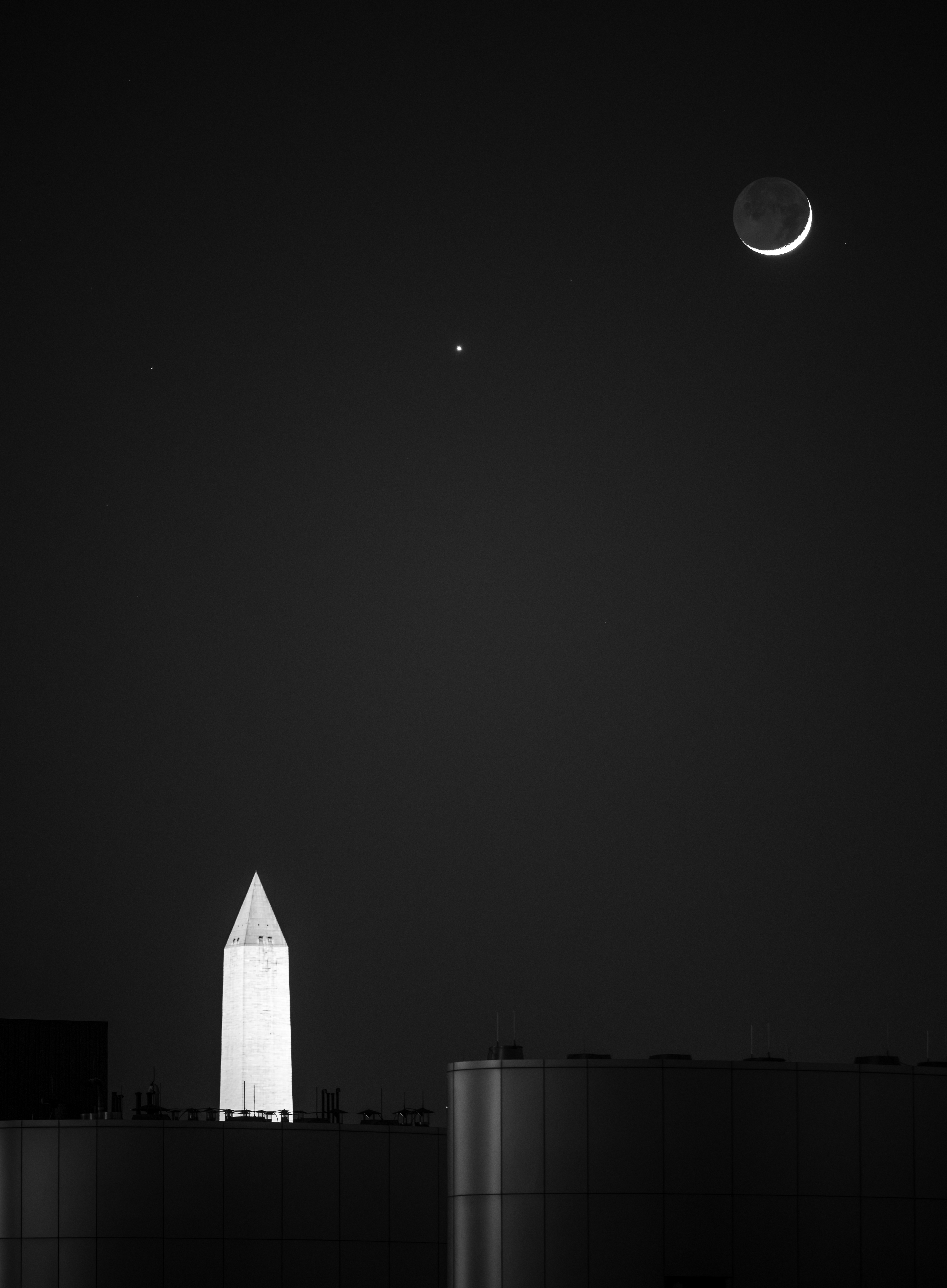
Moon-Venus Conjunction
The Moon and Venus, center, are seen in conjunction above the Washington Monument, Monday, May 18, 2026, as viewed from the Mary W. Jackson NASA Headquarters Building in Washington.
The Moon and Venus look close together because they line up from our point of view on Earth. In reality, they are separated by millions of miles in space.
See more photos of the conjunction.
Image credit: NASA/Bill Ingalls
Johnson’s Cindy Evans Prepares Artemis Teams for Lunar Science
NASA’s Artemis II crew had many technical and operational responsibilities during their historic mission to the Moon, but they also served an important role as scientific ambassadors to Earth’s nearest neighbor.
On their 10-day journey, the crew flew by the far side of the Moon, analyzing and photographing geologic features such as impact craters and ancient lava flows. Their observations will help pave the way for science activities on future Artemis missions to the Moon’s surface and contribute to lunar and planetary science. The crew relied on the extensive geology training they received on Earth to describe nuances in shapes, textures, and colors — the type of information that reveals the geologic history of an area.
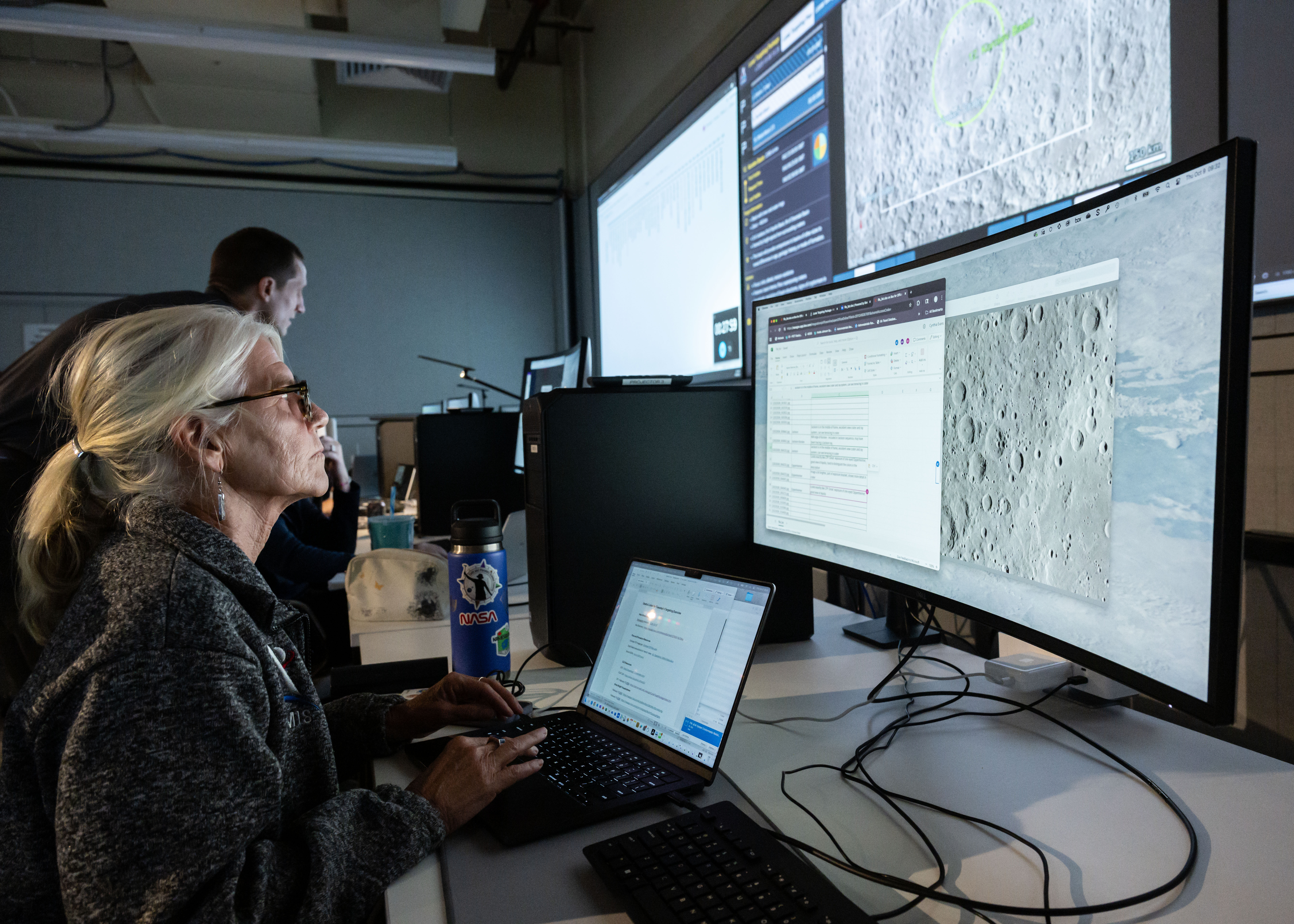
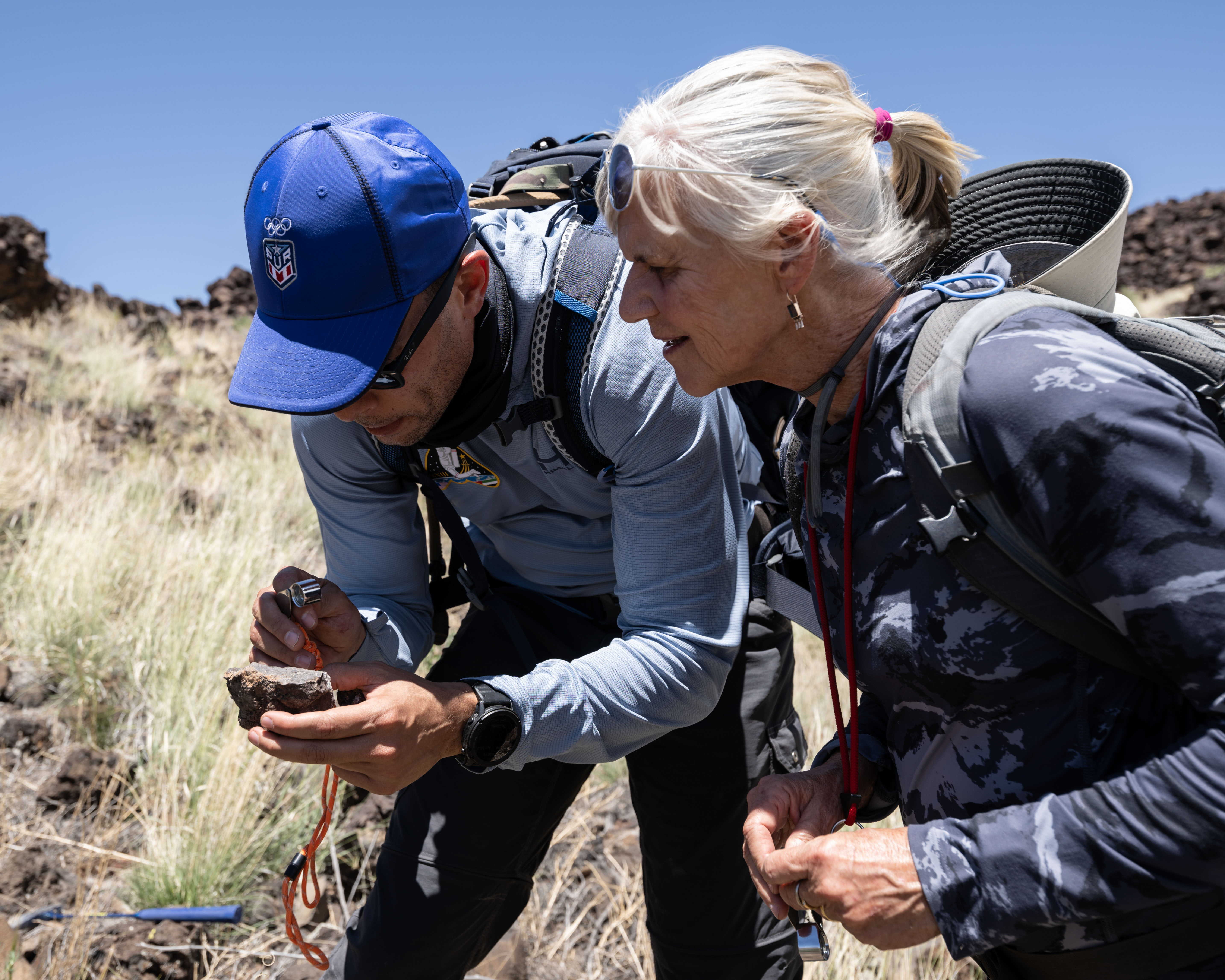
Artemis geology training lead at NASA’s Johnson Space Center in Houston, Cindy Evans (left) and NASA astronaut and Artemis II mission specialist Christina Koch study geologic features in Iceland during Artemis II crew geology training in August 2024. NASA/Robert MarkowitzCindy Evans, Artemis exploration scientist and geology training lead, was one of the crew’s instructors. Based at NASA’s Johnson Space Center in Houston in the Astromaterials Research and Exploration Science (ARES) Division, Evans is part of the Artemis Internal Science Team and spearheads geology training for crew members, mission managers, engineers, and flight controllers. That effort centers around a core curriculum of geology, lunar, and planetary classroom science as well as a progression of geology-focused field classes.
“As the scientists ‘on the ground,’ Artemis crew members require geology and field skills so that they can execute the mission science requirements from lunar orbit and on the surface of the Moon,” Evans explained. “Whether they’re looking out the spacecraft’s windows or walking the surface, Artemis astronauts are working on behalf of all scientists to collect clues to the ancient geologic processes that shaped the Moon and our solar system. They need to have the muscle memory and confidence in their geology knowledge to conduct the geology observations, sampling, and other scientific tasks.”
Cindy Evans during an Artemis II Lunar Science Team simulation at Johnson Space Center. The team used simulations to practice mission operations support for real-time assessment of imagery and observations made by the Artemis II crew. NASA/James BlairA former oceanographer who studied the rocks comprising oceanic crust, Evans imagined that she would explore the Moon as a NASA astronaut one day. That dream led her to Johnson, even if it did not result in her donning a flight suit.
In her 37 years with the agency, Evans contributed to the Space Shuttle Program, Shuttle-Mir Program, and the International Space Station before transitioning to NASA’s Artemis campaign. Some of her notable achievements include establishing the Crew Earth Observations effort for Shuttle-Mir, which equipped crews to photograph the Earth as it changed below them. As part of the imagery team investigating the Columbia accident, she helped to develop and integrate the space shuttle’s Return to Flight imagery inspection process. “I have been both honored and incredibly fortunate to have participated in a wide variety of human spaceflight programs,” Evans said. “And I am very proud of the work my team is doing right now.”
Evans also had two opportunities to travel to Antarctica to participate in deep-field geology sessions. “Few things in this world are as wonderful as camping on blue ice just a couple hundred miles from Earth’s South Pole and collecting rocks from space,” she said.
Cindy Evans collects a meteorite from the Davis Ward Icefield during a deep-field deployment to Antarctica. Cindy EvansCollaborating with professionals across a variety of fields has been an integral part of Evans’ work since the start of her career. “In graduate school I was trained as an oceanographer – an interdisciplinary field where geology meets biology, chemistry, and physical oceanography,” she said. “As a planetary scientist at Johnson, I am challenged to work in a world of engineers, and embrace the complex teamwork between hardware engineers, operations engineers, management – many of whom are engineers – and scientists. It has been an incredible opportunity.”
Those interdisciplinary experiences taught Evans to embrace flexibility. “Human spaceflight is a dynamic endeavor,” she said. “I have enjoyed many different roles, and each and every position taught me new things and stretched my perspective.”
Cindy Evans mentors NASA astronaut Marcos Berríos in observing and describing rock samples during an in-field geology training in Flagstaff, Arizona. NASA/Riley McClenaghanAnother important lesson? “As a former lab rat, I have learned that it’s all about the people. A common thread throughout my career at NASA is the professional fulfillment brought by relationships with and the talents of colleagues and teammates,” she said.
Evans encourages early-career and aspiring NASA team members to reach out to colleagues in different organizations to build connections. “You never know where a pathway will lead,” she said. “Plans can change – don’t pass up opportunities! Even if an opportunity isn’t an obvious or intuitive next step, it’s worth your consideration.”
About the AuthorLinda E. Grimm Share Details Last Updated May 19, 2026 Related Terms Explore More 3 min read Johnson Photographers Honored for Award-Winning Portraits Article 1 day ago 4 min read NASA Outlines Preliminary Artemis III Mission Plans Article 6 days ago 6 min read NASA Langley Engineer Attends FAA Training Article 1 week ago Keep Exploring Discover More Topics From NASAMissions
Humans in Space
Climate Change
Solar System
NASA’s New Shock Detectives Project Invites Volunteers to Help Study Solar Wind
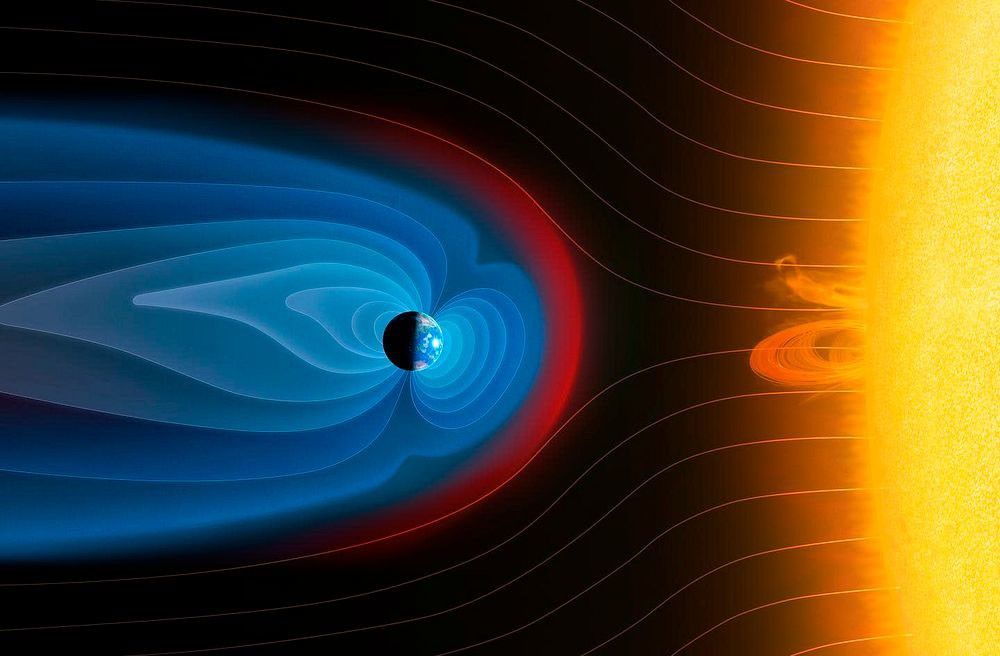
The Sun sprays an extremely fast stream of charged particles called the solar wind. At approximately 56,000 miles (90,000 kilometers) in front of the Earth toward the Sun, the solar wind collides with the Earth’s protective magnetic field, generating a long-lasting shock wave that stretches for hundreds of thousands of miles. Now, you can help scientists examine data about this “bow shock” to better understand how the solar wind affects the Earth by joining a new research project: Shock Detectives.
At this enormous shock wave boundary, the ever-changing magnetic field can either make the solar wind messy and dynamic (“chaotic”) or leave it smooth and stable (“peaceful”).
When “chaotic” plasma dominates, more energy can reach Earth’s magnetosphere, possibly leading to disruptions in GPS signals, communications, and power grids. Scientists don’t yet fully understand when the plasma changes between “peaceful” and “chaotic” states or how those changes affect energy transfer to Earth.
You can help solve this mystery. NASA’s Magnetospheric Multiscale (MMS) mission has collected more than ten years of data from this zone – more than scientists can analyze alone. As Shock Detectives, you’ll help sort the chaotic from peaceful regions of the data, giving researchers a crucial set of clues.
The value of this new knowledge doesn’t end at Earth – what scientists learn about the Earth-Sun bow shock will help them understand how the solar wind of other stars impacts their orbiting planets. Your contributions may help take Shock Detectives ‘out of this world’!
This project is closely connected to another NASA-supported project, Space Umbrella, which also relies on MMS data and imagery. While Space Umbrella focuses on the broad boundary between Earth’s magnetic shield and the surrounding solar wind, Shock Detectives zooms in just outside that boundary on the transition region, which can be upwards of 10 miles (17 kilometers) in thickness, to better understand how plasma behaves near the shock. Together, these efforts build a more complete picture of Earth’s space environment.
Join Shock Detectives and help crack the case here: https://go.nasa.gov/4wILD6Y
Want a quick overview? Check out the introduction video.
The Earth’s magnetosphere (blue) interacts with the solar wind,, creating a shock wave (red), like a sonic boom in space. Join the Shock Detectives project and help scientists study this region and better understand how the solar wind affects our livesMark Garlick/Science Photo Library via Getty ImagesFarming in Ancient Lake Agassiz
- Earth
- Earth Observatory
- Image of the Day
- EO Explorer
- Topics
- More Content
- About
Curiosity Blog, Sols 4893-4899: Drilling at Campo Marte and a Visit From the Psyche Spacecraft
- Curiosity Home
- Science
- News and Features
- Multimedia
- Mars Missions
- Mars Home
3 min read
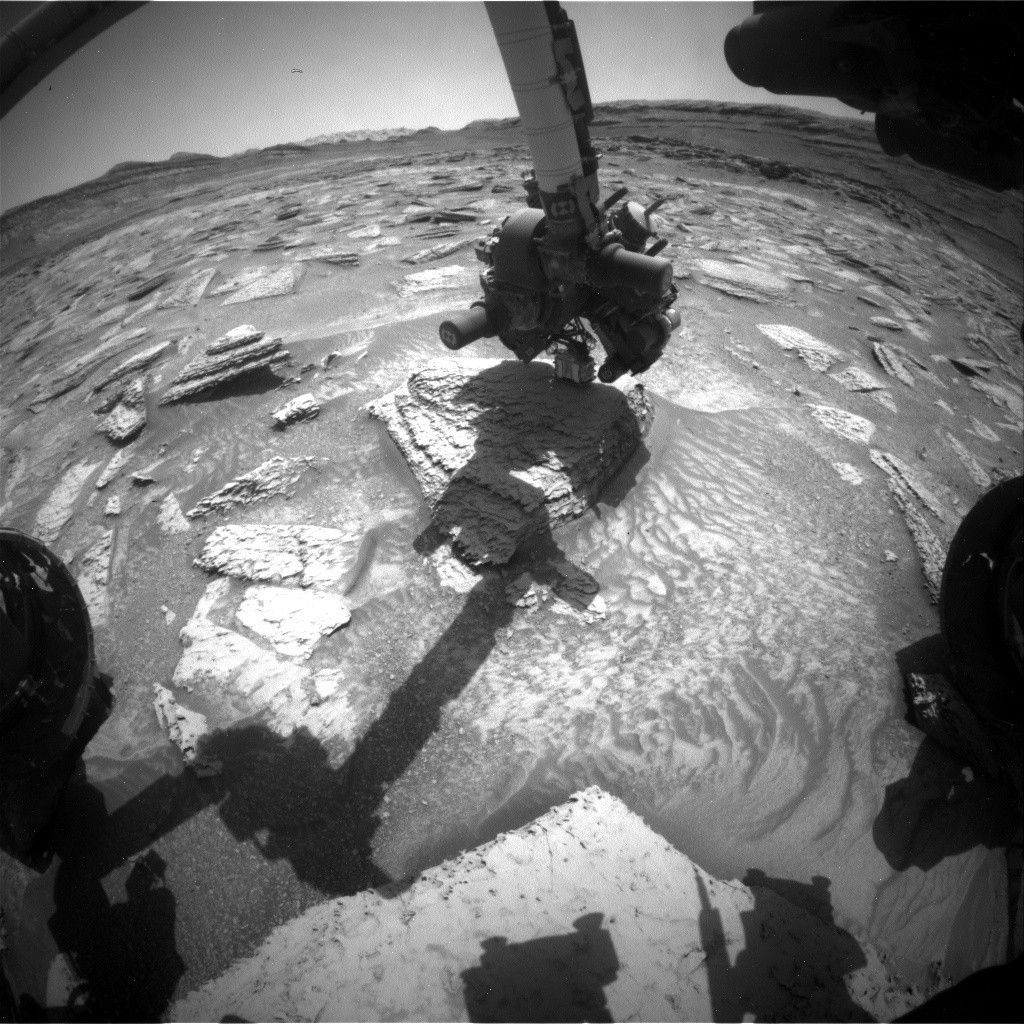
Curiosity Blog, Sols 4893-4899: Drilling at Campo Marte and a Visit From the Psyche Spacecraft NASA’s Mars rover Curiosity acquired this image, as the rover used its APXS instrument to measure the composition of the “Campo Marte” block in preparation for drilling. Curiosity captured the image using its Front Hazard Avoidance Camera (Front Hazcam) on May 14, 2026 — Sol 4895, or Martian day 4,895 of the Mars Science Laboratory mission — at 16:29:02 UTC. NASA/JPL-CaltechWritten by Lucy Lim, Planetary Scientist at NASA Goddard Space Flight Center
Earth planning date: Friday, May 15, 2026
After freeing the rover’s arm from the “Atacama” block, we are ready to drill again! The new drill target will represent the same geologic stratum as Atacama, which is the layered sulfate unit above the boxwork structures. We’ve named the new block “Campo Marte” after a natural red sandstone feature in Bolivia, following the theme of choosing target names in this Martian quadrangle from locations near the Uyuni region in South America. The name can be literally translated from Spanish as “Field of Mars” or “Mars Field,” appropriate for a target on Mars. In preparation for drilling, we measured the composition of Campo Marte with the ChemCam LIBS and the APXS as well as obtaining close-up imaging with MAHLI. Additional LIBS rasters provided geochemical data on nearby blocks, including a couple of vein and nodule-like features. As we’ve seen in several rover stops in this unit, the “Paso Malo” block and several others are covered in a prominent polygonal texture.
We’ve also imaged the Campo Marte block from several angles and determined that it’s substantially thicker than the Atacama block, so we’re hoping that its greater mass will keep it on the ground after drilling so that we can withdraw the drill bit normally this time. The team did get some interesting data on the volume and density of the Atacama block from our little adventure but we don’t feel the need to repeat that particular experiment.
In the meantime, we had a chance to support another solar system exploration mission as the Psyche spacecraft flew close by Mars in order to pick up a gravitational boost on its way to the main asteroid belt.
The Psyche spacecraft’s eventual destination is the asteroid 16 Psyche, one of the largest members of an unusual spectral category of asteroids that hasn’t yet been visited by a spacecraft. Although 16 Psyche is expected to be quite different from Mars as a science target (for example, it is too small to maintain a Mars-like atmosphere) this flyby was still a valuable opportunity to exercise the spacecraft’s instruments and data analysis pipelines, and validate their calibration. Because of this the Curiosity team planned an extra set of atmospheric observations timed to coordinate with the Psyche flyby: a zenith movie with Navcam to document clouds and a Mastcam solar observation to measure atmospheric opacity. The Mastcam was also supported by a fresh set of calibration data. Together with other coordinated observations from the Mars orbiters and Perseverance rover, these are intended to contribute to the Psyche instrument validation effort.
-
Want to read more posts from the Curiosity team?
-
Want to learn more about Curiosity’s science instruments?
Article
7 days ago
3 min read Curiosity Blog, Sols 4879-4885: Struggle at Atacama
Article
2 weeks ago
2 min read Curiosity Blog, Sols 4873-4878: Welcome to the Atacama Drill Target
Article
3 weeks ago
Keep Exploring Discover More Topics From NASA Mars
Mars is the fourth planet from the Sun, and the seventh largest. It’s the only planet we know of inhabited…
All Mars Resources
Explore this collection of Mars images, videos, resources, PDFs, and toolkits. Discover valuable content designed to inform, educate, and inspire,…
Rover Basics
Each robotic explorer sent to the Red Planet has its own unique capabilities driven by science. Many attributes of a…
Mars Exploration: Science Goals
The key to understanding the past, present or future potential for life on Mars can be found in NASA’s four…
Johnson Photographers Honored for Award-Winning Portraits
Three photographers at NASA’s Johnson Space Center who inspire the world through visual storytelling earned top honors in the portrait category at the 2025 NASA Imagery Experts Program Annual Awards.
“Congratulations to all three on this impressive achievement and for capturing such breathtaking imagery,” said Johnson Director Vanessa Wyche. “Their work represents the collaboration, precision, and creativity that drive human space exploration forward.”
David DeHoyos, Josh Valcarcel, and Bill Stafford were recognized during the award ceremony held April 20, 2026, in Las Vegas.
From engineering tests to astronaut training to mission control operations, these photographers document the people and work central to NASA’s human spaceflight mission.
First place: David DeHoyos ESA (European Space Agency) astronaut Sophie Adenot pauses for a pensive moment during her official NASA portrait session at Johnson Space Center in Houston.NASA/David DeHoyos Sophie is so kind and friendly with a beautiful presence. Being around her made everyone feel good, which allowed my creativity to flow.David Dehoyos
NASA Photographer
Portrait of NASA photographer David DeHoyos.A Houston native, born in 1963, David DeHoyos’ life has been deeply shaped by the city’s dual legacy of arts and aerospace.
DeHoyos graduated from Houston’s High School for the Performing and Visual Arts in 1981 with a specialization in photography. After spending a decade refining his technical craft in photo labs, he joined Johnson’s photography department in 1991.
“This opportunity represented the fulfillment of a lifelong ambition,” said DeHoyos. “Growing up during the fervor of the Apollo era, I always dreamed of contributing to NASA’s mission. I am so honored and blessed to be amongst a team of wonderful people and, more importantly, friends.”
Second place: Josh Valcarcel NASA astronaut Jessica Meir poses with an Extravehicular Mobility Unit (EMU) spacesuit during an official portrait session.NASA/Josh Valcarcel Jessica’s quiet presence reflects years of preparation, passion, and responsibility. She understands, more clearly than most of us ever will, the fragility of the body, the precision of systems, and the narrow margins within which exploration unfolds.Josh Valcarcel
NASA Photographer
Portrait of NASA scientific photographer Josh Valcarcel.Josh Valcarcel has worked as a professional photographer and videographer for over 20 years and has been a scientific photographer at Johnson since 2017. He previously served as a staff photographer and photo editor at WIRED magazine and as a mass communication specialist in the U.S. Navy, capturing stories from flight deck operations to remote island nations across the Pacific.
“As a NASA photographer, I’ve had the privilege of witnessing impossible dreams become reality every day,” said Valcarcel. “That experience has shown me that with the right vision, culture, and trust, what once seemed impossible can become part of everyday life.”
Third place: Bill Stafford Expedition 74 crew member Christopher Williams in an EMU spacesuit.NASA/Bill Stafford There’s a stillness and quiet resolve in Chris’ expression that says everything about who he is and what he’s about to do.Bill Stafford
NASA Photographer
Portrait of NASA scientific photographer Bill Stafford.A Texas native and 1999 graduate of East Texas A&M University, Bill Stafford has served as a photographer and videographer for NASA since graduation, documenting over two decades of the nation’s space exploration milestones.
In addition to his work with NASA, Stafford teaches photography at the Gilruth Center. He is passionate about sharing his expertise and helping others develop their skills behind the lens.
“Photography is how I find meaning in the moments around me, and working at NASA has given me a front-row seat to some of the most remarkable stories of our time,” said Stafford. “My job is to slow things down long enough to find the moment inside the moment: the small details that tell the bigger story.”
Explore More 2 min read Nicholas Houghton: Engineering Crew Safety for NASA’s Artemis Missions Article 1 week ago 3 min read Industry Moon Lander Training Cabin Lands at NASA for Artemis Article 2 weeks ago 2 min read Blue Origin Moon Lander Completes Testing at NASA Vacuum Chamber Article 2 weeks agoNASA’s MAVEN Makes 1st Discovery of Atmospheric Effect at Mars
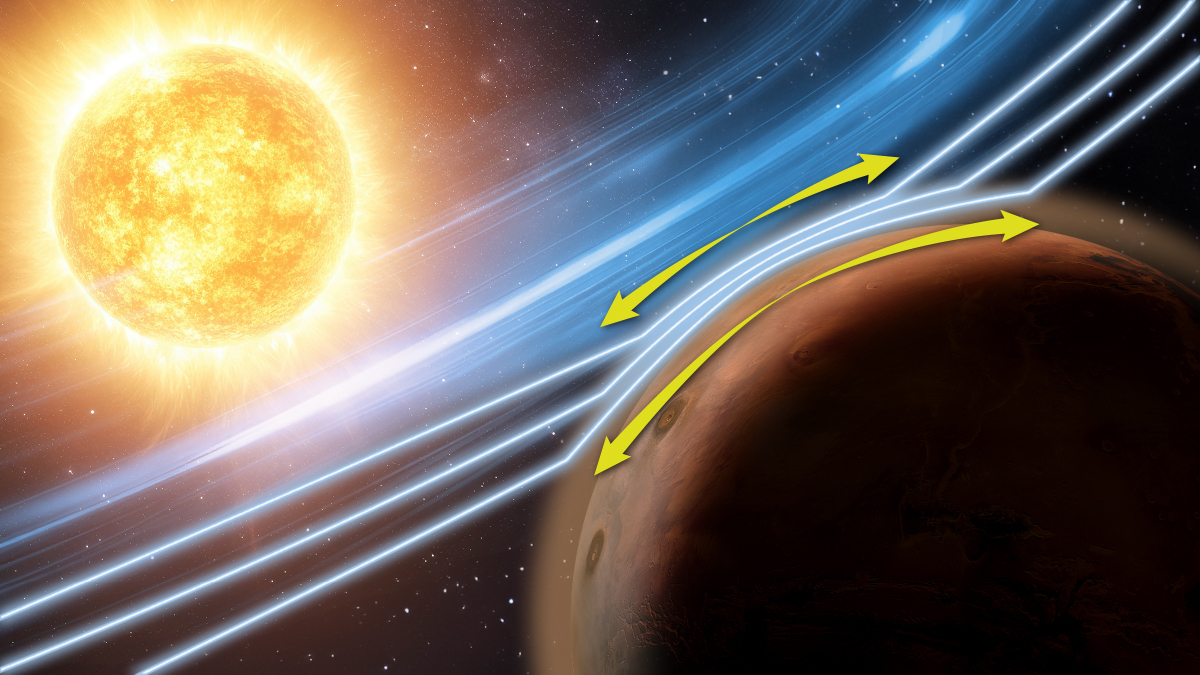
In December 2023, scientists looking at Mars data stumbled across something completely unexpected — observations of an atmospheric effect never before seen in the Red Planet’s atmosphere. Using instruments aboard NASA’s MAVEN (Mars Atmosphere and Volatile Evolution) mission, scientists identified a phenomenon known to occur in Earth’s magnetosphere, where charged particles are squeezed like toothpaste coming out of a tube along magnetic structures called flux tubes. This so-called Zwan-Wolf effect aids in the deflection of solar wind around Earth and has been observed and studied there for decades. Now, a new study published in Nature Communications provides the first comprehensive observations of the same effect in Mars’ atmosphere.
An artistic representation of the Zwan-Wolf effect at Mars, as observed by NASA’s MAVEN (Mars Atmosphere and Volatile Evolution) mission. While this effect typically helps to deflect the solar wind at Earth, at Mars it is shown to “squeeze” the atmosphere and have implications on how space weather interacts with the planet. The yellow arrows represent the movement of the effect in the Martian atmosphere. LASP/CU Boulder“When investigating the data, I all of a sudden noticed some very interesting wiggles,” said Christopher Fowler, a research assistant professor at West Virginia University in Morgantown and lead author of the study. “I would never have guessed it would be this effect, since it’s never been seen in a planetary atmosphere before.”
The Zwan-Wolf effect was first discovered in 1976, and until now has only been observed in planetary magnetospheres, not their atmospheres. Unlike Earth, Mars is not protected by a global magnetic field, affecting how it interacts with the solar wind and space weather. In this new study, the Zwan-Wolf effect was observed in the ionosphere — deep within the Martian atmosphere below 200 km — which contains significant numbers of electrically charged particles. The data showed that these charged particles were being squeezed and distributed around Mars’ atmosphere.
Although Mars has an induced magnetosphere, a magnetic field generated by the solar wind interacting with the Martian ionosphere, it can greatly change in size and shape with large solar wind and space weather events. That is what Fowler and his team saw in the MAVEN data when a large solar storm hit Mars. Based on their findings, the Zwan-Wolf effect may be occurring constantly in the Martian ionosphere but at levels undetectable by MAVEN’s instrumentation. The impact of the space weather event appears to have amplified the effect, allowing the scientists to observe it in the data.
In the beginning, Fowler and his team came across some interesting-looking fluctuations in measurements of the magnetic field as the spacecraft flew through the atmosphere. To explain this, they dug into observations made by several instruments on MAVEN, including measurements of the charged particle environment in the ionosphere. Their sleuthing uncovered even more weird and interesting features in the data. After ruling out several other possibilities, the team was able to identify the culprit as the Zwan-Wolf effect, which explained all the features they were seeing.
“No one expected that this effect could even occur in the atmosphere,” said Fowler. “That’s what makes this even more exciting. It introduces interesting physics that we haven’t yet explored and a new way the Sun and space weather can change the dynamics in the Martian atmosphere.”
Understanding the Zwan-Wolf effect at Mars will further our understanding of how space weather affects the planet and provides new insight into how this effect might occur at similar unmagnetized bodies, such as Venus and Saturn’s moon Titan. Observations like this also highlight the importance of knowing how large space weather events can lead to changes in the environment at and around the Red Planet and potentially affect assets on or near Mars.
“Knowing how space weather interacts with Mars is essential,” said Shannon Curry, the principal investigator of MAVEN and research scientist at the Laboratory for Atmospheric Space Physics at the University of Colorado Boulder. “The MAVEN team continues making new discoveries with our datasets and finding these links between our host star and the Red Planet.”
The MAVEN spacecraft launched in November 2013 and entered Mars’ orbit in September 2014. The mission’s goal is to explore the planet’s upper atmosphere, ionosphere, and interactions with the Sun and solar wind to explore the loss of the Martian atmosphere to space. Understanding atmospheric loss gives scientists insight into the history of the Red Planet’s atmosphere and climate, liquid water, and planetary habitability. The MAVEN spacecraft, in orbit around Mars, experienced a loss of signal with ground stations on Earth on Dec. 6, 2025. In Feb. 2026, NASA launched an anomaly review board to assess the probable current state of the spacecraft and the likelihood of its recovery.
The MAVEN mission is part of NASA’s Mars Exploration Program portfolio. The mission’s principal investigator is based at the Laboratory for Atmospheric and Space Physics at the University of Colorado Boulder, which is also responsible for managing science operations and public outreach and communications. NASA’s Goddard Space Flight Center in Greenbelt, Maryland, manages the MAVEN mission. Lockheed Martin Space built the spacecraft and is responsible for mission operations. NASA’s Jet Propulsion Laboratory in Southern California provides navigation and Deep Space Network support.
By Willow Reed
Laboratory for Atmospheric and Space Physics, University of Colorado Boulder
Media contacts:
Karen Fox / Alana Johnson
Headquarters, Washington
240-285-5155 / 202-672-4780
karen.c.fox@nasa.gov / alana.r.johnson@nasa.gov
Sarah Frazier
Goddard Space Flight Center, Greenbelt, Md.
sarah.frazier@nasa.gov