NASA - Breaking News

Gravity Waves From Super Typhoon Sinlaku
- Earth
- Earth Observatory
- Image of the Day
- EO Explorer
- Topics
- More Content
- About
NASA Awards Contract for Johnson Space Center Infrastructure
NASA has selected seven companies to provide construction, revitalization, and infrastructure improvements at the agency’s Johnson Space Center in Houston.
The Johnson Space Center Multiple Award Construction Contract supports up to $300 million in upgrades to mission‑support facilities, utilities, and equipment across the NASA Johnson campus. All funds must be obligated by Sept. 30, 2026.
The indefinite-delivery/indefinite-quantity award enables rapid execution of facility projects essential to sustaining astronaut crew training, engineering development, and mission readiness. Task orders will be competed among awardees to ensure fair opportunity and best value to the government.
Contract awardees are:
- Coho Construction Management, LLC
- Conti Federal Services, LLC
- Healtheon, Inc.
- HITT Contracting, Inc.
- Ross Group Construction Corporation, LLC
- Energy EPC Solutions, LLC, doing business as S&B Services
- Sauer Construction, LLC
For more information about NASA and its missions, visit:
-end-
Jennifer Dooren / Jessica Taveau
Headquarters, Washington
202-358-1600
jennifer.m.dooren@nasa.gov / jessica.c.taveau@nasa.gov
Chelsey Ballarte
Johnson Space Center, Houston
281-483-5111
chelsey.n.ballarte@nasa.gov
NASA Hosts SpaceX Crew-11 Astronauts for Public Event at Headquarters
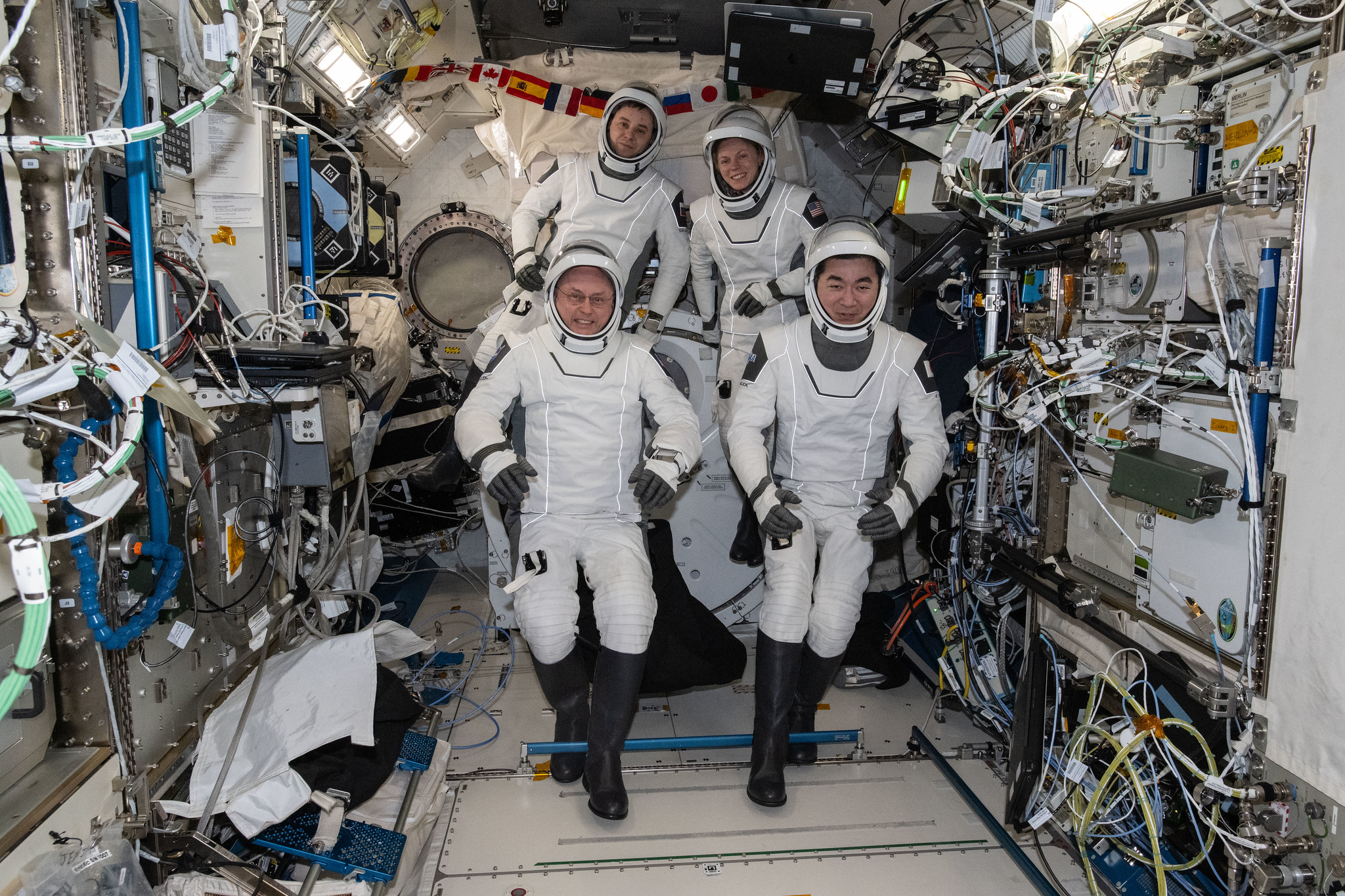
NASA will host a public event featuring three crew members from the agency’s SpaceX Crew-11 mission at 11 a.m. EDT Monday, June 1. The event, which takes place during the crew’s standard postflight visit, will be held in the Webb Auditorium at NASA Headquarters in the Mary W. Jackson building, 300 E. Street SW in Washington.
The crew members, including NASA astronauts Zena Cardman and Mike Fincke and JAXA (Japan Aerospace Exploration Agency) astronaut Kimiya Yui, will discuss their recent 167-day mission aboard the International Space Station, where they conducted a wide range of science experiments to benefit life on Earth and advance human space exploration as part of International Space Station Expedition 73/74.
The Crew-11 mission lifted off on Aug.1, 2025, from Launch Complex 39A at NASA’s Kennedy Space Center in Florida. The crew’s SpaceX Dragon spacecraft docked to the orbital outpost on Aug. 2.
During their mission, the three astronauts, along with crewmate Roscosmos cosmonaut Oleg Platonov, traveled nearly 71 million miles and completed more than 2,670 orbits around Earth. The Crew-11 mission was Fincke’s fourth spaceflight, Yui’s second, and the first for Cardman and Platonov. Fincke has logged 549 days in space, ranking him fourth among all NASA astronauts for cumulative days in space. The crew members returned to Earth on Jan. 15, splashing down off the coast of San Diego.
Along the way, Crew-11 logged hundreds of hours of research, maintenance, and technology demonstrations. The crew members also celebrated the 25th anniversary of continuous human presence aboard the orbiting laboratory on Nov. 2, 2025. Research conducted aboard the space station advances scientific knowledge and demonstrates new technologies that enable us to prepare for human exploration of the Moon and Mars.
Media interested in attending the event must RSVP by 8 a.m., June 1, by emailing the NASA Headquarters newsroom at hq-media@mail.nasa.gov. NASA’s media accreditation policy is online. Based on the crew’s schedule, NASA will not be able to accommodate interviews.
This opportunity also is part of NASA’s Frontiers Forum: Voices Shaping the Future of Space speaking series designed to convene bold thinkers and senior leaders at the forefront of exploration and innovation. The series will spotlight mission-critical priorities from advancing the Artemis campaign and strengthening commercial partnerships to shaping the future workforce and accelerating breakthrough technologies. The agency will share more details soon.
To learn more about the International Space Station and its research and crews, visit:
-end-
Gerelle Dodson
Headquarters, Washington
202-358-1600
gerelle.q.dodson@nasa.gov
NASA’s Roman Space Telescope Primary Mirror Gets Last Look
Engineers at NASA’s Goddard Space Flight Center in Greenbelt, Maryland, have completed their final inspection of a key element for the agency’s Nancy Grace Roman Space Telescope: the primary mirror. This 7.9-foot (2.4-meter) mirror will collect and focus light from cosmic objects near and far, helping Roman capture stunning panoramas of space.
The primary mirror for NASA’s Nancy Grace Roman Space Telescope has passed its final inspection. On May 20 and 21, engineers at NASA’s Goddard Space Flight Center in Greenbelt, Md., confirmed that no specks fell onto the mirrors during testing and that there are no changes in the mirror path and alignment. With this milestone complete, the primary mirror is ready for its next view: space.NASA’s Goddard Space Flight Center
“The Roman engineering team laid eyes on the telescope for the final time before it, in turn, becomes the eyes of humanity, revealing the wonders of the cosmos,” said J. Scott Smith, the Roman telescope manager at NASA Goddard. “It is a profoundly humbling moment to witness the culmination of hard work from so many dedicated individuals, teams, and partner organizations, including L3Harris.”
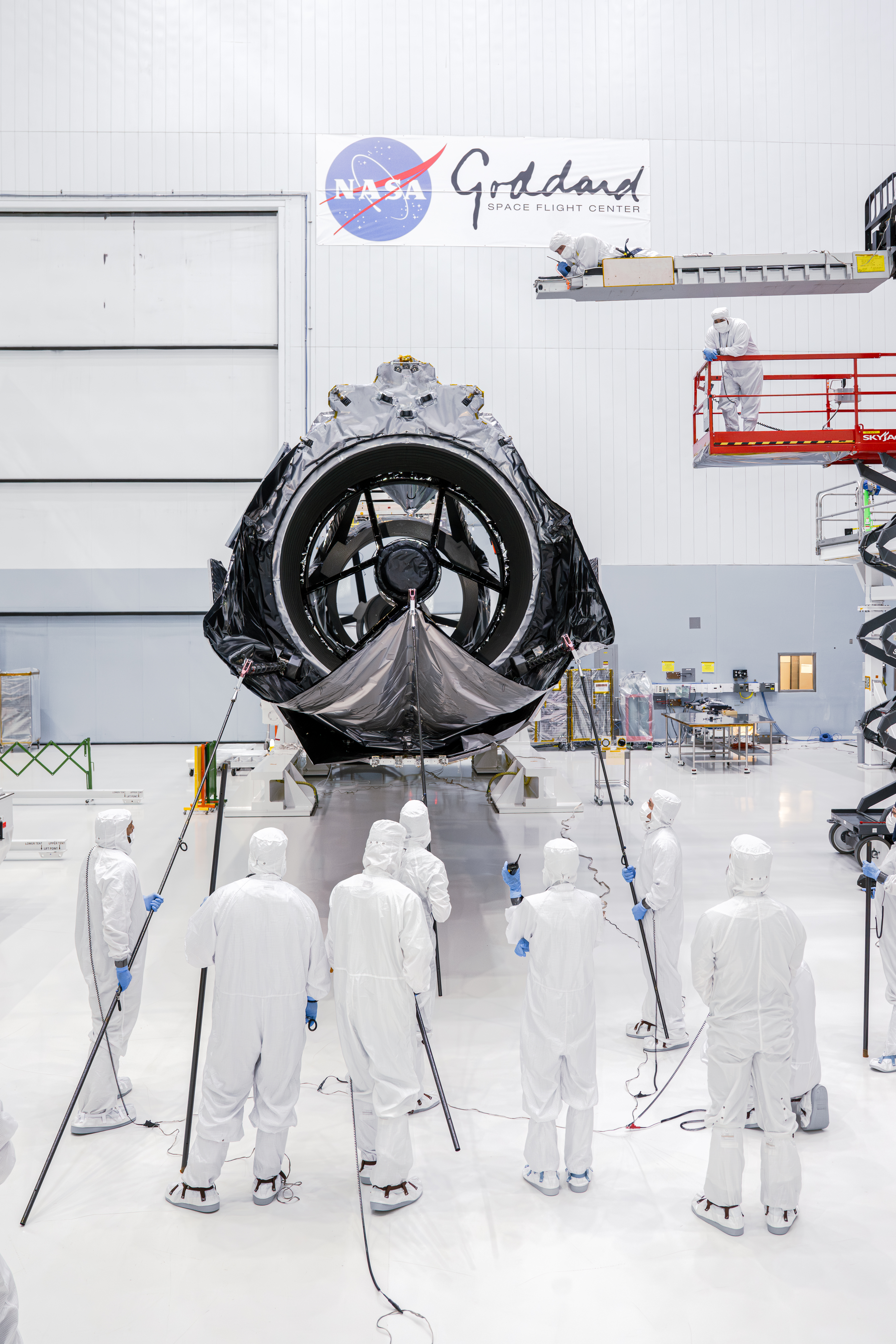
On May 20, engineers turned the Roman observatory onto its side and deployed the “hood” that will be stowed for launch to protect the mirror. Then the team conducted a meticulous visual inspection to ensure no specks fell onto the mirrors during testing and confirm there are no changes in the mirror path and alignment.
“We developed a method of using a high-resolution camera equipped with a very powerful zoom lens to do a multi-purpose inspection,” said Bente Eegholm, optics lead for Roman’s Optical Telescope Assembly at NASA Goddard. “The mirror passed with flying colors, keeping the mission on track for an early September launch.”
Technicians stow Roman’s deployable aperture cover, a large sunshade designed to keep unwanted light out of the telescope.NASA/Sydney RohdeThe team carefully observed the optics along the path light will follow to the Wide Field Instrument detector array and confirmed it remains in proper alignment following the observatory shake test.
“In order to gather very sensitive measurements of objects strewn throughout space, all of Roman’s components have to be ultraprecise,” Eegholm said. “The primary mirror certainly delivers on that precision.”
Roman’s primary mirror sports a layer of silver less than 400 nanometers thick — about 200 times thinner than a human hair. The silver coating was specifically chosen for Roman because of how well it reflects near-infrared light. By contrast, the Hubble Space Telescope’s mirror is coated with layers of aluminum and magnesium fluoride to optimize visible and ultraviolet light reflectivity. Likewise, the James Webb Space Telescope’s mirrors have a gold coating to suit its longer wavelength infrared observations.
The Roman mirror is so finely polished that the average bump on its surface is only 1.2 nanometers tall — more than twice as smooth as the mission requires. If the mirror were scaled up to Earth’s size, these bumps would be just a quarter of an inch high.
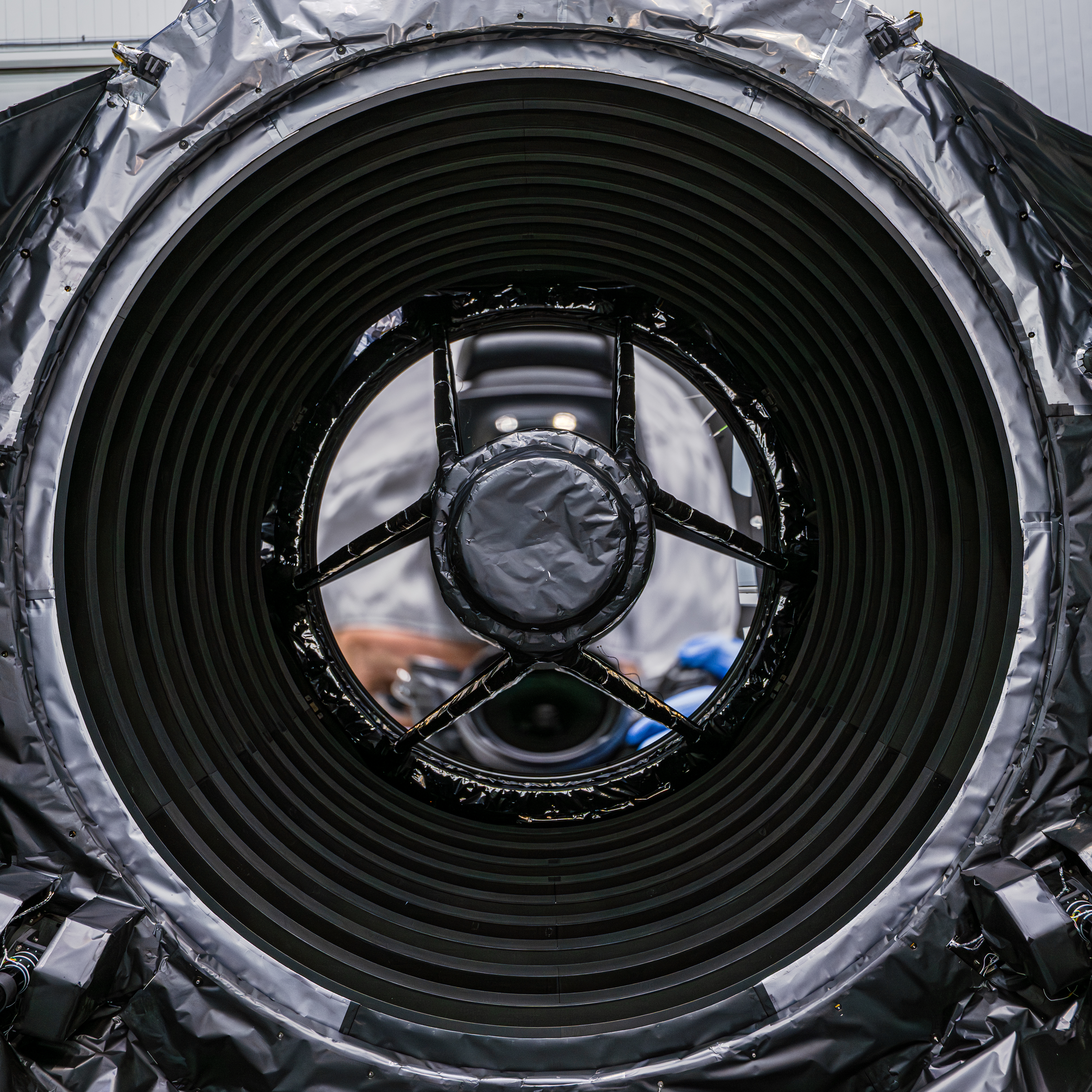
In this photo, which peers directly down the barrel of Roman’s telescope, the photographer’s camera is reflected in the primary mirror.NASA/Sydney RohdeSince it’s made of a specialty ultralow-expansion glass, the mirror will resist flexing, which can happen to materials during temperature changes (like going from balmy Earth conditions to the deep freeze of space). This preserves Roman’s image quality, because if the primary mirror changed shape, it would distort the images from the telescope.
“We’re really proud of the amazing optical system we’ve delivered for the Roman mission alongside our partners at L3Harris,” said Josh Abel, lead Optical Telescope Assembly systems engineer at NASA Goddard. “Now that it’s assembled, aligned, and all shined up, we’re ready to go.”
Now, the Roman team is preparing to ship the observatory to the launch site at NASA’s Kennedy Space Center in Florida in the coming weeks. NASA expects the mission to begin returning incredible cosmic vistas within several months after launch.
To learn more about NASA’s Roman mission, visit:
The Nancy Grace Roman Space Telescope is managed at NASA’s Goddard Space Flight Center in Greenbelt, Maryland, with participation by NASA’s Jet Propulsion Laboratory and Caltech/IPAC in Southern California, the Space Telescope Science Institute (STScI) in Baltimore, and scientists from various research institutions.
Media contact:
Claire Andreoli
NASA’s Goddard Space Flight Center, Greenbelt, Md.
301-286-1940
Ashley is the lead science writer for NASA's Nancy Grace Roman Space Telescope.
Share Details Last Updated May 30, 2026 EditorAshley BalzerContactAshley Balzerashley.m.balzer@nasa.govLocationGoddard Space Flight Center Related Terms Explore More 6 min read NASA’s Roman Mission Preps to Unveil New Populations of Faraway Worlds Article 4 days ago 4 min read NASA’s Roman Observatory Passes Final Major Prelaunch Tests Article 2 months ago 7 min read NASA Announces Plan to Map Milky Way With Roman Space Telescope Article 6 months ago Keep Exploring Discover More Topics From NASAMissions
Humans in Space
Climate Change
Solar System
Hubble Spies Faint Irregular Galaxy
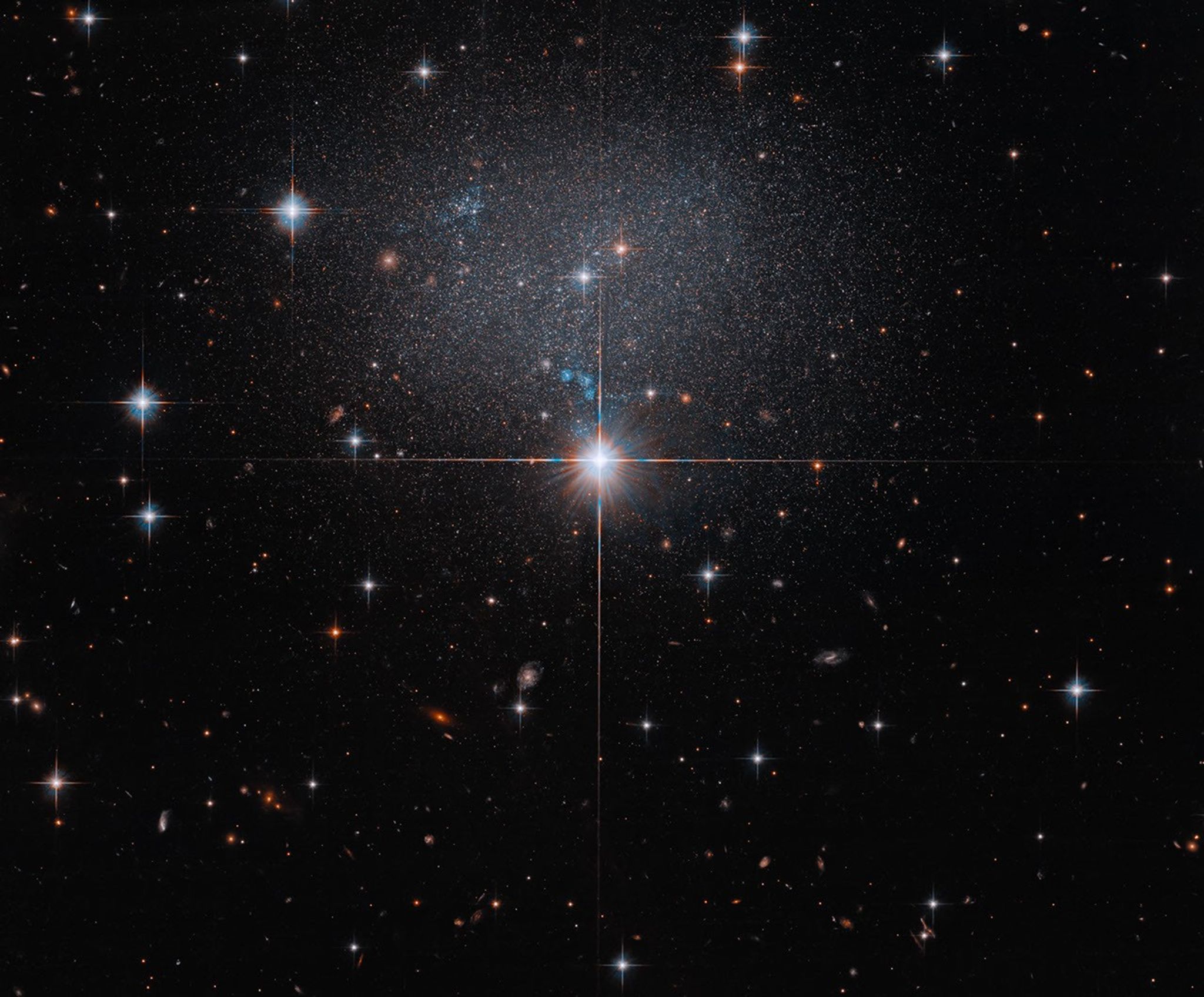
This NASA Hubble Space Telescope image released on May 27, 2026, features the dwarf irregular galaxy ESO 490-017, roughly 12,000 light-years in diameter and some 23 million light-years away in the constellation Canis Major. The galaxy’s low surface brightness makes it appear as a faint, starry swarm behind brighter foreground stars that are easily recognized by their diffraction spikes. Numerous red, orange, and beige dots are distant galaxies peppering the black background, many exhibiting distinct spiral structure.
The data in this image of ESO 490-017 was part of a Hubble observing program that looked at the movement of galaxies and galaxy clusters through space. Matter in the universe is distributed unevenly, and the gravitational influence of that matter drives the “cosmic flow” or movement of large-scale structures in the universe.
Image credit: NASA, ESA, R. Tully (University of Hawaii); Image Processing: G. Kober (NASA/Catholic University of America)
Hubble Captures M88 on Journey to Center of Virgo Cluster
- Hubble Home
- Overview
- Impact & Benefits
- Science
- Observatory
- Team
- Multimedia
- News
- More
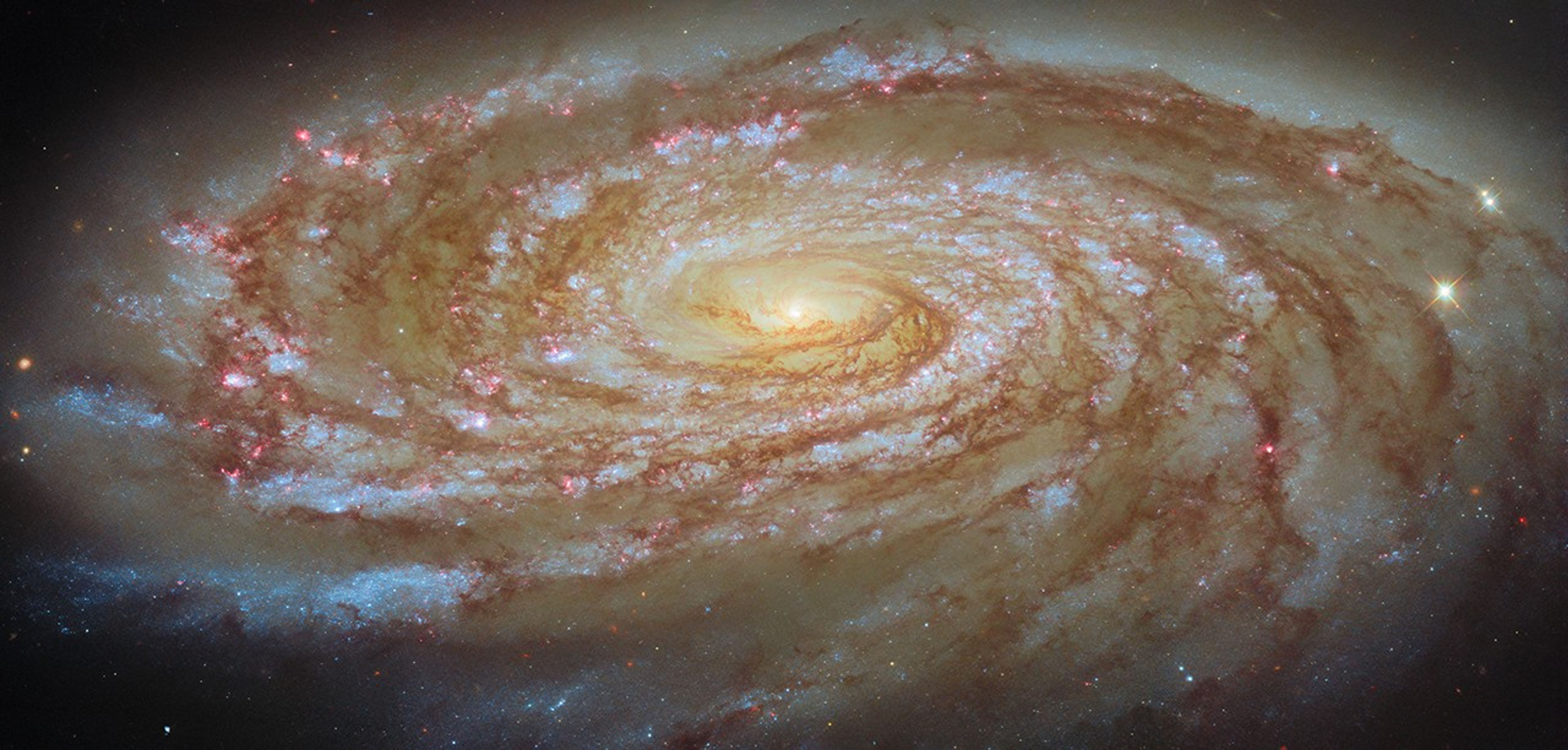
The focus of this NASA/ESA Hubble Space Telescope image is an active spiral galaxy on a journey lasting hundreds of millions of years. The galaxy Messier 88 (M88), also known as NGC 4501, is located about 63 million light-years away in the constellation Coma Berenices (Berenice’s Hair).
M88 is an active galaxy, which means that its center harbors a supermassive black hole that is snacking on gas and dust. Astronomers estimate the black hole is around 100 million times as massive as the Sun, and it appears to be powering outflows of gas from the galaxy’s center.
A population of old, reddish stars around the black hole give M88 its warmly glowing heart. Spreading out from the galaxy’s center are several tightly wound, symmetrical spiral arms, each outlined by sparkling pink and blue star clusters and knotted clouds of dust. We see M88 from an angle that makes it appear elongated, and its spiral arms delicately fan out before it.
M88 is a member of the Virgo Cluster, a collection of more than a thousand galaxies held together by gravity. As this massive galaxy group moves through space, the galaxies themselves are in constant motion as they orbit the cluster’s center of gravity. M88 itself is on a long and somewhat perilous cosmic journey that will bring it to the innermost reaches of the cluster.
As is the case with any epic journey, M88 will be fundamentally changed by its trek to the center of the Virgo Cluster, about two million light-years from where it is today. In 200–300 million years, M88 will make its closest approach to Messier 87, the massive elliptical galaxy that anchors the entire cluster. As it draws close to this gravitational behemoth, M88 will experience intense ram pressure stripping. Ram pressure stripping is a process through which a galaxy’s gas is swept away as it pushes through the ever-present gas between the galaxies in a cluster.
Researchers have already seen this process at work in M88. The galaxy’s swirling disk of gas is truncated and appears compressed on the leading edge of the galaxy, piling up gas and dust like snow before a plough. In fact, M88 appears to have considerably less cold gas — the raw fuel for star formation — than expected for a galaxy of its size, especially in its outer regions. This is a clear sign that M88 will be altered by its journey, which will affect its ability to form stars and alter the course of its evolution.
Astronomers observed M88 with Hubble as part of an observing program (#18103; PI: D. Thilker) dedicated to understanding the lives of spiral galaxies in crowded environments. This program uses Hubble’s Wide Field Camera 3, which can finely resolve individual star clusters and nebulae in galaxies tens of millions of light-years away. By studying galaxies on these scales, astronomers can understand how a journey through a cluster impacts a galaxy’s evolution and ability to form new stars.
Text credit: ESA/Hubble
Facebook logo @NASAHubble @NASAHubble Instagram logo @NASAHubbleMedia Contact:
Claire Andreoli
NASA’s Goddard Space Flight Center, Greenbelt, MD
claire.andreoli@nasa.gov
Since its 1990 launch, the Hubble Space Telescope has changed our fundamental understanding of the universe.
Messier 88
This galaxy’s core holds supermassive black hole roughly 100 million times more massive than our Sun.
Hubble Science Highlights
Hubble e-Books
Painting the Growing Season in the Maize Triangle
- Earth
- Earth Observatory
- Image of the Day
- EO Explorer
- Topics
- More Content
- About
NASA’s X-59 Prepares for First Supersonic Flight
6 min read
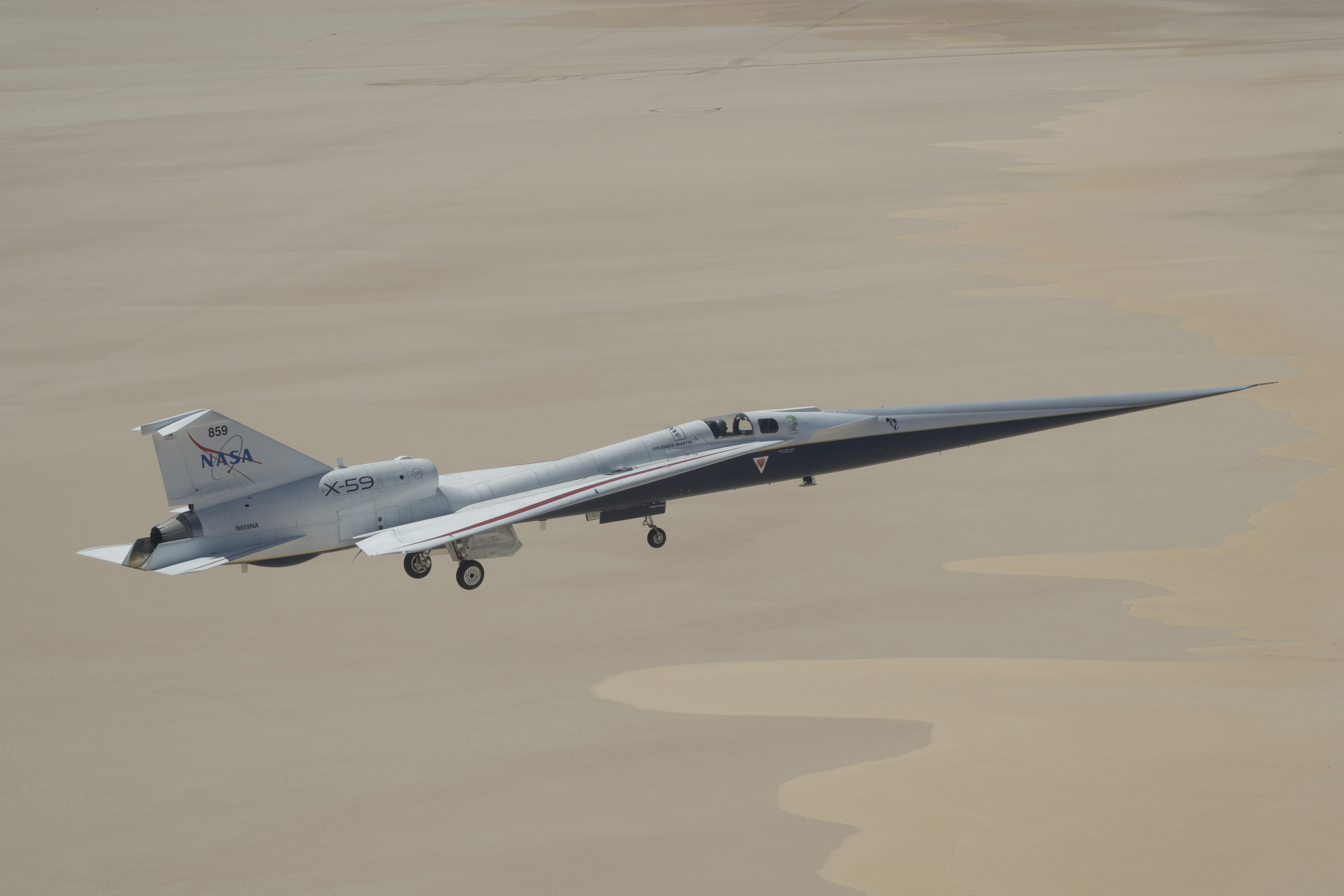
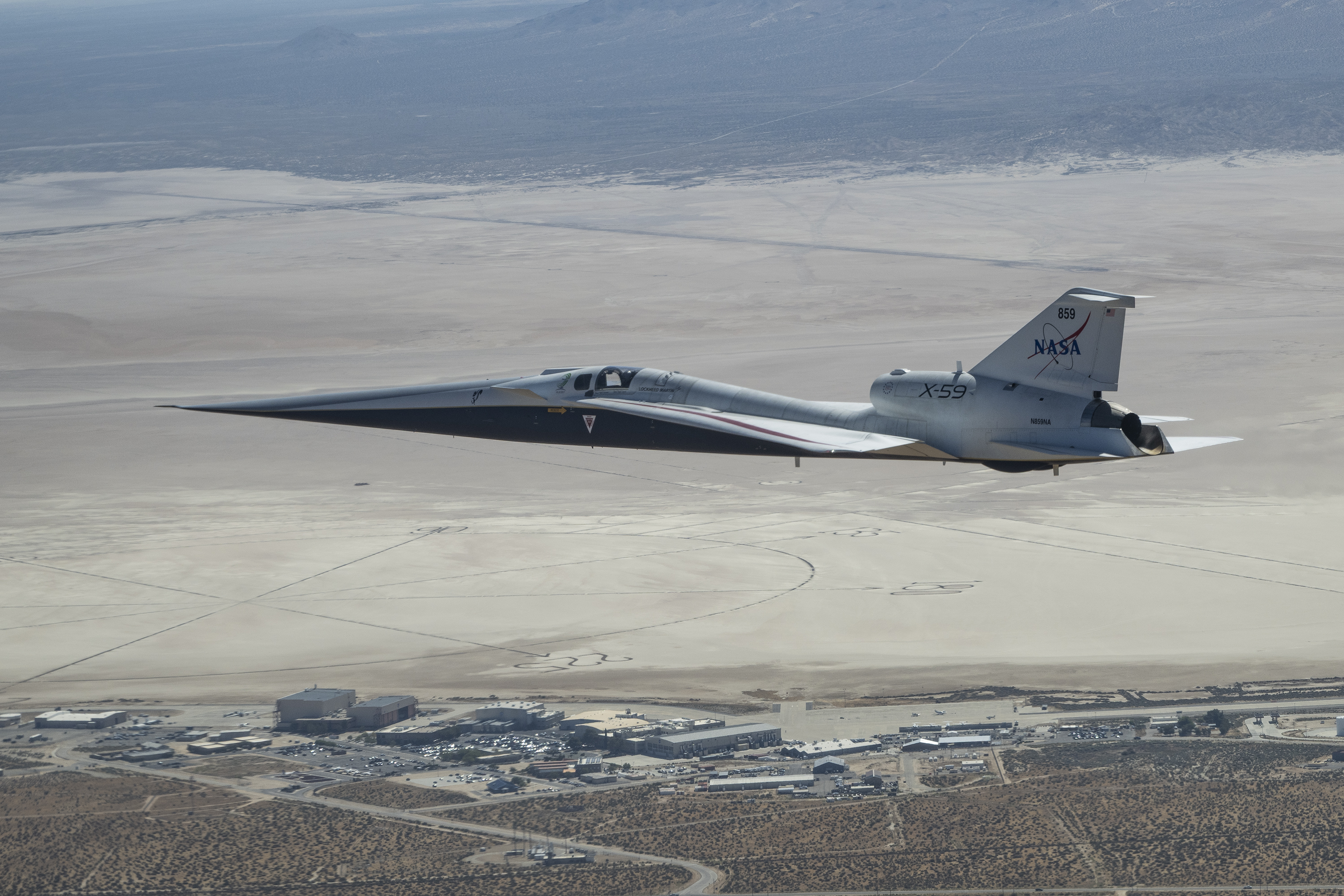
Preparations for Next Moonwalk Simulations Underway (and Underwater) NASA’s X-59 quiet supersonic research aircraft flies over Rogers Dry Lake near NASA’s Armstrong Flight Research Center in Edwards, California, on Tuesday, May 12, 2026. NASA continues expanding the aircraft’s flight envelope through a series of lower-altitude and slower-speed flights ahead of upcoming flight tests at speeds faster than the speed of sound.NASA/Jim RossNASA’s X-59 quiet supersonic research aircraft is preparing for some of its most significant flights yet. The X-plane is about to begin a new block of test flights that will include its first time flying faster than the speed of sound and other mission-critical objectives.
“What comes next is the first time this one-of-a-kind aircraft will fly supersonic,” said Cathy Bahm, project manager for NASA’s Low Boom Flight Demonstrator. “We are starting toward the mission conditions test point that X-59 was designed for.”
After months of flights, the X-59 team reviewed their progress in late May and now look toward the aircraft’s next series of flight tests, including higher altitudes and faster speeds. This will give engineers a look at how the X-59 handles under required operational conditions for NASA’s Quesst mission to eventually gather data on quiet supersonic flight.
The team expects the X-59 to fly supersonic – over 630 mph – for the first time at approximately 43,000 feet altitude during a series of test flights in early June, a major milestone for the aircraft. After that, it will conduct a “mission conditions” flight, where it will hit Mach 1.4 (925 mph) at approximately 55,000 feet. That speed and altitude are important because they’re NASA’s performance targets for the X-59 to eventually fly over U.S. communities to demonstrate quiet supersonic flight and collect feedback data about the aircraft’s quiet sonic “thump” from the public.
While the X-59 is designed to fly at supersonic speeds without producing a loud sonic boom, these early flights are not yet intended to demonstrate its quiet supersonic capabilities. The X-59 will be accompanied by a traditional supersonic chase plane, so any quiet thump it produces in the current phase of testing will be obscured by louder, traditional sonic booms from the chase. In supersonic flights this summer, the chase aircraft will also be outfitted with a specialized shock-sensing probe to take initial measurements of the X-59’s shock waves.
Completed flightsThe X-59’s first block of flights successfully met several test goals, generating data for its team to analyze. After making its first flight in October 2025, it entered a scheduled period of maintenance before returning to the skies in March 2026. It has since completed 14 additional flights, marking milestones including:
- Its first gear swing, or the retraction of its landing gear to show off its sleek design for the first time.
- Reaching altitudes up to 43,000 feet and near supersonic speeds at Mach 0.95, approximately 627 mph.
- Marking its first dual-flight day and then making those increasingly routine as the X-59 team increased flight cadence.
- After a period of moving higher and faster, transitioning into lower and slower test flight conditions so engineers could gather information on the X-59’s behavior across a range of flight conditions.
Data collected during the X-59’s first block of test flights helped teams better assess critical systems, including fuel, hydraulics, environmental controls, and the eXternal Vision System, which is the aircraft’s unique series of cameras that feed into a monitor that allows the pilot to see forward instead of using a traditional windshield. Teams monitored how the aircraft behaved during takeoff, landing, and throughout flight. Strain gauges installed throughout the X-59 collected detailed information on the forces it experienced, and how its structure responded to them.
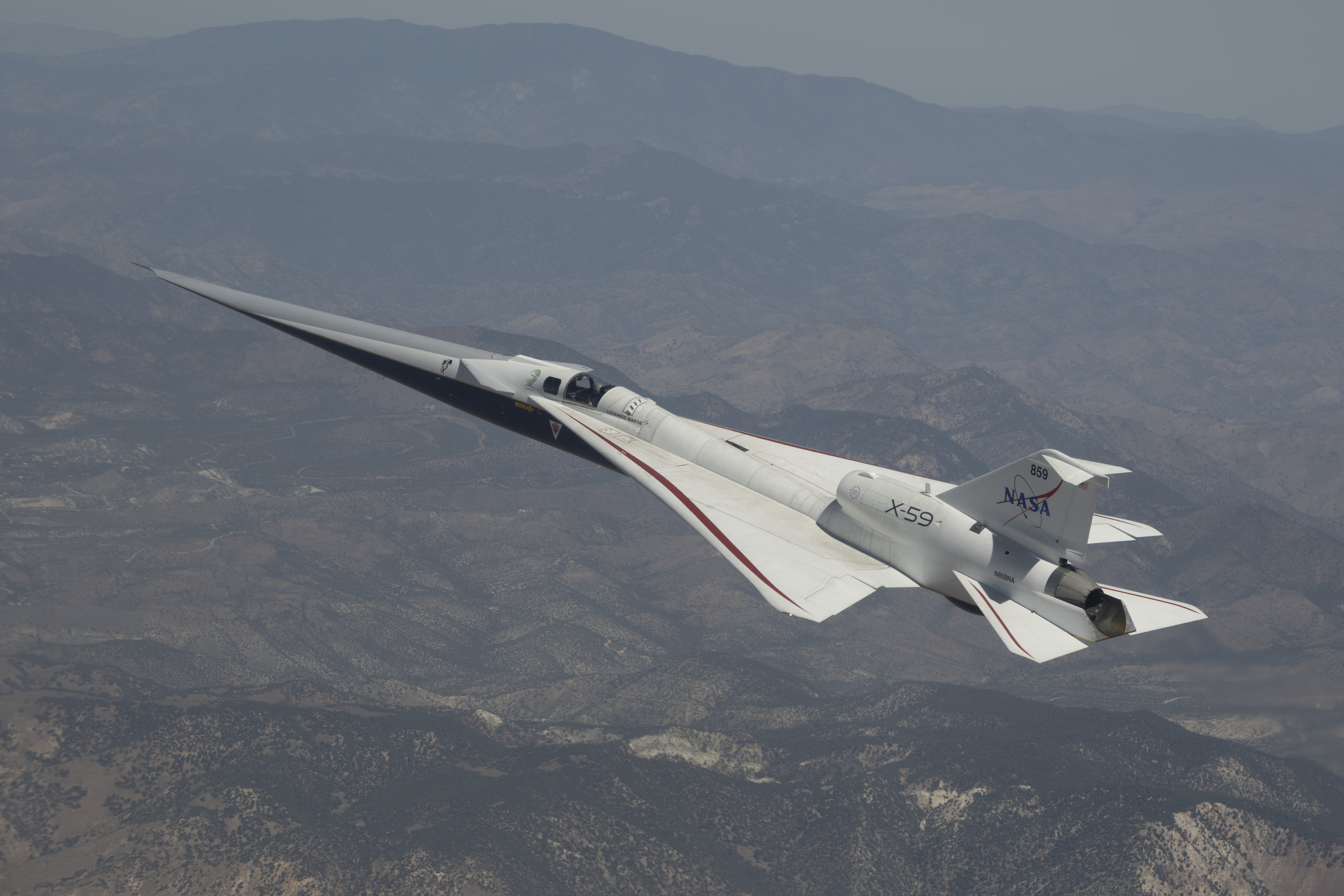
NASA’s X-59 quiet supersonic research aircraft flies above mountains near NASA’s Armstrong Flight Research Center in Edwards, California, on Tuesday, May 12, 2026. NASA continues expanding the aircraft’s flight envelope to evaluate how it performs across a range of flight conditions ahead of upcoming flight tests at speeds faster than the speed of sound in support of the agency’s Quesst mission.NASA/Jim Ross Next stepsDuring the X-59’s upcoming flights, pilots will run through test points while engineers watch the aircraft’s performance — but now in supersonic flight conditions.
“Flying at supersonic speeds is a major milestone for the X-59 team,” Bahm said. “Every step of envelope expansion brings us closer to demonstrating the quiet supersonic capability that is at the heart of the Quesst mission. Completing the first mission-conditions flight is especially meaningful – it’s the moment where we begin validating the aircraft in the environment it was designed for.”
In addition to reaching mission condition during this block of flight tests, the X-59 will also achieve its maximum speed of Mach 1.6 (1,218 mph) and altitude of 60,000 feet.
But just because the aircraft can go that fast doesn’t mean it always will fly supersonic. Testing will continue, including a mix of subsonic and lower-altitude flights so the team can continue monitoring it in varied conditions.
“These flights not only deepen our confidence in the X-59’s performance – they mark our progression toward the future phases of the mission that will ultimately help shape the future of supersonic travel,” Bahm said.
All flights so far and in the upcoming test block are part of Phase 1 of the X-59’s Quesst mission, focused on proving the performance and airworthiness of the aircraft. Some of those flights will include early deployment of equipment, including a probe mounted to one of NASA’s F-15 research aircraft that can measure the X-59’s unique shock wave signature.
Data gathered during those early probing flights will allow engineers to prepare for a new stage of work set to begin later this year: Quesst Phase 2, when teams will begin to measure the aircraft’s supersonic flight signature to verify that it’s producing a quiet supersonic thump, as designed.
“Aviation pioneer Otto Lilienthal said, ‘To design a flying machine is nothing. To build one is something. But to fly is everything.’ The 15 X-59 flights we’ve accomplished since March have been everything to this team and the mission,” Bahm said. “Every flight has pushed the boundaries of what’s possible, steadily expanding the envelope and strengthening our confidence in the aircraft.”
But, she said, rather than focusing on past progress, the team is already looking ahead.
“As we look ahead to the upcoming flights, we’re poised to open the envelope even further – moving boldly toward the mission test point this aircraft was built to achieve,” Bahm said. “Flying supersonic and reaching these milestones isn’t just progress; it’s the realization of years of perseverance, innovation, and teamwork. Each step brings us closer to Phase 2, and to the future of commercial supersonic flight.”
Share Details Last Updated May 28, 2026 EditorDede DiniusContactNicolas Cholulanicolas.h.cholula@nasa.govLocationArmstrong Flight Research Center Related Terms Explore More 5 min read NASA Uses Mineralogical Marker to Understand Ancient Martian ClimateScientists analyzed 20 Martian samples collected by NASA’s Curiosity Rover and found that differences in…
Article 4 days ago 5 min read NASA Develops Sensor to Improve Firefighter Safety Article 5 days ago 4 min read Keeping NASA Flying: Ground Crews Ensure Aircraft Readiness Article 1 week ago Keep Exploring Discover More Topics From NASAArmstrong Flight Research Center
Ames Research Center
Glenn Research Center
Langley Research Center
I Am Artemis: Daniel Stubbs
Listen to this audio excerpt from Daniel Stubbs, NASA aerospace engineer:
0:00 / 0:00
Your browser does not support the audio element.If you’ve driven through a cloud of dust and dirt that temporarily obscured your view, you’ve gotten a partial picture of a potential problem that NASA’s human landing systems for Artemis will face when they land on the Moon. Daniel Stubbs, an aerospace engineer with the Plume and Aero Environments team in the Spacecraft and Vehicle Systems office at NASA’s Marshall Space Flight Center in Huntsville, Alabama, studies and models the interaction between plumes of rocket exhaust and the regolith on the surface of the Moon, paving the way for crew safety and Artemis mission success.
Stubbs, a native of Trussville, Alabama, who earned a bachelor’s, master’s, and doctoral degree in aerospace engineering from Auburn University in Alabama, decided early in his college career he wanted to work for NASA, but he didn’t see a clear path at the time to reach his goal. In graduate school, he had the opportunity to work on plume-surface interaction modeling as part of a NASA Early Stage Innovations grant. Now, Stubbs is continuing some of the work he first started as a graduate student.
NASA’s Daniel Stubbs, seen here at the Lunar Regolith Terrain field at Marshall Space Flight Center, used his experience as a graduate student at in aerospace engineering at Auburn University modeling lunar regolith plumes into a position with NASA Marshall’s Plume and Aero Environments team working to characterize interactions between clouds of lunar regolith and commercial human landing systems. NASA/Charles BeasonNASA’s Apollo missions uncovered the risks lunar regolith presents to astronauts, spacecraft, spacesuits, and other assets on the Moon’s surface. Lunar regolith consists of meteoroids and micrometeoroids that, over millennia, have been ground up into razor-sharp, abrasive particles. Future lunar explorers and their landers, rovers, and vehicles will face similar challenges. Landers in development are larger, heavier, and incorporate more rocket engines than the Lunar Module that landed astronauts on the Moon during the Apollo missions of the 1960s and 1970s. And, unlike Apollo Lunar Modules that left descent stages on the Moon, the new lunar landers will take off directly from the surface using the same engines, thrusters, and other systems that they used for the initial landing. Accurate prediction of the plume-surface interaction between the systems and the lunar regolith during landing will help ensure the lander hardware can survive that environment, and that it is ready to take off to meet Orion and astronauts in lunar orbit to return safely home to Earth.
As the engines’ exhaust plumes interact with the Moon’s surface, they could erode the surface, potentially forming a crater and a large cloud of lunar regolith.”Daniel StuBBs
NASA aerospace engineer
“The dust and regolith plume can make it difficult for instruments on the landers to see the surface of the Moon,” Stubbs said. “If these instruments don’t report correct readings to the guidance computers, it could affect a lunar landing. Also, when a lander takes off from the surface to return astronauts to Orion, the lunar regolith blown away from the landing site by the rocket plumes could damage scientific instruments or other assets that have been deployed on the surface of the Moon.”
NASA’s Human Landing System program is spearheading a major ground-based study of rocket engine exhaust plumes and lunar dust and regolith. Testing in the 60-foot space simulator chamber at NASA’s Langley Research Center in Hampton, Virginia, will represent the conditions the lunar landers may experience, and create, when landing on the Moon.
The research will help engineers understand the aerodynamic forces landers will experience during descent and ascent from the surface, heating at a lander’s base, the potential for a large lunar lander to tip over as a result of crater formation or surface instability.
When the dust settles and NASA has landed American astronauts on the Moon in 2028, Daniel Stubbs will be able to reflect on his work modeling plumes of lunar dust and regolith that rocket engines will stir up.
Through the Artemis program, NASA will send astronauts to explore the Moon for scientific discovery, economic benefits, and to build the foundation for the first crewed missions to Mars – for the benefit of all.
For more on NASA’s human landing systems, visit:
https://www.nasa.gov/humans-in-space/human-landing-system/
About the AuthorBeverly PerryCommunications Strategist Share Details Last Updated May 29, 2026 EditorLee MohonContactCorinne M. Beckingercorinne.m.beckinger@nasa.govLocationMarshall Space Flight Center Related Terms Explore More 7 min read NASA’s 2026 Lunabotics: Winning Student Teams Engineering Lunar Future Article 3 days ago 3 min read Jaclyn Kagey Shapes Humanity’s Return to the Moon Article 4 days ago 2 min read NASA Seeks Interest for Artemis Mission CubeSats Article 1 week ago Keep Exploring Discover More Topics From NASAMissions
Humans in Space
Climate Change
Solar System
New Landsat Science Team Holds First In-Person Meeting
- Landsat Home
- Missions
- News
- Data
- Benefits
- Outreach
- Multimedia
- About
- Search
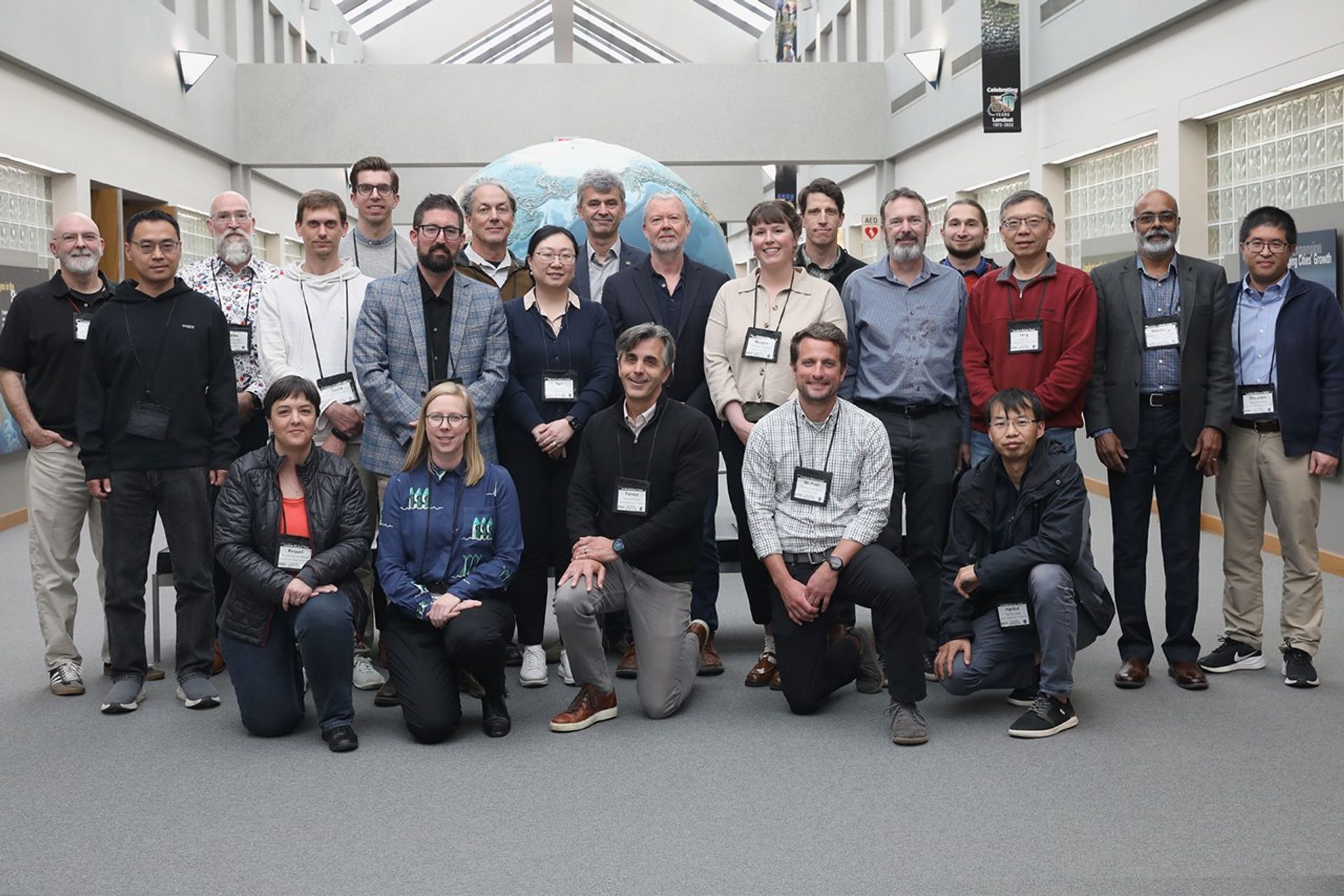
Front Row: Raquel De Los Reyes, Courtney Bright, Forrest Melton, Michael Campbell , Hankui Zhang
Standing: Greg Vaughan, Lin Yan, Mike Wulder, David Frantz, Kyle Knipper, Nimrod Carmon, Dean Hively, Yun Yang, Peter Strobl, David Roy, Morgan Crowley, Ned Bair, Phillip Dennison, Ryan O’Shea, Feng Gao, Medhavy Thankappan, Zhuosen Wang. Not pictured: Martha Anderson, Kimberlee Baldry, Eric Vermote. USGS
From May 5 to 7, the 2026–2030 Landsat Science Team met for their first in-person meeting at the Earth Resources Observation and Science (EROS) Center in Sioux Falls, SD. The three-day event, co-moderated by Landsat 8, 9, and 10 Project Scientist Chris Neigh, allowed leaders from USGS and NASA to begin work on a vision for the upcoming five-year period.
Attendees shared their current work and a vision for the future of the Landsat program. Participants received comprehensive status updates on the upcoming Landsat 10 project, the ongoing interagency and international collaboration on the Harmonized Landsat and Sentinel-2 (HLS) data products, and detailed plans for Collection 3 (C3).
Throughout the event, team members representing funded, international, and federal programs showcased the far-reaching impact of Landsat data across various Earth science disciplines, spanning snow cover mapping, atmospheric correction, water quality monitoring, evapotranspiration, agricultural applications, volcanic monitoring, and more.
The meeting culminated in focused breakout sessions, where experts drafted vital recommendations across four key technical areas to guide future mission data processing:
Surface ReflectanceThe surface reflectance working group identified several priorities, including topography and adjacency corrections, Bidirectional Reflectance Distribution Function (BRDF) correction, and enhanced cloud masking with consistent approaches for HLS data products. Key recommendations included incorporating CMIX2 cloud masking results into future collections and mapping out C3 toolkit dependencies for user-applied corrections.
Temperature and EmissivityDiscussions on land surface temperature and emissivity centered heavily on maintaining archive consistency. The team recommended either maintaining native resolution or standardizing to 60 meters, with additional testing specifically for volcano studies. They endorsed using ASTER GED/CAMEL emissivity datasets and preparing for Landsat 10’s five thermal bands through ECOSTRESS comparison. They also called for better quantification of how atmospheric inputs impact harmonization efforts through collaboration between NASA’s Jet Propulsion Laboratory (JPL), RIT, and EROS.
Aquatic ReflectanceAquatic reflectance experts raised critical concerns regarding Landsat 10’s planned 18-day repeat cycle, noting that it severely limits the monitoring of highly dynamic processes such as harmful algal blooms. The group called for increased investment in validation infrastructure for inland waters coordinated with international CEOS efforts. They also strongly advised against pixelwise algorithm switching to prevent data discontinuities and emphasized the need for strict compliance with CEOS Aquatic Reflectance V2.0 standards.
Projections, Tiling, and the PixelFinally, the group reviewing projection and tiling endorsed the USGS pixel grid nesting plan (which spans 10, 15, 20, 30, 60, and 120 meters). However, they recommended further trade analysis to optimize pixel replication errors, manage storage costs, and ensure proper coordination with Sentinel-2 Next Generation. The working group strongly recommended that if these complex grid issues remain unresolved, the program should maintain the Collection 2 approach (UTM and polar stereographic) while continuing to refine Analysis Ready Data (ARD) products for CONUS, Hawaii, and Alaska.
The recommendations generated during these breakout sessions created a roadmap for the new Landsat Science Team, ensuring that the global scientific community continues to receive high-quality, actionable Earth observation data through the end of the decade.
Explore More
New Landsat Science Team Holds First In-Person Meeting
3 min read
From May 5 to 7, the Landsat Science Team meeting convened at the Earth Resources Observation and Science (EROS) Center…
May 28, 2026 ArticleA Shift in What’s Shaping U.S. Landscapes
5 min read
Wild disturbances are on the rise, while land disturbed by human activity has been decreasing.
May 28, 2026 ArticleReleased: NASA Goddard Issues Draft Request for Proposal for the Landsat 10 Spacecraft
2 min read
The Landsat 10 Spacecraft Draft Request for Proposal (DRFP) is available for review via SAM.gov.
May 27, 2026 Article1
2
3
…
311
Next
Curiosity Blog, Sols 4900-4907: Pasadena, We Have a Drill Sample!
- Curiosity Home
- Science
- News and Features
- Multimedia
- Mars Missions
- Mars Home
3 min read
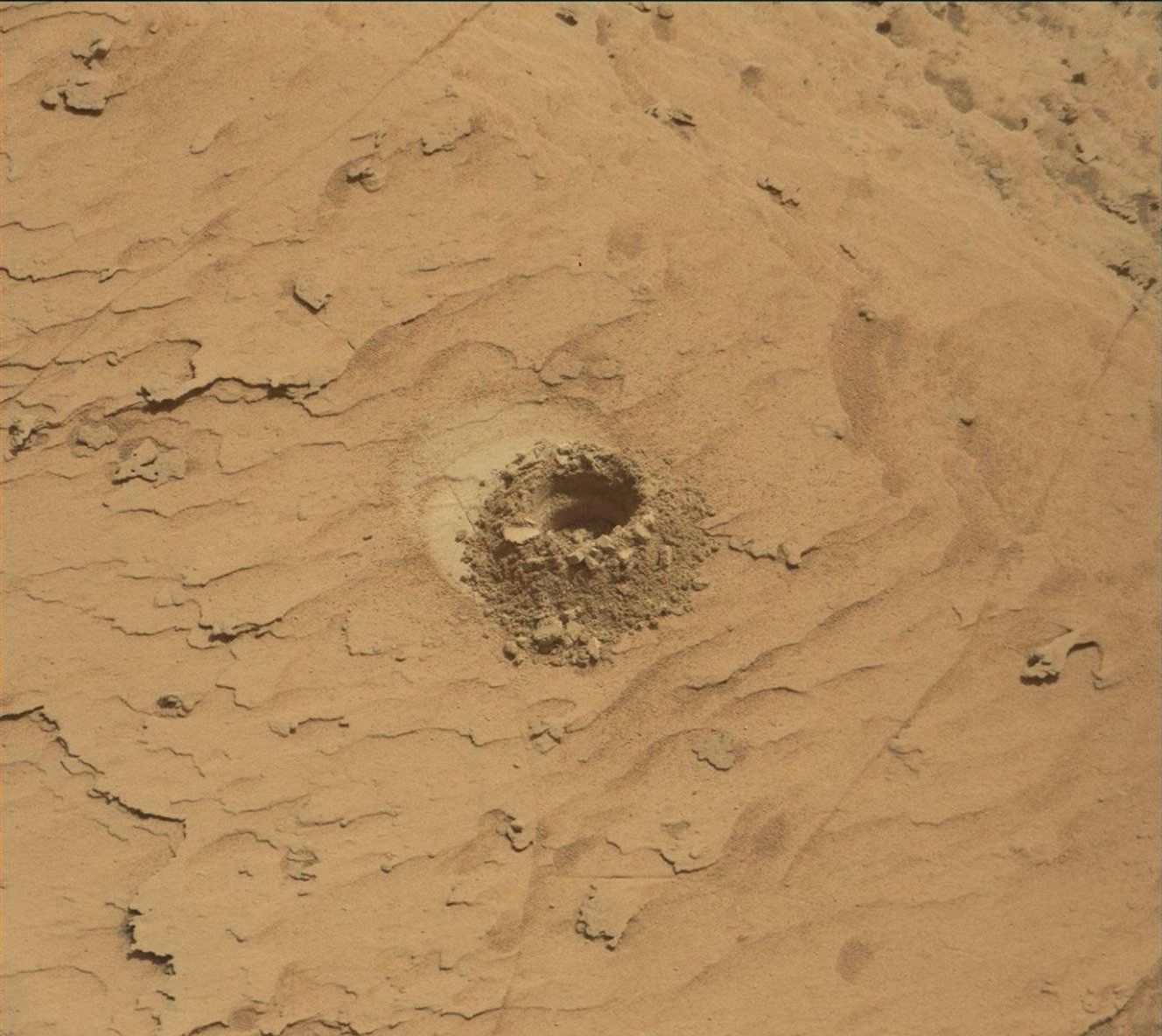
Curiosity Blog, Sols 4900-4907: Pasadena, We Have a Drill Sample! NASA’s Mars rover Curiosity acquired this image, the first color look of the “Campo Marte” drill hole, on May 16, 2026. The rover captured the image using its right Mast Camera (Mastcam) — one of a pair of cameras mounted on the head atop the rover’s mast — on Sol 4897, or Martian day 4,897 of the Mars Science Laboratory mission, at 18:05:49 UTC. NASA/JPL-Caltech/MSSSWritten by Abigail Fraeman, Deputy Project Scientist at Jet Propulsion Laboratory, California Institute of Technology
Earth planning date: Friday, May 22, 2026
I spent this past weekend eagerly awaiting the downlink from Mars that would show us the results of Curiosity’s drill attempt at “Campo Marte.” A few weeks ago, when Curiosity drilled the “Atacama” block, it had been quite the surprise to see the post-drill images arrive on Earth that showed the rover picking up the entire Atacama block along with the drill. After freeing ourselves from this pesky passenger, the team carefully assessed all the telemetry and imaging data we had collected to understand why the entanglement happened and to mitigate the chance of it happening again. We concluded it would be ok to try another drill in this general area, and nearby Campo Marte looked like a great target because it had all the right geologic features and was significantly bigger than Atacama. What a delight it was to see images, like the Mastcam shown above, streaming down on Saturday that showed Curiosity had successfully retracted its drill from the rock and collected some sample to analyze this time around!
On Monday, the team looked at the pinches of drilled rock powder, or portions, that we had dropped as a test onto part of Curiosity, an element of our standard post-drilling activities. You can also take a look at what we saw — here’s a picture of the rover before we did anything, and here’s what we saw after we delivered the first portion, and then the second portion. Can you make out the little bit of powder that appears between the sample deliveries? This test is important to make sure we’ll provide good samples to the analytical instruments inside our chassis, CheMin and SAM. Beyond their science operations value, I also love seeing these images because they remind me how powerful our laboratory instruments are. With just a little pinch of powder, no more than tens of milligrams, these laboratories can reveal incredibly detailed information about the composition of Martian rocks and give us huge new insights into the planet’s past climate and habitability.
We concluded the portions from Campo Marte looked similar to the drilled samples we’ve previously analyzed, so we went ahead and delivered one portion to CheMin in Monday’s plan. We use the results from CheMin to tailor our analysis of the samples with SAM, so after we saw the first CheMin results in the middle of the week, we made decisions about how to run SAM and then planned to analyze four portions with that instrument in today’s plan. We think we’ll be nearly out of sample after that, but it’s hard to know for sure (we only drilled to a depth of 28 millimeters here, about 1.1 inches, rather than our usual 35 millimeters, or 1.38 inches). To learn more, in this upcoming weekend’s plan, we’ll also repeat the sample drop-off test we did right after drilling, which will show us how many portions were left. We do a ton of testing with Curiosity’s twin drill here on Earth, but it’s always insightful to see how our hardware performs on Mars under the unique geologic and environmental conditions of that entirely different world.
-
Want to read more posts from the Curiosity team?
-
Want to learn more about Curiosity’s science instruments?
Article
1 week ago
3 min read Curiosity Blog, Sols 4886-4892: Ingenuity and Perseverance, Curiosity Style
Article
2 weeks ago
3 min read Curiosity Blog, Sols 4879-4885: Struggle at Atacama
Article
3 weeks ago
Keep Exploring Discover More Topics From NASA Mars
Mars is the fourth planet from the Sun, and the seventh largest. It’s the only planet we know of inhabited…
All Mars Resources
Explore this collection of Mars images, videos, resources, PDFs, and toolkits. Discover valuable content designed to inform, educate, and inspire,…
Rover Basics
Each robotic explorer sent to the Red Planet has its own unique capabilities driven by science. Many attributes of a…
Mars Exploration: Science Goals
The key to understanding the past, present or future potential for life on Mars can be found in NASA’s four…
NASA Uses Mineralogical Marker to Understand Ancient Martian Climate
NASA/JPL-Caltech/MSSS
While NASA imagery has shown evidence of ancient rivers and lakes on Mars that transitioned to dry dunes, uncertainty remains over the timing of the environmental changes that may have contributed to these shifts.
Now, data collected by NASA’s Curiosity rover has revealed that individual crystals in the iron oxide hematite can be used as a mineralogical marker of changes to Mars’ ancient climate. Because the shape and structure of these crystallites reflect the conditions – such as temperature and water presence – under which they were formed, they can serve as an indicator of when these changes occurred.
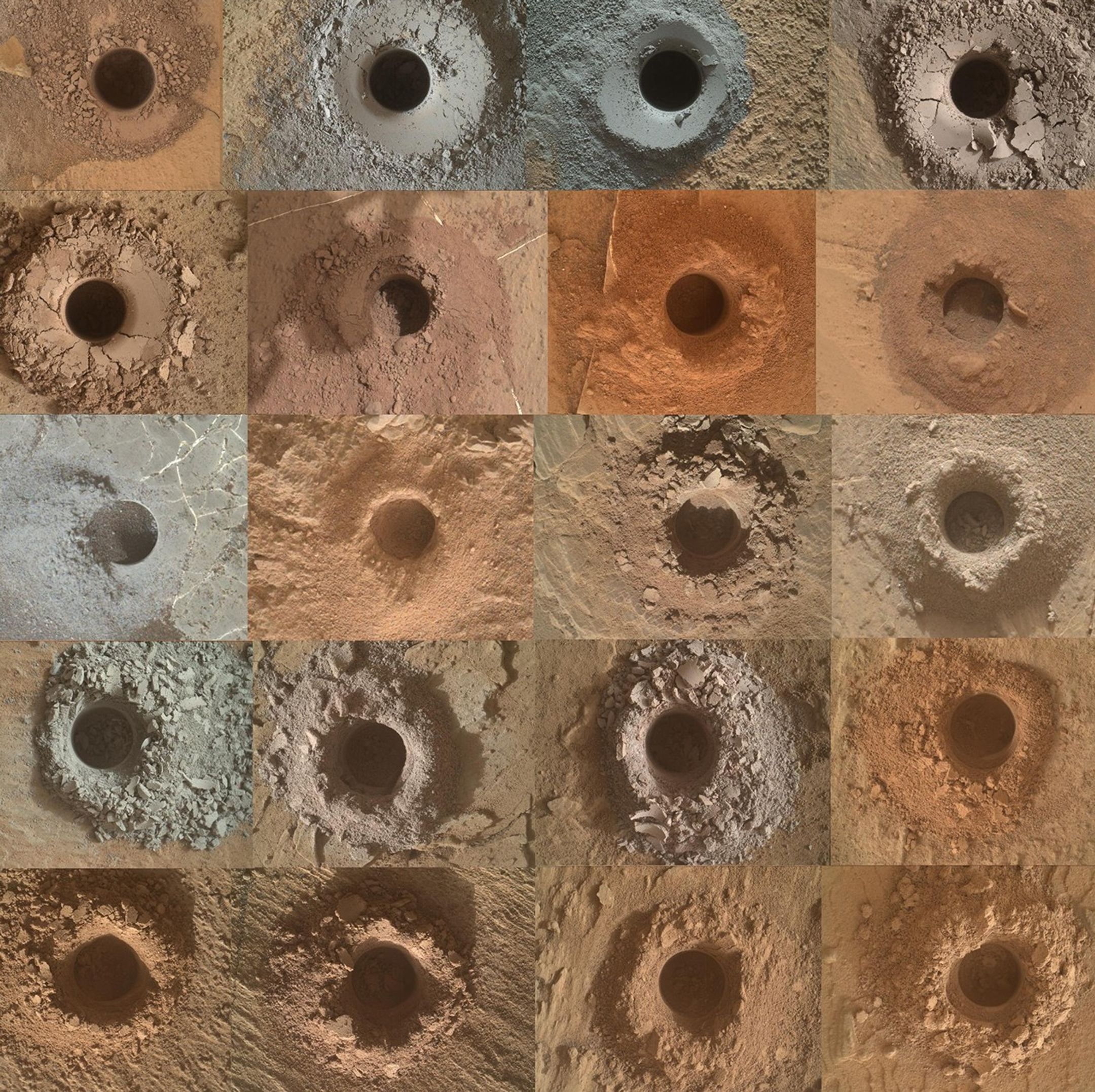
Scientists studied 20 samples collected by Curiosity across various elevations throughout Gale Crater for a paper published Thursday in Science. Gale Crater’s walls reveal Mars’ environmental history layer by layer, with deeper elevations capturing its earliest years. The team analyzed data from the rover’s Chemistry and Minerology (CheMin) instrument and discovered that hematite showed different crystallite sizes at different elevations. They also discovered that goethite, a mineral that typically forms alongside hematite, was absent in samples from lower elevations but still present in samples from higher elevations. This suggests that warm groundwater might have remained for up to 4.7 million years in the deepest layers of Gale Crater and that during much of this time, these long-lived aquifers could have been potentially habitable.
This image shows the 20 Curiosity drill samples from Gale Crater that were analyzed for this study. Credit: NASA/JPL-Caltech/MSSS“What we found was that warm and wet conditions were present for extended periods in buried rocks, despite Mars’ climate becoming colder,” said Tanya Peretyazhko, co-first author of the study and planetary scientist in the Astromaterials Research and Exploration Science division at NASA’s Johnson Space Center in Houston. “It means that deep in those rocks, those warmer conditions could have made for habitable conditions for much longer periods of time, provided that other essential factors were present.”
Iron oxides are considered indicators of water activity because they form in its presence. This study shows that hematite can also be a marker of climate changes based on its crystallite sizes and structures, which change under different temperatures. The scientists found that hematite crystallites from higher elevations in Gale Crater were less than 10 nanometers in size, while crystallites from lower locations were generally larger, reaching up to 65 nanometers. These findings aligned with the observations that samples from higher elevations contained both hematite and goethite, while lower elevation samples lacked goethite.
What we found was that warm and wet conditions were present for extended periods in buried rocks, despite Mars’ climate becoming colder.”Tanya Peretyazhko
Planetary Scientist
They concluded that, under warmer conditions when the pH of water is neutral or slightly alkaline, goethite can transform into hematite. These warmer conditions also favored an increase in hematite crystallite size in the deeper layers of Gale Crater through a process known as Ostwald ripening, in which smaller crystallites dissolve and contribute to the growth of larger ones.
“This can tell you that the top layers were colder and didn’t have enough water, or the water presence was relatively short-lived, so the crystallites didn’t have sufficient time and conditions to grow in size,” said Peretyazhko. “But the lower layers had longstanding warm water that allowed those crystallites to grow.”
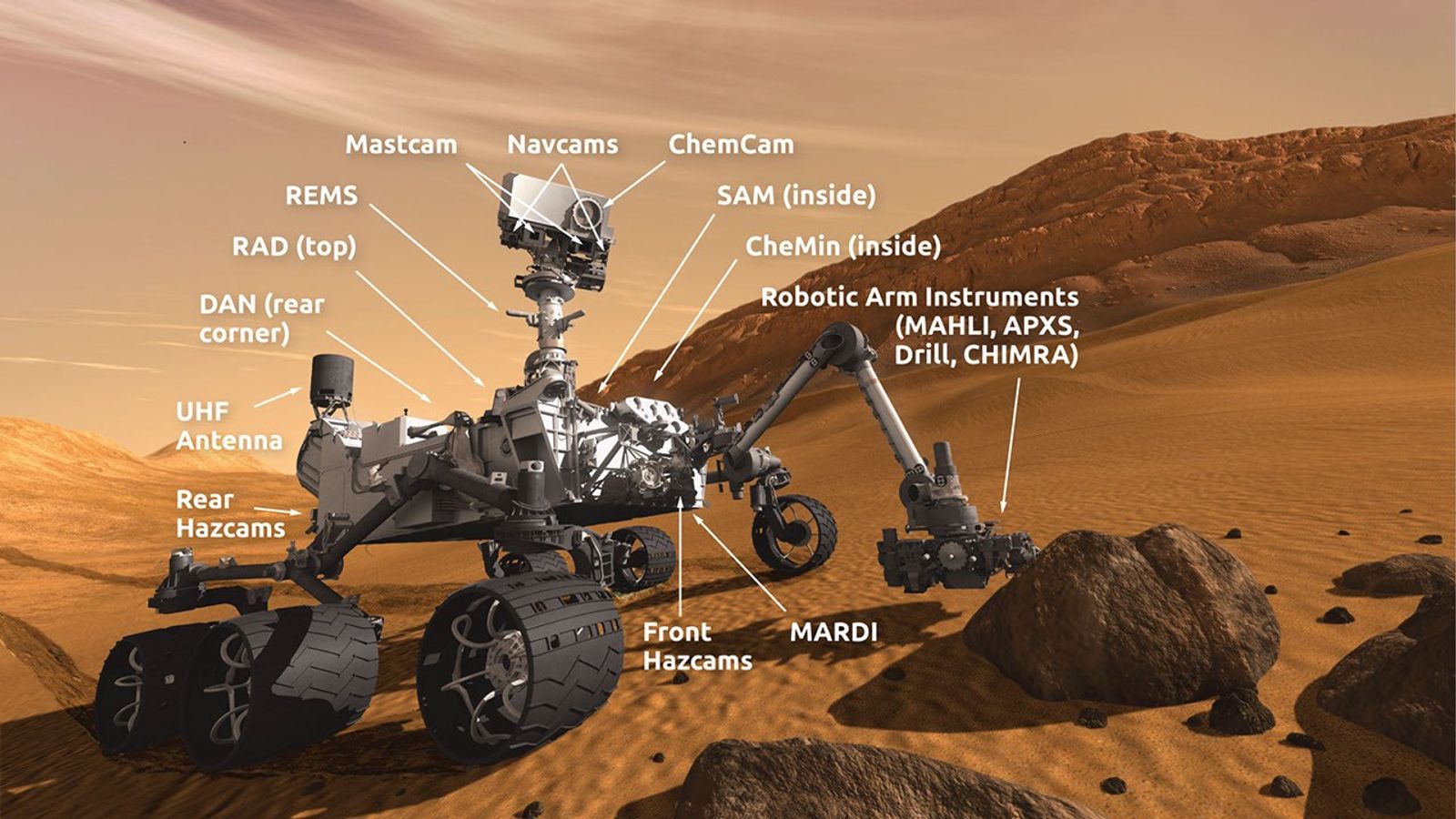
An artist rendering of the Curiosity rover with its scientific instruments labeled. Scientists used the Chemistry and Minerology (CheMin) instrument to perform X-ray diffraction analysis on samples of powdered rock. Credit: NASA/JPL-Caltech/MSSSA unique highlight of this study is that the data comes from Martian samples, rather than from theoretical modeling. Curiosity’s robotic arm delivered powdered rock to CheMin’s input funnel, where it was analyzed. “With CheMin’s X-ray diffraction patterns, we can look at the hematite crystal’s size and dimensions, information that that can’t be gathered from satellite analysis of the Martian surface.” said Tom Bristow, principal investigator of the CheMin instrument at NASA’s Ames Research Center in California’s Silicon Valley.
Ashwin Vasavada, Curiosity’s project scientist at NASA’s Jet Propulsion Laboratory in Southern California, said CheMin is capable of making measurements with extraordinary scientific fidelity.
“It doesn’t just tell you there is hematite,” Vasavada explained. “One can use the data to extract the size and shape of the hematite crystallites and the presence of other related minerals, all of which were necessary to produce this result.”
More about Curiosity
Curiosity was built by NASA JPL, which is managed by Caltech in Pasadena, California. NASA JPL leads the mission on behalf of NASA’s Science Mission Directorate in Washington as part of NASA’s Mars Exploration Program portfolio. CheMin, led by NASA Ames , is one of 10 science instruments aboard Curiosity and has a cross-country team of scientists, including researchers at NASA Ames, University of Arizona, California Institute of Technology, Planetary Science Institute, Carnegie Institution for Science, Lunar and Planetary Institute, JPL, NASA’s Goddard Space Flight Center in Greenbelt, Maryland, and NASA’s Johnson. The team combines expertise in mineralogy, petrology, materials science, astrobiology and soil science, with experience studying terrestrial, lunar and Martian rocks.
For more information on NASA’s Curiosity rover, visit:
https://science.nasa.gov/mission/msl-curiosity
Karen Fox / Alana Johnson
Headquarters, Washington
240-285-5155 / 202-672-4780
karen.c.fox@nasa.gov / alana.r.johnson@nasa.gov
Victoria Segovia
Johnson Space Center, Houston
281-483-5111
victoria.segovia@nasa.gov
Share
Details Last Updated May 29, 2026 Related Terms Explore More 3 min read Painting the Growing Season in the Maize TriangleRadar data from an agricultural area in South Africa, shown in a vivid color palette,…
Article
9 hours ago
5 min read NASA’s MAVEN Makes 1st Discovery of Atmospheric Effect at Mars
Article
2 weeks ago
2 min read NASA’s Curiosity Takes Close Look at Rock That Got Stuck on Drill
Article
3 weeks ago
Keep Exploring Discover More Topics From NASA
Missions
Humans in Space
Climate Change
Solar System
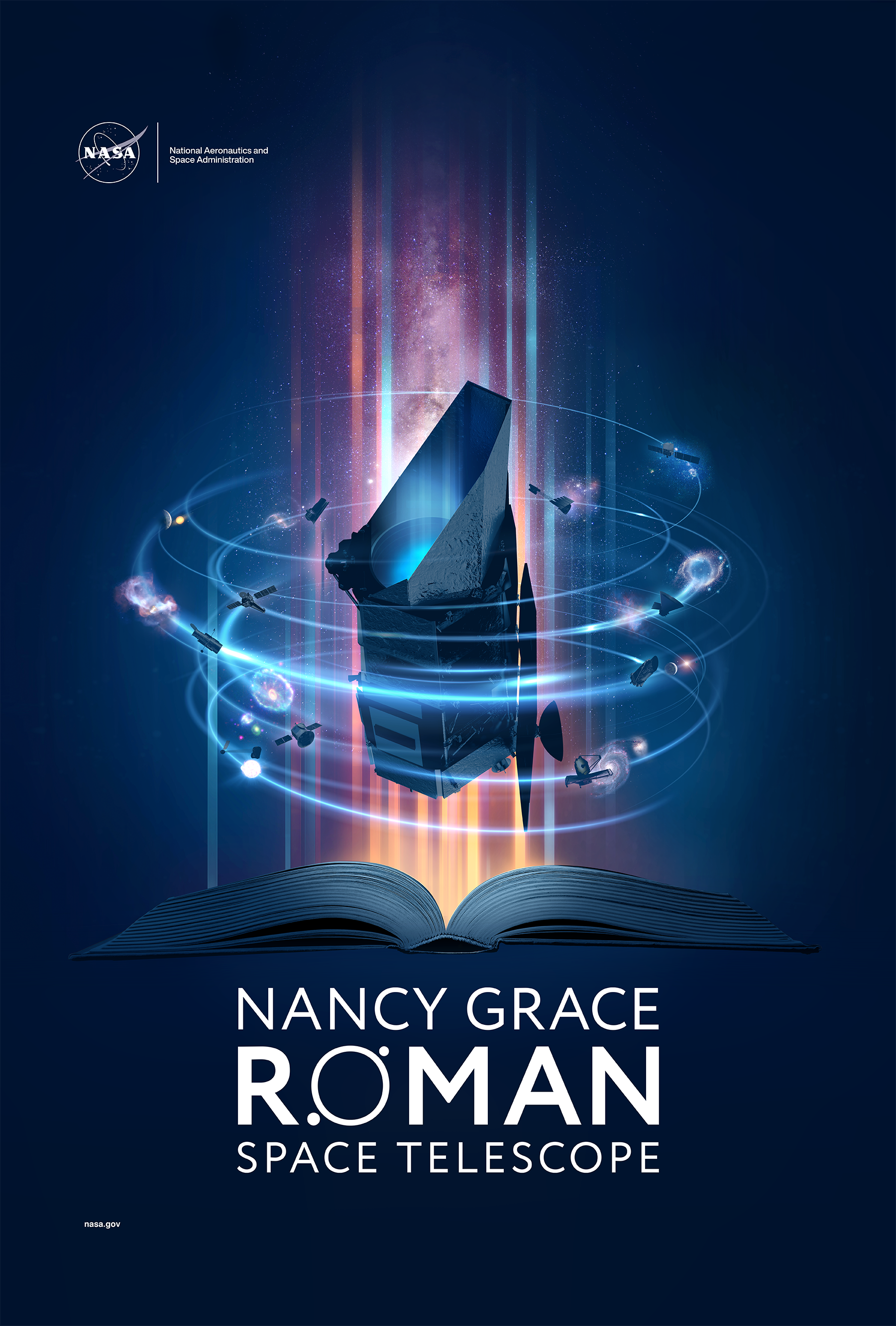
Nancy Grace Roman Space Telescope Poster
May 28, 2026
PDF (144.47 MB)
Print high resolution image
May 28, 2026
PNG (45.60 MB)
Smaller image for web view
May 28, 2026
PNG (3.75 MB)
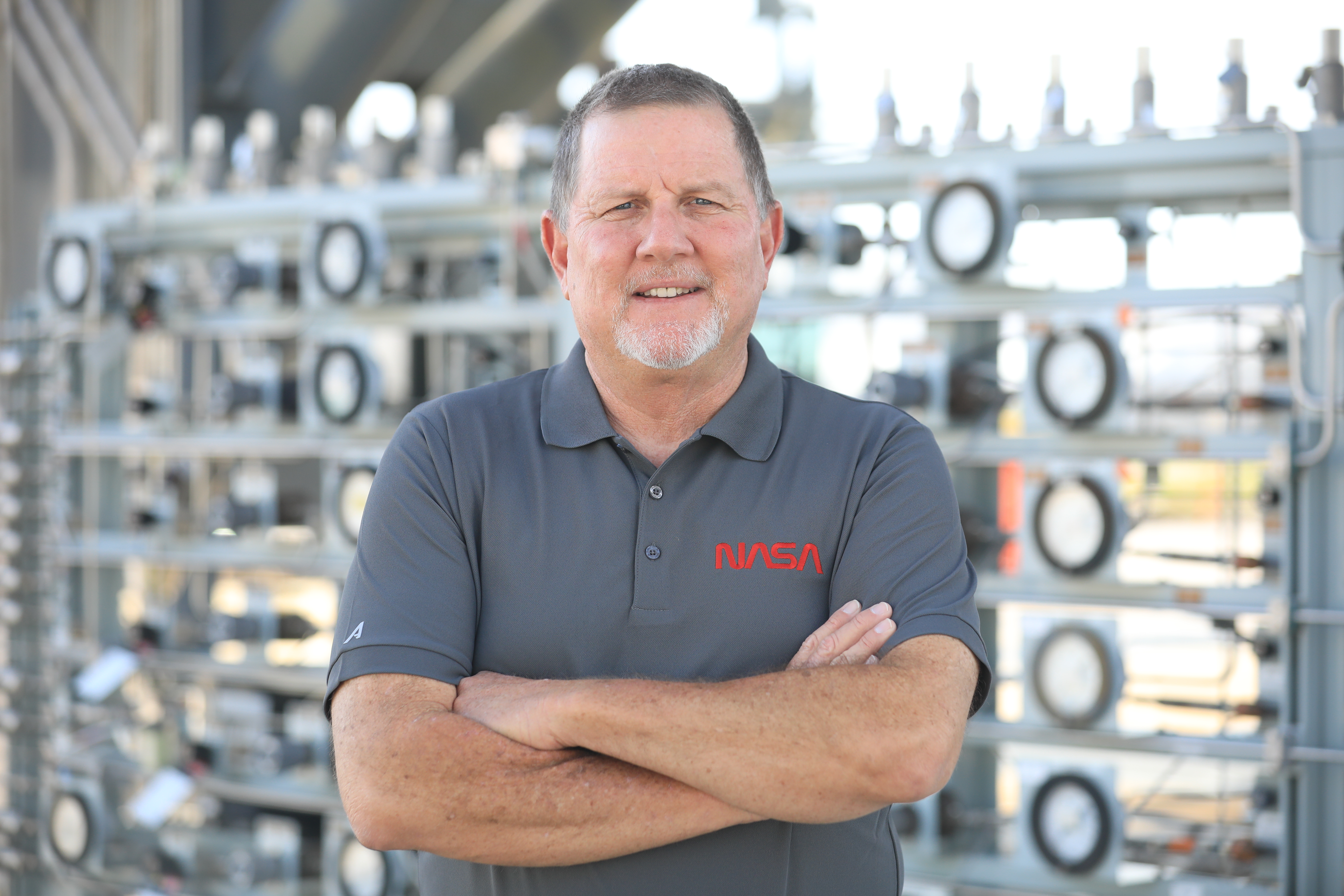
Contractor to Civil Servant: NASA Welcomes Kenny Heckle
Kenny Heckle grew up in Orlando, just west of NASA’s Kennedy Space Center in Florida. An 80s child, he comes from a long line of union pipefitters and fabricators.
Heckle recalls the day 42 years ago at KARS Park, which is a NASA Exchange–run recreation area for the agency’s workforce and their guests, when he attended an office party with his father. Heckle had his German Shepherd with him when a man who seemed to be enamored with the canine asked him who he was. “I’m Kenny Heckle, Wayne’s son,” he said. And the man who knew his dad well replied, “Why don’t you work for us (at NASA)?”
Two weeks later, Heckle was working at the center alongside his dad.
Heckle wasn’t a typical new employee. At 19, he already had seven years of mechanical experience, working on his father’s short-track stock cars, building and fabricating parts they needed. He later attended welding school before arriving for his first job as a contractor at NASA Kennedy’s Launch Equipment Test Facility (LETF) in 1984.
Since the 1970s, the LETF has provided NASA a place to safely assess machinery and designs to support launches through a unique set of structures, equipment, and tools to test full-scale umbilicals and release mechanisms.
Today, Heckle serves as the mechanical operations lead at NASA Kennedy’s LETF.
During the past four decades, Heckle has helped numerous NASA programs and commercial partners test their equipment ahead of launch, and in some instances, during and after liftoff. In his early years, his job was to test every umbilical on the launch pad and all the ground support equipment needed for Launch Complex 39A and B, even for Vandenberg Space Force Base in California.
Just two years into his career, Space Shuttle Challenger had a failure of the O-ring seals and broke apart just over a minute into its flight. Heckle remembered watching the catastrophic liftoff that morning, and hearing the broadcaster say Challenger was lost. A couple of weeks later, his team was tasked with helping to figure out what happened.
“You know, there’s always risk with spaceflight,” Heckle said. “But we got so consistent that we didn’t think something like that could happen and it hit hard. But then being able to come back and get the program going again, and being successful, that makes you proud.”
Nearly two decades later, Heckle’s team was asked to help with yet another investigation. After the Colombia accident, Heckle and his team were charged with showing how severe the damage was through their testing, and how to mitigate ice hitting a wing in the future. They spent hours shooting projectiles at thermal tiles, using ultrasonic sensors to track the data.
In recent years, Heckle has helped work on the first two Artemis missions. During the Artemis II wet dress rehearsal, there was a liquid hydrogen leak. Heckle was working long days, troubleshooting and fabricating possible solutions with Kennedy’s Prototype Lab. For Artemis I they had a similar leak, and Heckle’s team developed a process to slow fill the cryogenics and the LETF sent that information to the Artemis I launch team to implement.
During decades of problem-solving, Heckle and most of his team were contractors, having to work through the bureaucracy of working solutions across different contractors, as well as with NASA. On May 4, Heckle and 19 of his teammates applied and became NASA civil servants as part of the administrator’s workforce directive. The work done by the LETF team was deemed a critical capability to NASA’s future, and as such, the work was moved from an outside vendor to civil service, ensuring NASA is staffed and equipped to lead the most complex engineering and operational challenges directly.
The test facility ensures NASA retains the technical readiness, flexibility, and risk mitigation capabilities required for Artemis, SLS (Space Launch System), and future government and commercial missions. As the mechanical operations lead, Heckle has already noticed efficiencies with being able to get work done and securing the supplies needed now the LETF team has joined the civil servant workforce.
“If we continue to work together as a team and not have barriers, I think that will be great for the program moving forward no matter what we’re launching,” Heckle said.
NASA Astronaut Andrew Morgan Retires
May 28, 2026
Former NASA astronaut Andrew Morgan waves as he is photographed during an Expedition 61 spacewalk outside the International Space Station. Credit: NASAAfter a 12-year career at NASA, U.S. Army Brig. Gen. Andrew R. Morgan has retired from the agency to continue his military service. Morgan spent 272 days in space aboard the International Space Station.
NASA selected Morgan to join its 21st astronaut class in August 2013. He launched to the space station aboard a Soyuz MS-13 spacecraft on July 20, 2019, the same day as the 50th anniversary of the Apollo 11 Moon landing, from the Baikonur Cosmodrome in Kazakhstan.
Morgan served as a flight engineer on International Space Station Expeditions 60, 61, and 62, contributing to hundreds of scientific experiments, technology demonstrations, and space station maintenance activities. He traveled over 115 million miles (about 185 million km) while completing more than 4,300 Earth orbits over the course of his mission.
“Drew’s leadership and commitment to human spaceflight exemplify the very best of NASA,” said Vanessa Wyche, director of NASA’s Johnson Space Center in Houston. “From his service aboard the International Space Station to his continued passion for exploration, Drew’s impact across the agency has been profound. His steadfast dedication to the agency will continue to inspire generations to come.”
During his nine months aboard the station, Morgan conducted seven spacewalks for a total of 45 hours and 48 minutes of spacewalking time, breaking the record for a single spaceflight by a U.S. astronaut. Four of his spacewalks were dedicated to repairing the Alpha Magnetic Spectrometer, a particle physics detector designed to search for evidence of antimatter and dark matter.
“Drew approached every challenge with quiet confidence, sharp judgment, and an unwavering commitment to his team,” said Scott Tingle, chief of the Astronaut Office at NASA Johnson. “Whether serving in orbit or strengthening crew readiness here on the ground, he consistently elevated the people and missions around him. His leadership and example will continue to resonate across the astronaut corps for years to come.”
Morgan’s career at NASA also included serving as the Astronaut Office’s mission support branch chief, crew operations officer, astronaut mission control team liaison for Expeditions 67 and 68, and Army detachment commander. In his final two years at NASA, Morgan served a rotational assignment back to the U.S. Army as commander of U.S. Army Garrison Kwajalein Atoll, and senior military advisor for the U.S. Ambassador to the Republic of the Marshall Islands.
Morgan was born in Morgantown, West Virginia, but considers New Castle, Pennsylvania, his hometown. At the time of his NASA astronaut selection, he was a board-certified emergency physician and had served in elite special forces units around the globe. He is a graduate of the United States Military Academy at West Point, the Uniformed Services University of the Health Sciences, and the U.S. Army War College. He is currently serving as the commanding general of White Sands Missile Range in New Mexico.
“It has been an honor to serve in the nation’s space program,” Morgan said. “I am proud to have represented my country on an international mission that brings the best of humanity together for a shared purpose. I will miss the camaraderie of my incredible NASA teammates and their unparalleled expertise. While leaving the astronaut corps is bittersweet, I’m excited to continue serving our country as a leader in the U.S. Army.”
To learn more about how NASA explores the unknown and innovates for the benefit of humanity, visit:
https://www.nasa.gov/astronauts
-end-
Anna Schneider
Johnson Space Center, Houston
281-483-5111
Going Low and Slow in Testing
NASA’s X-59 quiet supersonic research aircraft flies above NASA’s Armstrong Flight Research Center in Edwards, California, on April 28, 2026, during testing focused on lower-speed and altitude flight conditions in support of NASA’s Quesst mission.
The X-59 has completed initial test flights at high altitudes and near-supersonic speeds, opening the door for additional flights focused on its full operating range. These more recent, lower-altitude flights at lesser speeds are helping to confirm the X-plane’s performance across a wide range of conditions, including flying with the landing gear both retracted and extended.
Read more about this series of test flights.
Image credit: NASA/Jim Ross
A Shift in What’s Shaping U.S. Landscapes
- Earth
- Earth Observatory
- Image of the Day
- EO Explorer
- Topics
- More Content
- About
NASA Develops Sensor to Improve Firefighter Safety
5 min read
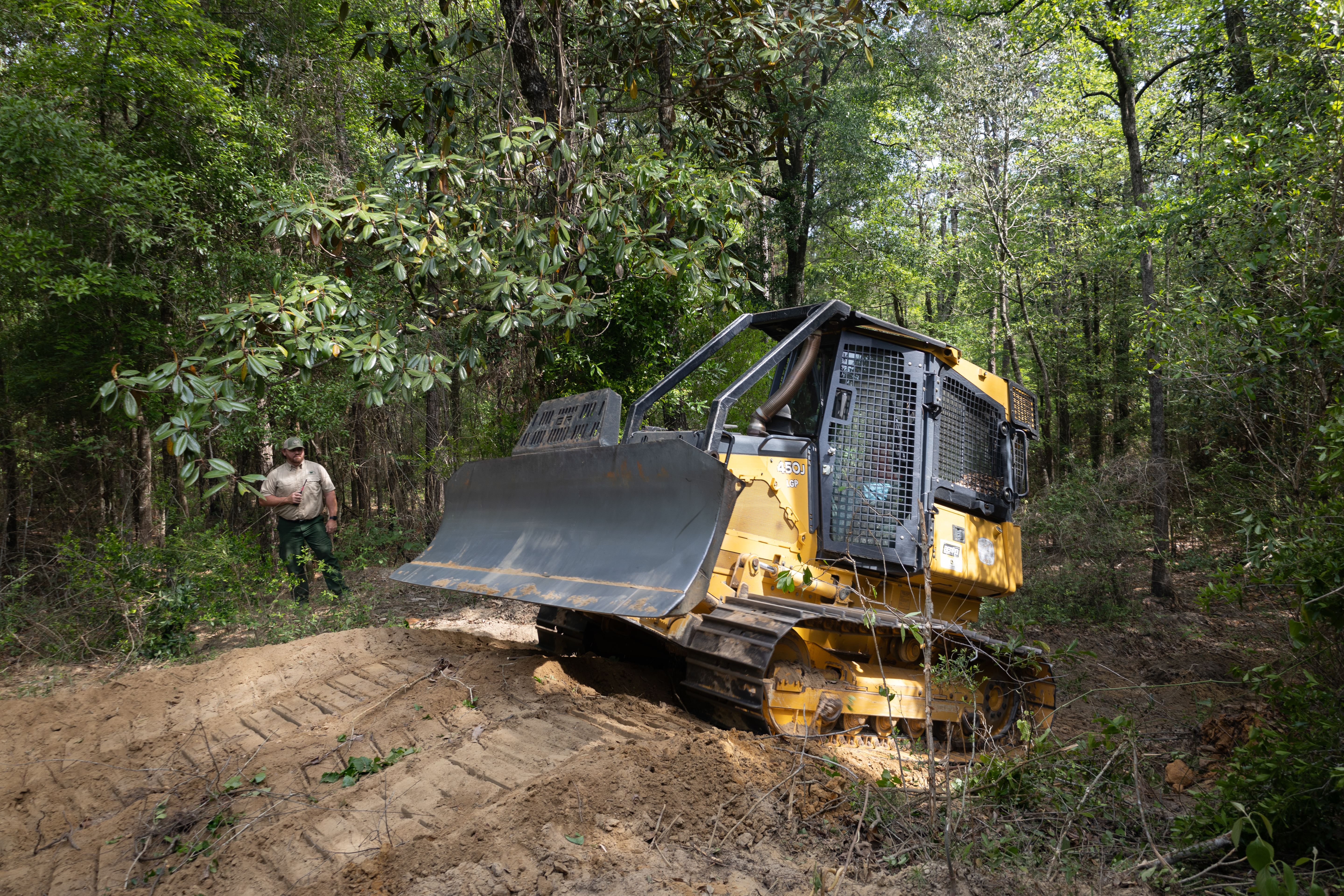
Preparations for Next Moonwalk Simulations Underway (and Underwater) Alabama Forestry Commission wildland firefighter Jason Berry teaches NASA Wildland Fires Technology Program Manager Teresa Kauffman how to drive a fire bulldozer during a stakeholder event April 23-24 in Andalusia, Alabama. NASA FireSense scientists have been working with the AFC to integrate thermal sensors onto these dozers, which notify the dozer operator if the radiant heat from a nearby fire reaches a dangerous threshold.NASA/Milan LoiaconoWith peak wildfire season approaching, scientists with NASA’s FireSense project have created low-cost thermal sensors to install on fire bulldozers that will alert firefighters when heat from a nearby fire reaches a dangerous level. The sensors also provide researchers with important data on what happens beneath the canopy during a fire.
In April, researchers and firefighters gathered in southern Alabama to discuss challenges and advances in firefighting, and to demonstrate the new technology. The event was part of a collaboration between NASA and the Alabama Forestry Commission (AFC). The goal: to make firefighting safer and gather critical data on fire behavior.
“As we try to develop technologies that allow us to understand and respond to wildfires with our partners, ground observations are vital to provide context for what we are seeing from space,” said Ian Brosnan, program manager for wildland fires at NASA’s Ames Research Center in California’s Silicon Valley.
To view this video please enable JavaScript, and consider upgrading to a web browser that supports HTML5 video
The Alabama Forestry Commission tests the new thermal sensor developed by NASA’s FireSense project for their fleet of fire dozers, during the initial integration in September 2025. After FireSense scientists installed the sensor, AFC operators drove the dozer next to a test fire, at the distance the dozers normally operate on a fire line. The thermal sensors performed as planned and have since been deployed on active wildfires. NASA/Ryan Wade Dozers on the fire lineFirefighters nationwide use bulldozers, colloquially referred to as fire dozers, on the front line of a fire to clear vegetation and to create fire breaks, which slow or stop a wildfire’s spread. This often puts dozers and their operators within feet of the flames.
The AFC is switching its fleet to a model of bulldozer that has an enclosed cab called an “envirocab.” While envirocabs are safer for operators than open cabs, the enclosure makes it more difficult to gauge when radiant heat from the fire has reached a dangerous temperature.
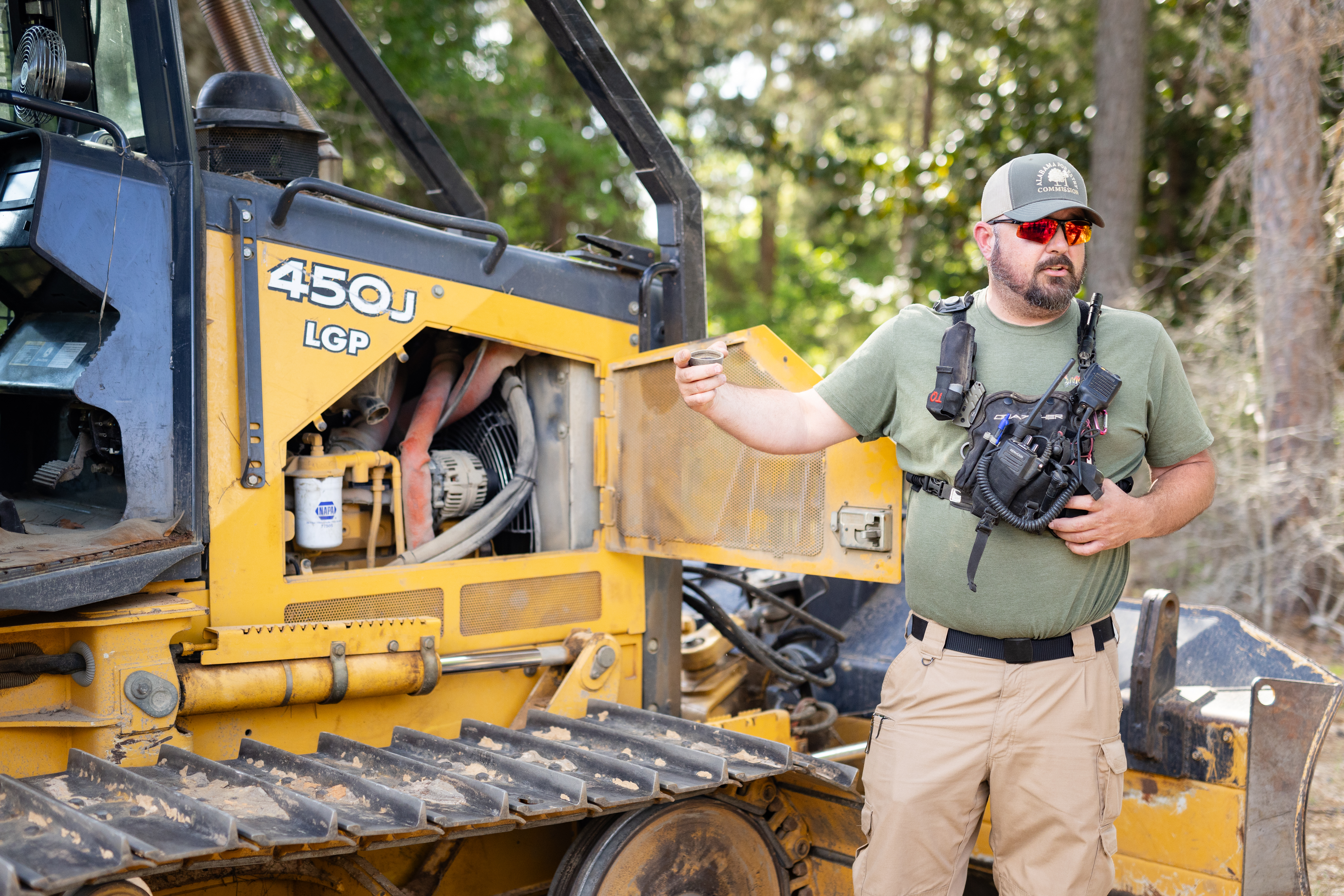
Alabama Forestry Commission fire analyst Ethan Barrett gives an overview of fire dozer operations to scientists and researchers from NASA’s FireSense project and other university and commercial partners during the April event. NASA/Milan Loiacono“It’s not so much about what’s going to burn the tractor up as what’s going to shut the tractor down,” said Ethan Barrett, AFC fire analyst. The electrical wiring can short or even melt from high heat, stranding the operator in a dangerous environment.
That’s where NASA comes in. According to Brosnan, developing thermal sensors for the AFC was an opportunity to create technology that has immediate impact on firefighter safety, while also providing scientists with valuable information about what happens on the ground during a fire.
It’s not so much about what’s going to burn the tractor up as what’s going to shut the tractor down.Ethan barrett
AFC Fire Analyst
How sensors workThe AFC’s requirements for a sensor were simple: it needed to be low-cost and easy to operate.
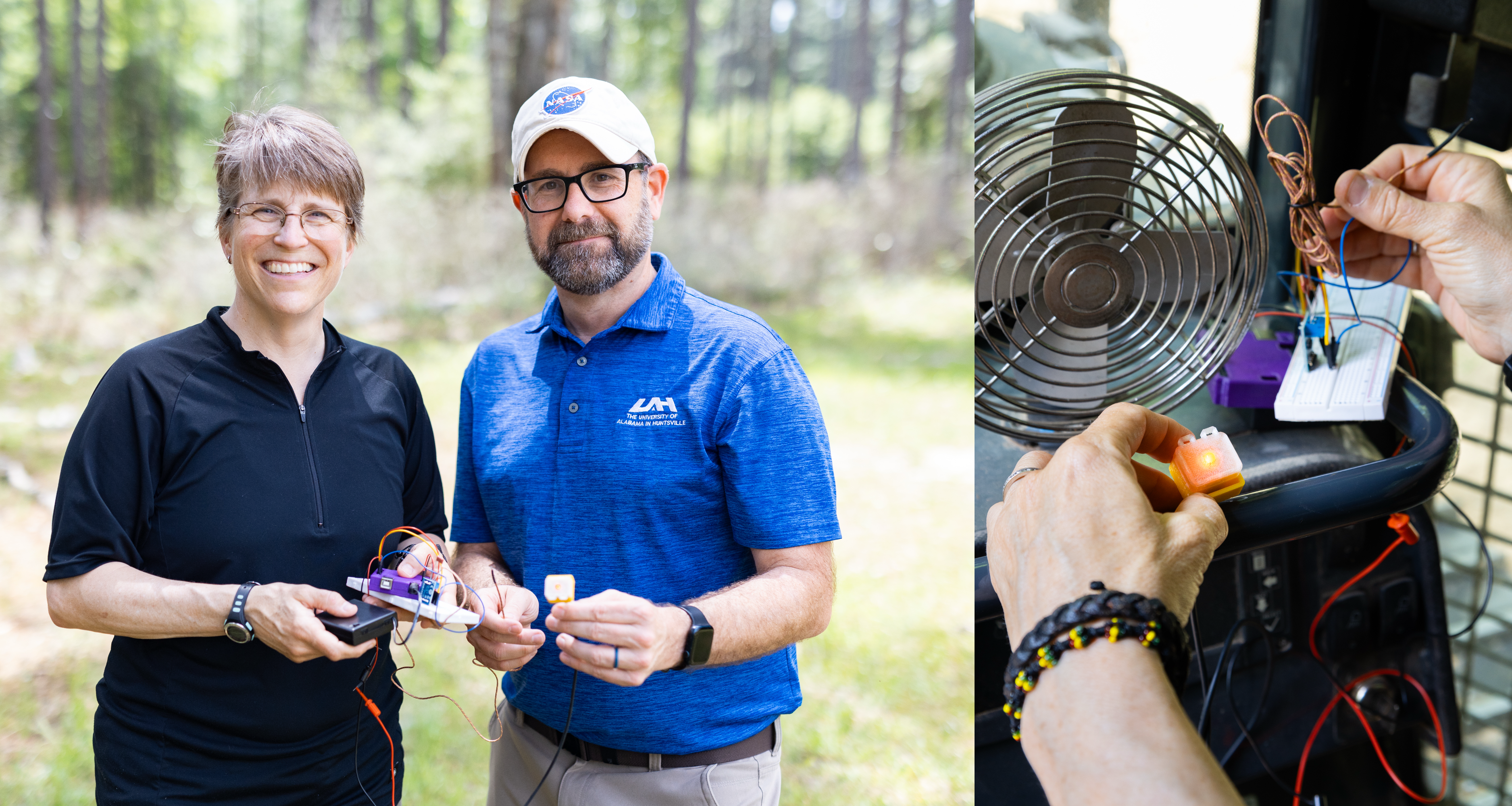
“We used commercial, off-the-shelf components to make this,” said Jennifer Fowler, science integration manager for the wildland fires program at NASA’s Langley Research Center in Hampton, Virginia. “The thermocouple that sits in the window to measure temperature, for example, is the same one used in an oven or a kiln.”
Jennifer Fowler, NASA Wildland Fires science integration manager (left) and Ryan Wade, research scientist with the University of Alabama, Huntsville and NASA FireSense (right) hold a version of the low-cost thermal sensor they developed to install on fire dozers. The sensor uses an off-the-shelf thermocouple, found in ovens and kilns, to read the radiant heat coming in from a nearby fire. When it reaches an unsafe temperature, the sensor triggers a blinking LED light on the dashboard (right), signaling the operator to move away from the fire line.NASA/Milan LoiaconoThat thermocouple is wired to a simple LED light attached to the dashboard that’s directly in the operator’s line of sight. When the thermocouple senses an unsafe temperature, the LED starts blinking. The whole system is powered by AA batteries.
“While installing the second sensor, we realized we needed an extra piece, so we just ran out to the local hardware store to grab it,” said Ryan Wade, research scientist with the University of Alabama, Huntsville and NASA FireSense. “NASA’s expertise in this case comes not in the novelty of the instrument itself, but in figuring out how to solve the problem quickly and integrate that technology into their existing system.”
Fowler installed the first of these sensors in September 2025, and Wade installed the second in March 2026.
“Since their installation, we have run them on wildfires and prescribed burns and they’ve been effective,” Barrett said. “They work exactly as intended, and the operators have said it leads to better situational awareness. Based on the success of this pilot, we are looking at outfitting all the dozers in our fleet.”
Driving fire science forwardCo-developing these thermal sensors is the latest milestone in a relationship the two agencies have been building for more than a year. NASA scientists led training classes on weather and soil moisture with the AFC last spring and worked with AFC ground crews to test airborne instruments on active wildfires.
Moving forward, NASA FireSense and the AFC are planning to integrate the Fire Thermal InfraRed Spectrometer, or FireTIRS, which will measure temperature, spread rate, flame length, fire convection, and gas emissions.
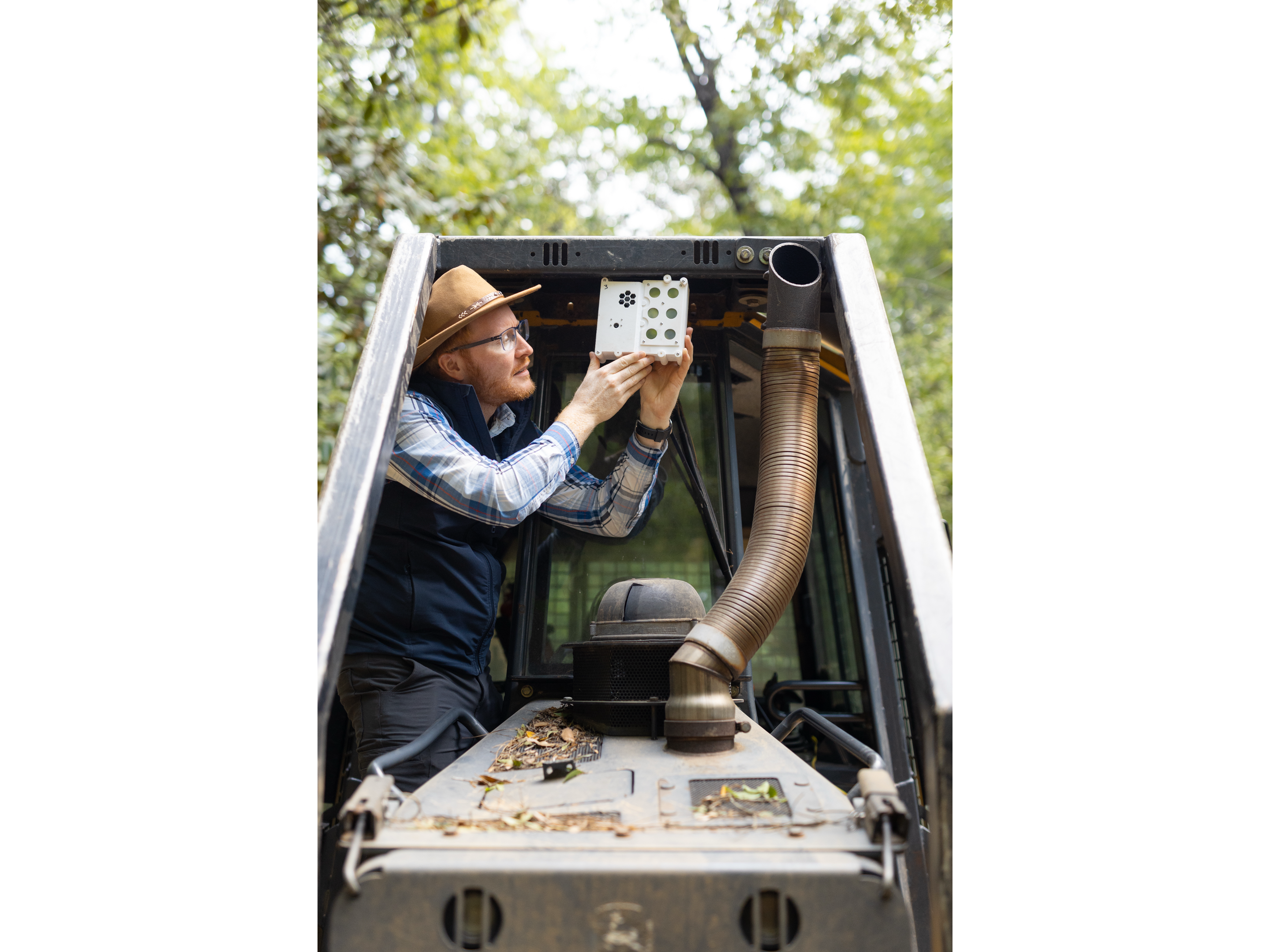
James Thompson, an assistant research professor at University of Texas at Austin and a principal investigator with NASA’s Earth Science Technology Office, tests out locations on a fire dozer where the FireTIRS thermal infrared imager could be mounted. Thompson was part of a stakeholder event held between NASA’s FireSense project and the Alabama Forestry Commission (AFC), which included demonstrating thermal sensors on the AFC’s fire dozers.Fowler is also evaluating anemometers and compact cameras for the dozers. Anemometers provide data on wind speed and direction, while compact cameras provide data on burn severity, rate of spread, and the type, volume, and consumption of fuels.
The data this suite of instruments can gather would fill an important gap in creating a well-rounded understanding of fire.
“This is the dataset that will get us to the next generation of fire models,” Fowler said. “It gives us the detailed understanding we need to create tools that can give firefighters more advanced notice of what a fire will do. On a wildfire, that extra time is everything.”
To view more photos from the FireSense campaign visit: nasa.gov/firesense
About the AuthorMilan LoiaconoScience Communication SpecialistMilan Loiacono is a science communication specialist for the Earth Science Division at NASA Ames Research Center.
Share Details Last Updated May 27, 2026 Related Terms Explore More 5 min read A Shift in What’s Shaping U.S. LandscapesWild disturbances are on the rise, while land disturbed by human activity has been decreasing.
Article 19 minutes ago 2 min read Released: NASA Goddard Issues Draft Request for Proposal for the Landsat 10 SpacecraftThe Landsat 10 Spacecraft Draft Request for Proposal (DRFP) is available for review via SAM.gov.
Article 8 hours ago 5 min read NASA-European Sea Level Mission Homes in on El Niño Article 13 hours agoReleased: NASA Goddard Issues Draft Request for Proposal for the Landsat 10 Spacecraft
- Landsat Home
- Missions
- News
- Data
- Benefits
- Outreach
- Multimedia
- About
- Search
The Landsat 10 Spacecraft Draft Request for Proposal (DRFP) is available for review via SAM.gov as of May 18, 2026. This solicitation marks a major milestone in continuing the decades-long partnership between NASA and the U.S. Geological Survey (USGS) to acquire, archive, and distribute multispectral imagery of Earth’s global landmasses and coastal regions.
Potential offerors may comment on all aspects of the draft solicitation by June 2, 2026. The final Request for Proposal (RFP) is currently expected to be released at the end of June 2026, with proposals due roughly 30 days thereafter.
The scope of work includes the end-to-end design and fabrication of the satellite bus, comprehensive observatory-level performance testing, development of high-fidelity simulators, launch vehicle integration support, and post-launch on-orbit commissioning. Beyond building the bus, the contractor will lead the mechanical and electrical integration of the government-furnished Landsat Instrument Suite (LandIS).
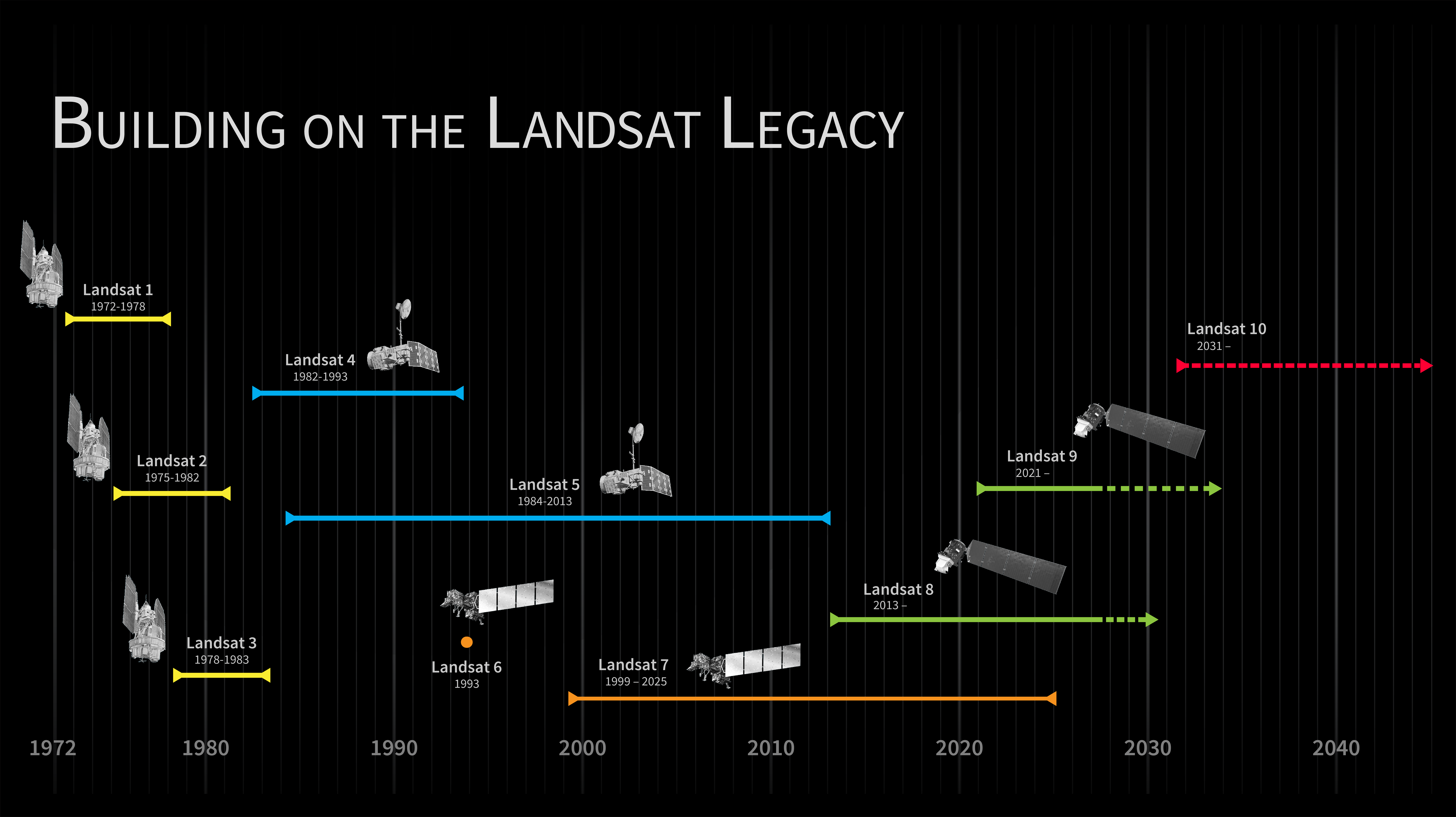
Recently re-architected as a single-observatory, Landsat 10 will fly in a 653-kilometer sun-synchronous, near-polar orbit with a repeating ground track every 18 days. Key technical specifications of this Class C mission require the spacecraft to support a maximum launch mass of 4,000 kilograms, feature advanced onboard autonomy and fault management, and ensure a minimum 5-year design life plus commissioning. Landsat 10 operations will ultimately transition to the USGS following its on-orbit checkout.
Landsat 10 provides improvements in both spectral and spatial capabilities compared to its predecessor missions, Landsats 8 and 9, all while guaranteeing critical data continuity with the legacy archive at the USGS Earth Resources Observation and Science (EROS) Center. The mission will ensure that researchers, resource managers, and policymakers worldwide continue to receive consistent, freely available data to monitor natural and human-induced environmental changes for years to come.
Explore More
Released: NASA Goddard Issues Draft Request for Proposal for the Landsat 10 Spacecraft
2 min read
The Landsat 10 Spacecraft Draft Request for Proposal (DRFP) is available for review via SAM.gov.
May 27, 2026 ArticleEver Restless Mount Dukono Erupts
2 min read
The volcano on Indonesia’s Halmahera Island routinely ejects ash, volcanic gases, and volcanic bombs.
May 27, 2026 ArticleThree Ways that a New Land Monitoring System is Transforming How We Manage Forests
7 min read
DIST-ALERT, a global land change monitoring system, is revolutionizing forest management.
May 26, 2026 Article1
2
3
…
310
Next
La NASA ofrece información actualizada sobre rovers, módulos de alunizaje y misiones de Base Lunar
Durante una sesión informativa sobre el programa Base Lunar, celebrada en la sede de la NASA en Washington, la agencia anunció nuevos contratos para el desarrollo de vehículos lunares con capacidad para transportar tripulación y módulos de aterrizaje de carga no tripulados con destino a la Luna. Directivos de la NASA también dieron a conocer los plazos de lanzamiento previstos y los próximos hitos para las primeras misiones de infraestructura de Base Lunar y de exploración a la región del Polo Sur de la Luna, como paso previo a la llegada de los astronautas del programa Artemis.
“La Base Lunar será el primer puesto de avanzada de Estados Unidos y de la humanidad en otro mundo celeste”, dijo el administrador de la NASA, Jared Isaacman. “Cada misión, tripulada o no, será una oportunidad de aprendizaje a medida que regresemos a la superficie lunar, construyamos la infraestructura necesaria para permanecer allí y dominemos las destrezas necesarias para vivir y trabajar en uno de los entornos más exigentes y peligrosos que se pueda imaginar. Iremos en busca de la ciencia, por todo lo que tenemos que ganar desde una perspectiva económica y tecnológica, por las innovaciones que mejorarán la vida aquí en la Tierra y para prepararnos para el próximo destino al que inevitablemente nos dirigiremos a continuación. Agradecemos el liderazgo del presidente Trump, el compromiso bipartidista del Congreso, a nuestros socios de la industria e internacionales, y a la dedicada fuerza laboral de la NASA, cuya pericia nos permite lograr lo casi imposible”.
La NASA anunció las tres primeras misiones de Base Lunar para comenzar a establecer operaciones sostenidas.
- Base Lunar I: Su lanzamiento está previsto para no antes del otoño [boreal] de 2026; para ello, se utilizará el módulo de aterrizaje Blue Moon Mark 1 Endurance de Blue Origin con el fin de transportar cargas útiles de la NASA. El equipamiento incluirá el instrumento Cámaras estéreo para el estudio de los penachos y la superficie lunar, diseñado para estudiar la interacción de los propulsores con la superficie de la Luna, y el Conjunto retroreflectivo láser, el cual ayuda a las naves espaciales en órbita a determinar su ubicación con mayor precisión utilizando luz láser reflejada. La misión alunizará en la cresta de conexión de Shackleton para demostrar capacidades que permitan reducir riesgos en anticipación a las futuras misiones tripuladas de aterrizaje del programa Artemis, previstas para el año 2028.
- Base Lunar II: Con un lanzamiento programado para más adelante este año, transportará más de 500 kilogramos (1.100 libras) de carga a bordo del módulo de aterrizaje Griffin de Astrobotic, incluyendo el rover FLIP de Astrolab, con el fin de madurar los sistemas de movilidad que servirán para orientar las futuras operaciones de vehículos para terreno lunar (LTV, por sus siglas en inglés).
- Base Lunar III: También programada para este año, esta misión transportará la primera carga útil seleccionada con la iniciativa Cargas Útiles e Investigaciones de Exploración en la Superficie de la Luna de la NASA. Su investigación central, Lunar Vertex (Vértice Lunar), viajará a bordo del módulo de alunizaje Nova-C Trinity de Intuitive Machines y estudiará los remolinos lunares —las manchas claras en la superficie— con el fin de mejorar nuestra comprensión sobre la evolución de la superficie y el comportamiento de los materiales en condiciones extremas. La misión incluirá cargas útiles de la ESA (Agencia Espacial Europea) y del Instituto Coreano de Astronomía y Ciencias Espaciales, lo que refleja la participación comercial e internacional en las actividades de la Base Lunar.
Estas misiones son las primeras de más de una docena de misiones que serán anunciadas este año; cada una está diseñada para producir datos operativos y reducir riesgos en anticipación a las actividades en la superficie de las misiones tripuladas de Artemis.
La NASA ha adjudicado contratos a Astrolab por 219 millones de dólares y a Lunar Outpost 220 millones de dólares para la construcción y entrega de la primera fase de los LTV. Adjudicados en el marco de las órdenes de trabajo de la Fase 1 de la Misión de Alta Viabilidad del contrato de Servicios de Vehículos de Terreno Lunar, estos hitos de costo fijo y basados en el desempeño permitirán a la NASA desplegar sistemas de movilidad, tanto tripulados como no tripulados, en la superficie lunar para 2028, mediante la iniciativa de Servicios Comerciales de Carga Útil Lunar (CLPS, por sus siglas en inglés) de la agencia. La movilidad inicial en la superficie es un componente fundamental en las prioridades de la política espacial nacional de establecer una presencia lunar duradera.
El Vehículo Lunar Tripulado (CLV 1) de Astrolab, adaptado a partir de la arquitectura FLEX de esa compañía, es un rover diseñado para transportar astronautas, trasladar suministros y dar apoyo en operaciones remotas; cuenta con una configuración compacta en estiba (en estado replegado), tiene una masa de aproximadamente 907 kilogramos (2.000 libras) y la capacidad de alcanzar más de 9,6 kilómetros por hora (6 mi/h) en terreno llano.
Como complemento a esta capacidad, el Pegasus de Lunar Outpost es una evolución de su rover Eagle más ligera y lista para la misión, y está diseñado explícitamente para cumplir con los requisitos actualizados para LTV de la NASA. Con una autonomía operativa de hasta un año y capaz de conducir de forma manual, autónoma o teleoperada a velocidades superiores a los 14 km/h (9 mph), Pegasus incorpora tecnologías heredadas del programa Apolo y se basa en una amplia experiencia en prototipos y vuelos para ofrecer una movilidad confiable y centrada en el ser humano, esencial para el establecimiento de una base lunar sostenida.
El despliegue de múltiples LTV en las etapas iniciales del desarrollo de Base Lunar acelerará las demostraciones tecnológicas, orientará la planificación de los emplazamientos y reducirá los riesgos operativos en anticipación de las misiones tripuladas de Artemis, lo que permitirá a la NASA caracterizar los peligros del terreno, transportar materiales, posicionar de antemano los recursos y madurar los sistemas necesarios para la exploración lunar de larga duración.
Durante los próximos dieciocho meses, los proveedores seleccionados finalizarán el diseño de los rovers, llevarán a cabo evaluaciones con tripulación y certificarán las unidades de vuelo para su operatividad. Los LTV resultantes darán apoyo a desplazamientos autónomos, la preparación del terreno, investigaciones científicas, demostraciones de tecnología y el transporte de astronautas.
A medida que avancen los esfuerzos para el establecimiento de la Base Lunar, la NASA ampliará las oportunidades para proveedores adicionales mediante concursos de acceso por etapas, fomentando un enfoque sólido y sostenible para la movilidad lunar y fortaleciendo las prioridades nacionales en materia de capacidades espaciales.
Para la entrega de estos rovers en la región del Polo Sur de la Luna, la NASA adjudicó a Blue Origin un contrato de 188 millones de dólares, con una opción de prórroga por un valor de 280,4 millones de dólares para dos órdenes de trabajo, lo que incluye una opción de prórroga en función del desempeño en la fase inicial. La NASA puede optar por extender la orden de trabajo para la entrega de la carga útil.
Esta contratación competitiva, ejecutada en el marco de la fase de entrega indefinida y cantidad indefinida de CLPS 1.0 con la orden de trabajo CX-2, representa una inversión estratégica en la exploración lunar y desempeñará un papel fundamental para posibilitar la movilidad y el desarrollo de infraestructuras para operaciones lunares sostenidas, marcando un paso significativo hacia el establecimiento de una presencia humana permanente en la Luna.
Sobre la base de los éxitos y las lecciones aprendidas en CLPS 1.0, la agencia también detalló cómo la próxima generación de módulos de aterrizaje de carga en el marco de CLPS 2.0 continuará con la entrega de cargas útiles tanto en la superficie lunar como en la órbita de la Luna, respaldando de esta manera los ambiciosos objetivos de la NASA para sus operaciones lunares sostenidas. Esta nueva fase introduce una mayor flexibilidad, permitiendo a la NASA contratar servicios de entrega “llave en mano” —completamente construidos, integrados, probados y listos para usar de inmediato— o comenzar a recibir el hardware de CLPS para integrarlo en sus propias misiones. La solicitud de propuestas definitivas para CLPS 2.0 fue publicada el 15 de mayo de 2026, y el plazo para la presentación de las respuestas se vence el martes 30 de junio de 2026.
Actualización sobre la misión MoonFall
La agencia también compartió nuevas actualizaciones sobre MoonFall, una misión que enviará cuatro drones para hacer vuelos cortos sobre la superficie lunar mientras inspeccionan posibles lugares de aterrizaje para los astronautas de Artemis. El Laboratorio de Propulsión a Chorro (JPL, por sus siglas en inglés) de la NASA, con sede en el sur de California, ha estado desarrollando el diseño y haciendo pruebas con prototipos de hardware, y ha seleccionado a Firefly Aerospace para construir la nave espacial que transportará los drones desde la órbita terrestre hasta la Luna. El lanzamiento de esta misión está programado para 2028.
Los drones aterrizarán de forma autónoma en la superficie lunar y, a lo largo de un único día lunar, recopilarán imágenes de alta resolución de terrenos de difícil acceso. Tras el último vuelo de cada dron, su carga útil para la supervivencia nocturna seguirá funcionando durante varios meses, lo que supondrá una presencia estadounidense continuada en el Polo Sur lunar.
Otras misiones robóticas en camino
Por último, la NASA anunció que en las próximas semanas dará a conocer una selección de adjudicaciones de trabajos adicionales de CLPS 1.0 —otorgadas durante el evento “Ignition” (Encendido) de la agencia— para cargas útiles y demostraciones de tecnología de Base Lunar. Asimismo, en los próximos meses también habrá nuevas oportunidades para licitar por las órdenes de trabajo de CLPS 1.0 y 2.0, a medida que se definan y planifiquen las demostraciones tecnológicas de la Fase 1 para las misiones de la Base Lunar.
Durante su sesión informativa, el liderazgo de la NASA reiteró que el establecimiento de una presencia lunar sostenida está alineado con la estrategia de exploración más amplia de la agencia, la cual se sustenta en una mayor frecuencia de lanzamientos, la ampliación de sus asociaciones con la industria y una coordinación a nivel de toda la agencia.
Como parte de una edad de oro de innovación y exploración, la NASA enviará astronautas de Artemis en misiones cada vez más difíciles para explorar más de la Luna con fines de descubrimiento científico y beneficios económicos, y para continuar sentando las bases para las primeras misiones tripuladas a Marte.
Para obtener más información sobre la Base Lunar, visita el sitio web (en inglés):
https://www.nasa.gov/moonbase
-fin-
George Alderman / James Gannon / María José Viñas
Sede central de la NASA, Washington
+1 202-358-1600
george.a.alderman@nasa.gov/ james.h.gannon@nasa.gov / maria-jose.vinasgarcia@nasa.gov