NASA - Breaking News

NASA Tests New Refuel Device for Future In-Space Refueling Missions
To view this video please enable JavaScript, and consider upgrading to a web browser that supports HTML5 video
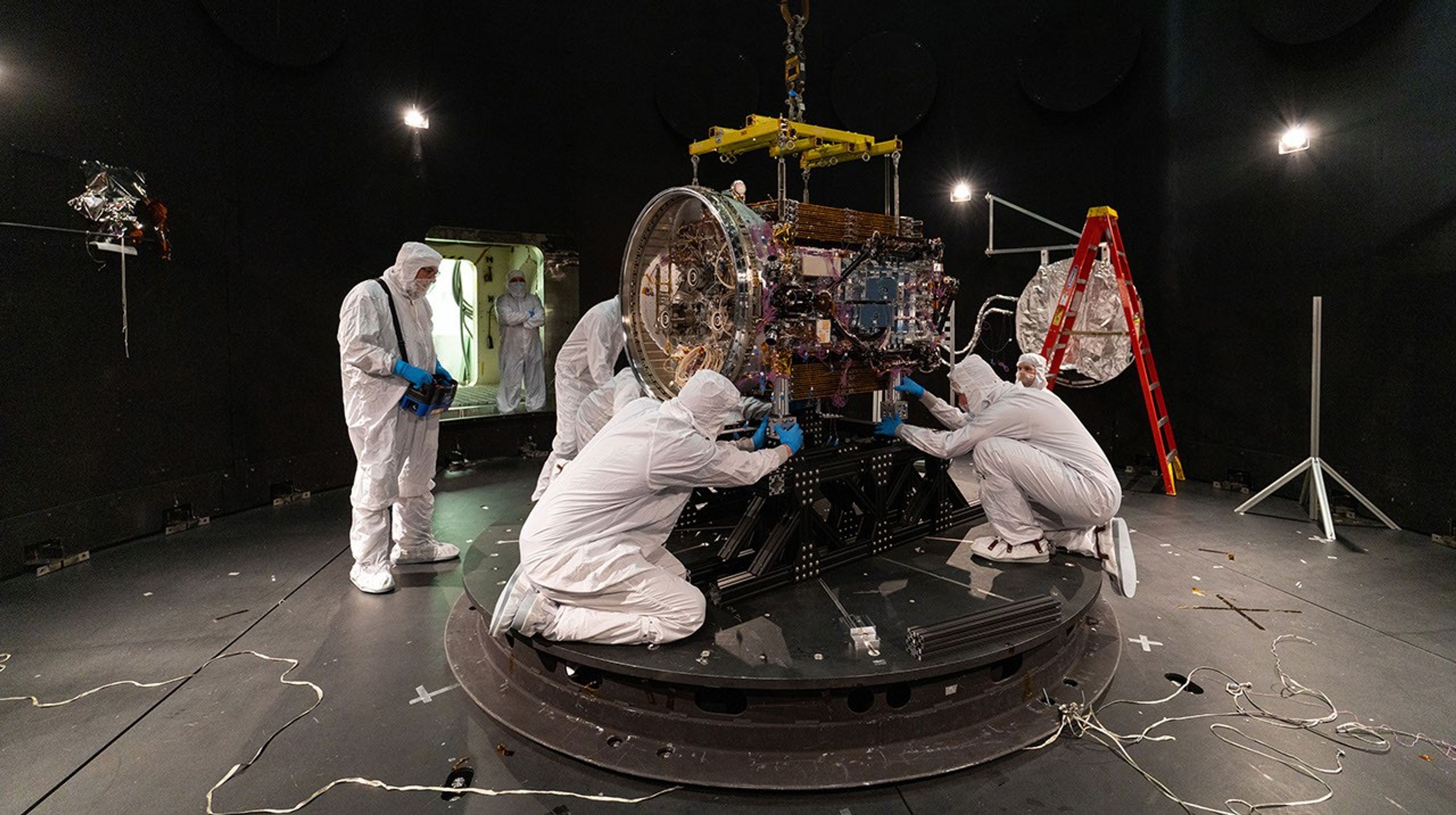
Engineers from NASA’s Marshall Space Flight Center in Huntsville, Alabama, and L3Harris conduct operational testing on a developmental cryocoupler, a vital technology for future in-orbit spacecraft refueling.NASA/Tyson EasonFor NASA’s next generation of deep space exploration missions, spacecraft may need to refuel in Earth orbit before pushing farther into the solar system. Similar to how a gas pump needs a nozzle to fit your fuel tank, future spacecraft could require a special device in order to fill up prior to departure, known as a cryocoupler.
Cryocouplers would allow spacecraft to connect to future orbital propellant depots, which would serve as the gas stations of space. The technology comes with the challenge of reliably transferring cryogenic, or super-cold, fluids without losing propellant or performance. Cryogenic propellants like liquid hydrogen and liquid oxygen must stay chilled to hundreds of degrees below zero Fahrenheit, placing strict demands on the materials, seals, and mechanisms that move them.
“In-orbit cryogenic refueling between two spacecraft has yet to be done and remains one of the toughest engineering challenges in spaceflight,” said Travis Belcher, cryocoupler project manager at NASA’s Marshall Space Flight Center in Huntsville, Alabama. “These propellant transfers are essential for the kinds of missions NASA wants to fly in the future, so developing a coupler that can handle ultra-cold propellants is a critical step toward making that capability real.”
Ground-based couplers like those used to fill the SLS (Space Launch System) for Artemis missions are not an option for orbiting propellant transfers. Those couplers release quickly while a rocket is launching and must be manually reconnected for the next flight. They also are not designed to operate in the harsh environment of space and are much larger than what would be used to refill an orbiting spacecraft’s fuel tank.
To meet these challenges, NASA tested a cryocoupler developed by L3Harris.
“The cryocouplers we’re working on can attach and detach multiple times and are fully automated, so astronauts won’t have to perform a spacewalk to transfer propellant,” said Belcher. “They’re rigorously designed to withstand space and sized for the expected tank designs.”
A joint NASA and L3Harris team recently conducted two types of tests at NASA Marshall. To ensure the cryocoupler can handle the extremely cold temperatures it will be exposed to, they ran liquid nitrogen at minus 321 degrees Fahrenheit through multiple connected and disconnected configurations to observe how the coupler reacts to thermal contraction, flow, and significant temperature differences between propellant and materials.
The team also put the cryocoupler through operational tests to determine its performance limits. In this setup, one coupler half was mounted to a robotic table that could move and rotate in any direction, allowing it to simulate misaligned docking with the other half, which remained stationary above the table. The cryocoupler is designed to accommodate some misalignment in case a spacecraft and depot are not perfectly aligned when docking.
“These cryocouplers are very early in development, so the testing is mostly focused on basic functionality,” said Belcher. “Future test campaigns will design them for specific missions and assess them more meticulously based on that mission’s requirements.”
The cryocoupler testing was done as part of a 2022 Announcement of Collaboration Opportunity, a partnership where NASA centers provide select companies with expertise, facilities, hardware, and software at no cost.
The Cryogenic Fluid Management Portfolio project, a cross-agency team based at NASA Marshall and NASA’s Glenn Research Center in Cleveland, oversees cryocoupler development.
To learn more about cryogenic fluid management, visit:
Share Details Last Updated Jun 29, 2026 EditorLee MohonContactJoel Wallacejoel.w.wallace@nasa.govLocationMarshall Space Flight Center Related Terms Explore More 1 min read Novel Recuperator Design for Cryogenic Fluid Management System Article 1 year ago 2 min read NASA, Industry Prepare Cryogenic Fuel Technology Demo Article 2 months ago 5 min read Brr, It’s Cold in Here! NASA’s Cryo Efforts Beyond the Atmosphere Article 2 years ago Keep Exploring Discover More Topics From NASACryogenic Fluid Management (CFM)
Technology Demonstration Missions (TDM)
Space Technology Mission Directorate
Space Nuclear Propulsion
Partners, NASA Ready for June Launch of Swift Boost Mission
5 min read
Partners, NASA Ready for June Launch of Swift Boost Mission NASA is on a mission to lift its Neil Gehrels Swift Observatory along with partners Katalyst Space and Northrop Grumman. Watch to get a sneak peek.Credit: NASA’s Goddard Space Flight Center/Katalyst Space/Northrop Grumman
Editor’s note, June 29, 2026: The no-earlier-than launch time for June 30 has shifted from 6:23 a.m. to 6:17 a.m. EDT (10:23 p.m. to 10:17 p.m. local time in Kwajalein).
A mission to raise the orbit of NASA’s Neil Gehrels Swift Observatory is poised for launch no earlier than Tuesday, June 30, 6:23 a.m. EDT (10:23 p.m. UTC+12), from Kwajalein Atoll, part of the Republic of the Marshall Islands in the South Pacific Ocean.
A robotic servicing satellite called LINK, built by Katalyst Space, will blast into orbit on a Northrop Grumman Pegasus XL rocket. LINK will rendezvous with, grapple, and slowly raise Swift’s altitude over several months, preventing it from re-entering Earth’s atmosphere later this year.
“Swift is NASA’s multitool when it comes to studying the cosmos,” said S. Bradley Cenko, principal investigator, Swift, NASA’s Goddard Space Flight Center in Greenbelt, Maryland. “It observes the sky using a wide range of light and rapidly points at short-lived outbursts, alerting other facilities in space and on the ground to help coordinate follow-up observations. For the last two decades, Swift has been a key player in NASA’s efforts to understand how the universe works, and we’re looking forward to getting back to that work after the boost is complete.”
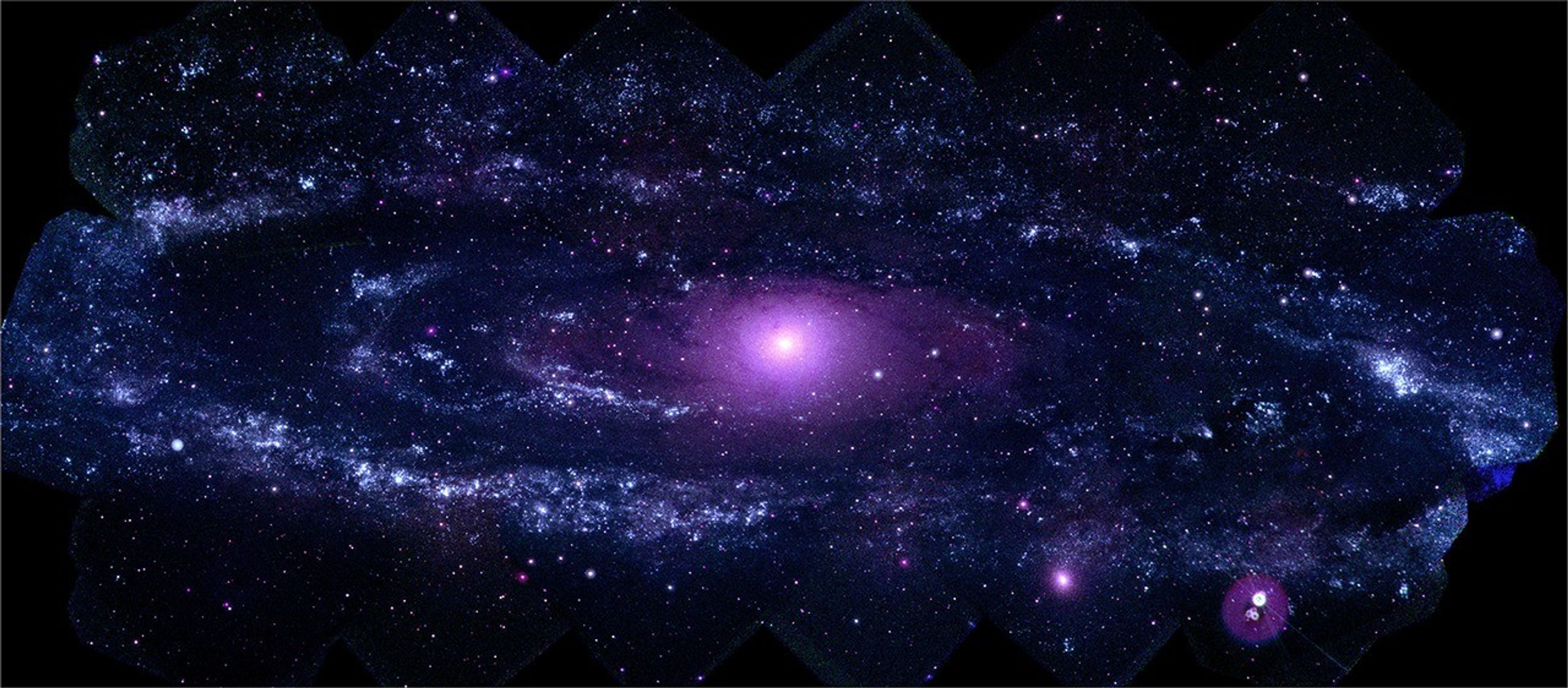
This mosaic of M31 merges 330 individual images taken by the Ultraviolet/Optical Telescope aboard Swift. It is the highest-resolution image of the galaxy ever recorded in the ultraviolet. The image shows a region 200,000 light-years wide and 100,000 light-years high. NASA/Swift/Stefan Immler (GSFC) and Erin Grand (UMCP)Download high-resolution images and videos related to Swift through NASA’s Scientific Visualization Studio.
Our planet’s atmosphere creates drag on all spacecraft in low Earth orbit, gradually reducing their altitudes if they don’t have propulsion systems to counteract the effect.
A recent bout of increased solar activity magnified this impact on Swift, which launched in November 2004.
Rather than allowing Swift to re-enter the atmosphere as many missions do, NASA is using the opportunity to advance the U.S. commercial satellite servicing industry.
In September, the agency contracted Katalyst to attempt to boost the observatory. The company would have less than one year to design, build, test, and launch a satellite to meet, grab, and lift Swift to nearly its original orbit.
“Swift wasn’t designed to be serviced,” said Ghonhee Lee, CEO of Katalyst. “By demonstrating we can quickly and cost-effectively extend its lifetime, we’re creating a blueprint for servicing spacecraft that were never designed for on-orbit maintenance. If we’re going to build an enduring presence beyond Earth, we need the capability to manipulate our environment in space. That means deploying robotic spacecraft that can reposition, repair, refuel, and refit satellites after launch.”
Katalyst engineers attach LINK to a baseplate inside the Space Environment Simulator at NASA Goddard on Tuesday, April 28, 2026. Once all the air was pumped out of the 27-foot-diameter chamber, the team practiced firing the satellite’s ion thrusters and operated one of the robotic arms while they cycled through space-like hot and cold temperatures. NASA/Sophia RobertsThe LINK spacecraft weighs about 880 pounds and stands about 5 feet tall, about a third of Swift’s overall size. Nearly 20 feet of solar panels will power three ion thrusters and a trio of robotic arms.
LINK completed environmental testing that mimicked launch and space-like conditions at NASA Goddard this spring, as well as additional preflight assessments at Katalyst’s facility in Broomfield, Colorado.
For the boost to have its best chance of success, Swift needs to stay above an altitude of about 185 miles.
By the end of last year, however, orbital predictions generated by NASA showed the observatory reaching that threshold as early as July.
To slow Swift’s descent, the operations team at Penn State’s Eberly College of Science altered how they managed and oriented the spacecraft.
Unlike during normal operating procedures, where Swift looks at spots on the sky that are scientifically interesting, the team now selects targets that steer Swift into the most streamlined position. They also reduced power consumption as much as possible to place the satellite’s large solar panels in a more aerodynamic orientation.
Recent orbital predictions show these changes will keep Swift above critical altitude until this fall.
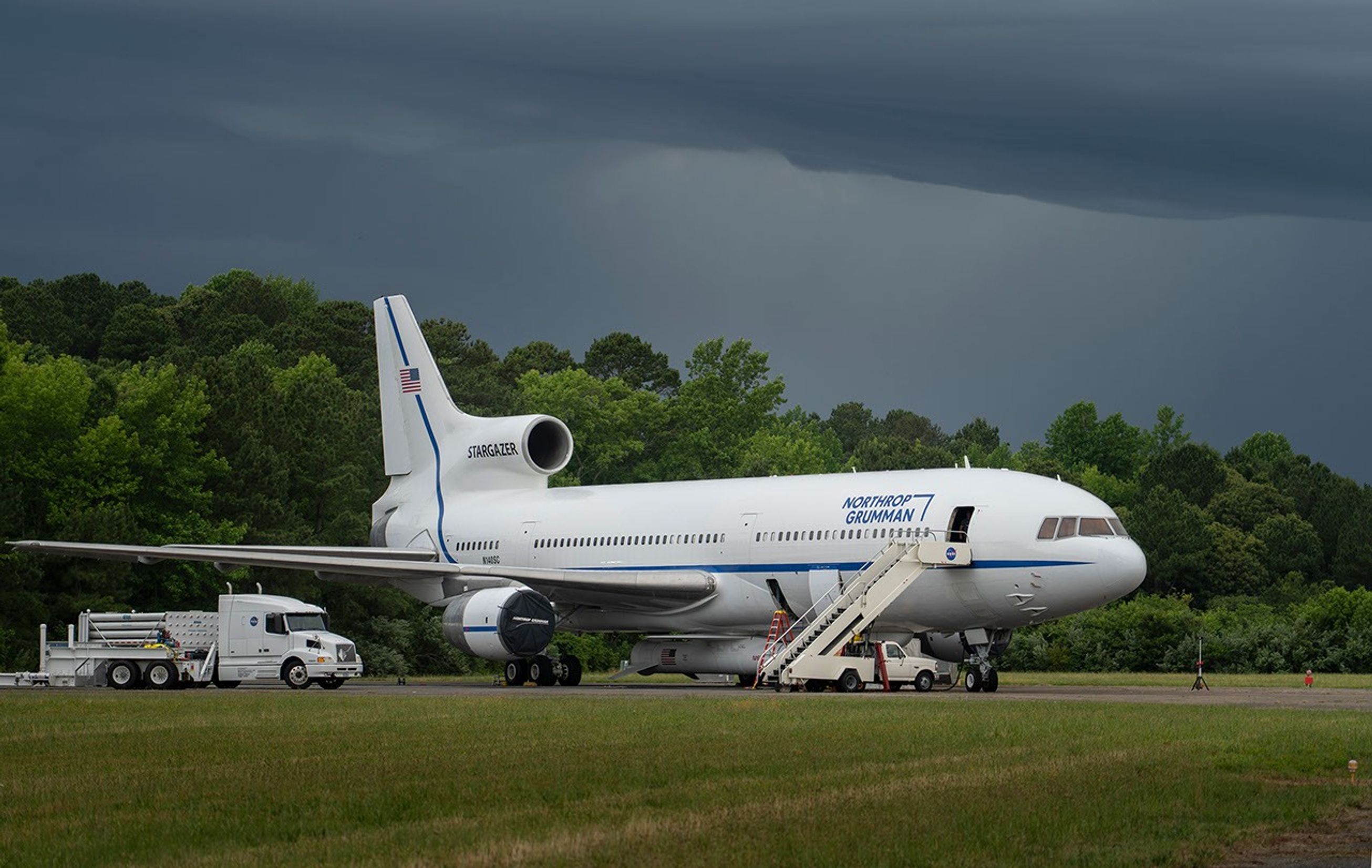
Stargazer, Pegasus XL, and LINK await takeoff on Wednesday, June 17, 2026, at NASA’s Wallops Flight Facility in Virginia. Engineers control the temperature and humidity inside the nose cone of the rocket to keep the satellite and avionics safe from weather and changing environmental conditions during flight. NASA/Ron BeardThe satellite will launch aboard the Pegasus XL.
“We can deploy Pegasus from almost anywhere in the world using our Stargazer, a modified L-1011 aircraft,” said Wes Collier, vice president of launch systems at Northrop Grumman. “That combination of flexibility and responsive access to space will help LINK quickly reach Swift, giving the teams time to complete the boost.”
Earlier this month, engineers loaded LINK into the Pegasus XL and attached the rocket to Stargazer at NASA’s Wallops Flight Facility in Virginia. The aircraft and its payload departed for Kwajalein Atoll on Thursday, June 18, where it now awaits launch.
Once in orbit, LINK will undergo several weeks of commissioning as Katalyst evaluates the spacecraft’s propulsion, navigation, and sensor systems. It then will slowly approach and survey Swift before grabbing the observatory with its robotic arms and slowly raising the orbit to nearly 370 miles.
“This is a high-risk, high-reward mission,” said Shawn Domagal-Goldman, division director, Astrophysics, NASA Headquarters in Washington. “Swift plays a notable role in our fleet. We have much to gain by attempting this boost, which is more affordable than trying to replace Swift’s capabilities and allows NASA to advance the nation’s satellite servicing industry, for the benefit of all.”
Learn more about the Swift boost at:
https://science.nasa.gov/mission/swift/swift-boost-mission/
By Jeanette Kazmierczak
Goddard Space Flight Center, Greenbelt, Md.
Media contacts:
Alise Fisher
Headquarters, Washington
202-358-2546
Claire Andreoli
Goddard Space Flight Center, Greenbelt, Md.
301-286-1940
NASA Identifies More Than 40 Space Technologies for Collaboration
NASA selected 41 proposals from 37 companies to advance technologies in support of the agency’s goals to establish a long-term presence on the Moon and enable human exploration of Mars.
These American companies, picked from NASA’s 2025 Announcement of Collaboration Opportunity (ACO), will mature technologies creating solutions for space transportation, planetary surface operations, and lunar surface infrastructure.
“We are empowering American industry to become active partners in NASA’s missions to the Moon, Mars, and beyond,” said Greg Stover, director, Advanced Research and Technology Division in the agency’s Research and Technology Mission Directorate at NASA Headquarters in Washington. “By tapping into commercial industry, NASA can rapidly develop key capabilities to support its most ambitious missions while fostering the nation’s robust space economy.”
NASA’s ACO establishes mutually beneficial partnerships between the agency and industry without the exchange of funds. Through this opportunity, companies leverage NASA’s specialized facilities, software, hardware, and subject matter experts, allowing them to rapidly mature their technologies for both commercial markets and future government missions.
Since launching the first ACO in 2015, NASA has supported more than 110 projects. The total estimated value of agency resources to support the agreements is approximately $30 million, which leverages an additional $32 million of industry contributions. The period of performance will be negotiated for each agreement, with an expected duration of 12 to 24 months.
Industry proposers were tasked with responding to agency technology topics that would benefit from the rapid development enabled by a public-private partnership, including space transportation engine elements, guidance and navigation systems, landing systems, in-space servicing assembly and manufacturing, and energy management technologies.
The complete list of selections can be found on the agency’s website and span cross-cutting capabilities, including:
Power generation
Lockheed Martin will mature a modular, compact energy solution that could support sustained power generation in the Moon’s permanently shadowed regions, helping future crew and resources survive the long lunar night. The company’s wireless power transfer system aims to advance power-beaming technology using fiber lasers and a space-based heat rejection system for durability.
In-space logistics
To enhance orbital missions, Kall Morris Inc. will develop Asteria, a supplemental payload attachment system. Asteria can attach to legacy, current, and next-generation orbital assets using a non-destructive, controlled-release adhesive without requiring pre-installed infrastructure. This technology enables advanced maneuvering, improved object tracking, asset protection, data collection, and satellite life extension.
Dust mitigation technology
Moonprint Solutions, a small business, is proposing flexible isolation covers to protect critical hardware and systems from abrasive dust in the harsh lunar environment. Flexible covers provide a strategic advantage by offering protection that conforms to complex shapes for a variety of hardware. These durable covers could be used on rovers, robotic joints, hoses, and other articulated equipment to support long-term operations on the Moon and Mars.
Selected projects could make a significant impact on the commercial space sector, such as expanding existing or opening new markets, lowering price, increasing choice, or providing entirely new capabilities.
Organizations interested in developing space technology with NASA can explore opportunities online.
For more information about NASA’s space technology investments, visit:
-end-
Jennifer Dooren / Rob Margetta
Headquarters, Washington
202-358-1600
jennifer.m.dooren@nasa.gov / robert.j.margetta@nasa.gov
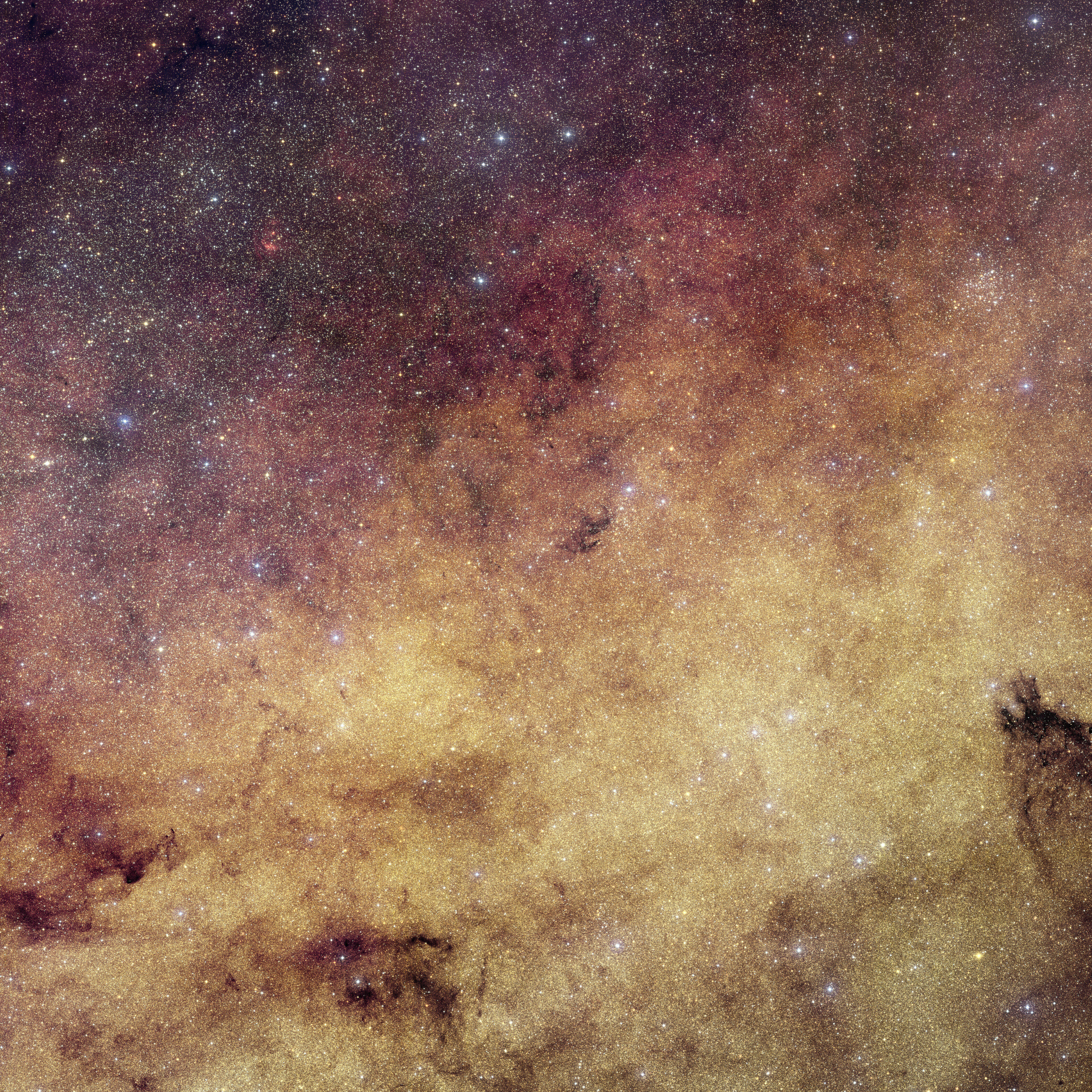
Euclid Sees Heart of Milky Way
Euclid, an ESA (European Space Agency) mission with NASA contributions, took a new look at the heart of our Milky Way galaxy, seen in this image released on June 24, 2026. This observation overlaps with a region scientists will observe with NASA’s Nancy Grace Roman Space Telescope, launching later this summer. This sneak peek gives astronomers a major jumpstart on a core Roman survey, helping scientists learn more than they could from either telescope alone.
Read more about Euclid and what Roman will see.
Image credit: ESA/Euclid/Euclid Consortium/NASA, CFHT, image processing by J.-C. Cuillandre and E. Bertin (CEA Paris-Saclay)
Bringing Signals to NASA
Growing up on the central California coast, watching rocket launches with his father was part of Eric Fernandez’s childhood routine. Fernandez had posters of rockets on the wall, but despite being fascinated by them, he never imagined one day this would be his career. Because both of his grandparents had served at Vandenberg Air Force Base (later renamed to Vandenberg Space Force Base), he assumed that the launches from there were for the military. NASA didn’t cross his mind. The space agency seemed very far away from a place like Orcutt, California, a small town situated among rolling hills covered with farms and vineyards.
Fernandez had been part of a painting crew for several years after high school. While it paid the rent, it wasn’t what he wanted to do with his life. However, he found something he enjoyed. He had started at his future father-in-law’s appliance store, working as a technician, repairing and installing appliances. He excelled at the work and planned to stay there with the goal to eventually run the small business.
Then he got a call.
It was from a friend about an opening for something called telemetry. Fernandez wasn’t sure what that meant. He was happy with his current career path. He nearly declined the offer, but after some persuading, he decided to go for the interview at a NASA building on the military base.
“I walked in the telemetry lab, and I see oscilloscopes, screens with squiggly lines, lots of blinking lights, and things I didn’t know about at the time,” Fernandez recounted. “I was very curious about it, so I was asking a million questions as we toured the lab, and they were asking about me. They really liked my background, especially my electronics experience, my troubleshooting skills, and my ability to solder.”
He received an offer for a technician position from a company that provided support to NASA under the Expendable Launch Vehicle Integrated Support, or ELVIS, contract. Fernandez had to make an important decision about his future.
“I prayed about it and met with my father-in-law,” said Fernandez. “I decided to change career paths and start a new career as a contractor working with NASA, supporting its Launch Services Program.”
That was 17 years ago, and he has been working there ever since, advancing to telemetry engineer in 2019. He has contributed to 27 launches for NASA, supporting scientific and robotic exploration missions. He’s also supported hundreds of launches for the U.S. military and commercial sector, as part of the agency’s efforts to work with its partners to understand the capabilities of the commercial rocket fleet.
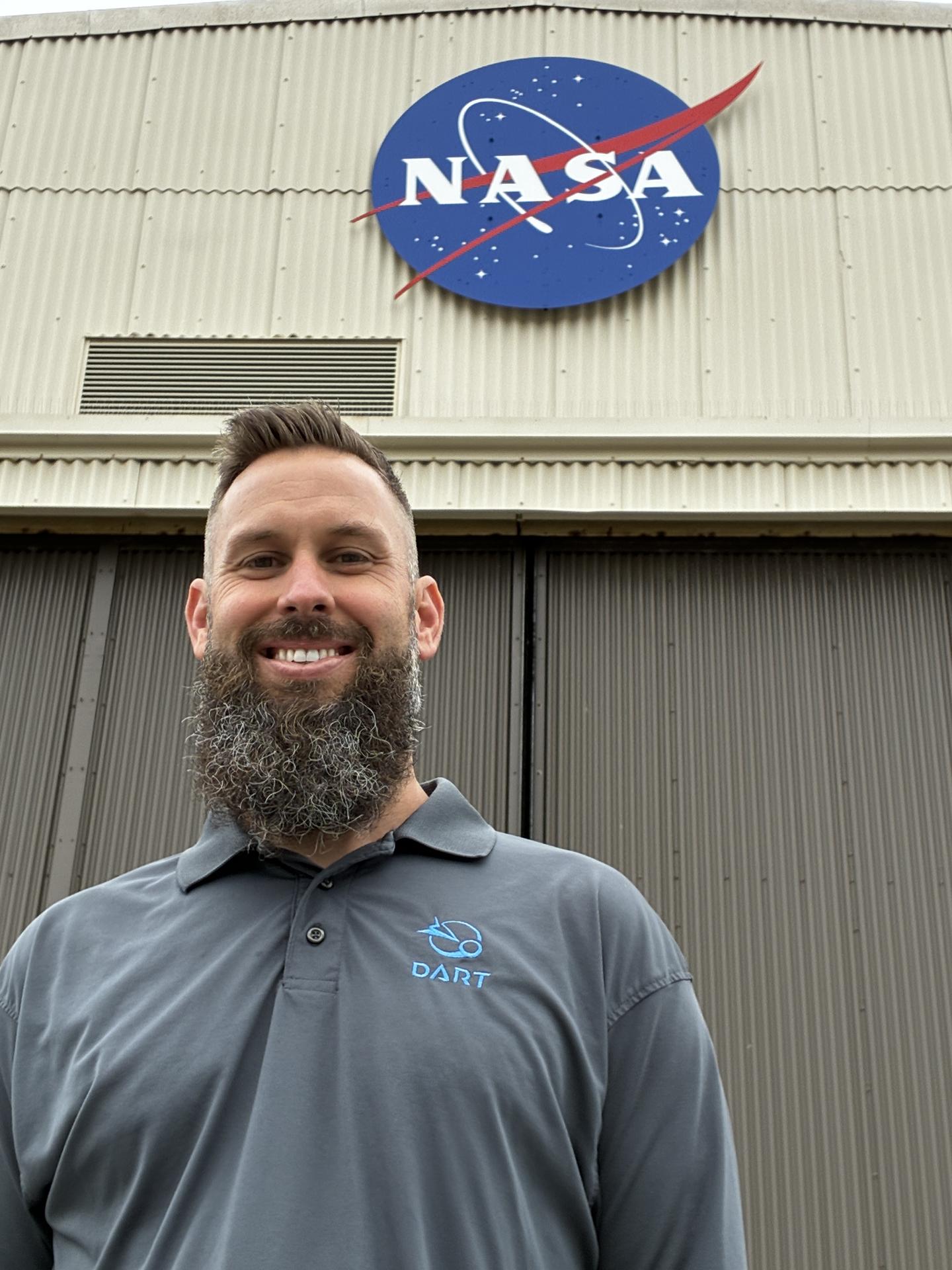
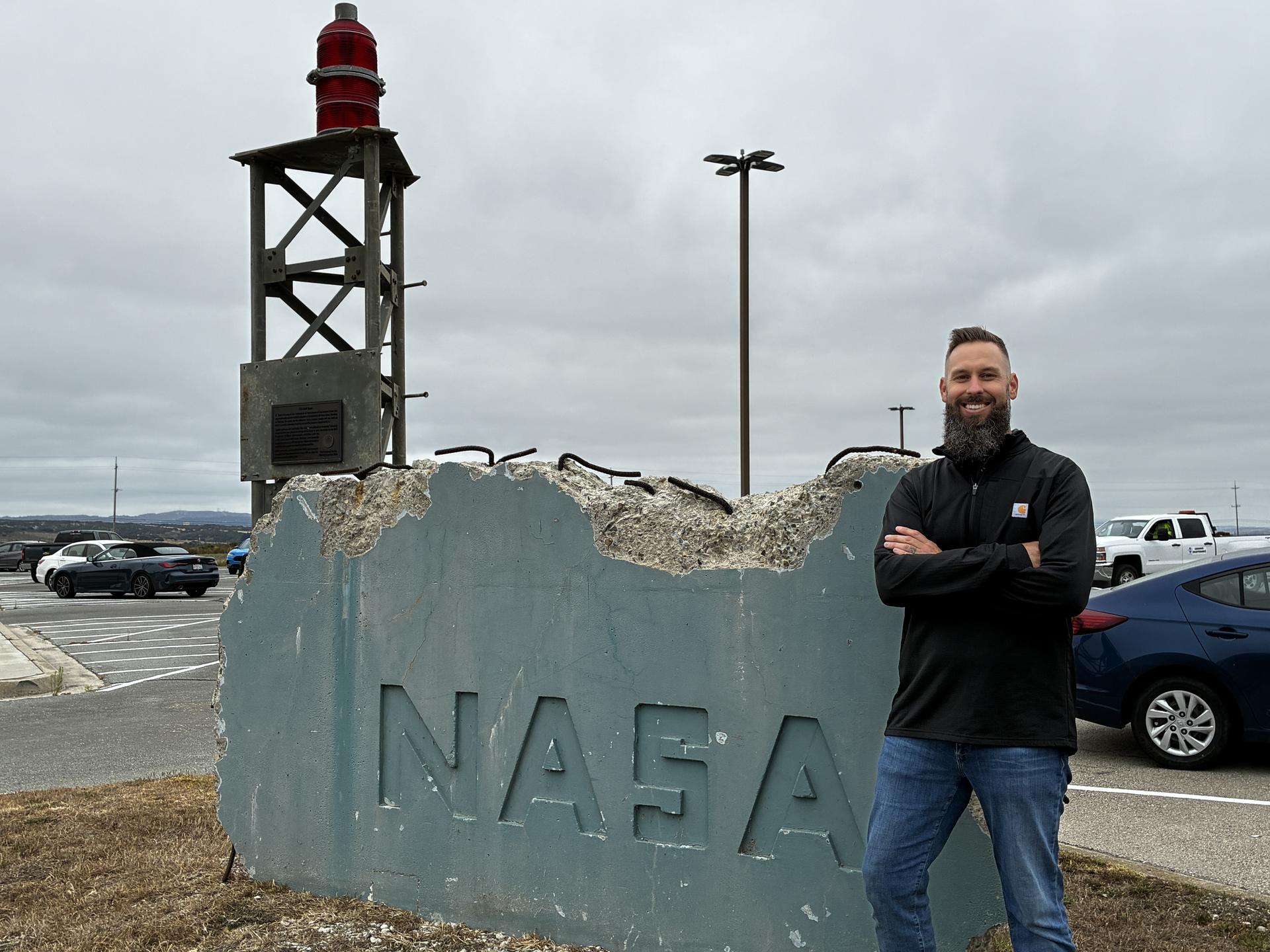
At Vandenberg Space Force Base in California, NASA employee Eric Fernandez stands by a preserved concrete section from the Space Launch Complex2 Mobile Service Tower counterweight, saved during demolition to retain the NASA insignia. The artifact was part of Delta and Delta II launches for decades before demolition, with its last launch for the agency being NASA’s ICESat2 on Sept. 15, 2018.NASA/Brandon SatterthwaiteWhile Fernandez wasn’t planning on making additional changes, a new opportunity presented itself earlier this year. The agency decided to strengthen its core capabilities by bringing mission-critical positions into the civil service.
When he had the opportunity to join the civil service at NASA, Fernandez applied. On June 15, he swore in at Vandenberg bringing his knowledge and experience to the agency, ready to become an official part of a group he already considered family.
“Telemetry is the collection of remote measurements that let us know the rocket is healthy when it’s fueling on the pad, when it’s in flight, and when it’s placing a spacecraft into the proper orbit,” said Fernandez. “It’s our job to make sure decision makers have all the right data to make the right calls in real time. We can’t afford to give them bad data.”
Fernandez’s team has multiple ways of getting the data when a rocket is on the launch pad, including ground data streams and radio frequencies link. Each data path is carefully tested beforehand using tools like bit-error-rate tests, called BERTs, that send pseudo-random patterns to help determine the health of the networks. Once the data is received, the team verifies it using frame sync patterns and word counters, sequenced data embedded in the stream. During ascent, they rely on ground tracking stations and dedicated satellites to relay data. All of it is recorded for posterity and post-flight review. The entire process requires extensive planning, coordination, and constant learning as the industry continues to innovate.
“You’re going to be humbled because the technology is always moving forward, and a new challenge is going to arise,” Fernandez said. “But there’s nothing we haven’t conquered, and there’s not a problem we haven’t figured out yet.”
He credits his teammates. He described his team as “iron sharpening iron.”
Today, Fernandez still lives in Orcutt, seven houses down from where he grew up. His children go to the same schools and play in the same parks he did. He still watches rocket launches, but now he does it with his children when he’s not supporting a launch for the agency.
While he spends his days at work looking ahead to the future, as part of a team that explores the Moon, Mars, and beyond, he hasn’t forgotten where he came from.
“I just wish I could go back and tell little boy Eric, you’re going to love every aspect of working here,” he said. “You’re never going to be bored, because you’ll always be learning new processes and technologies to deliver all these important missions to space.”
NASA’s PACE Mission Studies Smoke, Fires
3 min read
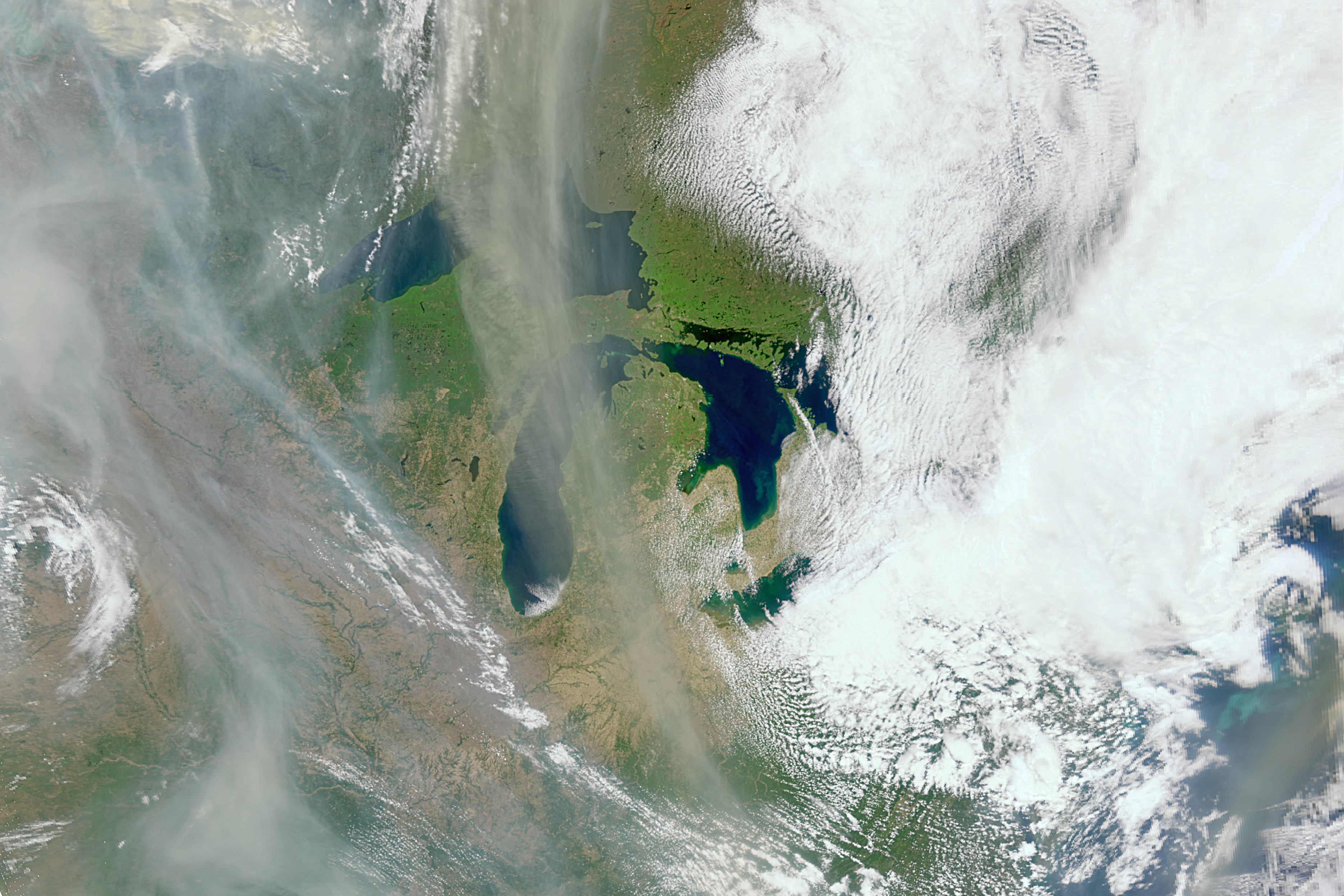
NASA’s PACE Mission Studies Smoke, FiresWith the North American fire season underway, and a record number of acres already burned nationwide, NASA’s Plankton, Aerosol, Cloud, and ocean Ecosystem (PACE) satellite’s three instruments are observing vegetation precursors to fires, along with plumes of smoke and their movement. This data will help scientists piece together clues that deepen their understanding of wildfires.
“The challenge that we have is to take those clues and use them in a meaningful way, so our models of Earth properly represent what’s happening,” said Kirk Knobelspiesse, a remote sensing scientist working on the PACE mission at NASA’s Goddard Space Flight Center in Greenbelt, Maryland.
Wisps of smoke coming from fires in multiple provinces and territories in Canada travel over the Great Lakes. This image was taken by the Ocean Color Instrument aboard NASA’s PACE satellite on May 31, 2025. NASAWhile the satellite, which launched in February 2024, was designed to study Earth’s ocean and atmosphere, it has an unexpected capability: monitoring changes to vegetation. It can also tell us about burn scars, the charred area of land left behind after a wildfire.
“The PACE satellite observes land too, and does it really well,” said Skye Caplan, terrestrial lead for the PACE mission at NASA Goddard. “There is so much to explore with a new hyperspectral data set.”
The Ocean Color Instrument on board PACE is a hyperspectral instrument, observing the planet in several hundred different wavelengths of visible, near infrared, and ultraviolet light. This breadth of the spectrum allows it to gather data on the health of plants, such as their state of stress, dryness, and their relative pigment balance, all of which assist in identifying high fire-risk areas. Land managers can use this data to distribute resources to help mitigate fire risk.
This instrument views the entire Earth daily, with more frequent coverage at high latitudes. With this frequency, on clear days, PACE scientists can quickly assess the aftermath of fires, determining the location and span of a burn scar. Areas that have been burned by wildfire often see increased flood and landslide risk. It’s important to identify these high-risk areas and monitor how they evolve through time, Caplan said.
Using wavelengths in the ultraviolet range, the Ocean Color Instrument can also monitor the smoke after a fire, along with information on how high in the atmosphere these particles drift — height plays a role in how far the particles travel and the systems they impact. The instrument, with its ultraviolet data, expands on fire observations from other satellite instruments, such as the Visible Infrared Imaging Radiometer Suite and the Moderate Resolution Imaging Spectroradiometer.
Thick smoke plumes coming from fires raging in multiple provinces and territories in Canada is visible in this image and affecting a large part of the north of the country. This image was taken by the Ocean Color Instrument aboard NASA’s PACE satellite on Aug. 11, 2024. NASAThe other two instruments on PACE, the Hyper-Angle Rainbow Polarimeter 2 and the Spectro-polarimeter for Planetary Exploration one, are rich with information about the composition of aerosols from vastly different regions, said Andrew Sayer, PACE project science lead for atmospheres from the Ocean Color Instrument at NASA Goddard.
By measuring characteristics of light as it reflects off particles in the atmosphere, these two instruments can determine the quantity of these particles, along with their chemical properties, color, size, and shape. Scientists use this information to differentiate smoke from other particulates. Smoke particulates are typically light absorbing — appearing gray, black, or brown in color — and are small in size compared to other aerosols PACE views, such as pollutants and dust.
Data from PACE will help scientists create more accurate wildfire models and simulate future events, said Knobelspiesse, the satellite’s polarimeter lead. “We’ll be able to then look at different scenarios of emissions in the future and see how smoke that’s created in one location can impact other parts of the Earth system.”
NASA’s Goddard Space Flight Center, Greenbelt, Md.
Share Details Last Updated Jun 26, 2026 Editor Jenny Marder Contact Erica McNamee erica.s.mcnamee@nasa.gov Location Goddard Space Flight Center Related Terms Explore More 4 min read NASA’s PACE Mission Reveals a Year of Terrestrial Data on Plant HealthA lot can change in a year for Earth’s forests and vegetation, as springtime and…
Article
1 year ago
5 min read New NASA Satellite To Unravel Mysteries About Clouds, Aerosols
Some of the same properties of light and optics that make the sky blue and…
Article
3 years ago
5 min read NASA-Funded Study Shows Wildfire Smoke’s Hidden Ozone Toll
Over the last decade, wildfires have worsened ground-level ozone pollution across much of the contiguous…
Article
3 weeks ago
Hubble Spies Starry Chandelier
- Hubble Home
- Overview
- Impact & Benefits
- Science
- Observatory
- Team
- Multimedia
- News
- More
3 min read
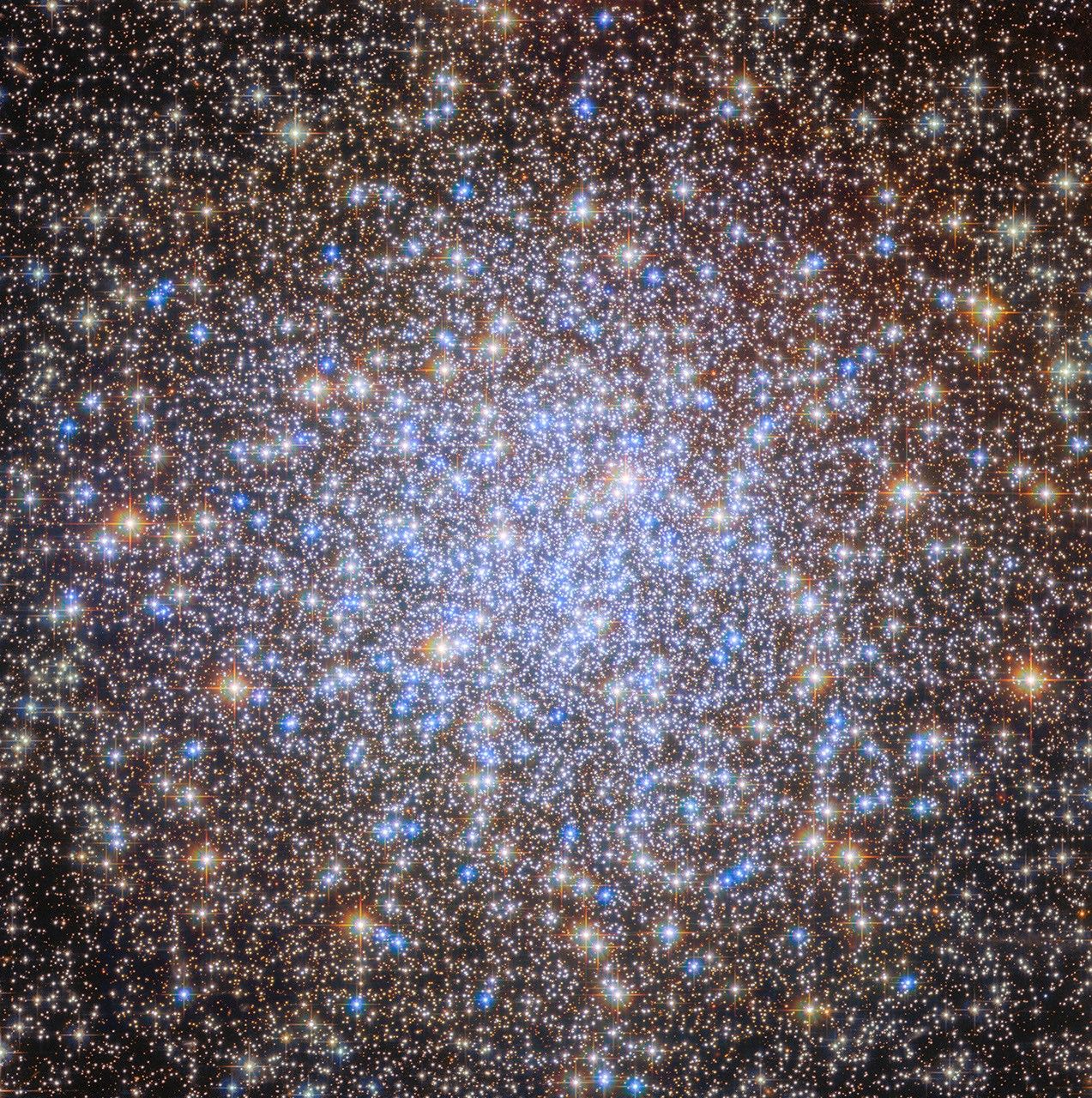
Hubble Spies Starry Chandelier This NASA/ESA Hubble Space Telescope image features the globular cluster NGC 6723, sometimes called the Chandelier Cluster. ESA/Hubble & NASA, A. Sarajedini, G. PiottoThe subject of today’s NASA/ESA Hubble Space Telescope image is an ancient inhabitant of our galaxy. This sparkling scene features a globular cluster: a collection of tens of thousands to millions of stars, all tightly bound together under the influence of gravity. There are more than 150 globular clusters in our galaxy, though there may be others still undiscovered, hidden from view by dust or densely packed fields of stars.
This globular cluster, NGC 6723, sometimes called the Chandelier Cluster, is much like its namesake because it sparkles with countless lights. However, each ‘lightbulb’ in this chandelier is an individual star 27,000 light-years away in the constellation Sagittarius (the Archer).
Globular clusters like NGC 6723 contain some of the oldest stars in our galaxy. These clusters have ages that often exceed 10 billion years old, and some are nearly as old as the universe itself. Astronomers think globular clusters are some of the first structures that formed in our galaxy, coalescing potentially billions of years before the thin disk of stars in which our Sun orbits. The details of how globular clusters formed, however, are not yet certain.
Astronomers initially thought that all stars in a globular cluster formed at the same time in a single flourish of star formation. This would mean that all stars in a globular cluster would be the same age and made of the same mixture of chemical elements. Now, thanks to observations from telescopes like Hubble, researchers know that these seemingly simple stellar populations have more complex histories than originally thought.
Hubble first observed NGC 6723 as part of an ambitious survey dedicated to demystifying the properties of globular clusters in our Milky Way galaxy. In this observing program (#10775, PI: Sarajedini), researchers used Hubble to study 65 globular clusters in our galaxy in visible and near-infrared light. That data allowed researchers to study everything from the ages of globular clusters to the process through which massive stars sink to the center of a star cluster and lower-mass stars drift toward the cluster outskirts. This survey has been immensely scientifically valuable, and these observations have inspired several hundred published research papers.
In a later observing program (#13297, PI: Piotto), researchers set their sights again on many of these same clusters, including NGC 6723. This time, they used Hubble’s unique sensitivity to ultraviolet light to detect the subtle variations in chemical composition between the stars of globular clusters and determine the age spread among the clusters’ stars. For NGC 6723, researchers found evidence of two closely-spaced periods of star formation, the second occurring within 634 million years of the first. (‘Closely-spaced’ is relative; 634 million years is a blink of an eye for a star cluster that is more than 10 billion years old!)
Thanks to these findings, astronomers are on the path to understanding how and when globular clusters formed — and Hubble observations of celestial chandeliers like NGC 6723 are lighting the way.
Text Credit: ESA/Hubble
Facebook logo @NASAHubble @NASAHubble Instagram logo @NASAHubbleMedia Contact:
Claire Andreoli
NASA’s Goddard Space Flight Center, Greenbelt, MD
claire.andreoli@nasa.gov
Since its 1990 launch, the Hubble Space Telescope has changed our fundamental understanding of the universe.
Hubble’s Star Clusters
Hubble e-Books
Hubble’s Cosmic Adventure
The Battle for Sullivan’s Island
- Earth
- Earth Observatory
- Image of the Day
- EO Explorer
- Topics
- More Content
- About
Expedition 73 Crew Reflects on Science, Teamwork, and Life in Orbit
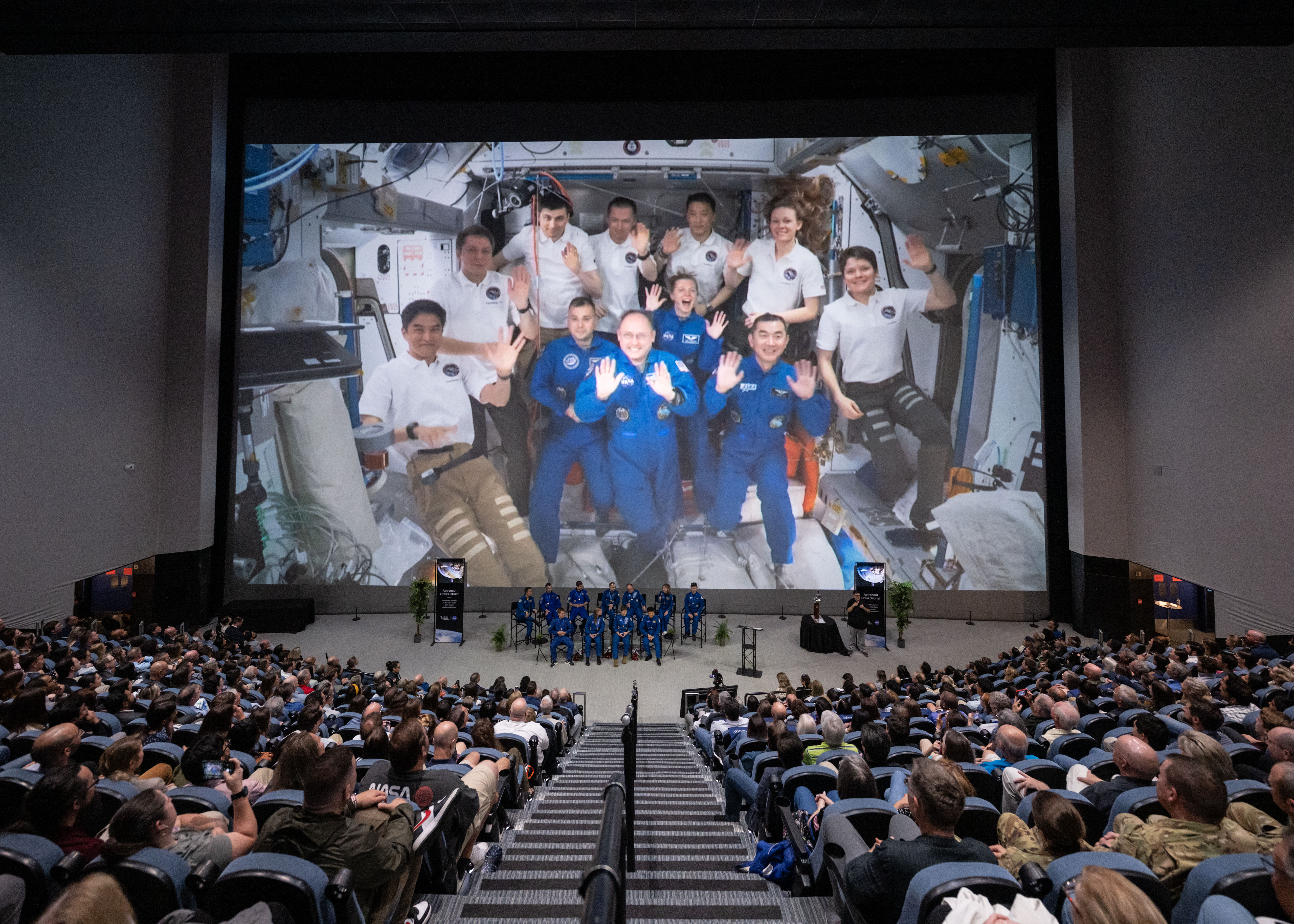
On June 16, astronauts and cosmonauts gathered at Space Center Houston to share stories from their missions aboard the International Space Station and recognize the teamwork and people on the ground that made their missions possible.
The Expedition 73 Welcome Home Ceremony brought together members of NASA’s SpaceX Crew-10, Soyuz MS-27, and NASA’s SpaceX Crew-11 missions. During the event, the crews reflected on the science, partnerships, and international collaboration that defined their time in orbit.
Remarks were delivered by NASA’s Johnson Space Center Director Vanessa Wyche, Low Earth Orbit Program’s Deputy Manager for the International Space Station Dina Contella, Richard Jones with NASA’s commercial crew office, Flight Operations Director Norm Knight, Johnson Employee Relations Lead David Kelley, and Space Center Houston Chief Operating and Strategy Officer Keesha Bullock. Together, they recognized the accomplishments of the crews and the team members who helped make the expedition a success.
NASA’s Johnson Space Center Director Vanessa Wyche gives opening remarks at the crew debrief and awards ceremony. NASA/Luna Posadas NavaWyche welcomed the crews home and reflected on the accomplishments of Expedition 73.
“Together, these crews exemplified professionalism, resilience, and the spirit of international cooperation,” Wyche said. “Their work ensured the continued success of the International Space Station Program and demonstrated the strength of our multi-vehicle crew transportation strategy.”
During the expedition, all available docking ports were occupied simultaneously for the first time, with eight spacecraft attached to the station. The crew also supported visiting missions, including Axiom Mission 4, and multiple cargo deliveries while maintaining a full schedule of scientific investigations.
Crew members completed three spacewalks, installing hardware that supports future solar array upgrades and maintenance activities critical to station operations.
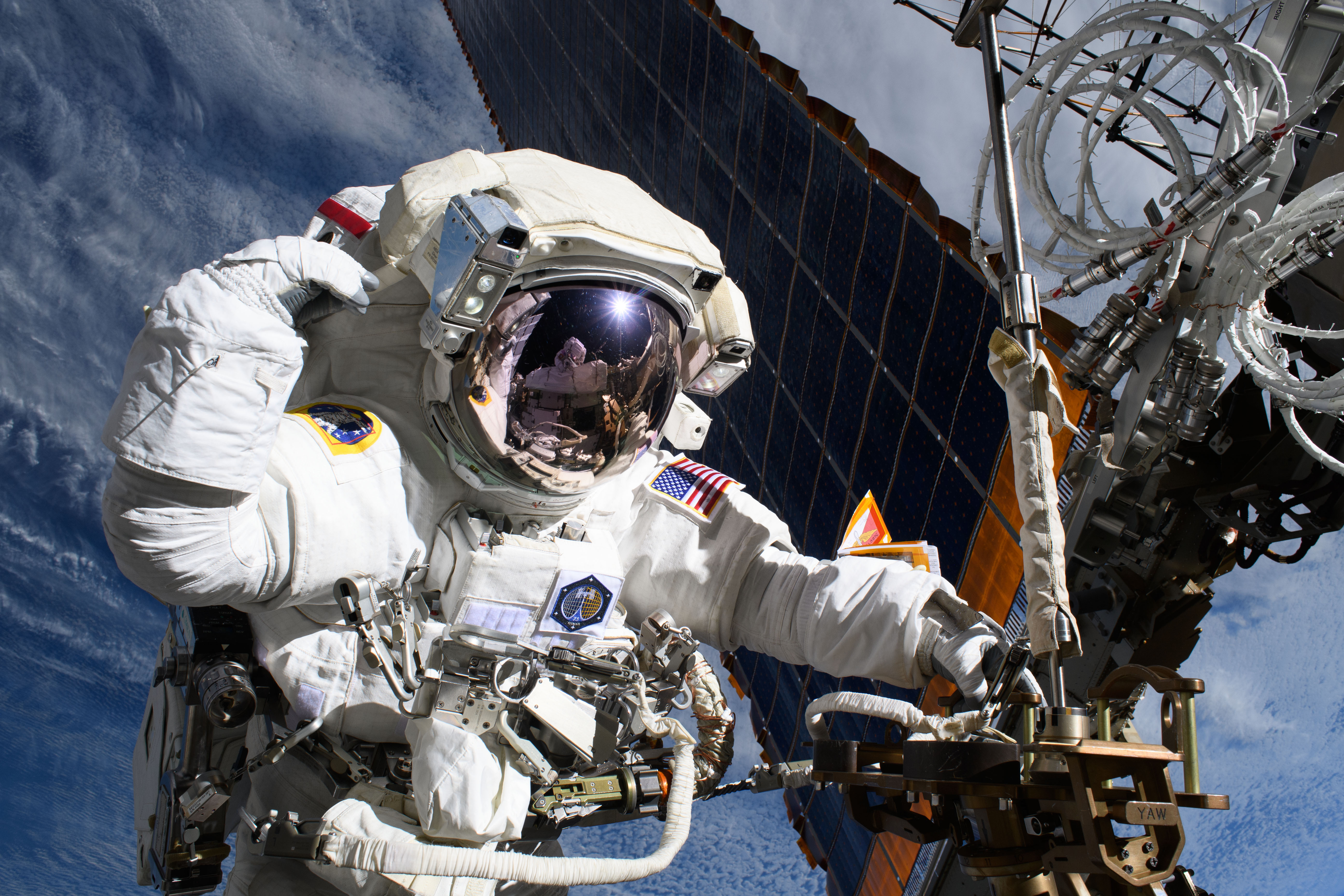
NASA astronaut Anne McClain is photographed near one of the International Space Station’s main solar arrays during a spacewalk to upgrade the orbital outpost’s power generation system and relocate a communications antenna on May 1, 2026. NASAThe ceremony also recognized the workforce whose dedication supported every aspect of Expedition 73, from mission planning and operations to research, training, and crew safety.
“You learned each other’s languages, and often, when we didn’t know the right answers, you partnered with us, and you would come up with the answers and help,” said International Space Station Deputy Manager Dina Contella. “You really helped make us successful.”
She noted that collaboration extended well beyond the crew in orbit, with teams across the program matching that dedication throughout the expedition.
Contella shared that Expedition 73 included six cargo missions, the inaugural flight of JAXA’s (Japan Aerospace Exploration Agency) HTV-X1 cargo spacecraft, and more than 37,000 pounds of supplies, equipment, and scientific investigations delivered to the space station.
She also thanked the Commercial Crew Program and Flight Operations teams for helping safely transport crews to and from the station and support mission operations.
More than 1,000 employees representing 40 teams received NASA Group Achievement Awards, while 23 individuals were honored with Superior Achievement Awards for their contributions to the mission.
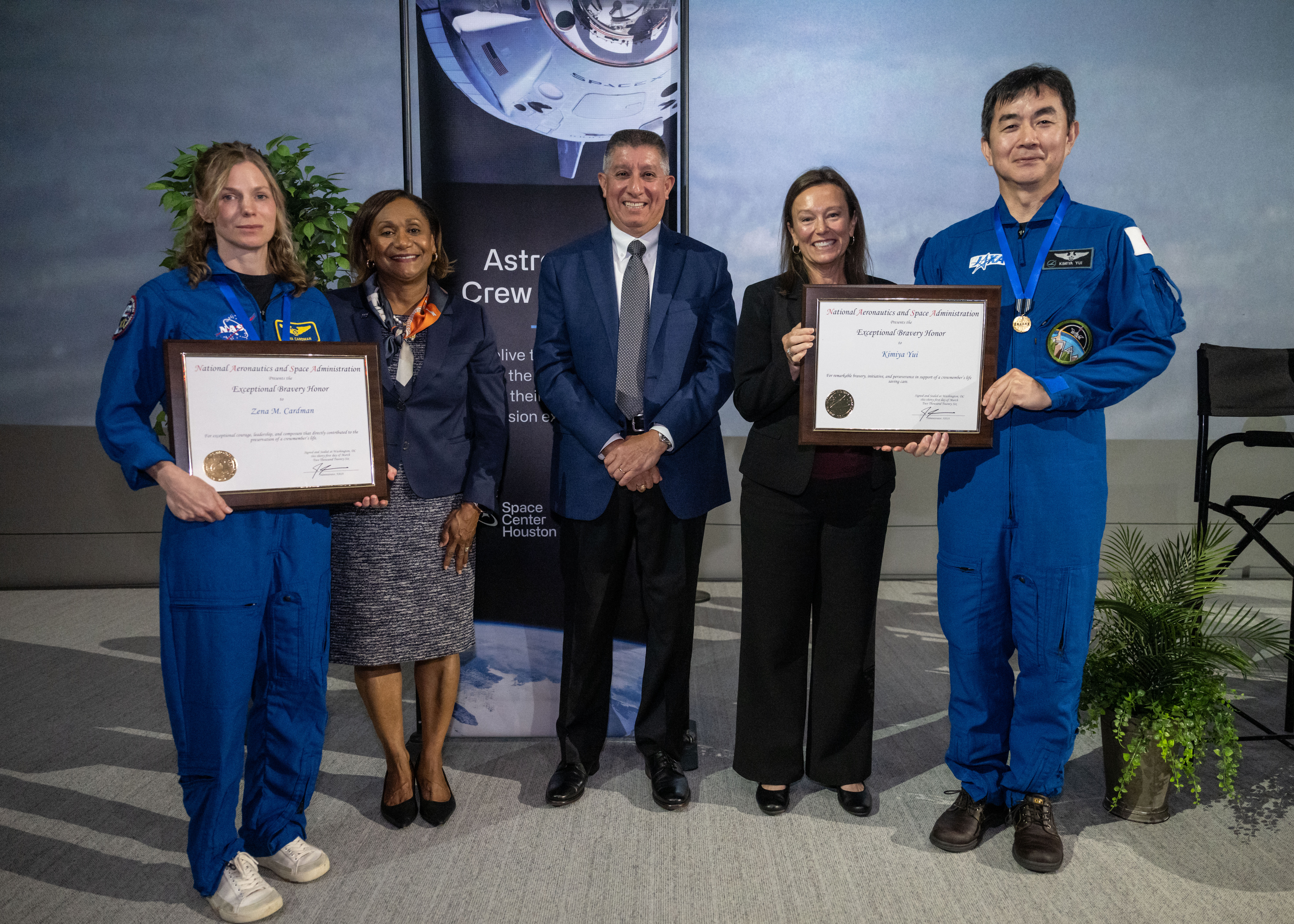
NASA astronaut Zena Cardman and JAXA (Japan Aerospace Exploration Agency) astronaut Kimiya Yui receive the NASA Exceptional Bravery Honors at the crew debrief. From left: NASA astronaut Zena Cardman, Johnson Director Vanessa Wyche, Richard Jones with NASA’s commercial crew office, Low Earth Orbit Program’s Deputy Manager for the International Space Station Dina Contella, and JAXA astronaut Kimiya Yui. NASA/Luna Posadas NavaNASA astronaut Zena Cardman and JAXA astronaut Kimiya Yui received NASA Exceptional Bravery Honors for demonstrating exceptional courage, leadership, and composure during a medical event.
Flight Operations Director Norm Knight thanked the teams that supported Expedition 73 from the ground while recognizing the crews’ contributions throughout their missions. “You represent an astronaut corps that is the best of the best, epitomizing courage and teamwork,” Knight told the crew. “Every opportunity or challenge that came your way, you met with confidence and creativity.”
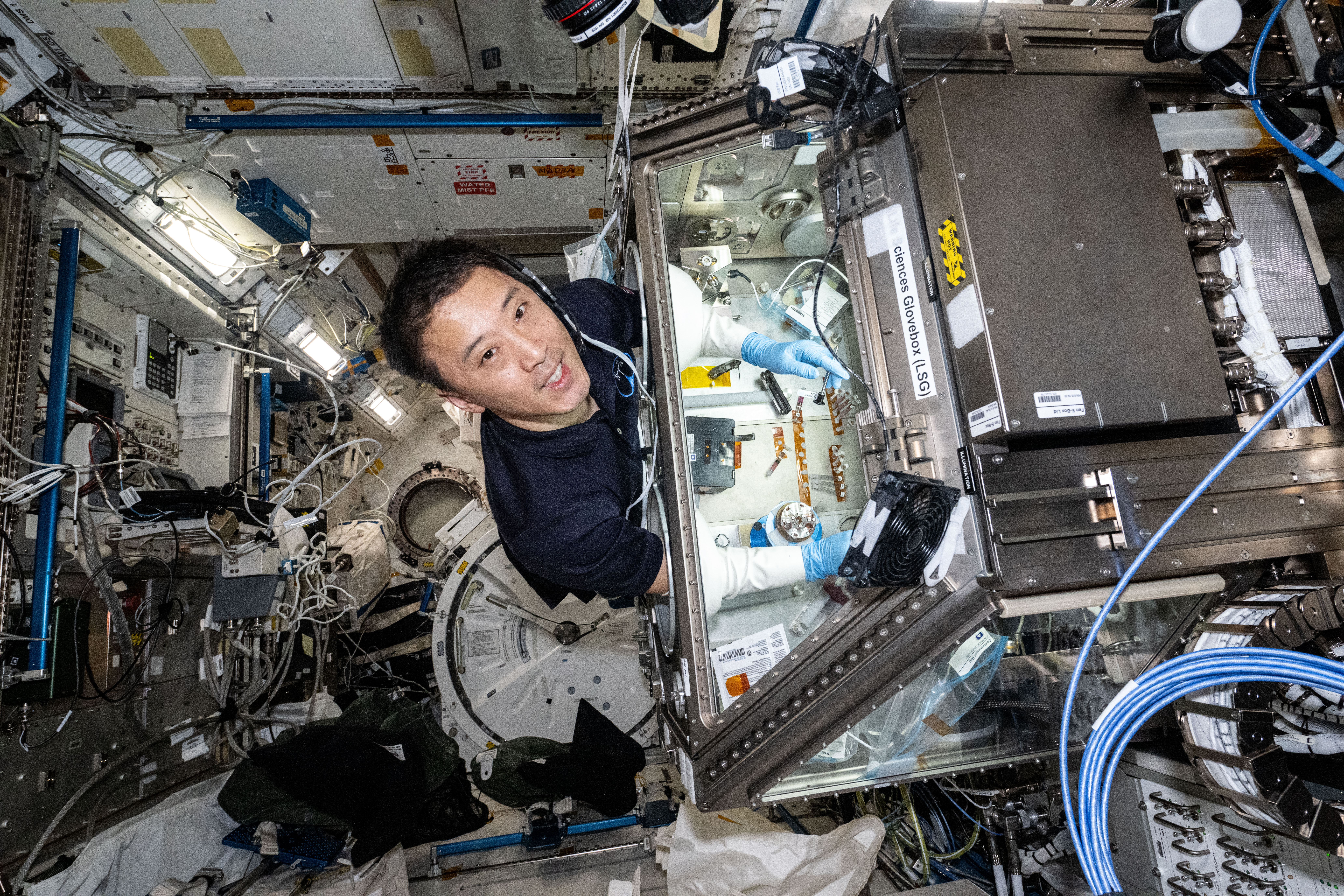
NASA astronaut Jonny Kim conducts an investigation to assess the effects of microgravity on bone marrow stem cells, including their ability to secrete proteins that form and dissolve bone.NASACrew members reflected on the station’s legacy as a platform for discovery, innovation, and international partnership after more than 25 years of continuous human presence in orbit.
Research conducted during Expedition 73 included investigations in human physiology, biology, materials science, pharmaceutical development, and technologies designed to benefit life on Earth and future exploration missions.
The crews also discussed research aboard the station that will help prepare NASA for future missions to the Moon and Mars, including advanced life-support systems and water recovery technologies.
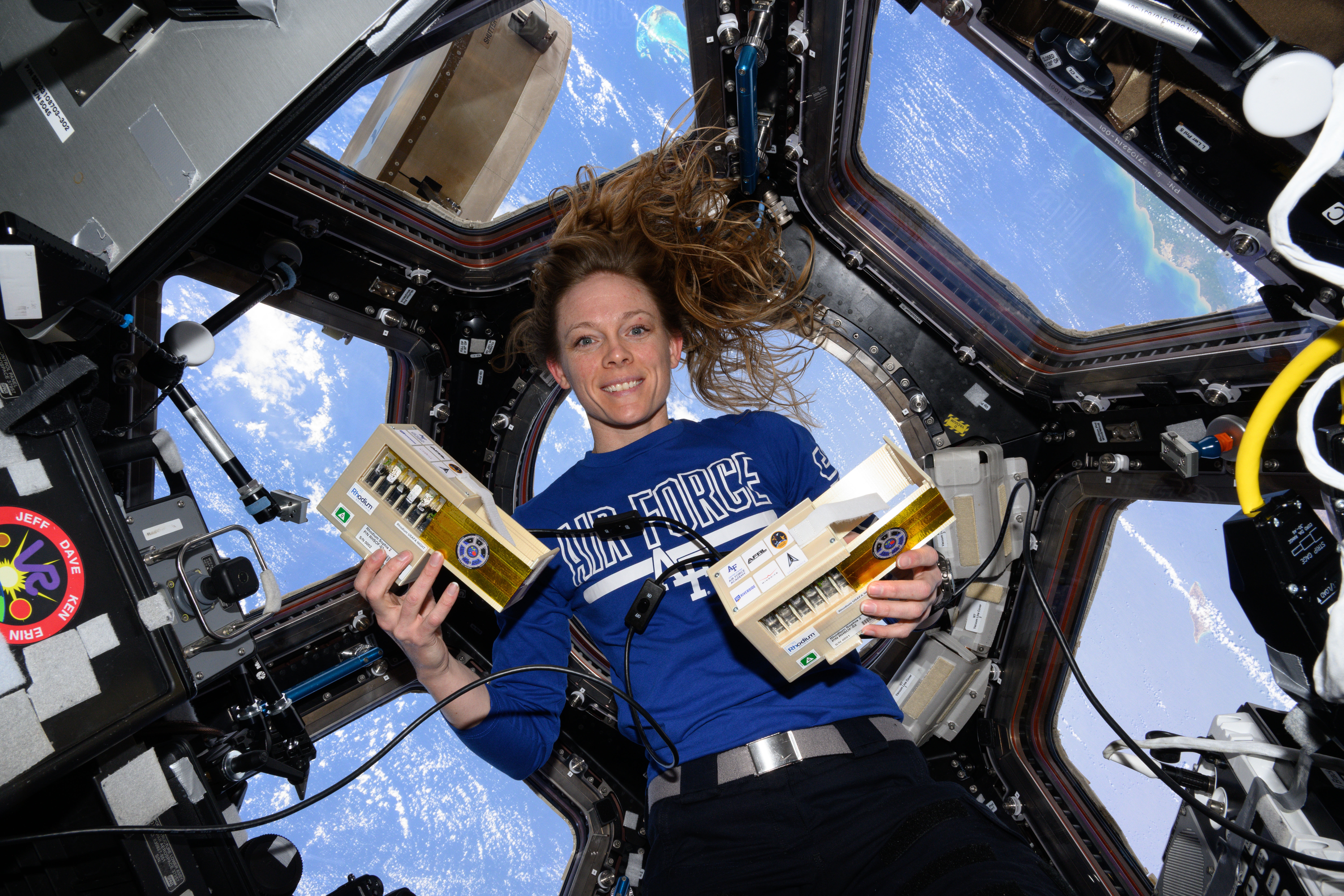
NASA astronaut Nichole Ayers holds space botany hardware that supports the low Earth orbit Integrated Flori-culture Experiment (LIFE) investigation as she floats inside the space station’s cupola. The study examines how radiation and microgravity affect plant growth to support future exploration and improve crop production on Earth. NASABeyond science and operations, the crew built strong bonds during their months in orbit. They marked birthdays, holidays, and mission milestones together, often creating elaborate cakes from the limited ingredients available aboard the station.
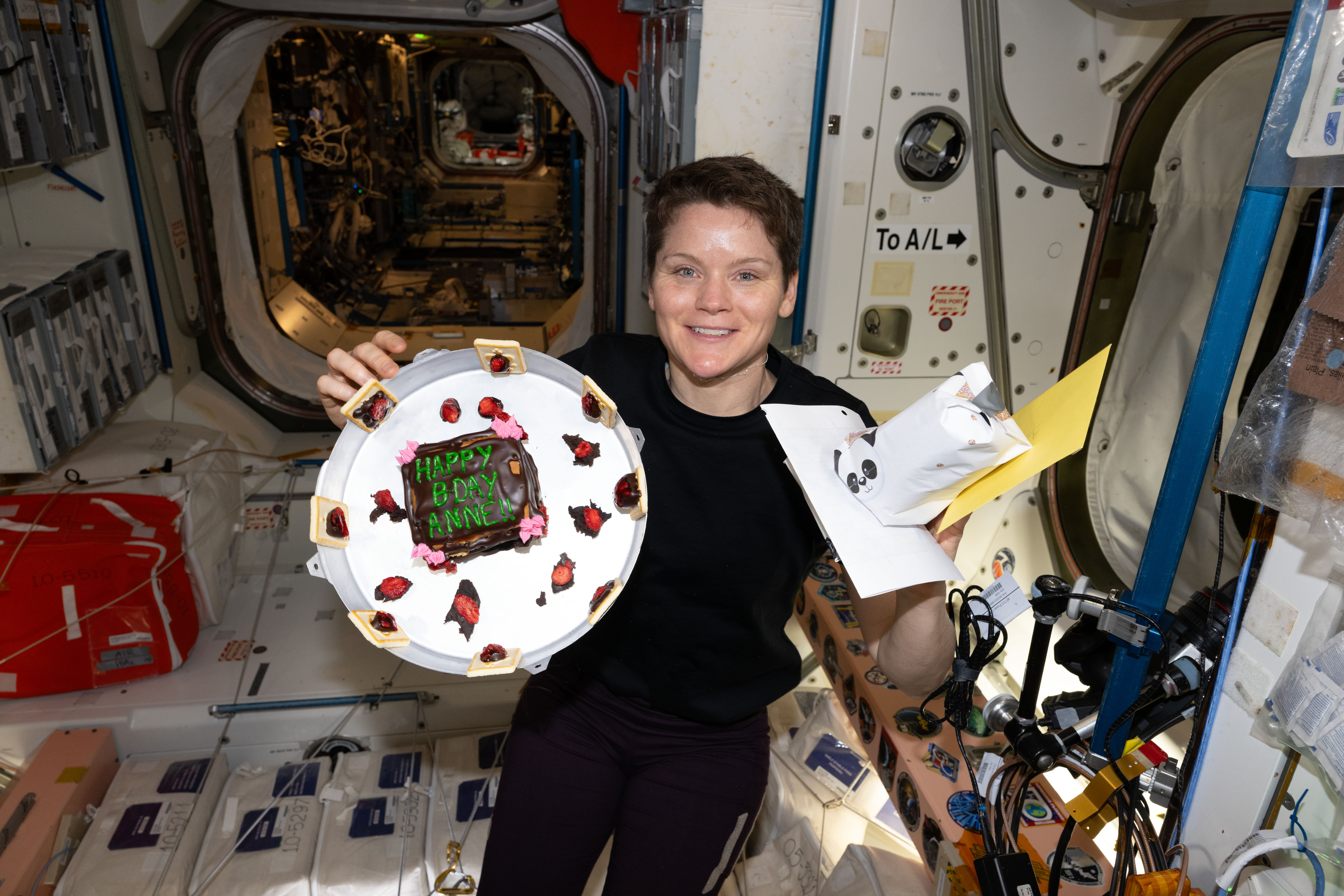
NASA astronaut Anne McClain celebrates her birthday with a cake, gifts, and cards aboard the space station’s Unity module. NASAMany crew members said their strongest memories centered on the people around them, and that trust and teamwork remained essential to mission success.
Viewing Earth from orbit provided the crew with a powerful reminder of humanity’s shared connection.
“When you look back at Earth, what we have in common is so much more important than what makes us different,” said McClain. “We’re all on this one planet. We’re all on the same crew.”
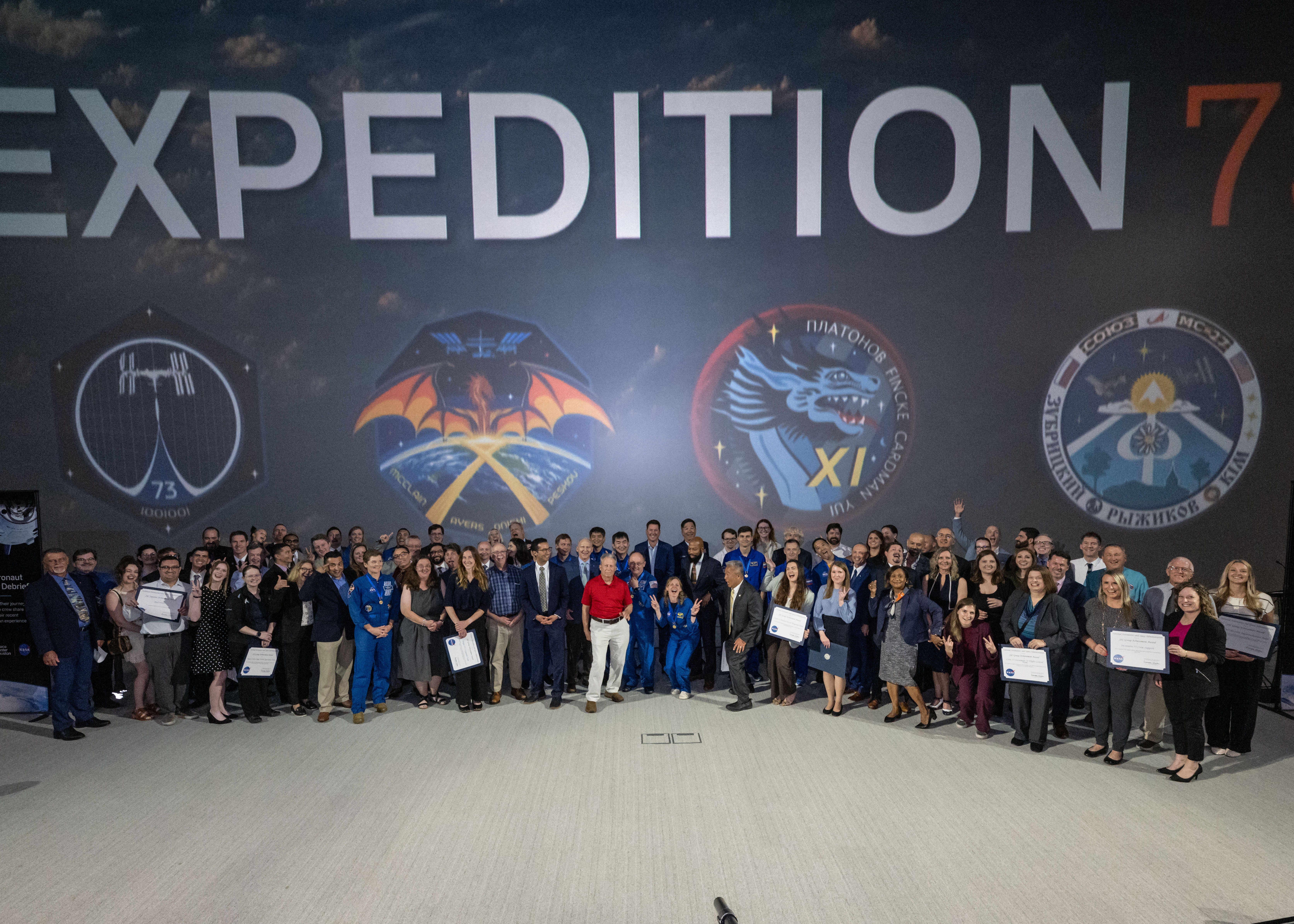
Awardees pose for a group photo from the Expedition 73 crew debrief and awards ceremony.NASA/Luna Posadas NavaThe evening concluded with the crew expressing gratitude to all those who supported their missions from launch through landing.
“It was overwhelming in the most wonderful way to step off that aircraft and see so many team members who had supported us and see family and friends for the first time,” said Cardman. “We are so grateful.”
View the list of award recipients here.
Watch the full Expedition 73 crew debrief and awards ceremony below.
Explore More 3 min read A Turquoise Tint for the Black SeaPhytoplankton added a milky blue hue to the waters of the Black Sea and nearby…
Article 2 days ago 5 min read NASA at the Ion: Orion Lessons from Artemis II Shape NASA’s Moon to Mars Path Article 3 days ago 2 min read Astronaut Jessica Meir Assists With Hardware Updates for NASA’s Cold Atom LabDescription NASA astronaut Jessica Meir inspects optical fibers while installing hardware updates to the agency’s…
Article 2 weeks agoNASA, US Small Business Administration to Announce Partnership
NASA and the U.S. Small Business Administration will sign a memorandum of agreement during a ceremony at 1 p.m. EDT, Monday, June 29, at NASA Headquarters in Washington.
The agreement will create a new interagency initiative that directly responds to President Donald J. Trump’s National Space Policy and supports the growth of the American space economy.
Participants include:
- NASA Administrator Jared Isaacman
- SBA Administrator Kelly Loeffler
This event is in person only. Media interested in attending must RSVP no later than 10 a.m. on June 29 to: hq-media@mail.nasa.gov. NASA’s media accreditation policy is available online.
For more information about NASA’s missions, visit:
-end-
Camille Gallo / Cheryl Warner
Headquarters, Washington
202-358-1600
camille.m.gallo@nasa.gov / cheryl.m.warner@nasa.gov
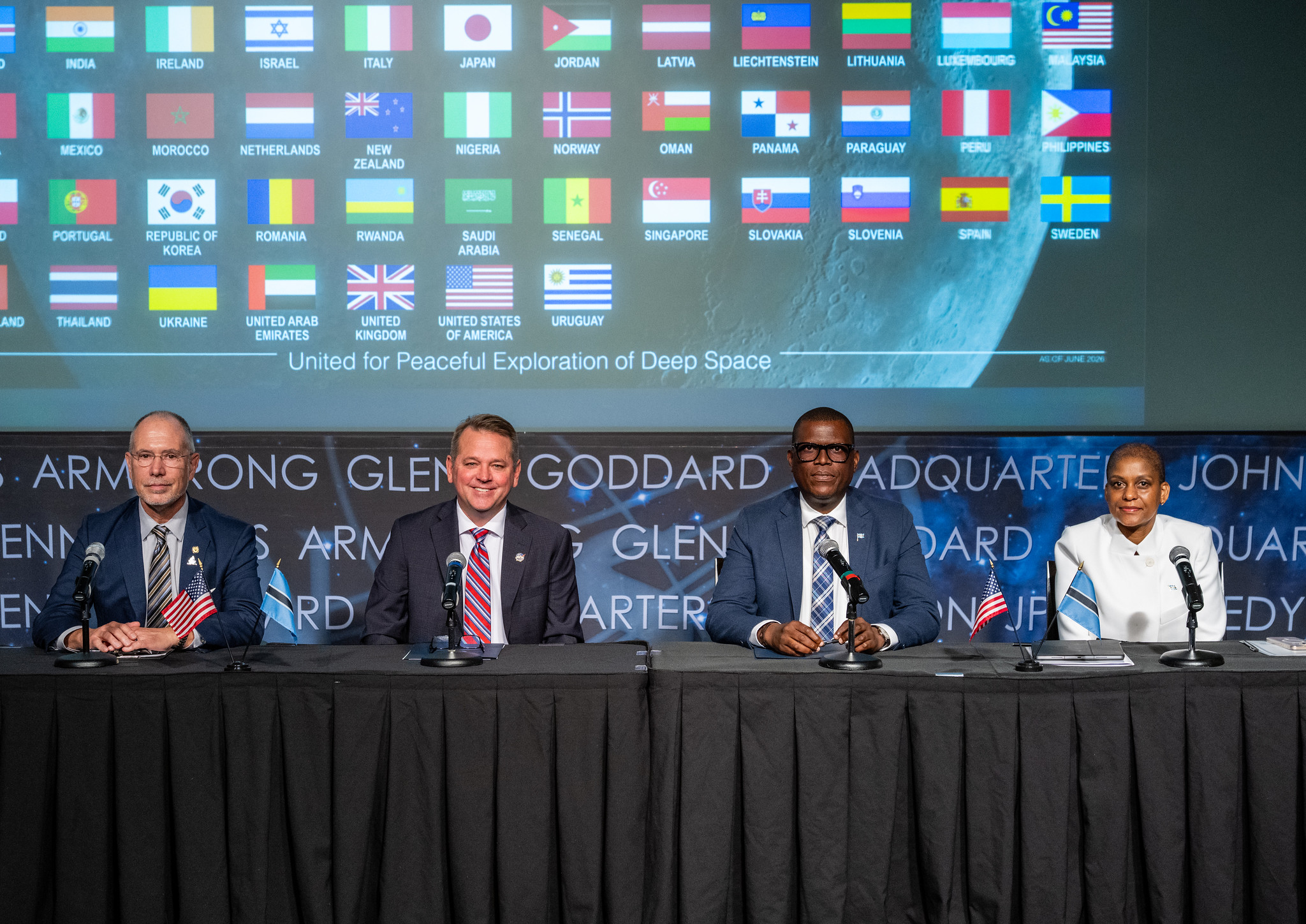
NASA Welcomes Botswana as 68th Artemis Accords Signatory
The Republic of Botswana signed the Artemis Accords Thursday during a ceremony hosted by NASA at the agency’s headquarters in Washington, becoming the sixth African nation to join a growing community of nations committed to the peaceful, transparent, and responsible exploration of space.
“It is my privilege to welcome Botswana as the newest signatory of the Artemis Accords,” said NASA Deputy Administrator Matt Anderson. “Today marks an important milestone in our international partnership and in the continued growth of the Artemis community. Botswana joins at an important moment. Earlier this month, we announced the crew of Artemis III and, as we speak, their spacecraft is being assembled as they prepare to play their part in mankind’s greatest adventure.”
Botswana’s Minister of Communications and Innovation David Tshere signed on behalf of the country. U.S. Department of State Senior Advisor for Space Gregory Autry, and Mabedi Ngwenya, acting ambassador of the Republic of Botswana to the United States, also participated in the ceremony.
“Botswana like many countries, we have interest in space exploration, found it important to become a signatory to the Artemis Accords to promote the safe, transparent, and sustainable civil space exploration, and to advance international cooperation, and a shared framework for responsible activities in the space,” said Tshere.
This new chapter builds on Botswana’s long history of collaboration with the United States in space-based Earth observation. In the early 1970s, Botswana participated in the satellite program later known as Landsat, joining dozens of other nations in pioneering satellite-based environmental observation. Botswana marked another milestone with the launch of its first Earth observation satellite, Botswana Satellite 1, in March 2025, aboard a SpaceX Falcon 9.
In 2020, during the first Trump Administration, the United States, led by NASA and the State Department, joined with seven other founding nations to establish the Artemis Accords, responding to the growing interest in lunar activities by both governments and private companies. The Artemis Accords introduced the first set of practical principles aimed at enhancing the safety and coordination between like-minded nations as they explore the Moon, Mars, and beyond.
Signing the Artemis Accords means committing to explore peaceably and transparently, to render aid to those in need, to enable access to scientific data that all of humanity can learn from, to ensure activities do not interfere with those of others, and to preserve historically significant sites and artifacts by developing best practices for space exploration for the benefit of all.
More countries are expected to sign the Artemis Accords in the months and years ahead, as NASA continues its work to establish a safe, peaceful, and prosperous future in space.
Learn more about the Artemis Accords at:
Share Details Last Updated Jun 25, 2026 Related TermsNASA Selects Rocket Lab to Launch Sun, Earth Science Missions
NASA has selected Rocket Lab to provide the launch service for both the agency’s PolSIR (Polarized Submillimeter Ice-cloud Radiometer) and Total and Spectral Solar Irradiance Sensor-2 (TSIS-2) missions.
The two selections are part of NASA’s Venture-Class Acquisition of Dedicated and Rideshare (VADR) launch services contract. This contract allows the agency to award fixed-price indefinite-delivery/indefinite-quantity launch service task orders during VADR’s 10-year ordering period, with a maximum total contract value of $300 million.
The PoISIR mission will help provide a better understanding of ice clouds that form at high altitudes throughout tropical and subtropical regions. Rocket Lab will launch PolSIR aboard two of its dedicated Electron rockets no earlier than June 2027 from Launch Complex 1 in Mahia, New Zealand.
Consisting of two small satellites, both of PoISIR’s 16U CubeSats have a scientific instrument designed to measure a specific spectrum of electromagnetic radiation, which will determine how the amount of ice in tropical clouds rises and falls during the day, as well as how the ice changes connect to larger storms. The instruments also will help determine how ice clouds affect sunlight and heat radiation throughout the day. The pair of CubeSats will fly in orbits separated by several hours to observe the pattern of cloud ice content changes over a day. This information will help researchers make more accurate weather predictions.
The PolSIR mission’s principal investigator is Vanderbilt University in Nashville. Science operations will be conducted by the Space Science and Engineering Center at the University of Wisconsin in Madison. The two spacecraft are being built by Blue Canyon Technologies.
The TSIS-2 mission will measure the Sun’s energy input to Earth. The spacecraft will provide critical data for understanding our planet’s ocean currents, seasons, and weather. The mission will continue NASA’s work to study and protect our home planet by providing insights that can only be gathered from space. Rocket Lab will launch TSIS-2 aboard an Electron rocket in early 2027 from Launch Complex 1 in Mahia.
The satellite measures Earth’s solar energy input, both the total irradiance, which is the Sun’s overall brightness at the top of Earth’s atmosphere, and the spectral irradiance, or how that energy is distributed across ultraviolet, visible, and infrared wavelengths. The satellite’s two instruments, the Total Irradiance Monitor and the Spectral Irradiance Monitor, are similar to those used for TSIS-1. Together, they cover a wavelength range that includes 96% of the energy in the solar spectrum. While TSIS‑1 works from the International Space Station, TSIS‑2 will operate from a free‑flying spacecraft.
Managed by NASA’s Goddard Space Flight Center in Greenbelt, Maryland, TSIS-2 includes instruments provided by the Laboratory for Atmospheric and Space Physics at the University of Colorado, Boulder, and the spacecraft is provided by General Atomics – Electromagnetic Systems.
NASA’s Launch Services Program, based at the agency’s Kennedy Space Center in Florida, manages the VADR contract.
Learn more about VADR online:
https://www.nasa.gov/vadr-venture-class-acquisition-of-dedicated-and-rideshare-launch-services
Millions of Stars in Cigar Galaxy
NASA’s James Webb Space Telescope recently observed edge-on starburst galaxy Messier 82 (M82), nicknamed the Cigar Galaxy. Webb’s new view of M82, added to archival data from NASA’s Hubble Space Telescope, gives us a more complete picture of this starburst galaxy. Because Webb can see infrared light, it is able to peer through clouds of dust and gas to see the shape of this edge-on galaxy, as well as approximately 16.5 million of its stars.
M82’s rapid star formation, thought to be the result of its merger with another galaxy, will only be a (relatively) brief period in its history. Ironically, the extreme star formation is causing plumes of material to be ejected above and below the disk of the galaxy – something that will disrupt future stellar birth.
Image credit: NASA, ESA, CSA, Adam Smercina (STScI, Tufts), Thomas Williams (University of Manchester); Image processing: Alyssa Pagan (STScI)
A Turquoise Tint for the Black Sea
- Earth
- Earth Observatory
- Image of the Day
- EO Explorer
- Topics
- More Content
- About
NASA’s TESS Mission Reveals the “Puffiest” Planets Ever Found
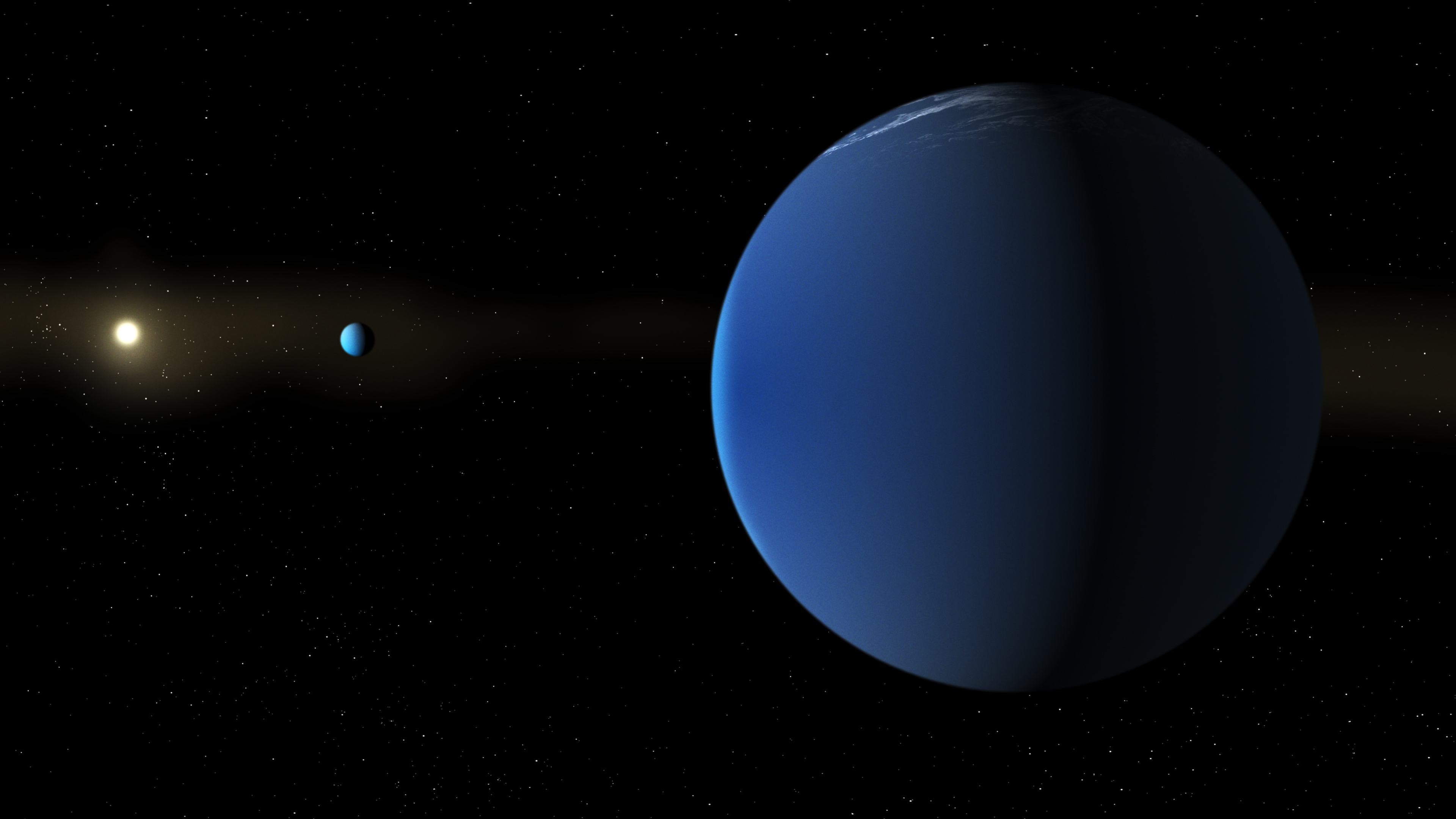
Data from NASA’s TESS (Transiting Exoplanet Survey Satellite) mission has revealed two new “super-puff” planets, giant worlds so light that their density is comparable to cotton candy. Scientists calculate that these Jupiter-sized planets—named TOI-791 b and TOI-791 c—are the “puffiest” worlds ever found.
The planets orbit a Sun-like star named TOI-791 that is approximately 1,113 light years away from Earth. The TESS mission first detected the planets by watching for repeated dips in TOI-791’s brightness, a telltale sign that a planet is transiting, or passing in front of, a star. Further study revealed two large planets with unusual features.
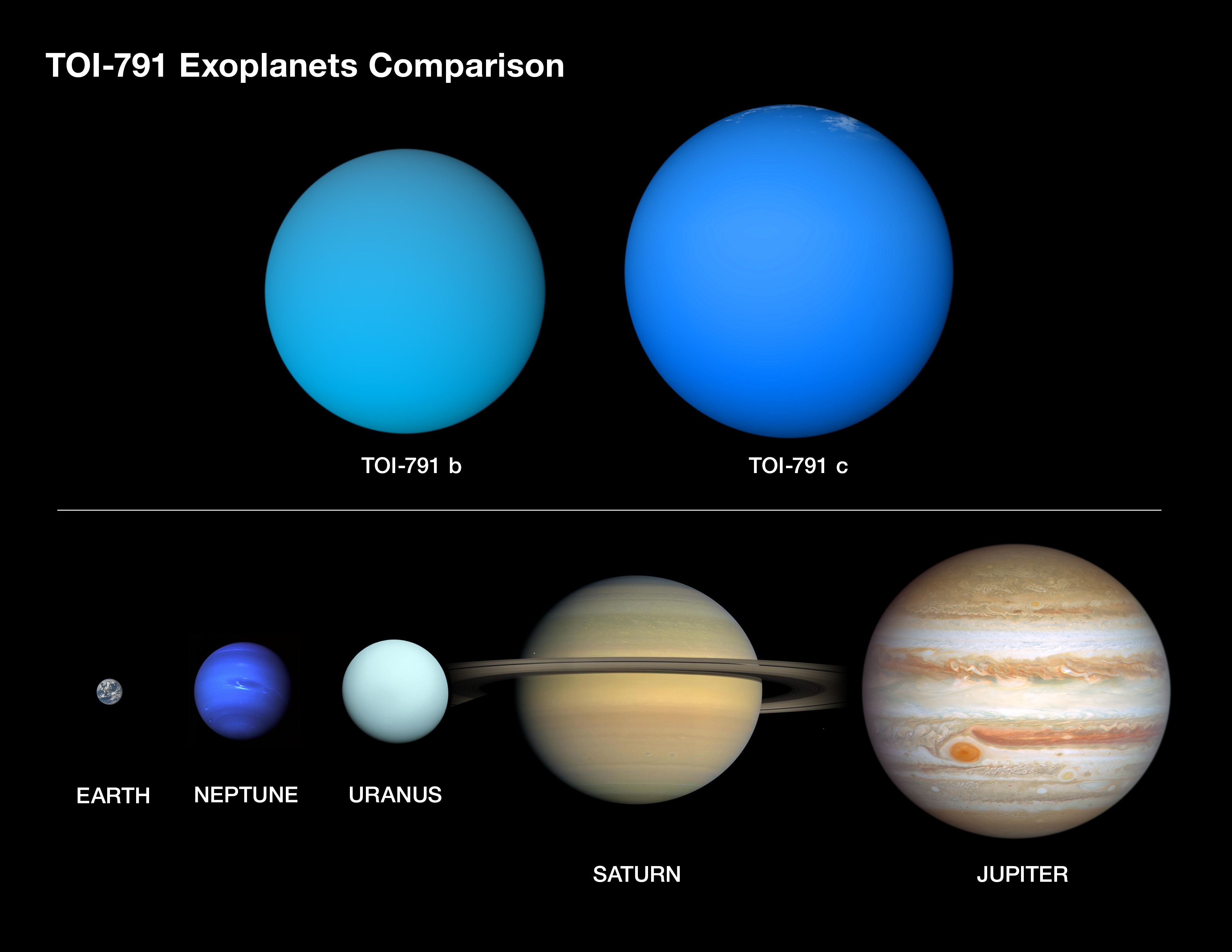
TOI-791 b is nearly the same size as Jupiter but contains just 3.0 percent of Jupiter’s mass. TOI-791 c is even larger than Jupiter but contains just 5.9 percent of Jupiter’s mass.
“The main reason these planets are interesting to study is that we didn’t expect to see them at all,” said Jon Jenkins, the science lead for the Science Processing Operations Center at NASA’s Ames Research Center in California’s Silicon Valley, which provided the science-ready data from TESS analyzed in this study. “They represent a puzzle for us to solve about how giant planets like Jupiter and the super-puffs form.”
This graphic depicts the two giant planets orbiting the Sun-like star TOI-791 as compared to some of the planets in our solar system. These planets are roughly the size of Jupiter but a very tiny fraction of its mass. NASA’s TESS mission detected the shadows of these planets as they passed in front of their star. There is no direct imaging. Therefore, the appearance of the TOI-79 planets in this illustration are an artist’s interpretation. NASA / Daniel RutterThe newly found super-puffs also have unusually long orbits, with TOI‑791 b taking 139 days and TOI‑791 c taking 232 days to circle the host star. Such long-orbit planets are rare to find, needing long durations of telescope observation to capture and confirm their attributes. From its vantage point in high Earth orbit, TESS was able to gather 1,122 days of data on this planetary system over the course of seven years, giving the research team a wealth of data about the planetary system.
Further analysis found that TOI-791 b and TOI-791 c are locked in an orbital pattern that allows them to tug on each other gravitationally. As they orbit their host star, the planets alternate pulling on each other, affecting the timing of their transits across the host star. Scientists used that variation in orbital timing to calculate the planets’ masses, cementing their status as low density super-puffs.
“Only a handful of these super-puffy planets are known, and it is even rarer to find two in the same system,” said lead author George Dransfield of Oxford University’s Department of Physics in Oxford, England. “Their extremely low densities make them fascinating targets for understanding how planetary systems form and evolve.”
With further study, the super-puffs may have more to tell us about planetary evolution.
“Large planet formation is believed to drive the evolution of a planetary system, so further study of these Jupiter-size, but far less than Jupiter-mass, planets is of high value,” said Steve Howell, a NASA Ames research scientist who was involved in this study.
Scientists hope to learn more about the chemical makeup of the planets’ atmospheres, how their spin affects their shape, and how the tilt of their host star compares to their orbits. Deeper investigation could provide new insight into how TOI-791 b and TOI-791 c migrated through the planetary system during their development, whether their orbits were shaped by interactions with other planets, and how low-density super-puff planets form.
The study, published today in the Monthly Notices of the Royal Astronomical Society, was led by the University of Oxford, in collaboration with Université Côte d’Azur/Observatoire de la Côte d’Azur and the University of Birmingham.
NASA at the Ion: Orion Lessons from Artemis II Shape NASA’s Moon to Mars Path
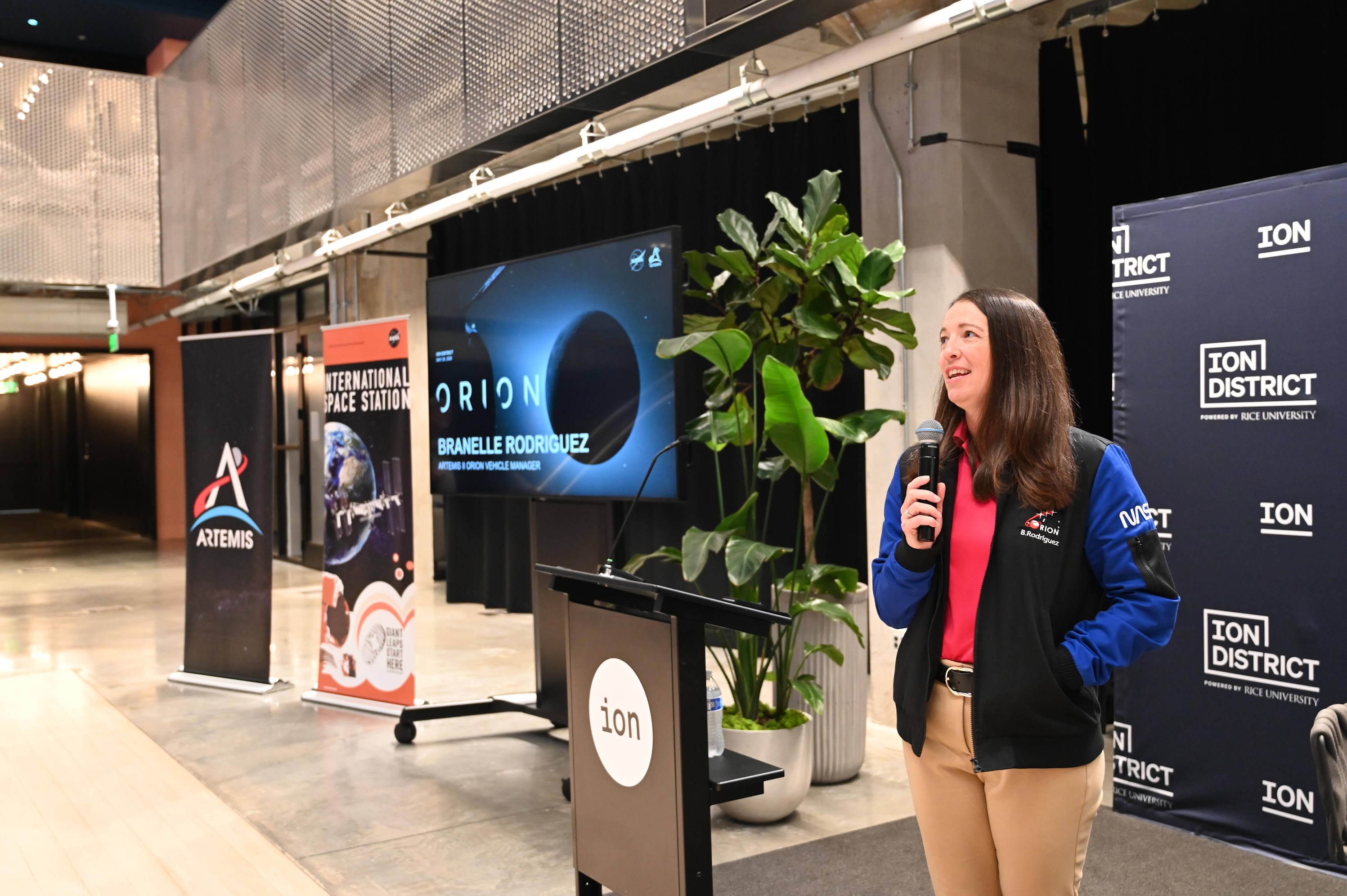
Seven weeks after the Orion spacecraft returned four astronauts from humanity’s first crewed journey around the Moon since Apollo, Artemis II Orion Vehicle Manager Branelle Rodriguez reflected on the mission’s achievements and how it is shaping NASA’s return to the lunar surface and future missions to Mars.
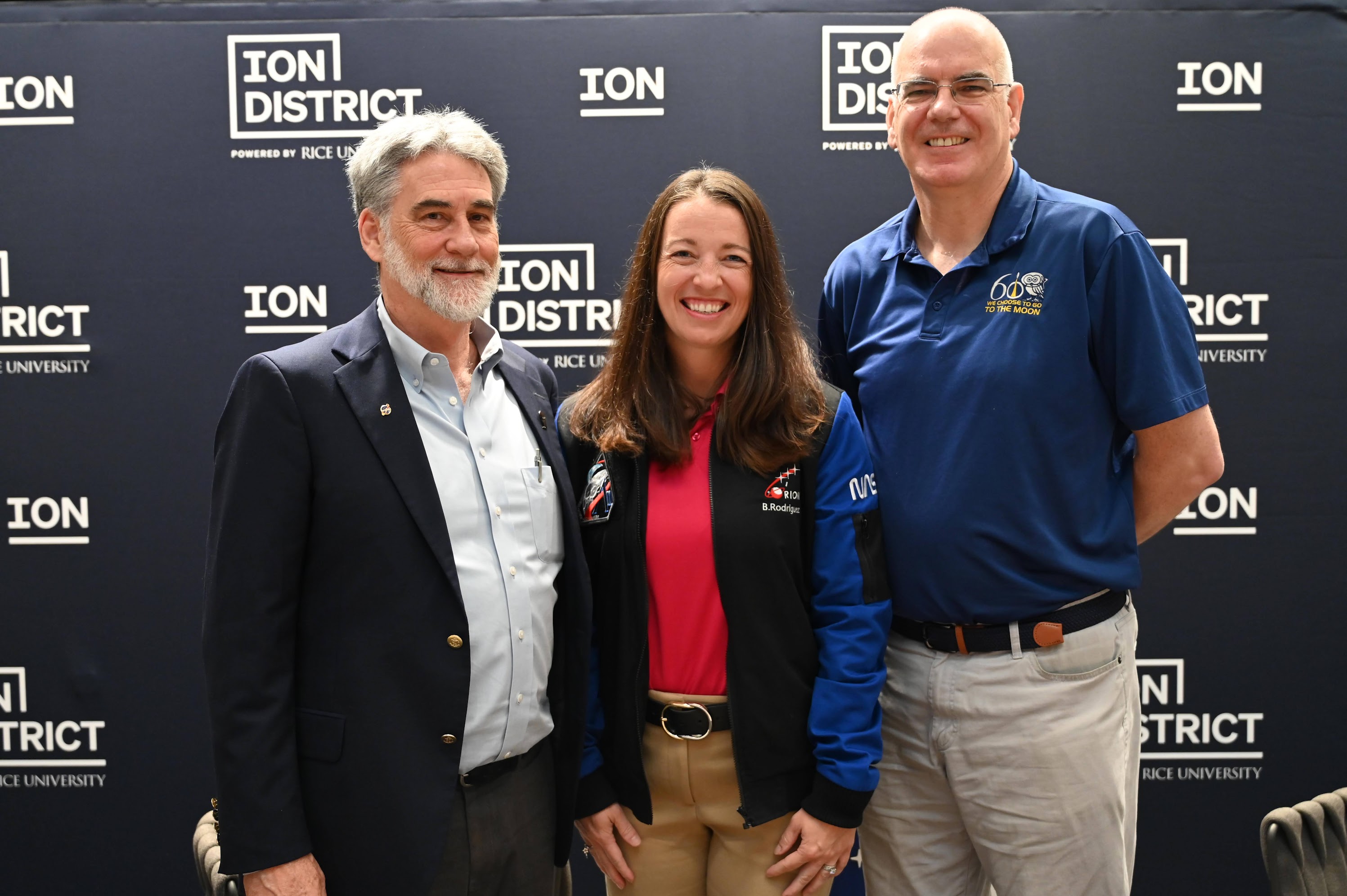
Introduced by NASA’s Johnson Space Center Acting Director of Business Development and Technology Integration Monte Goforth, Rodriguez spoke at the Ion in Houston on May 28 as part of the NASA Stories at the Ion speaker series. Located in Houston’s Ion District, the innovation hub serves as a gathering place for entrepreneurs, researchers, and industry leaders working to advance technology and shape the future of industries ranging from aerospace to energy.
She shared an inside look at the mission she helped guide — as the Orion vehicle manager for Artemis II, Rodriguez has overseen the life of the spacecraft from end-to-end, through its development, production, execution of the mission, and currently, the post-mission work underway now that Orion is back at NASA’s Kennedy Space Center in Florida.
“This mission was very near and dear to my heart,” Rodriguez said. “It has not sunk in what this mission and what this accomplishment all means to us and humanity.”
From left: NASA’s Johnson Space Center Acting Director of Business Development and Technology Integration Monte Goforth, Artemis II Orion Vehicle Manager Branelle Rodriguez, and Director of the Rice Space Institute David Alexander.Launched April 1, Artemis II carried NASA astronauts Reid Wiseman, Victor Glover, and Christina Koch, along with CSA (Canadian Space Agency) astronaut Jeremy Hansen, on a 10-day voyage around the Moon inside the Orion spacecraft.
Using mission imagery and video, Rodriguez walked attendees through key milestones, including launch aboard NASA’s SLS (Space Launch System) rocket, operations in high-Earth orbit, a lunar flyby, and Orion’s return to Earth. She also shared views from Orion captured by the crew, including Earthrise, detailed images of the lunar surface, and a solar eclipse observed from deep space.
Artemis II successfully demonstrated Orion’s performance during its first crewed deep space mission. The mission tested Orion’s life support systems, crew interfaces, navigation, and reentry systems, providing data that will help teams prepare for upcoming Artemis missions. The crew also completed a manual piloting demonstration, evaluating Orion handling and proximity operations that will inform future rendezvous and docking activities.
“I think it really hit me at T-minus 10 seconds,” Rodriguez said. “That’s when we go into ‘terminal count,’ meaning there’s just no turning back.”
Rodriguez emphasized that Orion’s success on Artemis II was the result of global teamwork across NASA centers, industry partners, and international agencies. She highlighted the European Service Module, provided by ESA (European Space Agency), which supplies Orion with power, propulsion, oxygen, water, and other resources needed during flight. In the Orion Mission Evaluation Room at Johnson, more than 300 people supported the mission, monitoring spacecraft systems and standing ready to respond in real time. Among the mission’s more personal touches was Rise, Orion’s zero-gravity indicator. The plushie, created by a student through an Artemis II design competition, carried a memory card containing over 5.6 million names of space fans who signed up through NASA’s “Send Your Name with Artemis” effort.
“It is what the crew wanted – to bring all of us with them on this mission,” Rodriguez said.
The crew also designed the mission patch with a hidden detail: viewed from a distance, the artwork reads “all” – a deliberate tribute to everyone who made the mission a success.
“It is a village that makes this possible, absolutely,” she said. Looking ahead, Rodriguez discussed preparations underway for upcoming Artemis missions. Artemis III will test critical rendezvous and docking capabilities between Orion and commercial human landing systems in low Earth orbit and advance plans to return astronauts to the lunar surface. On June 9, NASA announced the Artemis III crew at Johnson Space Center in Houston, while hardware for future missions is already in production at Kennedy Space Center in Florida.
For Rodriguez, Artemis II demonstrated what is possible when thousands of people work toward a common goal, supporting NASA’s vision of a sustained presence at the Moon and, ultimately, human missions to Mars.
“It’s going to take time to build this all up,” Rodriguez said. “But we are off and running.”
Explore More 4 min read I Am Artemis: Jason PetersonJason Peterson’s responsibilities for NASA’s Artemis II mission went beyond his usual role as the…
Article 2 days ago 3 min read I Am Artemis: Elkin Norena Article 2 weeks ago 4 min read How NASA Science and Artemis Are Shaping the 2026 FIFA World Cup Article 2 weeks agoLa NASA compartirá los últimos avances del programa Base Lunar
Lea esta nota de prensa en inglés aquí.
El administrador de la NASA, Jared Isaacman, ofrecerá una conversación virtual el martes 30 de junio a las 2:30 p.m. EDT (hora del este) para compartir las novedades más recientes sobre los planes de la agencia para construir una base en la superficie de la Luna.
El administrador Isaacman y Carlos García-Galán, director del programa Base Lunar, hablarán sobre la próxima ronda de adjudicaciones para nuevas misiones de módulos de alunizaje y ofrecerán un avance de las próximas oportunidades a medida que la agencia avanza en la construcción de una presencia sostenida en la Luna.
La rueda de prensa se transmitirá por el canal de YouTube de la NASA (en inglés). Una repetición instantánea estará disponible en línea. Infórmese sobre cómo ver el contenido de la NASA en distintas plataformas, incluidas las redes sociales (información en inglés).
Para hacer preguntas de forma virtual durante el evento, los periodistas deberán confirmar su asistencia a más tardar a las 12:30 p.m. EDT (hora del este) del 30 de junio escribiendo a: hq-media@mail.nasa.gov. La política de acreditación de medios de la NASA está disponible en línea (en inglés).
La NASA avanza en el desarrollo de la Base Lunar, una iniciativa de exploración e infraestructura lunar a largo plazo diseñada para permitir una presencia humana sostenida y ampliar la actividad científica y comercial en la superficie de la Luna.
Como parte de una edad de oro de innovación y exploración, la NASA enviará astronautas en misiones cada vez más difíciles para explorar más de la Luna con fines de descubrimiento científico y beneficios económicos, y para continuar sentando las bases para las primeras misiones tripuladas a Marte.
Para obtener más información (en inglés) sobre los planes de la NASA para la Base Lunar, visite:
-fin-
Bethany Stevens / Rachel Kraft / María José Viñas
Sede central, Washington
+1 202-358-1600
bethany.c.stevens@nasa.gov / rachel.h.kraft@nasa.gov / maria-jose.vinasgarcia@nasa.gov
NASA to Share Latest Moon Base Mission Progress
NASA Administrator Jared Isaacman will host a virtual conversation at 2:30 p.m. EDT, Tuesday, June 30, to share updates to NASA’s plans to build a Moon Base on the lunar surface.
Administrator Isaacman and Carlos García-Galán, Moon Base program manager, will discuss the next set of awards for new lunar lander missions and preview upcoming opportunities as the agency works toward building a sustained presence on the Moon.
The discussion will stream on NASA’s YouTube channel. An instant replay will be available online. Learn how to watch NASA content on a variety of platforms, including social media.
To ask a question virtually during the event, media must RSVP no later than 12:30 p.m., June 30 to: hq-media@mail.nasa.gov. NASA’s media accreditation policy is available online.
NASA is advancing development of the Moon Base, a long-term lunar exploration and infrastructure initiative designed to enable sustained human presence and expanded scientific and commercial activity on the lunar surface.
As part of the Golden Age of innovation and exploration, NASA will send astronauts on increasingly difficult missions to explore more of the Moon for scientific discovery, economic benefits, and to build on our foundation for the first crewed missions to Mars.
For more information about NASA’s Moon Base plans, visit:
-end-
Bethany Stevens / Rachel Kraft
Headquarters, Washington
202-358-1600
bethany.c.stevens@nasa.gov / rachel.h.kraft@nasa.gov
Roman Telescope Comes to Kennedy
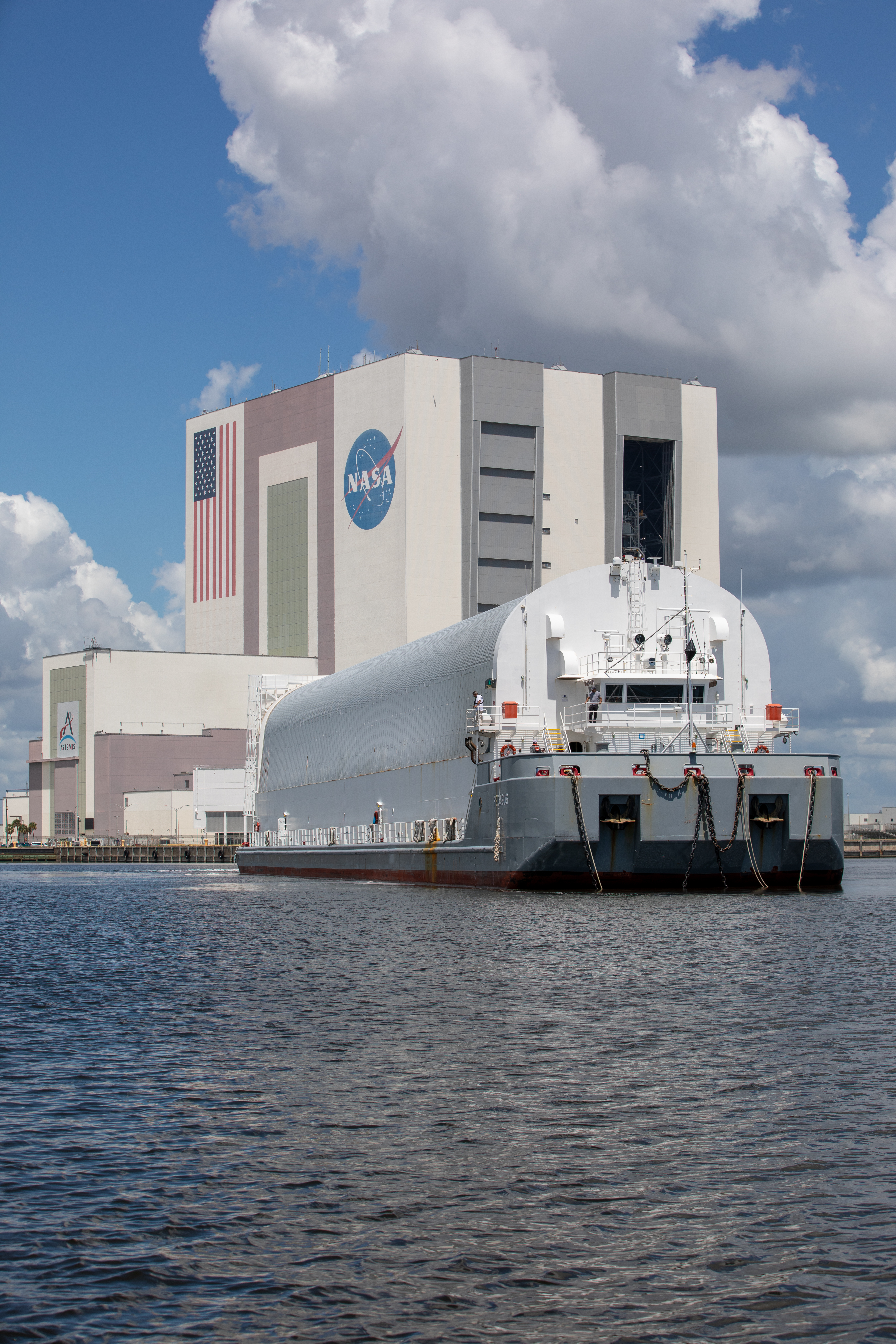
In this June 21, 2026, photo, NASA’s Nancy Grace Roman Space Telescope arrives at the agency’s Kennedy Space Center in Florida aboard NASA’s Pegasus barge. After offloading and transportation to the spaceport’s Payload Hazardous Servicing Facility, Roman will undergo processing ahead of launch, targeted no earlier than Sunday, Aug. 30, 2026.
Named for NASA’s first chief astronomer and “mother of the Hubble Space Telescope,” Roman will offer a field of view over 100 times larger than Hubble’s to study up to a billion galaxies, directly image exoplanets and planet‑forming disks, and address fundamental questions about dark energy, exoplanets, and infrared astrophysics.
Image credit: NASA/Amber Jean Notvest
NASA’s HiRISE Captures Perseverance Marking a Milestone on Mars
NASA/JPL-Caltech/University of Arizona Photojournal Navigation Downloads NASA’s HiRISE Captures Perseverance Marking a Milestone on Mars
JPEG (492.31 KB)
PIA26726 Figure A
PNG (12.89 MB)
Description
NASA’s Perseverance rover appears as a green speck on the Martian surface on June 13, 2026, a day before the robotic explorer marked a distance milestone, having traveled a full marathon (26.2 miles, or 42.195 kilometers) on the Red Planet. Perseverance reached that distance after five years and four months of driving — on the 1,890th Martian day, or sol, of its mission; the previous record holder, NASA’s Opportunity rover, took 11 years and two months to reach the same milestone.
This image was taken by NASA’s Mars Reconnaissance Orbiter (MRO) using its High-Resolution Imaging Science Experiment (HiRISE) camera. The rover’s tracks can be seen tracing the surface. The rover is in an area west of Jezero Crater that the science team is calling “Arbot.”
Figure AFigure A is the same image with a yellow circle indicating Perseverance.
Managed for NASA by Caltech, NASA’s Jet Propulsion Laboratory in Southern California manages operations of the Perseverance rover and MRO on behalf of the agency’s Science Mission Directorate as part of NASA’s Mars Exploration Program portfolio. Lockheed Martin Space in Denver built MRO and supports its operations. The University of Arizona, in Tucson, operates HiRISE, which was built by BAE Systems in Boulder, Colorado.
To learn more about these missions, visit:
https://science.nasa.gov/mars/
Keep Exploring Discover More Topics From Photojournal
Photojournal
Search Photojournal
Photojournal’s Latest Content
Feedback