NASA - Breaking News

NASA Outlines Preliminary Artemis III Mission Plans
NASA is moving quickly to define next year’s Artemis III mission in Earth orbit, a crewed flight that will test rendezvous and docking capabilities between the agency’s Orion spacecraft and commercial landers from Blue Origin and SpaceX. Since a February announcement adding an Artemis mission ahead of crewed landing missions to the Moon’s South Pole region, engineers have been evaluating mission profile options and operational considerations for Artemis III to ensure the test flight helps the agency and its partners reduce risk ahead of the next Americans landing on the Moon during Artemis IV.
“While this is a mission to Earth orbit, it is an important stepping stone to successfully landing on the Moon with Artemis IV. Artemis III is one of the most highly complex missions NASA has undertaken,” said Jeremy Parsons, Moon to Mars acting assistant deputy administrator, NASA’s Exploration Systems Development Mission Directorate in Washington. “For the first time, NASA will coordinate a launch campaign involving multiple spacecraft integrating new capabilities into Artemis operations. We’re integrating more partners and interrelated operations into this mission by design, which will help us learn how Orion, the crew, and ground teams all interact together with hardware and teams from both lander providers before we send astronauts to the Moon’s surface and build a Moon Base there.”
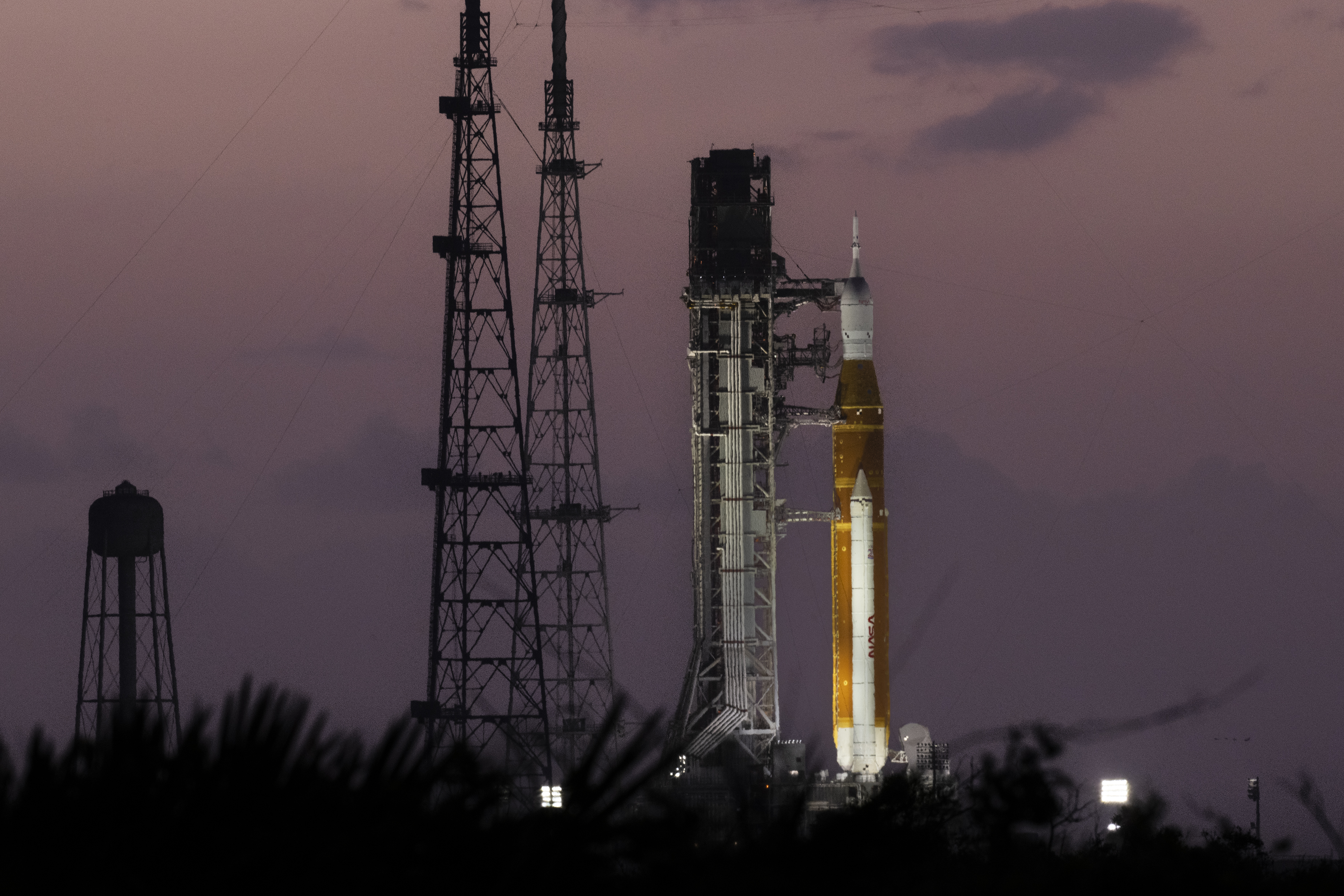
The mission is planned to carry out a series of objectives designed to demonstrate critical systems needed for a future lunar landing. During the Artemis III mission, the SLS (Space Launch System) rocket will launch the Orion spacecraft from NASA’s Kennedy Space Center in Florida with four crew members. Instead of using the interim cryogenic propulsion stage as the upper stage of the rocket, NASA will use a “spacer,” a representation of the mass and overall dimensions of an upper stage but without propulsive capabilities. The spacer will maintain the same overall dimensions and interface connection points as the upper stage between the Orion stage adapter and launch vehicle stage adapter.
Design and fabrication activities for the spacer are progressing rapidly at NASA’s Marshall Space Flight Center in Huntsville, Alabama. Material for the barrel section and the upper and lower rings is currently being machined at Marshall in preparation for upcoming welding operations.
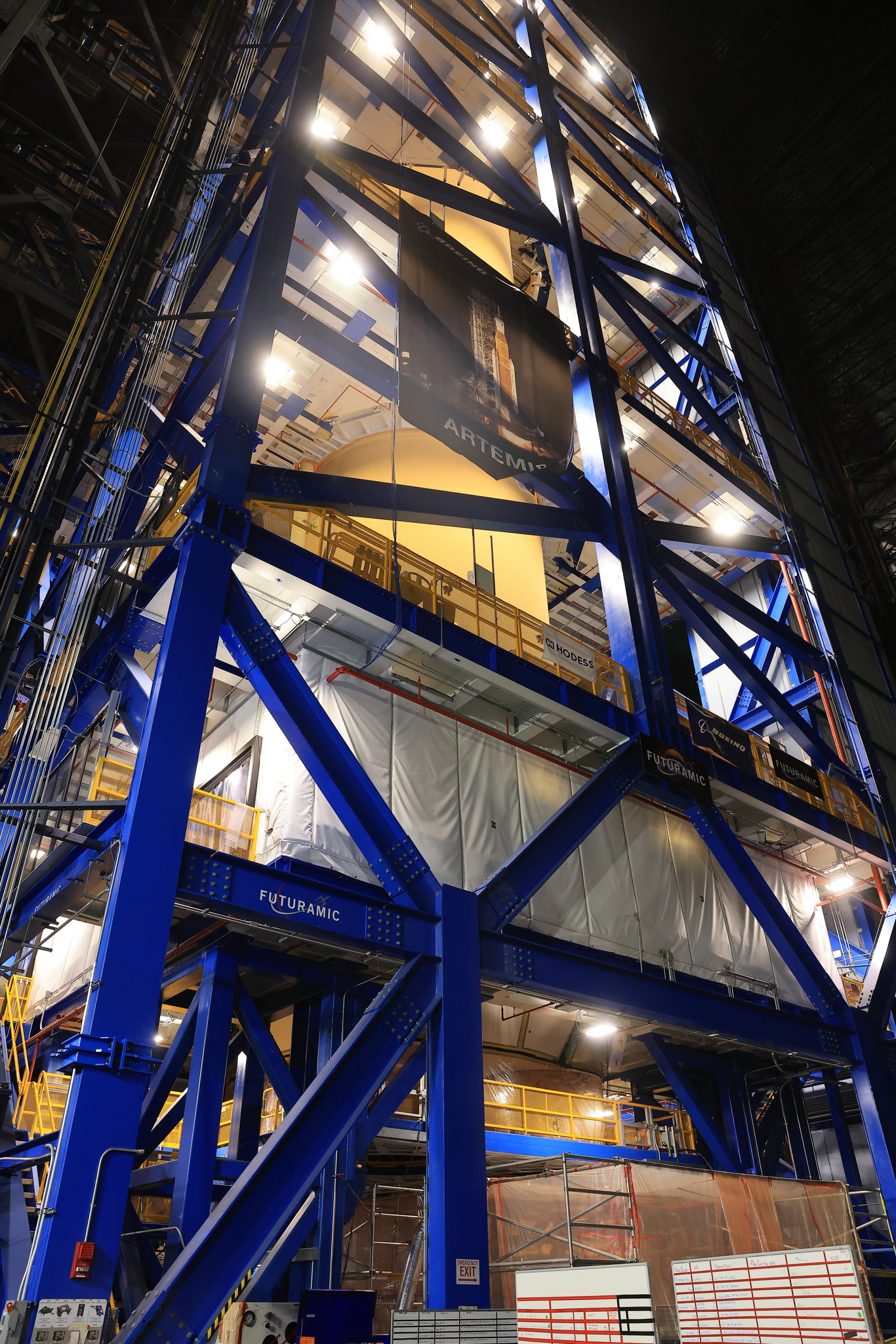
The Artemis III core stage sits in High Bay 2 in the Vehicle Assembly Building at NASA Kennedy with the core stage tank attached to its engine section on May 12, 2026.Credit: NASA/Kim ShiflettAfter the rocket delivers Orion to orbit, the spacecraft’s European-built service module will provide propulsion to circularize Orion’s orbit around the planet in low Earth orbit. This orbit increases overall mission success by allowing more launch opportunities for each element as compared to a lunar mission — SLS carrying Orion and its crew, SpaceX’s Starship human landing system pathfinder, and Blue Origin’s Blue Moon Mark 2 human landing system pathfinder.
Informed by Blue Origin and SpaceX capabilities, NASA also is defining the concept of operations for the mission. While some decisions are yet to be determined, astronauts could potentially enter at least one lander test article.
The crew will spend more time aboard Orion than during Artemis II, further advancing the evaluation of life support systems, and for the first time will demonstrate the docking system performance. The mission will inform lander rendezvous and habitation concepts and mission operations in preparation for future surface missions. The agency also plans to test an upgraded heat shield during Orion’s return to Earth to enable more flexible and robust reentry profiles for future missions.
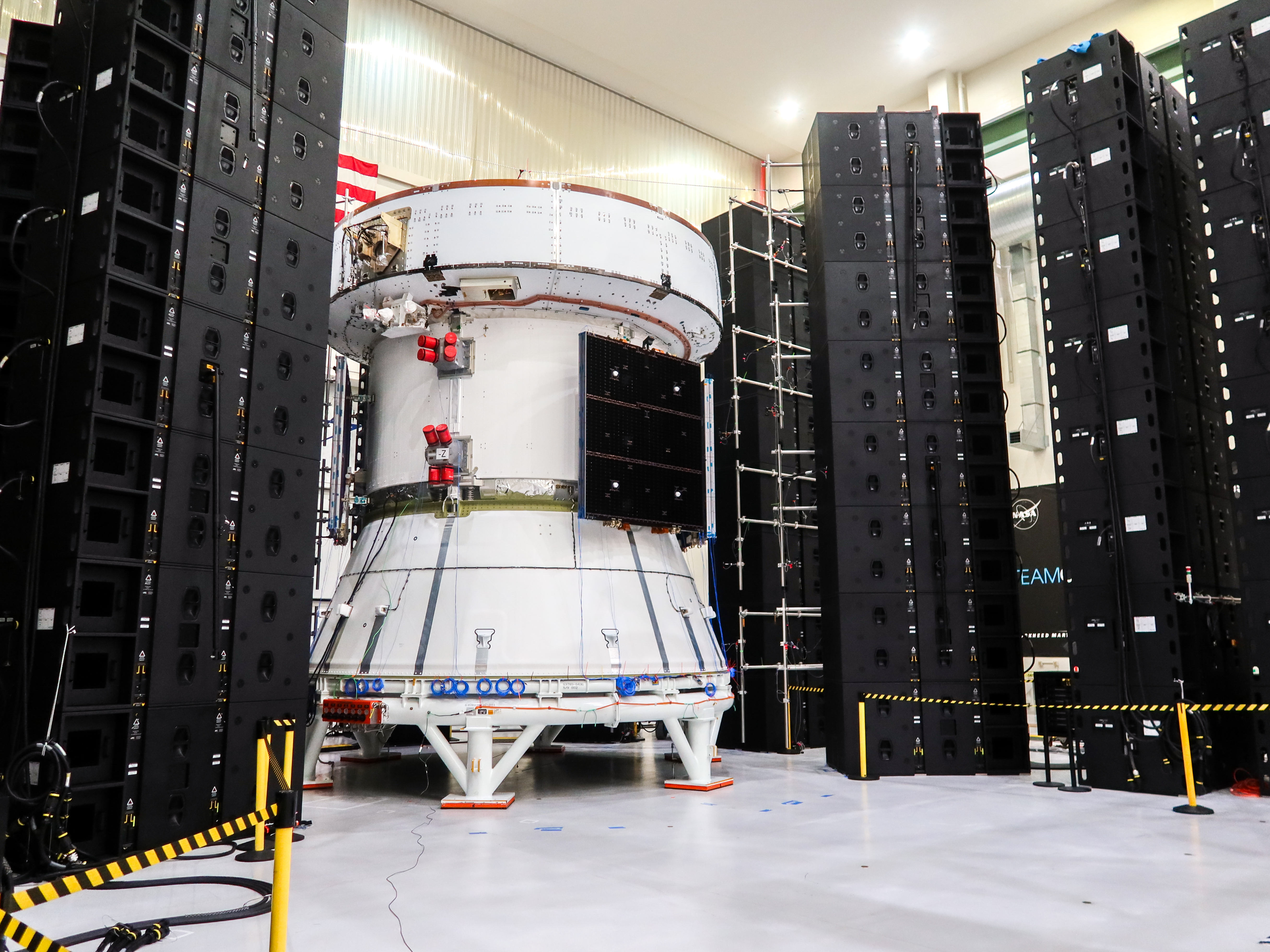
The Artemis III Orion service module is pictured ahead of acoustic testing in NASA’s Kennedy Space Center Operations and Checkout Facility on May 7, 2026.NASA/Jess RuffaOver the coming weeks, NASA will continue to refine specific plans for the flight, including a timeline for identifying astronauts to train for mission operations, options to evaluate Axiom’s AxEMU spacesuit lander interfaces ahead of lunar surface missions, mission duration, and potential science operations for the flight. NASA has asked for industry input on potential solutions to improve the communications with the ground during the mission since the Deep Space Network will not be used. The agency also is seeking both international and domestic interest in potentially flying CubeSats to deploy in Earth orbit, and may share other opportunities as the concept of operations for the mission is further defined.
As part of the Golden Age of innovation and exploration, NASA will send Artemis astronauts on increasingly difficult missions to explore more of the Moon for scientific discovery, economic benefits, establish an enduring human presence on the lunar surface, and to build on our foundation for the first crewed missions to Mars.
Learn more about NASA’s Artemis program:
Share Details Last Updated May 13, 2026 LocationKennedy Space Center Related TermsStudying Pneumonia in Space for Heart Health on Earth
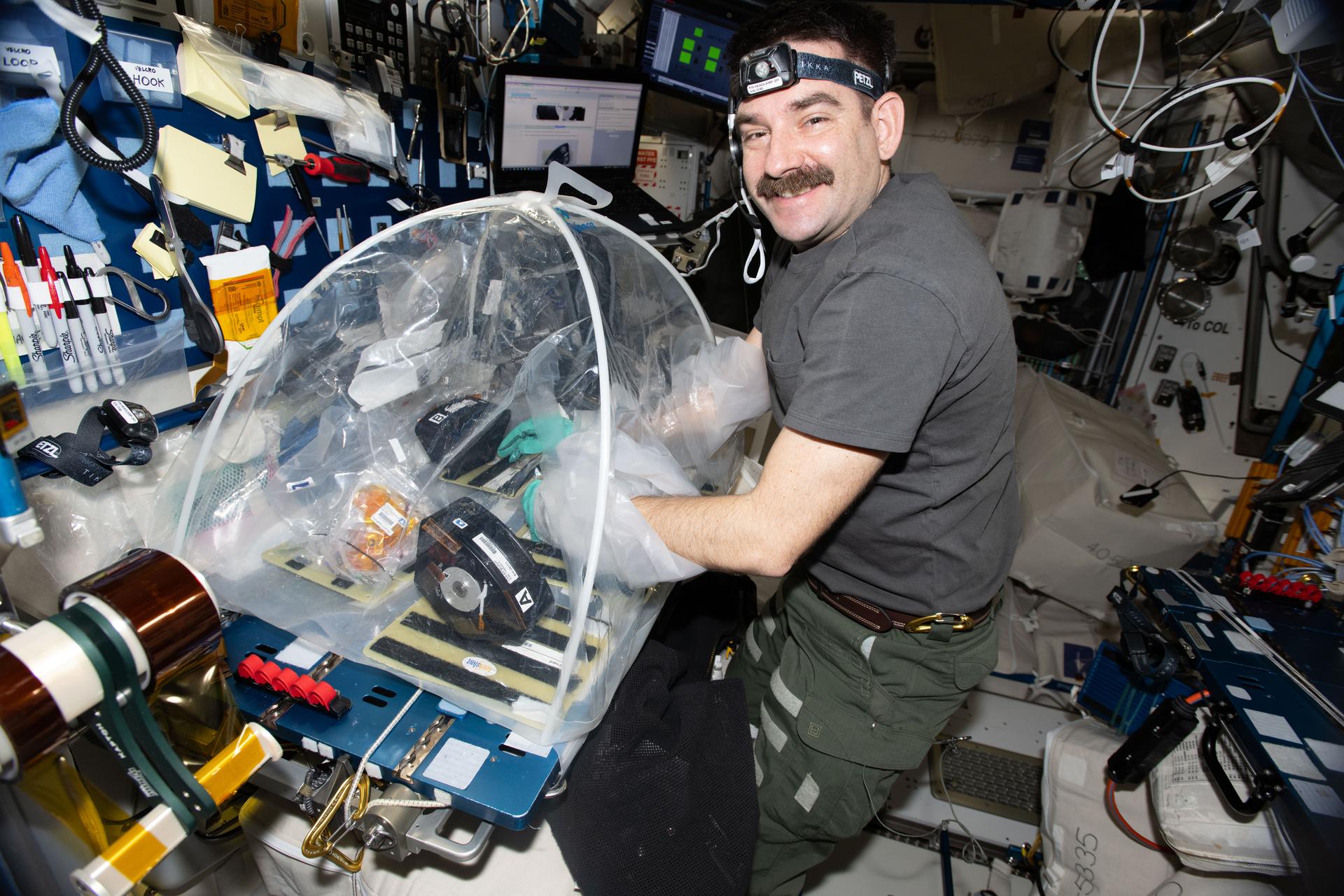
Expedition 74 astronauts aboard the International Space Station are uncovering how bacteria that causes pneumonia can lead to long-term damage in the heart. Researchers are leveraging the space environment to observe how stem cell derived heart tissues respond to bacterial infections, to discover new methods to manage cardiovascular health and infectious diseases.
In space, bacteria tend to be more severe and have enhanced drug resistance. Scientists are harnessing these traits to exaggerate their effect on heart cells and reveal important cellular responses that would be difficult to detect on Earth. Pinpointing the factors that make bacterial infections more severe in space could reveal targets for treatment. Dr. Palaniappan Sethu, professor of Medicine and Biomedical Engineering at the University of Alabama at Birmingham says, “By exacerbating the infection, we anticipate clear separation of the infection and control groups, making it easier to identify subtle factors that promote bacterial virulence”.
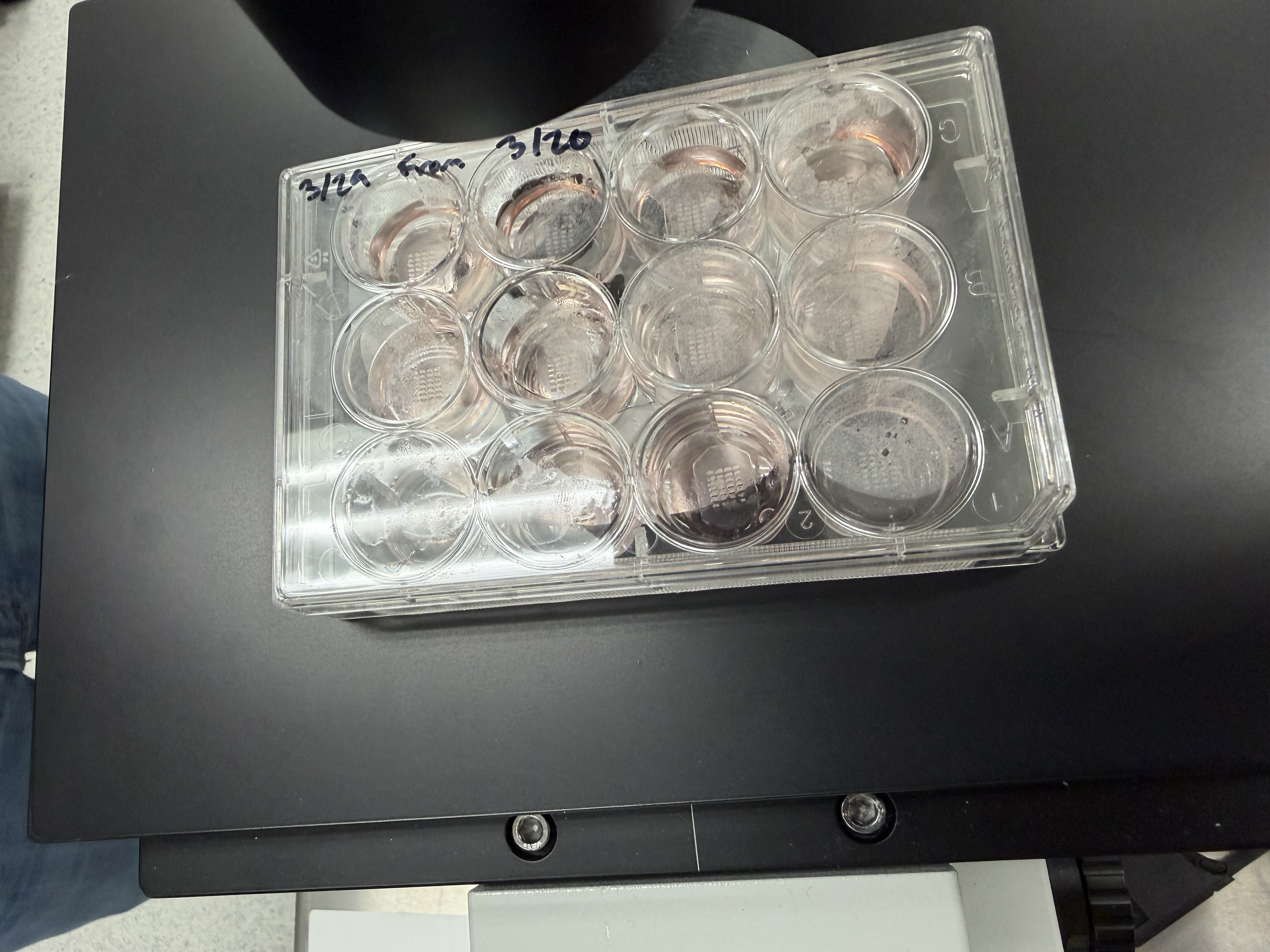
Preflight imagery of stem cell derived heart tissue models produced for the MVP Cell-09 investigation.University of Alabama at BirminghamThe Streptococcus pneumoniae bacteria is the leading cause of community-acquired pneumonia (CAP), an infection which causes millions of deaths each year. More than a quarter of adults hospitalized for CAP develop heart disease and patients that survive severe cases have an increased risk even after the pneumonia has been fully eradicated.
This research is also important as humans venture further into space. For over 25 years, researchers have utilized the space station to study how the human body and microbes respond to space, and deep space missions will require the strategies and knowledge we gain. “Addressing these questions is essential for ensuring human health during long duration space travel and for enabling sustainable habitation beyond Earth. Our experiments are expected to generate new insights into how space specific factors influence disease progression”, says Dr. Carlos J. Orihuela, professor of Microbiology at the University of Alabama at Birmingham.
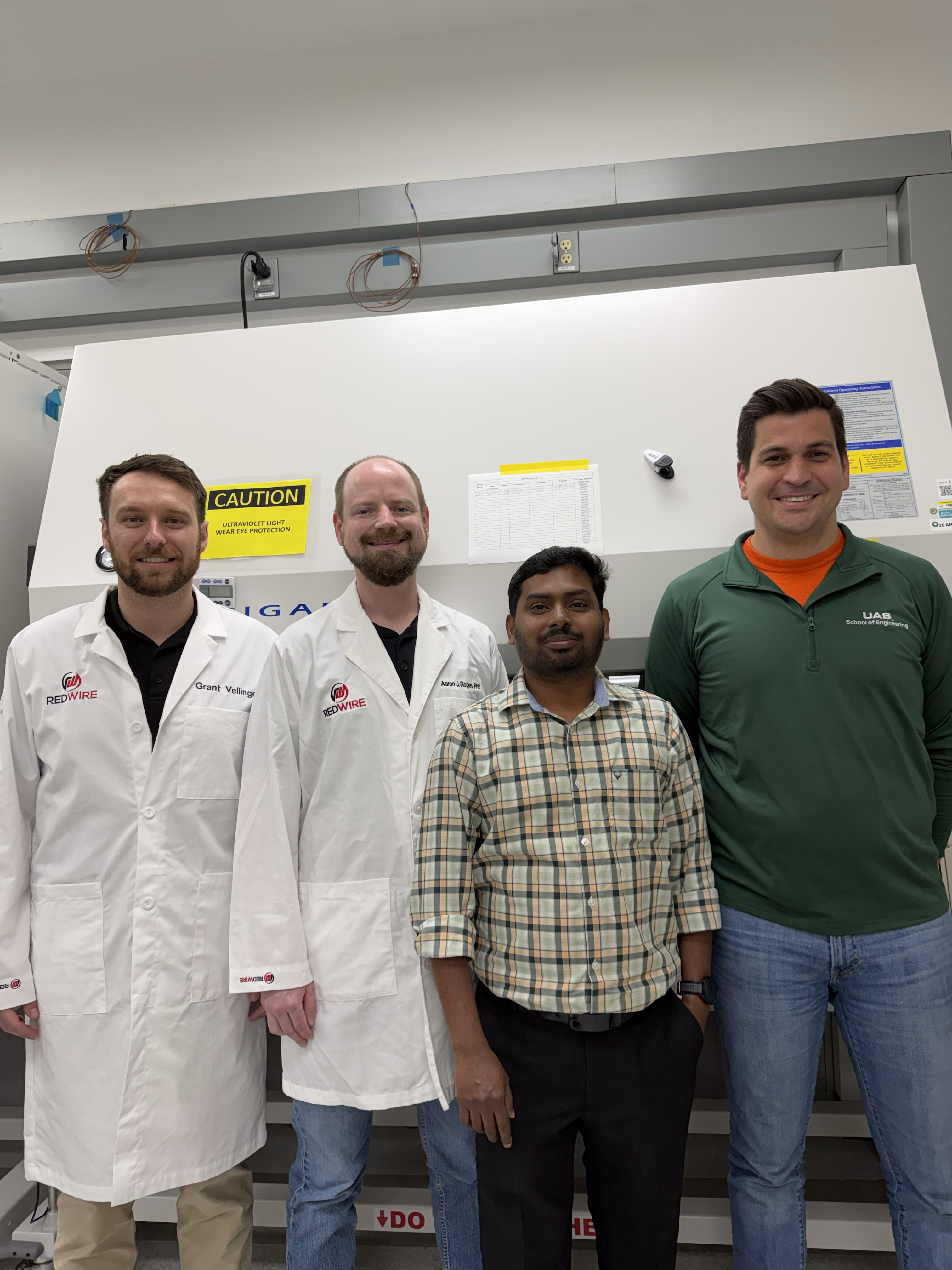
From left to right: Redwire Space researchers Grant Vellinger and Dr. Aaron Rogers, and University of Alabama at Birmingham researchers Dr. Vipin Chembilikand and Dr. Ian Berg prepare MVP Cell-09 ahead of launch to the space station.University of Alabama at BirminghamThe space station allows researchers from around the world to address complex human health problems on Earth and in space. Using the unique environmental factors aboard the space station allows for advanced study of disease formation, testing drugs and diagnostic tools, and more.
Keep Exploring Discover More Topics From NASALatest News from Space Station Research
International Space Station
Humans In Space
Space Station Research Results
NASA’s Planet-Hunting TESS Reveals Dazzling Night Sky
3 min read
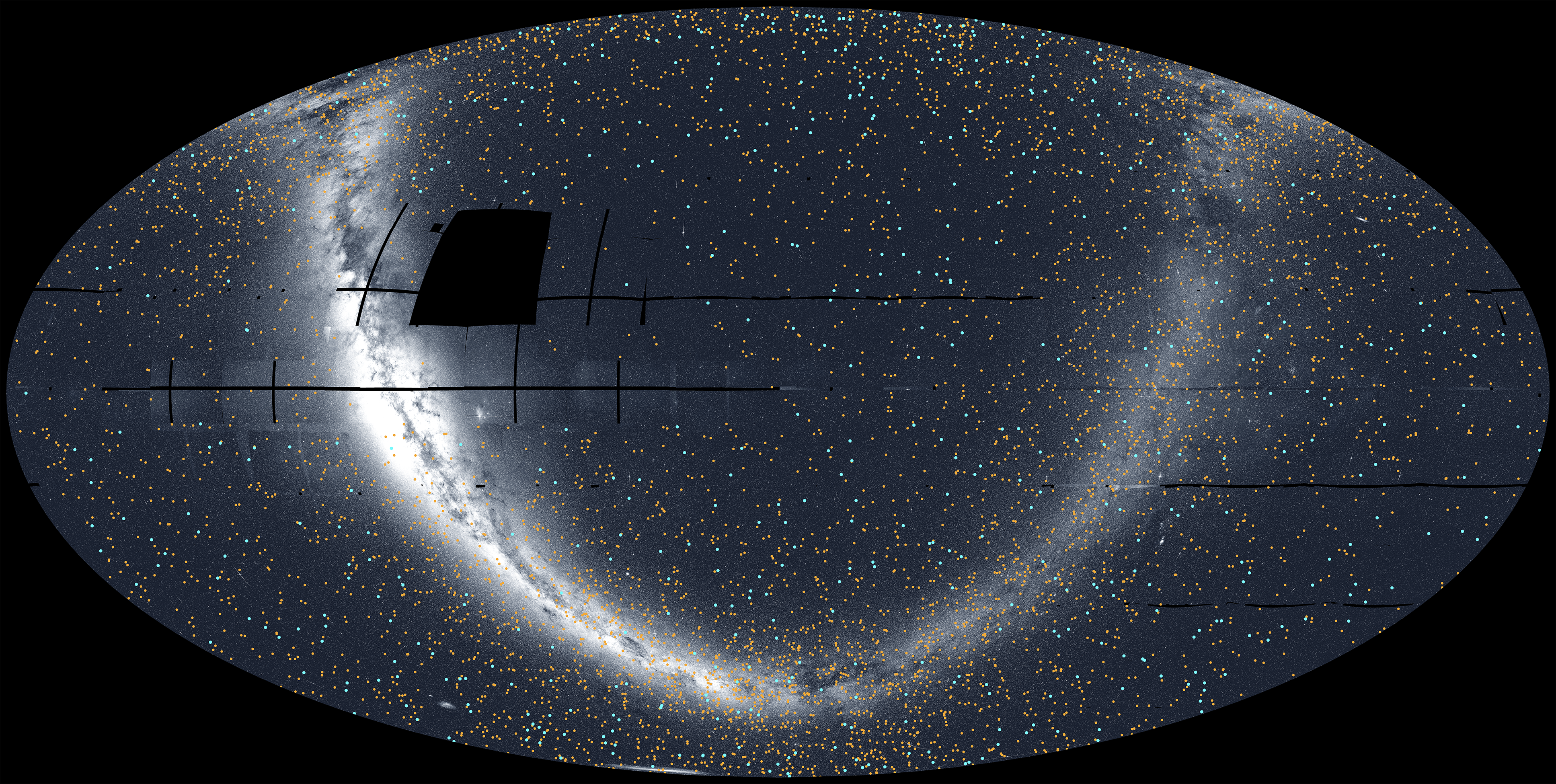
NASA’s Planet-Hunting TESS Reveals Dazzling Night SkyNASA’s TESS (Transiting Exoplanet Survey Satellite) has released its most complete view of the starry sky to date, filling in gaps from previous observations. Nearly 6,000 colored dots scattered across the image show the locations of either confirmed or candidate exoplanets — worlds beyond our solar system — identified by the mission as of September 2025 at the end of TESS’s second extended mission.
“Over the last eight years, TESS has become a fire hose of exoplanet science,” said Rebekah Hounsell, a TESS associate project scientist at the University of Maryland Baltimore County and NASA’s Goddard Space Flight Center in Greenbelt, Maryland. “It’s helped us find planets of all different sizes, from tiny Mercury-like ones to those larger than Jupiter. Some of them are even in the habitable zone, where liquid water might be possible on the surface, an important factor in our search for life beyond Earth.”
The TESS mission scans a wide swath of the sky, called a sector, for about a month at a time using its four cameras. These long stares allow the spacecraft to track the brightness changes of tens of thousands of stars, looking for variations in their light that might come from orbiting planets.
Researchers assembled an all-sky mosaic made of 96 sectors observed between April 2018, when TESS began its work, and September 2025.
This view of the whole sky was constructed from 96 TESS sectors. By the end of September 2025, when the last image of this mosaic was captured, TESS had discovered 679 exoplanets (blue dots) and 5,165 candidates (orange dots). The glowing arc running through the center is the plane of the Milky Way. The Large Magellanic Cloud can be seen along the bottom edge just left of center. Black areas within the oval indicate regions TESS has not yet imaged. NASA/MIT/TESS and Veselin Kostov (University of Maryland College Park)Download high-resolution images from NASA’s Scientific Visualization Studio.
The blue dots in the image mark the locations of nearly 700 confirmed planets, as of September 9. This menagerie includes worlds that may be covered by volcanoes, are being destroyed by their stars, or orbit two stars — experiencing double sunrises and sunsets each day. The orange dots represent more than 5,000 candidate planets that are awaiting verification.
To date, scientists have confirmed over 6,270 exoplanets using missions like TESS, NASA’s retired Kepler Space Telescope, and other facilities.
Also captured in the mosaic is the bright plane of our Milky Way galaxy, seen as a glowing arc through the center. The bright white ovals in the lower left are the Large and Small Magellanic Clouds. These satellite galaxies are located 160,000 and 200,000 light-years away, respectively.
“The more we dig into the large TESS dataset, especially using automated algorithms, the more surprises we find,” said Allison Youngblood, the TESS project scientist at NASA Goddard. “In addition to planets, TESS has helped us study rivers of young stars, observe dynamic galactic behavior, and monitor asteroids near Earth. As TESS fills in more of the night sky, there’s no knowing what it might see next.”
You could discover the next exoplanet! Join the Planet Hunters TESS citizen science project, and you’ll learn how to read light curves — plots of light data from distant stars — to find telltale signals from orbiting exoplanets.
By Jeanette Kazmierczak
NASA’s Goddard Space Flight Center, Greenbelt, Md.
Media Contact:
Claire Andreoli
301-286-1940
NASA’s Goddard Space Flight Center, Greenbelt, Md.
America’s Emerald Isle
- Earth
- Earth Observatory
- Image of the Day
- EO Explorer
- Topics
- More Content
- About
NASA Langley Engineer Attends FAA Training
At a busy airport, every aircraft in the area shares just a handful of radio frequencies. Spectrum and time are constrained and if multiple people speak at once, both messages can get lost. Communications like “clearance delivery,” which require long transmissions and readbacks, are challenging in high-traffic areas, particularly when weather or other factors require many aircraft to communicate with controllers at once. Going digital clears that channel for urgent, time-critical calls, among other things. And it’s the current practice at some airports, where pilots can confirm clearances with the touch of a button, that the response goes directly to the controller’s screen, and the updated information loads into their flight management system.
Will Cummings-Grande, aerospace engineer with the Systems Analysis and Concepts Directorate based at NASA’s Langley Research Center, is leading technical work that centers around Communications Architecture and Performance for Digital Clearance in NASA’s Air Traffic Management and Safety (ATMS) project. He’s researching the next layer of digital clearance, extending that same logic down to taxi instructions on the ground, so that pushback timing, routing, and runway assignments could also arrive digitally rather than over the radio.
He sought out the most current, ground-level knowledge about how digital clearance delivery works in practice — not in a research paper, but in a real tower, on real systems, with the people who run them every day. The Federal Aviation Administration (FAA) offers the training he wanted to air traffic controllers, so he reached out to the FAA Academy “on a hope and a prayer” that they might accept him as a student.
And in early April, Cummings-Grande traveled to the Mike Monroney Aeronautical Center (MMAC) in Oklahoma City to complete the Tower Data Link Services (TDLS) Application Specialist training — the same two-day, hands-on course required of working controllers at the 72 U.S. airports currently equipped with digital clearance delivery capability.
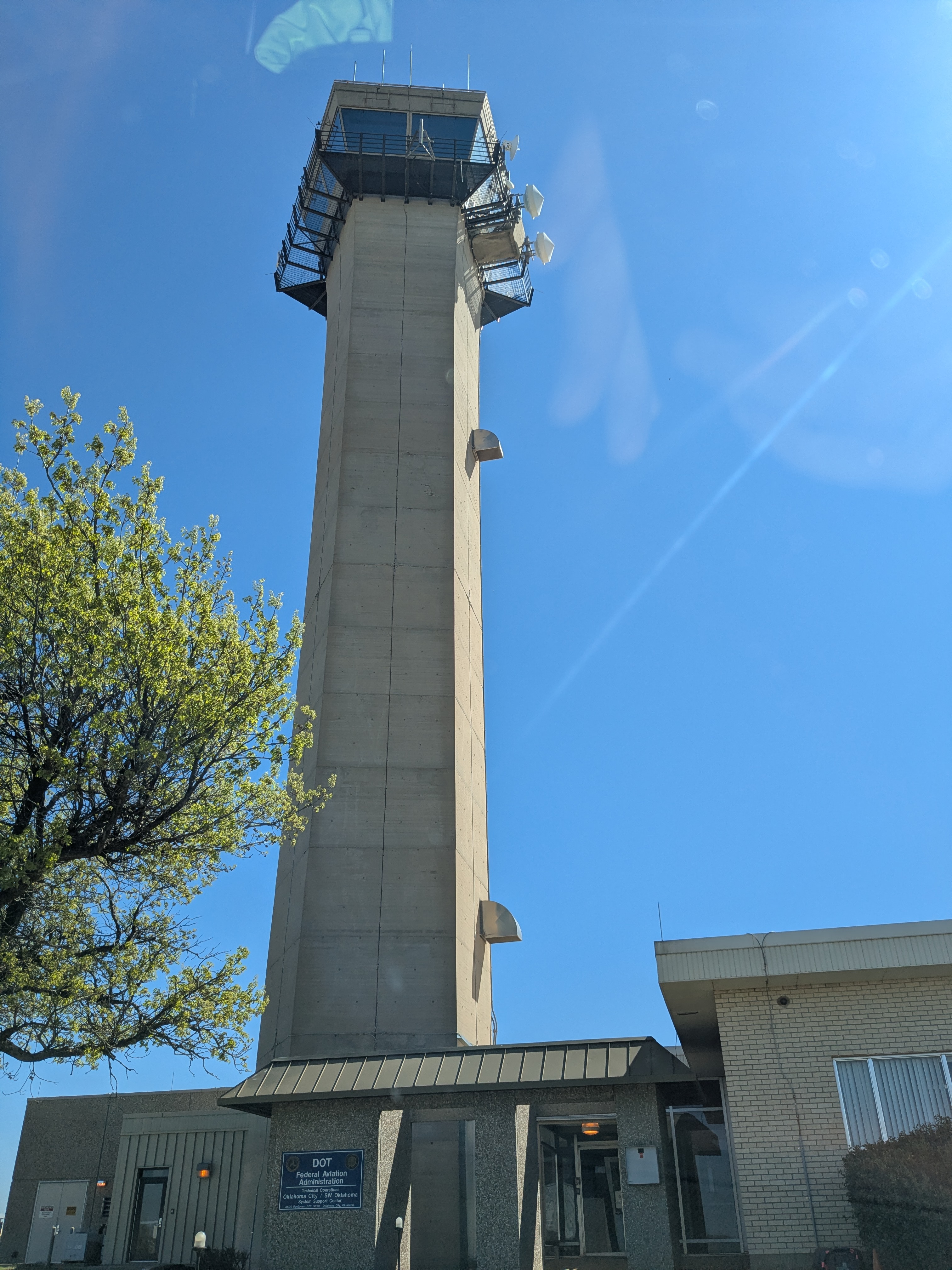
Will Cummings-Grande, aerospace engineer with the Systems Analysis and Concepts Directorate, based at NASA’s Langley Research CenterCredit: NASA The air traffic control tower at the Mike Monroney Aeronautical Center in Oklahoma City, where Cummings-Grande visited to observe the Tower Data Link Services system in live operation. Credit: Will Cummings-Grande/NASA In the ClassroomCumming-Grande shadowed a working controller during exercises, trading off at the terminal during breaks so both got time on the system. His classmates were application specialists from Seattle, Sacramento, San Jose, and Fort Lauderdale, all controllers with day jobs managing high-traffic airspace who were there to become the designated system maintainers at their home airports. During breaks, Cummings-Grande had a luxury: time to test. “I got to bounce some of my ideas and concepts off of controllers who are out there interacting with the TDLS and all of the tools it touches in the current system,” he said. “It was great to have both — here’s what the controller-in-training gets, and here’s what I get as a researcher — kind of lumped into the same experience.”
The FAA Academy also connected him with the systems engineers responsible for developing, testing, and implementing new TDLS hardware and software versions, and arranged a visit to the OKC tower to observe the system in live operation.
What He FoundThe TDLS runs on fully air-gapped software, completely isolated from standard operating systems — a deliberate cybersecurity design that made the hands-on experience revelatory in ways a research paper couldn’t replicate. “Interacting with the system was just very eye-opening as to how different these systems are from other computers that we commonly interact with,” he said.
The more significant discovery came from the curriculum itself. Reviewing the FAA’s system architecture during training, Cummings-Grande noticed something he didn’t know to look for: a link between the TDLS and the Terminal Flight Data Manager (TFDM), which does not yet exist operationally. That gap is now the center of his research questions. “I didn’t realize I was missing this piece until I took this course,” he said.
Building on Two Decades of HomeworkThe research Cummings-Grande is pursuing connects to a long thread of NASA work on surface safety and digital communications, including the Terminal Area Productivity program, the Surface Operation Automation Research (SOAR) project, the Low Visibility Landing and Surface Operations (LVLASO) project, and Surface Trajectory Based Operations (STBO) studies. These efforts kicked off in the mid-90s to inform FAA NextGen and demonstrated digital taxi clearances in a series of simulations at multiple facilities and ultimately flight tests at the Atlanta Airport. Those findings showed meaningful workload reductions, but the cost-benefit case wasn’t there yet, and the technology wasn’t ready in the fleet or in the facilities.
What’s changed, in Cummings-Grande’s view, is the convergence of new infrastructure investments, including the rollout of systems derived from Airspace Technology Demonstration (ATD-2) technologies like the Spot and Runway Departure Advisor and the Precision Departure Release Capability through the TFDM, with renewed industry interest from a partner on the aircraft side. “We have all this homework that people have been doing for the last 20-30 years,” he said. “Can we take advantage of the renewed interest from FAA and industry to enable this safety-enhancement?”
His timeline estimate for a fully implemented system leans somewhere in the range of five to ten years. And the payoff, he says, will be tangible to anyone who flies. “This means that your flight will be safer than ever, and that your pilots will be focused on the right things during taxi. Instead of relying on pilots to write down their taxi clearance correctly or be familiar with the airport, the airplane will know and can double-check what the pilot is doing.”
A Case for PartnershipCummings-Grande isn’t aware of another NASA researcher having taken this FAA course, and he thinks the model is worth repeating. He pointed to terminal procedures design (TERPS) as another area where FAA Academy training could benefit researchers working on urban air mobility and small UAS integration. “Anytime someone needs to do a deep dive into one of the systems — understanding the current state of practice, here are the buttons you push to make this happen — I think it’d be great to have an ongoing partnership with the FAA Academy and make that possible.”
The FAA Academy team was, by all accounts, a willing partner.
Cummings-Grande extends his special thanks to the FAA’s Eric Gandrud and Carol Raiford.
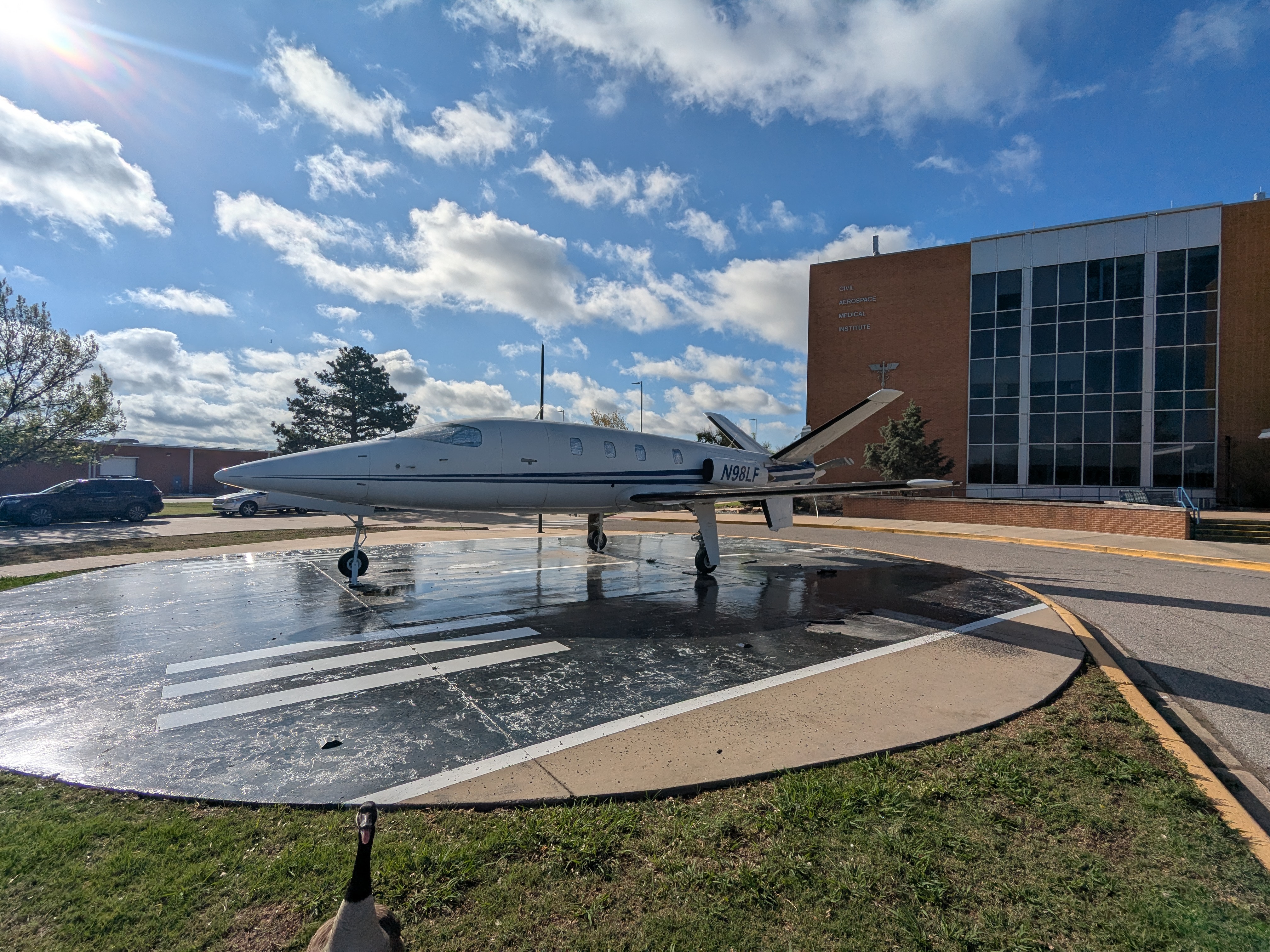
Will Cummings-Grande met an unexpected security detail during his final day at MMAC — a goose standing guard over a vintage Lear Fan 2100 parked outside the Civil Aerospace Medical Institute. “I hear a hiss, and I look down, and there’s a goose who is defending their favorite airplane.”Credit: Will Cummings-Grande/NASAPerseverance Stuns in New Selfie
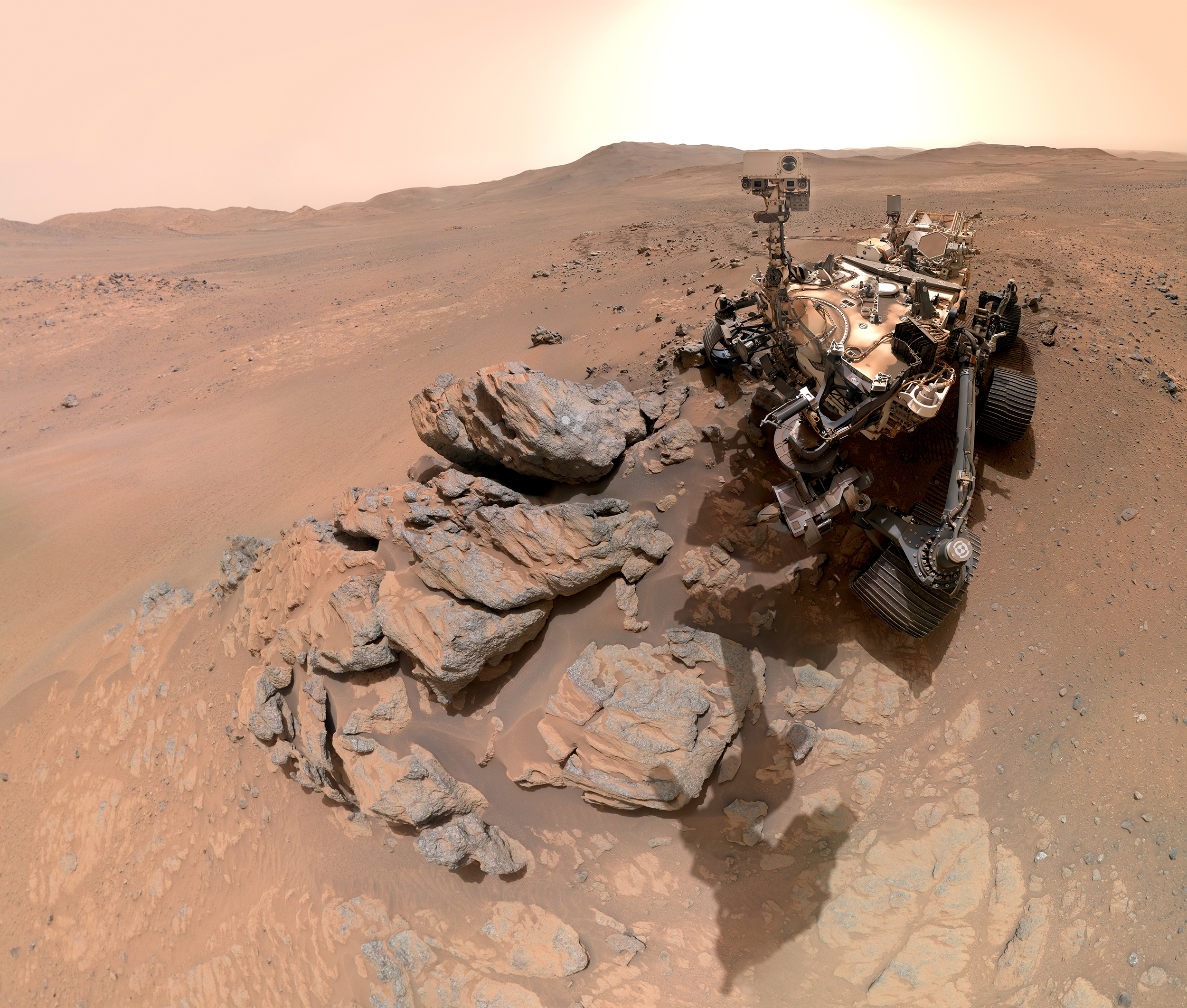
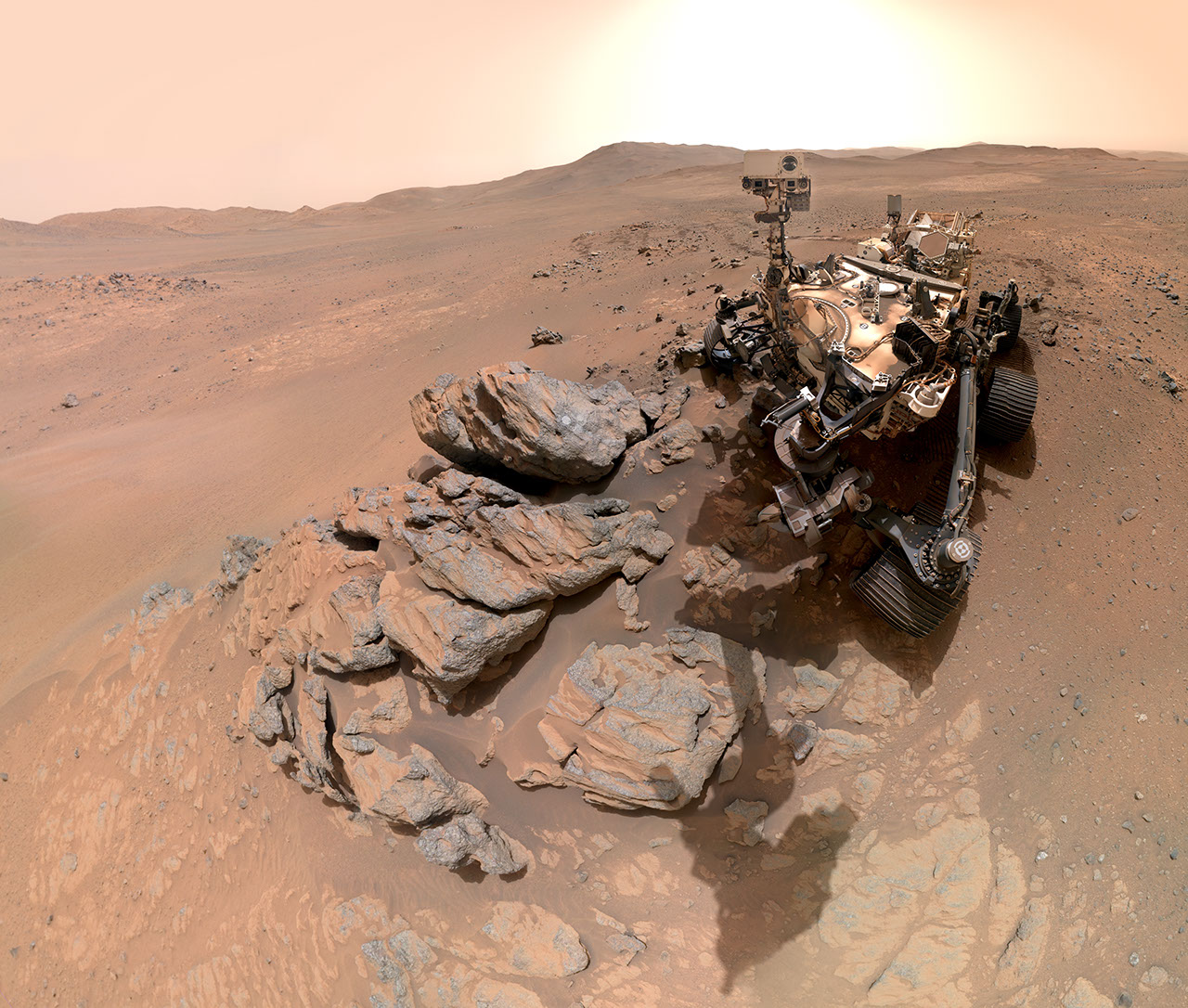
NASA’s Perseverance rover recently took a self-portrait against a sweeping backdrop of ancient Martian terrain at a location the science team calls “Lac de Charmes.” Assembled from 61 individual images, the selfie shows Perseverance training its mast on a rocky outcrop in the foreground after creating a circular abrasion patch, with the western rim of Jezero Crater stretching into the background. During abrading, the rover grinds down a portion of the rock’s surface, allowing the science team to analyze what’s inside. The selfie was captured on March 11, the 1,797th Martian day (or sol) of the mission, during the rover’s deepest push west beyond the crater.
Read more about Perseverance’s recent exploration.
Image credit: NASA/JPL-Caltech/MSSS
NASA’s Perseverance Rover Snaps Selfie in Mars’ Western Frontier
6 min read
Preparations for Next Moonwalk Simulations Underway (and Underwater)To view this video please enable JavaScript, and consider upgrading to a web browser that supports HTML5 video
NASA’s Perseverance looks down at a rocky outcrop nicknamed “Arathusa” and then appears to look into the camera in this animated selfie, which is composed of 61 images taken March 11, 2026, during the rover’s deepest push west beyond Jezero Crater. NASA/JPL-Caltech/MSSSEditor’s note: The text was updated on March 13, 2026, to correct the spelling of the outcrop nicknamed “Arathusa.”
NASA’s Perseverance Mars rover recently took a self-portrait against a sweeping backdrop of ancient Martian terrain at a location the science team calls “Lac de Charmes.” Assembled from 61 individual images, the selfie shows Perseverance training its mast on a rocky outcrop on which it had just made a circular abrasion patch, with the western rim of Jezero Crater stretching into the background. The selfie was captured on March 11, the 1,797th Martian day, or sol, of the mission, during the rover’s deepest push west beyond the crater.
Perseverance is in its fifth science campaign, known as the Northern Rim Campaign, of its mission on the Red Planet. The Lac de Charmes region represents some of the most scientifically compelling terrain the rover has visited.
NASA’s Perseverance captured this enhanced-color panorama of an area nicknamed “Arbot” on April 5, the 1,882nd Martian day, or sol, of the mission. Made of 46 images, the panorama offers one of the richest geological vistas of the rover’s mission, revealing a windswept landscape of diverse rock textures.NASA/JPL-Caltech/ASU/MSSS“We took this image when the rover was in the ‘Wild West’ beyond the Jezero Crater rim — the farthest west we have been since we landed at Jezero a little over five years ago,” said Katie Stack Morgan, Perseverance’s project scientist at NASA’s Jet Propulsion Laboratory in Southern California. “We had just abraded and analyzed the ‘Arathusa’ outcrop, and the rover was sitting in a spot that provided a great view of both the Jezero Rim and the local terrain outside of the crater.”
During abrading, the rover grinds down a portion of the rock’s surface, allowing the science team to analyze what’s inside. The technique enabled the team to determine that the Arathusa outcrop is composed of igneous minerals that likely predate the formation of Jezero Crater. Igneous rocks with large mineral crystals form underground as molten rock cools and solidifies. Perseverance acquired the selfie — its sixth since landing on Mars in 2021 — using the WATSON (Wide Angle Topographic Sensor for Operations and eNgineering) camera mounted at the end of its robotic arm, which made 62 precision movements over approximately one hour to build the composite image (learn more about how selfies are made).
Significant scienceAlong with the selfie, Perseverance used Mastcam-Z, located on its mast, to capture a mosaic of the “Arbot” area in Lac de Charmes on April 5, or Sol 1882. Made of 46 images, the panorama offers one of the richest geological vistas of the mission, revealing a windswept landscape of diverse rock textures.
The image provides the team a clear road map for investigating the ridgeline and the area’s ancient rock variety, including what appear to be megabreccia — large fragments (some the size of skyscrapers) hurled by a massive meteorite impact that occurred on the plain called Isidis Planitia about 3.9 billion years ago.
“What I see in this image is excellent exposure of likely the oldest rocks we are going to investigate during this mission,” said Ken Farley, Perseverance’s deputy project scientist at Caltech in Pasadena. “There is a sharp ridgeline visible in the mosaic whose jagged, angular texture contrasts starkly with the rounded boulders in the foreground. We also see a feature that may be a volcanic dike, a vertical intrusion of magma that hardened in place and was left standing as the softer surrounding material eroded away over billions of years.”
The rock color in the mosaic offers less information to the science team than the distinctive textures, which help them differentiate the rock types. Unlike Jezero Crater’s river delta, which is composed of sedimentary rock, some rocks here appear to be extrusive igneous rocks (molten rock that reached the surface as lava flows) and impactites (rocks created or modified by a meteorite impact) believed to have formed before the crater about 4 billion years ago, offering a window into the planet’s deep early crust.
New ballgame, near-marathon distance“The rover’s study of these really ancient rocks is a whole new ballgame,” said Stack Morgan. “These rocks — especially if they’re from deep in the crust — could give us insights applicable to the entire planet, like whether there was a magma ocean on Mars and what initial conditions eventually made it a habitable planet.”
After studying Arathusa, Perseverance drove northwest to the Arbot area, where it has been analyzing other rocky outcrops. When the team is satisfied with the work accomplished there, the rover will drive south to “Gardevarri,” a site with a notably clear exposure of olivine-bearing rocks. Formed in cooling magma, these types of rocks contain information that can help scientists better understand Mars’ volcanic history and provide context for large-scale geological processes. From there, the rover is expected to head southeast toward a region the team is calling “Singing Canyon” for more insights into the planet’s early crust.
After more than five years of surface operations, Perseverance has abraded 62 rocks, collected 27 rock cores in its sample tubes (25 sealed, 2 unsealed), and traveled almost 26 miles (42 kilometers) — in other words, just shy of a marathon (26.2 miles, or 42.195 kilometers).
“Having the benefit of four previous rover missions, the Perseverance team has always known our mission was a marathon and not a sprint,” said acting Perseverance project manager Steve Lee at JPL. “We’ve almost reached marathon distance. Our selfie may show that the rover is a bit dusty, but its beauty is more than skin deep. Perseverance is in great shape as we continue our explorations and extend into ultramarathon drive distances.”
More about PerseveranceNASA’s Jet Propulsion Laboratory, which is managed for the agency by Caltech, built and manages operations of the Perseverance rover on behalf of NASA’s Science Mission Directorate in Washington, as part of NASA’s Mars Exploration Program portfolio. The WATSON imaging system was built by, and is operated by, Malin Space Science Systems in San Diego.
To learn more about NASA’s Perseverance:
https://science.nasa.gov/mission/mars-2020-perseverance
News Media Contacts
DC Agle
Jet Propulsion Laboratory, Pasadena, Calif.
818-393-9011
agle@jpl.nasa.gov
Karen Fox / Alana Johnson
NASA Headquarters, Washington
240-285-5155 / 202-672-4780
karen.c.fox@nasa.gov / alana.r.johnson@nasa.gov
2026-032
Share Details Last Updated May 13, 2026 Related Terms Explore More 1 min read NASA’s Perseverance Captures Panorama at ‘Arbot’Description NASA’s Perseverance Mars rover used its Mastcam-Z camera to capture this panorama of an…
Article 1 day ago 2 min read NASA’s Perseverance Rover Snaps Westernmost SelfieDescription NASA’s Perseverance Mars rover took this selfie on March 11, 2026, the 1,797th Martian…
Article 1 day ago 4 min read Hello Universe: NASA’s Next-Gen Space Processor Undergoes Testing Article 2 days ago Keep Exploring Discover Related Topics Mars Perseverance RoverThe Mars Perseverance rover is the first leg the Mars Sample Return Campaign’s interplanetary relay team. Its job is to…
Ingenuity Mars HelicopterNASA’s Ingenuity Mars Helicopter completed 72 historic flights since first taking to the skies above the Red Planet.
Mars ExplorationMars is the only planet we know of inhabited entirely by robots. Learn more about the Mars Missions.
Planetary ScienceNASA’s planetary science program explores the objects in our solar system to better understand its history and the distribution of…
NASA’s Perseverance Captures Panorama at ‘Arbot’
NASA/JPL-Caltech/ASU/MSSS Photojournal Navigation Downloads NASA’s Perseverance Captures Panorama at ‘Arbot’
PNG (132.21 MB)
PIA26753 Figure A
PNG (117.68 MB)
PIA26753 Figure B
PNG (67.84 MB)
Description
NASA’s Perseverance Mars rover used its Mastcam-Z camera to capture this panorama of an area nicknamed “Arbot” on April 5, 2026, the 1,882nd Martian day, or sol, of the mission, during the rover’s deepest push west beyond Jezero Crater. Made of 46 images, the panorama offers one of the richest geological vistas of the mission, revealing a windswept landscape of diverse rock textures. This is an enhanced-color version, which had its color bands processed to improve visual contrast and accentuate color differences.
Figure AFigure A is a natural-color version of the mosaic.
Figure BFigure B is a 3D anaglyph version designed for use with red-blue glasses. It is composed of 92 images collected by Mastcam-Z.
NASA’s Jet Propulsion Laboratory, which is managed for the agency by Caltech in Pasadena, California, built and manages operations of the Perseverance rover. Arizona State University leads the operations of the Mastcam-Z instrument, working in collaboration with Malin Space Science Systems in San Diego, on the design, fabrication, testing, and operation of the cameras, and in collaboration with the Niels Bohr Institute of the University of Copenhagen on the design, fabrication, and testing of the calibration targets.
For more about Perseverance: science.nasa.gov/mission/mars-2020-perseverance/
Keep Exploring Discover More Topics From Photojournal
Photojournal
Search Photojournal
Photojournal’s Latest Content
Feedback
NASA’s Perseverance Rover Snaps Westernmost Selfie
PNG (178.16 MB)
PIA26752 Figure A
PNG (178.92 MB)
PIA26752 Animation (.gif)
GIF (3.55 MB)
PIA26752 Animation (.mp4)
MP4 (1.15 MB)
Description
NASA’s Perseverance Mars rover took this selfie on March 11, 2026, the 1,797th Martian day, or sol, of the mission, during the rover’s deepest push west beyond Jezero Crater. Assembled from 61 individual images, the selfie shows Perseverance training its mast on the “Arethusa” rocky outcrop after creating a whitish circular abrasion patch. The crater’s western rim of Jezero Crater is visible in the background.
Figure AFigure A is a version of the selfie in which the rover appears to be looking at the camera.
Animation (.gif)Here is a GIF combining the main image and Figure A, in which the rover appears to look up and down.
The selfie is composed of images taken by the WATSON (Wide Angle Topographic Sensor for Operations and eNgineering) camera on the end of the rover’s robotic arm. The images were stitched together after being sent back to Earth.
WATSON is part of an instrument called SHERLOC (Scanning Habitable Environments with Raman & Luminescence for Organics & Chemicals). WATSON was built by Malin Space Science Systems (MSSS) in San Diego and is operated jointly by MSSS and JPL.
The rover’s process for taking a selfie is explained in this video.
NASA’s Jet Propulsion Laboratory, which is managed for the agency by Caltech in Pasadena, California, built and manages operations of the Perseverance rover.
For more about Perseverance:
https://science.nasa.gov/mission/mars-2020-perseverance/
Keep Exploring Discover More Topics From Photojournal
Photojournal
Search Photojournal
Photojournal’s Latest Content
Feedback
Hello Universe: NASA’s Next-Gen Space Processor Undergoes Testing
4 min read
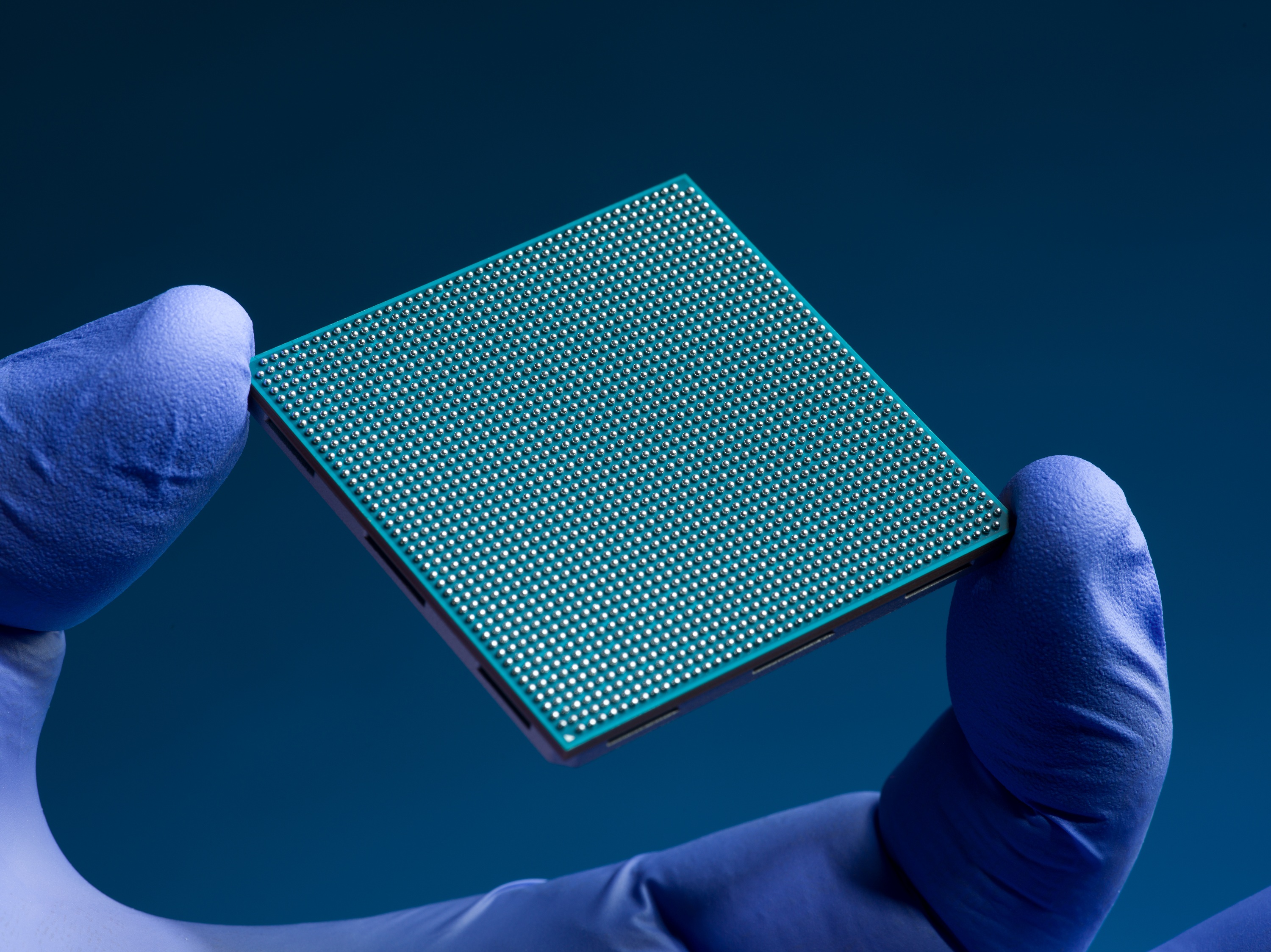
Preparations for Next Moonwalk Simulations Underway (and Underwater) Small enough to fit in the palm of a hand, NASA’s High Performance Spaceflight Computing processor packs the power of a full system-on-a-chip. This next-generation processor is made to survive deep space while delivering a massive leap in computational speed compared to current spacecraft technology.NASA/JPL-CaltechNASA’s High Performance Spaceflight Computing project aims to dramatically improve the computing power of spacecraft. Missions need processors that can withstand the harsh space environment, so they use chips developed years ago that are hardy and reliable. But upgraded chips are needed to enable the development of autonomous spacecraft, accelerate the rate of scientific discovery through faster data analysis, and support astronauts on missions to the Moon and Mars.
“Building on the legacy of previous space processors, this new multicore system is fault-tolerant, flexible, and extremely high-performing,” said Eugene Schwanbeck, program element manager in NASA’s Game Changing Development program at the agency’s Langley Research Center, in Hampton, Virginia. “NASA’s commitment to advancing spaceflight computing is a triumph of technical achievement and collaboration.”
The centerpiece of the High Performance Spaceflight Computing project is a new radiation-hardened, high-performance processor, designed to provide up to 100 times the computational capacity of current spaceflight computers while enduring a barrage of challenges in space. NASA’s Jet Propulsion Laboratory in Southern California has been conducting various tests that replicate those challenges.
“We are putting these new chips through the wringer by carrying out radiation, thermal, and shock tests while also evaluating their performance through a rigorous functional test campaign,” said Jim Butler, High Performance Space Computing project manager at JPL.
The processor must endure myriad tests to prove it can survive the rigors of spaceflight, including electromagnetic radiation and extreme temperature swings, both of which can degrade electronics. High-energy particles from the Sun and interstellar space can cause errors that send a spacecraft into “safe mode,” where nonessential operations are shut down until mission operators resolve the issue.
There are also unique challenges associated with landing on planetary bodies. “To simulate real-world performance, we are using high-fidelity landing scenarios from real NASA missions that would typically require power-intensive hardware to process huge volumes of landing-sensor data,” said Butler. “This is an exciting time for us to be working on hardware that will enable NASA’s next giant leaps.”
Testing at JPL, which began in February, will continue for several months. Results have been promising: The processor is working as designed and indications show it operating at 500 times the performance of the radiation-hardened chips currently in use. In a symbolic milestone, the team sent an email at the start of testing with the subject line “Hello Universe” — a nod to the test message that was popular in early computer development.
Computing superpowersBuilt by Microchip Technology Inc., headquartered in Chandler, Arizona, the High Performance Spaceflight Computing processor is being developed by the company and JPL through a commercial partnership. Samples have been provided to early access partners in the broader defense and commercial aerospace industry. The technology will enable autonomous spacecraft to use artificial intelligence to respond in real time to complex situations and environments where human input isn’t possible. It will help deep space missions analyze, store, and transmit troves of data to Earth, accelerating the rate of science discoveries. It could also support future human missions to the Moon and Mars.
Known as a system-on-a-chip (or SoC), the processor can fit in the palm of a hand and includes all the key components of a computer, such as central processing units, computational offloads, advanced networking units, memory, and input/output interfaces. Compact and energy-efficient, SoCs are commonly found in smartphones and tablets. But only the SoCs JPL is testing are built to survive for years, millions (or even billions) of miles from the nearest repair technician, enduring conditions that even the toughest home user couldn’t replicate.
Once certified for spaceflight, NASA will incorporate the chip into the computing hardware for many of the agency’s Earth orbiters, rovers exploring planetary surfaces, crewed habitats, and deep-space missions. The technology will be adapted by Microchip for Earth-based industries too, such as aviation and automotive manufacturing. The versatility of High Performance Spaceflight Computing supports NASA’s continued advancements in space exploration while providing transformative tools for numerous fields on Earth.
The project is managed by the Space Technology Mission Directorate’s Game Changing Development (GCD) program based at NASA Langley. The GCD program and JPL, a division of Caltech in Pasadena, California, led the end-to-end maturation of the High Performance Spaceflight Computing technology by developing mission requirements, funding industry studies, and guiding the project life cycle to delivery. NASA JPL selected Microchip as a partner in 2022, and the company funded its own research and development of the processor.
For more information about the High Performance Spaceflight Computing project, visit:
News Media Contacts
Ian J. O’Neill
Jet Propulsion Laboratory, Pasadena, Calif.
818-354-2649
ian.j.oneill@jpl.nasa.gov
Jasmine Hopkins
NASA Headquarters, Washington
321-432-4624
jasmine.s.hopkins@nasa.gov
2026-031
Share Details Last Updated May 12, 2026 Related Terms Explore More 6 min read NASA’s Perseverance Rover Snaps Selfie in Mars’ Western Frontier Article 11 hours ago 3 min read I Am Artemis: Kathleen Harmon Article 14 hours ago 3 min read NASA, Industry Advance High Performance Spaceflight Computing Article 4 days ago Keep Exploring Discover Related Topics High Performance Spaceflight Computing (HPSC)HPSC develops next-generation flight computing system that addresses computational performance, energy management and fault tolerance needs of NASA missions through…
Computing
Technology Transfer & Spinoffs
Technology
I Am Artemis: Kathleen Harmon
Listen to this audio excerpt from Kathleen Harmon, the Artemis II Mission Interface Manager for NASA’s Deep Space Network:
0:00 / 0:00
Your browser does not support the audio element.Captivated by Apollo launches on her television as a child, Kathleen Harmon now plays a key role in NASA’s Artemis program.
Harmon serves as the Artemis II mission interface manager for NASA’s Deep Space Network, an international array of giant radio antennas which are used to communicate with spacecraft. Managed by the agency’s Jet Propulsion Laboratory in Southern California, the Deep Space Network is the largest scientific telecommunications system in the world, supporting more than 40 missions exploring deep space. The network is also a key component of NASA’s Moon-bound Artemis missions.
Kathleen Harmon, Artemis II Mission Interface Manager for NASA’s Deep Space Network, in the Charles Elachi Mission Control Center at NASA’s Jet Propulsion Laboratory in Southern California.NASA/JPL-Caltech“If you’re in a car and you’re going somewhere and you don’t have GPS or a cellphone, you might get lost, or you might not be able to tell someone that you’re lost,” said Harmon, illustrating how the Deep Space Network “talks” to spacecraft. “The network provides that lifeline to spacecraft across the solar system, and even interstellar space, so that they can talk to Earth and send back amazing science data, images, and videos from Mars rovers, space telescopes, orbiters, and more.”
In her role as a mission interface manager, and with her background as a systems engineer and decades of experience with NASA, Harmon prepares missions for launch and operations. This role requires careful coordination and collaboration across international partners, as the Deep Space Network’s radio antennas are spread around the world. She was responsible for ensuring the Deep Space Network was prepared to support the Artemis II spacecraft before launch.
You could not get any of that information back without the network. It’s a critical asset that also lets spacecraft know where they are.Kathleen Harmon
Artemis II Mission Interface Manager for NASA's Deep Space Network
“The network has three complexes equally spaced around the world so, as the Earth rotates, one is always in view to communicate with spacecraft wherever they are in the solar system,” said Harmon.
At any given moment, the Deep Space Network complex that is currently experiencing daylight is “in control” of the entire network to ensure consistent spacecraft connectivity, an operational approach the network team calls “follow the Sun.”
While the network supports NASA’s return to the Moon, working in partnership with the Near Space Network, it will continue to maintain a close watch on NASA’s fleet of spacecraft at the Moon and beyond.
“We supported Artemis II 24 hours a day, seven days a week for the entire mission with two antennas — a prime and a backup,” Harmon said. She added that while the network was supporting Artemis II, it also communicated with robotic rovers and spacecraft throughout the solar system.
While Harmon’s work has supported missions from Juno to Voyager, her contributions to the Artemis program remind her of what first inspired her to join to NASA.
“I was a very small child when the Apollo missions happened,” said Harmon. “Apollo was my earliest memory.”
Just thinking that I can be part of not only the Apollo generation but now also the Artemis generation — it’s very exciting to bridge that gap. This is a Golden Age of exploration.Kathleen Harmon
Artemis II Mission Interface Manager for NASA's Deep Space Network
Share Details Last Updated May 12, 2026 EditorLauren LowContactLauren LowLocationJet Propulsion Laboratory Related Terms Explore More 3 min read I Am Artemis: Peter Rossoni Article 3 weeks ago 3 min read I Am Artemis: Erik Richards Article 2 months ago 5 min read Networks Keeping NASA’s Artemis II Mission Connected Article 3 months ago Keep Exploring Discover More Topics From NASAI Am Artemis
Communicating with Missions
Deep Space Network
SCaN & Moon to Mars
New Ultra-Black Coating Could Enable the Search for Life on Exoplanets
A recently developed ultra-black coating not only efficiently absorbs light, but is also extremely thin and durable, enabling its potential use on starshades that could someday support the imaging of exoplanets and potentially facilitate the detection of life beyond our solar system.
Artist’s conception of a starshade (a disk surrounded by “petals” at the top left) blocking starlight from a starso that a space-based telescope (at right) can image the two planets. Credit: NASA Exo-S Study Team What is a Starshade and What Could it Do?
The light emitted by a star can be billions of times brighter than the light reflected from its surrounding planets. This bright starlight makes it very difficult for a space telescope to image an exoplanet — it’s like trying to find the light reflected from a gnat that is flying near a spotlight. In addition, the light from our Sun scatters off spacecraft surfaces and back into the telescope, contributing even more light “pollution” that can easily obscure the dim light reflected from an exoplanet.
A starshade is a giant, flower-shaped spacecraft (roughly half the size of a football field) that is designed to be positioned between a space telescope and a distant star so that it casts a shadow from the distant star onto the telescope. A starshade can block unwanted light from the parent star to the extent that less than one part per billion of the starlight is observable, while allowing the much fainter light from an orbiting exoplanet to pass around the starshade and reach the telescope, thereby enabling its detection. But to enable a telescope to distinguish an exoplanet, a starshade must create an extremely pristine shadow on the telescope. Not only must it block the starlight from the parent star, it must also suppress the stray light from our Sun that scatters from the starshade’s “petal” edges into the telescope.
The Problem of Stray SunlightOver the past decade, NASA-sponsored engineers have explored various methods to address the issue of stray sunlight. For example, they developed a way to make a starshade’s edges razor sharp by crafting blades from amorphous metals. The edges of these blades were only 300 nanometers thick, but data showed that even such thin metal edges would still scatter too much sunlight into the telescope.
Researchers also tried applying black coatings to the starshade edges to reduce the reflected light. Unfortunately, the existing black coatings were far too thick; they made the starshade edges thicker (duller), which actually increased the scatter. Carbon nanotube coatings, for instance, are several microns thick — much thicker than the 300-nm starshade edge. Other existing coatings that rely on three-dimensional microstructures to trap light were also too thick.
A New Kind of Black CoatingIn 2004, David Sheikh, founder of the small business ZeCoat Corporation, was researching the concept of a “black mirror” — a mirror that absorbs nearly all incident light instead of reflecting it. He came across a methodology used decades ago to make light-absorbing, smooth surfaces.
Sheikh used modern computing techniques and more accurate material property data to improve this methodology, and developed a breakthrough method for manufacturing an ultra-black coating using a unique, motion-controlled, physical vapor deposition process also developed at ZeCoat. The coating design uses extremely thin, partially transparent metal layers that are separated by dielectric glass layers to form multiple light-absorbing, nanoscale cavities. When the thicknesses of the layers are tuned precisely with the aid of a computer, incoming light resonates as a standing wave inside the cavities, where the metals absorb it. The principle is similar to the Fabry–Perot cavity used in lasers — except instead of amplifying light, the light is trapped and absorbed. This new coating turned out to be 100 times thinner than those previously tested for use on starshades.
In 2020, NASA’s Exoplanet Exploration Program at the agency’s Jet Propulsion Laboratory (JPL) in Southern California chartered a Starshade Science and Industry Partnership (SIP) to maximize the technology readiness level of starshades to enable potential future exoplanet science missions. As part of this initiative, the new coating developed by Zecoat was applied to prototype starshade edges, and engineers at JPL used a custom-built laser scatterometer to measure scatter from coated and uncoated 50-cm long amorphous metal blades. These tests demonstrated that the new coating reduced the reflected light by a factor of about 20 — enough to enable a telescope to image an exoplanet. (The results of this effort were published here in the SPIE digital Library).
Beyond the Edge: Coating Starshade MembranesBuilding on the success of the edge coating demonstration and supported by a 2021 NASA Small Business Innovative Research (SBIR) contract, ZeCoat developed a novel thin film deposition process to coat large sheets of polyimide film with a similar ultra-black finish. The process uses multiple electron beam evaporators to apply thin, uniform films to a moving membrane substrate in a roll-to-roll coating process. These large coated membranes (~ 1-meter wide and many meters long) could be patched together to form a starshade’s central disk section, as well as its petal surfaces, which would remove even more stray light and further improve the quality of images a space telescope could produce. (For additional details, see the entry for this project on NASA TechPort and this article in the SPIE digital Library.)
Black coating applied to a thin plastic membrane at ZeCoat coating laboratory. Credit: David Sheikh Additional ApplicationsBesides use on starshades, durable black coatings have a wide variety of science, military, and commercial applications. For example, they could be used to darken constellations of satellites so they are less visible from the ground, or to darken surfaces near the camera on a cell phone.
In addition, ZeCoat recently was awarded a NASA SBIR Phase I contract and is applying the thin-film roll-to-roll coating process described above to develop thermal control coatings that are resilient enough to mitigate damage from micrometeorite strikes. These coatings could be potentially used on future space vehicles such as the Habitable Worlds Observatory.
For additional details, see the entry for this project on NASA TechPort.
Project Lead: David A. Sheikh, ZeCoat Corporation
Sponsoring Organization(s): NASA Astrophysics Exoplanet Exploration Program, NASA STMD, NASA JPL
Some of the work described above was carried out at the Jet Propulsion Laboratory, which is managed by Caltech for NASA (80NM0018D0004).
Share Details Last Updated May 12, 2026 Related Terms Explore More 7 min read Hubble Survey Sets Up Roman’s Future Look Near Milky Way’s CenterArticle
1 day ago
2 min read NASA Volunteers Double Known Population of Brown Dwarfs
A new paper from NASA’s Backyard Worlds: Planet 9 project announces that volunteers have essentially…
Article
1 week ago
4 min read For NASA’s TESS, Stellar Eclipses Shed Light on Possible New Worlds
Article
1 week ago
Australia’s Cloudy Beauty
- Earth
- Earth Observatory
- Image of the Day
- EO Explorer
- Topics
- More Content
- About
Curiosity Blog, Sols 4886-4892: Ingenuity and Perseverance, Curiosity Style
- Curiosity Home
- Science
- News and Features
- Multimedia
- Mars Missions
- Mars Home
3 min read
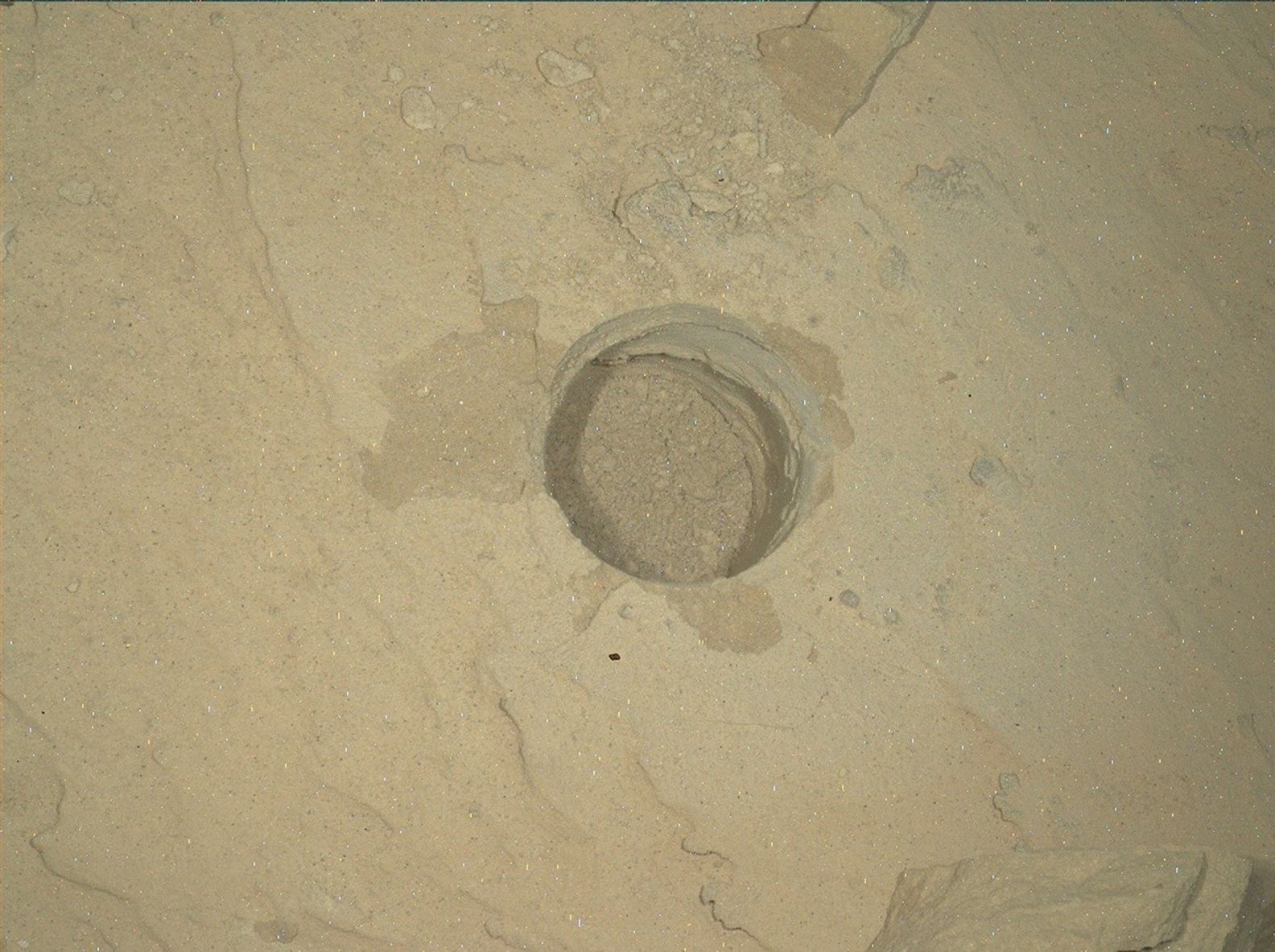
Curiosity Blog, Sols 4886-4892: Ingenuity and Perseverance, Curiosity Style NASA’s Mars rover Curiosity acquired this image showing an oblique view into the “Atacama” drill hole, where the rover’s drill was briefly lodged. Curiosity created the image using its Mars Hand Lens Imager (MAHLI), a close-up camera located on the turret at the end of the rover’s robotic arm, and an onboard focusing process that merges multiple images of the same target at different focus positions, creating a composite that brings as many features into focus as possible. Curiosity performed the focus merge on May 6, 2026 — Sol 4887, or Martian day 4,887 of the Mars Science Laboratory Mission — at 01:39:34 UTC. NASA/JPL-Caltech/MSSSWritten by Michelle Minitti, MAHLI Deputy Principal Investigator
Earth planning date: Friday, May 8, 2026
While we know the monikers Ingenuity and Perseverance are attached to our sister helicopter and rover on the Mars 2020 mission, those characteristics were in full force with Curiosity over the past week. The science we achieved this week was enabled by the ingenuity of the Curiosity engineers and scientists manifested in this extraordinary time lapse. It demonstrates the careful dance of arm motions employed — each one diligently planned by the team — to free Curiosity’s drill from the “Atacama” target. Watch the arm twist, bend, and turn with a rock slab attached, and be amazed.
The highest-priority activities after liberating the drill included imaging the drill with Mastcam and ChemCam RMI, and imaging into the now-empty drill hole with MAHLI (the image above). The science team made the most of the freshly-broken surfaces created when Atacama fell back to Mars, and the freshly-exposed sand once hidden underneath Atacama. ChemCam targeted one of the clean fracture faces with two LIBS rasters at “Tamarugal” and “Tamarugo,” and followed with another raster on a light-toned patch of bedrock formerly under Atacama at “Colchane.” MAHLI and APXS analyzed sand near Colchane at the target “Yerba Loca.” Beyond Atacama, Mastcam and ChemCam imaged the large buttes towering above our current and future drive paths. Mastcam also imaged two exposures of the polygonal fractures present in this area (targets “Cerro Elefantes” and “Azul Pampa”) and looked for wind-induced changes in the sand (“Playa los Metales”). ChemCam planned a passive spectroscopy observation of light-toned features on the “Paniri” butte and checked out a potential meteorite with a LIBS raster at “Isla Mocha.”
As engineering assessments continued, Curiosity drove uphill to study a contact between two different rock types, which can indicate a change in formation conditions, a break in time, or both. MAHLI, APXS, and ChemCam teamed up to study both rock types at the lighter-toned, layered “Toro” target and the darker, flaky “Inca de Oro” target. Mastcam planned multiple mosaics capturing different structures and transitions exposed along the contact. Across the plans during the week, REMS, RAD, and DAN regularly measured the environment above and below the rover, and Navcam and Mastcam teamed up to look for clouds, dust devils, and dust in the atmosphere.
With the health of the drill and arm confirmed by the engineers, Curiosity exhibited perseverance by heading toward a new workspace with a promising (larger) block for a new drill attempt. Our Martian exploration continues undaunted.
-
Want to read more posts from the Curiosity team?
-
Want to learn more about Curiosity’s science instruments?
Article
6 days ago
2 min read Curiosity Blog, Sols 4873-4878: Welcome to the Atacama Drill Target
Article
2 weeks ago
3 min read Curiosity Blog, Sols 4867-4872: Sand Fill In Antofagasta Crater and Finding Our Next Drill Target
Article
3 weeks ago
Keep Exploring Discover More Topics From NASA Mars
Mars is the fourth planet from the Sun, and the seventh largest. It’s the only planet we know of inhabited…
All Mars Resources
Explore this collection of Mars images, videos, resources, PDFs, and toolkits. Discover valuable content designed to inform, educate, and inspire,…
Rover Basics
Each robotic explorer sent to the Red Planet has its own unique capabilities driven by science. Many attributes of a…
Mars Exploration: Science Goals
The key to understanding the past, present or future potential for life on Mars can be found in NASA’s four…
NASA’s Curiosity Takes Close Look at Rock That Got Stuck on Drill
NASA/JPL-Caltech/MSSS Photojournal Navigation Downloads NASA’s Curiosity Takes Close Look at Rock That Got Stuck on Drill
PNG (20.94 MB)
Description
NASA’s Curiosity Mars rover used its Mast Camera, or Mastcam, to capture this view of a rock nicknamed “Atacama” on May 6, 2026, the 4,877th Martian day, or sol, of the mission. The rock had gotten stuck to the drill on the end of Curiosity’s robotic arm on April 25. Engineers spent several days repositioning the arm and vibrating the drill to try and get the rock loose, finally detaching the rock on May 1.
Atacama is estimated to be 1.5 feet in diameter at its base and 6 inches thick. It would weigh roughly 28.6 pounds (13 kilograms) on Earth (and about a third of that on Mars). The circular hole produced by Curiosity’s drill is visible in the rock.
This mosaic is made up of eight images that were stitched together after being sent back to Earth. The color has been approximately white-balanced to resemble how the scene would appear under daytime lighting conditions on Earth.
Curiosity was built by NASA’s Jet Propulsion Laboratory, which is managed by Caltech in Pasadena, California. JPL leads the mission on behalf of NASA’s Science Mission Directorate in Washington as part of NASA’s Mars Exploration Program portfolio. Malin Space Science Systems in San Diego built and operates Mastcam.
To learn more about Curiosity, visit:
science.nasa.gov/mission/msl-curiosity
Keep Exploring Discover More Topics From Photojournal
Photojournal
Search Photojournal
Photojournal’s Latest Content
Feedback
May 2026 Satellite Puzzler
- Earth
- Earth Observatory
- Image of the Day
- EO Explorer
- Topics
- More Content
- About
Nicholas Houghton: Engineering Crew Safety for NASA’s Artemis Missions
Nicholas Houghton always dreamed of working at NASA and one day becoming an astronaut. Today, he helps design systems that keep crews safe during missions aboard NASA’s Orion spacecraft, including the successful Artemis II mission around the Moon.
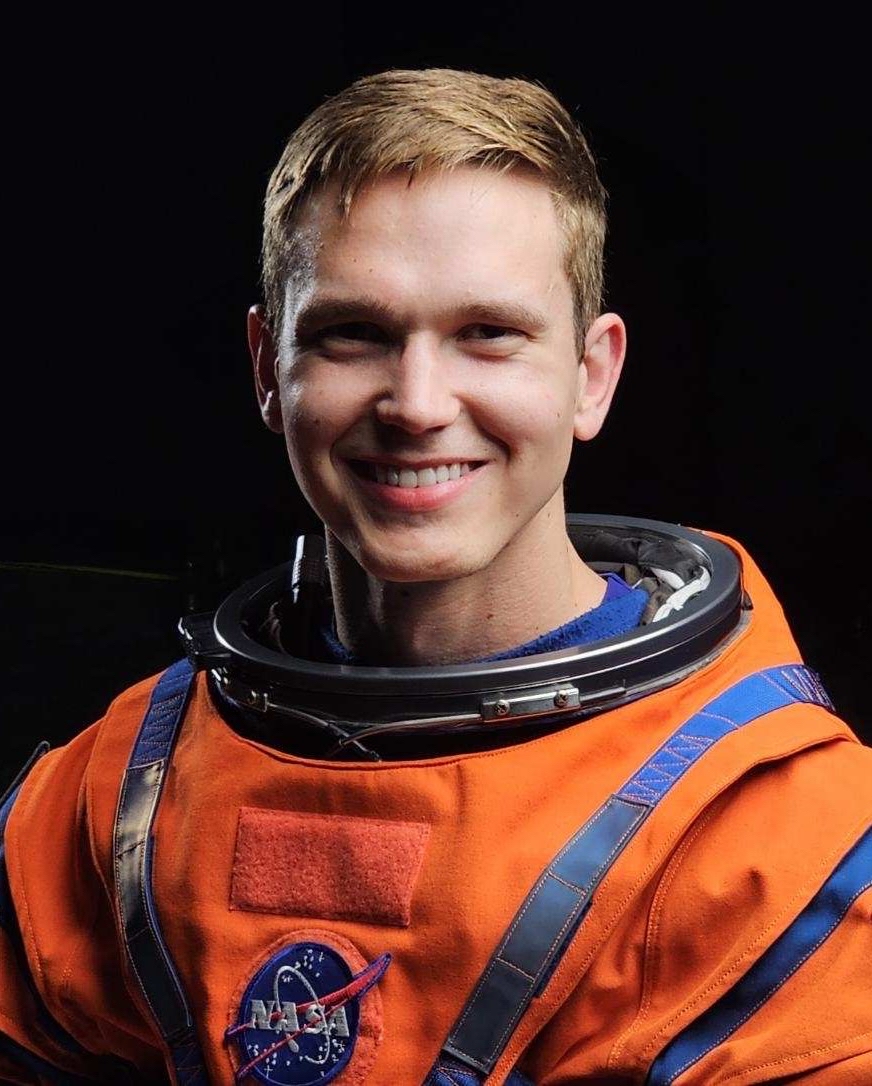
Nicholas Houghton in NASA’s Orion Crew Survival System Spacesuit. I hope someday people look back at Artemis and marvel at the technological achievement and collective dedication that it took to carry out these missions, just like we do now for Apollo.Nicholas Houghton
Orion Crew Survival Systems Engineer
After joining NASA as a Pathways intern, Houghton later became a full-time engineer on the Orion Crew Survival Systems (OCSS) team at NASA’s Johnson Space Center in Houston. The OCSS team designs and certifies the orange pressure suits that were worn by astronauts inside Orion during Artemis II, along with the survival hardware integrated into each suit system.
Houghton manages key pieces of flight hardware that keep crew members safe during contingency scenarios before launch, in flight, and after landing, including the Orion Crew Survival Kits, Suit-Worn Survival Suite, and Life Preserver Units. He guides each system from design through testing and final certification to ensure it performs as required in flight.
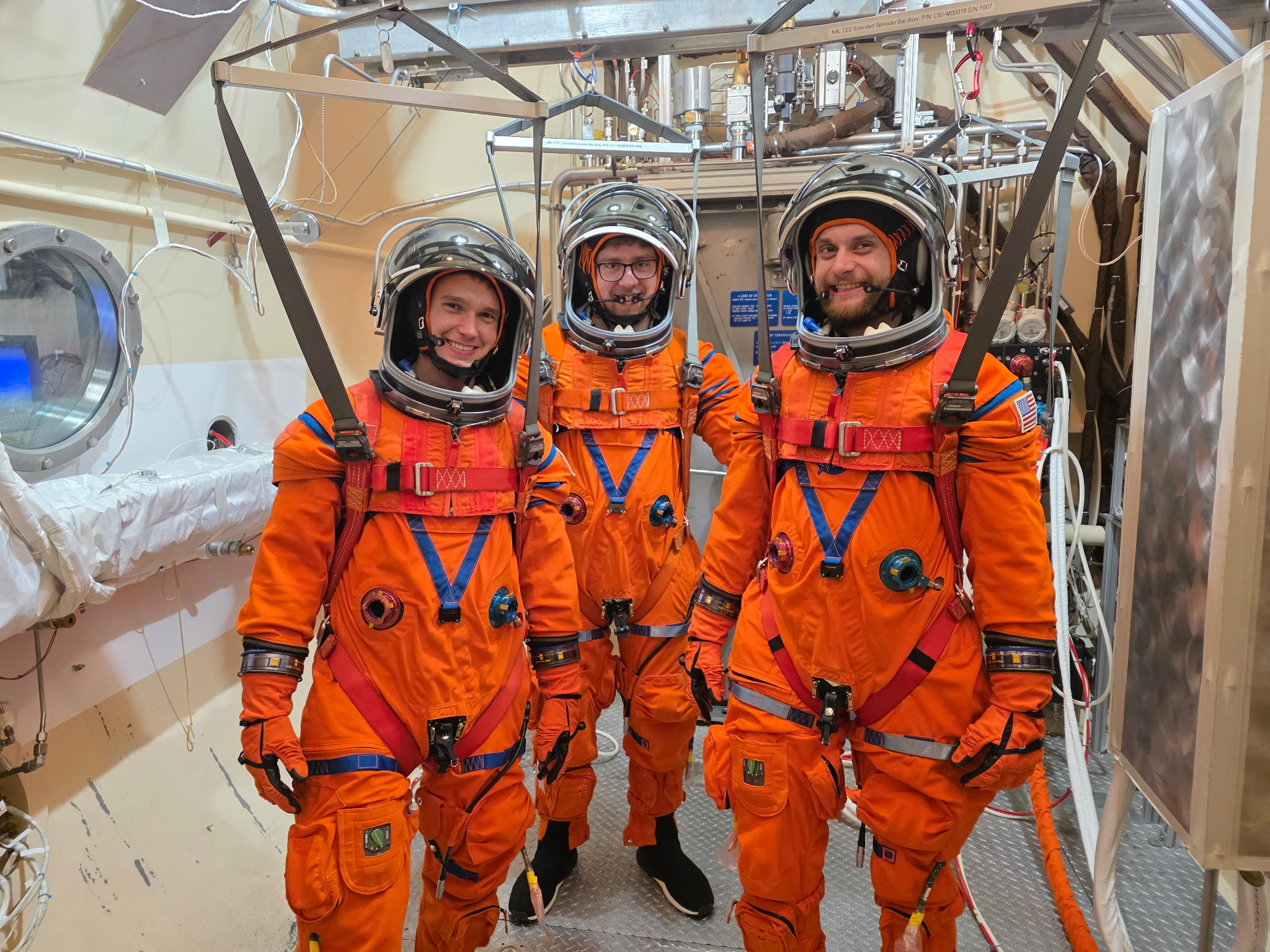
Nicholas Houghton, left, and two other suited subjects participate in Human Vacuum Chamber Testing at NASA’s Johnson Space Center to help certify Orion’s environmental control and life support system (ECLSS) for Artemis II. The test lasts about 12 hours while fully suited.Like many complex engineering efforts at NASA, the work relies on close collaboration across disciplines. Houghton works alongside experts in electromagnetic interference, radiation, stress and loads, and materials to evaluate and refine each system. He also helps lead development of water survival and post-landing hardware, writing manufacturing and assembly procedures and troubleshooting issues during integration and testing.
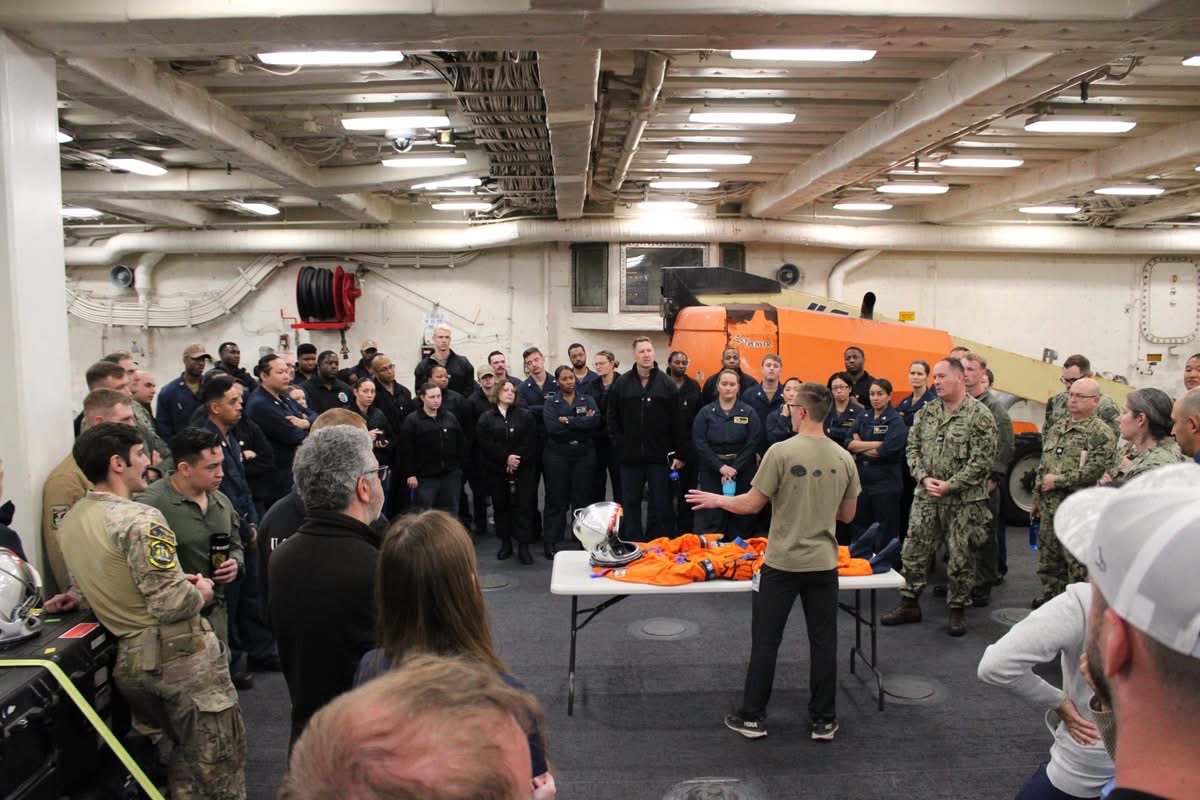
Nicholas Houghton gives U.S. Navy medical personnel space suit training aboard amphibious transport dock USS Somerset (LPD 25) during NASA Underway Recovery Test 12 in the Pacific Ocean, March 26, 2025.Beyond hardware development, Houghton prepares astronauts and recovery teams for real-world operations. He supports suit-up activities, helps train Department of Defense recovery forces, and participates in Underway Recovery Training alongside the U.S. Navy to rehearse post-splashdown operations.
Ground testing plays a critical role in that preparation. During these tests, systems are pushed to their limits to uncover potential issues before flight.
I have had my hardware fail during ground testing. It takes teamwork, quick thinking, technical understanding, and a willingness to dig into every detail to solve these kinds of problems.Nicholas Houghton
Orion Crew Survival Systems Engineer
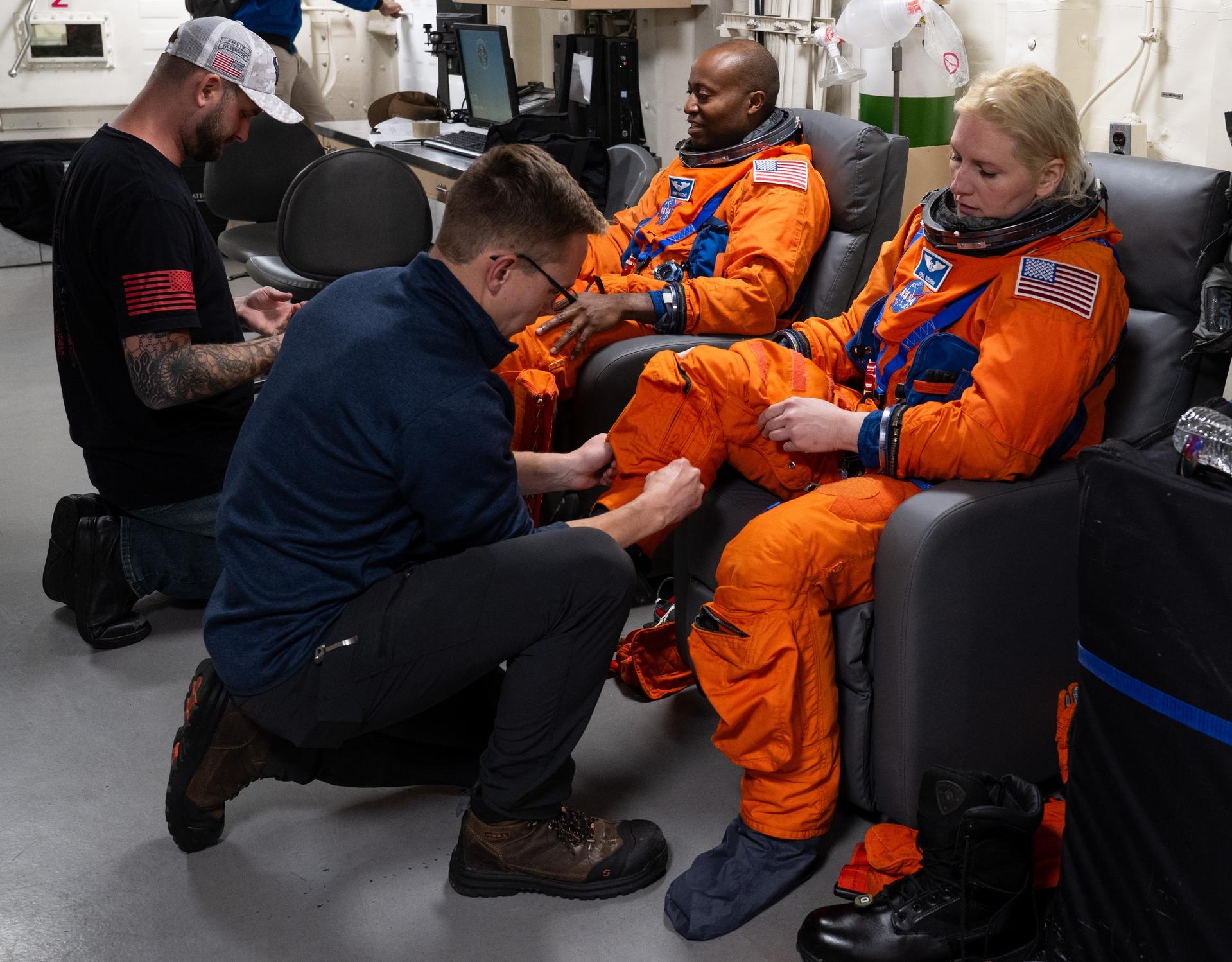
Nicholas Houghton, right, supports crew suit-up operations during Underway Recovery Training 12, an end-to-end practice recovery run conducted at sea to prepare for Artemis II.Outside of his NASA career, Houghton gives back by volunteering as a firefighter and emergency medical technician. “Serving my community is something that I have always been passionate about,” he said. “I am thankful to have the opportunity to support those around me.”
About the AuthorSumer Loggins Share Details Last Updated May 11, 2026 Related Terms Explore More 3 min read I Am Artemis: Kathleen Harmon Article 59 minutes ago 3 min read I Am Artemis: Anton Kiriwas Article 4 days ago 4 min read NASA Fuel Cell Tests Pave Way for Energy Storage on Moon Article 4 days ago Keep Exploring Discover More Topics From NASAMissions
Humans in Space
Climate Change
Solar System
NASA Invites Media to Annual Lunabotics Robotics Competition
NASA will hold its 2026 Lunabotics Challenge Tuesday, May 19, to Thursday, May 21, at the Astronauts Memorial Foundation’s Center for Space Education at the Kennedy Space Center Visitor Complex in Florida.
Links to view the Lunabotics competition live can be found on the agency’s Lunabotics page. The competition is slated to run between 8 a.m. and 6 p.m. each day.
Media are invited to attend the competition event on Wednesday, May 20, and should RSVP by 4 p.m. EDT on Monday, May 18, to the Kennedy newsroom at: ksc-newsroom@mail.nasa.gov.
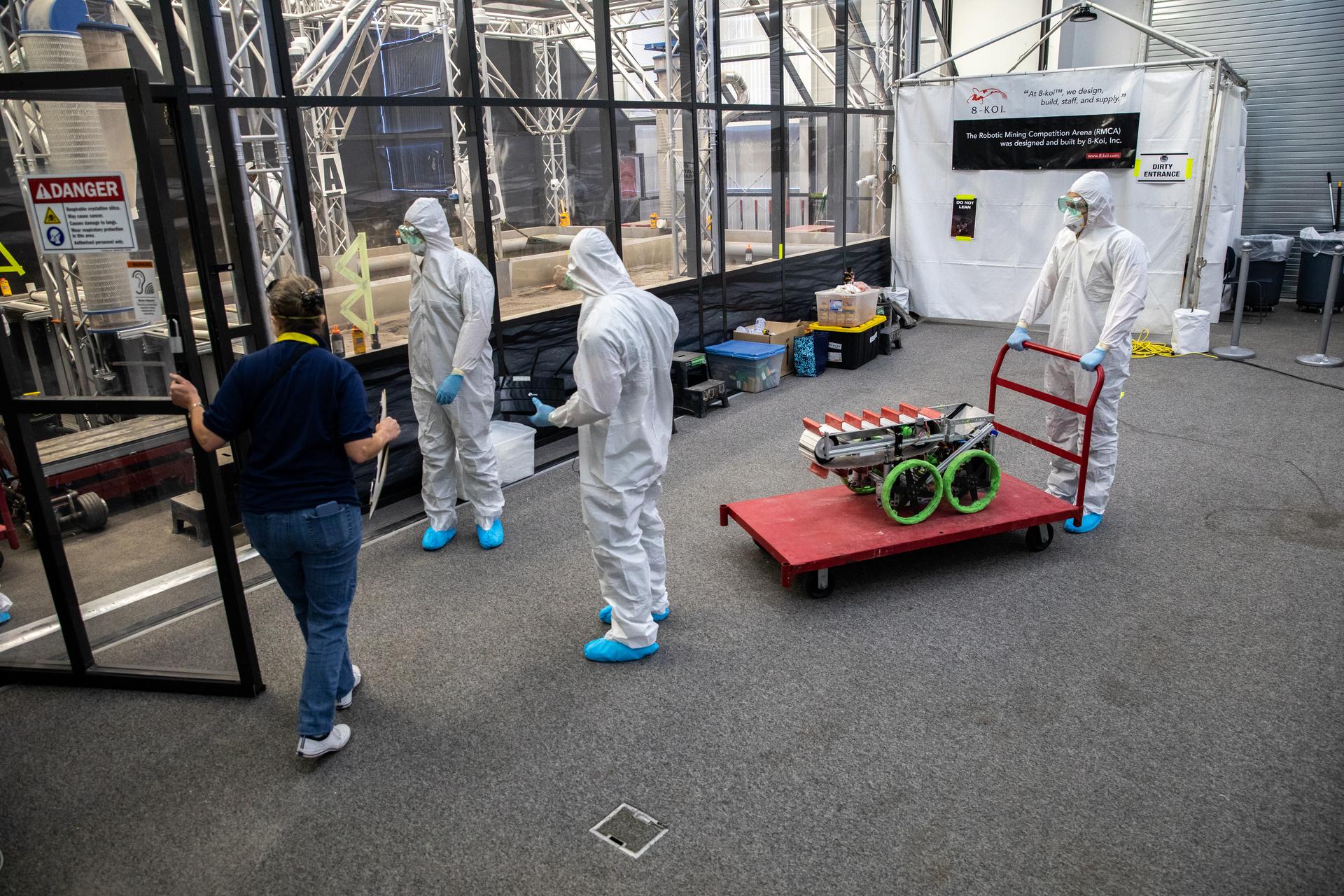
For this challenge, 50 college teams from across the country will convene to design, build, and operate their own lunar robot prototypes.
The teams’ self-driving rovers must be capable of building a berm, a protective barrier, from soil and other material simulating lunar regolith to safeguard Artemis infrastructure on the Moon. In space, such berms could protect equipment from debris during lunar landings and launches, shade cryogenic propellant tank farms, help shield a nuclear power plant from space radiation, and serve other purposes.
“The task of robotically building berm structures will be important for preparation and support of crewed lunar missions,” said Kurt Leucht, NASA software developer, In-Situ Resource Utilization researcher, and Lunabotics commentator located at Kennedy. “These competing teams are not only building critical engineering skills that will assist their future careers, but they are literally helping NASA prepare for our future Artemis missions to the Moon.”
NASA’s Lunabotics Challenge was established in 2010. As one of the agency’s Artemis Student Challenges, the competition is designed to engage and retain students in STEM fields by expanding opportunities for student research and design in science, technology, engineering, and mathematics.
For more competition information, visit:
https://www.nasa.gov/learning-resources/lunabotics-challenge
–end–
Amanda Griffin
Kennedy Space Center, Fla.
321-867-2468
amanda.griffin@nasa.gov
Joint Earth Observation Mission Quality Assessment Framework – Optical Guidelines Documents Released
- CSDA
- Commercial Data
- CSDA Vendors
- Program Activities
- Pilot Research Projects
- FAQs
- News
3 min read
Joint Earth Observation Mission Quality Assessment Framework – Optical Guidelines Documents Released Released on April 26, 2026, the Optical Guidelines document provides specific guidelines for the mission quality assessment of optical sensors as part of the implementation of the generic Earth observation mission quality assessment for the optical domain.NASA’s Commercial Satellite Data Acquisition (CSDA) program, in conjunction with the European Space Agency (ESA) and the U.S. Geological Survey (USGS), has released the Joint Earth Observation Mission Quality Assessment Framework – Optical Guidelines.
Released on April 26, 2026, the Optical Guidelines document provides specific guidelines for the mission quality assessment of optical sensors as part of the implementation of the generic Earth Observation (EO) mission quality assessment for the optical domain. This document summarizes the goals of the Joint Earth Observation Mission Quality Assessment Framework, reviews how optical mission quality is demonstrated through documentation, outlines guidelines for verifying that a mission’s data quality aligns with stated sensor performance, and provides appendices containing information on common radiometric and geometric calibration and validation practices.
“The release of these joint guidelines for EO data from optical missions both documents the rigorous standards we have for commercial data and bolsters the confidence of the user community in the CSDA’s commercial data acquisitions,” said CSDA Project Manager Dana Ostrenga. “By releasing this document to the public, we’re giving end-users the opportunity to review the approach for verifying whether the quality of commercial EO data is consistent with the stated performance of the mission.”
The Joint Earth Observation Mission Quality Assessment Framework was produced as part of an ESA and NASA partnership supporting Earthnet Data Assessment Project (EDAP) and CSDA activities, the document details the methodology used to assess the quality of data from commercial satellite data providers. This framework provides standardized, transparent, and repeatable data quality assessment processes and outputs to support mission selection, data integration, and the trusted use of commercial EO data for science and applications. Furthermore, the agencies intend to update the guidelines in step with the evolution of the market and the advancement of Earth sciences and applications of EO data products.
About the Joint EO Mission Quality Assessment FrameworkThe expanding range of applications for EO data products and the availability of low-cost launch services have resulted in a growing number of commercial EO satellite systems. This growth in the marketplace has prompted space agencies like NASA, ESA, and others to explore the acquisition of commercial EO data products and their potential to complement the capabilities and services currently available for scientific and operational purposes.
To ensure that decisions regarding the acquisition of commercial data can be made with confidence, ESA, NASA, and other stakeholders agreed there was a need for an objective framework to assess the quality of data from commercial sources. To that end, ESA established the EDAP, which performs early assessments of EO mission data to evaluate their quality and the potential integration of these missions as third-party missions within ESA’s Earthnet program. The development of EDAP led to the Joint Earth Observation Mission Quality Assessment Framework, which was later customized for the different types of sensors used in atmospheric, synthetic aperture radar, thermal infrared, and now, optical EO missions.
This joint framework serves as the foundation for the CSDA program’s comprehensive evaluation process to ensure the quality of commercial EO data. The process focuses on assessing geometric and radiometric quality, validating data against trusted reference datasets, ensuring completeness and traceability of dataset documentation, and evaluating data accessibility and utility. Together, these rigorous evaluation efforts help build trust in commercial partnerships, ensure scientific integrity and interoperability, and foster innovation within the EO community.
Share Details Last Updated May 12, 2026 Related Terms Explore More 3 min read Ahuachapán and Its Restive NeighborsFrom a geothermal hotspot to the one-time “Lighthouse of the Pacific,” the heat is on…
Article
1 week ago
5 min read Record-Setting Retreat of Hektoria Glacier
Scientists relied on satellite data to understand how the Antarctic glacier lost so much ice…
Article
1 week ago
3 min read Fiery Fall Color in Southern Chile
The beech forests of southern Patagonia put on vibrant autumn displays.
Article
2 weeks ago
Keep Exploring Discover Related Topics
Missions
Humans in Space
Climate Change
Solar System
Hubble Survey Sets Up Roman’s Future Look Near Milky Way’s Center
- Home
- About Roman
- Science Overview
- Observatory
- For Scientists
- News
- Multimedia
7 min read
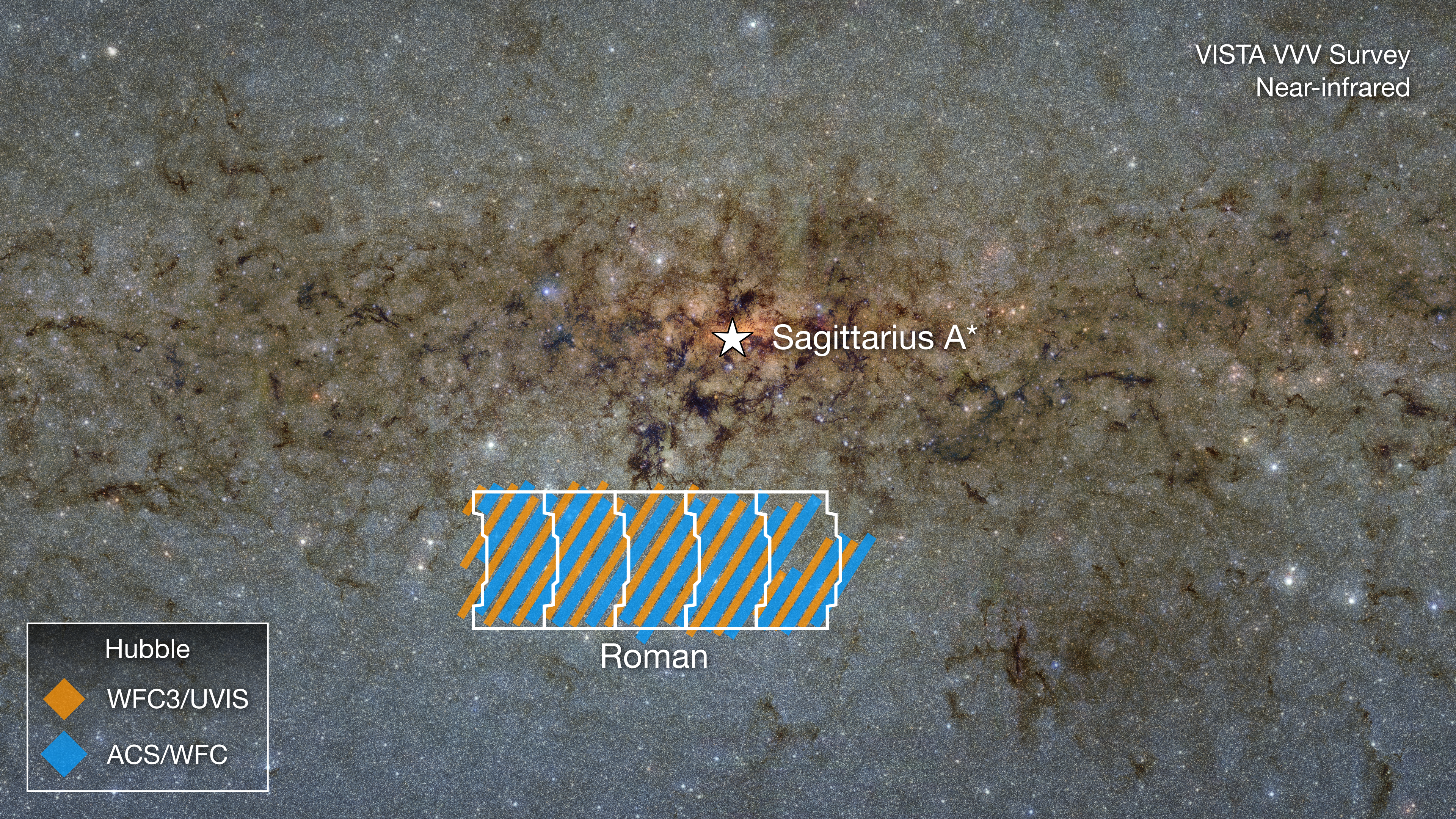
Hubble Survey Sets Up Roman’s Future Look Near Milky Way’s Center This VISTA VVV Survey image shows the galactic bulge near Sagittarius A*, the supermassive black hole at the Milky Way’s center. A region planned for observation by NASA’s Nancy Grace Roman Space Telescope is outlined. This area has been observed by NASA’s Hubble Space Telescope. Image: NASA, Alyssa Pagan (STScI); Acknowledgment: VISTA, Dante Minniti (UNAB), Ignacio Toledo (ALMA), Martin Kornmesser (ESO)The Milky Way’s galactic bulge, the bulbous region that surrounds the galactic center, contains a dense collection of stars, planets, and other free-floating objects. This region has been studied for decades with numerous ground-based and space-based telescopes, including NASA’s Hubble and James Webb space telescopes. Soon, NASA’s Nancy Grace Roman Space Telescope will be the first to make studying the galactic bulge a part of its core science objectives, building on the data collected from all observatories before it. Roman’s field of view will cover more area at a far faster cadence than previous space telescopes, allowing it to survey millions of stars and find thousands of new exoplanets.
To support Roman in characterizing numerous stars and planets, astronomers sought to use Hubble to observe many of the same areas of the galactic bulge that Roman will observe in its core Galactic Bulge Time-Domain Survey. By comparing Hubble data taken months or years earlier to new Roman data, astronomers will be better able to interpret Roman’s forthcoming observations. The Roman telescope team is targeting as soon as early September 2026 for launch.
“A top priority of our Hubble survey is to cover as much sky area as possible,” said Sean Terry, project lead and assistant research scientist from the University of Maryland, College Park and NASA’s Goddard Space Flight Center in Greenbelt.
A paper about the team’s work published May 11, 2026 in the Astrophysical Journal.
‘Small’ lenses, large discoveriesMany planetary systems within the Milky Way evolve much like our solar system did, beginning with the collapse of a cosmic gas cloud, the growth of a star, and the formation of surrounding planets. However, in some systems, different events can result in a planet being ejected from the system where it formed. Hundreds of these “rogue planets” will be detected by Roman’s Galactic Bulge Time-Domain Survey, in addition to previously unseen, isolated neutron stars, and even black holes with masses similar to our Sun.
This survey consists of six 72-day observing seasons during which Roman will take a snapshot every 12 minutes of a large portion of the bulge (approximately 1.7 square degrees of the region, or the area of 8.5 full moons). While it will detect a variety of targets, the survey is optimized to look for a specific type of event known as microlensing.
Microlensing events, a type of gravitational lensing event, occur when the light from a more distant object is warped by the mass of a closer object along the line of sight. These events occur on a much smaller scale than larger lensing events (on the order of individual stars instead of galaxies or galaxy clusters) and allow us to search for exoplanets between us and the densely packed stars within the galactic bulge.
“The great thing about microlensing is that we’ll be able to do a complete census of objects as small as Mars that are moving between us and these fields in the bulge, no matter what it is,” said co-author Jay Anderson of the Space Telescope Science Institute in Baltimore.
For Roman, from HubbleWhen a telescope observes a lensing object, such as a bright star, aligning with a star in the galactic bulge, it can be difficult for astronomers to decipher which of the two the starlight comes from. Therefore, timing is a key consideration. If astronomers can identify light sources separately before a microlensing event occurs, it becomes far easier to disentangle them.
To collect this pre-Roman data, astronomers used the Hubble Space Telescope to conduct a large-scale survey, which began in the spring of 2025, covering much of the same area that Roman will observe in the Galactic Bulge Time-Domain Survey. The size of this program is even larger than two previous surveys (each around 0.5 square degrees) that led to Hubble’s largest mosaic, that of our neighboring Andromeda galaxy, which took over 10 years to assemble.
“The main goal of these observations is to be able to identify objects that participate in lensing events during the Roman survey, catching them before they undergo the lensing event,” said Anderson. “When, in a couple of years, an event happens during Roman’s long stare at the field, we can go back and say, ‘This was a red star, this was a blue star, and the event happened when the red star went in front of the blue star.’”
The data from Hubble also will help shape the analysis of the lensing objects themselves. The microlensing event itself measures only a ratio of the masses of a host star and its planet. With data from stars before or after their microlensing events, however, scientists would be able to measure the stars’ individual masses, echoing the way Hubble previously determined the mass of a star and its planet in the Milky Way. This method turns a more opaque measurement of the relationship between a star and its planet into one far more certain.
“Instead of estimating a mass ratio of a planet that’s orbiting a star, we can say that we’re confident it’s a Saturn-mass planet orbiting a star that’s 0.8 solar masses, for example,” Terry said. “So with the help of precursor imaging from Hubble you can hope to get direct measurements of the masses as opposed to indirect mass ratios.”
Next leap in magnitudeWhile exoplanet discovery is a large part of Roman’s Galactic Bulge Time-Domain Survey, observing such a large area with Hubble also can help identify areas of extinction, dense pockets of dust and gas that absorb or scatter light, allowing us to create maps detailing where we can see stars and where we can’t.
Hubble’s survey also has provided the crucial beginning of a brand-new catalog of stars, which will help astronomers characterize the host stars of exoplanets discovered by Roman. The research team predicts Roman will add to Hubble’s star catalog by an order of magnitude.
“This Hubble survey will build a catalog of 20 to 30 million point sources,” said Terry. “But, by the end of the Galactic Bulge Time-Domain Survey, Roman may measure about 200 to 300 million, and it will produce, essentially, some of the deepest images ever taken of any part of the sky.”
The data from the most recent Hubble survey is available in the Mikulski Archive for Space Telescopes.
The Hubble Space Telescope has been operating for over three decades and continues to make ground-breaking discoveries that shape our fundamental understanding of the universe. Hubble is a project of international cooperation between NASA and ESA (European Space Agency). NASA Goddard manages the telescope and mission operations. Lockheed Martin Space, based in Denver, also supports mission operations at Goddard. The Space Telescope Science Institute in Baltimore, which is operated by the Association of Universities for Research in Astronomy, conducts Hubble science operations for NASA.
The Nancy Grace Roman Space Telescope is managed at NASA Goddard with participation by NASA’s Jet Propulsion Laboratory in Southern California; Caltech/IPAC in Pasadena, California; the Space Telescope Science Institute; and a science team comprising scientists from various research institutions. The primary industrial partners are BAE Systems, Inc. in Boulder, Colorado; L3Harris Technologies in Melbourne, Florida; and Teledyne Scientific & Imaging in Thousand Oaks, California.
Related Images & Videos Hubble/Roman Galactic Bulge Survey Region (VISTA VVV Survey)This VISTA VVV Survey image shows the galactic bulge near Sagittarius A*, the supermassive black hole at the Milky Way’s center. A region planned for observation by NASA’s Nancy Grace Roman Space Telescope is outlined. This area has been observed by NASA’s Hubble Space Telescope.
Microlensing Event at OGLE-2013-BLG-0341 (Hubble Image)
A follow-up observation by NASA’s Hubble Space Telescope shows a region containing a microlensing event captured by the Optical Gravitational Lensing Experiment (OGLE) in 2013. Hubble was able to separate the foreground lens from the background star.
Microlensing Infographic
This graphic illustrates a microlensing event, which occurs when the light from a distant object warps as a mass, such as a foreground star, precisely aligns in front of that object. This causes the more distant background star to increase in apparent brightness.
Zoom Into the Milky Way’s Galactic Bulge – Hubble/Roman Survey Regions
This video shows a zoom into the Milky Way’s galactic bulge near the galactic center. As it zooms in, the view changes from the near-infrared 2MASS survey to the VISTA VVV survey (both ground-based).
Claire Andreoli
NASA’s Goddard Space Flight Center
Greenbelt, Maryland
claire.andreoli@nasa.gov
Matthew Brown, Christine Pulliam
Space Telescope Science Institute
Baltimore, Maryland
Keep Exploring Discover More Topics From NASA Hubble Space Telescope
Since its 1990 launch, the Hubble Space Telescope has changed our fundamental understanding of the universe.
About Roman
Hubble Images
Cosmology with the Nancy Grace Roman Space Telescope