NASA - Breaking News

Hubble Captures Star-Studded Cluster
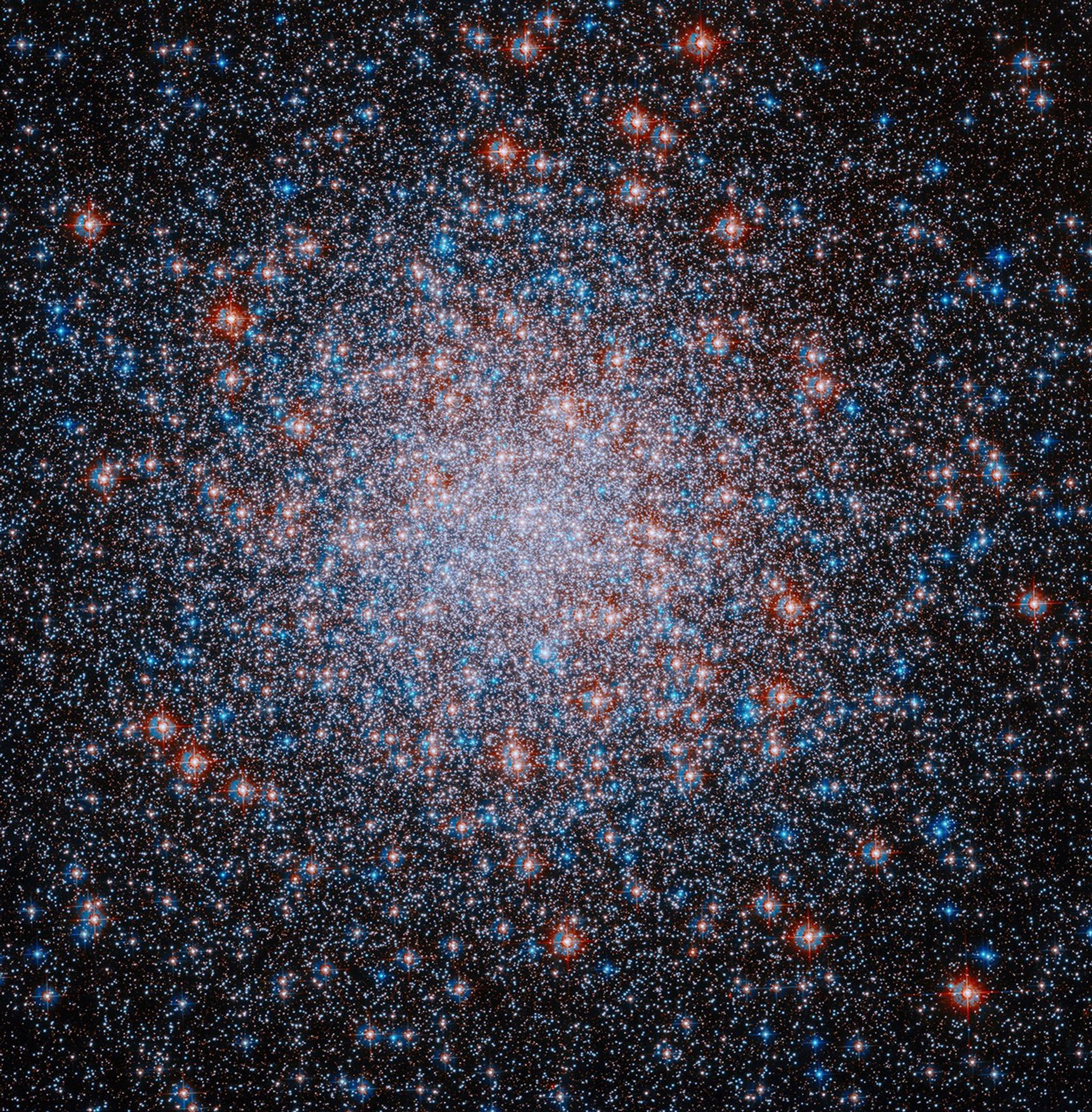
This image from NASA’s Hubble Space Telescope showcases Messier 3 (M3), one of the Milky Way galaxy’s most massive globular clusters, or spherical collections of gravitationally bound stars. Globular clusters are made up of ancient stars that formed at roughly the same time from the same cloud of gas, giving those stars similar ages. Around 150 known globular clusters are sprinkled around the outer regions of the Milky Way.
Image credit: NASA, ESA, and A. Sarajedini (Florida Atlantic University); Processing: Gladys Kober (NASA/Catholic University of America)
Cottonwood Fire Chars Utah
- Earth
- Earth Observatory
- Image of the Day
- EO Explorer
- Topics
- More Content
- About
NASA Transfers ‘Hundred Acre Wood’ to Patuxent Research Refuge
NASA ceremonially transferred ownership of about 105 acres of wooded land at its Goddard Space Flight Center’s Greenbelt, Maryland, campus Tuesday to the adjoining Patuxent Research Refuge, managed by the U.S. Fish and Wildlife Service.
The property, formerly known as NASA Goddard’s Area 400, is now part of the largest block of unfragmented forest between Washington and Baltimore. The nearly 13,000-acre woodland is the nation’s only refuge specifically established to support wildlife research. The refuge also supports recreational uses, such as walking, biking, horseback riding, fishing, and hunting.
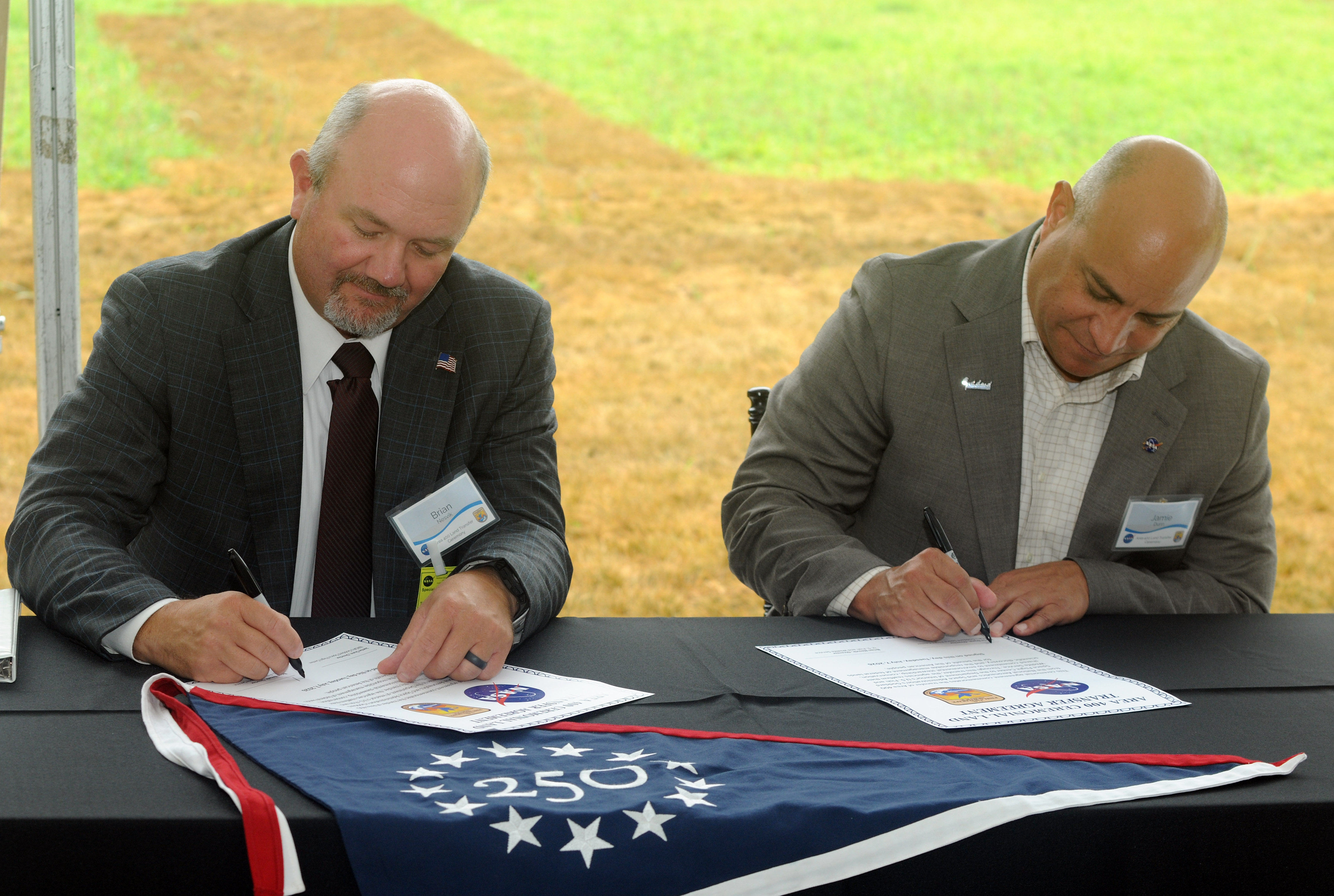
At a ceremony on July 7, 2026, U.S. Fish and Wildlife Service Director Brian Nesvik (left) and Jamie Dunn, center director, NASA’s Goddard Space Flight Center, Greenbelt, Md., sign certificates that ceremonially transfer a 105-acre parcel of property known as “Area 400” from NASA Goddard to the Service.NASA“For over six decades, NASA Goddard has helped shape humanity’s understanding of Earth,” said Jamie Dunn, center director, NASA Goddard. “We’re glad to present this land to our colleagues in the Fish and Wildlife Service, whose conservation and research helps do the real legwork in preserving our Blue Marble for future generations.”
NASA Goddard had used Area 400 for propellant research beginning in the 1960s. That work has largely since shifted to NASA facilities in other states or to commercial providers, and the property had long been a candidate for divestment. NASA and the Service began discussing a potential transfer in 2021.
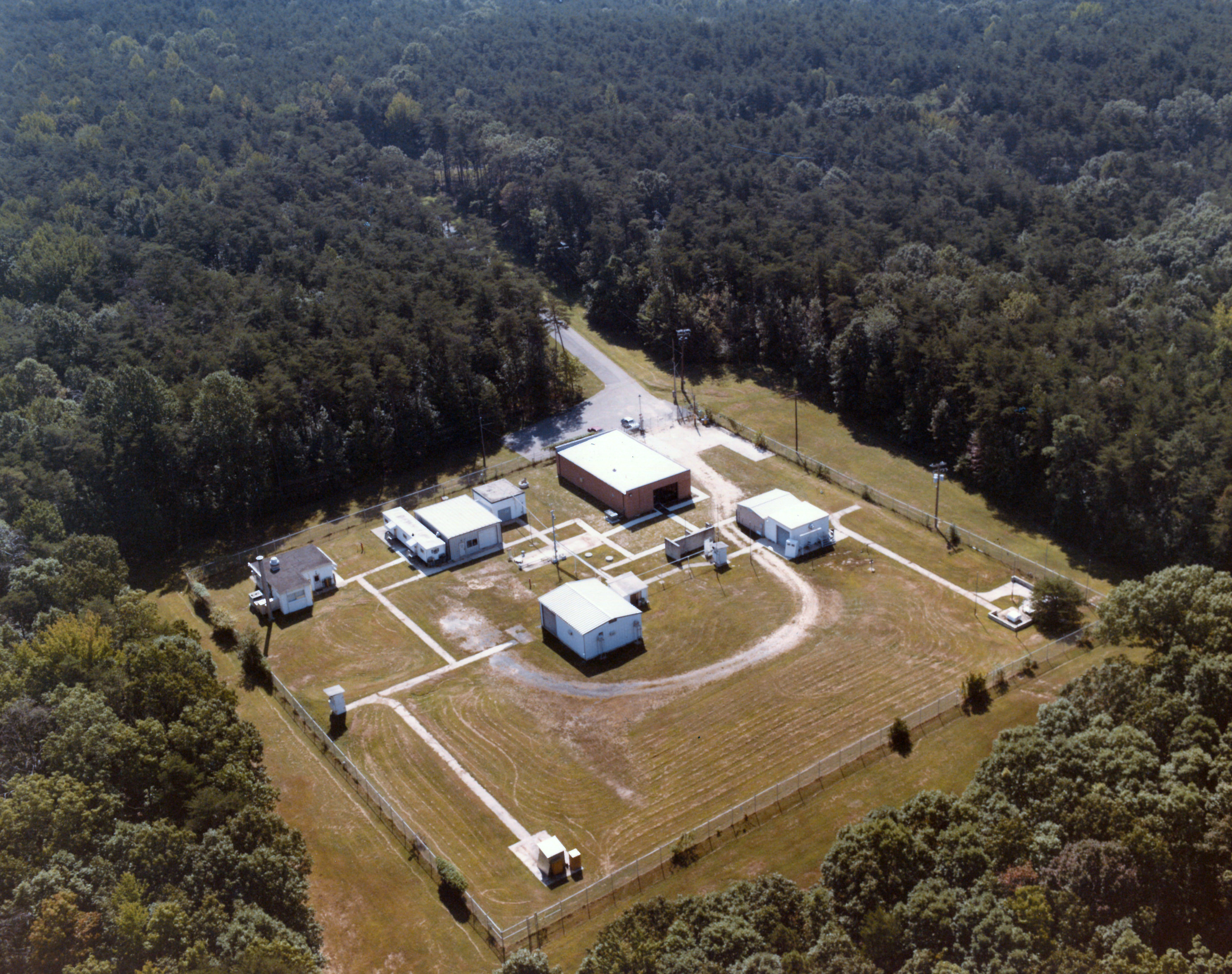
Following remarks from attending dignitaries and the signing ceremony, assembled guests participated in a monarch butterfly release and milkweed seed dispersal.NASAPrior to the transfer, Area 400 was still almost entirely wooded aside from a two-and-a-half-acre clearing with 11 small structures. The interagency transfer was effective on Feb. 23, and NASA recently completed its final closeout activities at the property, deconstructing the buildings, roadway, and utility service.
This aerial photograph shows Area 400’s appearance in 1984. The surrounding forest has remained largely unchanged since NASA Goddard occupied the property in the 1960s.NASA“Through working with partners on the best use of land, as exemplified with this land transfer, we can continue to conserve America’s natural beauty and expand outdoor recreation opportunities for future generations,” said U.S. Fish and Wildlife Service Director Brian Nesvik.
Media contacts:
Rob Garner
News Chief, Office of Communications
NASA’s Goddard Space Flight Center
Keith Shannon
Regional Communications Lead – U.S. Fish and Wildlife Service Northeast Region
U.S. Department of the Interior
NASA’s New Horizons Spacecraft Wakes from Hibernation in Good Health
3 min read
NASA’s New Horizons Spacecraft Wakes from Hibernation in Good HealthFollowing its longest hibernation period ever of nearly a year, NASA’s New Horizons spacecraft has emerged in good health and is ready to begin transmitting science data gathered in the distant Kuiper Belt far beyond Pluto.
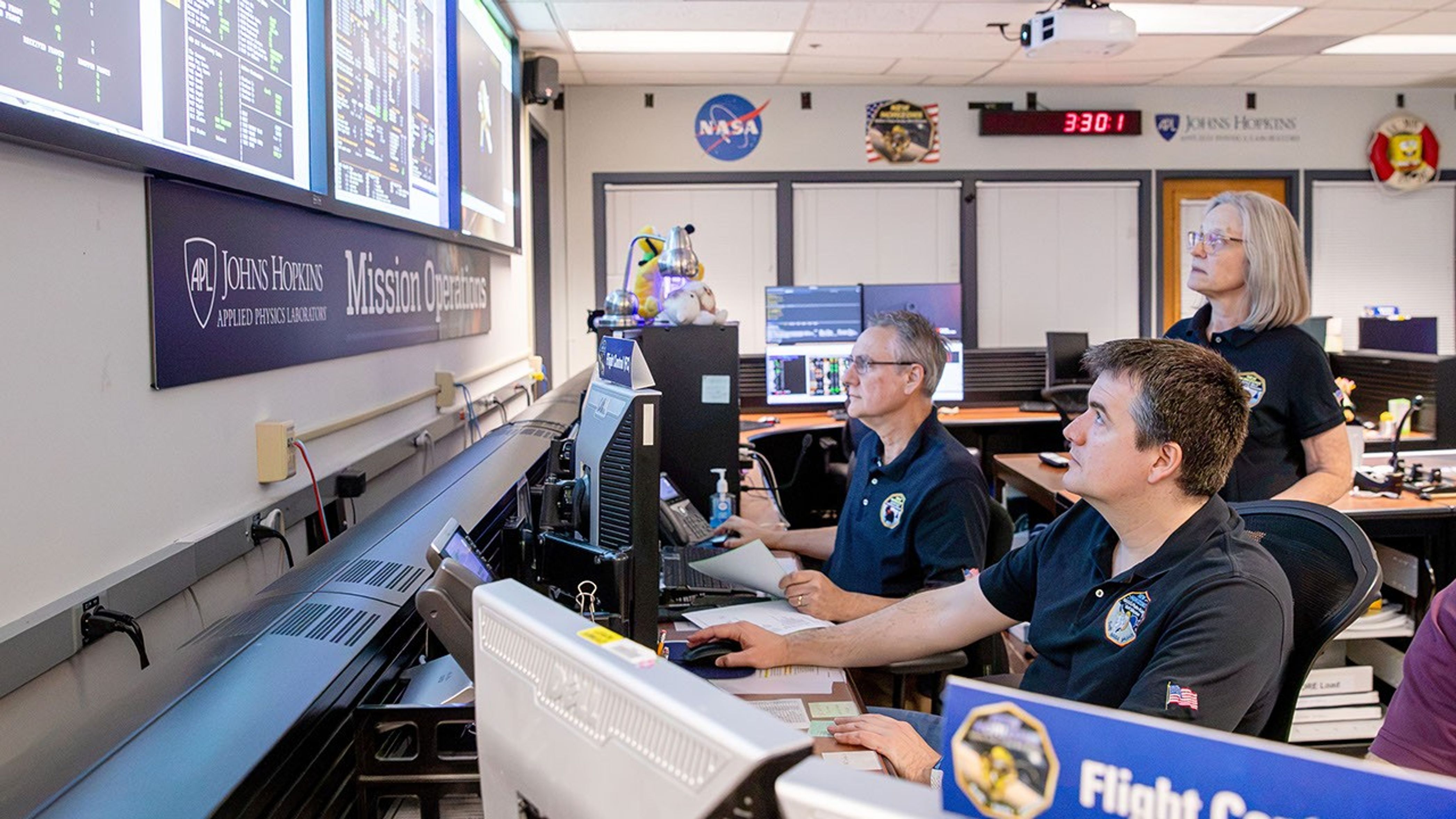
From left, flight controllers Mark Lahr and Josh Albers, and Mission Operations Manager Alice Bowman, monitor telemetry streaming from NASA’s New Horizons spacecraft to the mission operations center at the Johns Hopkins Applied Physics Laboratory in Laurel, Maryland, on June 24, 2026. Now approximately 5.9 billion miles (9.5 billion kilometers) from Earth, New Horizons is ready to begin transmitting science data after being awakened from its longest ever, nearly yearlong hibernation period. NASA/Johns Hopkins APL/SwRI/Justin GladdenOn June 23, flight controllers at the Johns Hopkins Applied Physics Laboratory (APL) in Laurel, Maryland, confirmed New Horizons, acting on stored commands uplinked to its main computer last July, had safely awakened from a 321‑day hibernation period that began Aug. 7. With the spacecraft now approximately 5.9 billion miles (9.5 billion kilometers) from Earth, the radio signals carrying that confirmation took about 8 hours and 52 minutes to reach the APL Mission Operations Center via NASA’s Deep Space Network station near Madrid, Spain.
The mission team typically places New Horizons in resource‑saving hibernation mode during long cruise periods. While the spacecraft is hibernating, operators do not send commands or retrieve data, but the spacecraft continues gathering and storing data around the clock from its heliospheric plasma sensors, Solar Wind at Pluto and the Pluto Energetic Particle Spectrometer Science Investigation, as well as its space dust detector, the Venetia Burney Student Dust Counter.
Alice Bowman, the New Horizons mission operations manager at APL, said the spacecraft reported back to Earth, via the Deep Space Network, with a weekly status beacon. “Every status report through this hibernation period was ‘green,’ meaning all was well aboard New Horizons each and every week,” she said.
As New Horizons resumes active operations, Bowman noted, the team will begin downlinking spacecraft health and safety data, followed by data from the three scientific instruments. In about three weeks, the spacecraft’s onboard Alice ultraviolet spectrograph will look at the hydrogen gas distribution in the outer heliosphere, while the Solar Wind at Pluto, the Pluto Energetic Particle Spectrometer Science Investigation, and the Venetia Burney Student Dust Counter instruments continue their measurements, and the ground team conducts a series of spacecraft and instrument checkouts.
The team also is completing upgrades to the ground‑system software that will make it easier to maintain operations of the spacecraft. Tests are already underway and are expected to continue through the year.
New Horizons is operating on updated autonomy logic designed for operations farther from the Sun and to accommodate the expected reduction in power and the naturally occurring increase in radio‑signal travel time.
The NASA spacecraft’s exploration of this distant region of the solar system marks the latest step in a journey that began in January 2006 with the fastest launch on record; a flyby of Jupiter in February 2007 that included stunning views of the gas giant and its moons; the first exploration through the Pluto system in July 2015; the first exploration of a Kuiper Belt object, Arrokoth, in January 2019, and unique studies of the Sun’s outer heliosphere and dozens of additional Kuiper Belt objects since then.
For more information on NASA’s New Horizons mission, visit:
https://science.nasa.gov/mission/new-horizons/
Keep Exploring Discover More Topics From NASA
New Horizons
Kuiper Belt
Asteroids, Comets & Meteors
Our Solar System
Artemis II Crew and Apollo 14 Moon Tree
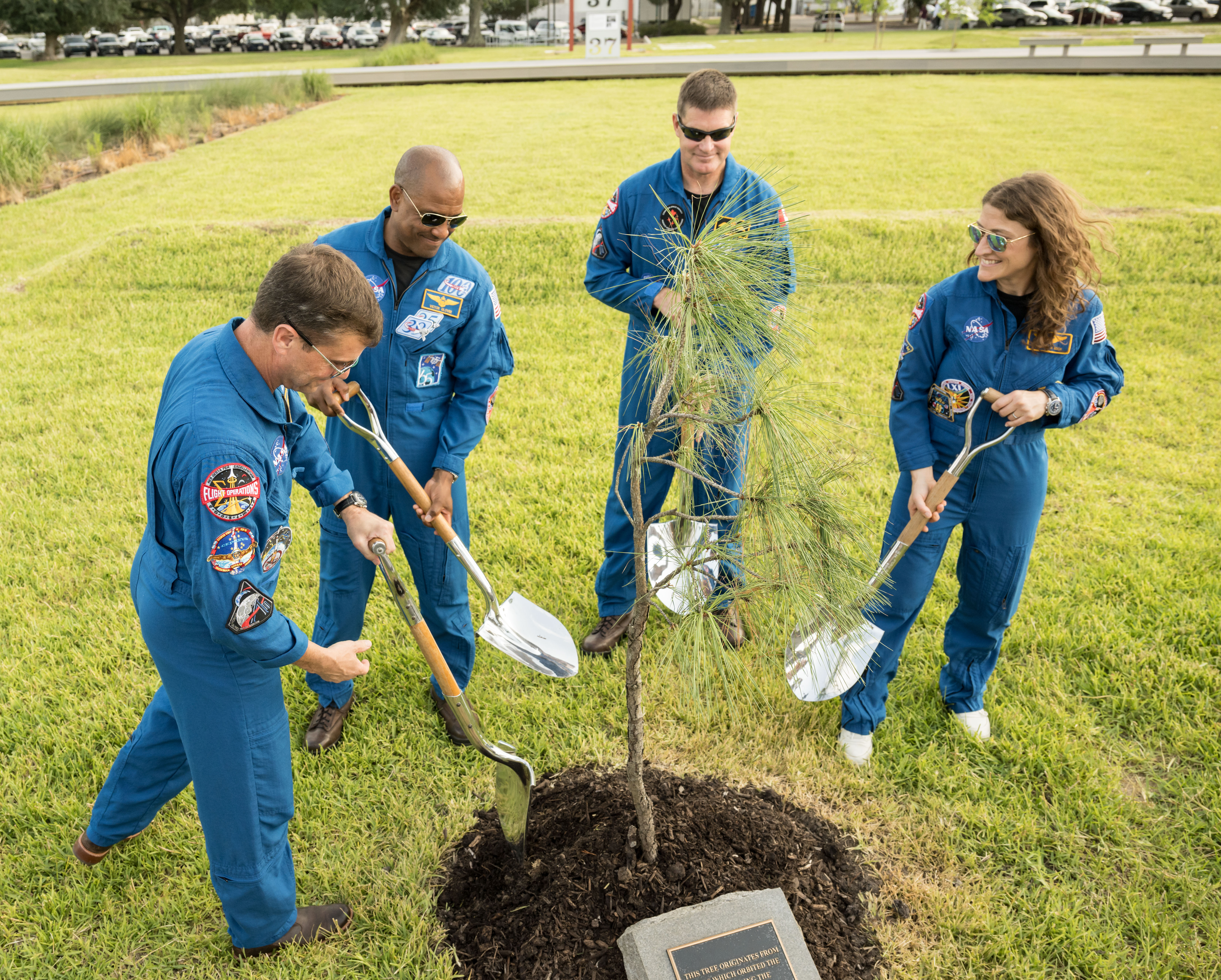
In this photograph, the Artemis II crew participates in the dedication of the Apollo 14 Moon tree at the Lunar Receiving Park at NASA’s Johnson Space Center on June 25, 2026. This tree is a second-generation Apollo Moon tree of the loblolly pine species. The original Apollo Moon trees were grown from seeds carried aboard Apollo 14 by NASA astronaut Stuart Roosa, a former U.S. Forest Service smoke jumper. Upon return to Earth, the seeds were germinated by the Forest Service, and the resulting seedlings were planted throughout the United States and around the world.
Image credit: NASA/James Blair
July 2026 Satellite Puzzler
- Earth
- Earth Observatory
- Image of the Day
- EO Explorer
- Topics
- More Content
- About
The World Cup From 250 Miles Up
- Earth
- Earth Observatory
- Image of the Day
- EO Explorer
- Topics
- More Content
- About
NASA Takes Flight For America’s 250th
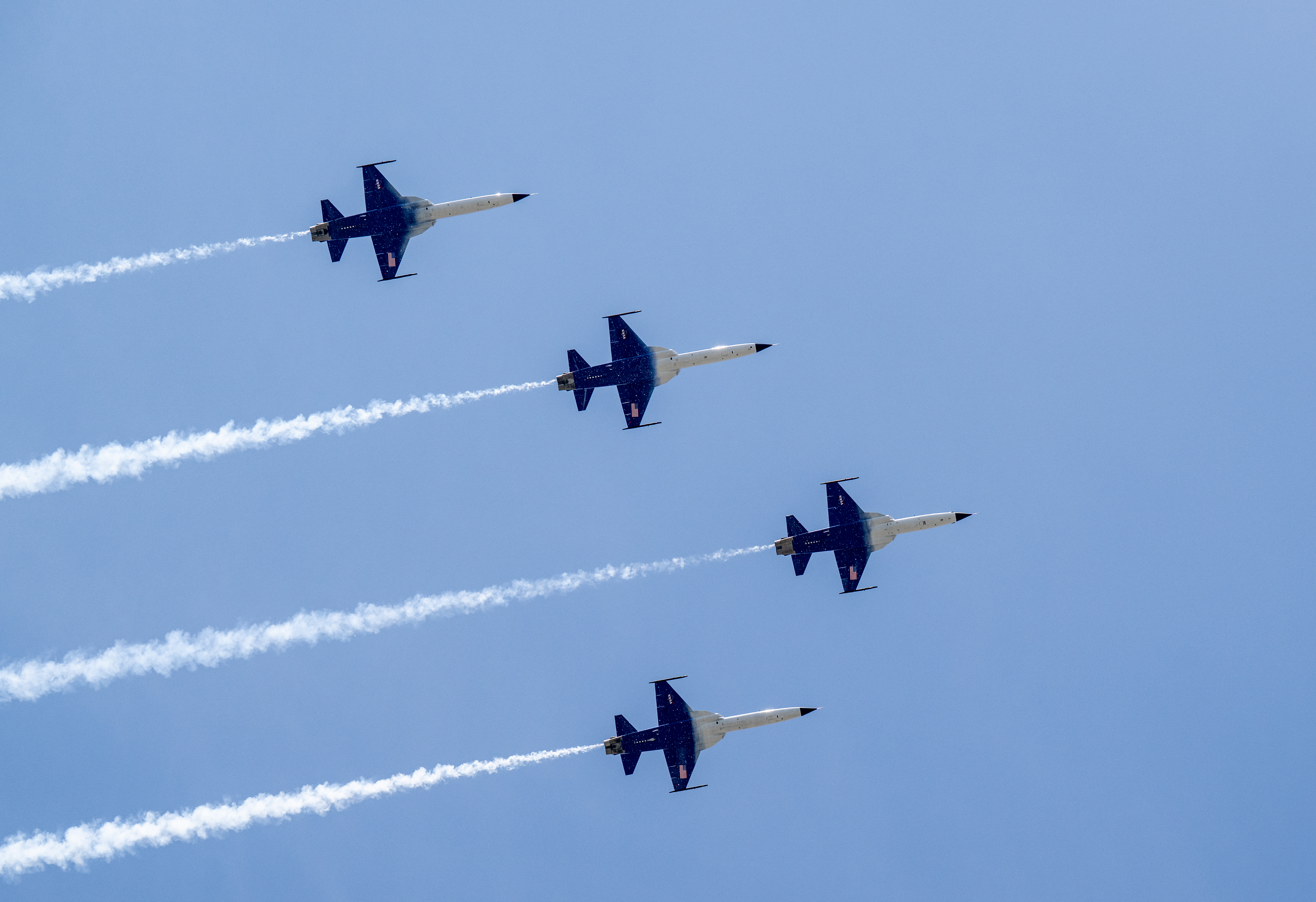
NASA Administrator Jared Isaacman leads a flyover featuring his personally owned Northrop F-5 Tiger during the Great American State Fair on July 4, 2026, on the National Mall in Washington, D.C.
For 250 years, America has pushed the boundaries of what’s possible. From the earliest days of exploration, to the first steps on the Moon and the missions shaping our future, NASA represents the spirit of discovery that defines our nation.
As the United States celebrates its semiquincentennial, Freedom 250 highlights how innovation, courage, and scientific leadership have carried America forward — and how NASA continues to expand the frontier for the next generation.
NASA Seeks Industry Input on Second Phase of Commercial Space Stations
On Monday, NASA released a draft Request for Proposals (RFP) seeking feedback from American companies on the next phase of its commercial space stations strategy, aimed at ensuring a seamless transition of activities in low Earth orbit from the International Space Station.
“NASA’s review reflects what we’ve been hearing from industry throughout this process. Industry believes it can meet the timelines and that a viable commercial marketplace exists where NASA is one customer among many,” said NASA Administrator Jared Isaacman. “We’re focused on supporting those efforts, enabling the capabilities that make this transition possible, and doing all we can to ensure the United States maintains a continuous human presence in low Earth orbit.”
The draft RFP builds on the agency’s request for information released March 25. Based on industry’s input, NASA will proceed with its original plan to procure commercial services through FAR-based contract(s) awarded via full and open competition. Industry has indicated there is significant capital investment behind this approach and expressed high confidence in their ability to attract additional capital investment and expand future market opportunities after NASA makes an award.
NASA intends to award firm-fixed-price, multi-award, indefinite-delivery/indefinite-quantity contracts supporting development, certification, and services. This approach would allow NASA to select two or more contractors through early development, followed by a competitive task order for final design, test, evaluation, as well as certification and services from one or more contractors.
Industry feedback is due Monday, July 27. NASA also will hold an informational industry briefing on Thursday, July 9, at the agency’s Johnson Space Center in Houston to provide a top-level summary of the documents and expectations.
The draft RFP gives companies the opportunity to review and comment on the planned acquisition approach for future commercial space station services, helping shape the agency’s path forward as it proceeds with its original commercial strategy. This strategy will provide the government with reliable, safe, cost-effective services through commercial partners, enabling NASA to focus on the next step in humanity’s deep space exploration while also continuing to use low Earth orbit as an ideal training environment and proving ground for Artemis missions to the Moon and future human exploration of Mars.
Learn more about commercial space stations at:
Share Details Last Updated Jul 06, 2026 Related TermsNASA’s CAPSTONE Completes Extended Mission Testing Lunar Technologies
As NASA prepares for a sustained human presence on the Moon, missions will increasingly require spacecraft that can navigate and communicate without a direct connection to Earth.
NASA’s Cislunar Autonomous Positioning System Technology Operations and Navigation Experiment, or CAPSTONE, validated and advanced these capabilities.
Designed to test and validate technologies in lunar orbit, CAPSTONE launched in June 2022 and became the first U.S. commercial mission at the Moon. The spacecraft tested operations in three-body orbits around the Moon, using the combined gravity of Earth and the Moon to reduce the fuel needed to maintain a stable lunar path. It became the first spacecraft to fly and characterize this orbit for future exploration and science missions. Owned and operated by Advanced Space, the microwave-sized spacecraft then received a 15-month mission extension, becoming a testbed for advanced communications, networking, autonomous navigation, and software-defined satellite technologies.
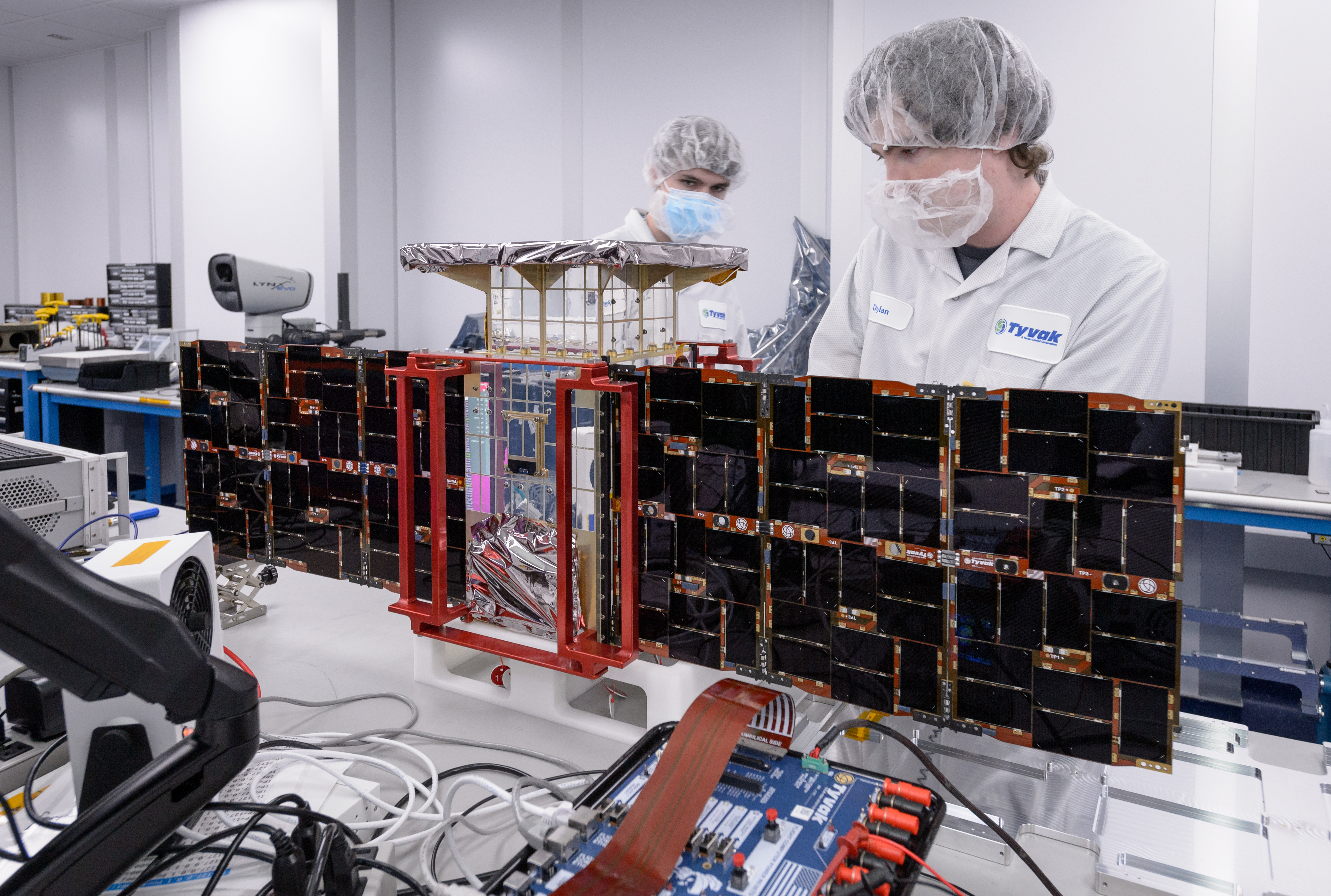
Dylan Schmidt, CAPSTONE assembly integration and test lead, right, and Lachlan Moore, systems integration engineer, left, install solar panels onto the CAPSTONE spacecraft at Tyvak Nano-Satellite Systems, Inc., in Irvine, California.NASA/Dominic HartRather than launch a new satellite, NASA’s Research and Technology Mission Directorate demonstrated that CAPSTONE’s existing hardware could host new applications after launch, transforming the spacecraft into a cost-effective, flexible lunar technology demonstration platform. NASA’s SCaN (Space Communications and Navigation) Division will now use the data to demonstrate innovative networking and navigation techniques on future experiments.
“Operating multiple experiments simultaneously aboard the same spacecraft allows NASA to evaluate how these technologies perform together in a real lunar environment,” said Greg Stover, director of the Advanced Research and Technology Division within NASA’s Research and Technology Mission Directorate at NASA Headquarters in Washington. “Investments in autonomous operations and resilient communications infrastructure are essential to ensuring U.S. leadership as activity around the Moon continues to increase.”
Two experiments aboard CAPSTONE used software-defined infrastructure to advance two future mission essentials: autonomous navigation and deep space communications. The autonomous Navigation, Guidance, and Control software, or autoNGC, is designed to allow a spacecraft to determine where it is, where it is going, and how to get where it needs to be without waiting for instructions from the ground. While portions of the software had previously flown in Earth orbit, CAPSTONE marked the first time autoNGC was tested at the Moon.
“To really demonstrate that something works, you have to fly it,” said Sun Hur-Diaz, principal investigator for the autoNGC technology development project at NASA’s Goddard Space Flight Center in Greenbelt, Maryland. “The real environment is key.”
To really demonstrate that something works you have to fly it. The real environment is key.Sun Hur-Diaz
Principal Investigator for the autoNGC Project, NASA Goddard Space Flight Center
Researchers also evaluated how autoNGC performed with limited contact to Earth. While NASA’s Deep Space Network antennas were supporting the Artemis II crewed test flight around the Moon, CAPSTONE’s communications window dropped to just a few passes per week.
Those gaps became one of the experiment’s most valuable tests. Without data from Earth, autoNGC determined CAPSTONE’s location using an onboard star tracker camera to image the Moon, Earth, and other celestial bodies. The camera-based system, known as optical navigation, at times outperformed ground-based methods for real-time onboard navigation, advancing technologies for future deep-space missions.
Alongside autonomous navigation testing, CAPSTONE also tested delay/disruption tolerant networking (DTN), a communications architecture designed for deep space. Unlike Earth-based internet systems, deep space communications must function despite long delays and frequent signal gaps. The DTN system addresses those challenges by storing information on the spacecraft when no connection is available and automatically forwarding it once communications are restored. With these demonstrations, CAPSTONE became the first to fly the latest DTN protocols beyond Earth orbit and the first to run them in NASA’s core Flight System, an open-source framework that can be implemented on any spacecraft.
In one demonstration, engineers began transmitting data from CAPSTONE to Earth, but the connection ended before the transfer was complete. The spacecraft stored the remaining data until the next communications opportunity, and transmission resumed automatically. Every piece of data made it home.
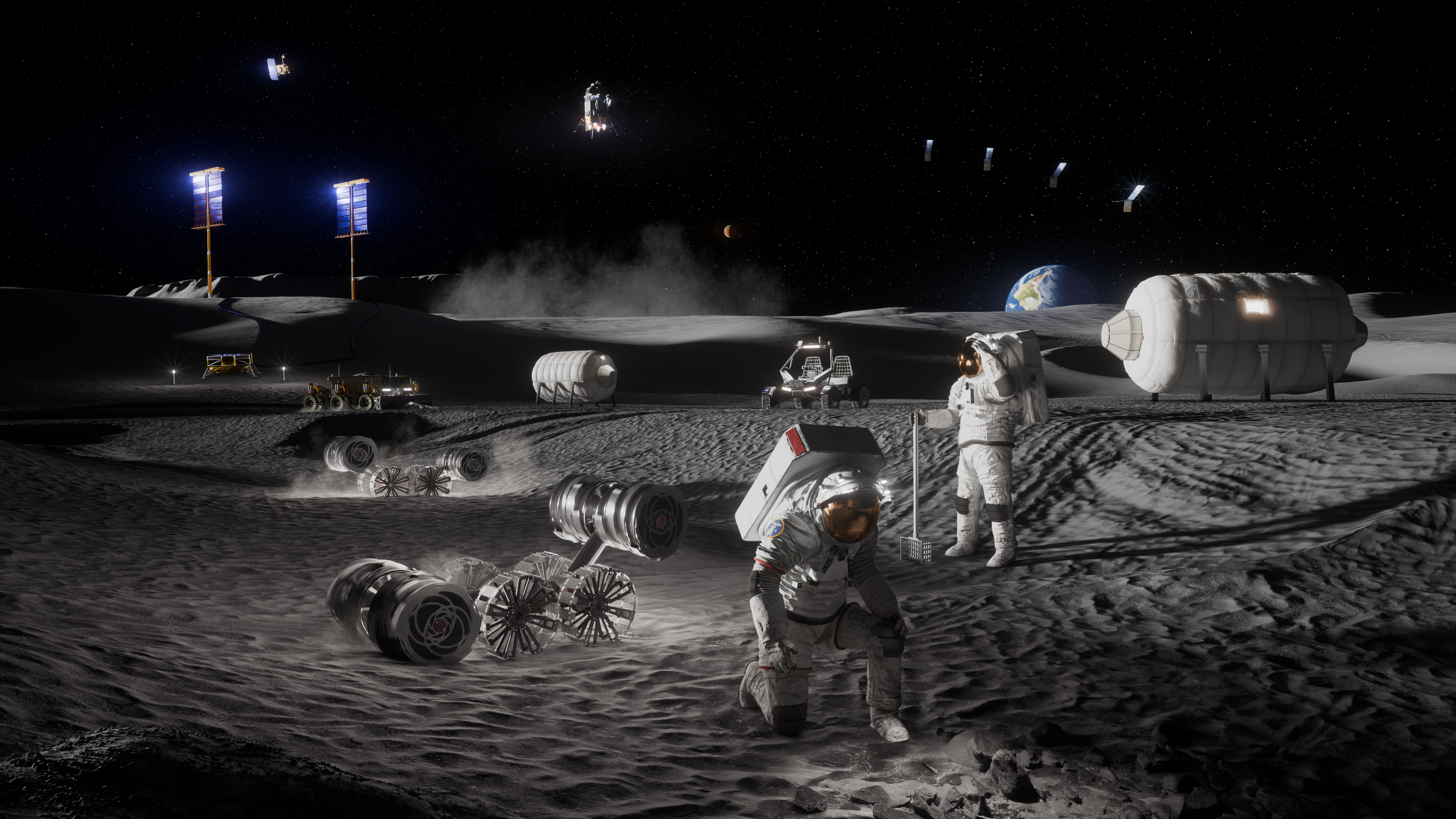
Artist’s rendering depicting astronauts, habitats, rovers, power systems, and cargo operations supporting sustained human activities at the Moon Base near the lunar South Pole. The technologies CAPSTONE tested may be key to NASA’s growing lunar communications and navigation infrastructure.NASA“You can imagine an astronaut walking behind a lunar hill or descending into a crater and temporarily losing connectivity,” said Ben Anderson, a systems engineer for the Near Space Network at NASA’s Goddard Space Flight Center in Greenbelt, Maryland. “This technology allows that data to be automatically retransmitted once communications are restored.”
In addition to its primary achievements, CAPSTONE’s second life as a software-defined testing platform demonstrated that new technologies can be affordably tested and proven directly in their operational environment.
After nearly four years of technology maturation, NASA’s activities on CAPSTONE concluded in June 2026, while Advanced Space will continue to use the spacecraft as a technology development testbed.
The CAPSTONE spacecraft was designed and built by Terran Orbital and is owned and operated by Advanced Space. NASA’s Research and Technology Mission Directorate managed the mission through the Small Spacecraft and Distributed Systems program, based at NASA’s Ames Research Center in California’s Silicon Valley. Elements of the CAPSTONE technology suite were supported by NASA’s Small Business Innovation Research program. The autoNGC and DTN demonstrations conducted during CAPSTONE’s extended mission were managed by NASA’s SCaN Division, based at NASA Headquarters in Washington.
About the AuthorKorine PowersLead Writer and Communications StrategistKorine Powers, Ph.D. is a writer for NASA's SCaN (Space Communications and Navigation) Program office and covers emerging technologies, commercialization efforts, exploration activities, and more.
Share Details Last Updated Jul 06, 2026 EditorJimi RussellContactKorine Powerskorine.powers@nasa.govLocationAmes Research Center Related Terms Explore More 2 min read NASA Transfers ‘Hundred Acre Wood’ to Patuxent Research Refuge Article 10 hours ago 3 min read NASA’s New Horizons Spacecraft Wakes from Hibernation in Good HealthFollowing its longest hibernation period ever of nearly a year, NASA’s New Horizons spacecraft has…
Article 11 hours ago 6 min read NASA Webb Uncovers Unusual Galaxy Shaped by Cosmic CollisionIn new images from NASA’s James Webb Space Telescope to celebrate its fourth science anniversary,…
Article 2 days ago Keep Exploring Discover More Topics From NASACAPSTONE
Communicating with Missions
SCaN & Moon to Mars
Moon Base
NASA Webb Uncovers Unusual Galaxy Shaped by Cosmic Collision
- Webb
- News
- Overview
- Science
- Observatory
- Multimedia
- Team
- More
6 min read
NASA Webb Uncovers Unusual Galaxy Shaped by Cosmic Collision 6 Min Read NASA Webb Uncovers Unusual Galaxy Shaped by Cosmic Collision The mid-infrared view of Centaurus A from NASA’s James Webb Space Telescope reveals dusty structures and hidden activity within the nearby, active galaxy. Credits:Image: NASA, ESA, CSA, STScI; Image Processing: Alyssa Pagan (STScI), Joseph DePasquale (STScI), Macarena Garcia Marin (ESA Office at STScI)
In new images from NASA’s James Webb Space Telescope to celebrate its fourth science anniversary, a familiar galaxy transforms into something far richer, and far more complex, than ever seen before. Webb’s unprecedented sensitivity across near- and mid-infrared wavelengths cuts through the thick lanes of dust that obscure Centaurus A’s center in visible light, showing a densely packed tapestry of individual stars and an active, everchanging galaxy. These images mark four years of better-than-anticipated performance and successful science operations for the most powerful space telescope in history.
Centaurus A is 11 million light-years away from Earth, relatively close in cosmic terms. Yet, unlike most nearby galaxies, it is very active, making it a powerful laboratory for understanding how galaxies and black holes grow and evolve together.
Image: Centaurus A (MIRI Image) Unable to render the provided source The mid-infrared view of Centaurus A from NASA’s James Webb Space Telescope reveals dusty structures and hidden activity within the nearby, active galaxy. Image: NASA, ESA, CSA, STScI; Image Processing: Alyssa Pagan (STScI), Joseph DePasquale (STScI), Macarena Garcia Marin (ESA Office at STScI)At its core sits a supermassive black hole actively feeding on surrounding material. As it does, the black hole launches powerful jets and releases enormous amounts of energy, shaping the galaxy around it. At the same time, Centaurus A bears the scars of a dramatic past: a major collision with another galaxy roughly two billion years ago. The aftermath of that merger is still visible today in its unusual structure and ongoing star formation.
Visible light observations from NASA’s Hubble Space Telescope could not reveal the central region where dust blocked the view, while NASA’s retired Spitzer Space Telescope revealed large scale structures in the infrared without resolving individual stars. Now, Webb brings both clarity and depth, exposing the galaxy’s inner workings star by star.
Interactive: Journey into Centaurus A Unable to render the provided source Use this interactive tool to journey into NASA’s James Webb Space Telescope’s mid-infrared view of Centaurus A, where dust gives way to a rich landscape of stars and hidden features. NASA / STScI“No single telescope tells the whole story,” said Shawn Domagal-Goldman, division director, Astrophysics, NASA Headquarters in Washington. “Discoveries build over time and new observatories expand on the foundations laid by earlier missions. Webb represents the most powerful step forward yet, opening a window into wavelengths and details never before accessible. This allows astronomers to examine structures and processes that other telescopes could not see.”
Dust, aweWebb’s mid-infrared vision highlights the galaxy’s rich dust structures, which glow in intricate shapes that surprise and even perplex astronomers. A warped, parallelogram-like band cuts across the galaxy’s center, while wisps of material stretch outward like cosmic clouds.
An “S” shaped feature, most notable in the image from Webb’s MIRI (Mid-Infrared Instrument), is also unusual and invites questions that need further study to answer. What created this shape? How does the black hole influence it? Is it influenced by merger-induced star formation?
Many of the glowing red points in the MIRI image are dust-rich stars or stellar nurseries, where aging stars are shedding material back into space or new stars are forming. This dust is the raw ingredient for future generations of stars and planets, making it central to the ongoing life cycle of the galaxy.
Image: Centaurus A Crop (NIRCam & MIRI) Unable to render the provided source In the combined mid- and near-infrared view of Centaurus A, the NIRCam (Near-Infrared Camera) on NASA’s James Webb Space Telescope brings out the galaxy’s dense field of millions of stars. Image: NASA, ESA, CSA, STScI; Image Processing: Alyssa Pagan (STScI), Joseph DePasquale (STScI), Macarena Garcia Marin (ESA Office at STScI) Written in its starsWith Webb’s high resolution, astronomers can now study Centaurus A star by star, even in its long-obscured central region. What looks “grainy” in the image from Webb, most obvious in the combined MIRI and NIRCam (Near-Infrared Camera) view, is actually a densely packed field of individual stars, together carrying information about the galaxy’s past.
With Webb’s view of Centaurus A, it becomes a case of galactic archaeology. Each star revealed helps to reconstruct when different events happened: when older stars first formed, when activity slowed down, a burst of star formation during the collision, and stars born from gas stirred in its aftermath. Together, they form a timeline of the galaxy’s evolution.
Dynamic black holeWebb’s capabilities go beyond imaging. By analyzing light with spectroscopy, astronomers can measure how gas moves within the galaxy.
Early findings from Webb show fast-moving ionized gas flowing outward, likely driven by the black hole’s activity, and warmer molecular hydrogen in a warped rotating disk near the center. These observations help explore one of astronomy’s biggest questions: How does a black hole influence an entire galaxy?
The answer appears to be complex. The black hole can trigger star formation by compressing gas, but also limit it by pushing material away. Centaurus A offers a rare, nearby view of this cosmic interplay.
By tracing dust in never-before-seen detail, resolving millions of stars, and revealing the motion of gas near a supermassive black hole, Webb transforms Centaurus A into a vivid record of cosmic history.
The James Webb Space Telescope is the world’s premier space science observatory. Webb is solving mysteries in our solar system, looking beyond to distant worlds around other stars, and probing the mysterious structures and origins of our universe and our place in it. Webb is an international program led by NASA with its partners, ESA (European Space Agency) and CSA (Canadian Space Agency).
To learn more about Webb, visit:
Downloads & Related InformationThe following sections contain links to download this article’s images and videos in all available resolutions followed by related information links, media contacts, and if available, research paper and Spanish translation links.
Related Images & Videos Centaurus A (MIRI Image)The mid-infrared view of Centaurus A from NASA’s James Webb Space Telescope reveals dusty structures and hidden activity within the nearby, active galaxy.
Centaurus A Crop (NIRCam and MIRI Image)
In the combined mid- and near-infrared view of Centaurus A, the NIRCam (Near-Infrared Camera) on NASA’s James Webb Space Telescope brings out the galaxy’s dense field of millions of stars.
Centaurus A Context Image (ESO and Webb Images)
A ground-based image of nearby galaxy Centaurus A from the European Southern Observatory (top left) puts the near-infrared and mid-infrared views from NASA’s James Webb Space Telescope image into context.
Centaurus A (MIRI Compass Image)
Annotated image of the active galaxy Centaurus A captured by the James Webb Space Telescope’s MIRI (Mid-Infrared Instrument), with compass arrows, a scale bar, and color key for reference. The north and east compass arrows show the orientation of the image on the sky. Note …
Centaurus A Crop (NIRCam and MIRI Compass Image)
Annotated image of the active galaxy Centaurus A captured by the James Webb Space Telescope’s NIRCam (Near-Infrared Camera) and MIRI (Mid-Infrared Instrument), with compass arrows, a scale bar, and color key for reference. The north and east compass arrows show the orientat…
Related Links
Read more: What Are Active Galactic Nuclei?
Watch: Black Hole Snapshot
Explore more: ViewSpace: Black Holes: Centaurus A
Infographic: Dissecting Supermassive Black Holes
Watch: Galaxy collisions: Simulation vs Observations
More Webb: News | Images | Science | Home Page
Contact Media
Laura Betz
NASA’s Goddard Space Flight Center
Greenbelt, Maryland
laura.e.betz@nasa.gov
Hannah Braun
Space Telescope Science Institute
Baltimore, Maryland
Christine Pulliam
Space Telescope Science Institute
Baltimore, Maryland
Related Terms Keep Exploring Related Topics James Webb Space Telescope
Webb is the premier observatory of the next decade, serving thousands of astronomers worldwide. It studies every phase in the…
Galaxies
Galaxies Stories
Universe
Examining Algal Blooms in Blue Mesa
- Earth
- Earth Observatory
- Image of the Day
- EO Explorer
- Topics
- More Content
- About
NASA’s Hubble Spies Stellar Sparkler for July 4th
- Hubble Home
- Overview
- Impact & Benefits
- Science
- Observatory
- Team
- Multimedia
- News
- More
3 min read
NASA’s Hubble Spies Stellar Sparkler for July 4th Ancient stars shine in red, white and blue from a globular cluster almost as old as the universe itself in this image from NASA’s Hubble Space Telescope. NASA, ESA, and A. Dotter (Dartmouth College); Processing: Gladys Kober (NASA/Catholic University of America)Red, white, and blue stars glitter like a sparkler being waved on a dark night in this new image from NASA’s Hubble Space Telescope. NASA released this image to celebrate the United States’ 250th anniversary, as the agency carries forward America’s legacy of exploration.
Located in the outer halo of our Milky Way galaxy, globular cluster NGC 6426 is a spherical collection of stars bound together by their mutual gravity, one of 150 known globular clusters in our galaxy. These groups of stars are thought to form as a unit from the same collapsing cloud of gas, and thus the stars in them typically have similar ages. The stars in globular clusters tend to be ancient. At approximately 13 billion years old, NGC 6426 is one of the Milky Way’s oldest globular clusters and almost as old as the universe itself (13.7 billion years).
In this image, blue indicates the shorter wavelengths that are visible light, while red depicts the longer wavelengths of visible light, as well as some near-infrared light. Colors in Hubble images are chosen based on standard image processing techniques to best represent the wavelengths of light that pass through the filters used in the observation. Because the color and temperature of stars are directly related, we know that the blue stars in this image are hotter and the red stars are cooler.
The stars of NGC 6426 have low metallicity, which means they have fewer elements that are heavier than hydrogen and helium. These conditions resemble those of the early universe, when matter was mostly helium and hydrogen and heavier elements were just beginning to form via nuclear fusion within massive stars.
Researchers have found evidence for two chemically distinct populations of stars in NGC 6426, indicating that the slightly younger and more metallic stars were enriched with material from the explosive deaths of the cluster’s earlier stars. Massive stars that explode as supernovae fling elements heavier than hydrogen and helium into the universe, seeding it with materials to build new stars and planets.
Hubble took this image as part of a study of globular clusters in the Milky Way’s halo intended to determine their ages and shed light on the formation and evolution of the galaxy. Over the past three decades in orbit, Hubble has fundamentally changed our understanding of the universe. Its discoveries are expanded upon and complemented by observations from other NASA missions like the infrared-detecting James Webb Space Telescope and the Nancy Grace Roman Space Telescope, scheduled to launch in late summer.
Facebook logo @NASAHubble @NASAHubble Instagram logo @NASAHubble Explore MoreHubble’s Star Clusters
Exploring the Birth of Stars
Hubble’s Nebulae
Media Contact:
Claire Andreoli
NASA’s Goddard Space Flight Center, Greenbelt, MD
claire.andreoli@nasa.gov
Since its 1990 launch, the Hubble Space Telescope has changed our fundamental understanding of the universe.
Hubble Celebrates Nation’s 250th Birthday
Commemorating the United States’ 250th anniversary with new images and more!
What Did Hubble See on Your Birthday?
Take a look at what cosmic wonders Hubble observed on your special day!
Hubble’s Star Clusters
These jewels of the night sky offer us a glimpse at the lifecycle of stars.
NASA’s Hubble Captures Crimson Cloud Sparkling with White, Blue Stars
- Hubble Home
- Overview
- Impact & Benefits
- Science
- Observatory
- Team
- Multimedia
- News
- More
3 min read
NASA’s Hubble Captures Crimson Cloud Sparkling with White, Blue Stars A glowing landscape of gas and dust is heated and illuminated by a thriving population of young stars in the LH 95 region of the Large Magellanic Cloud. NASA, ESA, and N. Da Rio (The University of Virginia), G. De Marchi (European Space Agency – ESTEC), and D. Gouliermis (Universitat Heidelberg); Processing: Gladys Kober (NASA/Catholic University of America)Like fresh fireworks launched against a background of dissipating smoke, blue and white stars shine brilliantly against a crimson background of glowing gas in this image of stellar nursery LH 95 from NASA’s Hubble Space Telescope.
LH 95 is a region in the Large Magellanic Cloud, a dwarf galaxy that orbits the Milky Way. Low-mass infant stars live alongside massive blue giant stars in what is known as a stellar association, one of many in the Large Magellanic Cloud.
The LH 95 region’s most massive stars, possessing at least three times the mass of the Sun and visible here as the largest and brightest blue stars, expel ultraviolet radiation and stellar winds that both heat and shape the surrounding hydrogen gas. Dark filaments stand out in sharp contrast against the glowing hydrogen where denser dust lanes resist erosion.
In this image, blue indicates the shorter wavelengths that are visible light, while red depicts the longer wavelengths of visible light, as well as some near-infrared light. Colors in Hubble images are chosen based on standard image processing techniques to best represent the wavelengths of light that pass through the filters used in the observation. The gas of the nebula glows crimson due to hydrogen-alpha emissions.
Hydrogen-alpha is an excellent indicator of star formation, allowing astronomers to identify very young stars embedded in this glowing gas. Researchers found developing stars still gathering material from the disks of gas and dust around them. In fact, LH 95 is home to an extraordinary 2,500 stars that have accumulated almost all of their critical mass but have not yet “turned on” by beginning fusion reactions. These stars, called “pre-main-sequence stars,” have formed from collapsing clouds of gas and are still contracting. They will soon begin burning hydrogen in their cores to become full stars.
By studying these forming stars, researchers confirmed that the stars’ accretion rate ― the rate at which they accumulate matter ― decreased with age, as expected. However, they also learned that accretion can persist for several million years, longer than sometimes assumed. This information helps refine our understanding of how young stars keep growing and how their disks evolve.
Researchers noted that distinct generations of stars in LH 95 exist side-by-side, indicating that rather than forming stars in a single event, the region produces multiple stellar generations over an extended period.
The most massive star in LH 95 (above center, slightly left) has about 60-70 times the mass of the Sun and is about a million years younger than the rest of stars in the system, which appear to be around 4 million years old. Massive stars like these burn through their fuel quickly and die in supernova explosions.
With its rich stellar population, LH 95 is valued by astronomers for providing a way to observe forming stars at relatively close range in an environment with less obscuring dust than similar regions of the Milky Way.
As one of NASA’s flagship observatories, Hubble has produced a wealth of scientific discoveries over more than 30 years in orbit. Its observations are expanded upon and enhanced by observations with other NASA missions, including the infrared-detecting Webb Space Telescope and the upcoming Nancy Grace Roman Space Telescope, which is scheduled to launch in late summer.
Facebook logo @NASAHubble @NASAHubble Instagram logo @NASAHubble Explore MoreHubble’s Nebulae
Exploring the Birth of Stars
Hubble’s Star Clusters
Media Contact:
Claire Andreoli
NASA’s Goddard Space Flight Center, Greenbelt, MD
claire.andreoli@nasa.gov
Since its 1990 launch, the Hubble Space Telescope has changed our fundamental understanding of the universe.
Hubble Celebrates Nation’s 250th Birthday
Commemorating the United States’ 250th anniversary with new images and more!
What Did Hubble See on Your Birthday?
Take a look at what cosmic wonders Hubble observed on your special day!
Fourth of July Through Hubble’s Eyes
To commemorate the nation’s 250th birthday, Hubble shares 13 images for the nation’s 13 original colonies.
NASA’s Hubble Spots Star-Spangled Cosmic Scene
- Hubble Home
- Overview
- Impact & Benefits
- Science
- Observatory
- Team
- Multimedia
- News
- More
3 min read
NASA’s Hubble Spots Star-Spangled Cosmic Scene This image from NASA’s Hubble Space Telescope shows Messier 3, a densely packed cluster of stars whose origins may be a merger between globular clusters in the early universe. NASA, ESA, and A. Sarajedini (Florida Atlantic University); Processing: Gladys Kober (NASA/Catholic University of America)More than 500,000 stars blaze red, white, and blue in this image from NASA’s Hubble Space Telescope, released in celebration of the United States’ 250th anniversary. The image showcases Messier 3 (M3), one of the Milky Way galaxy’s most massive globular clusters, or spherical collections of gravitationally bound stars. Globular clusters are made up of ancient stars that formed at roughly the same time from the same cloud of gas, giving those stars similar ages. Around 150 known globular clusters are sprinkled around the outer regions of the Milky Way.
In addition to its significant mass, M3 is unusual because it lies relatively far from the galactic center and has more than 240 RR Lyrae variable stars, the most of any globular cluster in our galaxy. RR Lyrae variables are some of the galaxy’s oldest stars and are of special interest to astronomers, due to their age and because their light fluctuates over time in a way that tells us their intrinsic brightness. This true brightness can be used to measure distances in the cosmos, just as knowing the brightness of car headlights on a dark road can help estimate the distance to an oncoming vehicle.
The M3 globular cluster also contains around 70 identified “blue straggler” candidates, which are stars that shine with a bright, blue light that makes them look like younger stars than the typical, redder residents of globular clusters. This was the first cluster in which these oddball stars were located. These stars are thought to have gravitationally pulled mass from companion stars, rejuvenating them and making them appear bluer and younger despite their true age.
The unusual characteristics of M3 may arise from its origins. The globular cluster, which contains two distinct populations of stars, may be the result of a merger of two globular clusters. These two clusters were members of the same dwarf galaxy, which was later swallowed up by the Milky Way.
Hubble has taken several images of M3, also known as NGC 5272, documenting its complicated and intriguing characteristics. In this image, blue indicates the shorter wavelengths that are visible light, while red depicts the longer wavelengths of visible light, as well as some near-infrared light. Colors in Hubble images are chosen based on standard image processing techniques to best represent the wavelengths of light that pass through the filters used in the observation. Because the color and temperature of stars are directly related, we know that the blue stars in this image are hotter and the red stars are cooler.
This image is part of a Hubble Treasury program survey designed to observe approximately half of the Milky Way’s globular clusters to construct a detailed chronology of how the Milky Way galaxy formed. With over 30 years of observations, Hubble is one of NASA’s flagship observatories and works in complement with its sibling space missions, including the infrared-detecting Webb Space Telescope and the upcoming Nancy Grace Roman Space Telescope, to weave together a comprehensive picture of our vast universe.
Facebook logo @NASAHubble @NASAHubble Instagram logo @NASAHubble Explore MoreExploring the Birth of Stars
Hubble’s Star Clusters
Hubble’s Nebulae
Media Contact:
Claire Andreoli
NASA’s Goddard Space Flight Center, Greenbelt, MD
claire.andreoli@nasa.gov
Since its 1990 launch, the Hubble Space Telescope has changed our fundamental understanding of the universe.
Explore the Night Sky
Break out your telescope or binoculars and compare your view with Hubble’s observations.
What Did Hubble See on Your Birthday?
Take a look at what cosmic wonders Hubble observed on your special day!
Fourth of July Through Hubble’s Eyes
To commemorate the nation’s 250th birthday, Hubble shares 13 images for the nation’s 13 original colonies.
NASA’s Artemis II Breaks Agency Streaming Record
NASA’s live coverage of the Artemis II mission mission drew unprecedented public interest – including more than 149.4 million views of the launch, lunar flyby, splashdown on NASA-owned platforms, including the 24/7 streams covering the mission and the Orion spacecraft views – demonstrating strong, sustained global engagement throughout the mission.
Around the Clock Live BroadcastNASA’s Artemis II Crew Launches to the Moon broadcast set unprecedented viewership records across the agency’s streaming platforms, drawing a combined peak of 3,662,554 viewers—rising to 3.66 million when including more than 411,130 concurrent viewers on X and Twitch—surpassing previous milestones, including the launches of Artemis I (2022) and the James Webb Space Telescope (2021–2022). The launch generated 23.9 million total views across NASA platforms, with 16.6 million people watching live, underscoring the mission’s broad national and global appeal from liftoff onward. NASA en español’s dedicated broadcast also reached a landmark peak of 458,366 concurrent viewers and has since amassed 2.8 million total views, highlighting the mission’s strong resonance with Spanish‑speaking audiences and expanding the global reach of Artemis communications.
NASA’s Artemis II Lunar Flyby broadcast delivered one of the largest peak audiences ever recorded across the agency’s streaming platforms, reaching 1,471,069 total concurrent viewers – driven largely by 897,789 on YouTube, one of NASA’s strongest single platform performances – along with an additional 190,221 viewers on X and Twitch, underscoring the mission’s broad global reach and sustained excitement. Together, the Artemis II launch and Moon flyby broadcasts have redefined NASA’s livestreaming benchmarks, demonstrating record-breaking public interest in humanity’s return to the Moon. As of April 13, the flyby broadcast has accumulated 40 million views across NASA+, YouTube, X, and Twitch, highlighting the intense and enduring engagement surrounding Artemis II.
Pre‑splashdown coverage across major outlets emphasized the “riskiest moments” still ahead—particularly Orion’s reentry and heat‑shield performance—framing the return as the mission’s climax and driving heightened public attention. As anticipation grew, audience interest that had already surged during the record‑setting launch only intensified: Artemis II’s liftoff drew 3,662,554 peak viewers, but global curiosity about the crew’s safe return pushed splashdown viewership even higher to 3,838,418, a 4.8% increase that reflected widespread investment in the mission’s outcome as viewers tuned in to witness the critical reentry sequence, confirm crew safety, and celebrate humanity’s first journey around the Moon in more than 50 years. NASA’s Artemis II Crew Comes Home generated 29.5 million total views across NASA-owned platforms, with an estimated 24.1 million occurring during the live return sequence—an exceptional level of engagement that underscores the deep public interest carried through the mission’s final and most critical moments.
Major entertainment platforms including HBO Max, Netflix, Peacock, and Amazon Prime Video exponentially expanded NASA’s global footprint by placing Artemis II in front of hundreds of millions of potential viewers worldwide, with HBO Max reaching 120–150 million global subscribers; Netflix reaching 325 million paid subscribers and covering 54% of global households; Peacock contributing 36–41 million U.S. subscribers; and Amazon Prime Video reaching up to 275 million global subscribers. Together, these partners enabled NASA to reach mainstream, international, and non-traditional audiences at a scale unattainable through NASA-owned channels alone.
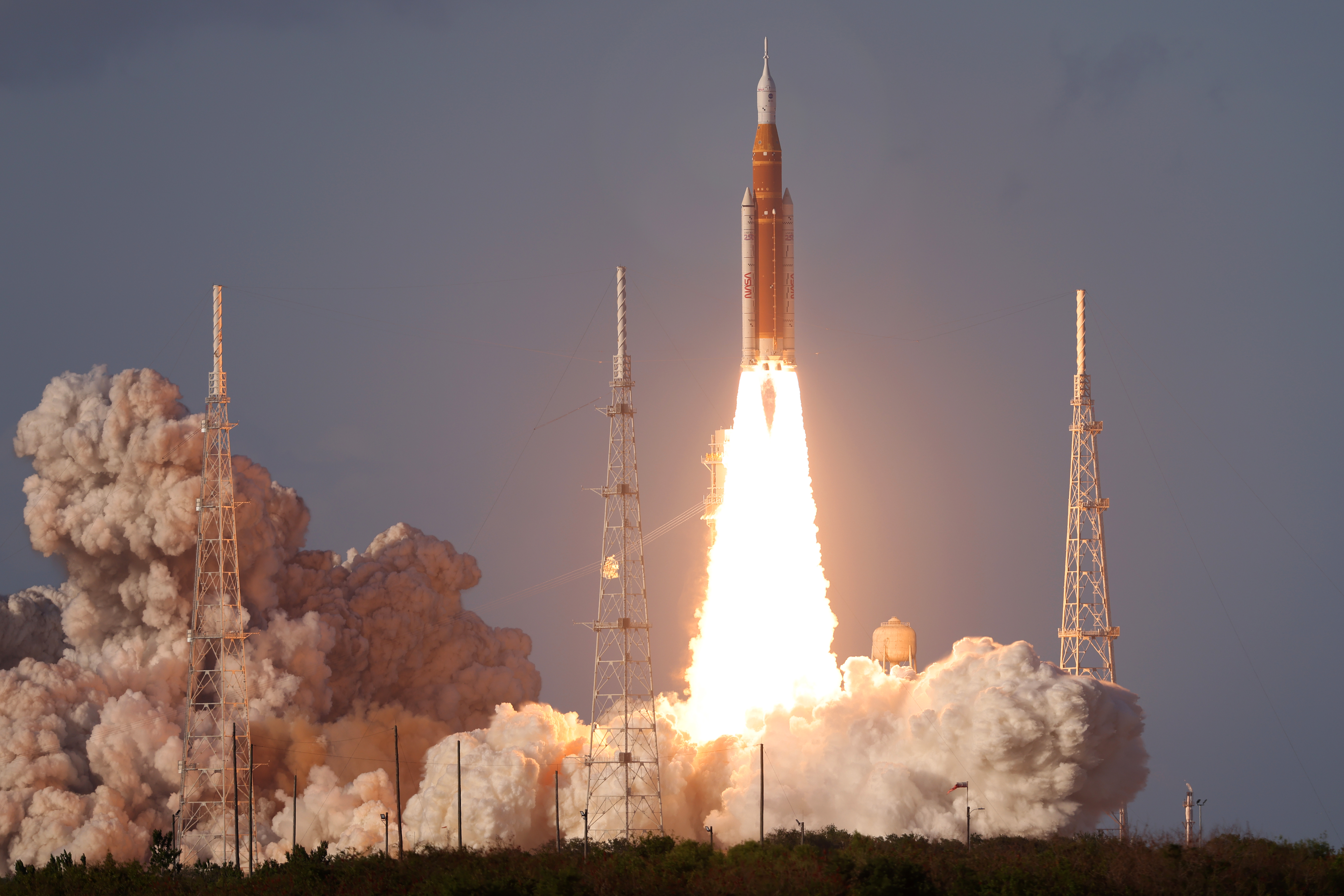
Four astronauts aboard NASA’s Orion spacecraft atop the SLS (Space Launch System) rocket launched on the agency’s Artemis II test flight on Wednesday, April 1, 2026, from Launch Complex 39B at NASA’s Kennedy Space Center in Florida.NASA/Michael DeMocker WebsitesNASA’s Artemis II mission drove a major surge in traffic across the agency’s websites, with NASA.gov recording 125.1 million pageviews between April 1 and 10 – more than double the roughly 50 million logged in all of March – reflecting intense public interest in following the mission in real time. On launch day alone, NASA sites saw 17.6 million pageviews from 8.3 million visitors, with the Artemis Real-Time Orbit Website (AROW) drawing 797,796 pageviews,
Interest spiked again during the April 6 lunar flyby, generating 16.5 million pageviews from 6.2 million visitors; AROW registered 1.9 million pageviews – boosted by more than 440,000 Google referrals – while the NASA homepage reached 2.3 million. Splashdown day brought another surge to NASA-owned websites, with more than 16 million pageviews from 6.1 million visitors as audiences followed the Artemis II crew’s return; AROW drew over 1 million pageviews and surpassed 11 million cumulative views since launch. Together, these metrics show sustained, high-volume engagement across all mission milestones, with live hubs, broadcast pages, and real-time tracking consistently ranking among the most-visited content throughout launch, flyby, and splashdown.
Social MediaPublic reaction to NASA’s Artemis II mission remained largely steady across launch week, with neutral and positive posts dominating the online conversation. Neutral sentiment consistently led daily discussion, ranging from 47 to 60 percent, while positive reactions accounted for 30 to 42 percent, fueled by excitement over the crew’s historic lunar journey, striking mission imagery, and renewed interest in deep space exploration. Engagement spiked around major mission milestones, with NASA accounts generating 35 million engagements on splashdown day content alone and 261 million from March 27 to April 13, underscoring how closely audiences followed each phase. Strong amplification from major news outlets, brands, and international partners, further boosted visibility and cemented Artemis II as a global cultural moment.
NASA’s Artemis II mission drove major social media growth across the agency’s flagship and mission‑specific accounts, with follower numbers climbing steadily from rollout through the lunar flyby and splashdown. Internal tracking shows NASA’s flagship Instagram account added more than 4.6 million followers, while the Artemis‑dedicated Instagram account grew by 2 million—a 66% increase over the course of the mission. Significant gains were also recorded across X, Facebook, and YouTube, including a 2 million increase in YouTube subscribers and NASA’s flagship Facebook page climbing by 1.7 million. Collectively, these gains highlight how Artemis II’s human‑spaceflight narrative, real‑time crew updates, and highly visual moments drew millions of new followers across platforms.
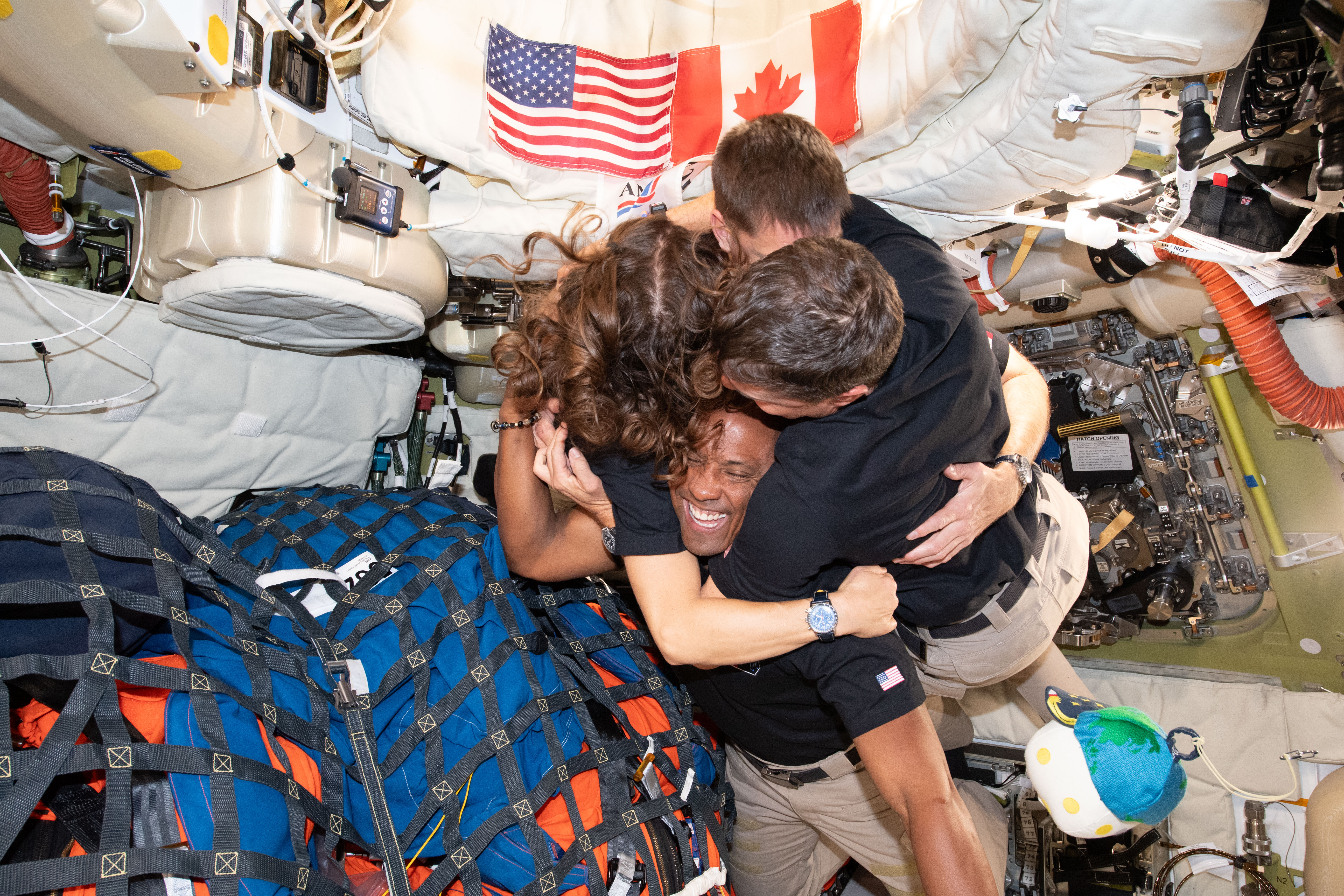
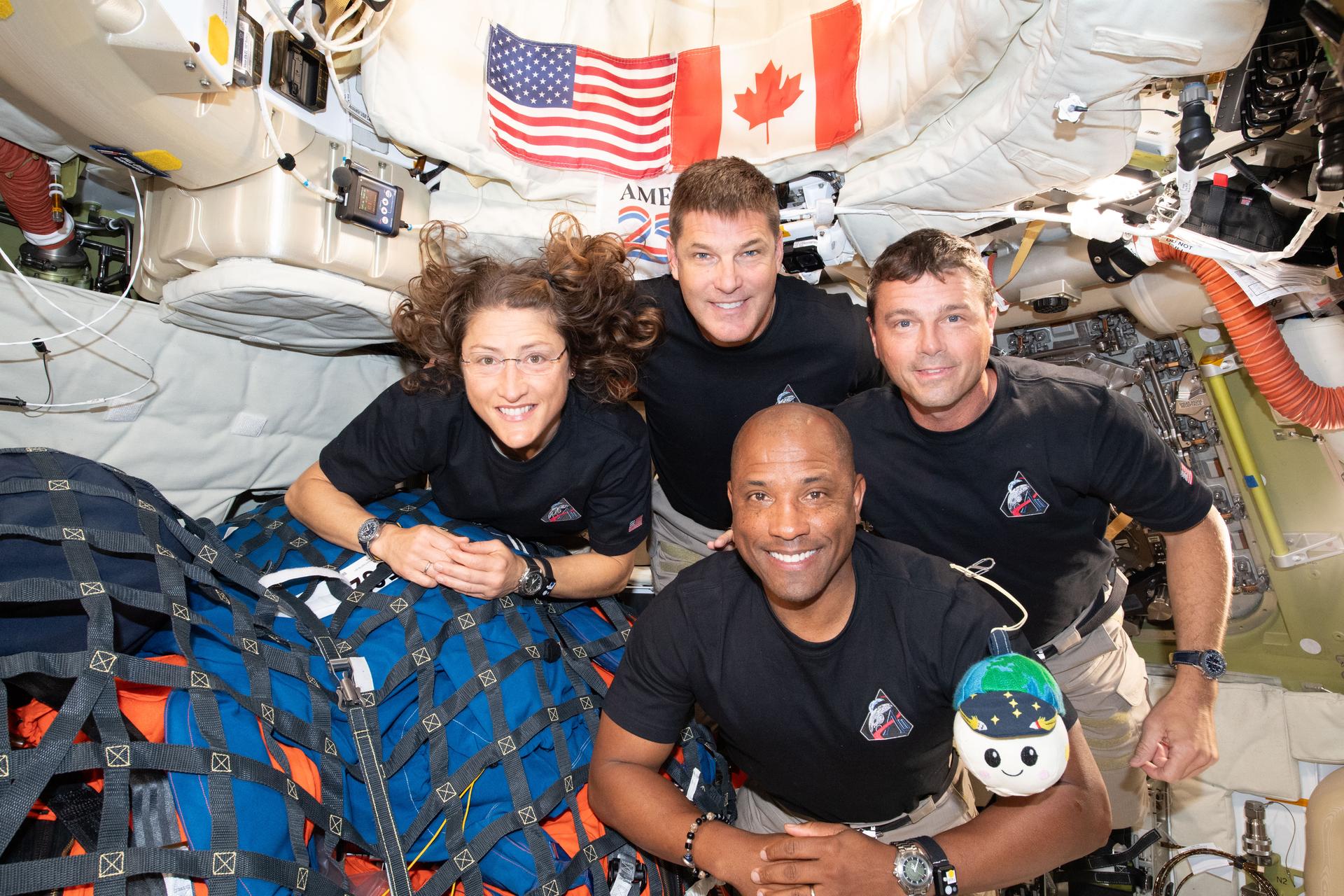
From left: The Artemis II crew—NASA astronaut Christina Koch, CSA (Canadian Space Agency) astronaut Jeremy Hansen, and NASA astronauts Reid Wiseman and Victor Glover—pause for a group photo with their zero-gravity indicator “Rise” inside the Orion spacecraft on April 7, 2026.NASA Mission ImagesNASA has long shaped its legacy through unforgettable imagery—pictures that don’t just document history but become part of it. Artemis II carries that tradition forward with a growing collection of images capturing every phase of the mission, from the anticipation of launch to the sweep of a lunar flyby and splashdown. For those eager to explore more, the mission’s dedicated image galleries offer a rich visual journey, complemented by additional photos on the NASA Headquarters official Flickr account and the NASA Image and Video Library.
NASA CampaignsMoon Mascot: NASA Artemis II ZGI Design Challenge
Last year, the Moon mascot design contest received thousands of submissions from more than fifty countries for the Artemis II mission’s zero‑gravity indicator. This plush item serves a special purpose — it begins to float once the astronauts reach space, signaling the onset of zero gravity. It also provides a comforting reminder of Earth when the crew is far from home.
Ultimately, the Artemis II astronauts selected “Rise”—inspired by the iconic Earthrise photograph captured during the Apollo 8 mission and designed by Lucas Ye of Mountain View, California—as the zero‑gravity indicator that will accompany them around the Moon. “Rise” also features a small pouch that will carry an SD card containing all 5.6 million names submitted through the Send Your Name with Artemis campaign.
Send Your Name with Artemis II
NASA invited the public to join the agency’s Artemis II test flight as four astronauts ventured around the Moon and back to test the systems and hardware needed for deep space exploration. As part of the agency’s “Send Your Name with Artemis II” effort, anyone could claim their spot by signing up before Jan. 21, 2026. Participants launched their names aboard the Orion spacecraft and SLS (Space Launch System) rocket alongside NASA astronauts Reid Wiseman, Victor Glover, Christina Koch, and CSA (Canadian Space Agency) astronaut Jeremy Hansen.
Online CollaborationsThe April 1, 2026, Google Doodle celebrated the launch of Artemis II, the NASA mission that sent astronauts around the Moon and back for the first time in more than 50 years. During the approximately 10‑day voyage, the crew tested the spacecraft’s systems while traveling farther into deep space than any human had gone since the Apollo program. This critical test flight brought us one step closer to a long‑term return to the Moon and future missions to Mars.
Spotify Playlist: The Artemis II Crew’s Wake-up Songs
NASA’s official playlist for the Artemis II mission featuring songs selected by the crew for their historic 10-day journey around the Moon.
Merriam-Webster highlighted the Artemis II mission on their official Facebook page, engaging with astronauts in deep space to discuss the experience of traveling farther than any human before.
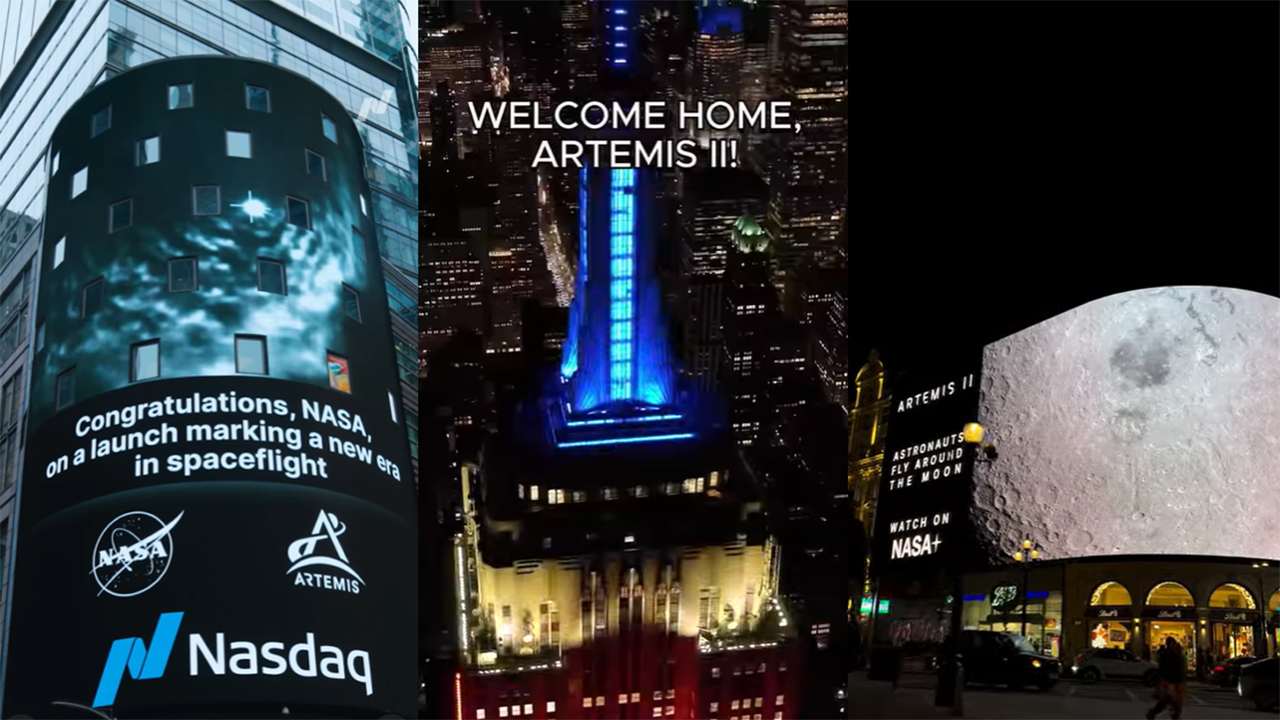
In New York, a digital display on the Nasdaq Marquee and special lights on the Empire State Building marked successful Artemis II mission milestones. In London, Piccadilly Lights celebrated the mission with a digital display following a successful lunar flyby. Offline CollaborationsNASDAQ, New York
Nasdaq celebrated the successful launch of NASA’s Artemis II mission, marking humanity’s return to the Moon after more than 50 years.
Empire State Building, New York
Red, white, and blue for the Artemis II crew. Welcome back to Earth.
Sphere, Las Vegas
As the astronauts on Orion reached their closest approach to the Moon, the sphere celebrated this milestone here on Earth. NASA provided the Sphere with a 3D model of the Orion spacecraft and unique soundbites from the April 1, 2026, launch to help design the moon, spacecraft, and flight path to match the real-life version.
London’s Piccadilly Lights celebrated the lunar flyby of Artemis II, where the four astronauts aboard the Orion spacecraft went deeper into space than ever before.
NASA’s Artemis ProgramThe Artemis II mission launched April 1, 2026, on NASA’s SLS (Space Launch System) rocket from Kennedy Space Center in Florida. During the nearly 10‑day test flight, the crew achieved the mission’s primary objectives, including testing its life support systems; manually piloting the Orion spacecraft; performing maneuvers to propel Orion to the Moon and adjust its course; conducting a lunar flyby with unprecedented views of the Moon’s far side; and completing a safe re-entry and recovery. The astronauts also set a record for the farthest distance traveled by humans away from Earth.
As part of a Golden Age of innovation and exploration, NASA will send Artemis astronauts on increasingly challenging missions to explore more of the Moon for scientific discovery, economic benefits, establish an enduring human presence on the lunar surface, and lay the groundwork for sending the first astronauts – American astronauts – to Mars.
Keep Exploring Discover MoreArtemis
Humans In Space
Astronauts
Destinations
Good Morning, Earth!
NASA astronaut Chris Williams took this photo of an orbital sunrise from the International Space Station on June 26, 2026. In 24 hours, the space station makes 16 orbits of Earth, traveling through 16 sunrises and sunsets.
Learn more about the orbiting laboratory.
Image credit: NASA/Chris Williams
NASA’s Webb Reveals Stars Sparking to Life in Cosmic Celebration
- Webb
- News
- Overview
- Science
- Observatory
- Multimedia
- Team
- More
Image: NASA, ESA, CSA, STScI; Image Processing: Alyssa Pagan (STScI)
NASA’s James Webb Space Telescope has captured the infrared light of numerous features that previously were impossible to see beyond the thick dust of the FS Tau star system. In addition to myriad background galaxies that burst into view like fireworks for the United States’ 250th anniversary celebrations, this image flickers with a number of protostars, or baby stars that are formed from dense pockets of gas and dust. These hot, clumpy, and low-mass objects eventually will become full-fledged stars capable of burning hydrogen in their cores, like our Sun. The protostars of FS Tau are about 1 to 3 million years old, which is relatively young in cosmic scales. Our Sun, by contrast, is 4.6 billion years old.
Low-mass stars emit less radiation and have less energetic stellar winds than those with larger masses, which means they disrupt their environment at a much lower level. This makes the FS Tau region incredibly useful for studying low-mass star evolution without the same level of environmental interference seen near higher-mass stars. A pair of protostars that creates the largest diffraction pattern seen slightly to the left of center in the image, called FS Tau A, is about half the mass of our Sun.
Image: FS Tau (Webb Image) In infrared light, NASA’s James Webb Space Telescope reveals bright protostars in star system FS Tau and a tapestry of background galaxies. FS Tau B, the orange protostar slightly right of center, is thought to be responsible for the orange outflows amid the dusty region. Image: NASA, ESA, CSA, STScI; Image Processing: Alyssa Pagan (STScI)Even though these objects are young and low-mass, they still can impact their surroundings, partially due to the outflows they emit. These outflows, seen as orange and red wisps and wide sheets, are theorized to come from FS Tau B, the protostar slightly to the right of center that has an orange diffraction pattern. As FS Tau B feeds on the surrounding dust and gas to grow, it ejects some of that matter outward. The wider outflows are thought to come from the interaction between the protostar’s magnetic field and superheated matter closest to the protostar within its accretion disk. The disk is seen as a dark band that cuts across at a 30-degree angle.
The gaps between the outflows, newly discovered in this Webb observation, add to growing evidence that protostars accrete matter in discrete episodes. In the periods where protostars gather material and increase in mass, they also eject superheated matter in different directions. In between these episodes, they are relatively quiet.
Image: FS Tau Side-by-Side (Webb and Hubble Image) A comparison between the observations of FS Tau by NASA’s Hubble and James Webb space telescopes. Hubble’s visible-light view shows the star-forming region mostly obscured by thick dust. Webb sees through the dust, revealing how the protostars are shaping their surroundings. Image: NASA, ESA, CSA, STScI; Image Processing: Alyssa Pagan (STScI)As protostars eject these outflows, they shape their surroundings. This is best shown by the prominent light-blue ridges of dust and gas near FS Tau B. These thicker regions were likely created as outflows struck and compressed matter together. The brightness of these light-blue ridges shows that the nearby protostar’s light is reflected. Moreover, Webb’s sensitivity reveals the varying textures of dust and gas across the entire region.
The range of colors seen in this observation also provides a wealth of information, specifically about where dust is and how much of it obscures the region. Light with bluer wavelengths is absorbed and scattered by dust, while redder-wavelength light is able to slip through. Therefore, background galaxies behind thicker foreground dust appear redder. Alternatively, yellow galaxies have much less dust obscuring them. The few white stars visible in this image are likely in the foreground.
The James Webb Space Telescope is the world’s premier space science observatory. Webb is solving mysteries in our solar system, looking beyond to distant worlds around other stars, and probing the mysterious structures and origins of our universe and our place in it. Webb is an international program led by NASA with its partners, ESA (European Space Agency) and CSA (Canadian Space Agency).
To learn more about Webb, visit:
Downloads & Related InformationThe following sections contain links to download this article’s images and videos in all available resolutions followed by related information links, media contacts, and if available, research paper and Spanish translation links.
Related Images & Videos FS Tau (Webb Image)In infrared light, NASA’s James Webb Space Telescope reveals bright protostars in star system FS Tau and a tapestry of background galaxies. FS Tau B, the orange protostar slightly right of center, is thought to be responsible for the orange outflows amid the dusty region.
FS Tau Side-by-Side (Webb and Hubble Image)
A comparison between the observations of FS Tau by NASA’s Hubble and James Webb space telescopes. Hubble’s visible-light view shows the star-forming region mostly obscured by thick dust. Webb sees through the dust, revealing how the protostars are shaping their surroundings.
FS Tau (Webb Compass Image)
An image of FS Tau captured by Webb’s NIRCam (Near-Infrared Camera), with compass arrows, scale bar, and color key for reference.
Related Links
Read more: Webb’s Star Formation Discoveries
Explore more: ViewSpace | Image Tour: Herbig-Haro 46/47
Watch: Herbig-Haro 49/50 Stellar Jets Visualization
Explore more: ViewSpace | Star formation in the Eagle Nebula
Watch: Celestial Lightsabers: Stellar Jets in HH24
More Webb: News | Images | Science | Home Page
Contact Media
Laura Betz
NASA’s Goddard Space Flight Center
Greenbelt, Maryland
laura.e.betz@nasa.gov
Matthew Brown
Space Telescope Science Institute
Baltimore, Maryland
Abigail Major
Space Telescope Science Institute
Baltimore, Maryland
Related Terms Keep Exploring Related Topics James Webb Space Telescope
Webb is the premier observatory of the next decade, serving thousands of astronomers worldwide. It studies every phase in the…
Stars
Stars Stories
Universe
What’s Up: July 2026 Skywatching Tips from NASA
A predawn Moon-and-planets meetup, a returning comet, a great chance to see the Milky Way, and Saturn’s rings at a new angle.
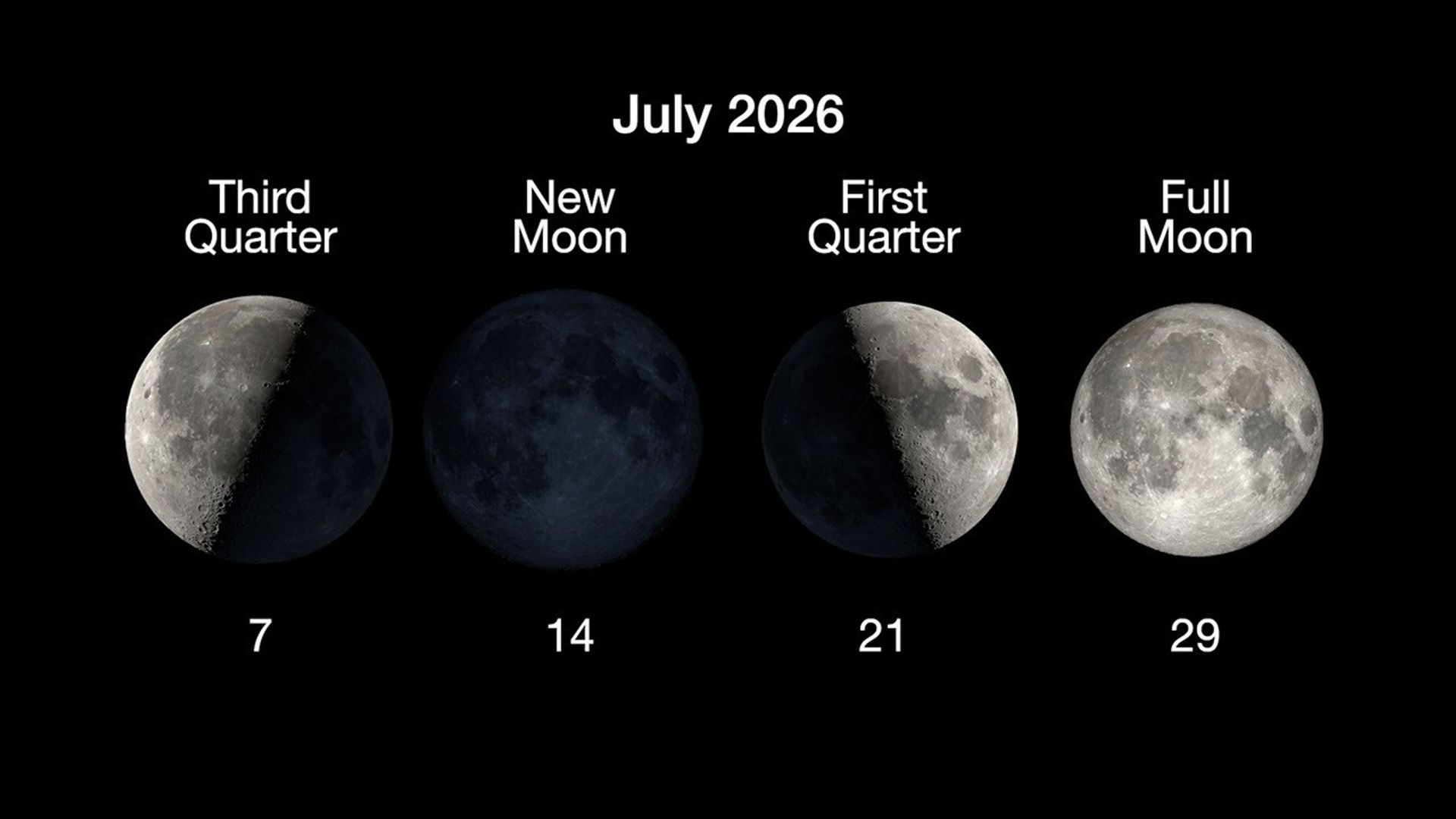
Skywatching Highlights- July 7: Last Quarter Moon
- July 11 + 12: Dawn alignment of the Moon, Mars, Saturn, and Uranus
- July 14: New Moon; best dark-sky window for Comet 10P/Tempel 2 and the Milky Way
- Later in July: Saturn’s unusually thin rings are a rewarding telescope target
- July 21: First Quarter Moon
- July 29: Full Moon
An early morning hangout with the Moon and planets, a comet swings by, prime time for the Milky Way, and Saturn’s rings shine at a new angle. That’s What’s Up for July.
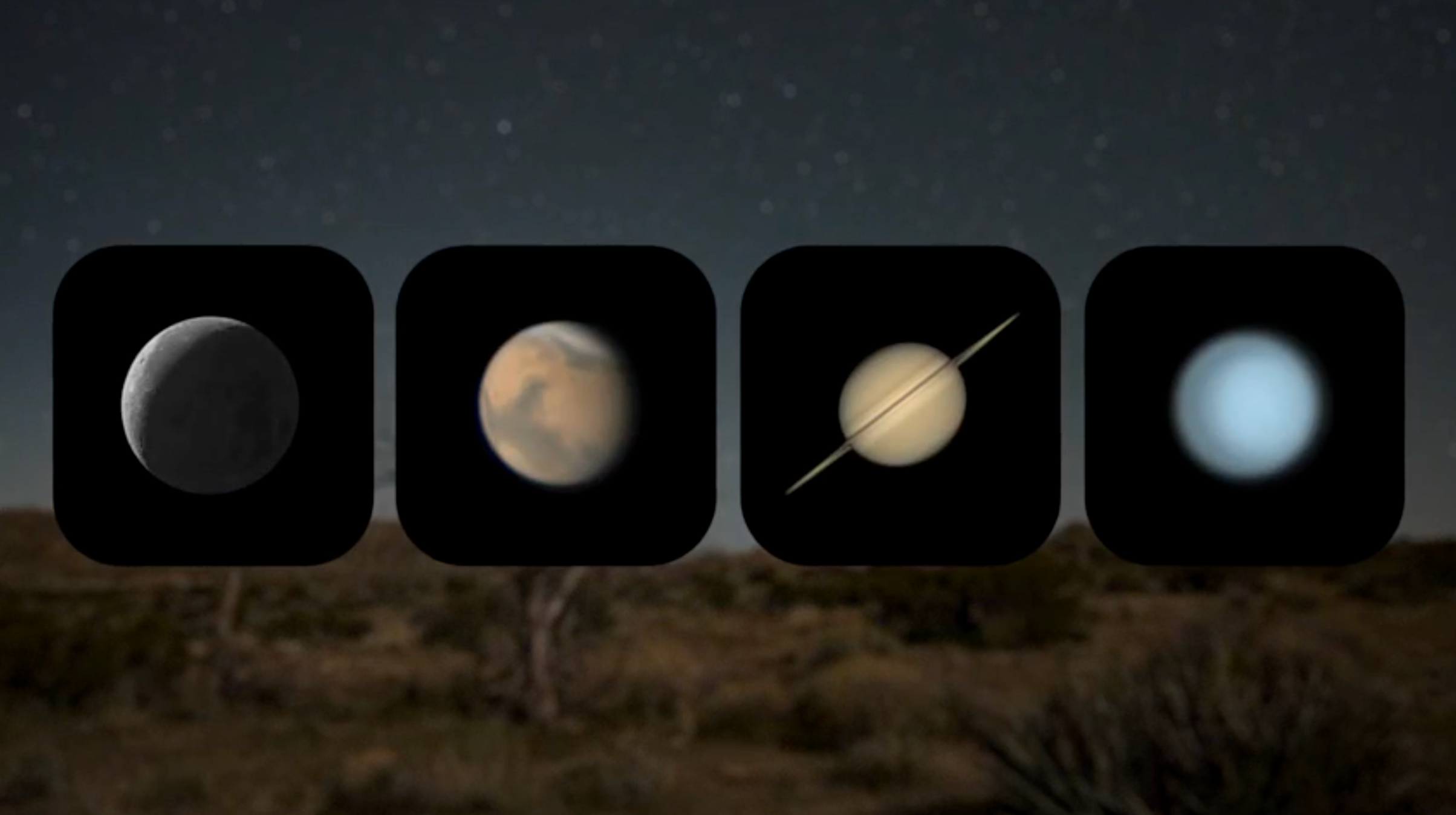
Before sunrise on July 11 and 12, look toward the eastern sky for a lineup of the Moon and planets. On these mornings, the waning crescent Moon helps point the way to Mars, with Saturn shining nearby in the morning sky.
Uranus is in the same general part of the sky, too, but it is much fainter, so you will need binoculars or a telescope to see it.
Mars will look like a small reddish point of light, Saturn is brighter and easier to spot, and the Moon makes the whole scene easy to locate.
Before sunrise on July 11 and 12, the Moon, Mars, Saturn, and Uranus will parade in the eastern sky. NASA/JPL-CaltechAround the New Moon on July 14, Comet 10P/Tempel 2 swings by.
This is a short-period comet, meaning it returns to the inner solar system on a regular orbit. In this case, it comes back about every 5½ years. It is not a dramatic comet that you see just by looking up at the sky, though.
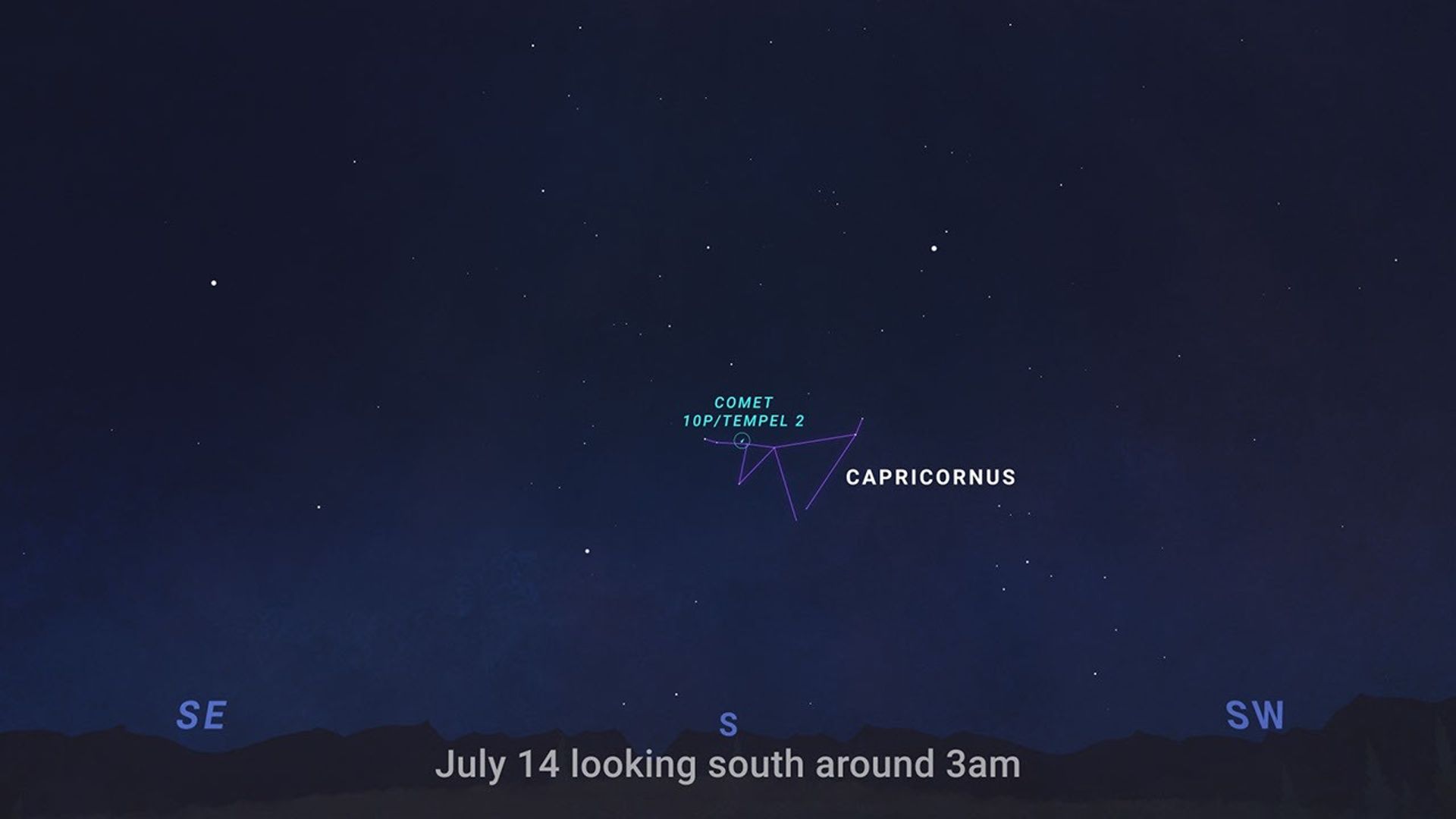
Through binoculars or a telescope, find the constellation Capricornus and look for a small fuzzy glow nearby, possibly with a brighter central knot and a short, broad, fan-shaped tail.
For the best chance to view the comet, head somewhere dark, away from city lights. Start looking once the sky is fully dark, ideally about 45 to 60 minutes after sunset.
NASA/JPL-CaltechThose same dark nights around the July 14 New Moon are also the best time this month to look for the Milky Way.
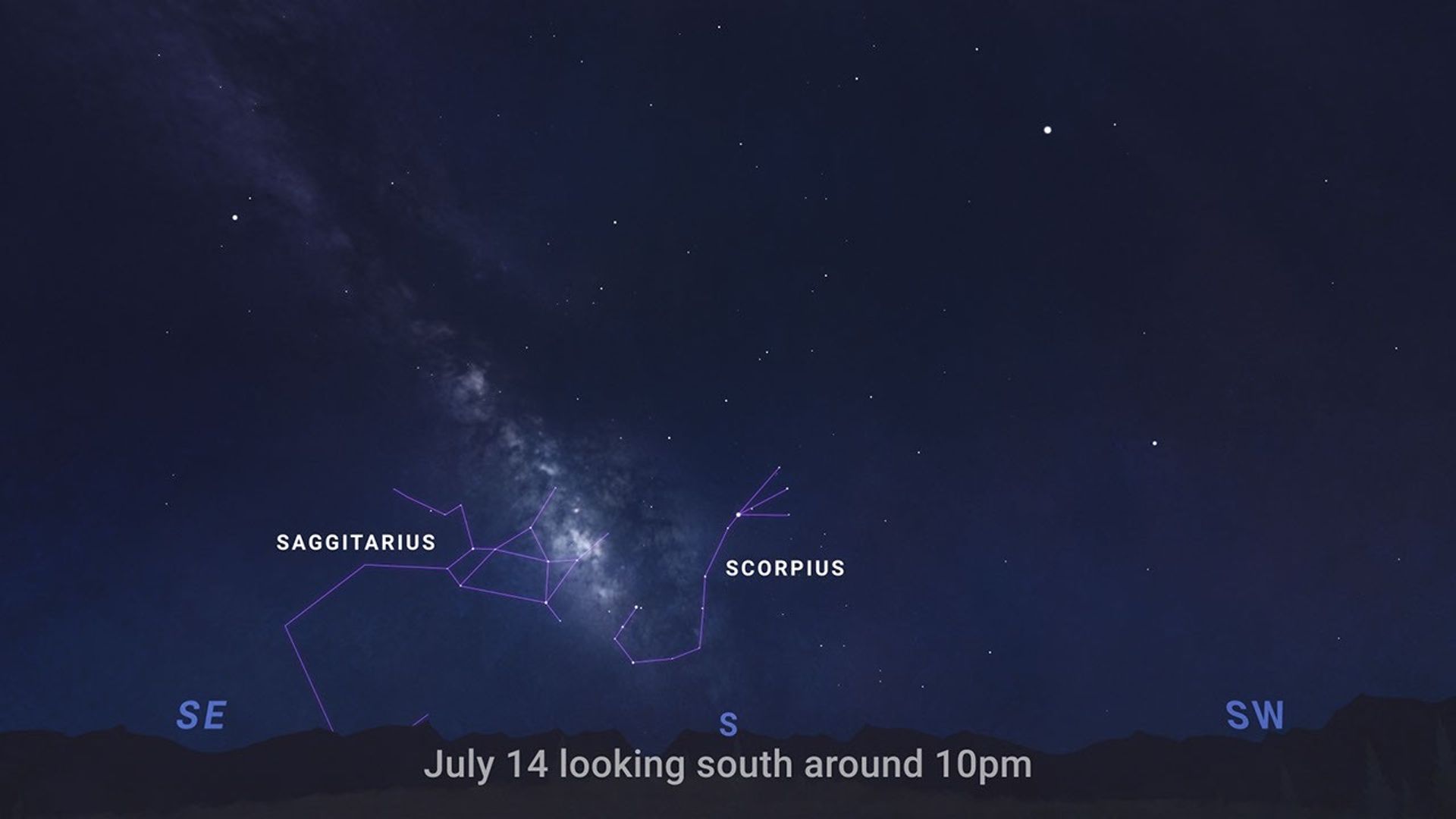
From a dark location, away from city lights, the Milky Way appears as a pale, cloudy band across the summer sky. The bright, cloudy region of the Milky Way marks the direction of the galactic center. It looks so dense because we’re looking toward one of the most crowded parts of our galaxy, where countless stars glow behind dark clouds of cosmic dust.
Late in the evening, look low in the southern sky for a group of stars shaped like a big hook or scorpion tail. That’s Scorpius. The bright, cloudy part of the Milky Way is nearby, close to another group of stars called Sagittarius.
For the best chance to see the Milky Way, go somewhere dark, give your eyes time to adjust, and try not to look at your phone.
NASA/JPL-CaltechLater in July, Saturn is a rewarding target for telescope users.
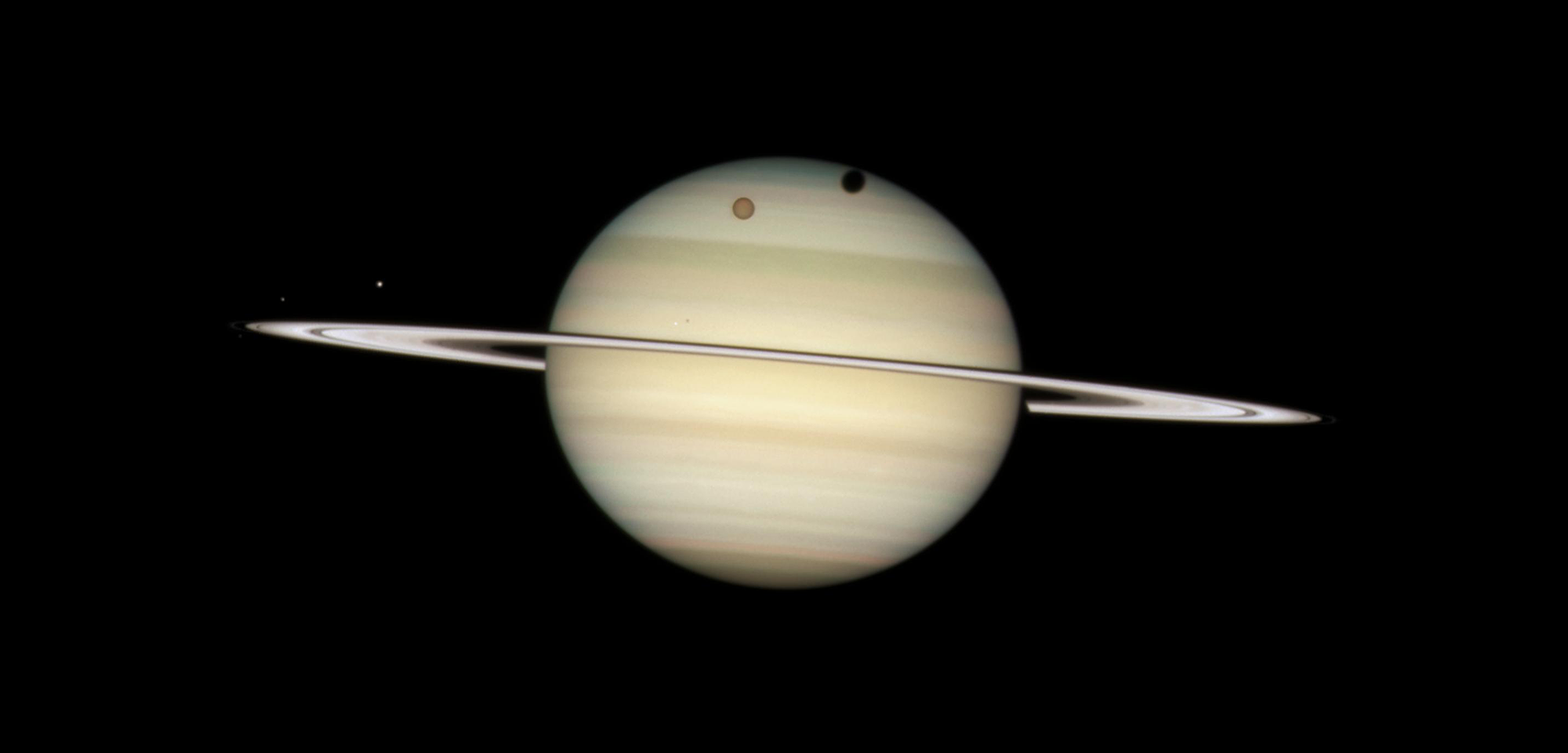
Saturn’s rings are still tilted at a very shallow angle from our point of view, making them look unusually thin. The rings aren’t disappearing, but how they appear from Earth is changing. It’s a great reminder that our view of the solar system is always in motion.
Saturn is famous for the intriguing rings that encircle it. As Saturn orbits the Sun, though, our view of its rings changes. Roughly every 15 years (halfway through Saturn’s almost-30-year orbit), Saturn’s rings appear edge-on, sometimes seeming to disappear altogether. On Feb. 24, 2009, when Saturn’s rings were nearly edge-on, Hubble tracked four of Saturn’s moons as they passed across the face of the giant ringed planet. NASA, ESA, and the Hubble Heritage Team (STScI/AURA)Here are the phases of the Moon for July.
NASA/JPL-CaltechYou can stay up to date on all of NASA’s missions exploring the solar system and beyond at science.nasa.gov. I’m Raquel Villanueva from NASA’s Jet Propulsion Laboratory, and that’s What’s Up for this month.
Find skywatching events and clubs with NASA’s Night Sky Network
More skywatching resources from NASA
Keep Exploring Discover More Topics From NASA
What’s Up
Skywatching
Galaxies
Stars
NASA’s Chandra Examines Milky Way at Arms’ Length
5 min read
NASA’s Chandra Examines Milky Way at Arms’ LengthTo view this video please enable JavaScript, and consider upgrading to a web browser that
supports HTML5 video
A new result using NASA’s Chandra X-ray Observatory shows that the outer spiral arms in the Milky Way galaxy may reach wider than previously thought. This finding may lead astronomers to adjust their understanding of our home galaxy’s structure.
A team of astronomers made this discovery by making precise measurements of distances to dust clouds in the Milky Way’s spiral arms using data from both NASA’s Chandra and XMM-Newton, an ESA (European Space Agency) mission with NASA contributions. The results are described in a new paper published Wednesday in the Astronomy & Astrophysics journal.
The researchers determined the distances by studying rings around gamma-ray bursts, some of the brightest bursts of light in the universe, which arise from the collapse of massive stars or the merger of neutron stars. They are located at enormous distances, well beyond the confines of our galaxy.
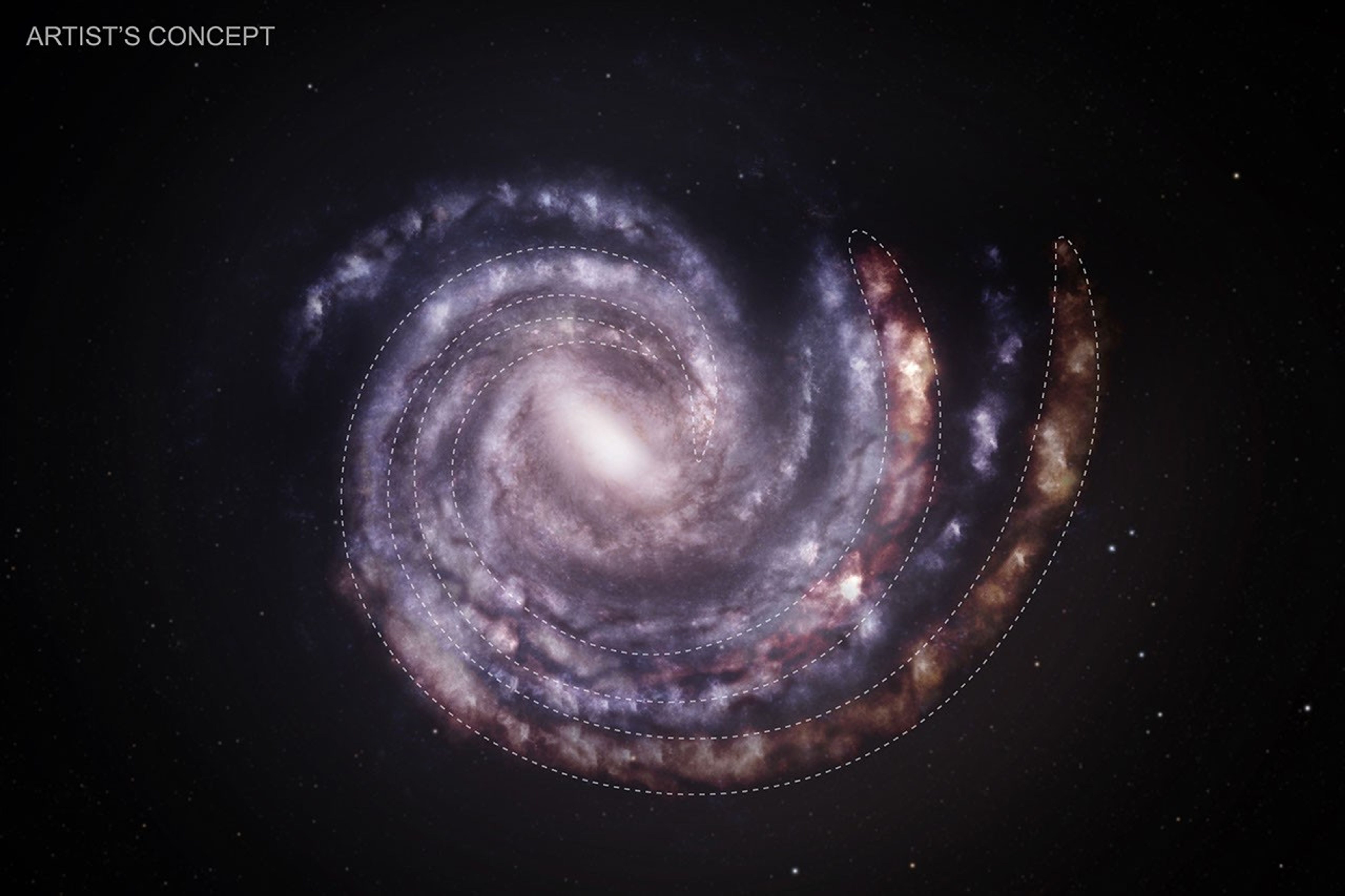
An artist’s concept showing the Milky Way galaxy as seen from above, with the estimated positions of spiral arms based on previous data, in blue. Overlaid on this is an updated view of the Milky Way showing different positions for the two outermost spiral arms, shown in red and bordered by dashed lines. Both arms may be more distant than previously thought, based on newly processed X-ray data from Chandra and XMM. NASA/CXC/SAO/M.WeissThis distance measurement technique capitalized on the phenomenon of light echoes, where the light from the gamma-ray burst bounced off dust clouds in the spiral arms. The diameters of the rings in X-rays give the distances to Earth, with larger rings being generated by dust clouds closer to us.
“This is a very direct way – relying only on geometry – to precisely measure distances to the Milky Way’s spiral arms,” said Beatrice Vaia, who led the study while a PhD student in a joint program between Scuola Universitaria Superiore IUSS Pavia and University of Trento in Italy. “Most other methods rely on assumptions about how the Milky Way rotates, which become increasingly uncertain in the outer regions of our galaxy.”
Despite a century of awareness of the Milky Way’s spiral arms, astronomers are still working toward precise characterization of its arms because of Earth’s position within one. Dust and gas also block the view to other arms.
The researchers used three different gamma-ray bursts to determine the distances to three spiral arms in the Milky Way. In order of increasing distances from the Galactic Center, they are the Perseus, the Outer, and the Outer Scutum-Centaurus arms. Along the direction of one of the bursts, they found that both the Outer and Outer Scutum-Centaurus arms are about 10% more distant than astronomers previously thought.
“The differences are small, but any revision of these distances is important because they are so fundamental for understanding our galaxy,” said co-author Ilaria Fornasiero, who was a PhD student in the same program as the leading author. “For example, this could mean that astronomers have to revise estimates of the mass of the galaxy, because that affects how wide the arms stretch.”
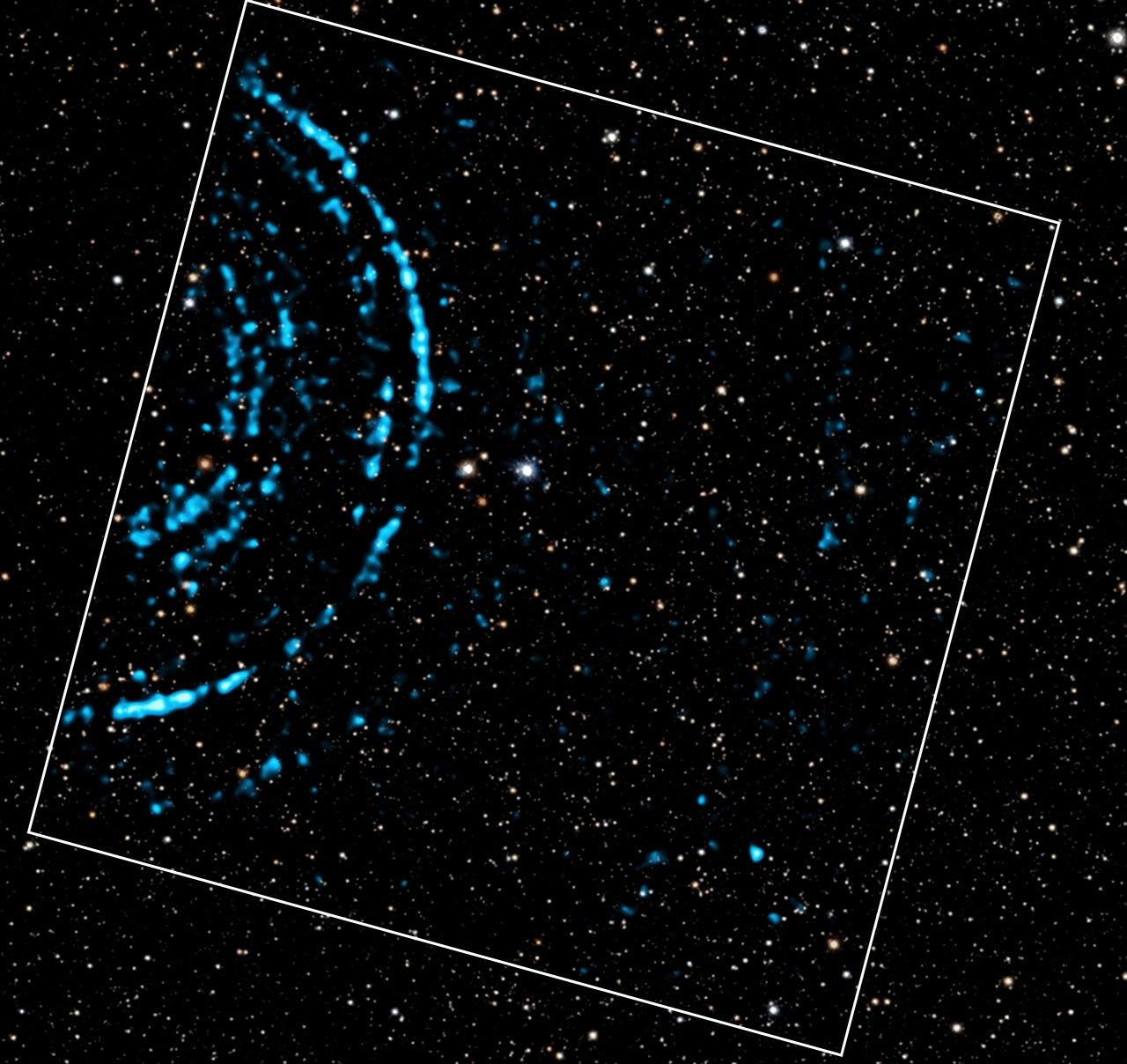
The images include X-ray data from Chandra and optical data from Pan-STARRS. The composite image shows X-ray rings generated by a gamma-ray burst (GRB), a bright X-ray source located outside our galaxy. In a phenomenon called light echoes, the X-rays from the GRB bounced off dust clouds in the spiral arms of our galaxy. The diameters of the rings in the Chandra data give the distances of the dust clouds to Earth, with larger rings being generated by dust clouds closer to us. The GRB is located at the center of the circles defining the rings, to the left of the X-ray data outlined by the white square. X-ray: NASA/CXC/INAF/B. Vaia et al.; Optical: Pan-STARRS; Image processing: NASA/CXC/SAO/N.Wolk & P.EdmondsThe team also used their data to estimate that the dust cloud in the most distant arm is about 3,500 light-years wide. These findings show that their measurements apply to the full thickness of the spiral arm, rather than a random, isolated dust cloud that may not fully be representative of the arm’s location.
While this technique provided major improvements in accuracy according to the researchers, it may be difficult to use it for further measurements because bright gamma-ray bursts that are visible through the plane of the galaxy are rare.
“We’re relying on the universe to provide us with these events, and so far, over 25 years, we’ve only found a handful that we can use,” said co-author Andrea Tiengo of Scuola Universitaria Superiore IUSS Pavia. “That said, we will continue to be on the lookout for more.”
NASA’s Marshall Space Flight Center in Huntsville, Alabama, manages the Chandra program. The Smithsonian Astrophysical Observatory’s Chandra X-ray Center controls science operations from Cambridge, Massachusetts, and flight operations from Burlington, Massachusetts.
Read more from NASA’s Chandra X-ray Observatory
To learn more about Chandra, visit:
To learn more about NASA’s Chandra mission, visit:
Visual DescriptionThis release features a short video and a series of images, all related to an updated understanding of our home galaxy’s structure. By studying rings of X-ray light echoes, researchers now believe that two of the Milky Way’s spiral arms may be more distant from the center of the galaxy than previously thought.
The updated understanding of the structure of the Milky Way is highlighted in a short video, which compares two artist concept images. In both images, our spiral Milky Way galaxy is shown face-on. It has a bright white core with several arms that spiral out from the center, like long thin clouds corkscrewing counterclockwise. The two longest arms make a full rotation of the spiral galaxy, and curve all the way around to the upper right of the images.
The first image in the video shows the previous understanding of the Milky Way. Here, the two longest arms are curled around the core in a fairly tight spiral. In the second image, which represents the updated understanding, the two longest arms are more loosely spiraled. Visually, this means there is more open space between the curving arms, which are further away from the bright galaxy core. The video fades back and forth between the two artist concept images to illustrate the structural differences between the two understandings.
These findings are further shown by a static image which overlays the new understanding on top of the earlier understanding. In this artist’s concept illustration, dotted lines and different colors are used to differentiate between the two.
A team of astronomers made this discovery by studying gamma-ray bursts that bounce off of dust clouds in the galaxy’s spiral arms. The resulting rings of X-rays, known as light echoes, were detected and mapped by NASA’s Chandra X-ray Observatory and ESA’s XMM-Newton. In a supplemental data image, the light echoes resemble concentric arches of neon blue dots trailing across a speckled sky.
Identifying the position of the Milky Way’s spiral arms through X-ray light echoes has allowed astronomers to use geometry, rather than assumptions about galaxy rotation, to better understand the structure of our galaxy.
Share Details Last Updated Jul 02, 2026 Editor Lee Mohon Contact Joel Wallace Megan Watzke Location Marshall Space Flight Center Related Terms Share Details Last Updated Jul 02, 2026 Editor Lee Mohon Contact Joel Wallace Megan Watzke Location Marshall Space Flight Center Related Terms Explore More 7 min read NASA’s Chandra Reveals ‘Red, White, Blue’ Universe for US 250thArticle
2 days ago
5 min read NASA’s Chandra Discovers Possible Supernova Remnant in Galactic Center
Article
3 weeks ago
5 min read NASA Finds Young Stars Dim in X-rays Surprisingly Quickly
Article
3 months ago
Keep Exploring Discover More Topics From NASA
Chandra X-ray Observatory
James Webb Space Telescope
Webb is the premier observatory of the next decade, serving thousands of astronomers worldwide. It studies every phase in the…
Hubble Space Telescope
Since its 1990 launch, the Hubble Space Telescope has changed our fundamental understanding of the universe.
Solar System