NASA News

Meet NASA’s New Artemis II Science Officers
NASA/Josh Valcarcel
Business attire, headsets, and multiple computer monitors are a much different backdrop than hiking gear, rock hammers, and the volcanic fields of Iceland. For Kelsey Young of NASA’s Goddard Space Flight Center in Greenbelt, Maryland, and Trevor Graff and Angela Garcia of NASA’s Johnson Space Center in Houston, comfort and skill across both environments have made them uniquely suited to be certified as NASA’s first Artemis II science officers.
The integration of science operations into human spaceflight dates back to Apollo, but Artemis introduces a new dedicated position in NASA’s Mission Control, marking an evolution of how science is embedded in mission operations.
“The science officer is the senior flight controller responsible for lunar science and geology objectives during Artemis missions,” said Young, who also serves as NASA’s Artemis II lunar science lead. “They will integrate with all the other console disciplines and ensure NASA’s lunar science objectives are seamlessly integrated into mission execution.”
Artemis science officers, from left, Kelsey Young, Trevor Graff, and Angela Garcia stand at the new SCIENCE console in the Mission Control Center at NASA’s Johnson Space Center in Houston. Credits NASA/Josh ValcarcelThe front room of Mission Control is filled with consoles, or workstations, each dedicated to a particular system or function of the mission. Flight controllers at each console monitor areas such as communications, life support, propulsion, and now, science. Many of the console positions are supported by larger teams of experts who work from either different “back rooms” at NASA’s Johnson Space Center in Houston, or other locations.
Young, Garcia, and Graff completed months of flight controller training, testing, and certification simulations in Mission Control, while also executing geology and lunar observation trainings and integrated simulations with the astronauts.
One of the most exciting, challenging, and rewarding components of the process are the simulations, where we tested our skills and knowledge while immersed in very realistic mission scenarios.Trevor Graff
Artemis Science Officer
“One of the most exciting, challenging, and rewarding components of the process are the simulations, where we tested our skills and knowledge while immersed in very realistic mission scenarios,” said Graff.
The simulations often included the Artemis II astronauts and covered the lunar flyby portion of the mission, planned for Monday, April 6, during which time the crew will take photographs of the Moon and record audio of their observations. They will be the eyes of the lunar scientists on Earth and have gone through geology training in the classroom and in the field to be able to capture as much information as possible during their pass around the far side of the Moon. Young said the astronauts have worked incredibly hard at building their lunar science toolboxes, studying lunar geography, traipsing across lunar-like landscapes in Iceland, and cultivating their ability to provide scientifically impactful descriptions of the Moon.
Artemis II science officer Kelsey Young monitors science operations at the new SCIENCE console in NASA’s Mission Control Center. Credits: NASA/Bill StaffordListen to this audio clip from Kelsey Young talking about how the Artemis II astronauts have studied lunar geography to prepare for their mission. Credit: NASA’s Curious Universe
0:00 / 0:00
Your browser does not support the audio element.
“After so many months of hearing their descriptions of lunar visualizations during simulations, I’m most excited for the very first time I hear them describing the actual Moon out of the Orion windows,” said Young. “Hearing the excitement and scientific meaning behind their descriptions will be an incredible moment.”
Human eyes and brains are highly sensitive to subtle changes in color, texture, and other surface characteristics. Having astronaut eyes observe the lunar surface directly, in combination with the context of all the advances that scientists have made about the Moon over the last several decades, may uncover new discoveries and a more nuanced appreciation for the features on the surface of the Moon. While Artemis II will not land on the lunar surface, its contributions to lunar science are significant.
“The crew will be exploring through observation—a foundational scientific tool,” said Garcia.
To view this video please enable JavaScript, and consider upgrading to a web browser that
supports HTML5 video
As the astronauts make those observations, their photos and recorded audio will be fed down to two science back rooms at NASA Johnson, the Science Evaluation Room and Science Mission Operations Room. Experts in these rooms will provide data analysis and strategic guidance in real time to the science officer in Mission Control. These processes represent a major component of Artemis II as a test flight: refining science mission operations.
This mission will test the lunar science team’s workflows, technical requirements, and integration into Mission Control. Lessons learned during Artemis II will pave the way for lunar science operations for future Artemis missions. Young explained that science integration into human spaceflight has a long, rich history. While there was no science representative in the front room of Mission Control during Apollo, there was a geology back room onsite at Johnson. As Apollo missions progressed, the structure of integrating with the rest of the flight control team evolved and the footprint expanded as the science capability of each mission grew.
Garcia said she is humbled, honored, and grateful to be a part of the flight control team and to have trained the astronauts. The Moon is something everyone, everywhere, can see and connect with, according to Young.
“I hope people all over the world can be inspired by this push away from our planet,” said Young, “I also hope they remember the Moon, how much we still have to learn about our nearest neighbor but also the special place it holds to people everywhere.”
Download high-res images and videos
About the Author Rachel BarryShare
Details Last Updated Apr 03, 2026 Related Terms Explore More 4 min read Barents Sea Tied to Low Arctic Sea IcePatches of open water in the region contributed to low sea ice extent across the…
Article
16 hours ago
3 min read NASA Names Scientists to Support Lunar South Pole Science
Article
1 week ago
3 min read What’s Up: April 2026 Skywatching Tips from NASA
Mercury shines at its brightest for the year, the Lyrid meteor shower peaks, and a…
Article
1 week ago
Keep Exploring Discover More Topics From NASA
Missions
Humans in Space
Climate Change
Solar System
Virgil I. “Gus” Grissom
Today marks the 100th anniversary of the birth of Virgil I. “Gus” Grissom, born April 3, 1926, in Mitchell, Indiana. As one of NASA’s first seven astronauts, he became America’s second astronaut to fly in space when he launched aboard the Liberty Bell 7 spacecraft on July 21, 1961, just weeks after Alan Shepard’s historic first Project Mercury spaceflight.
In this photo, Grissom is seen enjoying a meal aboard the recovery ship, USS Randolph, following his 15-minute suborbital mission. Although the flight itself was smooth, the situation turned dangerous after splashdown when the capsule’s hatch blew prematurely and the spacecraft began flooding with water. Grissom escaped, but his spacesuit also filled with water as the recovery helicopters attempted to save his sinking spacecraft. He was successfully rescued, but the Liberty Bell 7 sank to the ocean floor.
Grissom made history again in March 1965 as the first NASA astronaut to fly in space twice, serving as commander of Gemini III, the first crewed Gemini mission, alongside John Young. Reflecting on this test flight, he wrote, “To our intense satisfaction we were able to carry out these maneuvers almost exactly as planned… The longer we flew, the more jubilant we felt. We had a really fine spacecraft, one we could be proud of in every respect.”
One year later, in March 1966, NASA announced that Grissom had been selected to command the first Apollo mission, with crewmates Edward White and Roger Chaffee. On January 27, 1967, tragedy struck during a preflight test at Cape Kennedy when fire swept through the command module. Grissom, White, and Chaffee lost their lives in an accident that stunned the nation and shook NASA to its core.
Just weeks before the tragedy, Grissom wrote: “There will be risks, as there are in any experimental program, and sooner or later, we’re going to run head-on into the law of averages and lose somebody. I hope this never happens, and… perhaps it never will, but if it does, I hope the American people won’t think it’s too high a price to pay for our space program.”
Hello, World
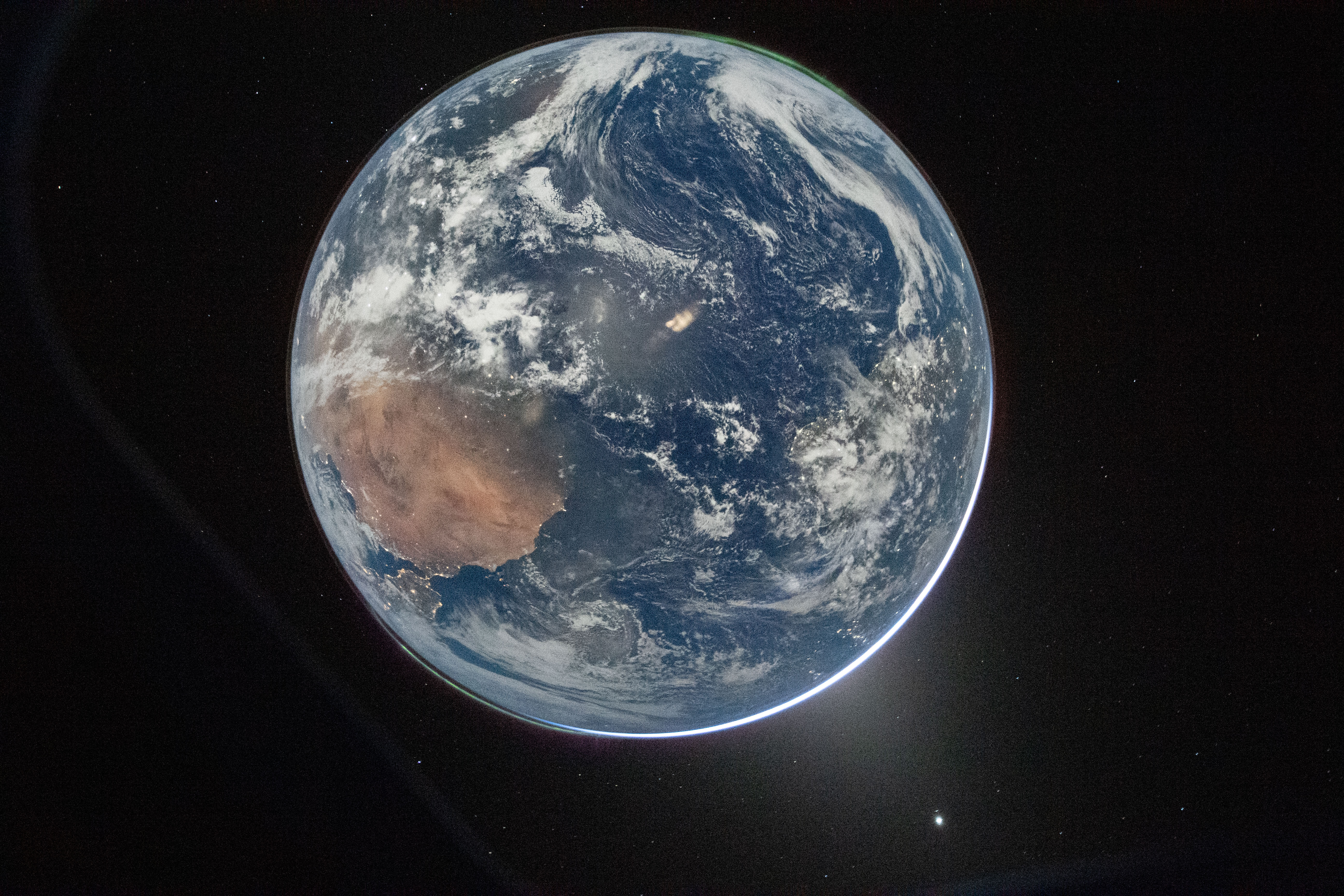
NASA astronaut and Artemis II Commander Reid Wiseman took this picture of Earth from the Orion spacecraft’s window after completing the translunar injection burn. There are two auroras (top right and bottom left) and zodiacal light (bottom right) is visible as the Earth eclipses the Sun.
This and another photo of Earth are the first downlinked images from the Artemis II astronauts. See more photos from Orion as they are shared.
See and hear what the astronauts do with our 24/7 feed.
Image credit: NASA/Reid Wiseman
Barents Sea Tied to Low Arctic Sea Ice
- Earth
- Earth Observatory
- Image of the Day
- EO Explorer
- Topics
- More Content
- About
NASA’s Artemis II Mission Leaves Earth Orbit for Flight around Moon
For the first time in more than 50 years, astronauts on a NASA mission are bound to fly around the Moon after successfully completing a key burn of Orion’s main engine.
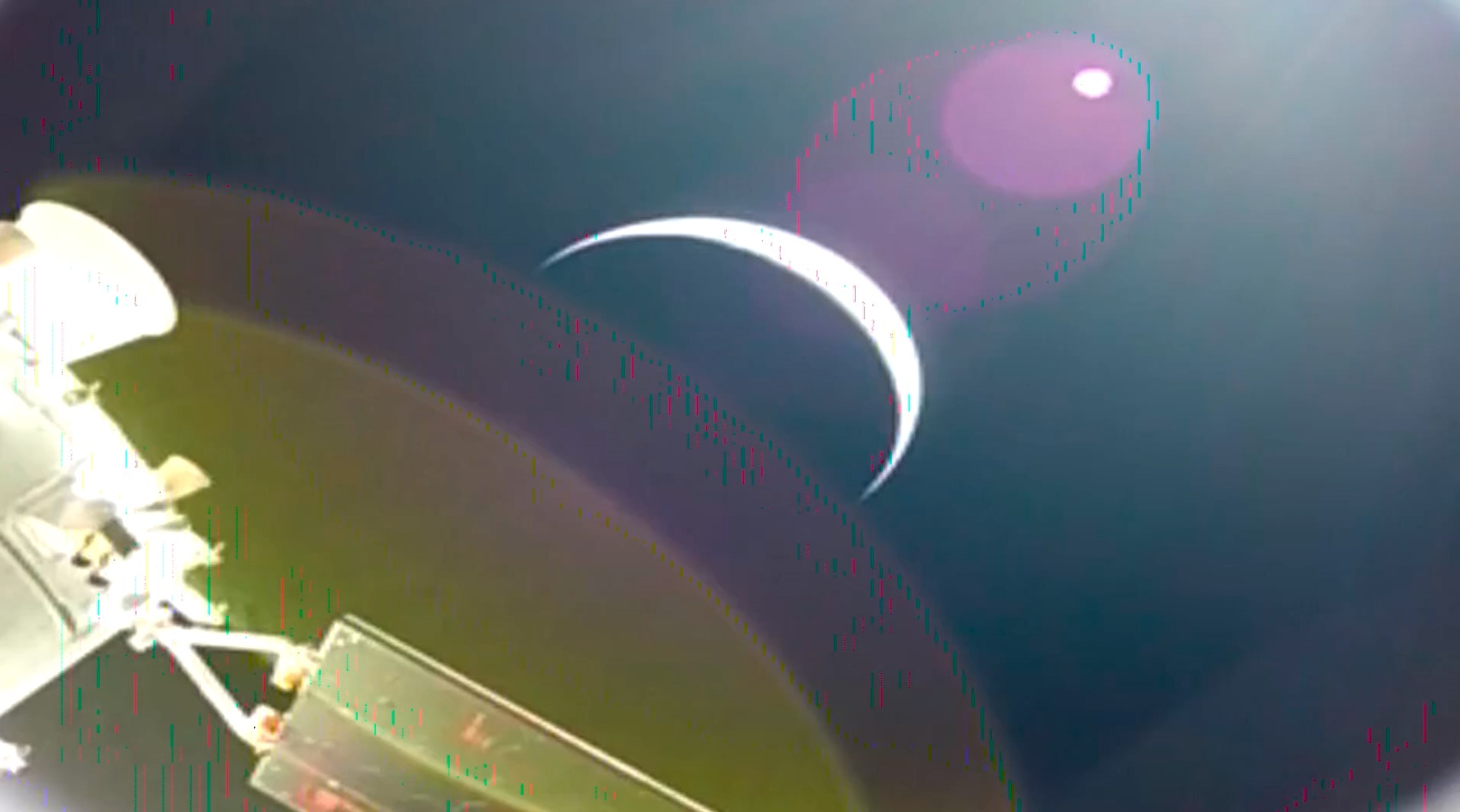
With the approximately six-minute firing of the spacecraft’s service module engine on Thursday, known as the translunar injection burn, Orion and its crew of NASA astronauts Reid Wiseman, Victor Glover, Christina Koch, and CSA (Canadian Space Agency) astronaut Jeremy Hansen accelerated to break free of Earth’s orbit and began the outbound trajectory toward Earth’s nearest neighbor.
“Today, for the first time since Apollo 17 in 1972, humans have departed Earth orbit. Reid, Victor, Christina, and Jeremy now are on a precise trajectory toward the Moon. Orion is operating with crew for the first time in space, and we are gathering critical data, and learning from each step,” said Dr. Lori Glaze, acting associate administrator for the Exploration Systems Development Mission Directorate at NASA Headquarters in Washington. “Each milestone we reach marks meaningful progress on the path forward for the Artemis program. While we have eight intensive days of work ahead, this is a big moment, and we’re proud to share it with the world.”
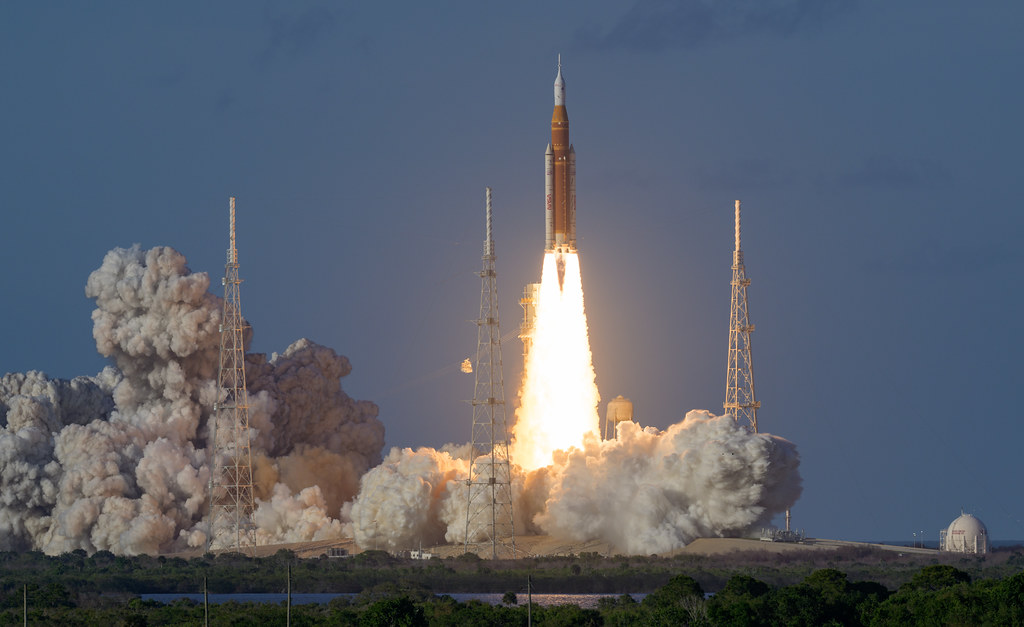
NASA’s SLS (Space Launch System) rocket and Orion spacecraft lifted off from Launch Pad 39B at the agency’s Kennedy Space Center in Florida at 6:35 p.m. EDT on April 1, sending the four astronauts on a planned 10-day test flight around the Moon and back.
After reaching space, Orion deployed its four solar array wings, enabling the spacecraft to receive energy from the Sun, while the crew and engineers on the ground immediately began transitioning the spacecraft from launch to flight operations to start checking out key systems.
About 49 minutes into the test flight, the SLS rocket’s upper stage fired to put Orion into an elliptical orbit around Earth. A second planned burn by the stage propelled Orion, which the crew named “Integrity,” into a high Earth orbit extending about 46,000 miles above the Earth for about 24 hours of system checkouts. After the burn, Orion separated from the stage, flying free on its own.
The crew then conducted a manual piloting demonstration to test Orion’s handling qualities using the ICPS (interim cryogenic propulsion stage) as a docking target.
At the conclusion of the demonstration, Orion executed an automated departure burn to safely back away from the ICPS, after which the stage performed its own disposal burn and re-entered Earth’s atmosphere over a remote region of the Pacific Ocean.
Prior to its re-entry, four small CubeSats were deployed from SLS rocket’s Orion stage adapter.
Other tasks completed so far include a transition to the Deep Space Network for communications, the crew becoming acclimated to the space environment, completing their first rest periods, performing the first flywheel exercise, restoring the spacecraft’s toilet to normal operations, and configuring the spacecraft for the translunar injection burn.
During a planned lunar flyby on Monday, April 6, the astronauts will take high resolution photographs and provide their own observations of the lunar surface, including areas of the far side of the Moon never seen directly by humans. Although the lunar far side will only be partially illuminated during the flyby, the conditions should create shadows that stretch across the surface, enhancing relief and revealing depth, ridges, slopes, and crater rims that are often difficult to detect under full illumination.
Following a successful lunar flyby, the astronauts will return to Earth and splash down in the Pacific Ocean off the coast of San Diego.
As part of a Golden Age of innovation and exploration, NASA will send Artemis astronauts on increasingly challenging missions to explore more of the Moon for scientific discovery, economic benefits, and to build on our foundation for the first crewed missions to Mars.
Follow the latest mission progress, including more images from the test flight, at:
https://www.nasa.gov/artemis-ii
-end-
Cheryl Warner / Rachel Kraft
Headquarters, Washington
202-358-1600
cheryl.m.warner@nasa.gov / rachel.h.kraft@nasa.gov
Artemis II Astronauts Launch to Moon
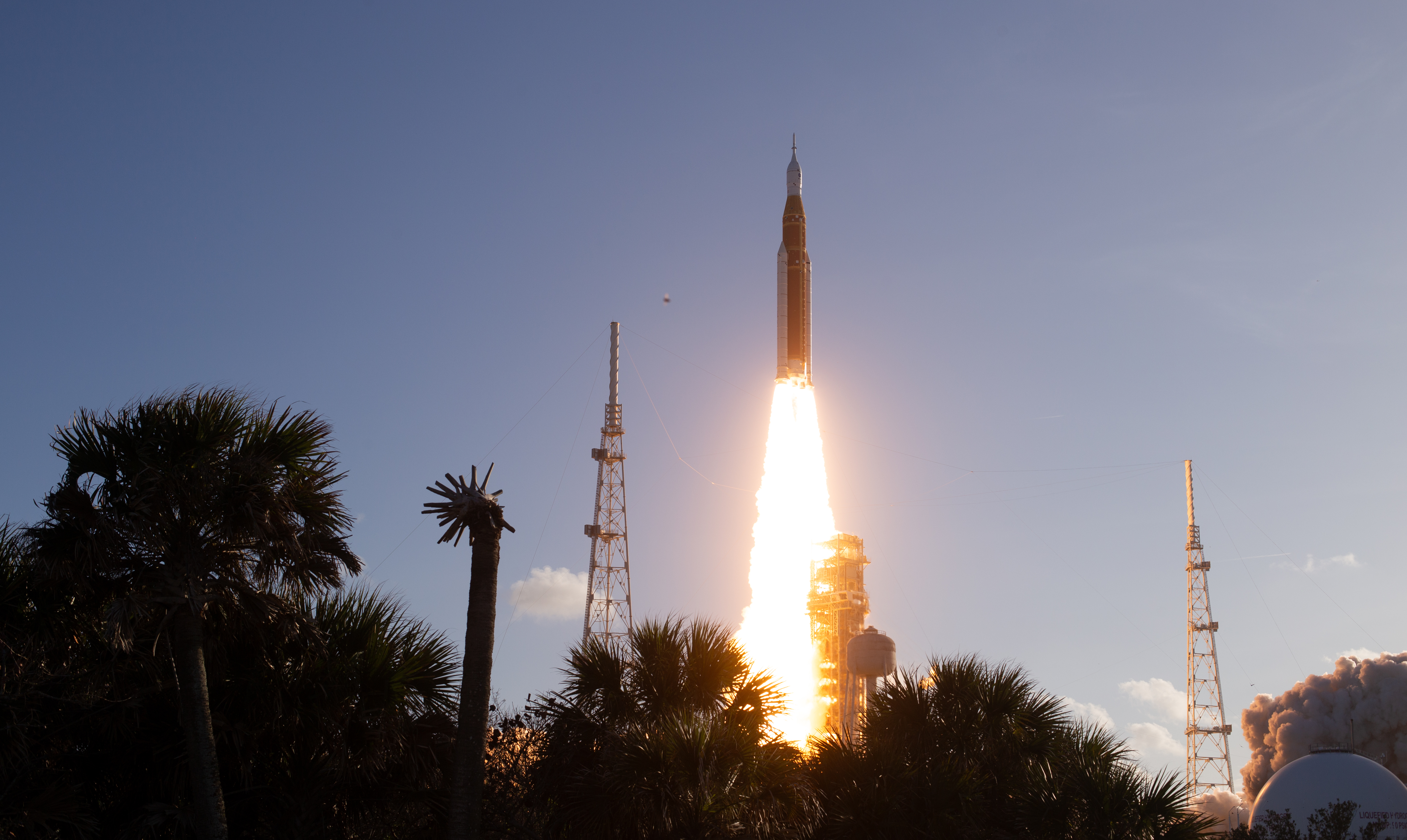
NASA’s Space Launch System rocket and Orion spacecraft lift off in this April 1, 2026, image. NASA’s Artemis II mission will take NASA astronauts Reid Wiseman, Victor Glover, and Christina Koch, and CSA (Canadian Space Agency) astronaut Jeremy on an approximately 10-day journey around the Moon and back aboard their Orion spacecraft.
Image credit: NASA/Aubrey Gemignani
Réunion Island Lava Reaches the Sea
- Earth
- Earth Observatory
- Image of the Day
- EO Explorer
- Topics
- More Content
- About
Liftoff! NASA Launches Astronauts on Historic Artemis Moon Mission
Spurred by American ingenuity, astronauts on NASA’s Artemis II mission are in flight, preparing for the first crewed lunar flyby in more than 50 years.
NASA’s SLS (Space Launch System) rocket lifted off from Launch Pad 39B at the agency’s Kennedy Space Center in Florida at 6:35 p.m. EDT Wednesday, sending four astronauts aboard the Orion spacecraft on a planned test flight around the Moon and back.
“Today’s launch marks a defining moment for our nation and for all who believe in exploration. Artemis II builds on the vision set by President Donald J. Trump, returning humanity to the Moon for the first time in more than 50 years and opening the next chapter of lunar exploration beyond Apollo. Aboard Orion are four remarkable explorers preparing for the first crewed flight of this rocket and spacecraft, a true test mission that will carry them farther and faster than any humans in a generation,” said NASA Administrator Jared Isaacman. “Artemis II is the start of something bigger than any one mission. It marks our return to the Moon, not just to visit, but to eventually stay on our Moon Base, and lays the foundation for the next giant leaps ahead.”
The successful launch is the beginning of an approximately 10-day mission for NASA astronauts Reid Wiseman, Victor Glover, Christina Koch, and CSA (Canadian Space Agency) astronaut Jeremy Hansen. As the first crewed mission of NASA’s Artemis program, among its objectives, the flight will demonstrate life support systems for the first time with crew and lay the foundation for an enduring presence on the Moon ahead of future missions to Mars.
After reaching space, Orion deployed its solar array wings, enabling the spacecraft to receive energy from the Sun, while the crew and engineers on the ground immediately began transitioning the spacecraft from launch to flight operations to start checking out key systems.
“Artemis II is a test flight, and the test has just begun. The team that built this vehicle, repaired it, and prepared it for flight has given our crew the machine they need to go prove what it can do,” said NASA Associate Administrator Amit Kshatriya. “Over the next 10 days, Reid, Victor, Christina, and Jeremy will put Orion through its paces so the crews who follow them can go to the Moon’s surface with confidence. We are one mission into a long campaign, and the work ahead of us is greater than the work behind us.”
About 49 minutes into the test flight, the SLS rocket’s upper stage fired to put Orion into an elliptical orbit around Earth. A second planned burn by the stage will propel Orion, which the crew named “Integrity,” into a high Earth orbit extending about 46,000 miles beyond Earth. After the burn, Orion will separate from the stage, flying free on its own.
In several hours, a ring on the rocket’s upper stage, which will be a safe distance away from the spacecraft, will deploy four CubeSats – small satellites from Argentina’s Comisión Nacional de Actividades Espaciales, German Aerospace Center, Korea AeroSpace Administration, and Saudi Space Agency – to perform scientific investigations and technology demonstrations.
The spacecraft will remain in high Earth orbit for about a day, where the crew will conduct a manual pilot demonstration to test Orion’s handling capabilities. The astronauts, with Mission Control Center teams at NASA’s Johnson Space Center in Houston, will continue checking spacecraft systems.
If all systems remain healthy, mission controllers will give Orion’s European-built service module a command to conduct the translunar injection burn on Thursday, April 2. This move is an approximately six-minute firing to send the spacecraft on a trajectory that will simultaneously carry crew around the Moon, while also harnessing lunar gravity to slingshot them back to Earth.
During a planned multi-hour lunar flyby on Monday, April 6, the astronauts will take photographs and provide observations of the Moon’s surface as the first people to lay eyes on some areas of the far side. Although the lunar far side will only be partially illuminated during the flyby, the conditions should create shadows that stretch across the surface, enhancing relief and revealing depth, ridges, slopes and crater rims that are often difficult to detect under full illumination. Crew observations and other human health scientific investigations during the mission, such as AVATAR, will inform science during future Moon missions.
Following a successful lunar flyby, the astronauts will return to Earth and splash down in the Pacific Ocean.
As part of Golden Age of innovation and exploration, NASA will send Artemis astronauts on increasingly difficult missions to explore more of the Moon for scientific discovery, economic benefits, and to build on our foundation for the first crewed missions to Mars.
Follow the latest mission progress, including more images from the test flight, visit:
https://www.nasa.gov/mission/artemis-ii/
-end-
Bethany Stevens / Rachel Kraft
Headquarters, Washington
202-358-1100
bethany.c.stevens@nasa.gov / rachel.h.kraft@nasa.gov