NASA News

Strong Solar Flare
This Feb. 4, 2026, image from NASA’s Solar Dynamics Observatory (SDO) captures a strong solar flare erupting from the star. Solar flares are powerful bursts of energy that can, along with other types of solar eruptions, can impact radio communications, electric power grids, navigation signals, and pose risks to spacecraft and astronauts. The flare pictured was classified as an X4.2 flare. X-class denotes the most intense flares, while the number provides more information about its strength.
SDO measures the Sun’s properties and solar activity to help us better understand the Sun’s magnetic changes. By studying flares and how they affect our planet and nearby space, SDO helps us to better prepare for and deal with these potential disruptions.
Image credit: NASA/SDO
Boreal Forests Are Shifting North
- Landsat Home
- Missions
- News
- Data
- Benefits
- Outreach
- Multimedia
- About
- Search
To view this video please enable JavaScript, and consider upgrading to a web browser that
supports HTML5 video
The boreal forest—the world’s largest terrestrial biome—is warming faster than any other forest type. To understand the changing dynamics of boreal forests, Feng et al., 2026 analyzed the biome from 1985 to 2020, leveraging the longest and highest-resolution satellite record of calibrated tree cover to date. The study, published in February in Biogeosciences with four co-authors from NASA Goddard Space Flight Center, confirms a northward shift in boreal forest cover over the past four decades. Landsat imagery played a central role in this study: the researchers applied machine learning to process 224,026 scenes collected by Landsats 4, 5, 7, and 8 to create annual, 30-meter resolution maps of tree cover across the entire boreal biome. They downscaled and extended calibrated MODIS Vegetation Continuous Fields data to 30-meter resolution, creating a 36-year time series (1984-2020) that provided unprecedented spatial detail for tracking forest changes.
The analysis revealed that boreal forests both grew in size and moved northward. The forests expanded by 0.844 million km² (a 12% increase) and shifted northward by 0.29° mean latitude, with gains concentrated between 64-68°N. Their work also showcased the capacity of new growth to act as a carbon sink. Young boreal forests (up to 36 years) hold an estimated 1.1-5.9 petagrams of carbon (Pg C) with potential to sequester an additional 2.3-3.8 Pg C if allowed to mature. Landsat’s long time series of highly calibrated data allows researchers to study how ecosystems shift over decades, a crucial insight into our changing world.
Explore More
Boreal Forests Are Shifting North
2 min read
The boreal forest—the world’s largest terrestrial biome—is warming faster than any other forest type. New research uses Landsat data to…
ArticleMilano Cortina 2026
4 min read
About 2,900 Olympic athletes have converged on northern Italy to sort out who is the GOAT—or perhaps the stoat.
ArticleTracking Glacial Change with Landsat and Radar
5 min read
NASA Scientist Alex Gardner highlights how Landsat made his research into the dynamics of glacial flow possible.
Article1
2
3
…
288
Next
A Winter Blanket Covers North Carolina
- Earth
- Earth Observatory
- Image of the Day
- EO Explorer
- Topics
- More Content
- About
NASA Selects Two Earth System Explorers Missions
Two next-generation satellite missions announced Thursday will help NASA better understand Earth and improve capabilities to foresee environmental events and mitigate disasters.
“NASA uses the unique vantage point of space to study our home planet to deliver life-saving data into the hands of disaster response and decision-makers every day for the benefit of all, while also informing future exploration across our solar system,” said Nicky Fox, associate administrator, Science Mission Directorate, NASA Headquarters in Washington. “By understanding Earth’s surface topography, ecosystems and atmosphere, while also enabling longer range weather forecasting, these missions will help us better study the extreme environments beyond our home planet to ensure the safety of astronauts and spacecraft as we return to the Moon with the Artemis campaign and journey onward to Mars and beyond.”
These two missions were selected for continued development as part of NASA’s Earth System Explorers Program, which conducts principal investigator-led Earth science missions based on key priorities laid out by the science community and national needs. The program is designed to enable high-quality Earth system science investigations to focus on previously identified key targeted observables.
The STRIVE (Stratosphere Troposphere Response using Infrared Vertically-resolved light Explorer) mission will provide daily, near-global, high-resolution measurements of temperature, a variety of Earth’s atmospheric elements, and aerosol properties from the upper troposphere to the mesosphere – at a much higher spatial density than any previous mission. It also will measure vertical profiles of ozone and trace gasses needed to understand the recovery of the ozone layer. The data collected from STRIVE would support longer-range weather forecasts, an important tool in protecting coastal communities, where nearly half the world’s population lives. The mission is led by Lyatt Jaeglé at the University of Washington in Seattle.
The EDGE (Earth Dynamics Geodetic Explorer) mission will observe the three-dimensional structure of terrestrial ecosystems and the surface topography of glaciers, ice sheets, and sea ice. The mission will provide an advancement beyond the measurements currently recorded from space by NASA’s ICESat-2 (Ice, Cloud, and land Elevation Satellite 2) and GEDI (Global Ecosystem Dynamics Investigation). The data collected by EDGE will measure conditions affecting land and sea transportation corridors, terrain, and other areas of commercial interest. The mission is led by Helen Amanda Fricker at the University of California San Diego.
The selected missions will advance to the next phase of development. Each mission will be subject to confirmation review in 2027, which will assess the progress of the missions and the availability of funds. If confirmed, the total estimated cost of each mission, not including launch, will not exceed $355 million with a mission launch date of no earlier than 2030.
For more information about the Earth System Explorers Program, visit:
https://explorers.larc.nasa.gov/2023ESE
-end-
Liz Vlock
Headquarters, Washington
202-358-1600
elizabeth.a.vlock@nasa.gov
Career Spotlight: Welder (Ages 14-18)
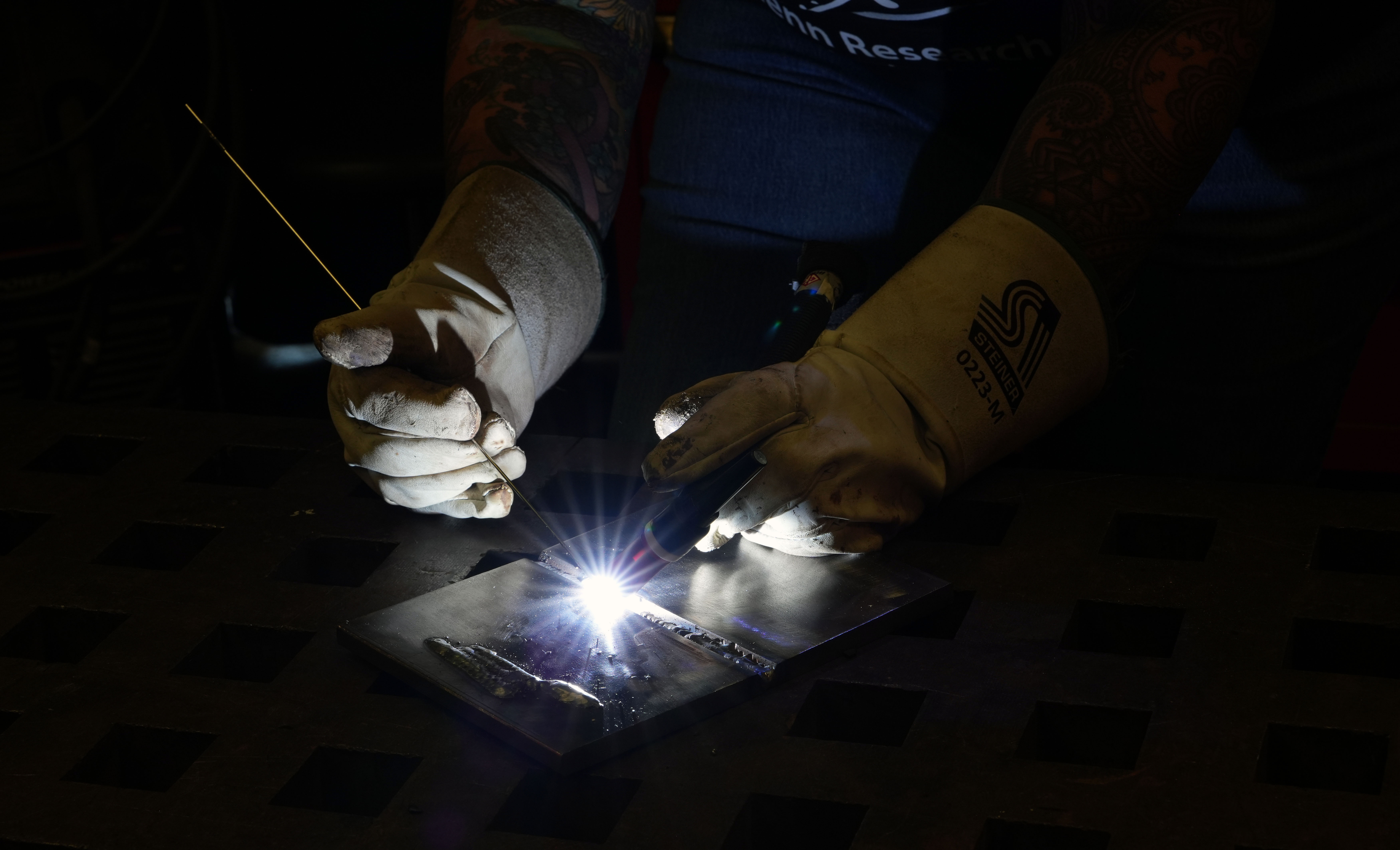
A welder uses tools that join two or more parts through forces such as heat or pressure. Metals are the materials most commonly used in welding, but it’s also possible to weld thermoplastics or wood. Welders use their hands, skills, and problem-solving abilities to create something new.
At NASA, welders use different types of welding processes to assemble spacecraft and rocket components. Welders also put their expertise to work on equipment and facilities that make space exploration possible, such as launch pads, fuel tanks, propellant lines, and buildings where rockets are assembled.
What are the different types of welding?Welding can be done in many different ways. Here are some of the types of welding used at NASA:
- Arc Welding: Uses electricity to melt metals and fuse them together. There are many types of arc welding, including TIG and MIG welding, described below.
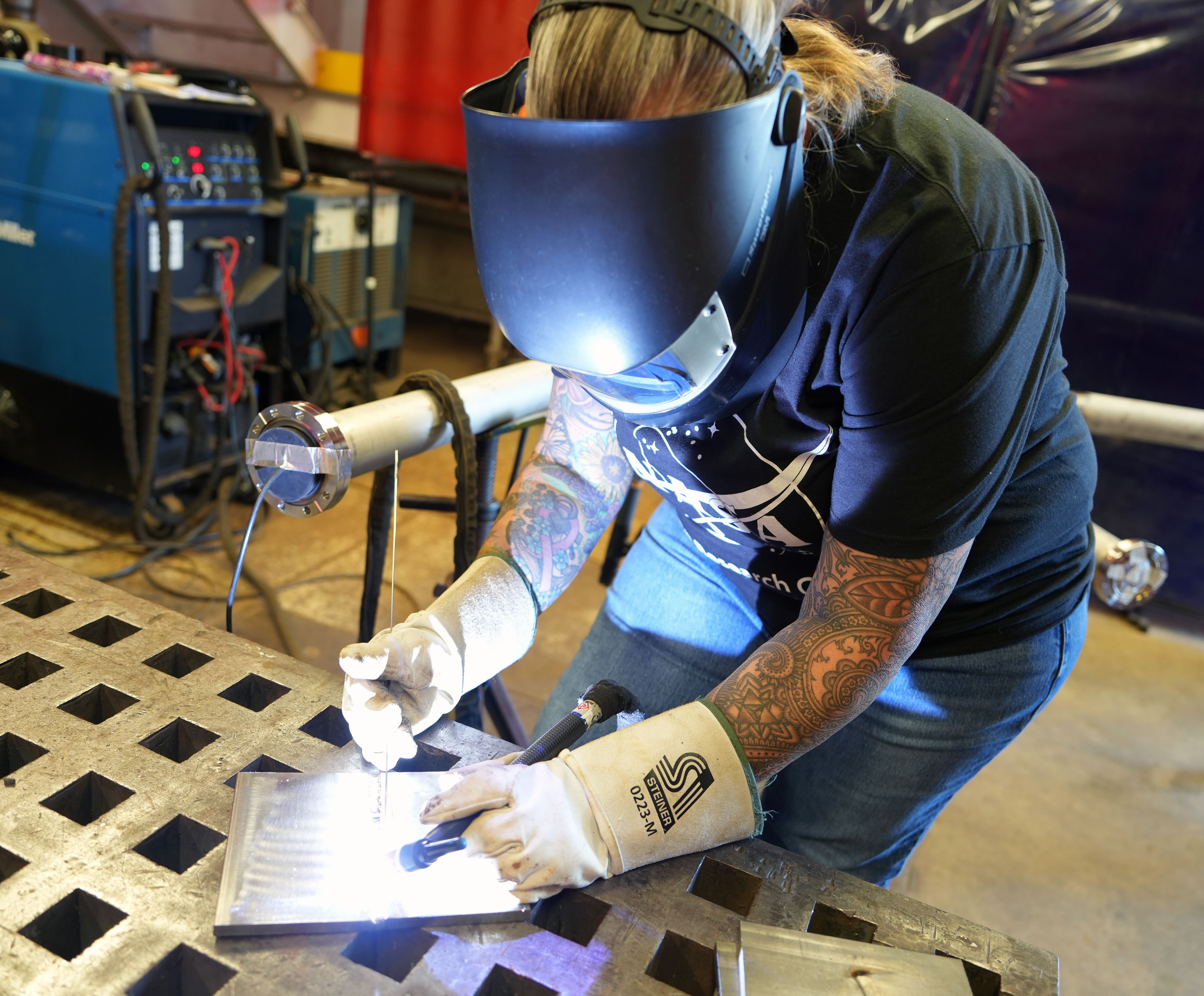
- Tungsten Inert Gas (TIG) Welding: Uses a protective gas like argon or helium to keep the metal from reacting with air. TIG welding doesn’t leave behind splatter or residue, giving a clean, precise weld.
- Metal Inert Gas (MIG) Welding: While not as clean and precise as TIG welding, is used for fast, strong welds on thicker materials, like sheet metal.
- Laser Welding: Enables welders to create tiny, perfect joints for delicate components.
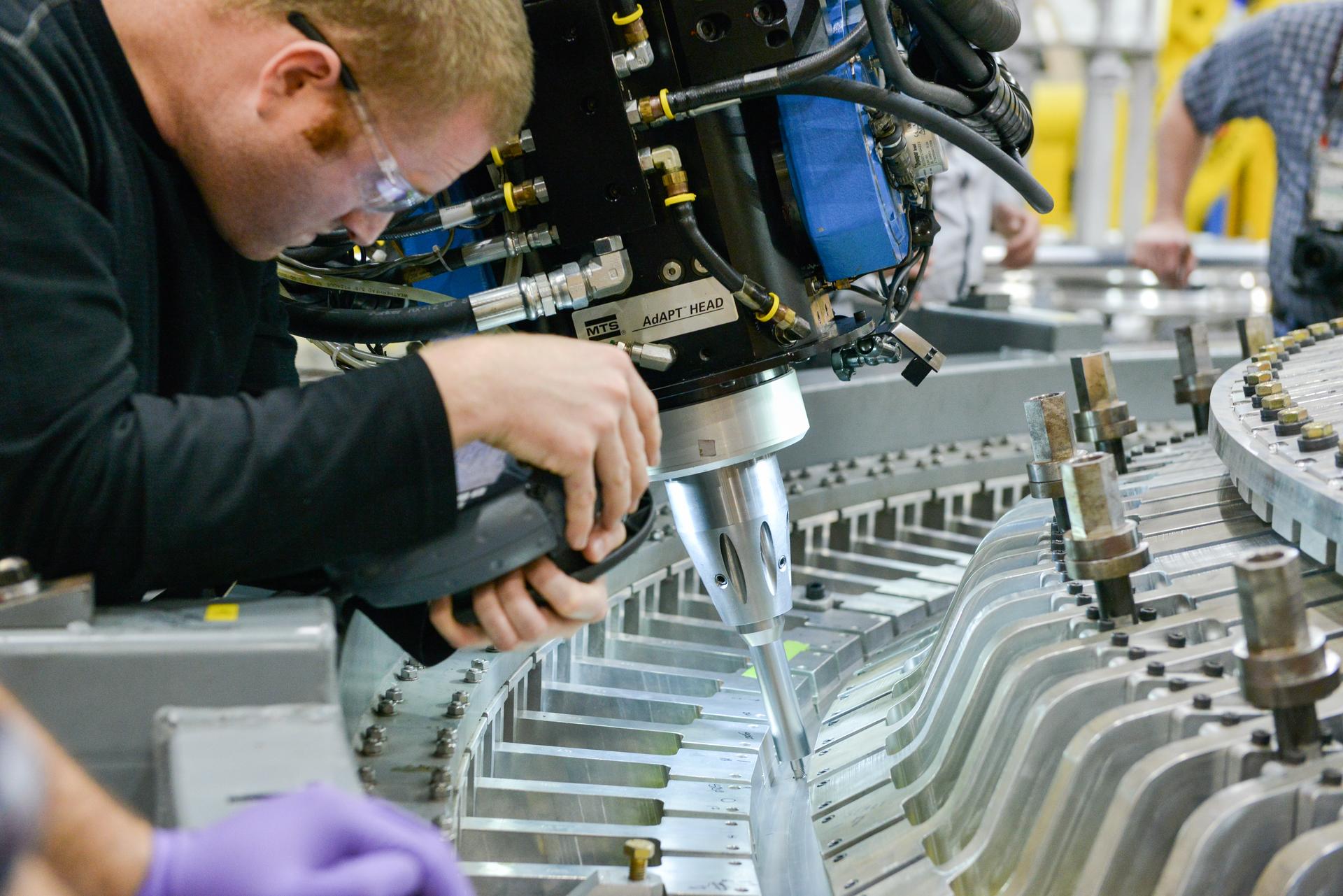
- Ultrasonic Welding: Uses sound and friction to create a solid-state bond between layers of metal.
After graduating from high school, there are a couple of pathways to choose from. You can pursue an associate’s degree in welding, typically a two-year program available through community colleges and technical schools. Another option is to obtain a certificate from a vocational school or trade school. An apprenticeship during or after this training is often the next step toward a career as a professional welder.
A NASA welder working on the RS-25 engine.NASA How can I start preparing today to become a welder?Taking a welding class at your high school or local college is a great way to find out whether it’s a skill you enjoy. Research welding degrees and programs at colleges and schools to determine which one(s) fit your needs and interest. It’s also a good idea to research job vacancies to learn what employers are looking for. Finally, seek out opportunities for hands-on experience to help you practice and improve your welding skills.
Michelle Bahnsen uses TIG welding techniques to join two metal sheets.NASA Once I tried it, I really, really enjoyed it. There’s just something about creating something with your hands. It gives you a sense of accomplishment.Michelle Bahnsen
Research laboratory mechanic/welder at NASA’s Armstrong Test Facility, part of the agency’s Glenn Research Center
A research laboratory mechanic and welder joins two metal sheets.NASA Advice from other NASA welders- “Building your knowledge in math and science is always a helpful tool, as you’ll need to understand measurements, geometry, and materials.” – Spencer Wells, engineering technician, Kennedy Space Center
- “One of the best ways to set yourself up as a welder is by attending a vocational school for welding, and then working in an apprentice/internship to gain work experience and training.” – Enricque Lee, tool and die apprentice, NASA’s Glenn Research Center
- Occupational Outlook for Welders: Pay, Education, Job Outlook, and More (From the U.S. Bureau of Labor Statistics)
- NASA Careers
- Career Spotlight: Engineer
- Career Spotlight: Scientist
- Career Spotlight: Technologist
- Career Spotlight: Mathematician
NASA’s SpaceX Crew-12 to Study Adaptation to Altered Gravity
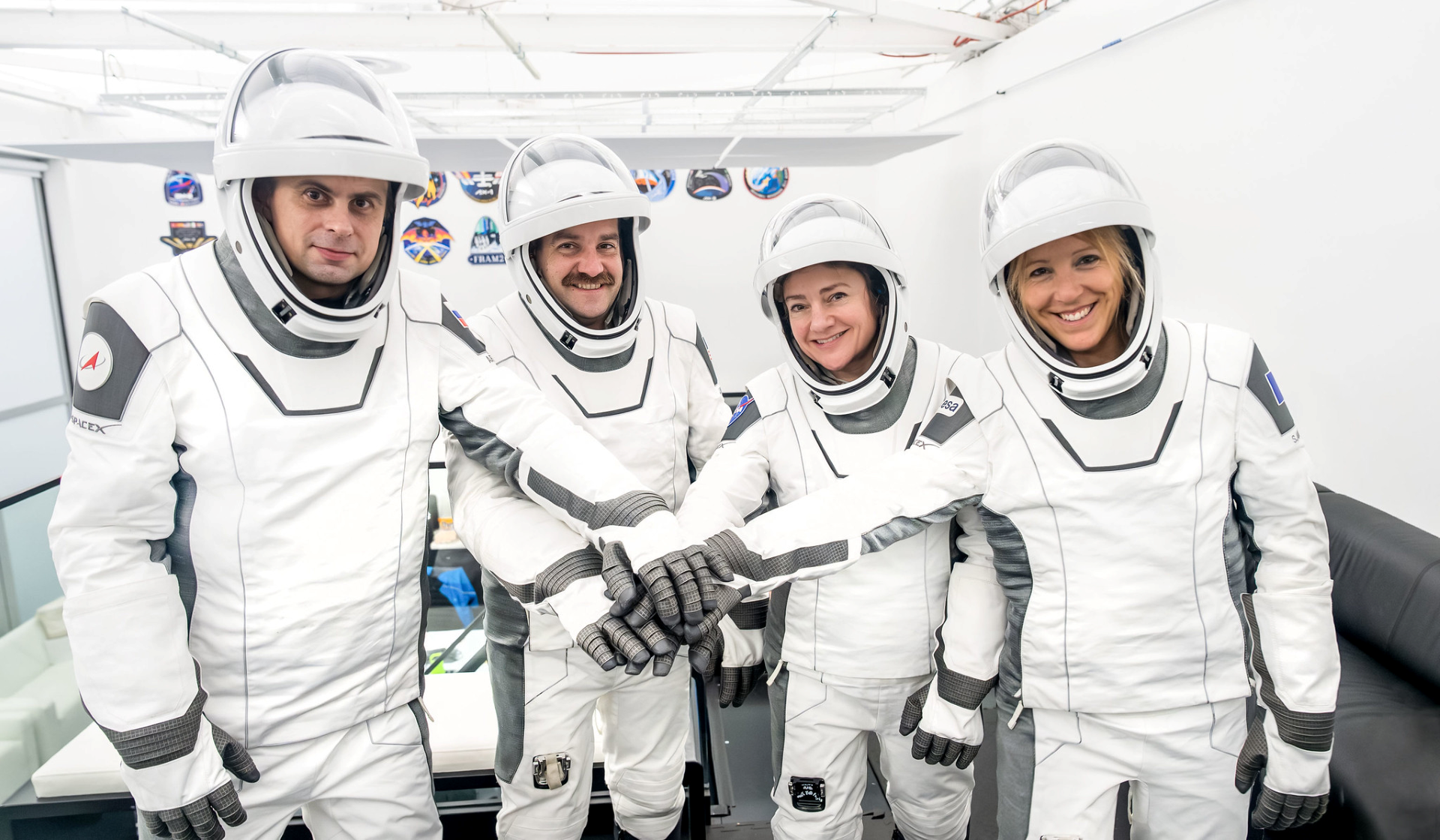
NASA’s SpaceX Crew-12 mission is preparing to launch for a long-duration science mission aboard the International Space Station. During the mission, select crew members will participate in human health studies focused on understanding how astronauts’ bodies adapt to the low-gravity environment of space, including a new study examining subtle changes in blood flow.
The experiments, led by NASA’s Human Research Program, include astronauts performing ultrasounds of their blood vessels to study altered circulation and completing simulated lunar landings to assess disorientation during gravitational transitions, among other tasks. The results will help NASA plan for extended stays in space and future exploration missions.
The new study, called Venous Flow, will examine whether time aboard the space station increases the chance of crew members developing blood clots. In weightlessness, blood and other bodily fluids can move toward the head, potentially altering circulation. Any resulting blood clots could pose serious health risks, including strokes.
“Our goal is to use this information to better understand how fluid shifts affect clotting risk, so that when astronauts go on long-duration missions to the Moon and Mars, we can build the best strategies to keep them safe,” said Dr. Jason Lytle, a physiologist at NASA’s Johnson Space Center in Houston who is leading the study.
To learn more, crew members in this study will undergo preflight and postflight MRIs, ultrasound scans, blood draws, and blood pressure checks. During the flight, crew members also will capture their own jugular vein ultrasounds, take blood pressure readings, and draw blood samples for scientists to analyze after their return to Earth.
In another study, called Manual Piloting, select crew members will perform multiple simulated Moon landings before, during, and after the mission. Designed to assess their piloting and decision-making skills, participants attempt to fly a virtual spacecraft toward the lunar South Pole region — the same area future Artemis crews plan to explore.
“Astronauts may experience disorientation during gravitational transitions, which can make tasks like landing a spacecraft challenging,” said Dr. Scott Wood, a neuroscientist at NASA Johnson who is coordinating the investigation.
While spacecraft landings on the Moon and Mars are expected to be automated, crews must be prepared to take over and pilot the vehicle if necessary.
“This study will help us examine astronauts’ ability to operate a spacecraft after adapting from one gravity environment to another, and whether training near the end of their spaceflight can help prepare crews for landing,” said Wood. “We’ll monitor their ability to manually override, redirect, and control a vehicle, which will guide our strategy for training Artemis crews for future Moon missions.”
The risk of astronauts experiencing disorientation from gravitational transitions increases the longer they’re in space. For this study, which debuted during the agency’s SpaceX Crew-11 mission, researchers plan to recruit seven astronauts for short-term private missions lasting up to 30 days and 14 astronauts for long-duration missions lasting at least 106 days. A control group performing the same tasks as the astronauts will provide a basis of comparison.
A different study will investigate potential treatments for spaceflight associated neuro-ocular syndrome, or SANS, which causes vision and eye changes. Researchers will examine whether taking a daily B vitamin supplement can help relieve SANS symptoms.
After returning to Earth, select crew members will participate in a study that documents any injuries, such as scrapes or bruises that may occur during landing. Transitioning from weightlessness to Earth’s gravity can increase the injury risk without proper safeguards. The data will help researchers improve spacecraft design to better protect crews from landing forces.
____
NASA’s Human Research Program
NASA’s Human Research Program pursues methods and technologies to support safe, productive human space travel. Through science conducted in laboratories, ground-based analogs, commercial missions, the International Space Station and Artemis missions, the program scrutinizes how spaceflight affects human bodies and behaviors. Such research drives the program’s quest to innovate ways that keep astronauts healthy and mission ready as human space exploration expands to the Moon, Mars, and beyond.
Explore More 4 min read NASA Selects Participants to Track Artemis II Mission Article 2 weeks ago 5 min read Out of This World Discoveries: Space Station Research in 2025 Article 3 weeks ago 4 min read NASA’s SpaceX Crew-11 Wraps Up Space Station Science Article 3 weeks ago Keep Exploring Discover More Topics From NASALiving in Space
Artemis
Human Research Program
Space Station Research and Technology
Hubble Spots Lens-Shaped Galaxy
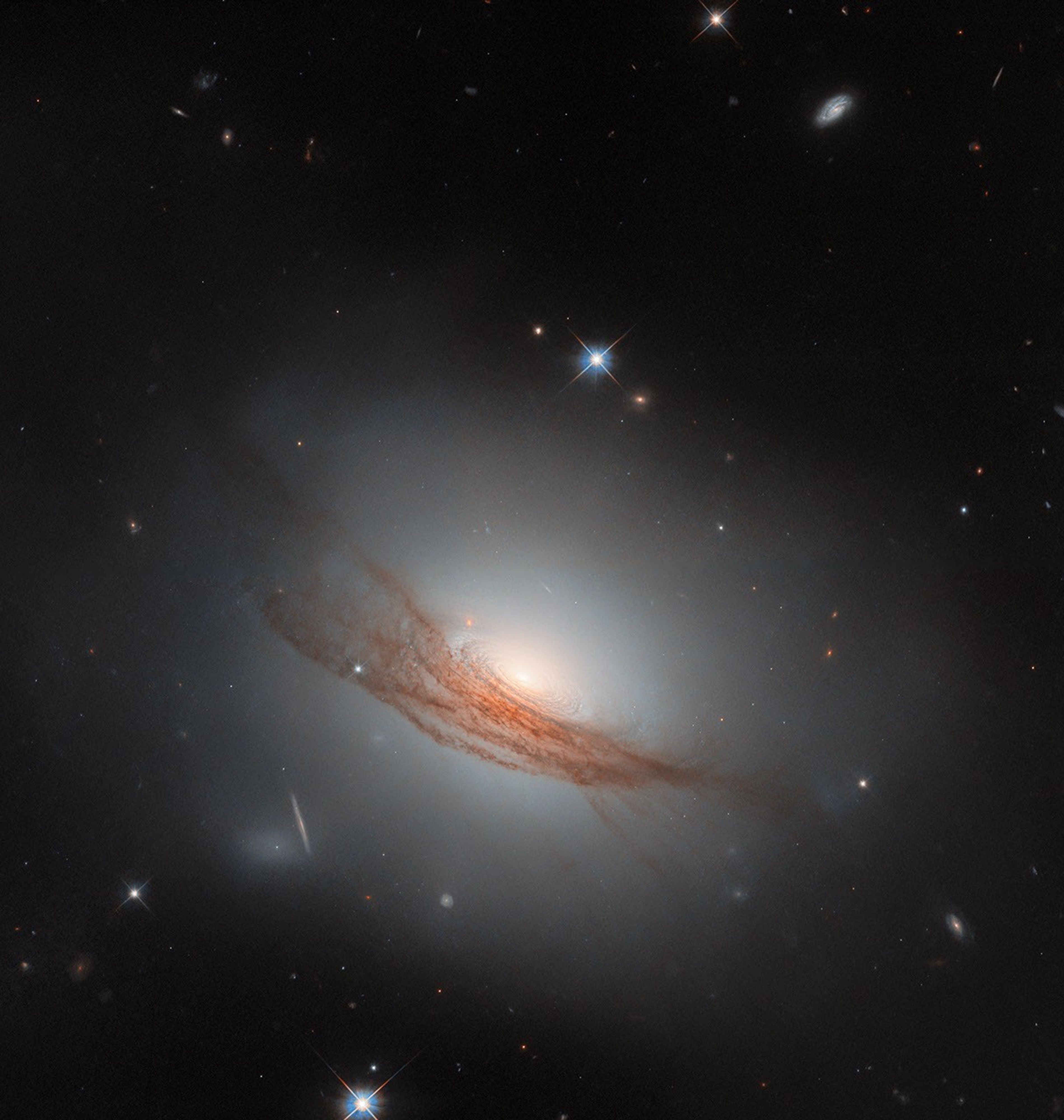
This new Hubble image, released on Jan. 30, 2026, is the sharpest taken of NGC 7722, a lenticular galaxy located about 187 million light-years away in the constellation Pegasus. A lenticular, meaning “lens-shaped,” galaxy is a type whose classification sits between more familiar spiral galaxies and elliptical galaxies. It is also less common than spirals and ellipticals — partly because these galaxies have a somewhat ambiguous appearance, making it hard to determine if it is a spiral, an elliptical, or something in between.
Learn more about this observation.
Image credit: ESA/Hubble & NASA, R. J. Foley (UC Santa Cruz), Dark Energy Survey/DOE/FNAL/DECam/CTIO/NOIRLab/NSF/AURA; Acknowledgment: Mehmet Yüksek
Milano Cortina 2026
- Earth
- Earth Observatory
- Image of the Day
- EO Explorer
- Topics
- More Content
- About
Curiosity Blog, Sols 4788-4797: Welcome Back from Conjunction
- Curiosity Home
- Science
- News and Features
- Multimedia
- Mars Missions
- Mars Home
2 min read
Curiosity Blog, Sols 4788-4797: Welcome Back from Conjunction NASA’s Mars rover Curiosity acquired this image using its Mast Camera (Mastcam); it shows the “Nevado Sajama” drill site from November, right next to the location of this weekend’s drill. The new drill site will be to the upper left of the existing hole. Curiosity captured the image on Jan. 25, 2026 — Sol 4789, or Martian day 4,789 of the Mars Science Laboratory mission — at 19:20:37 UTC. NASA/JPL-Caltech/MSSSWritten by Alex Innanen, Atmospheric Scientist at York University, Toronto
Earth planning date: Friday, Jan. 30, 2026
Mars has emerged from its holiday behind the Sun, and we here on Earth have been able to reconnect with Curiosity and get back to work on Mars. Our first planning day last Friday gave Curiosity a full weekend of activities, which wrapped up with getting us ready for our next drill. We checked out a broken white rock in the workspace with APXS, MAHLI, and ChemCam’s laser spectrometer and finished up imaging a sandy area we’ve kept an eye on during conjunction to see if we could catch any wind motion, before taking a small drive to our drill location about 2 meters away (about 6 feet).
This location may look familiar — our next drill will be only a few centimeters away from “Nevado Sajama,” which we drilled back in November. The reason we’ve returned here is to do a rare SAM experiment the instrument’s last container of tetramethylammonium hydroxide (or TMAH, for less of a mouthful). TMAH is a chemical that we can mix with our sample from Nevado Sajama to help identify any organic molecules. SAM had only two containers of TMAH (the first of which we used almost six years ago, so we want to be very certain that everything will go well with this experiment. As a result, we did a rehearsal of the handoff of the sample to SAM in Wednesday’s plan, before we drill this weekend.
The TMAH experiment takes up a lot of Curiosity’s energy, so there isn’t a ton to spare for other science activities. Luckily, we’ve spent a lot of time in this area and have collected plenty of images of our surroundings. Because of that, we’ve used our little bit of extra time in the second half of the week for environmental observations. We’re well into the dusty season now, so we’re keeping an eye on dust both near (looking out for dust devils) and far (keeping track of how much dust is in the crater and wider atmosphere).
-
Want to read more posts from the Curiosity team?
-
Want to learn more about Curiosity’s science instruments?
Article
1 month ago
3 min read Wind-Sculpted Landscapes: Investigating the Martian Megaripple ‘Hazyview’
Article
2 months ago
3 min read Curiosity Blog, Sols 4743-4749: Polygons in the Hollow
Article
2 months ago
Keep Exploring Discover More Topics From NASA Mars
Mars is the fourth planet from the Sun, and the seventh largest. It’s the only planet we know of inhabited…
All Mars Resources
Explore this collection of Mars images, videos, resources, PDFs, and toolkits. Discover valuable content designed to inform, educate, and inspire,…
Rover Basics
Each robotic explorer sent to the Red Planet has its own unique capabilities driven by science. Many attributes of a…
Mars Exploration: Science Goals
The key to understanding the past, present or future potential for life on Mars can be found in NASA’s four…
NASA, University of Texas Expand Research and Workforce Development
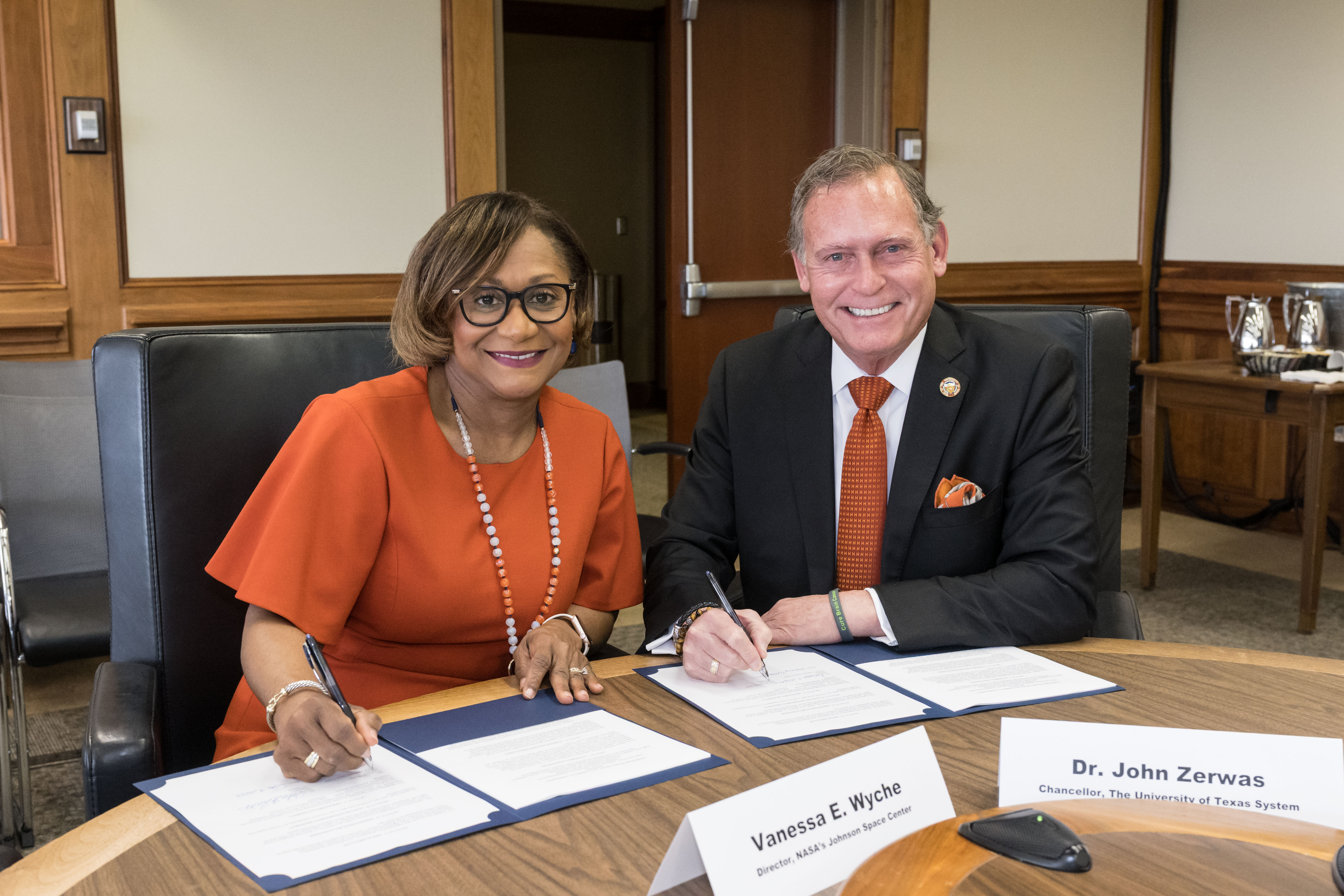
NASA’s Johnson Space Center in Houston and the University of Texas System (UT System) announced the signing of a collaborative Space Act Agreement on Jan. 9, 2026. The agreement expands research and workforce development partnership opportunities across NASA centers and UT System facilities.
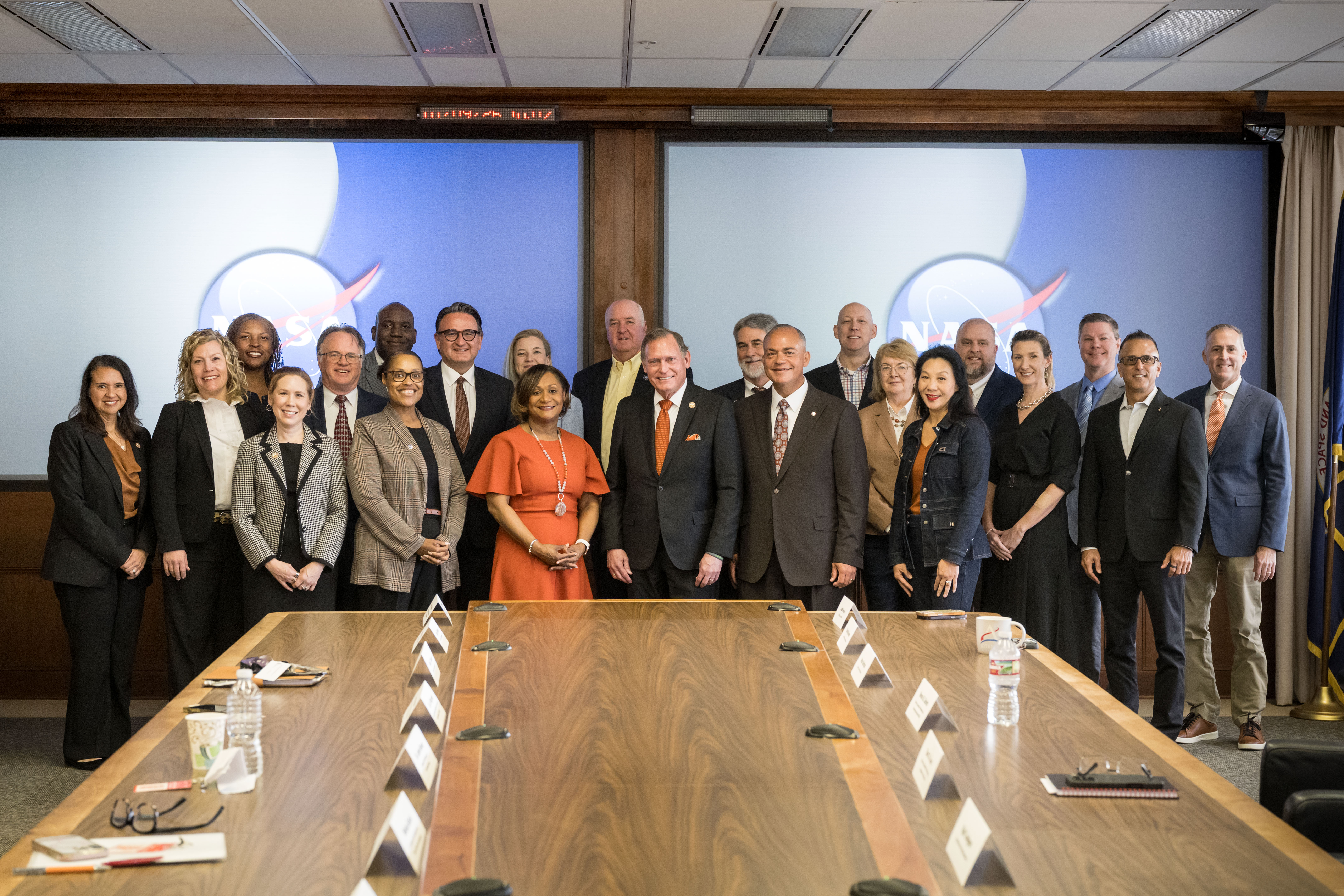
NASA’s Johnson Space Center Director Vanessa Wyche and University of Texas System Chancellor John M. Zerwas, participate in a ceremonial signing of a Space Act Agreement at Johnson Space Center in Houston on Jan. 9, 2026.NASA/Helen Arase VargasThe agreement builds upon decades of collaboration between NASA and the UT System by enabling additional research, teaching resources, and educational engagements that support human spaceflight and grow the pipeline of next-generation talent. It will leverage Johnson’s unique capabilities as the hub of human spaceflight and the UT System’s assets across its 13 institutions.
“NASA’s Johnson Space Center has a long history of working with colleges and universities to help us achieve our human spaceflight missions,” said Johnson Center Director Vanessa Wyche. “We are eager to partner with the UT System to collaborate in vital research and technology development initiatives that will enable us to meet our nation’s exploration goals and advance the future of space exploration.”
The agreement also reflects Johnson’s continued evolution through Dare Unite Explore – a set of commitments designed to ensure the center will remain the world leader in human space exploration. Those commitments include expanding partner access to the center’s world-class facilities and expertise, as well as establishing robust workforce development and recruitment programs.
Johnson Center Director Vanessa Wyche and UT System Chancellor John Zerwas (center) stand with members of their respective leadership teams following the ceremonial agreement signing.NASA/Helen Arase VargasWyche and UT System Chancellor John M. Zerwas hosted a ceremonial signing event at Johnson. During the event, Wyche and Zerwas, along with the center’s leadership team and the UT System executives and faculty, strategized on potential partnership opportunities and next steps for stakeholders.
Explore More 8 min read Station Nation: Erin Edwards, Deputy Branch Chief for Crew Operations and Capsule Communicator Article 2 days ago 4 min read Preparing for Artemis II: Training for a Mission Around the Moon Article 1 week ago 3 min read NASA Johnson Celebrates 25 Years in Space with Community Day Article 1 week agoStation Nation: Erin Edwards, Deputy Branch Chief for Crew Operations and Capsule Communicator
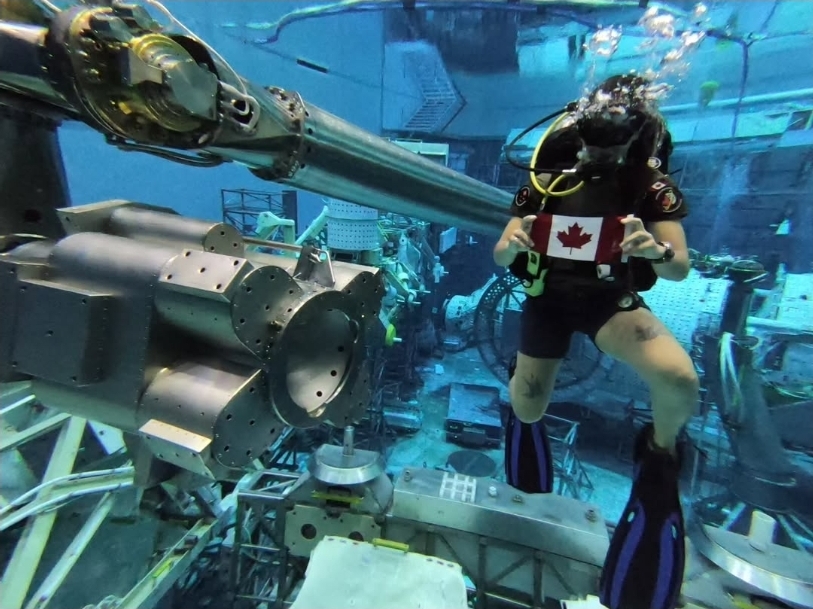
As a member of the Crew Operations Office, Erin Edwards and her team manage astronaut candidate training schedules, including field medical exercises, land survival, and underwater operations at NASA’s Neutral Buoyancy Laboratory in Houston. She also develops and tests new training programs to keep crews mission-ready.
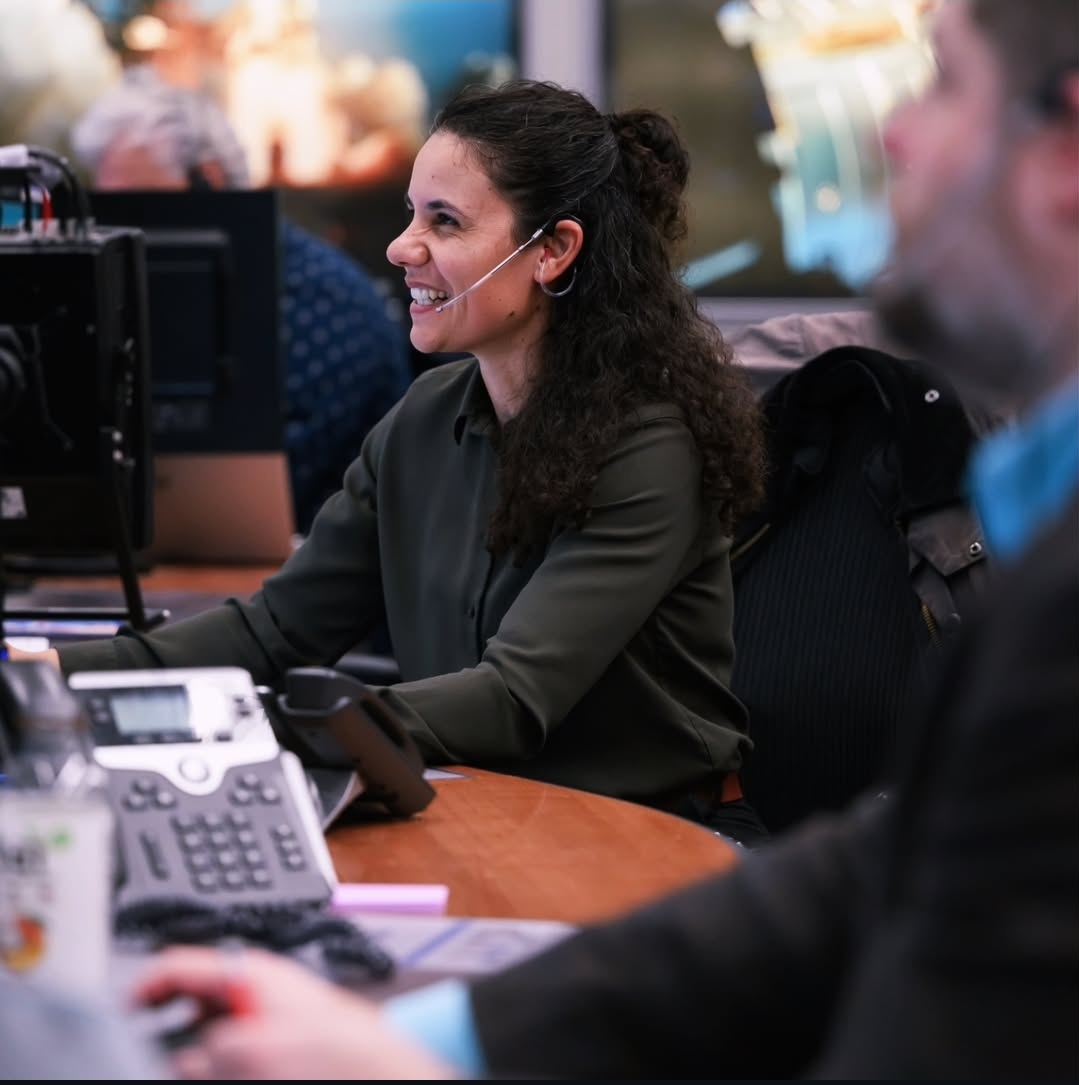
Along with her role as a crew operations officer, Edwards works in the International Space Station Mission Control Center as a capsule communicator, or capcom, and instructor. As a capcom, she must be fluent in the language of the spacecraft and its operations to clearly relay important information to the crew, especially during dynamic operations.
Read on to learn about Edwards’ career with NASA and more!
Erin Edwards serves as a capsule communicator, or capcom, in the International Space Station Mission Control Center in Houston.NASA/James BlairWhere are you from?
Port Moody, British Columbia, Canada.
How long have you been working for NASA?
I’ve been at NASA for two years. My term here with the military is three years.
What was your path to NASA?
Super random! I’m a Canadian military pilot, previously working in the Canadian Special Operations Forces Command as an aircraft commander on the CH-146 Griffon. While we use a lot of space-based assets in aviation, the leap to human spaceflight was unexpected.
An opportunity for an officer to work in the astronaut office as a capcom arose a few years ago. As a lifelong space nerd, I figured it would be an amazing opportunity. I applied and was interviewed, and before long, was posted to NASA’s Johnson Space Center as the first Canadian non-astronaut to be posted as a capcom and later as an operations officer.
How would you describe your job to family or friends that may not be familiar with NASA?
My team and I organize the unassigned crew and astronaut candidates’ work lives! As a capcom, I help translate what the engineers are saying in the flight control room for the astronauts aboard the station, and I help with the station activities as call sign Houston. More recently I’ve been assigned as the TH57 Helicopter Project Pilot at AOD to help get that fleet integrated for more lunar-focused Space Flight Readiness Training.
What advice would you give to young individuals aspiring to work in the space industry or at NASA?
Just go for it! You miss 100% of the shots you don’t take, as Wayne Gretzky said. My background as a military helicopter pilot, Navy diver, and mining engineer may appear to have no relevance to NASA, but that diverse experience has turned out to be useful here as an operations officer for astronaut training. I wouldn’t have known that if I hadn’t thrown my hat in the ring. No matter your technical background, there’s probably a place for it in spaceflight. Your experience has unique ways of benefiting such complex, multifaceted programs like spaceflight—so give it a shot!
Is there a space figure you’ve looked up to or someone that inspires you?
Spaceflight isn't something we can do on our own, there are many integrated teams comprised of many different types of people all pulling together to make the impossible happen.Erin Edwards
Deputy Branch Chief for Crew Operations and Capsule Communicator
Honestly, there isn’t a single person, but I think what NASA and my own country’s space program, like others, have committed themselves to as a giant team is what has inspired me over the years. I think I was inspired by that, the mission, and the culture of a united effort of so many to do hard things.
What is your favorite NASA memory or the most meaningful project you’ve worked on during your time with NASA?
There are two! After only a few months at NASA, I was told by my soon-to-be boss, James ‘Vegas’ Kelly, that I was selected to take over NASA astronaut Jonny Kim’s operations job. This was a huge vote of confidence for me as a new team member from Canada. The second was sending my first transmission to the station as a qualified capcom, which was incredibly cool. I am just a big nerd from a small town in Canada, and never in a million years did I think I would be at NASA at that console, so it was a little mind blowing.
Erin Edwards during diving operations at NASA’s Neutral Buoyancy Laboratory in front of the Canadarm2 mock-up.NASA/Tess CaswellWhat do you love sharing about station?
Everyone is playing their part to accomplish important science and experiments that we can't do anywhere else.Erin Edwards
Deputy Branch Chief for Crew Operations and Capsule Communicator
People always seem surprised at how big the teams are that support the station and how collaborative of an effort it is. It stretches across disciplines, centers, and even countries. That information is critical for solving problems here on Earth.
November 2, 2025, marked 25 years of continuous human presence. What does this milestone mean to you?
A quarter century of science and partnership aboard the orbital laboratory is a testament to what we can do as a global society when we really want to. To me personally, being able to be here with people who have worked in space or help train the people going next is such a full circle situation. I dreamed of working on a team like this, and it happened 20 years later. That opportunity to fulfill a dream and represent Canada as part of the ISS program means a lot to me!
If you could have dinner with any astronaut, past or present, who would it be?
I was never able to meet Sally Ride. I think I would have loved to ask her some questions and hear her story in person.
Do you have a favorite space-related memory or moment that stands out to you?
Dr. Robert Thirsk, a Canadian astronaut, spoke to my elementary school in 1996, which he had attended years earlier. I was in sixth grade, and it was a formative interaction. Hearing him talk so passionately about his shuttle mission and life with his team aboard the orbiter was absolutely lifechanging. I didn’t know how I was going to do it, but I decided then that I wanted to work in space. That set my course for life. I’ll likely never get to space, but I got pretty close, and it is really something to pursue a goal like that for so long and have it work out, almost
What are some of the key projects you have worked on during your time at NASA? What have been your favorite?
Being able to put my operational helicopter background to use in helping to build the helicopter flight program here has been a really cool and unexpected opportunity! I happened to be the right person at the right time with the right skill set to make a difference in that aspect of training. I’m proud of that.
Erin Edwards pictured in her role as a Royal Canadian Air Force helicopter pilot, where she built skills that she leverages in her work at NASA.Canadian Armed Forces/Erin EdwardsWhat are your hobbies/things you enjoy doing outside of work?
I’m in my forties, but still really like playing contact rugby, which is such a fun sport. Between the tactics, teamwork, bashing into people on the pitch, and a cheeky beer after a game, it’s a great way to spend a weekend. I run a lot and, when I can, climb – any kind of climbing, sport, bouldering, trad, ice climbing. All of it!
Day launch or night launch?
Night launch!
Favorite space movie?
Apollo 13. Obviously.
NASA Worm or Meatball logo?
Meatball!
The NASA Meatball logoNASA and its partners have supported humans continuously living and working in space since November 2000. After 25 years of continuous human presence, the space station remains a training and proving ground for the future of commercial space stations, deep space missions, enabling NASA’s Artemis campaign, lunar exploration, and future Mars missions.
Every day, we are conducting exciting research aboard our orbiting laboratory that will help us explore farther into space and bring benefits back to people on Earth. You can keep up with the latest news, videos, and pictures about space station science on the Station Research & Technology news page. It is a curated hub of space station research digital media from Johnson and other centers and space agencies.
Sign up for our weekly email newsletter to get the updates delivered directly to you.
Follow updates on social media at @Space_Station on X, and on the space station accounts on Facebook and Instagram.
Explore More 2 min read NASA, University of Texas Expand Research and Workforce Development Article 19 hours ago 2 min read NASA Honor Awards for Cold Atom Lab Team MembersNASA OUTSTANDING PUBLIC LEADERSHIP MEDAL Awarded for notable leadership accomplishments that have significantly influenced NASA’s…
Article 6 days ago 4 min read Preparing for Artemis II: Training for a Mission Around the Moon Article 6 days agoTB 26-01 Evaluation of Adhesive and Solvent Alternatives for Polymeric Bonding Applications
The NASA Engineering and Safety Center (NESC) conducted a technical assessment to evaluate alternatives to dichloromethane, traditionally used for bonding transparent polymeric materials. This effort was initiated in response to potential regulatory restrictions under the EPA Toxic Substances Control Act (TSCA), which could impact critical bonding processes used in spaceflight hardware and experimental systems.
Download PDF: Evaluation of Adhesive and Solvent Alternatives for PolymericBonding Applications
ARMD Research Solicitations (Updated Feb. 4)
8 min read
Preparations for Next Moonwalk Simulations Underway (and Underwater) NASA / Lillian Gipson/Getty ImagesTHIS PAGE WAS UPDATED ON FEBRUARY 4, 2026
This Aeronautics Research Mission Directorate (ARMD) solicitations page compiles the opportunities to collaborate with NASA’s aeronautical innovators and/or contribute to their research to enable new and improved air transportation systems.
Most opportunities to participate in research are officially announced through the Web-based NASA Solicitation and Proposal Integrated Review and Evaluation System, better known as NSPIRES. You are encouraged to visit the NSPIRES web site, create an account, and sign up for automated email announcements.
Other types of collaborative opportunities, such as those involving Requests for Information or academic research contests, also are included on this page.
This ARMD Solicitations page has four major sections:
- Quick list of open solicitations with key dates listed.
- Current open solicitations with more details and helpful links.
- Closed solicitations in case it is helpful to see other examples of the kind of research opportunities NASA Aeronautics makes available.
- Summary of NASA’s Research Opportunities in Aeronautics (ROA) NASA Research Announcement (NRA) selection process.
March 20, 2026
NASA Aerospace Skilled Technical Workforce Hubs Proposal deadline.
This opportunity seeks proposals to establish state or regionally focused Skilled Technical Workforce Hubs (NAS_Hubs) that will serve as strategic centers for developing and sustaining a skilled technical workforce aligned with aerospace industry and NASA mission needs. The NAS_Hub Notice of Funding Opportunity has been released and may be found in NASA’s Solicitation and Proposal Integrated Review and Evaluation System (NSPIRES) on the NAS_Hub landing page.
Key Dates
- Pre-Proposal Webinar: February 18, 2026, 2:00 to 3:00 p.m. ET
- Office Hours Session: March 3, 2026, 2:00 to 3:00 p.m. ET
- Proposal Deadline: March 20, 2026, at 11:59 p.m. ET
- Anticipated Award Notification: June 2026
About the Opportunity
The rapid expansion of the space economy and renewed national priorities in human space exploration have created an urgent demand for a robust skilled technical workforce—individuals in critical science- and engineering-based roles who do not require a bachelor’s degree. To address nationwide shortages and ensure U.S. competitiveness in aerospace and defense, NASA’s Office of STEM Engagement is launching the NASA Aerospace Skilled Technical Workforce Hubs (NAS_Hub) initiative.
Through this notice NASA seeks lead organizations to establish hubs that:
- Collaborate with aerospace employers to align education and training with industry-defined workforce needs.
- Partner with community colleges and high school Career and Technical Education programs to deliver hands-on, industry-aligned learning experiences.
- Coordinate with state or regional workforce development system.
- Build clear and sustainable employment pathways into high-demand aerospace technical careers.
NAS_Hubs will serve as focal points for aligning education, workforce, industry, and government partners to accelerate workforce readiness over a three-year period of performance.
Eligibility
Eligible applicants include:
- State, county, city, township, special district, and tribal governments
- Public and private institutions of higher education
- Nonprofit organizations
- For-profit organizations and small businesses
Proposals must include partnerships with, at a minimum:
- Three aerospace industry collaborators supporting NASA’s work
- Community college career and technical education program
- High school career and technical education program
- State or regional workforce development system
- NASA Center or other NASA facility
Award Information
- Maximum Annual Award: $500,000
- Maximum Total Award: $1,500,000 over three years
- Cost Sharing: Not required
How to Apply
Proposals must be submitted electronically via NSPIRES. Registration in NSPIRES and an active SAM.gov registration are required.
Pre-Proposal Webinar and Technical Assistance
NASA will host an interactive pre-proposal webinar for the NAS_Hub opportunity on Feb. 18, 2026, from 2:00 to 3:00 p.m. ET. This session will provide an in-depth overview of this funding opportunity, including program goals, eligibility requirements, proposal preparation guidance, and submission tips. Proposers will also have the opportunity to receive technical assistance and clarification from NASA staff. Prior to attending a webinar, proposers are strongly encouraged to review the full NAS_Hub notice and to check the NAS_Hub landing page in NSPIRES regularly for updates and additional guidance.
Please note that registration is required for the webinar. Connection details will be provided upon completion of registration. Webinar dates, times, registration links, and connection information will be posted on the NAS_Hub landing page in NSPIRES, which also will feature recordings and presentation materials from the webinar after the event for those unable to attend.
Office Hours Session
March 3, 2026, 2:00 to 3:00 p.m. ET
Last opportunity for questions prior to the proposal deadline. Join the office hours session here.
Contact Information
For technical assistance with NSPIRES
NSPIRES Help Desk available Monday–Friday, 8:00 AM–6:00 PM ET
(202) 479-9376
nspires-help@nasaprs.com
Program Contact
Maria Arredondo
Next Gen STEM Program Manager
NASA Office of STEM Engagement
Mary W. Jackson NASA Headquarters
Email: NAS_Hub@nasaprs.com
The Project F.I.R.E. team receives their “Future Game-Changer” award during the 2024 Gateways to Blue Skies forum held at NASA’s Ames Research Center in California. Gateways to Blue Skies is one of several Aeronautics Innovation Challenges open to the academic community.NASA / Brandon Torres Aeronautics Innovation Challenges – OPENNASA’s nationwide team of aeronautical innovators are committed to giving students of all ages opportunities to solve some of the biggest technical challenges facing the aviation community today. Through NASA-sponsored challenges and competitions, students representing multiple disciplines will put their skills to work by designing and building solutions to real-world problems.
See the Complete List of Challenges Currently Closed Solicitations Advanced Capabilities for Emergency Response Operations RFI – CLOSEDView the full ACERO RFI announcement here.
NASA’s Advanced Capabilities for Emergency Response Operations (ACERO) project used this request for information to identify technologies that addressed current challenges facing the wildland firefighting community. NASA was seeking information on data collection, airborne connectivity and communications solutions, unmanned aircraft systems traffic management, aircraft operations and autonomy, and more. This would support development of a partnership strategy for future collaborative demonstrations.
Interested parties were requested to respond to this notice with an information package submitted via https://nari.arc.nasa.gov/acero-rfi no later than 4 pm ET, October 15, 2023. Submissions were accepted only from U.S. companies.
Advanced Air Mobility Mission RFI – CLOSEDView the full AAM RFI announcement here.
This request for information is being used to gather market research for NASA to make informed decisions regarding potential partnership strategies and future research to enable Advanced Air Mobility (AAM). NASA is seeking information from public, private, and academic organizations to determine technical needs and community interests that may lead to future solicitations regarding AAM research and development.
This particular RFI is just one avenue of multiple planned opportunities for formal feedback on or participation in NASA’s AAM Mission-related efforts to develop these requirements and help enable AAM.
The respond by date for this RFI closed on Feb. 1, 2025, at 6 p.m. EST.
ROA-2025 NRA Amendment 1 – CLOSEDAdvanced Air Vehicles Program Fellowship Opportunities
(View the full ROA-2025 NRA Amendment 1 text here.)
This announcement solicits proposals from accredited U.S. institutions for research training grants to begin the academic year. This Notice of Funding Opportunity is designed to support independently conceived research projects by highly qualified graduate students in disciplines needed to help advance NASA’s mission, thus affording these students the opportunity to directly contribute to advancements in STEM-related areas of study. These opportunities are focused on innovation and the generation of measurable research results that contribute to NASA’s current and future science and technology goals.
Research proposals are sought to address the key challenges summarized in the Elements section at the end of the Amendment 1 document, and which reference NASA’s Hypersonic Technology project.
Reflecting the Fiscal Year 2026 budget changes, the Transformational Tools & Technologies project opportunities originally described in this announcement were cancelled. Proposals citing this project will not be evaluated.
Notices of Intent are not required.
A budget breakdown for each proposal is required, detailing the allocation of the award funds by year. The budget document may adhere to any format or template provided by the applicant’s institution. Two pre-proposal teleconferences for potential proposers will be held and meeting links will be posted on NSPIRES.
Proposals were due by 5 p.m. EDT on June 11, 2025.
NASA Research Opportunities in AeronauticsCompetition for NRA awards is open to both academia and industry.
The current open solicitations for ARMD Research Opportunities are ROA-2024 and ROA-2025.
Here is some general information to know about the NRA process.
- NRA solicitations are released by NASA Headquarters through the Web-based NASA Solicitation and Proposal Integrated Review and Evaluation System (NSPIRES).
- All NRA technical work is defined and managed by project teams within these four programs: Advanced Air Vehicles Program, Airspace Operations and Safety Program, Integrated Aviation Systems Program, and Transformative Aeronautics Concepts Program.
- NRA awards originate from NASA’s Langley Research Center in Virginia, Ames Research Center in California, Glenn Research Center in Cleveland, and Armstrong Flight Research Center in California.
- Competition for NRA awards is full and open.
- Participation is open to all categories of organizations, including educational institutions, industry, and nonprofits.
- Any updates or amendments to an NRA is posted on the appropriate NSPIRES web pages as noted in the Amendments detailed below.
- ARMD sends notifications of NRA updates through the NSPIRES email system. In order to receive these email notifications, you must be a Registered User of NSPIRES. However, note that NASA is not responsible for inadvertently failing to provide notification of a future NRA. Parties are responsible for regularly checking the NSPIRES website for updated NRAs.
Missions
Artemis
Aeronautics STEM
Explore NASA’s History
Share Details Last Updated Feb 04, 2026 EditorJim BankeContactJim Bankejim.banke@nasa.gov Related TermsNASA Armstrong Contributions Propel Artemis, Deep Space Innovation
5 min read
Preparations for Next Moonwalk Simulations Underway (and Underwater)NASA is leveraging expertise, capabilities, and partnerships across its centers to make Artemis campaign and deep space exploration safer, more reliable, and efficient. At NASA’s Armstrong Flight Research Center in Edwards, California, contributions include technical leadership, unique flight-testing capabilities, and management of a key technology program that advances critical exploration concepts.
Artemis II is an upcoming challenging test flight, and the lessons learned will directly prepare NASA to return humans to the surface of the Moon on Artemis III and beyond, as well as send the first astronauts – Americans – to Mars.
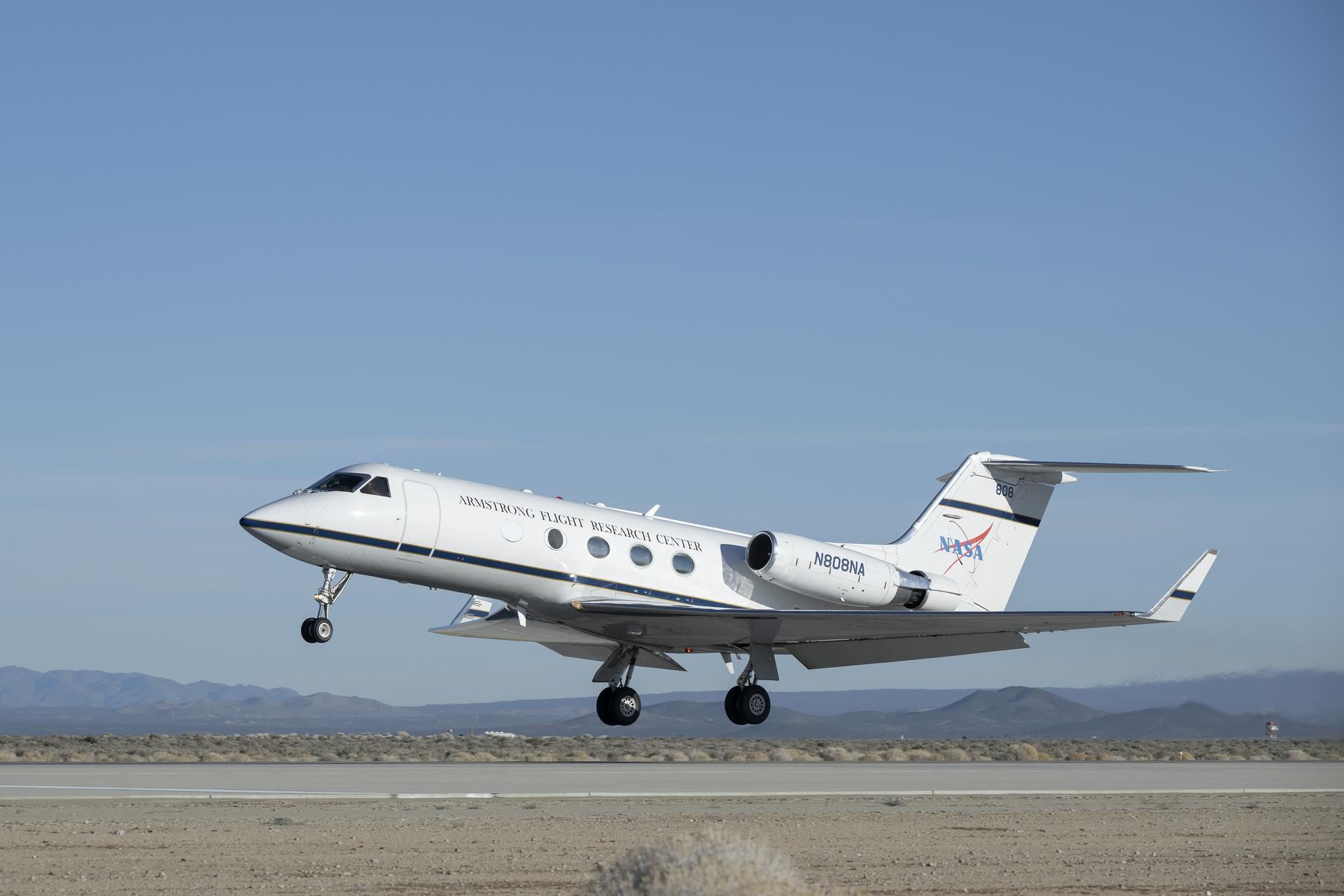
Gulfstream G-III aircraft collects heat shield data A NASA Gulfstream G-III aircraft lifts off from NASA’s Armstrong Flight Research Center in Edwards, California, on Tuesday, Jan. 20, 2026. Modifications were made to the aircraft to enable it to join three others flying at different altitudes to capture a complete view of the Orion spacecraft’s heat shield during Artemis II reentry. This effort is part of NASA’s Scientifically Calibrated In-Flight Imagery project.NASA/Carla ThomasAs preparations continue for the Artemis II launch, NASA Armstrong technicians modified a Gulfstream G-III to collect heat shield data during Orion’s reentry. As part of NASA’s Scientifically Calibrated In-Flight Imagery, the G-III will join other aircraft to capture Orion’s thermal protection data.
“Before the Artemis II mission begins, the aircraft will complete a dress rehearsal over the Pacific Ocean to verify the airborne system performance,” said Robert Navarro, NASA Armstrong support aircraft fleet project manager.
Technicians at NASA’s Johnson Space Center in Houston installed sensors and special windows for the imagery mission with assistance from NASA Armstrong technicians.
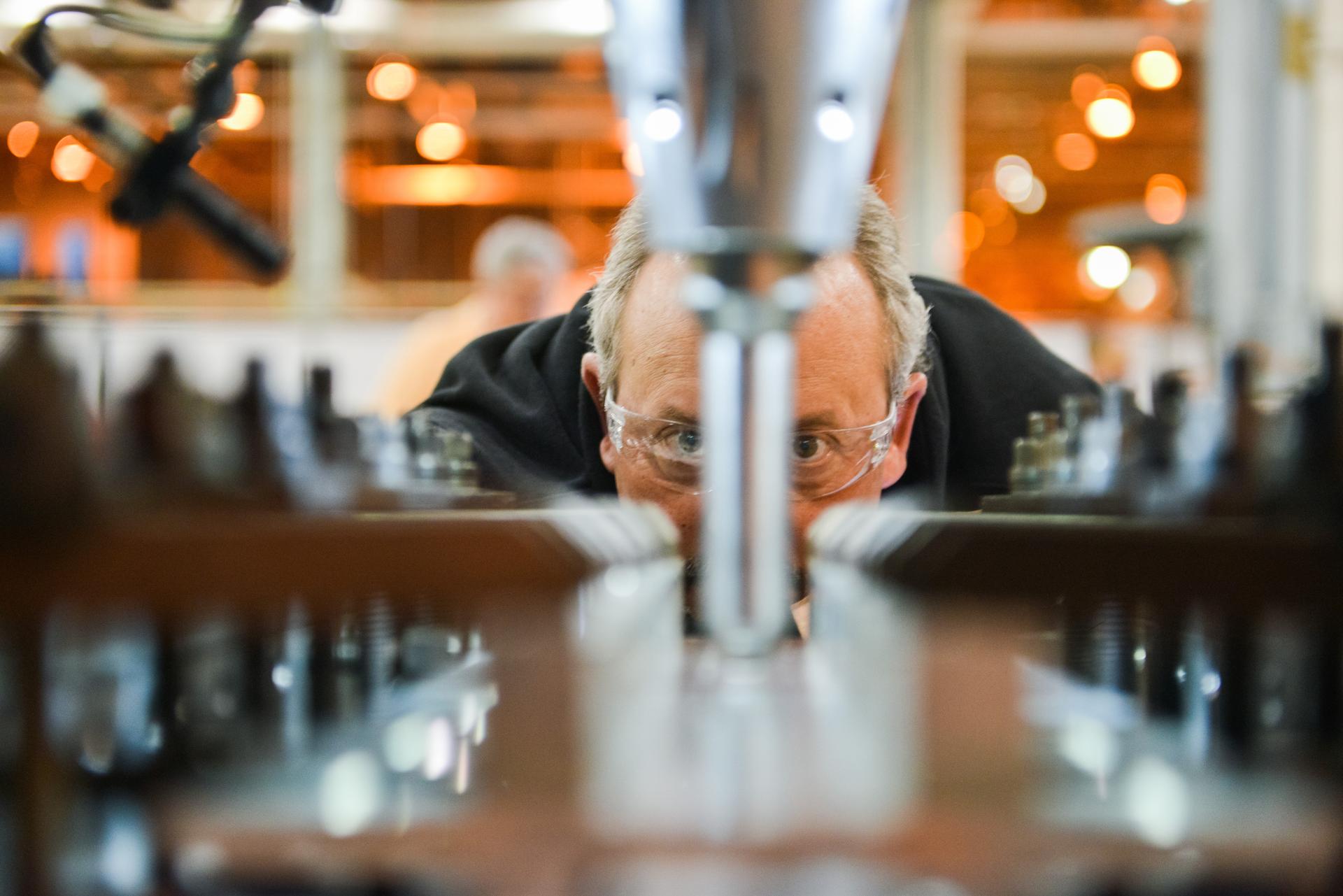
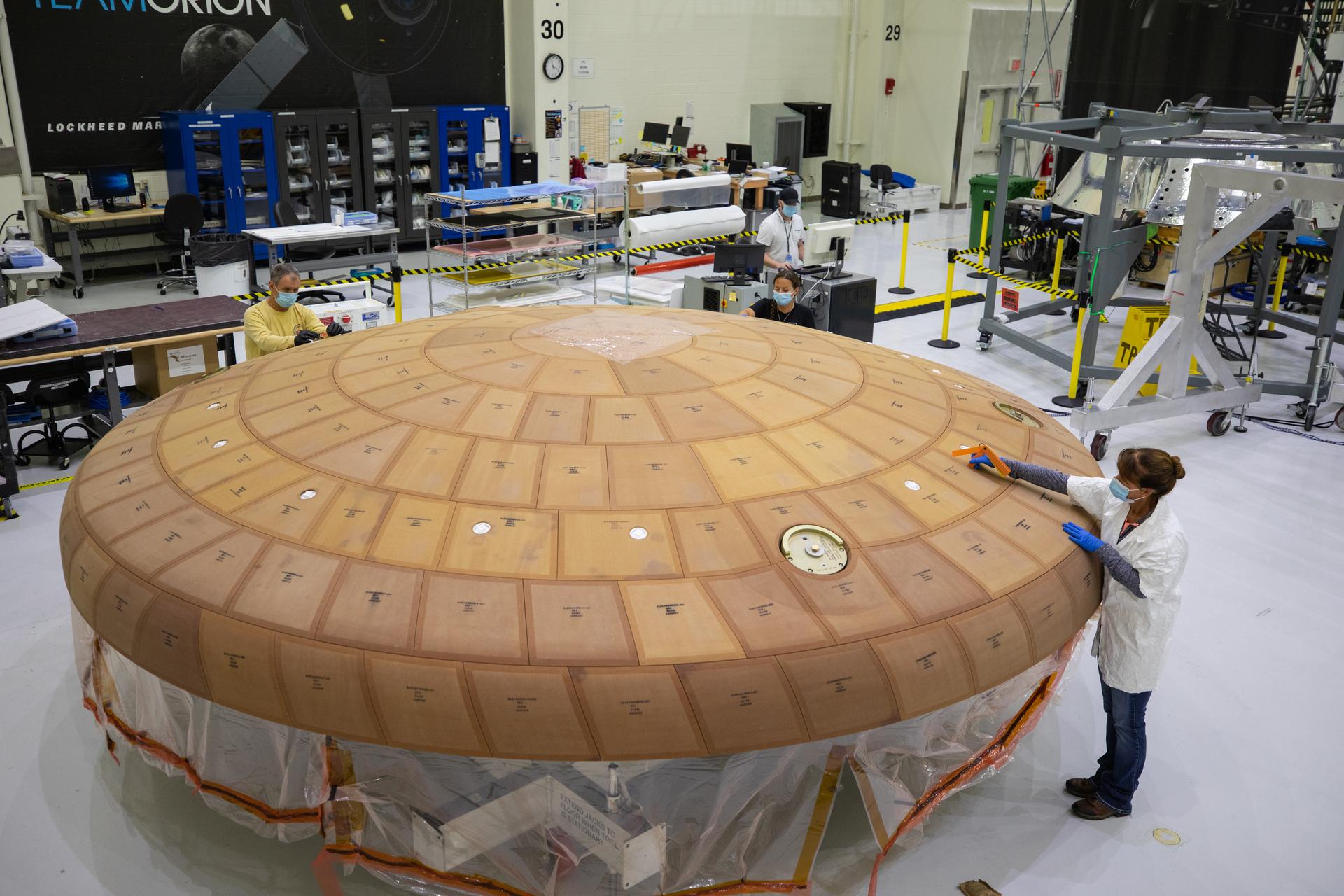
Measuring Orion’s reentry heat Inside the Neil Armstrong Operations and Checkout Building high bay at NASA’s Kennedy Space Center in Florida, from left, technicians Kenny Leidner, Diamond ScharSenstine, Russ Novak and Darlene Beville with ASRC Federal, inspect AVOCAT block bonding on the Artemis II heat shield on July 2, 2020. The heat shield is one of the most critical elements of Orion and will protect the capsule and astronauts during reentry through Earth’s atmosphere. Artemis II is the first crewed mission in a series of missions to the Moon and on to Mars. Artemis II will confirm all of the Orion spacecraft’s systems operate as designed in the actual environment of deep space with astronauts aboard. NASA/Isaac WatsonNASA Armstrong also assists with the Orion heat shield spectrometer system for Artemis II. The system is designed to collect shock layer radiation data from the heat shield during atmospheric entry, data that will be used to enhance astronaut safety.
NASA Armstrong’s expertise in integrating technologies, high reliability flight test instrumentation, and flight operations are a match for some Artemis and deep space projects.
“There is nothing that can go to space or come back without going through the atmosphere, so our mission of atmospheric flight research and test is very relevant,” said Brad Flick, NASA Armstrong center director. “We specialize in testing technologies and working through the challenges of flight.”
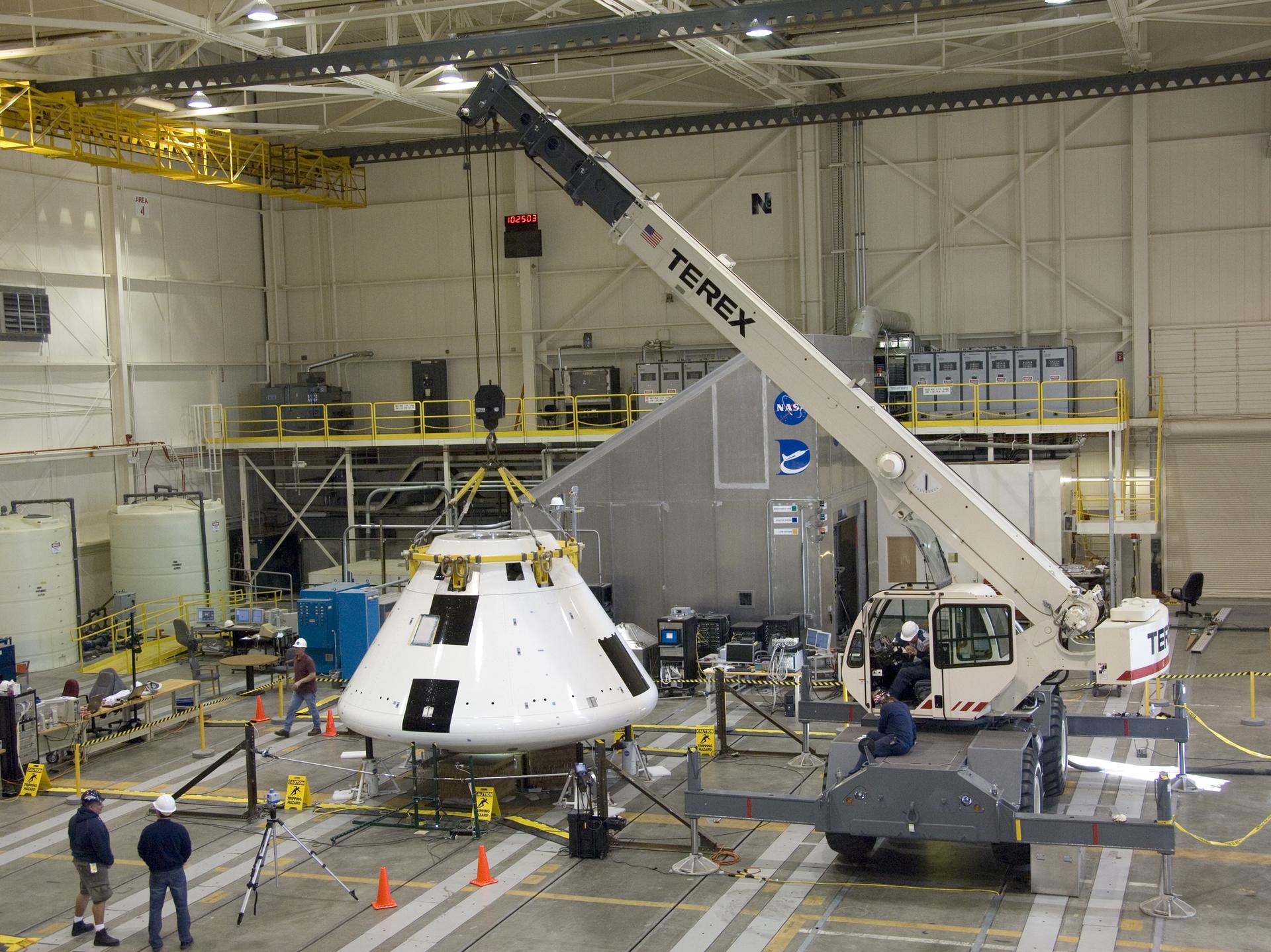
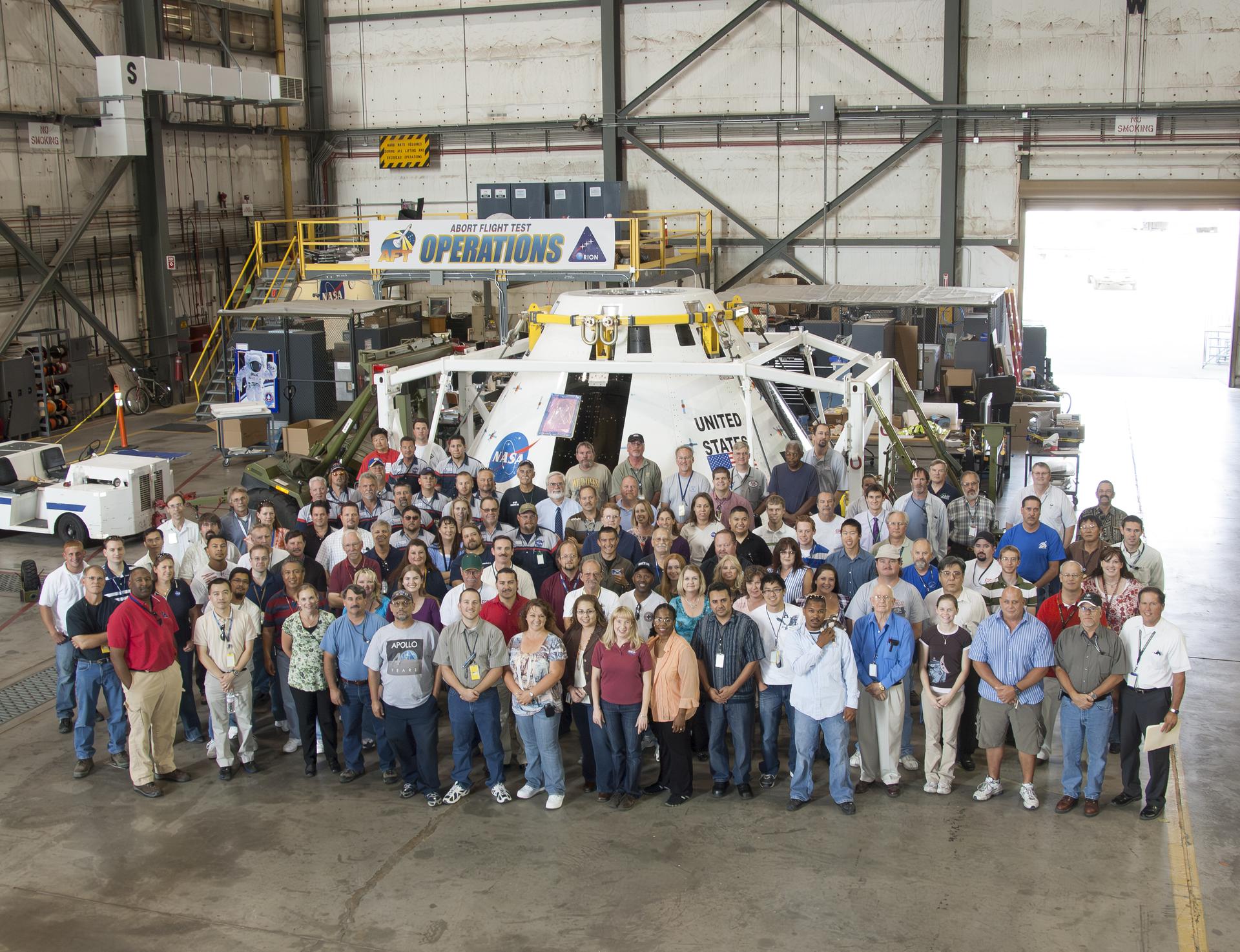
Testing Orion’s launch abort system Under the watchful eyes of technicians, a crane positions the Orion Pad Abort-1 Abort Flight Test module for mass properties testing in the Flight Loads Laboratory at NASA’s Armstrong Flight Research Center in Edwards, California.NASA/Tony Landis Teamwork was on full display at NASA’s Armstrong Flight Research Center in Edwards, California, on Aug. 13, 2009, as engineers and technicians prepared the Pad Abort-1 vehicle – the Orion launch abort system development test article. After assembly and integration, the mock crew capsule was transported to the U.S. Army’s White Sands Missile Range in New Mexico where it successfully completed its test on May 6, 2010.NASA/Tony LandisNASA Armstrong demonstrated that approach when it tested a system to enable Artemis astronauts to escape harm in the event of an emergency on the ground, or in the boost phase of the Orion spacecraft.
“We proved the system could get the astronauts to safety,” said Cathy Bahm, project manager for NASA’s Low Boom Flight Demonstrator. Earlier in her career, she played key roles in engineering, integration, and management for Pad Abort-1 and Ascent Abort-2 that validated the Orion spacecraft’s launch abort system.
Armstrong integrated and tested the capsule and abort system and operations at the launch abort pad at White Sands Test Facility in New Mexico for the Pad Abort-1 test.
“Hopefully we’ll never need it, but knowing I contributed to the safety of future astronauts is a highlight of my career,” Bahm said. “Looking back on it, it was a tremendous accomplishment for the center, the team, and a contribution to the future of space travel.”
Flight Opportunities program advances space tech A NASA F/A-18 research aircraft flies near NASA’s Armstrong Flight Research Center in Edwards, California, on Feb. 24, 2025, testing a commercial precision landing technology for future space missions. The Psionic Space Navigation Doppler Lidar (PSNDL) system is installed in a pod located under the right wing of the aircraft.NASAAnother contributor to future space travel is the Flight Opportunities program, which matures capabilities needed for NASA missions and commercial applications while strategically investing in the growth of the U.S. commercial spaceflight industry. NASA Armstrong manages the program, which supports flight testing of promising technologies, instruments, and experiments aboard commercial vehicles. Part of the agency’s Space Technology Mission Directorate, the program identifies the best ideas – from industry, academia, and NASA researchers – for flight testing.
Flight Opportunities advanced precision landing and optical communications technologies for future lunar missions.
“Landing safely in shadowed lunar regions is critical,” said Greg Peters, Flight Opportunities program manager.
Another deep space technology Flight Opportunities supported was a vibration isolation platform that helped provide extremely precise pointing for the Deep Space Optical Communications technology demonstration. That instrument used lasers to transmit data between Earth and the Psyche spacecraft from more than 215 million miles away, which could benefit future missions to Mars.
NASA Armstrong tested Doppler Lidar system navigation on an F/A-18 to prepare for Moon and Mars missions.
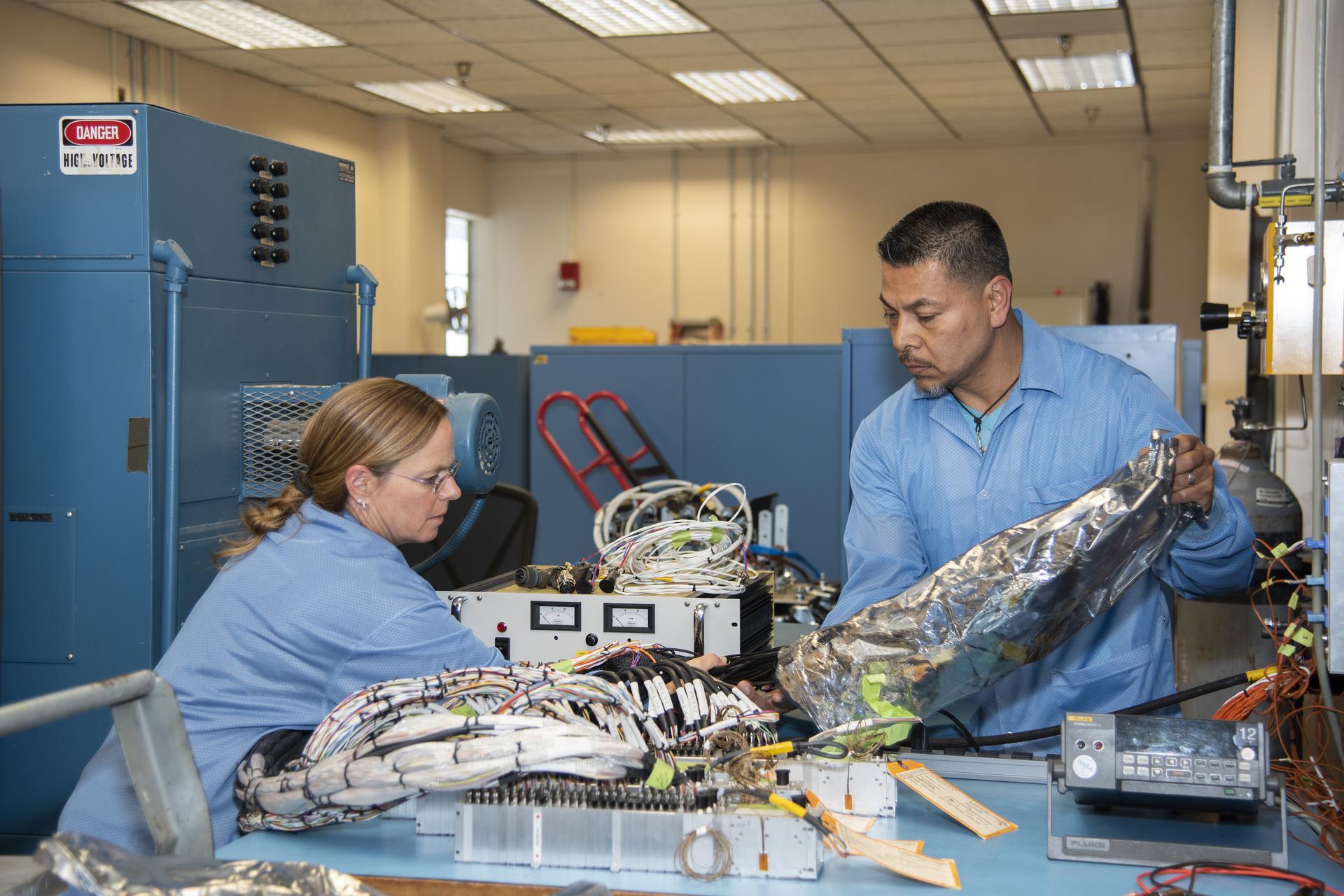
Contributions to Artemis, deep space exploration April Torres and Angelo De La Rosa remove wire harnesses for signal input for the Orion Ascent Abort-2 vehicle from electrostatic discharge protective covers at NASA’s Armstrong Flight Research Center in California. NASA/Lauren HughesNASA Armstrong’s work supporting Artemis and future deep space exploration missions also includes:
- A NASA F/A-18 based at NASA Armstrong tested an autopilot for the SLS (Space Launch System) that proved sensors would work at the trajectory needed for landing on Mars.
- NASA Armstrong researchers advanced a Fiber Optic Sensing System that flew in space for the first time on the Low Earth Orbit Flight Test of an Inflatable Decelerator mission.
- NASA Armstrong researchers developed a cryogenic FOSS, called CryoFOSS, to support future deep space missions. CryoFOSS was used during testing of a system designed to liquefy oxygen – as it would on the Moon or Mars – for use as return-trip fuel. By producing fuel on-site, missions could avoid carrying return fuel from Earth, significantly reducing launch weight and overall mission cost.
- NASA Armstrong staff were in the control rooms when the Orion spacecraft launch abort system was demonstrated.
- Before the Ascent Abort-2 tests could advance, NASA Armstrong assisted with component testing and integration work.
- NASA Armstrong photographers and videographers documented the Orion parachute tests in Yuma, Arizona.
Under the Artemis campaign, NASA is returning humans to the Moon for economic benefits, scientific discovery, and to prepare for crewed missions to Mars.
Share Details Last Updated Feb 04, 2026 EditorDede DiniusContactTeresa Whitingteresa.whiting@nasa.govLocationArmstrong Flight Research Center Related Terms Explore More 4 min read Preparing for Artemis II: Training for a Mission Around the Moon Article 6 days ago 3 min read NASA Heat Shield Technology Enables Space Industry Growth Article 7 days ago 3 min read I Am Artemis: Doug Parkinson Article 7 days ago Keep Exploring Discover More Topics From NASAArmstrong Flight Research Center
Aircraft Flown at Armstrong
Artemis
Flight Opportunities
NASA Heat Shield Tech Contributes to America’s Space Industry
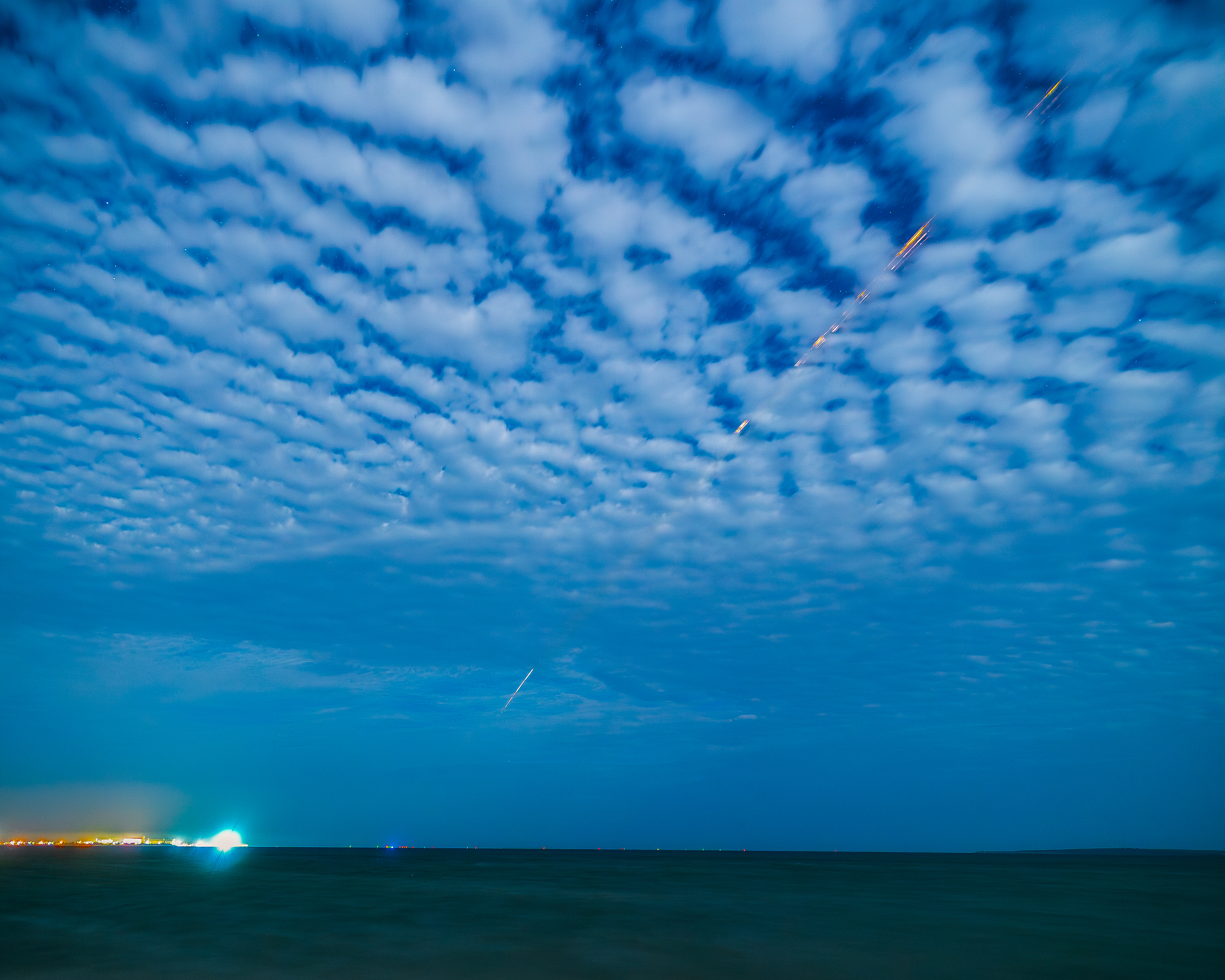
This Jan. 29, 2026, photo captures the streak the Varda Space Industries W-5 capsule made while returning to Earth. The capsule uses a protective heat shield Varda produced made of cutting-edge material it licensed from NASA. The material, known as C-PICA (Conformal Phenolic Impregnated Carbon Ablator), provides a stronger, less expensive, and more efficient thermal protection coating to capsules, allowing them – and their valuable contents – to return to Earth safely.
Developed at NASA’s Ames Research Center in California’s Silicon Valley, C-PICA sets the standard for heat shields, reflecting the decades of expertise that NASA brings to designing, developing, and testing innovative thermal protection materials. This flight test of Varda-produced C-PICA was supported by NASA’s Flight Opportunities program.
Image credit: Varda Space Industries/William Godward
NASA’s SPHEREx Examines Comet 3I/ATLAS’s Coma
NASA/JPL-Caltech Photojournal Navigation Downloads NASA’s SPHEREx Examines Comet 3I/ATLAS’s Coma
PNG (1.87 MB)
Description
These observations by NASA’s SPHEREx (Spectro-Photometer for the History of the Universe, Epoch of Reionization and Ices Explorer) show the infrared light emitted by the dust, water, organic molecules, and carbon dioxide contained within comet 3I/ATLAS’s coma. The comet brightened significantly during the December 2025 period when SPHEREx made the observations — about two months after the icy body had passed its closest distance to the Sun in late October.
The space telescope has the singular capability of seeing the sky in 102 colors, each representing a wavelength of infrared light that provides unique information about galaxies, stars, planet-forming regions, or other cosmic features, including the various gases and dust seen in the coma of 3I/ATLAS. The information gathered by SPHEREx helps scientists better understand what materials 3I/ATLAS contains and how the interstellar object’s pristine ices react to the Sun’s heating as the comet journeys through the solar system.
The mission is managed by NASA’s Jet Propulsion Laboratory in Southern California for the agency’s Astrophysics Division within the Science Mission Directorate in Washington. The telescope and the spacecraft bus were built by BAE Systems. The science analysis of the SPHEREx data is being conducted by a team of scientists at 13 institutions across the U.S., and in South Korea and Taiwan, led by Principal Investigator Jamie Bock, based at Caltech with a joint JPL appointment, and by JPL Project Scientist Olivier Dore. Data is processed and archived at IPAC at Caltech in Pasadena, which manages JPL for NASA. The SPHEREx dataset is freely available to scientists and the public.
For more information about the SPHEREx mission visit: https://science.nasa.gov/mission/spherex/
Keep Exploring Discover More Topics From Photojournal
Photojournal
Search Photojournal
Photojournal’s Latest Content
Feedback
Chilled New York City
- Earth
- Earth Observatory
- Image of the Day
- EO Explorer
- Topics
- More Content
- About
Full Moon over Artemis II
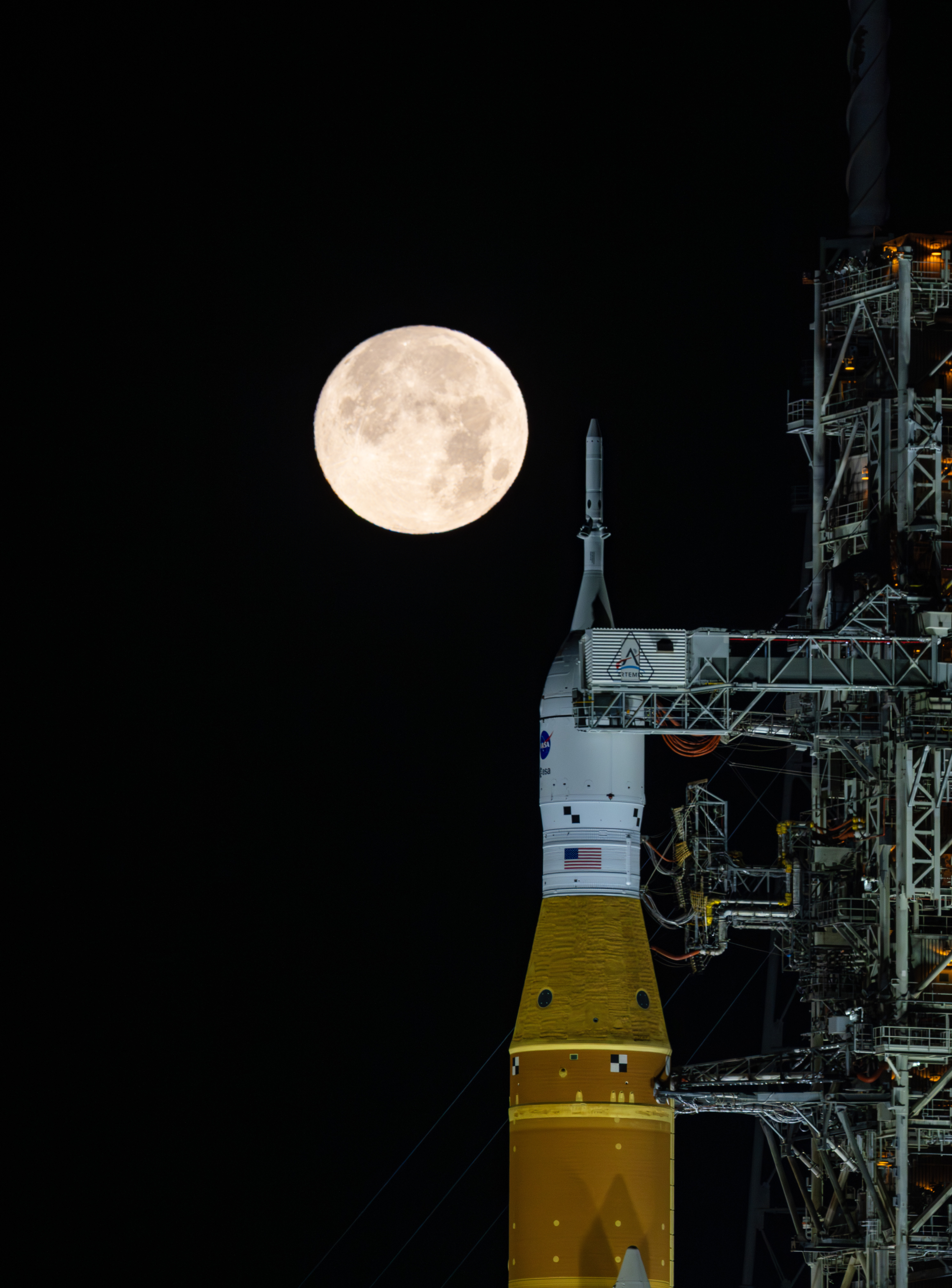
A full moon is seen shining over NASA’s SLS (Space Launch System) and Orion spacecraft, atop the mobile launcher at Launch Pad 39B at NASA’s Kennedy Space Center in Florida in the early hours of February 1, 2026.
The agency concluded a wet dress rehearsal for the agency’s Artemis II test flight early Tuesday morning, successfully loading cryogenic propellant into the SLS (Space Launch System) tanks, sending a team out to the launch pad to closeout Orion, and safely draining the rocket. The wet dress rehearsal was a prelaunch test to fuel the rocket, designed to identify any issues and resolve them before attempting a launch. To allow teams to review data and conduct a second wet dress rehearsal, NASA now will target March as the earliest possible launch opportunity for the flight test.
Read more about the wet dress rehearsal.
Image credit: NASA/Sam Lott
NASA Space to Soil Challenge
Rapid advances in commercial space, artificial intelligence, and edge computing are transforming what is possible for Earth observation. By pushing more intelligence onboard, missions can move from passively collecting data to actively interpreting and responding to changing surface conditions in near-real time, enabling more targeted observations and dramatically improving the value of data returned to the ground. Within this context, land-focused applications such as regenerative agriculture, sustainable forestry, and broader land resilience efforts stand to benefit enormously from satellites that can adapt what, when, and how they sense based on dynamic environmental signals and algorithmic insight rather than fixed schedules or static acquisition plans.
NASA Earth Science Technology Office (ESTO) invites participants to design small satellite (SmallSat) mission concepts that leverage adaptive sensing and onboard processing to enhance regenerative agriculture, forestry, or a similar land resilience objective. Participants must work within onboard power, compute, and bandwidth constraints characteristic of SmallSat missions, focusing on how to orchestrate existing land observation algorithms into an efficient, responsive onboard intelligence layer. Both hardware-oriented and software-oriented solutions—or combinations of the two—are encouraged.
NASA’s primary objective for this challenge is to advance computational and systems approaches for adaptive sensing or onboard processing on SmallSat missions. The goal is not to develop new agricultural or forestry science but rather to improve how SmallSats sense, process, and deliver information to enable these applications.
Award: $400,000 in total prizes
Challenge Open Date: January 30, 2026
Submission Close Date: May 4, 2026
For more information, visit: https://nasa-space-to-soil.org/
Cracking Antarctic Sea Ice
- Earth
- Earth Observatory
- Image of the Day
- EO Explorer
- Topics
- More Content
- About